
Alright, let's have a real talk. The market for agency software is a complete circus. Every week there's a new 'game-changing' AI tool that promises to 10x your results overnight. Most of it is just garbage, repackaged features with a higher price tag.
As someone building and scaling tech products in Europe, I've wasted more money than I'd like to admit on tools that just create more work. The truth is, scaling an agency isn't about having the most tools—it's about having the right ones that form a cohesive, efficient system. A good tool doesn't just add a feature; it removes a bottleneck. It automates the tedious stuff so your smart people can focus on strategy, not manually updating spreadsheets or building hundreds of landing pages by hand. This frees up your team for high-value tasks that actually move the needle for your clients.
This list isn't a sales pitch. It's my personal, battle-tested stack. These are the digital marketing agency tools I'd recommend to any founder, PPC manager, or agency lead who is serious about getting results and building a profitable operation. We'll cover everything from PPC automation and landing page builders to reporting and client management. For each one, you'll get the real story—what they're genuinely good for, where they fall short, and exactly when you should (or shouldn't) spend your money on them.
I'll show you exactly how platforms like Optmyzr, Unbounce, AgencyAnalytics, and our own tool, dynares, fit into a modern agency workflow. You'll find direct links and screenshots for every tool mentioned. Let's get practical and build a tool stack that actually works.
1. dynares
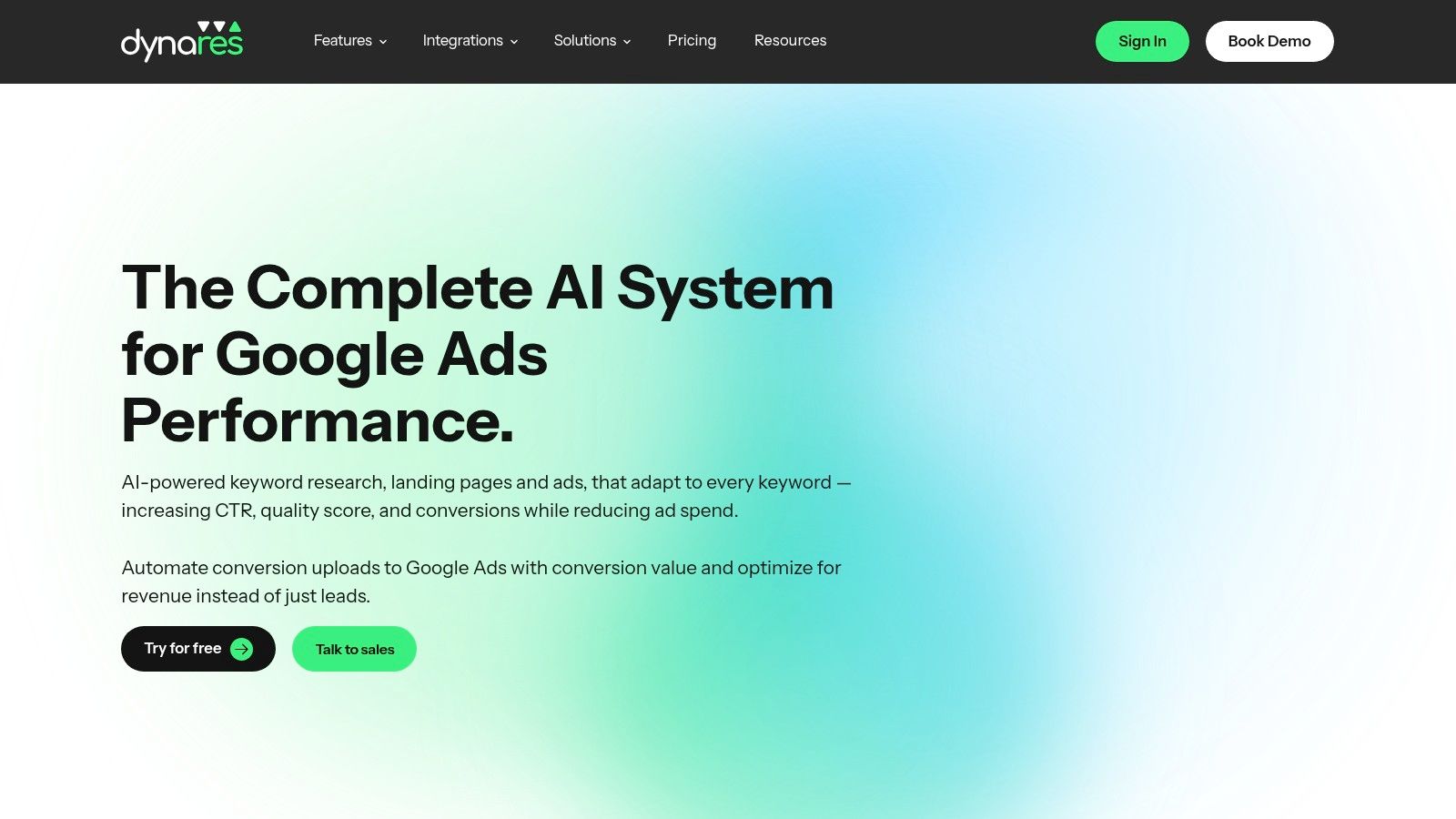
For agencies serious about scaling Google Ads performance, dynares is a standout platform. It’s an AI-first tool purpose-built to automate the entire paid search funnel, from initial keyword research to final conversion uploads. This isn't just another landing page builder; it’s an end-to-end system designed to connect ad creative directly to user intent on a massive scale.
The core idea is simple but powerful. You feed the platform your brand guidelines and target keywords, and its AI generates a unique, high-intent landing page and a matching ad for every single keyword. This level of granularity directly attacks a major pain point for PPC managers: maintaining a high Quality Score and relevance across thousands of keywords. By dynamically adapting copy and layout, it aims to boost click-through rates and, more importantly, conversions.
Why it’s my featured choice
What sets dynares apart is its closed-loop optimization system. It doesn’t just build the assets; it continuously tests and improves them. The platform includes Auto A/B Testing with a real-time analytics feedback loop, automatically promoting winning page and ad variants. This is one of the more practical digital marketing agency tools I've seen because it removes a huge amount of manual CRO work.
Crucially, it uploads conversion events with their actual monetary value back into Google Ads. This allows your team to optimize campaigns for revenue, not just lead volume, which is a game-changer for demonstrating ROI to clients. The modular template builders and integrations with Google Ads, GTM, and HubSpot also mean it fits into existing agency workflows without a complete overhaul.
Pricing structure
dynares offers a transparent pricing model with a free plan for getting started.
- Starter: Around €29/month for freelancers.
- Pro: Around €243/month for growing teams.
- Business: Around €765/month for established agencies.
- Enterprise: Custom plans are available for large-scale needs.
Pros and cons
Pros: Automates the generation of keyword-matched ads and landing pages, saving immense time. Built-in Auto A/B Testing helps continuously improve conversion rates and ROAS. Enables revenue-based optimization in Google Ads by uploading conversion values. Integrates smoothly with essential tools like HubSpot and Google Tag Manager.
Cons: Primarily focused on Google Ads, so you'll need other solutions for social or programmatic campaigns. AI-generated content still requires a human eye for brand or legal compliance checks.
For agencies aiming to deliver measurable results and scale client accounts efficiently, dynares is an exceptional choice. It directly addresses the need for personalization at scale, a constant challenge in paid search. If you want to deepen your team's knowledge, reading up on effective ad copy practices can help you get even more out of the platform's suggestions.
Website: https://dynares.ai
2. Optmyzr
Optmyzr is a purpose-built PPC optimization suite for agencies and advanced teams running Google and Microsoft Ads. It's essentially a force multiplier, designed to automate the tedious, repetitive tasks that eat up your team's day, allowing them to focus on high-level strategy instead of manual bid adjustments or sifting through search query reports. I’ve found its real power lies in standardizing quality across dozens of client accounts.
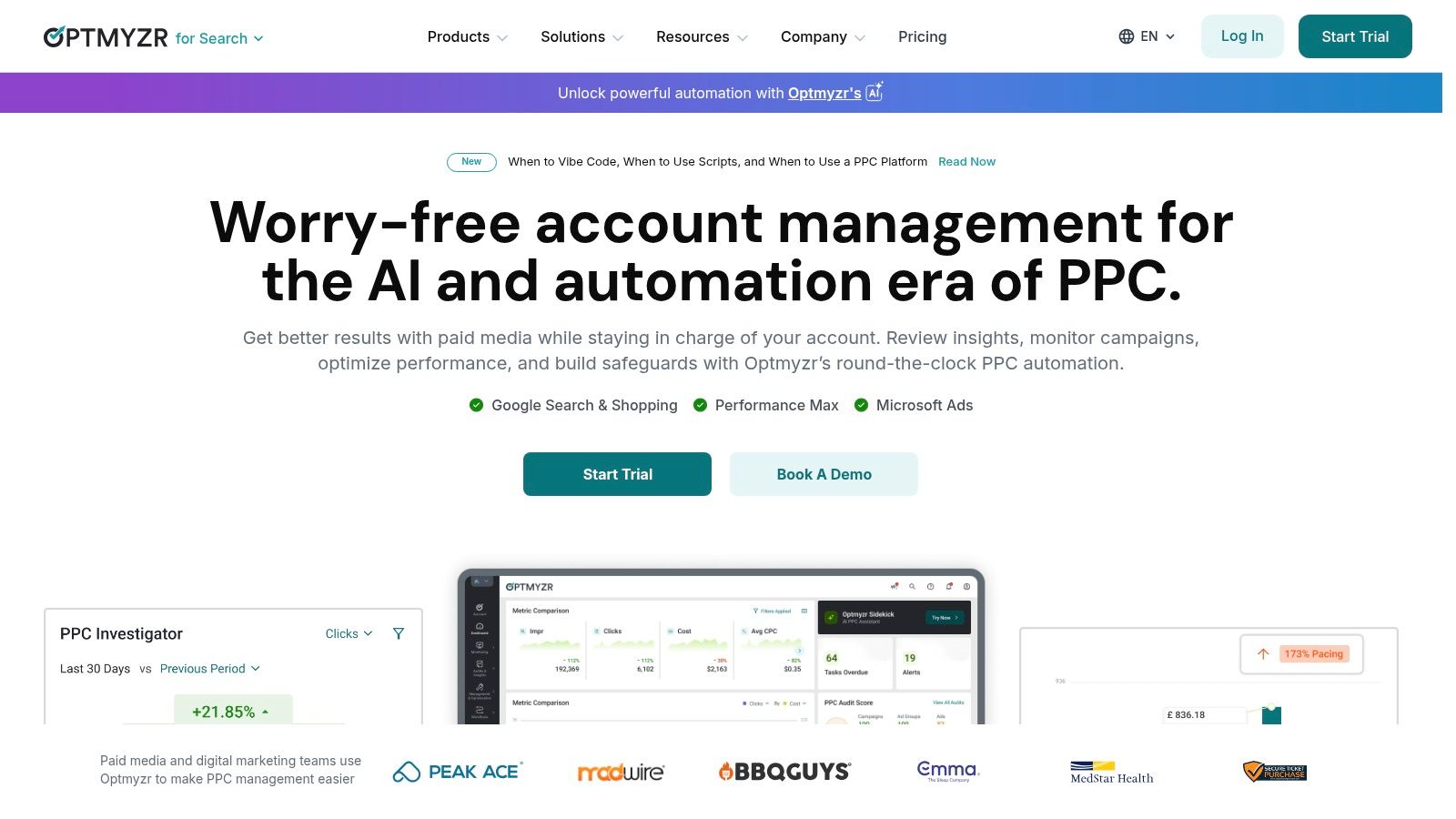
This platform stands out among other digital marketing agency tools because it was built from the ground up for agency workflows. It handles budget pacing and forecasting with surprising accuracy, and its Performance Max (PMax) tools provide insights that the native Google Ads interface just doesn't offer. For a deep dive into advanced techniques, you can explore more strategies for Google Ads campaign optimization.
However, it's not a set-it-and-forget-it solution. The learning curve for its custom rules and automation scripts can be steep. Also, the pricing scales with ad spend, which is fair, but it means your costs will climb as your clients grow - something to factor into your agency's pricing model from day one.
- Best for: Agencies managing multiple PPC accounts, in-house teams with large ad spends.
- Pricing: Starts at a few hundred dollars per month and scales based on your total ad spend managed through the platform.
- Key takeaway: A powerful, agency-focused tool that demands some initial investment in learning to unlock its full automation potential.
3. Adalysis
Adalysis is a continuous PPC audit platform designed to enforce account hygiene across Google and Microsoft Ads at scale. Think of it as an automated quality assurance layer that constantly scans your accounts for performance drains, budget risks, and missed opportunities. I find it’s brilliant for standardizing best practices, especially when you have multiple account managers with varying experience levels touching client campaigns.
This platform is one of the more focused digital marketing agency tools, centering on proactive monitoring rather than just reactive optimization. Its strength lies in the 100+ automated checks and custom alerts that spot issues like conflicting negative keywords or poor Quality Score trends before they become serious problems. The budget tracking and projection tools are also sharp, helping prevent the dreaded end-of-month overspend surprises from clients.
However, the interface can feel quite dense at first; it's packed with data and requires some acclimatization to navigate efficiently. Similar to other platforms in this space, its pricing is tied to your total ad spend, so your costs will increase as you scale your clients' budgets. This is a crucial detail to build into your agency's pricing structure from the outset.
- Best for: Agencies obsessed with PPC account hygiene, teams needing strong budget pacing and alerts.
- Pricing: Starts at a few hundred dollars per month and scales with the total ad spend managed. One plan includes all features with unlimited accounts and users.
- Key takeaway: An excellent tool for enforcing quality and catching errors automatically, but expect a learning period to master the interface and factor the spend-based pricing into your financial planning.
4. Birch (formerly Revealbot)
Birch, which you might know by its former name Revealbot, is an automation layer for social and search ads on platforms like Meta, Google, TikTok, and Snapchat. For agencies, it’s a lifesaver for standardizing campaign management across multiple channels without getting bogged down in each native ads manager. I see it as a command center to build granular, trigger-based rules that can pause bad ads, scale winning creatives, or adjust budgets based on performance metrics that you define.
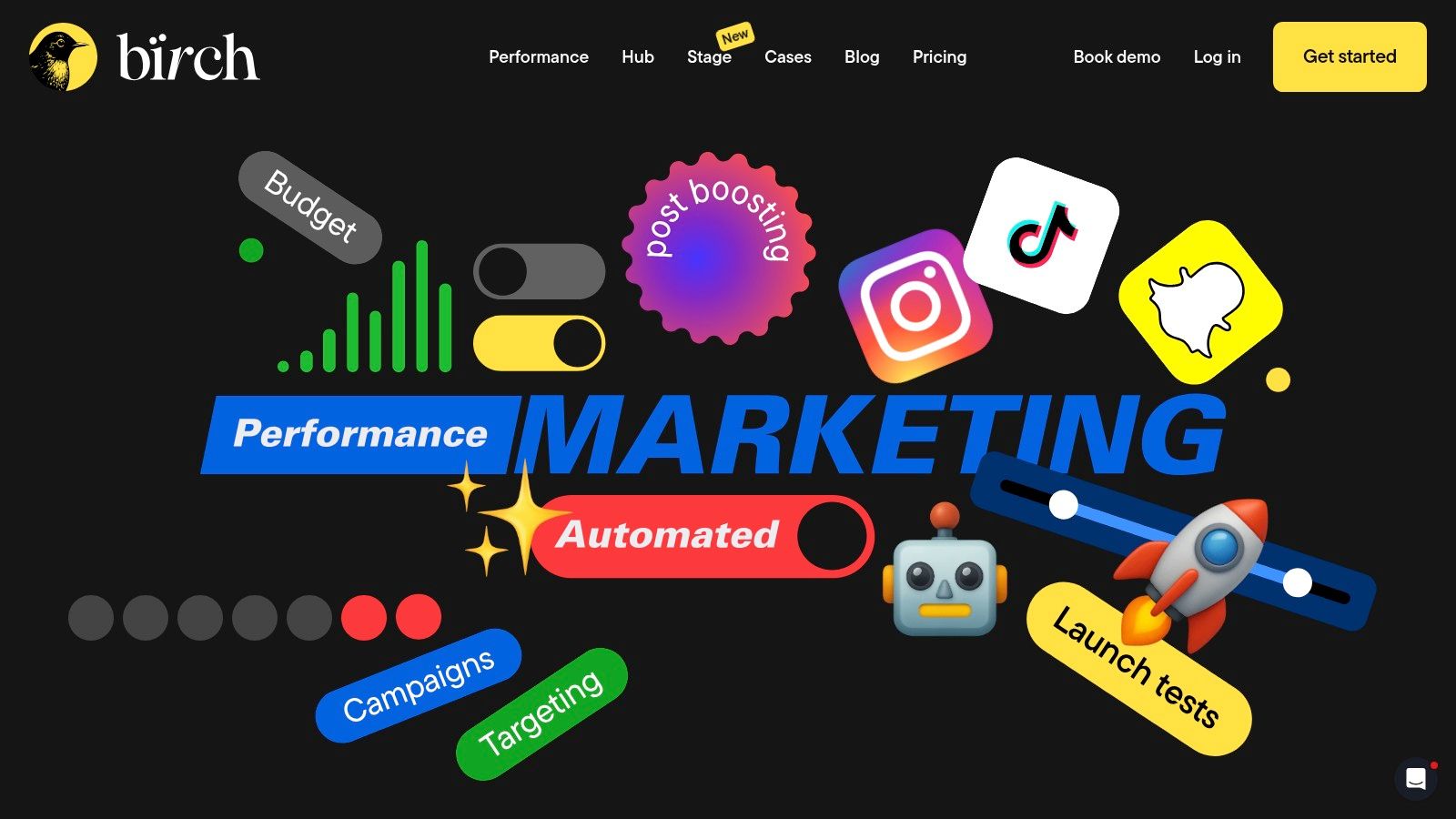
This tool is one of the more powerful digital marketing agency tools specifically for cross-channel automation. Its integrations with Slack are brilliant for getting real-time alerts, and the Google Sheets connection allows for some truly custom reporting and bulk management workflows. The platform also directly connects with first-party data sources like Hyros and server-side tracking, which is essential for accurate automation when your attribution gets complex. For a broader look at performance tracking, consider how these tools fit into your overall marketing analytics stack.
The main catch is that your automation is only as good as the rules you design and the data you feed them; it’s not a magic bullet. Also, the rebrand from Revealbot to Birch might cause some minor confusion when explaining the tech stack to clients or new team members, but that's a small hurdle.
- Best for: Agencies managing paid social and search for multiple clients, performance teams focused on ROAS.
- Pricing: Tiered plans based on monthly ad spend, starting from a few hundred dollars with a 14-day free trial.
- Key takeaway: A robust tool for creating sophisticated, cross-channel ad automation rules, but its success depends entirely on your strategy and measurement setup.
5. Supermetrics
Supermetrics is the de facto data connector for most marketing agencies, period. It’s the plumbing that gets your campaign data from platforms like Google Ads, Meta, and LinkedIn into the places you actually analyze it, such as Looker Studio, Google Sheets, or BigQuery. Its core job is to automate data fetching, saving your team from the mind-numbing task of manually exporting CSVs and copy-pasting numbers. It just works, which is exactly what you need for reliable client reporting.
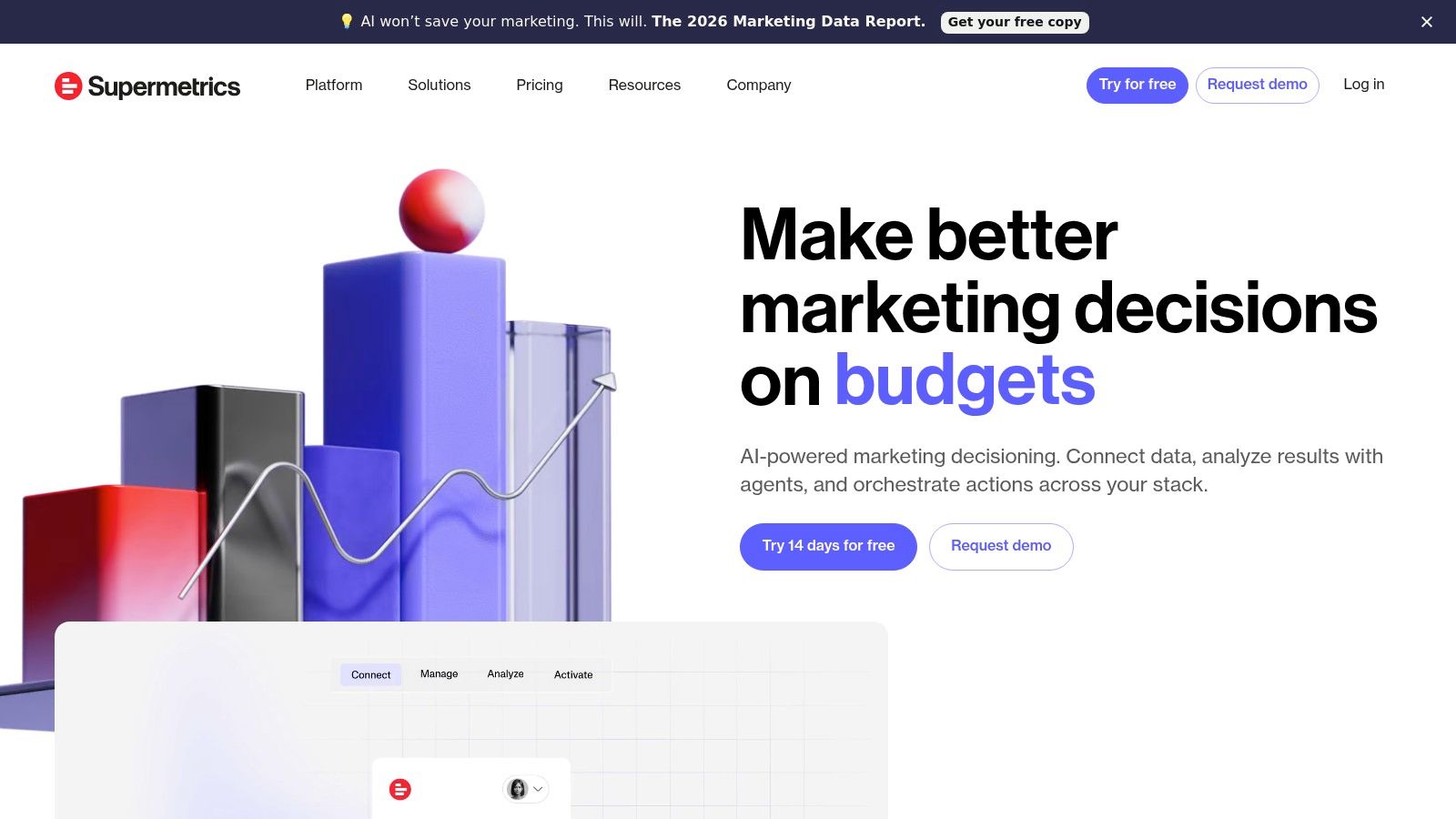
This platform is a key player among digital marketing agency tools because it offers the broadest set of reliable connectors for paid media, social, SEO, and web analytics. This allows agencies to build a unified reporting stack and standardize dashboards across all clients. The predictable subscription model, based on data sources and destinations, helps with budgeting and avoids surprise costs tied to data volume, which is a big plus for agency financial planning.
However, recent pricing updates have caused some frustration for legacy users, so new customers should carefully evaluate the total cost based on their specific needs for connectors and user seats. While it's powerful, remember it's a data pipeline, not a BI tool; you still need to build your dashboards and derive insights yourself.
6. AgencyAnalytics
AgencyAnalytics is the go-to platform for client reporting, period. It’s built entirely around one core agency problem: how to efficiently create beautiful, white-labeled reports that clients actually understand and value. Its main job is to pull data from all the different tools you use - Google Ads, Facebook Ads, SEO tools, email marketing platforms - and consolidate it into a single, clean dashboard. This stops your team from wasting hours each month manually copy-pasting screenshots into slide decks.
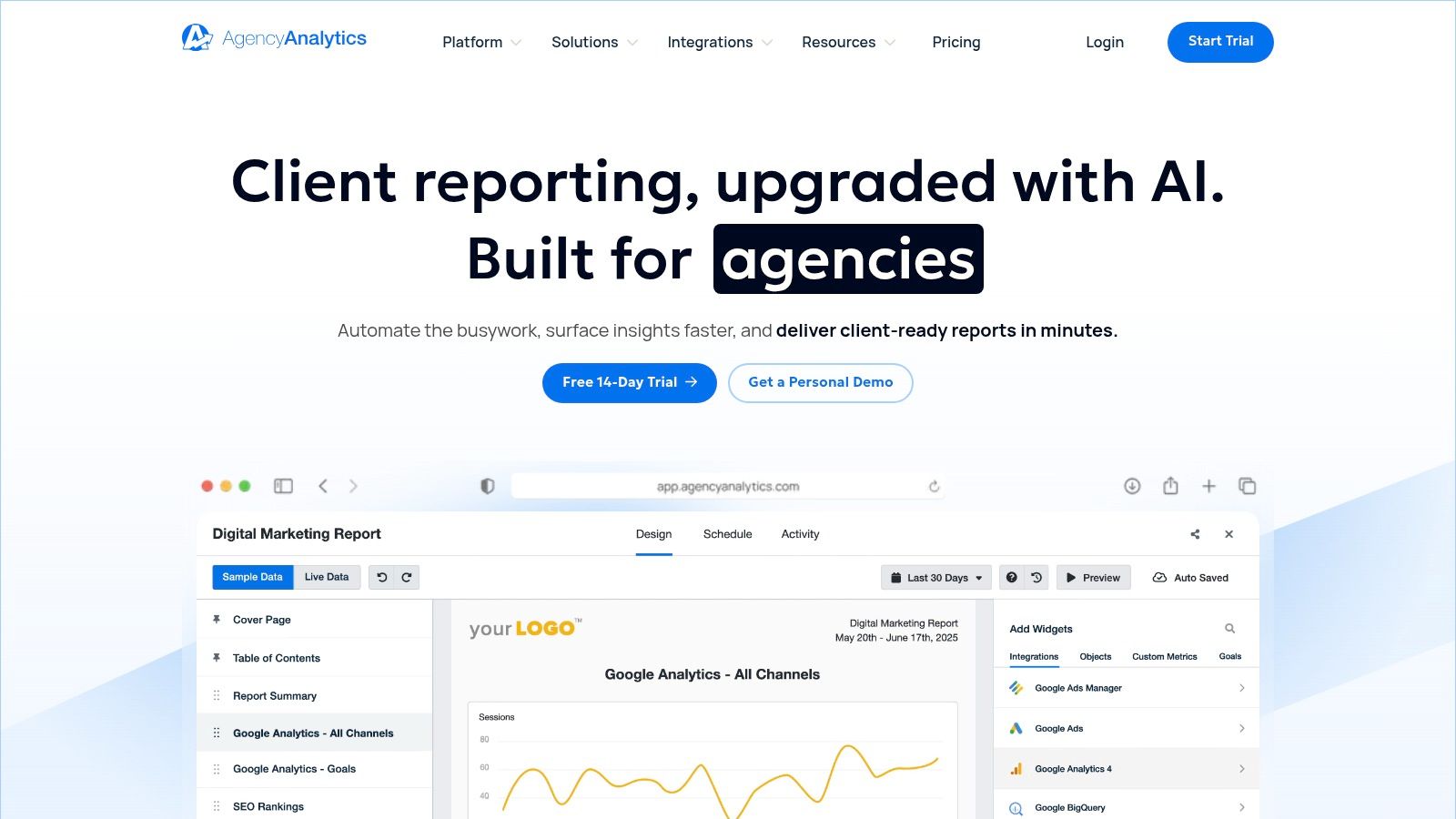
This platform earns its spot among other digital marketing agency tools by focusing purely on the agency workflow. With over 80 native integrations, you can spin up a comprehensive client-facing portal in minutes, not days. The ability to schedule automated reports and give clients their own login saves countless back-and-forth emails. It's about standardizing your reporting process and presenting a polished, professional front to every client, no matter their size.
However, the model has its trade-offs. While the base platform is powerful, more advanced features like database connectors for BigQuery or a dedicated rank tracker are paid add-ons. If you need several of these, the costs can escalate quickly, so you need to plan your package carefully. The per-client pricing structure is fair but means you have to account for it in your agency's retainer fees as you scale.
7. Whatagraph
Whatagraph is a marketing reporting platform built specifically for agencies that need to unify data and deliver white-label reports at scale. Its core strength is in automating the tedious parts of reporting - pulling data from dozens of sources, organizing it, and generating insights. The built-in AI features are what really set it apart, as they can write narrative summaries and accelerate the commentary that used to take my team hours. It's a massive time-saver, especially when you're managing 20+ clients.
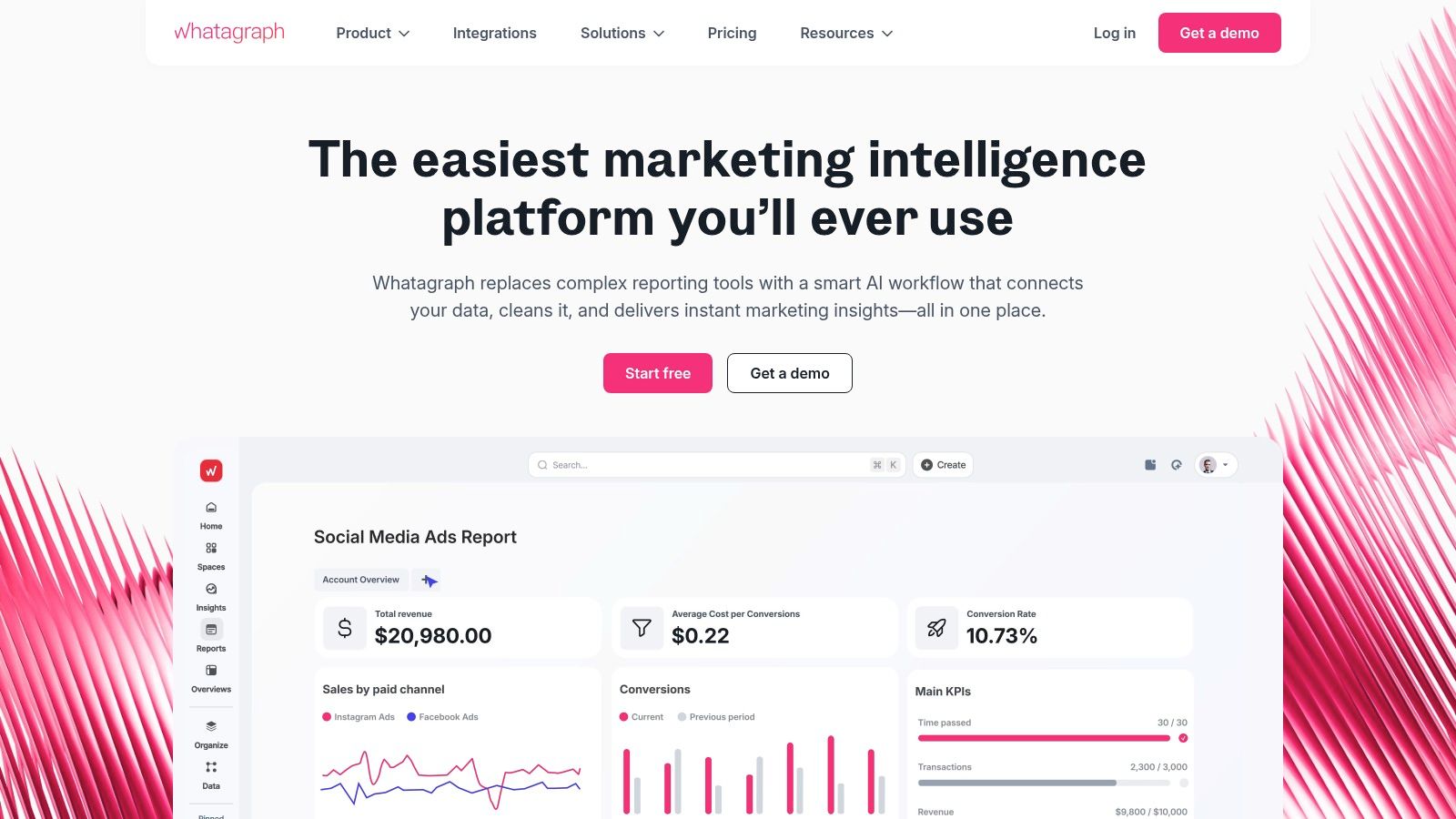
This platform is a standout among digital marketing agency tools because it focuses so heavily on the agency workflow and presentation layer. Features like unlimited users and reports on paid tiers remove the per-seat anxiety that comes with other tools, letting you give your whole team access. The ability to export data to BigQuery or connect directly with Looker Studio also gives it flexibility for more advanced data teams.
The main downside is the entry price, which is higher than some alternatives. Its credit-based system for data sources also means you have to be deliberate about what you connect, or you might run up against your limit. It forces you to be strategic, which isn't necessarily a bad thing, but it requires some planning upfront.
8. CallRail
If your agency runs lead generation campaigns for clients where phone calls are a key conversion, then call tracking isn't optional, it's essential. CallRail is the go-to platform for this, allowing you to connect inbound calls and even form submissions directly back to the specific marketing channel, campaign, and keyword that drove them. It’s how you prove that your ad spend is generating actual, valuable leads, not just clicks.
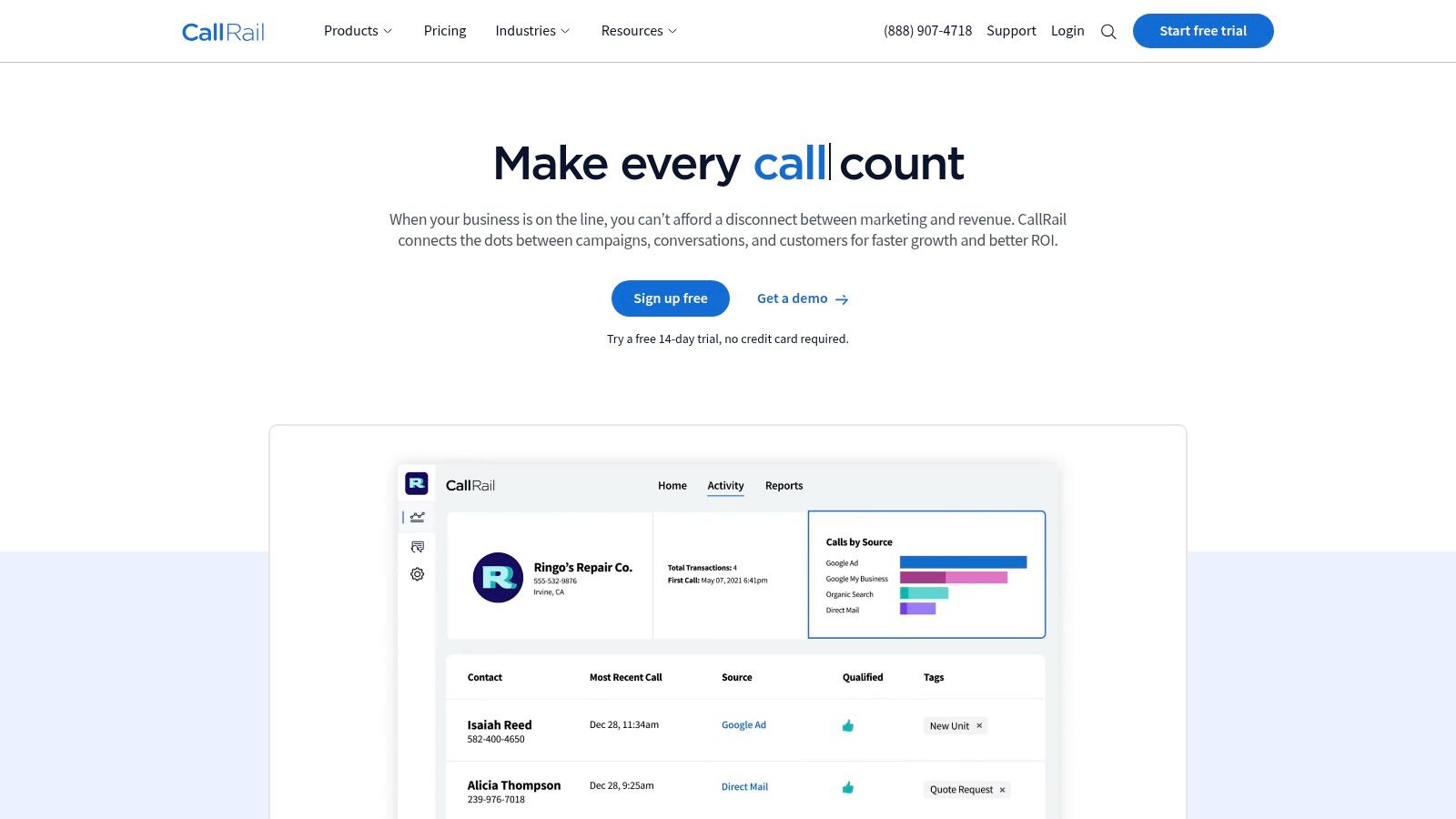
This platform stands out among digital marketing agency tools because of its simplicity and focus on attribution. The dynamic number insertion (DNI) feature is straightforward to implement, swapping the number on a client's website to match the traffic source. Its Conversation Intelligence add-on, which transcribes calls and spots keywords, gives you qualitative insights into lead quality that you can't get from a simple call log.
However, you must watch your usage closely. The pricing model is based on numbers and minutes, and overage costs can quickly add up if you don't monitor client call volumes. Sizing your plans correctly from the start is critical to avoid unexpected bills. While the core features are solid, adding form tracking and conversation intelligence will increase your monthly subscription cost.
9. Unbounce
Unbounce is the go-to landing page builder for agencies that need to ship high-converting pages for paid campaigns without waiting on developers. It lets you create, test, and optimize landing pages, pop-ups, and sticky bars quickly. For an agency, its real value is in the speed and independence it gives your campaign managers, letting them align ad creative directly with a purpose-built landing page in hours, not weeks.
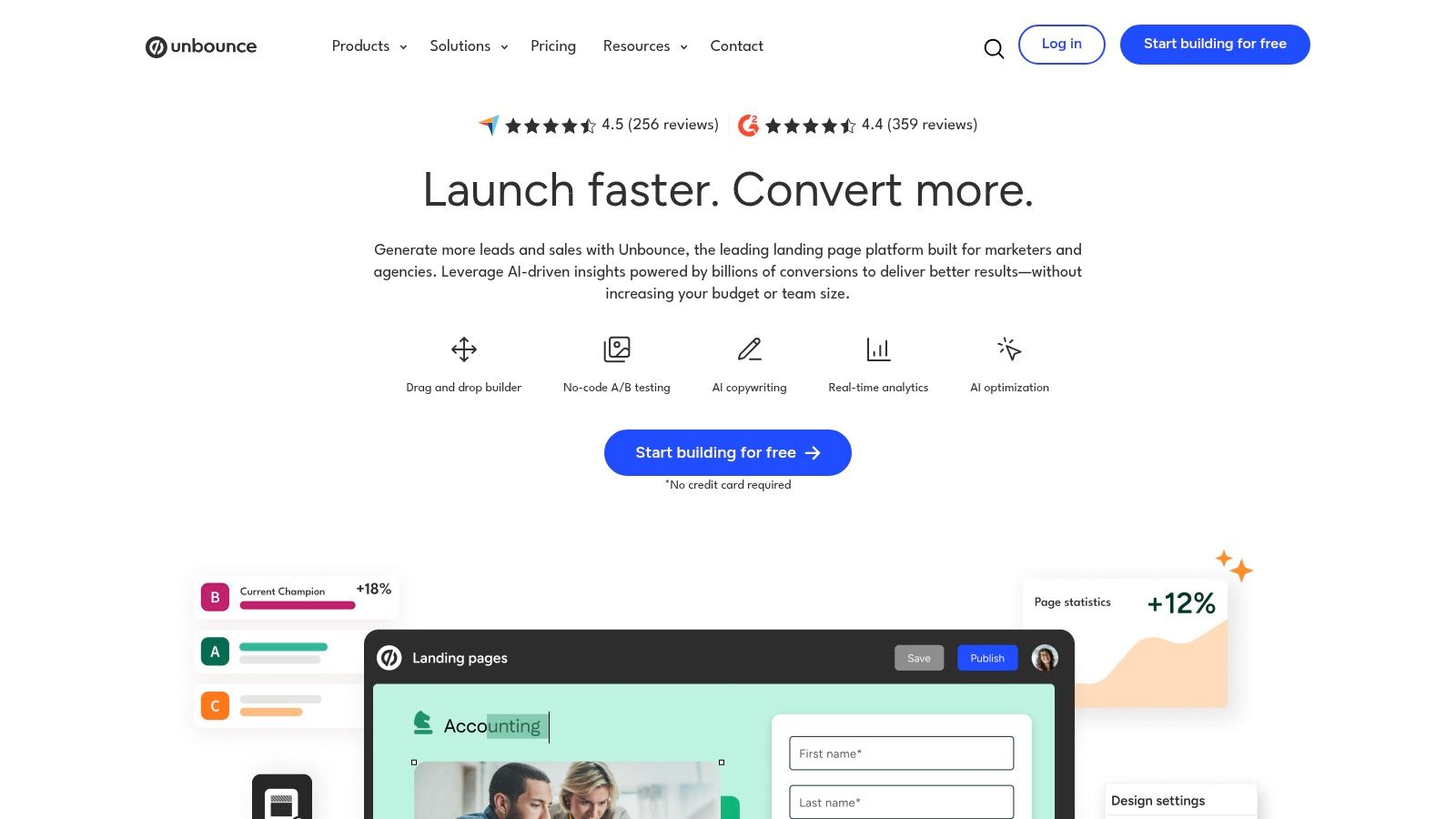
This platform stands out among other digital marketing agency tools because it's built around the core loop of paid advertising: build, test, convert, repeat. The drag-and-drop builder is straightforward, and the A/B testing functionality on higher-tier plans is essential for any serious agency. The ability to deploy pages on unlimited subdomains is a small but critical feature for managing multiple clients under one account. For a deeper look at improving page performance, you can read more about landing page conversion rate optimization.
That said, you need to watch the numbers. Recent pricing changes introduced visitor limits, which can be a real headache if a campaign suddenly goes viral. The jump in cost to access more advanced features like A/B testing is significant, so you have to be sure you'll use them. It's an excellent tool, but it demands you calculate the ROI carefully.
10. VWO
VWO is a full-stack Conversion Rate Optimization (CRO) platform that has become a go-to for agencies needing to standardize experimentation, especially since Google Optimize was sunsetted. It combines A/B testing, multivariate testing, heatmaps, session recordings, and personalization tools into a single suite. For an agency, this means you can manage the entire optimization and insights-gathering process for multiple clients under one roof, moving from identifying user friction with session recordings to validating a fix with an A/B test.
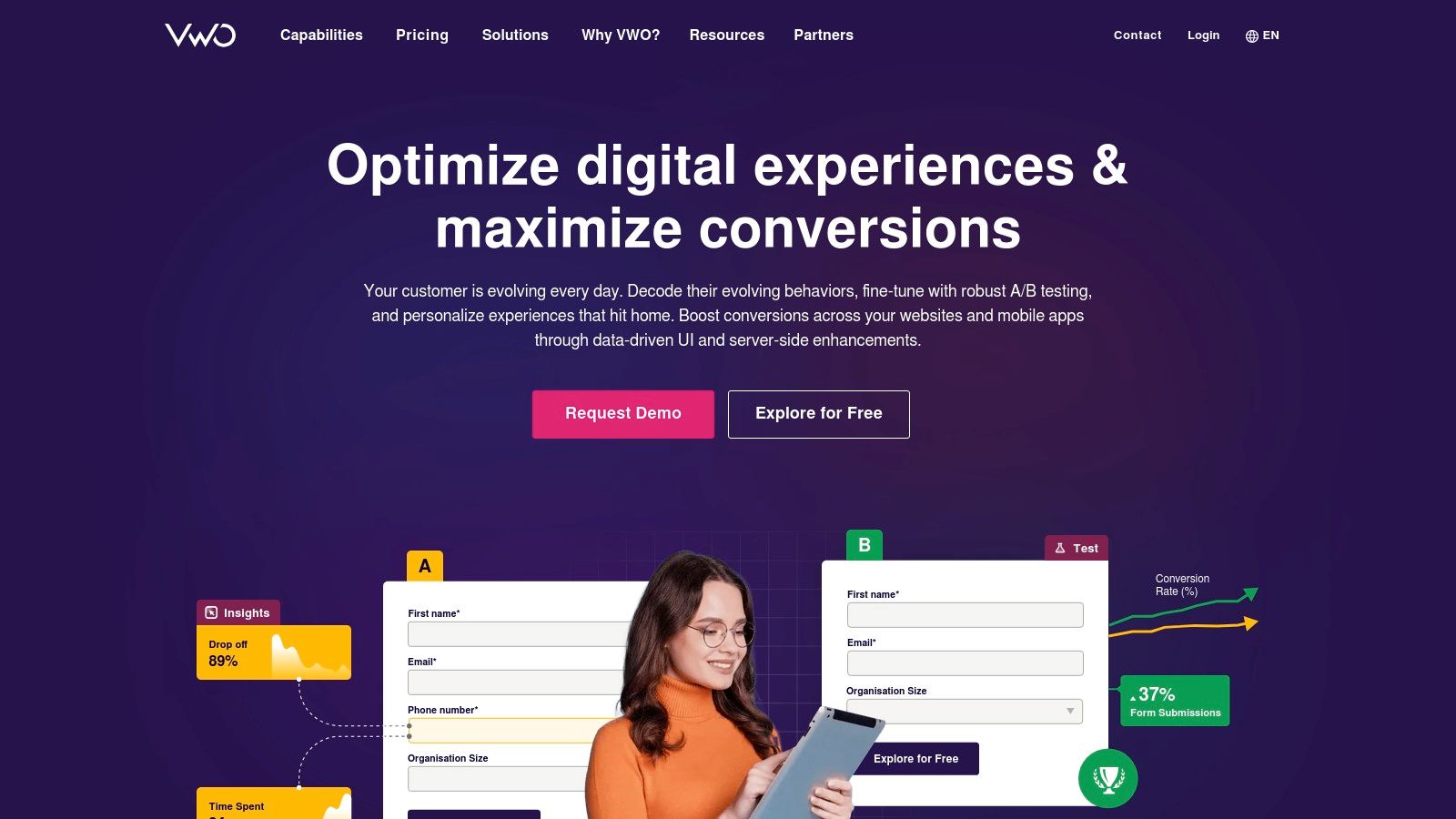
This platform is a strong contender among digital marketing agency tools because it offers a broad, integrated toolset that prevents you from having to stitch together multiple point solutions. The behavioral analytics features like heatmaps and surveys are invaluable for building data-backed hypotheses before you ever launch a test. Its pricing model, based on Monthly Tracked Users (MTU), is also agency-friendly, making it easier to forecast costs and build them into client retainers as their traffic grows.
However, the platform isn't cheap, and the pricing isn't transparent; you’ll have to get a custom quote, which can be a hurdle for smaller agencies. It is a powerful tool, but it requires a dedicated resource to manage it effectively across your client base to truly get a return on the investment.
11. Semrush
Semrush is the Swiss Army knife of digital marketing research, an all-in-one suite that is a staple in almost every serious agency I've worked with. It’s where you start your competitive analysis, covering everything from SEO and PPC to content and social media. I find its real value is in providing a 360-degree view of a competitor's online footprint, showing you the keywords they rank for, the ads they run, and where their backlinks come from.
This platform stands out among digital marketing agency tools because of its sheer data depth. While other tools specialize, Semrush gives you a broad, interconnected dataset that supports both SEO and PPC teams from one place. Its tools for ads and PLA intelligence are particularly useful for dissecting competitor campaign strategies. To get the fundamentals right, you can learn more about how to perform keyword research effectively.
The platform is powerful, but it's not cheap, and the cost can add up quickly if you need extra projects, user seats, or access to its content marketing and historical data add-ons. Also, the sheer volume of tools can be overwhelming for newcomers, so there's a definite learning period to get your money's worth.
12. Ahrefs
Ahrefs is the SEO research platform I consider non-negotiable for any serious agency. It’s built around one of the largest backlink indexes on the planet, making it an absolute beast for competitive analysis, link-building outreach, and understanding why a competitor ranks when you don’t. For agencies, its real value is in the speed and accuracy of its data, letting you quickly diagnose a client's SEO problems and build a data-backed strategy.
What sets Ahrefs apart from other digital marketing agency tools is its brilliant balance of power and accessibility. The Keywords Explorer and Site Explorer are incredibly intuitive, giving you deep insights into traffic value and keyword difficulty almost instantly. Plus, their free Webmaster Tools offering is a smart on-ramp for smaller clients, letting you hook up their owned properties for ongoing site audits and monitoring without a major cost commitment.
Of course, it’s not perfect. The full-fat agency plans with multi-user seats and extensive data access can get pricey, fast. You need to be sure you're using its advanced features to justify the cost. Some of the most valuable historical data and deeper SERP analysis features are also locked behind higher tiers, which is a necessary consideration when onboarding new clients with complex needs.
Top 12 digital marketing agency tools comparison
| Tool | Core features | Quality ★ |
Price 💰 |
Target 👥 |
Unique ✨ |
|---|---|---|---|---|---|
| dynares 🏆 | AI-driven per-keyword ads, landing pages, forms, Auto A/B Testing & analytics | 💰 Free → Starter (€29/mo) → Pro/Business/Custom | 👥 PPC managers, agencies, SMB growth teams | ✨ Per-keyword page+ad generation, conversion value uploads to Google Ads | |
| Optmyzr | PPC audits, automation rules, budget pacing, PMax & bid tools | 💰 Ad-spend tiers (scales with spend) | 👥 Multi-account agencies, advanced PPC teams | ✨ 100+ audit checks, agency account workflows | |
| Adalysis | Continuous audits, automated remediation, budget forecasting | 💰 Spend-based pricing (unlimited accounts) | 👥 Agencies enforcing PPC hygiene | ✨ Built-in experimentation + remediation engines | |
| Birch (Revealbot) | Cross-channel automation, creative pipelines, integrations | 💰 Tiered ad-spend pricing, 14-day trial | 👥 Paid-social agencies, growth teams | ✨ Multi-platform creative testing + server-side tracking | |
| Supermetrics | Connectors to Looker Studio, Sheets, Excel, Power BI, BigQuery | 💰 Fixed destination subscriptions + add-ons | 👥 Agencies needing BI/reporting pipelines | ✨ Broadest connector set, predictable billing | |
| AgencyAnalytics | White-label dashboards, client portals, scheduled reports | 💰 Per-client pricing + add-ons (14-day trial) | 👥 Agencies delivering client reports | ✨ Rapid white-label client-ready dashboards | |
| Whatagraph | AI-assisted reporting, summaries, Looker Studio/BigQuery exports | 💰 Higher entry price, credits model for sources | 👥 Agencies needing automated insights | ✨ AI narrative summaries & unlimited reports on paid tiers | |
| CallRail | Call & form tracking, conversation intelligence, DNI | 💰 Tiered plans + minutes/number add-ons (usage risk) | 👥 Lead-gen advertisers, multi-location SMBs | ✨ Transcriptions, keyword spotting, source-level call attribution | |
| Unbounce | Drag-and-drop landing pages, templates, A/B testing | 💰 Tiered plans (visitor/page limits) | 👥 Agencies & marketers needing fast pages | ✨ Large template library + agency/concierge options | |
| VWO | A/B & MVT testing, personalization, heatmaps, server-side experiments | 💰 Quote-based (MTU licensing) | 👥 Mid-market & enterprise CRO teams | ✨ Full CRO stack with behavioral insights | |
| Semrush | SEO/PPC research, keyword & competitor intelligence, audits | 💰 Subscription tiers; add-ons raise cost | 👥 Agencies needing cross-channel research | ✨ All-in-one SEO+PPC dataset and training resources | |
| Ahrefs | Backlink index, site/explorer tools, rank tracking, audits | 💰 Tiered plans (Starter → Agency) | 👥 SEO & competitive research teams | ✨ Industry-leading backlink data and fast competitive insights |
Build a system, not a collection of tools
We've just walked through a dozen powerful digital marketing agency tools, from PPC automation platforms like dynares and Optmyzr to all-in-one analytics suites like Semrush. It’s easy to look at a list like this and get a serious case of “shiny object syndrome,” thinking that if you just add one more subscription, all your agency's problems will magically disappear.
Let me be direct: that’s a dumb way to think. The goal isn't to collect tools; it's to build a system. A system is an interconnected set of processes and technologies that work together to produce a consistent, high-quality result. A collection of tools is just a pile of monthly invoices and logins your team forgets.
Your agency is a machine. Every tool you add should be a gear that makes the machine run faster, more efficiently, or with greater precision. If you’re just throwing more cogs into the housing without a plan, you’re just going to jam the works. Stop collecting and start architecting.
How to choose your next tool (the right way)
Before you pull out the company card, you need to diagnose your actual problem. Don't just buy a CRO tool like VWO because you heard A/B testing is important. Figure out why you need it. Are your clients' landing pages underperforming? Do you lack a structured process for testing ad copy against landing page headlines? Your real bottleneck defines your next move.
Here's a simple framework for making a decision:
- Identify the biggest bottleneck: What single task consumes the most manual, repetitive hours from your most skilled people? Is it building new Google Ads campaigns? Pulling together client reports?
- Calculate the cost of inaction: Put a real number on that bottleneck. If your lead PPC manager spends 10 hours a week on manual bid adjustments and campaign builds, that’s 40 hours a month you’re paying a premium salary for work a machine could do.
- Define the core function: You need one tool to be the “sun” in your solar system. For a PPC-focused agency, this should be your campaign generation and management platform. Everything else, from reporting to call tracking, should orbit that central hub.
For many agencies, the most significant time sink is the initial client onboarding and campaign creation process in Google Ads. This is where a tool like dynares can become your central system, generating structured, highly-relevant campaigns in minutes, not days. Once that core function is automated, you can then plug in a reporting tool like Supermetrics to pull the data, a CRO tool like Unbounce to test the landing pages, and a CRM to manage the leads. See? It's a system.
Don't just buy, integrate
Once you’ve chosen a tool, the work has just begun. The biggest mistake agencies make is failing to properly integrate a new platform into their workflow. They buy it, a few people try it, it feels like too much work to change old habits, and it ends up as expensive shelfware.
To avoid this, you need a champion. One person on your team needs to own the implementation. Their job is to learn the tool inside and out, document a new standard operating procedure (SOP) that incorporates it, and train the rest of the team. Without that internal ownership, your investment is likely to fail.
The perfect stack of digital marketing agency tools is a myth. It doesn’t exist. Your needs today will be different from your needs in a year. Clients will churn, new ad platforms will emerge, and your team will grow. The key is to build a flexible, efficient system with a strong core. Start by solving your biggest, most expensive problem first. Find a tool that gives you true leverage and frees up your team's most valuable asset: their brainpower. Now go build your machine. 🚀
Ready to build the core of your agency's PPC machine? Many of the bottlenecks we discussed, especially around campaign creation and management in Google Ads, are exactly what we built dynares to solve. It’s not just another tool; it’s a system for generating high-performance campaigns at scale, giving you the leverage to grow. See how it works at dynares.


