
Alright, let's have a real chat. Most Google Ad copy is garbage. It's bland, generic, and screams it was written by a committee that has never spoken to a customer. It’s a massive waste of time and, more importantly, a colossal waste of money. I've scaled enough tech products from zero to hero to know that ad copy isn't just fluffy marketing text; it's the sharpest edge of your spear. It’s the difference between burning cash and printing money.
Every day, I see founders and marketers obsessing over complex bidding strategies while running ads with copy so vague it could be for a SaaS tool or a new brand of yogurt. It’s dumb. You're fighting for a sliver of attention in the most competitive marketplace on earth, and you show up with a butter knife. No wonder your CPC is through the roof and your lead quality is trash.
This isn't another one of those fluffy top-ten lists with obvious advice like ‘know your audience’. We’re going deeper. We're talking about the specific, battle-tested ad copy best practices that actually move the needle for lead generation right now. This is a roundup of actionable frameworks that get results, from aligning copy with keyword intent to leveraging social proof and nailing your calls to action. We'll cover how to write copy that doesn't just get clicks, but gets qualified leads.
You'll learn the exact tactics my teams use to turn ad spend into a predictable revenue engine. We'll explore everything from high-intent language and quantified value props to scaling your creative testing with automation. These are the principles you need to stop wasting money and start winning. Let’s get into it. 🚀
1. Keyword-driven copy alignment
When a user searches for something, they have a clear intent. The simplest, most effective way to capture their attention is to mirror their exact language back at them. This isn't just a psychological trick; it's a core principle of Google's algorithm. Keyword-driven copy alignment means your ad headlines, descriptions, and landing page content directly reflect the user's search query. This creates a seamless, relevant journey from search to conversion.
This tight alignment is a massive signal to Google that your ad is highly relevant, which directly boosts your Quality Score. A higher Quality Score means lower costs and better ad positions. It’s a foundational tactic that many marketers overlook in their rush to get creative, but it’s one of the most powerful ad copy best practices for a reason: it just works.
Why this is a game-changer
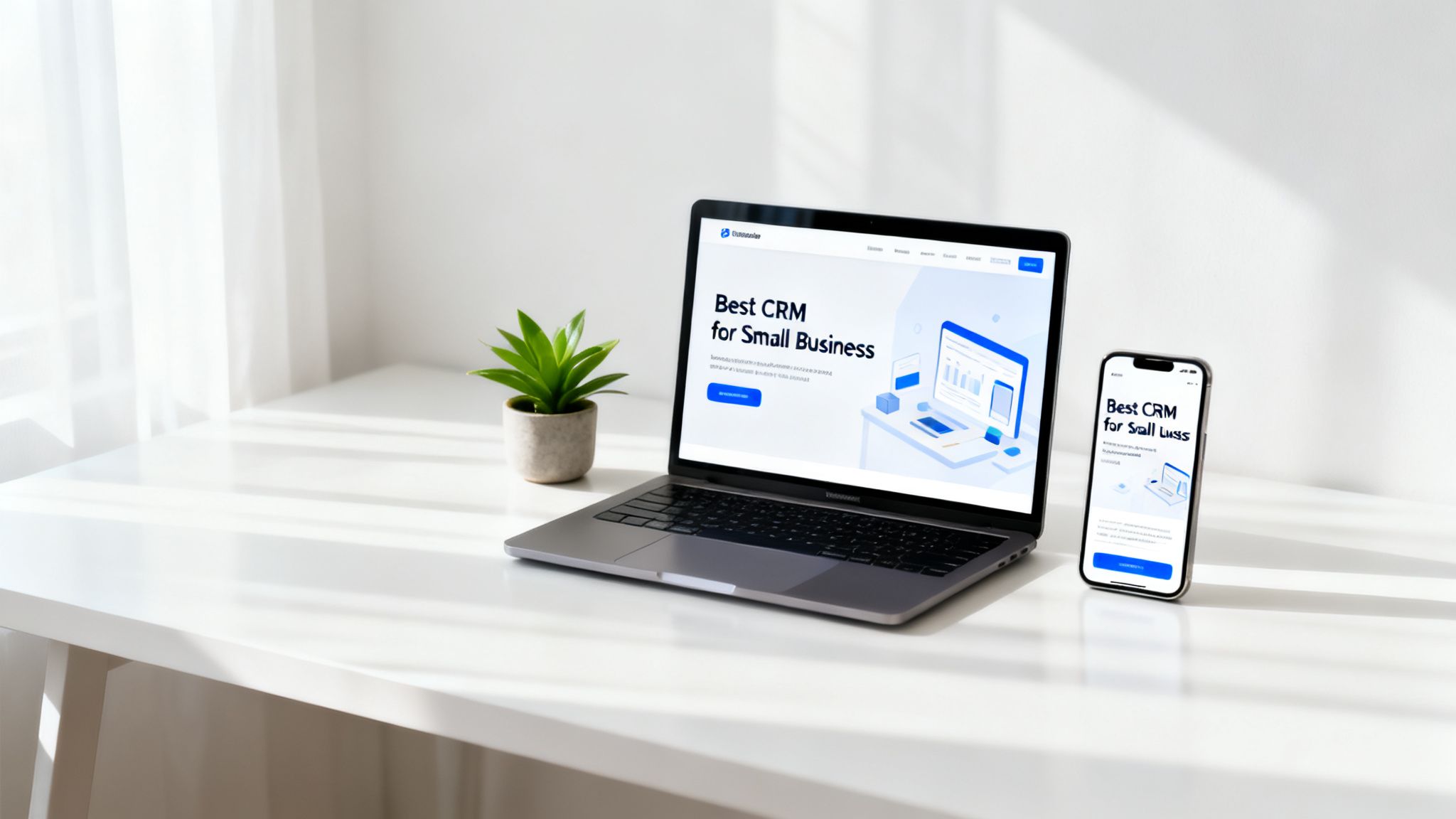
Think about it from the user's perspective. If you search for "best CRM for small business," you're subconsciously scanning for those exact words. An ad that leads with "Best CRM for Small Business | BrandName" immediately confirms you've found a relevant result. This semantic consistency tells the user they are in the right place, increasing click-through rates and building trust before they even hit your landing page.
How to implement it
Getting this right requires a structured approach, not just winging it. You need a system that ensures your messaging stays consistent at every step.
- Build small, tightly-themed ad groups with 7-20 closely related keywords. This allows you to write hyper-specific copy that matches the searcher's intent precisely.
- Use Google's
{KeyWord:Fallback Text}feature to automatically insert the user's search query into your headline. It's powerful but use it with a safe fallback text. - Your landing page must continue the conversation. The H1 tag and above-the-fold content should feature the same primary keywords from your ad group. A mismatch here is a conversion killer.
2. High-intent language & action-oriented CTAs
Weak, passive ad copy is a waste of money. Your potential customer is scrolling fast and has zero time for vague promises. High-intent language cuts through the noise by using commanding, benefit-driven words that signal urgency and immediate value. You’re not just describing a service; you’re presenting a solution to a problem they’re trying to solve right now.
Pairing this with a crystal-clear, action-oriented call-to-action (CTA) is non-negotiable. Verbs like Get, Start, Claim, and Schedule remove all friction and tell the user exactly what to do next. This combination transforms a passive ad into a direct invitation, guiding the user from interest to action without a moment of hesitation. It’s one of the most fundamental ad copy best practices because it respects the user’s time and intent.
Why this is a game-changer
People don’t want to think; they want to solve their problem. An ad like Calendly’s “Schedule Meetings Without the Back-and-Forth” works because it combines a clear benefit with an implied action. It’s a world away from a generic headline like “Meeting Scheduling Software.” This direct approach aligns with the searcher’s goal, making the decision to click an easy one. You’re not just selling a product; you’re selling a specific, desirable outcome.
How to implement it
Injecting high-intent language into your ads isn't about being pushy; it's about being clear and confident in the value you provide. It’s about making your solution the obvious next step.
- Structure your headlines to grab attention immediately. Use Headline 1 for the outcome (e.g., Increase Sales by 40%) and Headline 2 for the directive (Get Your Free Demo Today).
- Use second-person language. Write “Get your free ROI calculator” instead of “Our company offers a free ROI calculator.” It makes the offer personal and immediate.
- Tailor your CTA to the user's position in the buying journey to avoid friction. A low-commitment searcher might click "View Options," but a high-intent lead is ready for "Request a Consultation."
3. Specificity & quantified value propositions
Vague promises like "save time" or "increase revenue" are just noise in a crowded search results page. They mean nothing because everyone claims them. Specificity, on the other hand, cuts through the fluff. Using concrete numbers, percentages, and measurable outcomes in your ad copy gives your claims instant credibility and helps prospects immediately grasp the ROI of your offer. It’s the difference between a flimsy promise and a tangible result.
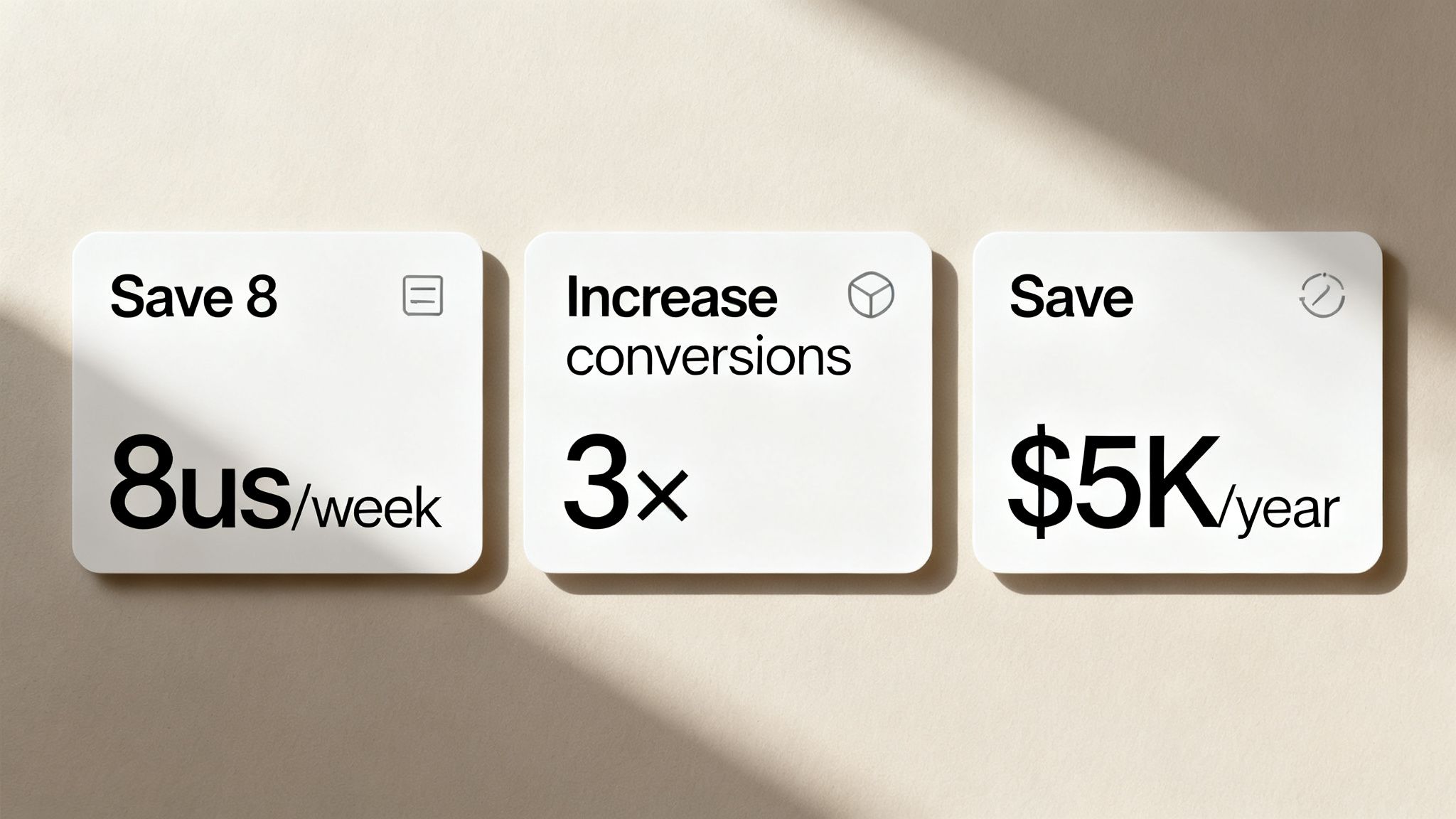
This isn’t about making up numbers; it’s about translating your product's value into a language that the brain can process quickly. Claims like 'Save 8 hours per week' or 'Cut emails by 40%' are far more powerful because they create a clear, memorable picture of the outcome. This approach, rooted in direct response copywriting, is one of the most effective ad copy best practices for demonstrating real-world impact.
Why this is a game-changer
When a prospect sees a specific number, their brain immediately tries to validate it. This cognitive engagement makes your ad more memorable and believable. A claim like "300,000+ companies trust Salesforce" builds massive credibility, while "Set up your first meeting in 30 seconds" from Calendly is a testable claim that feels real and low-risk. Quantified value propositions turn abstract benefits into concrete, persuasive proof points that drive clicks.
How to implement it
Stop guessing and start digging. Your best numbers are hiding in your own data. The goal is to find real metrics that resonate with your target audience's pain points.
- Talk to your product and success teams. Find the real performance metrics your customers are seeing, like time saved, leads generated, or conversion rate improvements.
- Put your most impressive metric right in the headline, like 'Get 50+ Qualified Leads/Month' or 'Save 10 Hours Weekly With Our Tool'.
- A/B test different ways of presenting the same data. Does "40% faster" perform better than "3x faster"? Does a dollar amount outperform a time-saved metric? The results might surprise you.
4. Emotional resonance & pain point targeting
Logic makes people think, but emotion makes them act. Ads that speak directly to a prospect's specific pain points convert better because they bypass rational objections and create an immediate, visceral connection. By naming the problem clearly, like "Tired of manual data entry errors?", you prove you understand their struggle before you even mention your solution.
This approach positions your brand as an empathetic problem-solver, not just another vendor. It’s a core tenet of modern marketing and one of the most effective ad copy best practices for lead generation because it taps into the fundamental human desire for relief from a persistent problem. It shifts the conversation from "what does this do?" to "how does this make my life better?".

Why this is a game-changer
When a prospect sees an ad that perfectly articulates their frustration, they feel seen and understood. An ad headline like "Stop Wondering Where Your Team's Time Goes" from Hubstaff doesn't just describe a feature; it speaks to the anxiety of a manager who suspects inefficiency but can't prove it. This emotional resonance builds instant rapport and makes your solution feel like the only logical next step, dramatically increasing click-through rates.
How to implement it
Effectively targeting pain points requires deep customer empathy and a structured campaign setup. You can't just guess what keeps your audience up at night. Your best insights are buried in customer interviews, support tickets, and sales call recordings. Look for the exact phrases customers use to describe their problems. Then, structure your ads to hit the pain point first. Use Headline 1 to state the problem ("Your Team's Work Scattered Everywhere?") and Headline 2 to introduce the solution ("Bring It All Together with Asana").
5. Social proof & trust signals in ad copy
People are fundamentally risk-averse, especially when it comes to spending money or trusting a new service. Social proof is the ultimate shortcut to overcoming that hesitation. It’s the digital equivalent of seeing a crowded restaurant and assuming the food must be good. By embedding trust signals like customer counts, ratings, and awards directly into your ad copy, you are borrowing credibility and telling prospects that choosing you is a safe, validated decision.
This isn’t just about feeling good; it’s a powerful lever for improving click-through rates and conversions. An ad that says "Join 200,000+ businesses" feels infinitely more legitimate than one that just shouts about its features. It’s one of the ad copy best practices that directly addresses a prospect’s core fear: making the wrong choice.
Why this is a game-changer
Think about the user’s internal monologue. They see a dozen ads, all making similar promises. Which one do they click? The one that provides external validation. A headline like "G2 Leader 2024 - 4.8/5 Stars" or a description mentioning "Trusted by Shopify and Amazon" instantly differentiates your offer. It shifts the conversation from "Do I believe their claims?" to "So many others already trust them, maybe I should too." This immediately lowers the perceived risk and makes the click a much easier decision.
How to implement it
Integrating social proof requires you to know what your audience values and to be specific. Vague praise is useless; hard numbers and recognizable names are gold. Be hyper-specific with numbers, don't just say "Thousands of happy customers." Use precise figures like "Rated 4.8/5 by 2,187 users" or "Join 15M+ users worldwide." If you have well-known clients, name them. An ad for a B2B tool that says "Used by teams at Google & Slack" instantly borrows the credibility of those brands, making your solution seem enterprise-ready.
6. Audience segmentation & personalized copy variants
Blasting a generic message to everyone is a lazy, expensive way to burn your ad budget. Smart marketers know that different customers have different problems, motivations, and vocabularies. Audience segmentation is the practice of breaking down your target market into smaller, more defined groups and then tailoring your ad copy to speak directly to each one's unique reality. An enterprise CTO doesn't care about the same features as a solo consultant, so why would your ads speak to them in the same way?
This is one of the most crucial ad copy best practices because it’s a direct lever on relevance. When copy resonates with a specific segment, it feels less like an ad and more like a solution. It acknowledges their specific pain points and positions your offer as the precise answer, dramatically improving engagement and conversion rates. Instead of shouting into a crowded room, you're having a one-on-one conversation.
Why this is a game-changer
Think about the difference in mindset. An overworked PPC manager at an agency is looking for efficiency and automation. The agency owner is focused on profitability and client retention. A single ad with a generic "Improve Your PPC" message will be mildly interesting to both but compelling to neither. However, an ad that says "Stop Drowning in Manual Bid Adjustments" hits the manager's pain point directly. An ad with the headline "Boost Agency ROAS & Stop Client Churn" speaks the owner's language. This level of personalization makes your ad feel hyper-relevant, signaling that you truly understand their world and have built a solution just for them.
How to implement it
Getting this right requires moving beyond a one-size-fits-all campaign structure. You need to build a system that speaks to your key customer personas individually. Start by identifying 3-5 of your most valuable customer personas based on actual data. Look at industry (SaaS vs. e-commerce), company size (SMB vs. Enterprise), or user role (practitioner vs. manager). Then build separate campaigns for each major segment. This gives you granular control over budgets, bidding, and performance tracking. You'll see exactly which personas drive the best ROAS.
7. Scarcity, urgency & limited-time offers
Procrastination is the silent killer of conversions. Scarcity and urgency are its direct antidote. By incorporating psychological triggers like "Only 3 spots left" or "Offer ends Friday," you create a fear of missing out (FOMO) that forces a decision. This isn't about manipulation; it's about breaking through the noise and giving prospects a compelling reason to act now instead of "later."
These tactics work because they introduce a real or perceived constraint, making the offer more valuable. Humans place a higher value on things that are less available. It’s a core principle of persuasion that's been proven for decades in direct response marketing, and it's one of the most reliable ad copy best practices for driving immediate action.
Why this is a game-changer
Think about the user's mindset. They're constantly bombarded with offers and have learned to delay decisions. An ad that says "Sale Ends in 24 Hours | 50% Off Everything" instantly changes the dynamic. It creates a deadline, frames the decision, and removes the "I'll think about it" objection. This shift from passive consideration to active decision-making can dramatically shorten the sales cycle and boost conversion rates almost overnight.
How to implement it
Using urgency effectively requires precision and credibility. You can't just slap "Limited Time!" on everything and expect it to work. Be specific: "Offer ends at midnight" or "Only 7 spots left at this price." Most importantly, your deadline must be real. If you extend a sale, you train your audience to ignore future deadlines, destroying your credibility. The urgency in your ad copy must be mirrored on your landing page. Use countdown timers, inventory counters, and consistent messaging to reinforce the deadline.
8. Benefit-driven copy over feature lists
Your prospects don’t care about your product's features; they care about what those features can do for them. It’s a simple truth, but so many marketers get it wrong. Benefit-driven copy focuses on the outcome, the transformation, and the solution to a problem. Instead of saying you have "automated lead routing" (a feature), you say you can "reduce lead response time from 2 hours to 5 minutes" (a benefit).
This approach taps directly into the prospect's core motivation, answering their unspoken question: "What's in it for me?" While features describe what your product is, benefits describe what your prospect becomes or achieves. This shift from technical specs to tangible results is one of the most powerful ad copy best practices because it creates an immediate emotional connection and demonstrates value before they ever click.
Why this is a game-changer
Think about it: nobody wakes up wanting "cloud-based CRM software with API integrations." What they really want is to "close deals 40% faster with instant visibility." Leading with the benefit grabs attention and frames your product as a solution, not just another piece of tech. Features are just the mechanism for delivering that value; they are supporting evidence, not the headline act. This isn’t just marketing fluff; it’s about aligning your message with the prospect's desired end state. When your ad copy speaks their language of goals and aspirations, your click-through and conversion rates will reflect that deeper understanding.
How to implement it
Translating dry features into compelling benefits requires a systematic approach. Take every feature and ask, "so what?" For example, a feature is a "mobile app." So what? "You can manage your leads on the go." So what? "You can close deals from anywhere, anytime." Keep drilling down until you hit a core human or business desire. Start your headlines and descriptions with action-oriented, benefit-driven verbs. Instead of "Our platform has..." try "Get...", "Increase...", "Save...", or "Stop...". This puts the user and their results at the center of the message.
9. Ad copy-to-landing page message match (consistency)
The click is not the goal; the conversion is. Yet so many marketers drop the ball in the milliseconds between the ad click and the landing page load. Message match is the principle of ensuring your ad’s promise, tone, and offer are perfectly mirrored on the landing page. It’s about creating a single, cohesive experience that reduces friction and tells the user, "you're in the right place."
When a prospect clicks an ad that screams "Save 50% NOW!" and lands on a page that politely asks them to "Request a demo," their brain registers a disconnect. This cognitive dissonance creates instant distrust and sky-high bounce rates. Nailing this is one of the most effective ad copy best practices for increasing conversion rates because it makes the user’s journey feel intuitive and seamless, not disjointed and confusing.
Why this is a game-changer
Think of your ad as a promise. Your landing page is the fulfillment of that promise. If the promise and fulfillment don't align, you’ve broken the user's trust before you’ve even had a chance to earn it. For example, an ad headline like "Get 50+ Qualified Leads/Month" should lead directly to a landing page with a clear H1 that says "Attract 50+ Qualified Leads Per Month." This simple consistency can boost conversion rates by 10-30% because it eliminates confusion and reinforces the value proposition.
How to implement it
Message match isn't a "set it and forget it" task; it requires a systematic approach, especially when you're testing multiple ad variations. Create a simple scorecard for every ad-to-page journey. Does the headline match? Is the tone consistent? Are the benefits the same? Does the value proposition align? Is the Call-to-Action (CTA) identical? When you A/B test a new ad headline, you must also create a corresponding landing page variant with an updated H1 and hero section. Don't test ad copy against a generic, static landing page.
10. Negative keywords & copy clarity to reduce wasted spend
One of the most expensive mistakes in PPC is paying for clicks from people who were never going to convert. While a robust negative keyword list is your first line of defense, your ad copy is the second. Using clear, and sometimes exclusionary, language in your headlines and descriptions acts as a filter, repelling unqualified searchers before they ever cost you a penny.
This isn't about being exclusionary for the sake of it; it's about surgical precision. If your service is enterprise-level, a click from a student doing research is pure waste. By clearly stating who your product is for (and who it's not for), you align your ad spend with your ideal customer profile. This is one of those ad copy best practices that directly impacts your bottom line by improving lead quality and reducing cost-per-acquisition.
Why this is a game-changer
Think of your ad copy as a bouncer at a club. Its job is to let the right people in and politely turn away those who don't fit the bill. An ad that says "Enterprise CRM Platform | For Teams of 50+" instantly discourages a solo founder from clicking. This simple act of pre-qualification saves you the click cost and saves the user from a frustrating experience on a landing page that isn't for them. It’s a win-win that protects your budget and respects the user's time.
How to implement it
Integrating disqualifying language into your copy requires a clear understanding of who you don't want to attract. This is just as important as knowing your ideal customer. Weave exclusionary terms directly into your headlines and descriptions. Examples include "For B2B SaaS Only," "Not for Freelancers," or "Plans Start at $299/mo." Your copy should work in tandem with your negative keyword strategy. If you've added "free" as a negative, reinforce this in your copy by highlighting your premium positioning. To master this, you need a deep understanding of building a comprehensive negative keywords list.
The real takeaway: stop guessing and start scaling
Alright, we've walked through a mountain of tactics. From aligning copy with keyword intent to leveraging social proof and nailing your message match, these aren't just abstract ideas; they are the fundamental building blocks of a high-performing Google Ads account. If you just cherry-pick a couple of these ad copy best practices, you'll likely see a tangible lift in your CTR and conversion rates. You’ll be ahead of the competition, no question.
But let's be candid for a moment. The real challenge isn't knowing what to do. The real bottleneck is the doing. Manually creating unique, hyper-relevant ad copy for hundreds or thousands of keywords is a fool's errand. It’s a direct path to burnout, riddled with human error and missed opportunities. You simply can't A/B test your way to market dominance one ad group at a time. It’s an old-school approach in a new-school world.
Your strategic roadmap from here
The goal isn't to become the world's most efficient manual ad writer. The goal is to build a system that wins. True scale doesn't come from working harder; it comes from applying leverage. This is where you need to shift your mindset from a campaign manager to a system architect. Stop tweaking and start building.
This iterative process is how you turn theory into results. It’s about making small, intelligent bets that compound over time. The biggest mistake is reading an article like this, nodding along, and then changing nothing. Don’t be that person.
The shift to scaled execution
The ultimate evolution of this process is automation. The future of performance marketing belongs to those who can operationalize these ad copy best practices at scale. Manually maintaining perfect message match across a massive keyword list is impossible. But with the right technology, it becomes trivial.
This is precisely where tools come into play. They don't replace your strategic thinking; they amplify it. They take the grunt work of generating thousands of unique, keyword-aligned ad-and-page combinations off your plate. This frees you up to focus on the high-leverage activities: understanding your customer, defining your core value proposition, and architecting the overall growth strategy. You focus on the why, and let technology handle the how.
The principles we’ve covered are your strategic playbook. Your next move is to find the most efficient way to execute that playbook at a scale your competitors can't touch. That's how you build a durable, long-term advantage. So, pick your first step and take it. Now. 🙏
Ready to stop the manual grind and start scaling your message match? At dynares, we built a platform to automate the creation of thousands of perfectly matched ads and landing pages, letting you implement these best practices across your entire account in minutes, not months. See how it works and start building your performance system at dynares.


