
Let's be direct. Most "expert" Google Ads advice is recycled garbage. It’s either so basic it's insulting ("use relevant keywords!") or so abstract it's useless. As a founder building tech products here in Europe, I've had to learn what actually moves the needle, not just what gets repeated in marketing webinars. We’re all trying to scale businesses, build incredible products, and not incinerate our funding on clicks that go nowhere.
I've seen a well-oiled Google Ads machine become an engine for insane growth. I've also seen a poorly managed one turn into a black hole for cash, draining resources with nothing to show for it. The difference isn't some secret formula; it's a commitment to a set of practical principles that prioritize efficiency and genuine return.
So, this article is different. No fluff. No sales pitch. This is the stuff I wish someone had handed me years ago—the direct strategies that separate the campaigns that limp along from the ones that dominate. This is the real Google Ads advice you need to stop wasting money and start driving results.
We're going to break down 10 core principles we use to drive scalable growth. Think of this as your playbook for building a smarter paid search operation. Let’s get into it. 🚀
1. Implement keyword-to-landing page relevance matching
Stop sending paid traffic to your homepage. Seriously, it's one of the laziest and most expensive mistakes you can make. The core principle here is simple: the message on your landing page must be a direct continuation of the promise made in your ad, which was triggered by their specific search. This is relevance matching, and it's non-negotiable.
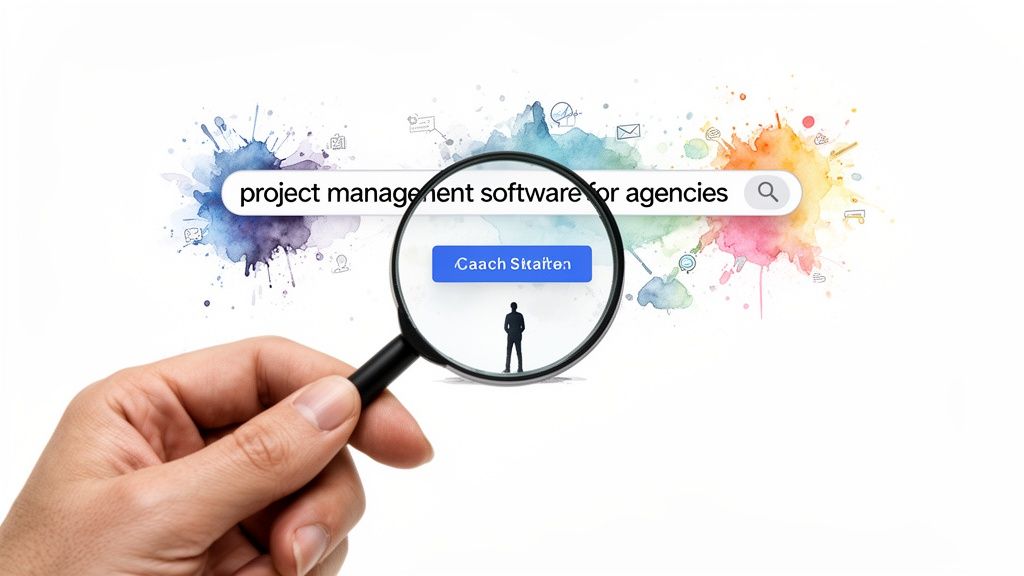
When someone searches for “project management software for agencies,” they don't want a generic page about your SaaS. They want to see features and testimonials tailored specifically to agencies. This alignment signals to Google that you provide a great user experience, which directly improves your Quality Score. A better Quality Score means a lower cost-per-click (CPC) and higher ad positions. It’s a flywheel: relevance boosts Quality Score, which lowers costs, which increases your return on ad spend (ROAS).
How to implement it
Getting this right isn't just theory; it requires a structured approach. Your goal is a seamless journey from search intent to conversion.
- Create Themed Ad Groups: Structure campaigns around tightly-themed ad groups. Each group should contain a small cluster of highly similar keywords (5-15 is a good range). This is a fundamental piece of Google Ads advice that makes page matching manageable.
- Dedicated Landing Pages: Each ad group should point to a unique landing page that reflects the theme of those keywords. A B2B firm targeting legal tech needs a landing page with case studies and messaging for law firms.
- Mirror Ad Copy on the Page: Your ad's headline should closely match the H1 tag on your landing page. If your ad says "The Best CRM for Small Law Firms," your landing page better have a headline that says something very similar.
This isn’t about just getting the click; it’s about converting it. Strong keyword-to-page relevance tells the user they’ve come to the right place, immediately building trust and making them more likely to take action.
2. Leverage auto A/B testing to continuously optimize ad performance
Manually A/B testing ad copy is a relic. If you're still painstakingly creating multiple ads and waiting weeks to declare a winner, you're leaving money on the table. The game has changed, and the only way to win is by letting machine learning do the heavy lifting. Using Google's built-in ad variations and Responsive Search Ads (RSAs) isn't optional anymore; it's the core of modern ad optimization.
The principle is brutally efficient: feed the algorithm multiple headlines and descriptions, and let it figure out the winning combinations for different users in real time. Google can test thousands of permutations far faster than any human, identifying which call-to-action resonates and which benefit drives clicks. This accelerates your learning curve from months to days. Stop guessing what works and start letting data give you the answer.
How to implement it
Moving to an automated testing framework isn't just flipping a switch. It requires a strategic approach to feeding the machine the right ingredients.
- Embrace Responsive Search Ads (RSAs): Max out your RSA assets. Provide at least 10-12 unique headlines and all 4 descriptions. Mix in benefit-focused headlines ("Close 40% More Deals"), trust-builders ("Trusted by 5,000+ Companies"), and clear calls-to-action.
- Isolate Your Variables: When you want to test a specific hypothesis, use the "Ad variations" feature. For instance, you could test "Book a Demo" vs. "Get a Free Quote" across an entire campaign to get a clean, statistically significant result.
- Document and Replicate Winners: Don't just let the algorithm run without learning from it. When you find a headline or description that consistently performs well, document it. Replicate these winning angles across other relevant ad groups.
This method transforms ad optimization from a slow, manual chore into a continuous, automated feedback loop. This is essential Google Ads advice for anyone serious about scaling their account performance without scaling their workload.
3. Use negative keywords to prevent irrelevant traffic and lower CPC
Paying for clicks from people who will never convert is just burning money. It's the digital equivalent of advertising a high-end steakhouse in a vegan magazine. Negative keywords are your primary defense against this waste. They explicitly tell Google which search terms you don't want your ads to show for, acting as a filter to block irrelevant traffic before it costs you a cent. This isn't an optional tweak; it's a foundational discipline for any profitable PPC account.
When you block irrelevant queries, you improve your click-through rate (CTR) and user experience signals, which directly boosts your Quality Score. A higher Quality Score means you pay less per click for better ad positions. This is fundamental Google Ads advice: stopping bad traffic is just as important as attracting good traffic. You’re not just saving money; you're making your paid spend more efficient.
How to implement it
A proactive negative keyword strategy is about constant refinement. You’re teaching the algorithm what your ideal customer looks like by showing it what they don’t look like.
- Audit Your Search Terms Report (STR): This is non-negotiable. Review your STR weekly to find irrelevant queries that triggered your ads. A B2B service firm might find and block terms like "DIY," "tutorial," or "example" to filter out users looking for free information, not a paid solution.
- Build Pre-Launch Negative Lists: Don't wait for your budget to be wasted. Before launching a campaign, brainstorm a "starter" list of at least 50-100 negative keywords. For a premium e-commerce brand, this would include terms like "cheap," "discount," and "used."
- Use Shared Negative Keyword Lists: Create master lists at the account level and apply them to multiple campaigns. This is incredibly efficient. For example, you can have a universal list of negatives (like "jobs," "career," "salary") and campaign-specific lists for more nuance.
4. Optimize quality score through ad copy, landing page, and CTR alignment
Treating Quality Score as an afterthought is like trying to win a race with a flat tire. It's Google's rating (from 1 to 10) of your ad relevance, landing page experience, and expected click-through rate (CTR). A low score means you pay more for every click, while a high score gets you better ad positions for less money. This isn’t a vanity metric; it’s a direct lever on your profitability.
The entire system is a feedback loop. A user's search query triggers your ad, which promises a solution. Your landing page must deliver on that promise instantly. An insurance comparison site that sends traffic for an "auto insurance quote" search to a generic homepage is creating friction. Sending them to a dedicated auto insurance page, however, aligns the journey, boosts user experience, and tells Google you’re a good match. This simple alignment can bump a Quality Score from a 5 to an 8, easily cutting your cost-per-click by 25% or more.
How to implement it
Boosting your Quality Score is a systematic process of improving the three core components: Expected CTR, Ad Relevance, and Landing Page Experience. Your goal should be a baseline of 7/10 for your most important keywords.
- Focus on Landing Page Experience First: This is often the lowest-hanging fruit. Use Google's PageSpeed Insights to fix speed issues. Ensure your page is mobile-responsive and the value prop is crystal clear above the fold.
- A/B Test Ad Copy for CTR: Don't just set and forget your ads. Continuously test different headlines and descriptions. An e-commerce retailer found that adding "Free Shipping On All Orders" to their ad copy boosted CTR by 40% and improved their Quality Score from 6 to 8.
- Create Unbreakable Relevance Chains: The keyword, ad headline, and landing page H1 tag should be in perfect sync. This direct message match is a powerful signal to Google.
This element of Google Ads advice is foundational. By systematically improving these three pillars, you're not just pleasing an algorithm; you're creating a better experience for your potential customers, which is what drives conversions.
5. Build high-intent landing pages tailored to user search intent
Your landing page isn't just a destination; it's the most critical part of your conversion funnel. Treating it as an afterthought is like building a high-speed train that leads to a shack. A high-intent landing page is purpose-built to answer the exact question or solve the specific problem the user searched for, continuing the conversation started by your ad. This focus is the single biggest lever you can pull to improve conversion rates.
When a user’s search intent is perfectly matched by the page they land on, the friction disappears. They feel understood, see a clear solution, and are far more likely to convert. This is why intent-matched pages often see 2-3x higher conversion rates than generic pages. Google rewards this seamless experience with a higher Quality Score, lowering your CPCs. This piece of Google Ads advice is less about tweaking campaigns and more about fundamentally improving your ability to turn traffic into revenue.
How to implement it
Building a high-intent landing page is a strategic exercise in empathy and precision. Your goal is to create a frictionless path from the user's problem to your solution.
- Match Message and Intent: Your page headline (H1) must directly reflect both the ad copy and the user’s underlying intent. If someone searches for a comparison, your page should be a direct comparison, not a sales pitch for one side.
- Minimize Conversion Friction: Be ruthless with your forms. Every extra field is a reason for someone to bounce. Test 3, 5, and 7-field variations; you’ll almost always find that fewer fields lead to more conversions.
- Add Social Proof Above the Fold: Don't make users scroll to feel safe. Place trust signals like client logos or review scores in the first viewport.
- Optimize for Mobile First: Over half your traffic is coming from mobile devices. If your page is slow or difficult to navigate on a phone, you're willingly throwing away conversions.
6. Implement conversion tracking and revenue upload to optimize for revenue (not just leads)
If your Google Ads account is still optimizing for lead volume, you're flying blind. It's a classic mistake: celebrating 100 leads from Campaign A while ignoring that Campaign B brought in 50 leads that generated five times the revenue. Optimizing for sheer volume is a vanity metric; optimizing for revenue is how you build a profitable business.
The game-changer here is feeding real business outcomes back into Google's algorithm. By tracking not just the conversion itself but the value of that conversion, you enable Smart Bidding to work its magic. It stops chasing cheap leads and starts hunting for high-value customers. This is fundamental performance marketing and a piece of Google Ads advice that separates amateur efforts from professional, profit-driven campaigns.
How to implement it
Moving from lead volume to revenue optimization requires connecting your sales data back to your ad spend. It's not as complex as it sounds, but it requires a disciplined setup.
- Establish Foundational Tracking: Before anything else, ensure you have robust tracking in place via Google Tag Manager. Track every meaningful interaction: form submissions, phone calls, key page views. This is your data foundation.
- Assign Static or Dynamic Values: If you can't connect your CRM yet, start by assigning static values. For an insurance broker, a "full application" lead might be worth $300, while a "quote request" is only worth $50. This gives the algorithm a basic sense of priority.
- Leverage Value-Based Bidding: Once you have reliable conversion value data flowing in (aim for 50+ value-driven conversions a month), switch your bidding strategy to Maximize Conversion Value or Target ROAS. This tells Google to stop caring about cost-per-lead and start focusing purely on return on ad spend.
This isn't just about better reporting. It's about fundamentally changing how the algorithm allocates your budget, ensuring every dollar is spent chasing maximum profitability, not just activity.
7. Use audience segmentation and remarketing to maximize customer lifetime value
Focusing only on acquiring new customers is a guaranteed way to burn cash. The real money is in the follow-up. Not all traffic is equal, and treating a first-time visitor the same as someone who abandoned their cart is a colossal mistake. The core idea is to segment your audience based on their behavior, then re-engage those warm leads with tailored messaging. It’s significantly cheaper and converts at a much higher rate because you're talking to people who already know you.
This strategy combines first-touch acquisition with a smart, multi-step nurturing process. For an e-commerce store, a cold click might cost $2 and convert at 2%, but remarketing to cart abandoners could cost $0.80 and convert at 8%. You're not just getting one bite at the apple; you're creating a system to turn initial interest into repeat business and higher customer lifetime value (LTV). This is essential Google Ads advice for building a scalable, profitable growth engine.

How to implement it
Building a robust remarketing system requires moving beyond a single "all visitors" list. Your goal is to create a conversation that evolves as the user gets closer to converting.
- Build Granular Audience Segments: Start by creating distinct audience lists in Google Ads. Key segments include all site visitors (last 30 days), specific page viewers (e.g., pricing page), cart abandoners, and past converters for upsell opportunities.
- Create Sequential Messaging: Don't show the same ad to everyone. A new visitor might see a problem-aware, brand-building ad. Someone who viewed your pricing page should see a direct call-to-action with a specific offer.
- Leverage Dynamic Remarketing: For e-commerce or businesses with large inventories, this is non-negotiable. Connect your product feed to show users ads featuring the exact products they viewed. This level of personalization is incredibly effective.
This isn't just about chasing lost leads; it's a strategic approach to guide prospects through the funnel, maximizing the value of every single click you pay for.
8. Leverage brand and non-brand keyword separation for budget allocation
Mixing your brand and non-brand keywords into the same campaign is a rookie mistake. Brand keywords (your company name) and non-brand keywords (category terms like “CRM software”) behave in completely different universes. Lumping them together means your high-performing brand terms artificially inflate the campaign's average performance, masking the fact your non-brand efforts are likely bleeding money.
The economics are simple: brand keywords have sky-high intent, leading to conversion rates that are often 2-3x better. Non-brand keywords are your engine for growth, but they are more expensive and convert at a lower rate. Separating them into distinct campaigns allows you to allocate budget intelligently, setting aggressive bids for your brand traffic and controlling costs for your discovery-focused non-brand traffic. This is a fundamental piece of Google Ads advice for anyone serious about scaling.
How to implement it
This isn't just about splitting keywords; it's about building a strategic framework for growth and profitability. The goal is to defend your brand while efficiently capturing new market share.
- Create Separate Campaigns: Build at least two primary campaigns: one exclusively for brand keywords and another for non-brand keywords. This is the foundational step.
- Allocate Budget Strategically: Don't split the budget 50/50. A common starting point is allocating 20-30% of your budget to the brand campaign to maximize its high ROAS and 70-80% to the non-brand campaign to fuel customer acquisition.
- Set Different Bidding Strategies: Bid aggressively on your brand keywords. These are your hottest prospects, and you should aim for a top position. For non-brand, use a more conservative bidding strategy focused on a target CPA or ROAS to ensure profitability.
Treating these two keyword types as one is like having a single sales strategy for warm leads and cold prospects. It just doesn't work. Separating them gives you the control needed to maximize both profitability and growth.
9. Optimize ad schedule and geographic bidding to maximize ROI by day/location
Leaving your ads running 24/7 across every single location is like leaving the lights on in an empty office all night. It’s a waste of money. The reality is that your customers don't search, browse, and buy uniformly. Conversion rates fluctuate dramatically by the hour, day, and even the city they’re in. Smart bidding isn't just about keywords; it's about context.
This isn't about guesswork; it's about data. A B2B SaaS company will almost certainly see peak conversions during business hours on weekdays. A local plumber will get a surge of "emergency plumber" searches before people leave for work. Ignoring these patterns means you're paying top dollar for low-intent clicks during off-peak hours and not bidding aggressively enough when your best customers are looking. This piece of Google Ads advice is about surgically applying your budget where and when it generates the highest return.
How to implement it
Your goal is to become a master of timing and location, focusing your spend on peak performance windows to maximize efficiency and scale intelligently.
- Analyze Performance by Dimension: Dive into your campaign's "When and where ads showed" reports. Look at data for the last 30-60 days and segment by "Hour of day," "Day of week," and "Geographic." Identify the clear winners and losers.
- Apply Bid Adjustments: Based on your analysis, apply bid adjustments. If Wednesdays from 10 am to 2 pm deliver a 30% higher conversion rate, apply a +20-30% bid adjustment for that window. If late-night traffic never converts, apply a -90% bid adjustment or pause ads entirely.
- Isolate High-Value Geographies: For locations that significantly outperform others, consider creating a separate campaign targeting only that region. This gives you complete control over its budget and bidding strategy.
This isn't just about saving money on bad clicks; it’s a growth lever. By reallocating budget from low-performing periods to high-performing ones, you drive more conversions without necessarily increasing your total ad spend.
10. Build scalable account structure with modular campaign organization
A messy account structure is like building a skyscraper on a foundation of sand. It will eventually collapse under its own weight. Your account structure—how campaigns and ad groups are organized—is the backbone of your entire operation. A clean, modular structure is what separates accounts that scale efficiently from those that become a chaotic mess. This isn't just about being neat; it's about enabling rapid testing, clear performance tracking, and streamlined management.
The core idea is to move away from ad-hoc campaign creation and adopt a standardized, hierarchical model. Think of it like building with LEGOs. You create standardized campaign and ad group "bricks" based on themes like product vertical or user intent. This modular approach allows you to quickly assemble, test, and scale new initiatives without reinventing the wheel every time. It's a fundamental piece of Google Ads advice for anyone serious about long-term growth.
How to implement it
Building a scalable structure requires thinking like an architect, not just a marketer. Your goal is a system that anyone on your team can understand and manage effectively.
- Standardize Your Hierarchy: Create a template for your campaigns. A common and effective model is Vertical → Product/Service → Intent. For a SaaS client, this could look like:
SaaS → CRM Features → "Free Trial" Intent. This keeps everything logical. - Maintain Tight Ad Groups: Each ad group should contain a small, hyper-relevant cluster of keywords (5-15 is a good rule of thumb). This ensures your ad copy perfectly matches the search queries, boosting your Quality Score.
- Enforce Naming Conventions: Don't get creative with campaign names. Use a consistent format like
Client_Product_Geo_MatchTypeso you can tell what a campaign is doing at a glance. It sounds boring, but it saves hours of confusion.
This isn’t about making your account look pretty. It’s about building a machine that can grow without breaking. A logical, scalable structure is the single best investment you can make for future performance.
Stop tinkering, start building systems
Alright, let's land this plane. We've walked through a ton of Google Ads advice, from structuring campaigns and nailing keyword relevance to optimizing landing pages and using automation. If you just see this as a checklist of ten random tactics, you’ve missed the point entirely. This isn't about tinkering with bids or chasing the latest algorithm hack. The real takeaway is a complete mindset shift.
The most successful founders and performance marketers I know aren't just running ads; they are architects of growth. They build scalable, data-driven acquisition systems. They understand that Google Ads is not a slot machine you feed money into hoping for a jackpot. It's a complex machine with levers and gears, and your job is to engineer it for predictable, profitable output.
From tactics to a cohesive engine
Think about the core principles we covered. They all connect to form a powerful, self-reinforcing loop.
- Relevance is the foundation: Matching keywords to landing pages and refining ad copy isn't just about Quality Score. It's about respecting the user's intent. When you deliver exactly what they searched for, you create a seamless experience that Google rewards.
- Data is your fuel: Without proper conversion tracking and, ideally, revenue data, you're flying blind. You can't optimize what you can't measure. Similarly, segmenting audiences and refining bids by time and location turns raw data into intelligent, profit-driven decisions.
- Structure dictates scale: A messy account is impossible to scale. A modular campaign structure and the strategic separation of brand and non-brand traffic create a clean, organized framework. This structure is what allows you to efficiently allocate budget and scale your winners without creating a mess.
The common thread here is moving away from reactive, manual adjustments and toward proactive, systematic optimization. Stop logging in every day just to nudge bids. Instead, spend your time designing A/B tests, building high-intent landing pages, and refining your negative keyword lists to create a machine that runs better and smarter over time.
Automation as leverage, not a crutch
This is where the future is heading. Some marketers are terrified that AI will replace them. Dumb marketers will be replaced, not by AI, but by smart marketers who use AI as leverage. The goal isn't to "set it and forget it". The goal is to automate the tedious tasks so you can focus on high-level strategy, creative thinking, and understanding your customer.
You shouldn't be manually creating hundreds of landing pages or ad variants. That’s a terrible use of a human brain. Your time is better spent analyzing market trends, understanding customer psychology, and architecting the next phase of your growth strategy. Let technology handle the brute-force execution. This is the only way to build a truly scalable acquisition engine.
So, the best Google Ads advice I can give you is this: stop being a campaign manager and start being a system builder. Obsess over the fundamentals, build repeatable processes, and use automation to amplify your strategic efforts. That’s how you win in the long run. Now go build something great. I'm rooting for you.
If you're tired of manually building and testing landing pages for every ad group, you’re ready to build a real system. We built dynares to solve this exact problem by automating the creation of thousands of hyper-relevant, high-converting landing pages for your Google Ads. Stop tinkering and start scaling by visiting dynares to see how it works.


