
Let's get one thing straight about pay per click lead generation.
Most people are doing it wrong. They throw money at Google, cross their fingers, and then wonder why their CPL is sky-high and their sales team is complaining about garbage leads.
The reality is, PPC isn’t a slot machine; it’s a precision instrument. It’s about way more than just bidding on keywords. It’s a full-funnel discipline that demands an almost obsessive connection between a search query, the ad someone clicks, the page they land on, and the value you deliver.
In this guide, I’ll cut through the usual fluff and set the foundational mindset you need to actually win. We'll talk about why thinking in terms of 'leads' is outdated and why you should be obsessed with 'revenue.' This isn't about getting form fills; it's about building a scalable engine for your business.
It's a revenue engine, not a lead faucet
The biggest mistake I see founders and marketers make is treating PPC as a simple lead faucet. They turn it on, leads come out, and they assume the job is done. This is a fundamentally broken mindset. It leads to optimizing for the wrong metrics, like Cost Per Lead (CPL), which is often a total vanity metric.
Who cares if you get a €20 lead if that lead never converts or only buys your cheapest product? It’s a distraction that makes you feel productive while your business slowly bleeds cash. You can learn more about the fundamentals in our guide on what paid search marketing is.
The only metric that truly matters is Return on Ad Spend (ROAS). Are you putting €1 in and getting €5, €10, or €20 back in actual revenue? This requires a shift in thinking:
- From quantity to quality: Focus on attracting high-intent prospects who are likely to become high-value customers, even if it means getting fewer leads overall.
- From CPL to revenue: Your goal isn't the cheapest lead; it's the most profitable customer. This means tracking value all the way through the sales cycle.
- From campaigns to systems: Build a repeatable, scalable process that connects ad spend directly to business growth.
This visual shows the mental shift required: moving from just collecting leads to generating revenue and finally building a self-sustaining growth engine.
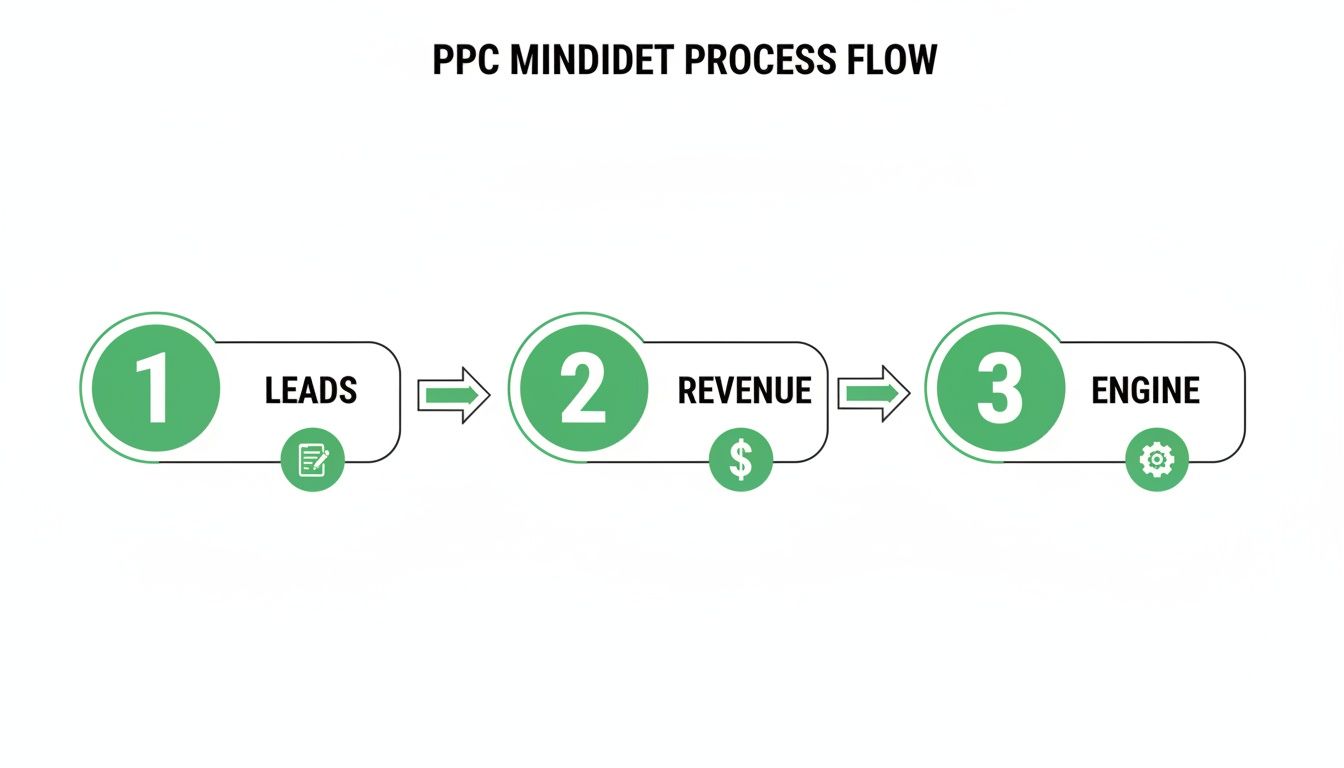
The takeaway is clear—each step has to build on the last to create a powerful, predictable system.
Why this mindset matters now
The game has changed. AI-driven bidding on platforms like Google Ads is incredibly powerful, but it's only as smart as the data you feed it. If you tell it to get you cheap leads, it will find you people who love filling out forms but have no intention of buying. That's just dumb.
But if you feed it revenue data—showing it which clicks led to actual sales—it will get terrifyingly good at finding more of those people. This is the new competitive advantage.
To get a sense of what this looks like in practice, you can explore what professional paid search services offer as a blueprint. This strategic approach is what separates the businesses that scale from those that stagnate.
Building a campaign architecture that actually works
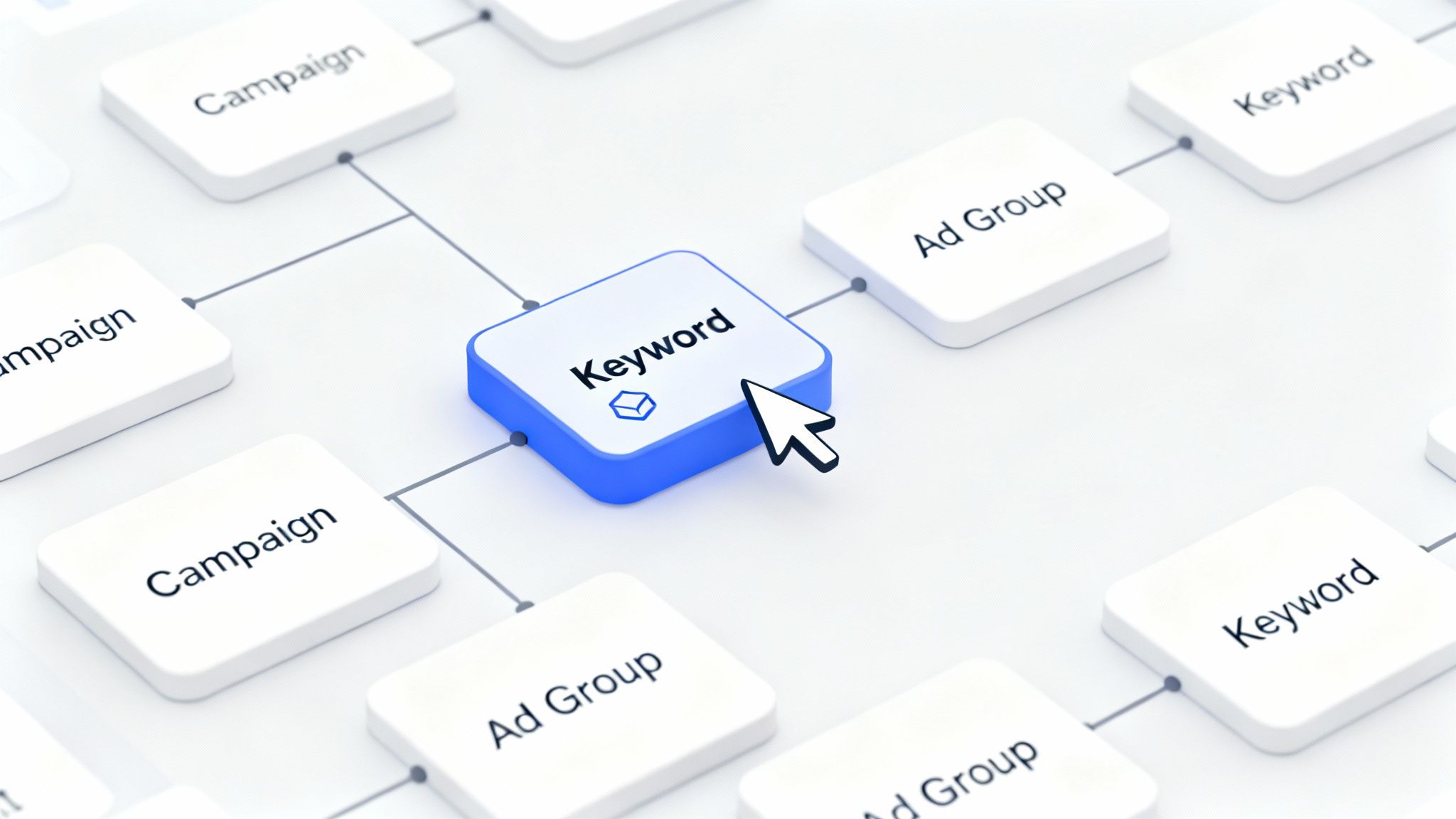
Your campaign structure is the skeleton of your entire PPC strategy. Get it wrong, and you'll be fighting the algorithm forever, bleeding cash on low Quality Scores and irrelevant clicks. I’ve seen countless agencies and in-house teams build messy, illogical structures that are impossible to scale or optimize. We're not doing that.
Let’s be blunt: a sloppy setup is just lazy. It tells me you don't respect the user's journey or your own budget. The goal is to build a hyper-granular campaign structure that aligns perfectly with user intent from the very first click. This is the unsexy work that separates the pros from the amateurs who just throw keywords into a bucket and hope for the best.
This isn’t just about pleasing Google; it’s about creating a machine that’s easy to manage and diagnose. When something breaks (and it will), a clean structure lets you pinpoint the problem in minutes, not days.
Ditching SKAGs for intent-based ad groups
For years, the gold standard was Single Keyword Ad Groups (SKAGs). The idea was simple: one keyword per ad group for maximum relevance. It worked, but it was a management nightmare and, frankly, it’s outdated in the age of AI and machine learning.
Instead, we need to think smarter. The new model is Intent-Based Ad Groups (IBAGs). This means grouping keywords not just by their topic, but by the intent behind the search. Someone searching for "what is CRM software" is in a completely different headspace than someone searching for "hubspot alternative for small business."
The fundamental flaw in most PPC setups is treating all keywords as equal. Lumping research-based queries with buy-now queries is like putting a first-date prospect in the same room as someone ready to sign a marriage license. It’s awkward, inefficient, and guarantees a poor outcome for everyone.
Here’s how you can structure your campaigns around intent:
- Top-of-Funnel (Research): Group keywords containing terms like 'what is', 'how to', 'guide', or 'learn'. These users are gathering information, so send them to a blog post or a downloadable guide.
- Middle-of-Funnel (Consideration): These are your comparison keywords. Think 'X vs Y', 'best software for', or 'reviews'. These people know the problem and are weighing solutions.
- Bottom-of-Funnel (Decision): This is where the money is. Keywords like 'pricing', 'demo', 'free trial', or branded searches signal high commercial intent. These clicks should go straight to a dedicated, high-converting landing page.
This approach gives Google’s Smart Bidding the clear signals it needs to find the right people. It understands the value difference between a 'how to' search and a 'buy now' search, allowing it to bid more aggressively on clicks that are more likely to convert into revenue.
Making broad match your ally, not your enemy
Now, let's talk about the boogeyman of PPC: broad match keywords. Most marketers are terrified of them, and for good reason—used carelessly, they will absolutely incinerate your budget on irrelevant searches. It's like leaving the door to your vault wide open. 🔓
However, when you combine broad match with a powerful Smart Bidding strategy like Target ROAS and a meticulously organized intent-based structure, it becomes an incredibly powerful tool for discovery. It allows Google’s AI to find new, profitable search queries you would have never thought of yourself.
This is where the power of a logical architecture shines. By segmenting your campaigns by intent, you can safely test broad match in a controlled environment. You can learn more about the day-to-day work involved in our guide on how to manage PPC campaigns effectively.
In the competitive world of PPC, Google Ads remains a dominant force. With the average cost per click now around €5 and some niches hitting over €8, every click has to count. Discover more lead generation statistics that highlight why a precise structure is so critical. A solid foundation isn’t just a nice-to-have; it's your only path to sustainable growth.
The critical link between your ad and landing page
Here’s where most PPC campaigns fall apart: the jarring disconnect between the ad someone clicks and the page they land on.
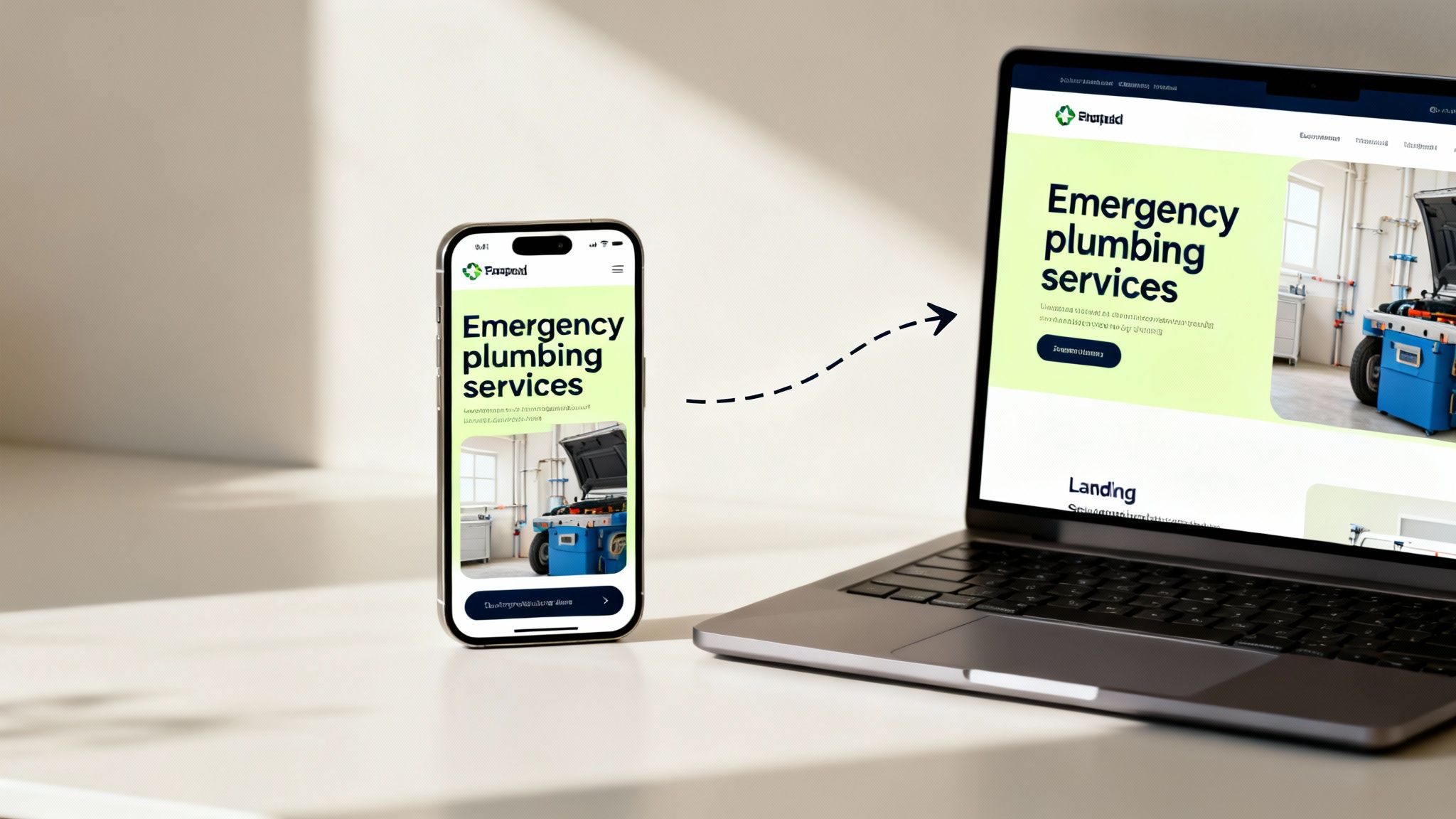
Think about it. Someone searches for 'emergency plumbing services', clicks an ad promising exactly that, but ends up on a generic company homepage. It’s lazy, it’s frustrating for the user, and it absolutely torches your conversion rate.
This isn't a minor mistake; it's a fundamental misunderstanding of user intent. When a user clicks your ad, they've been given a very specific promise. Your landing page has one job: fulfill that promise instantly and without friction. Anything else feels like a bait-and-switch.
The goal is to create a seamless 'scent trail' from the keyword all the way to the conversion. You have to maintain the momentum you just built with your ad.
Why your homepage is the worst place for paid traffic
Let's get this straight: you should almost never send paid traffic to your homepage. Your homepage is designed for exploration. It has a navigation bar, a blog link, an 'About Us' section—it's a buffet of options.
But a user clicking a high-intent ad isn't looking for a buffet. They have an urgent problem and are looking for a specific solution. Giving them a dozen different things to click is the fastest way to create analysis paralysis and lose the lead for good.
You need to eliminate every possible distraction and guide them down a single, clear path. That path is a dedicated landing page.
- Singular Focus: A landing page has one job—to get the conversion for the specific offer in the ad. No navigation, no links to your social media, no distractions. Just a headline, a form, and a compelling reason to fill it out.
- Message Match: The headline on your landing page should perfectly mirror the headline of the ad they just clicked. This provides immediate confirmation that they're in the right place, building instant trust.
- Higher Quality Score: Google rewards this kind of relevance. When your landing page experience is tightly aligned with your ad and keyword, your Quality Score goes up, which means your Cost Per Click (CPC) goes down. You literally get paid for not being lazy.
The power of dynamic, intent-matched pages
The old way of doing this was brutal. You'd manually build a unique landing page for each of your top ad groups. It worked, but it was impossible to do at scale. What happens when you have thousands of keywords? You can't possibly build thousands of pages by hand.
This is where modern platforms have completely changed the game.
Using automation, we can now generate thousands of unique, high-intent landing pages on the fly. Each page is dynamically populated to mirror the exact ad copy and search term that triggered it.
Imagine a user searches for "24/7 commercial HVAC repair in Berlin." They click an ad with that headline and land on a page that immediately greets them with, "Need 24/7 Commercial HVAC Repair in Berlin? We're on our way."
That level of hyper-relevance is what makes a user feel understood and confident they've found the right solution.
This isn't just a conversion trick; it's a fundamental shift in how we approach user experience in paid search. We're moving from a one-to-many broadcast model to a one-to-one conversation, and we're doing it at scale. The technology is finally here to deliver the personalized journey users have always deserved.
This approach is especially powerful for high-intent, local service searches. Pay-per-click lead generation shines brightest in industries like home services and contracting, where a whopping 65% of high-intent queries end in a click on a PPC ad. Those clickers are also 50% more likely to convert than organic visitors, making this a no-brainer for anyone chasing real ROAS.
The difference between the old way and the new, automated approach is night and day. Shifting to an automated workflow allows you to deliver the relevance Google rewards and customers expect, without the operational bottleneck.
Ultimately, the link between your ad and landing page isn't just a technical detail; it's the core of your campaign's performance. For a deeper dive into the mechanics of building these pages, check out our guide on how to create a landing page that converts. Getting this right is how you turn unpredictable results into a reliable, scalable lead generation machine.
Tracking what actually matters for ROAS
If you’re only tracking form submissions as 'conversions', you're flying blind.
A lead for a €100k enterprise deal is not the same as someone downloading a free PDF, yet most pay-per-click lead generation accounts treat them as identical. This is a massive, costly mistake.
Optimizing for Cost Per Lead (CPL) is a rookie move. It feels productive, but it ultimately poisons your entire strategy. It trains Google’s AI to find you people who are great at filling out forms, not people who become profitable customers. The real key to growth is shifting your focus from lead volume to actual revenue.
This is where we get into the weeds of conversion tracking, and it's the single most important element for scaling with modern bid strategies like Target ROAS. When you feed Google's AI high-quality data about what a valuable lead actually looks like, it gets scary good at finding more of them.
From CPL to true revenue optimization
The goal is to stop telling Google, "Get me form fills for €50," and start telling it, "Here's a euro, go find me five euros back."
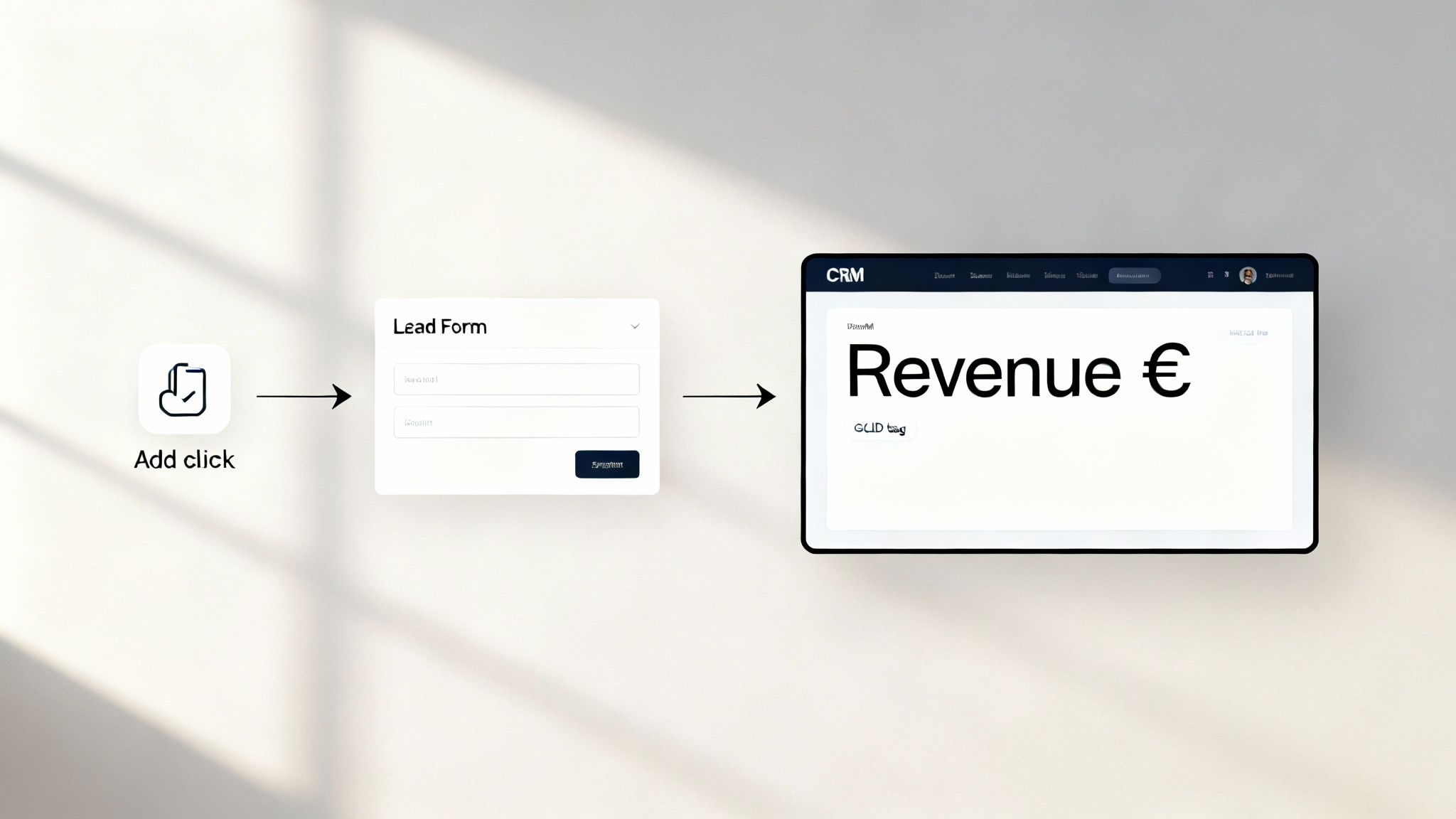
Doing this means connecting your advertising platform to your source of truth—your CRM. This is how you implement offline conversion tracking. Instead of just firing a 'conversion' tag when a form is submitted, you track the lead's entire journey. You capture the unique click ID from the ad, and then weeks or months later, you can tell Google, "Hey, that click from January? It just closed for €25,000."
This is the data that truly matters. It transforms your campaigns from a guessing game into a predictable revenue engine.
The technical bits made simple
The magic behind connecting a click to a future sale is the Google Click ID (GCLID). It's a unique parameter Google sticks onto your URL every time someone clicks an ad. Your only job is to capture this ID and store it with the lead's information in your CRM.
When that lead eventually becomes a customer, you simply upload that GCLID back to Google Ads along with the conversion value and date. It sounds technical, but most modern CRMs like HubSpot have direct integrations that make this a fairly straightforward setup. You don't need to be a developer to get this done.
The moment you start uploading real revenue data, you change the game. You're no longer just buying clicks; you're making strategic investments based on real business outcomes. This is how you leave competitors who are still stuck on CPL in the dust.
The whole point of PPC lead generation is evolving, and AI is at the center of it. Businesses that get this right report a 50% surge in sales-ready leads and cut customer acquisition costs by up to 60%—a game-changer for lean teams. With the average Google Ads CPL climbing, PPC managers are under pressure to innovate beyond surface-level metrics. Feeding the AI the right data is simply non-negotiable.
Putting it all into action
Once you have offline conversion tracking set up, you can finally use Google's most powerful bidding tools the way they were intended.
A bid strategy like Target ROAS (Return On Ad Spend) is completely dependent on this data. Without accurate conversion values, it's useless. But when you're feeding it a steady stream of real sales data, it becomes an incredibly efficient tool for maximizing your profitability at scale. For a deeper dive, you can check out our guide on how to calculate ROAS the right way.
This isn't just a "nice-to-have" feature; it's the foundation of modern, effective pay-per-click lead generation. It’s how you build a campaign that doesn’t just generate leads, but drives tangible, predictable business growth. 🚀
How to scale your campaigns without breaking everything
So you’ve got a few campaigns working. The leads are good, ROAS is positive, and things are looking up. Now what? The immediate temptation is to just crank up the budget and watch the leads pour in.
Don't. That’s how you break things.
Scaling pay-per-click lead generation is a delicate process that requires a repeatable system, not just a bigger wallet. It’s about methodical growth—not just throwing more fuel on the fire and hoping the engine doesn’t explode. This is the exact moment where promising accounts go off the rails because growth exposes every single weakness in your setup.
If your foundation is shaky, adding more budget will only make it collapse faster.
Build a relentless A/B testing culture
Before you add a single extra euro to your daily budget, you need to be damn sure you're running the most optimized version of your campaigns. The only way to know that is to test everything, all the time. Complacency is the enemy of scale.
This isn’t about running one test a quarter. It's about creating a culture of continuous improvement where testing is the default state.
Manually managing this is a nightmare. This is exactly why platforms like dynares exist—to automate the process. A system should be able to run hundreds of A/B tests simultaneously, automatically pushing traffic to the winning variants in real-time. That's how you ensure your budget is always funding what works best.
A smart approach to budget allocation
Once your optimization engine is humming, you can start thinking about increasing spend. But "increasing spend" doesn’t mean upping the budget on every campaign by 20%. That's a blunt instrument. You need a scalpel.
The right way to do this is to identify your winners and feed them while methodically exploring new opportunities. It's a two-pronged strategy: vertical scaling (going deeper) and horizontal scaling (going wider).
Scaling isn't a single action; it's a disciplined process of reinforcing success while intelligently managing risk. You double down on what’s proven to work and use those profits to fund calculated expansion. Trying to do both at once without a clear strategy is just gambling with your marketing budget.
First, find your top-performing campaigns, ad groups, and even specific keywords that are driving the highest ROAS. These are your cash cows. Increase their budgets incrementally—no more than 15-20% every few days—to avoid shocking Google's algorithm. Let the performance stabilize before you increase it again.
Methodical expansion into new territories
While you’re scaling your winners vertically, it's time to expand horizontally. This is about finding new pockets of growth without disrupting your core, profitable campaigns.
This could mean a few things:
- Geographic expansion: If you're succeeding in Berlin, can you replicate that success in Munich or Hamburg? Use a separate campaign to test new locations.
- Targeting adjacent keywords: Are there related search terms you haven't explored? Use your existing data to make educated guesses about what might work.
- Testing new channels: Can you take your winning messaging from Google Ads and test it on LinkedIn or Facebook?
The key here is isolation. Test these new territories in separate campaigns with their own small, dedicated budgets. Don’t pollute your proven campaigns with unproven variables.
Once a new expansion campaign proves its worth and hits your target ROAS, it gets promoted into your "core" group of campaigns, and the scaling cycle begins again. This is how you build an efficient system that grows with your business—not one that collapses under its own weight.
Common PPC pitfalls and how to avoid them
I’ve seen it all over the years. Smart people making simple mistakes that cost their companies a fortune. This isn't about tiny bid adjustments; it's about avoiding the big, systemic errors that turn paid search into an expensive hobby instead of a profitable growth engine.
Think of this as my pre-flight checklist. It's the stuff that seems obvious but always gets missed in the rush to get campaigns live. Internalize this, and you'll save yourself a lot of pain (and money).
Ignoring the junk mail of PPC
The single biggest unforced error you can make is forgetting to build a robust negative keyword list. Honestly, it’s like leaving your front door wide open. You're basically inviting low-intent, completely irrelevant traffic to come in and burn through your budget.
If you sell premium accounting software, you don’t want clicks from people searching for "free accounting courses" or "accounting jobs." The intent is totally different. Ignoring this doesn't just waste cash; it pollutes your data, confuses the bidding algorithms, and makes it impossible to optimize for what actually works.
Make building and refining your negative keyword list a weekly ritual. It's the most straightforward way to improve your campaign's profitability almost overnight.
Running ads with a vague or weak offer
Another classic blunder is running ads without a clear, compelling offer. Let me be blunt: 'Learn More' is not a compelling offer. It’s a lazy call-to-action that signals you haven't thought hard enough about what your customer actually wants from you right now.
Your offer is the heart of the entire transaction. It’s the specific value you promise in exchange for their click and, ultimately, their contact information.
A strong offer filters out the casual browsers and attracts serious prospects. It’s the difference between a click that costs you money and a click that makes you money. Don't be lazy here.
Obsessing over vanity metrics
Finally, let's talk about the metrics that make you feel good but mean absolutely nothing for the business. Clicks, impressions, even Click-Through Rate (CTR)—these are mostly distractions.
Who cares if your CTR is 10% if none of those clicks ever turn into revenue? It’s like celebrating that your restaurant is full of people who only ordered tap water. It looks busy, but it doesn't pay the bills.
The only KPIs that truly matter are the ones tied directly to revenue. Everything else is secondary.
Focus relentlessly on these. They tell the true story of your campaign’s health. Everything else is just noise. ✌️
Your top PPC lead gen questions, answered
I’ve been in the PPC trenches for a long time, and the same questions pop up again and again. Here are my straight-up, no-fluff answers to the ones I hear most often.
How long does this actually take to work?
Look, anyone who promises you a flood of profitable leads in the first week is either lying or deeply inexperienced. While you'll see clicks and impressions almost right away, getting to real, predictable results takes time.
Give it at least 90 days. Seriously.
Think of it like this: the first month is all about listening. You’re launching the campaigns and letting the algorithms gather baseline data. The worst thing you can do is start fiddling with things too early. Just let it run. The second month is where you start optimizing. Armed with a month's worth of data, you can begin making smart, informed tweaks to bids, copy, and targeting. The third month brings clarity. By now, a clear picture should be emerging. You'll know which campaigns are winners, which are losers, and you'll have a solid roadmap to profitability.
PPC lead gen is a system you build, not a lottery ticket you scratch. Patience is your biggest competitive advantage.
What’s a good CPL?
Honestly? This is the wrong question to ask. Obsessing over your Cost Per Lead (CPL) is a classic rookie mistake. It's a vanity metric that tells you absolutely nothing about the health of your business.
Think about it. For a law firm that closes a €50k case, paying €500 for that lead is an absolute steal. But for a SaaS company selling a €50/month subscription, that same CPL would sink the business.
Stop asking about CPL. Start obsessing over your Cost Per Acquisition (CPA) and, more importantly, your Return on Ad Spend (ROAS). The only metric that truly matters is whether you're putting more money in the bank than you're spending on ads. Full stop.
Can I do this manually, without an automation tool?
Sure, you can. People have been managing PPC campaigns by hand for years, and for a very small-scale operation, it can work.
But the real question isn't can you, it's should you?
If you have any ambition to scale your lead generation, a manual approach will quickly become your biggest bottleneck. You simply can't create, manage, and A/B test thousands of unique landing pages and ad variants by hand. It's not humanly possible.
Using an AI-powered platform isn't about being lazy; it's about getting leverage. It’s about staying competitive in a world where your rivals are already automating the grunt work to move faster and smarter than you.
Ready to stop wasting time and start scaling your PPC lead generation the smart way? With dynares, you can automate the creation of thousands of high-intent ads and landing pages, optimize for revenue, and build a predictable growth engine. See how it works at dynares.ai.


