
Here's the honest truth about leads and conversions: most of what you're tracking is probably useless. A lead is not just a form fill, and a conversion isn't just a button click. It’s about attracting people with genuine buying intent, not just collecting email addresses from tire-kickers.
Most of what you call 'leads and conversions' are worthless
Let’s be blunt. The obsession with generating more has created a swamp of vanity metrics. We celebrate every new name that hits the CRM, but the vast majority of them are just noise—people who will never, ever buy from us. This quantity-over-quality mindset is a trap so many founders and marketers fall into.
It feels productive, doesn't it? Watching those numbers go up delivers a nice little dopamine hit. But it’s a dangerous illusion that burns through ad spend, wastes your sales team's precious time chasing ghosts, and keeps you busy without actually moving the needle on revenue. Frankly, it’s one of the dumbest ways to run a growth strategy.

Redefining what a 'lead' actually is
We need to fundamentally change what a 'lead' means to us. It's not a contact detail. It's a clear, unambiguous signal of buying intent.
Think about the difference between someone downloading a free, top-of-funnel ebook versus someone requesting a personalized demo or viewing your pricing page three times in one week. One is curiosity, the other is a cry for help.
The data backs this up. Across industries, the average website conversion rate is a pathetic 2.23%. Of those who do convert, a staggering 79-80% vanish without ever buying anything. Paid search on platforms like Google Ads does a bit better at 3.2%, but that still highlights a massive gap between a click and a customer.
This is exactly why chasing a low Cost Per Lead (CPL) is a fool's errand. A cheap lead that never converts is infinitely more expensive than a higher-cost lead that becomes a profitable customer. We need to stop optimizing for activity and start optimizing for outcomes.
Focusing on what actually pays the bills
The only metric that truly matters is profit. Everything else is just a means to that end. This guide is about cutting through the nonsense and building a system that connects your ad spend directly to revenue. It’s time to shift our focus.
Time to ditch the metrics that make you feel good for the ones that actually pay the bills. This isn't just about changing what's on your dashboard; it's about changing your entire approach. It’s a move from celebrating busywork to celebrating real business impact. We need to evolve our thinking from clicks to intent, from form fills to qualified opportunities, and from CPL to ROAS.
This isn't just a philosophical change; it's a practical one. It requires aligning your marketing, your sales process, and your analytics around a single source of truth: revenue. You can find out more by checking out our guide on essential marketing metrics and reports.
This playbook is designed to give you the exact steps to build a Google Ads machine that doesn't just generate leads and conversions, but drives predictable, scalable profit for your business. Let's get to it.
Building a Google Ads structure that catches high-intent leads
Most Google Ads accounts I get my hands on are a complete disaster. Seriously. They're a chaotic mess of broad match keywords, generic ad copy, and campaigns that just spray money around with zero strategy.
The fix isn't about adding more complexity; it's about surgical precision. We need to build a structure designed for one thing and one thing only: attracting prospects who are actually ready to talk business.
Forget casting a wide net. That’s how you fill your pipeline with tire-kickers and burn through your budget before your morning coffee. The goal here is to create a lean, hyper-relevant system where every single click has a clear purpose. This foundational work is what separates the amateurs from the pros, and it’s where you'll find the biggest leverage on your ad spend. Understanding this structure is a huge part of creating lead gen ads that actually convert.
Segmenting by intent
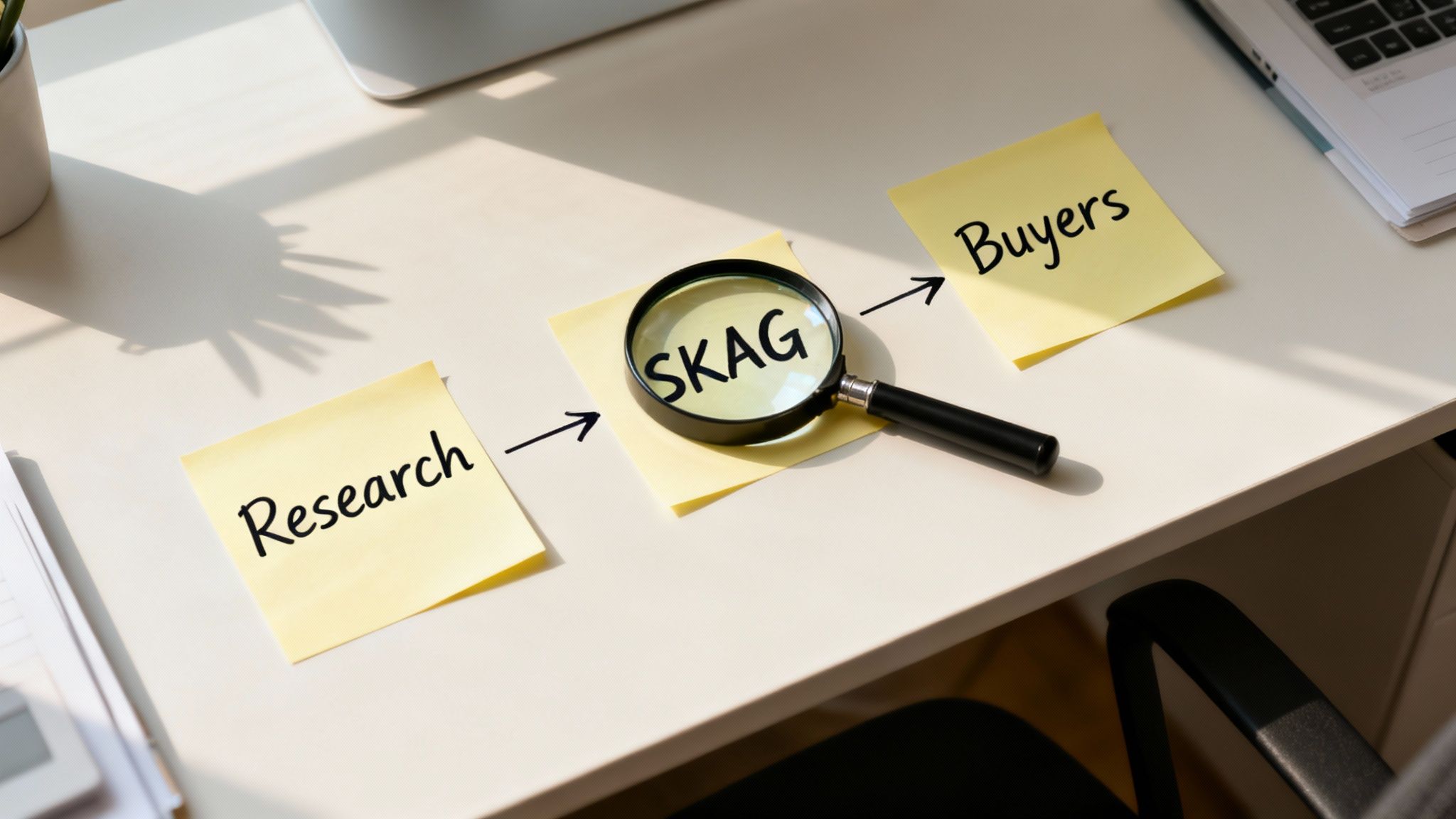
The first, most critical step is to separate the 'researchers' from the 'buyers'. Someone searching for 'what is CRM software' is in a completely different headspace than someone searching for 'HubSpot alternative for small business'. Lumping them into the same ad group isn't just lazy marketing—it's incredibly expensive.
Your campaign structure needs to mirror this intent. That means creating separate campaigns for the different stages of the buying journey. Top-of-funnel campaigns can target informational keywords, but your bottom-of-funnel campaigns have to be laser-focused on transactional, high-intent terms.
Here’s a practical way I like to break it down:
- Top-of-Funnel (ToFu) Campaigns: These target broad, problem-aware keywords like 'how to improve sales follow-up'. The goal here is awareness, not immediate leads. You'll want to bid low and send this traffic to helpful blog posts or guides.
- Middle-of-Funnel (MoFu) Campaigns: Now we're focusing on solution-aware keywords, like 'best sales CRM software'. These users are actively evaluating their options. Direct them to comparison pages or detailed feature breakdowns.
- Bottom-of-Funnel (BoFu) Campaigns: This is where you make your money. Target specific, brand-related, or 'ready-to-buy' keywords like 'dynares pricing' or 'get a CRM demo'. Bid aggressively here—these are your most valuable clicks, period.
The power of hyper-relevance with SKAGs
Once you’ve segmented your campaigns by intent, it’s time to get granular with your ad groups. The old-school method that’s still brutally effective is using Single Keyword Ad Groups (SKAGs). The concept couldn't be simpler: one ad group, one keyword, and ads written specifically for that single keyword.
Why does this work so well? It creates a perfect message match between what the user searched for, the ad they see, and the landing page they click through to. Google rewards this alignment with higher Quality Scores, which translates directly to lower costs-per-click and better ad positions. More importantly, it gives the user a seamless, relevant experience, which dramatically increases the chances they’ll convert.
For example, a user searching for 'AI software for ad spend reduction' shouldn't see a generic ad about 'marketing automation'. They should see an ad with a headline that screams, Reduce Your Ad Spend With AI Software. When they click, they land on a page that talks about exactly that. It sounds obvious, but you’d be shocked how few advertisers actually do it.
You're not just buying keywords; you're entering a conversation. SKAGs ensure you start that conversation with the right message, at the right time. It’s the difference between shouting into a crowd and having a one-on-one discussion with your ideal customer.
Writing ad copy that speaks to problems
Finally, let's talk about the ads themselves. Your ad copy's job isn't to list features; it's to speak directly to the user's pain point and offer a clear solution. Forget clever wordplay and focus on clarity and empathy.
I always stick to a few core principles. Mirror the user's language by using their exact keyword in your headline—it's a powerful psychological trigger. Lead with the benefit, not the feature; instead of 'Our software has automated reporting', try 'Stop Wasting Hours on Reports. Get Instant Insights'. Lastly, include a strong, specific Call to Action (CTA) like 'Get Your Free Demo' instead of a vague 'Learn More'.
This meticulous structure—segmenting by intent, using SKAGs for relevance, and crafting problem-focused copy—is the foundation for a Google Ads account that doesn't just generate clicks. It delivers high-quality leads and conversions that fuel real growth. It takes more work upfront, but the payoff is a predictable, profitable customer acquisition machine.
Why your landing page is a conversion graveyard
You can have the most brilliant ads in the world, but if they lead to a terrible landing page, you're just paying Google to disappoint potential customers. It's where good leads go to die. So many founders obsess over ad creative and keyword bids, completely forgetting that the click is just the beginning.
A landing page that actually generates leads and conversions isn't about flashy design or winning some award; it's about clarity, relevance, and removing every single ounce of friction. If a user has to think for even a second about what to do next, you’ve already lost them.

Nail the message match
The absolute cardinal sin of landing pages is a lack of message match. It’s when your ad promises a solution to a specific problem—like 'AI Software for Ad Spend Reduction'—but the page they land on is a generic homepage babbling about your company's mission. That's an immediate bait-and-switch that shatters trust.
Your landing page must be a seamless, logical continuation of the ad's promise. The headline, the hero image, the copy—it all needs to scream, 'Yes, you're in exactly the right place'. This alignment is non-negotiable.
Design for action, not distraction
Your landing page has one job and one job only: get the user to take a specific action. That's it. This means stripping away anything and everything that doesn't serve that one goal.
It's not a website; it's a machine built for a single purpose. Every element must either build trust, clarify the offer, or guide the user toward the call-to-action. If it doesn't, kill it.
This means no navigation bar leading to your 'About Us' page. No links to your blog. No distracting social media icons. Just a clear, unobstructed path to conversion. For an even deeper look, you might be interested in our guide on how to create a landing page that converts.
The form is your final boss
You can do everything right—perfect ad, perfect headline, perfect copy—and still fail at the very last step: the form. People hate filling out forms. Your job is to make it as painless as humanly possible.
Only ask for the minimum information you absolutely need for the next step. Name and email are often enough. Use a clear CTA on the button, something specific and value-driven like 'Get My Free Demo' instead of a lazy 'Submit'. And make it fast. This isn't just about the number of fields, but how quickly you respond once the form is submitted.
Shockingly, stats reveal that leads contacted within 5 minutes are 9 times more likely to convert. Yet, only 37% of businesses respond within that golden hour. Companies that automate lead management see a 10% revenue bump in just 6-9 months, showing just how much money is being left on the table by slow follow-up.
Fixing your landing page isn't just about tweaking colors and copy. It's about building a focused, frictionless experience that respects the user's intent and delivers on the promise your ad made. Stop treating it as an afterthought and start treating it as the most important part of your entire campaign.
Automating your pipeline the smart way
Let's get one thing straight: automation is a necessity, not a luxury. But I've seen way too many teams burn cash by slapping a shiny new tool on top of a broken, chaotic process. You’re not fixing the problem; you're just failing faster and on a much grander scale. It’s time to be smarter about this.
We're not just talking about automating a few tasks, like a follow-up email sequence. We're talking about automating your entire lead generation strategy.
Imagine this: for every single high-intent keyword in your Google Ads account, an AI instantly generates a unique, hyper-relevant landing page, a perfectly matched ad, and a frictionless form. That’s the level of personalization that's not just possible now—it's essential for winning.
This is how you achieve perfect message match at a scale that used to require a massive marketing department. When the ad, page, and form are all in perfect sync with what the user searched for, Google rewards you. Your Quality Scores go up, your cost-per-click goes down, and your conversion rates climb. It frees you up to actually think about the bigger picture.
Integrating your entire tech stack
This level of automation isn't just about capturing a lead; it's about creating a seamless flow of data across your entire business. A truly intelligent pipeline connects everything. Your ads talk to your landing pages, your forms talk to your CRM, and—most importantly—your revenue data flows all the way back to Google Ads.
Without that complete loop, you're flying blind. You might be celebrating a low Cost Per Lead from a campaign that generates nothing but junk, while unknowingly starving a higher-CPL campaign that’s actually delivering your most profitable customers. The goal is to build a closed-loop system where every action is informed by real business outcomes.
This is how you stop being a button-pusher, endlessly tweaking bids and copy. You evolve into a true growth strategist, designing and overseeing a revenue engine that practically runs itself. You become the architect, not the mechanic.
The focus must always be on quality over quantity. This isn't just a nice-to-have philosophy; it's a brutal reality of lead generation. Data shows that a shocking 79% of leads never convert, often because marketers are chasing volume instead of value. To combat this, B2B marketers often turn to platforms like LinkedIn, where 40% rank it as the best source for high-quality leads, largely because audiences there are 6x more likely to convert after seeing brand messaging. You can find more insights on how different channels perform at Sopro.io.
From spreadsheets to automated funnels
For years, PPC management was a nightmare of spreadsheets and manual adjustments. It was a tedious, soul-crushing process that kept even the best marketers stuck in the weeds, managing URLs instead of strategy. Now, we have tools that can handle all that heavy lifting.
This isn't about replacing the marketer; it's about augmenting them. It's about letting machines do what they do best—process massive amounts of data and execute repetitive tasks with perfect consistency—so that we can do what we do best: think strategically, understand our customers, and build the business. You can learn more about making this transition by reading our guide on moving from spreadsheet hell to automated PPC funnels with AI.
The core components of a smart, automated pipeline are dynamic generation of ads and pages, intelligent lead routing to your CRM, and automated A/B testing to constantly improve performance. Building this kind of automated system is the single biggest lever you can pull to scale your leads and conversions profitably. It’s how you build a predictable, efficient growth machine that works for you 24/7.
From cost per lead to return on ad spend
Let’s get something straight. If you're still obsessing over your Cost Per Lead (CPL), you're playing the wrong game entirely. It’s a relic from a bygone marketing era, and frankly, it’s a dumb way to measure success in 2024.
A cheap lead that never closes isn't a bargain; it’s a time and money sink. That $5 'lead' your sales team spends hours chasing before realizing they have no budget is infinitely more expensive than the $100 lead who signs a contract next week.
The only metric that truly matters is Return on Ad Spend (ROAS). Full stop.
This is the final, most critical piece of the puzzle. It’s where we connect your ad spend to actual, tangible revenue. This is how you stop justifying your budget with fluffy 'lead' numbers and start proving your department is a profit center.
Making your data work for you
First things first: you have to stop treating all conversions as equal. A 'Contact Us' form fill from an enterprise prospect is not the same as a newsletter signup from a student. You have to start assigning real, monetary values to your conversions inside Google Ads.
Without this, you're feeding Google’s algorithm junk food. It will happily optimize for cheap clicks and easy form fills because that’s all you told it to value. But when you start feeding it real revenue data, its entire mission changes. It stops being a simple traffic engine and starts becoming a smart revenue machine.
This process is non-negotiable and requires two things: offline conversion tracking to connect your CRM to Google Ads, and assigning dynamic values to actions without an immediate sale. For example, a demo request might be worth $150 based on your average deal size and close rate, while a whitepaper download is worth $5. This gives the algorithm a much clearer picture of what you actually care about.
This process ensures data flows cleanly from a user's initial search all the way to a final, optimized page.
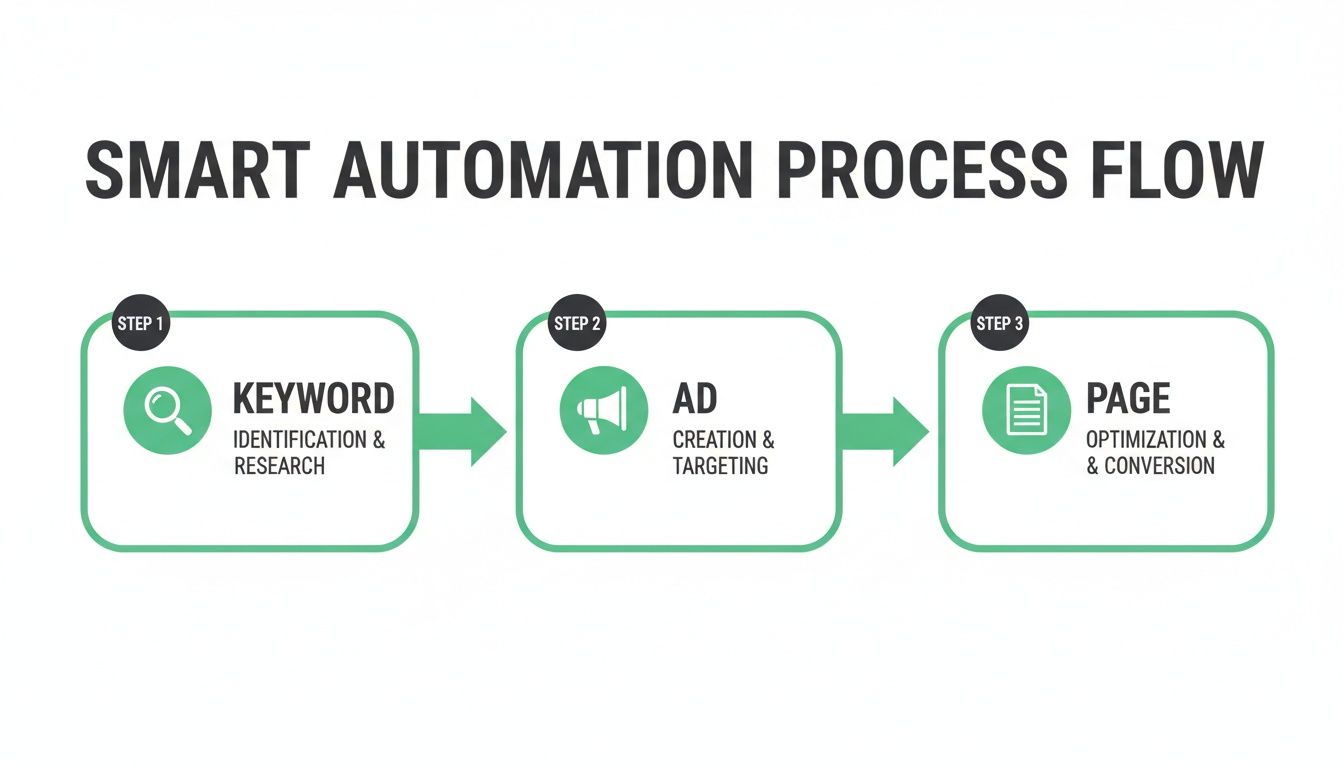
This kind of streamlined flow is fundamental to feeding Google's algorithm the high-quality data it needs for effective value-based bidding.
The handshake between marketing and sales
This entire system falls apart without a strong, almost obsessive alignment with your sales team. Marketing can’t operate in a vacuum, celebrating MQLs while the sales floor is silent. You need a closed-loop feedback system.
I have a recurring meeting with our sales lead every single week. The agenda is simple: we review the leads marketing generated, and they tell me which ones were gold and which were garbage.
This isn't about pointing fingers; it's about calibration. It’s a constant, human-driven feedback loop that refines our definition of a good lead.
We’re not just passing leads over the fence. We’re partners in a single revenue operation. When they win, I win. When they’re wasting time on bad leads, my ad spend is being wasted.
This process ensures we know exactly which keywords, ads, and landing pages are driving our most profitable customers. Armed with that knowledge, we can confidently double down on what works and kill what doesn’t. You can learn more about this by reading our guide to calculate ROAS the right way.
This is how you finally break free from the CPL trap. You stop generating 'leads' and start generating profit. It’s more work, yes, but it’s the only work that actually matters for scaling a business. You build a predictable engine for growth, turning your Google Ads from an expense into your most valuable investment.
Frequently asked questions
Alright, let's cut through the noise. When you get serious about generating leads and conversions that actually turn into revenue, a lot of the same questions pop up. Here are the straight, no-BS answers to the ones I hear most often.
How do I know if a lead is actually high-quality?
A high-quality lead isn't just a form fill; it’s a clear signal of genuine buying intent. You have to look beyond the surface-level action. It’s all about context.
Did they download your pricing guide, or did they grab a generic, top-of-funnel ebook? One is a bottom-of-funnel buying signal, the other is just research. The real test, though, is connecting marketing actions to sales outcomes. If your sales team consistently qualifies leads from a specific campaign as legitimate opportunities they can actually work, those are your high-quality leads.
The best way to manage this is to use your CRM to automate lead scoring based on these signals. This lets you focus your team’s energy on the prospects who are ready to talk now, while you nurture the rest.
What is the biggest landing page mistake people make?
The single biggest, most expensive mistake is a total lack of message match. It’s when someone clicks your ad for 'AI software for ad spend reduction' and gets dumped on a generic homepage talking about all your services. It's a jarring disconnect that absolutely kills trust and sends them running for the back button.
Your landing page must be a focused, seamless continuation of the conversation your ad started.
The headline, the copy, and the visuals must all reinforce the ad's specific promise. Anything else is friction, and friction is the sworn enemy of conversions. Every ad group deserves its own tailored landing page. No excuses.
Should I use more form fields or fewer?
Ah, the classic quality versus quantity debate. The right answer completely depends on your sales process and capacity. There's no one-size-fits-all solution here.
If your sales team is drowning in unqualified prospects and wasting their time on dead-end calls, you need to add a couple of strategic fields to your form. Something like 'Company Size' or 'Biggest Challenge' can work wonders to weed out the tire-kickers. You’ll definitely get fewer leads, but they will be much, much better.
On the other hand, if your goal is to fill the top of your funnel for a long-term nurturing strategy, a simple email-only form is the way to go.
My advice? Start lean. Ask only for what you absolutely need to take the next logical step in the conversation. You can always gather more information later with multi-step forms or progressive profiling once you've earned their trust.
Why isn't my ROAS improving with value-based bidding?
Value-based bidding in Google Ads is incredibly powerful, but it's not a magic wand. It's a machine, and it's only as good as the fuel—the data—you feed it. If it's not working, it's almost always one of these three things.
- Your inputs are garbage: If your conversion values are inaccurate, inconsistent, or just plain wrong, you're telling Google's AI to optimize for a completely flawed outcome. Garbage in, garbage out.
- You don't have enough data: The algorithm needs a healthy volume of conversions to learn effectively. Google suggests at least 50 conversions in the last 30 days for its algorithms to find patterns. If your volume is too low, the machine is just guessing.
- The problem is outside your ads: Your ads might be perfect, but no bidding strategy on earth can fix a leaky sales process, a bad product-market fit, or a terrible follow-up time. The most sophisticated AI can’t close a deal for you.
You have to diagnose the root cause. Start by ensuring your data is clean and plentiful. If that’s solid, it’s time to look in the mirror and audit what happens after the click. That's usually where the real problem is hiding.
Ready to stop chasing vanity metrics and build a predictable revenue engine? dynares uses AI to automatically generate hyper-relevant ads and landing pages for every keyword, turning your Google Ads from a cost center into a profit machine. Get your demo and see how it works.


