Look, I’ve built enough tech products and scaled enough businesses to know that most marketing advice is recycled garbage. It’s either vague theory or so outdated it’s useless, especially in paid search. Last year's best practice is this year's money pit. So, let’s get real. This isn't another generic checklist. This is a candid, no-nonsense roundup of the 10 SEM best practices that are actually delivering results for founders and growth teams right now.
I’m sharing what I’ve seen work, what’s a complete waste of time, and how you can apply these principles to stop burning cash and start generating real revenue from your Google Ads. No sugarcoating, just practical steps to get ahead. We're going to dive deep into the strategic frameworks that matter, from nailing keyword intent and optimizing your account structure to leveraging automation without letting the machines run your business into the ground.
This guide is for the operators in the trenches: the PPC managers, agency teams, and SMB founders who need actionable insights, not fluffy concepts. We will cover everything from advanced bidding tactics and precise audience segmentation to landing page alignment that actually converts visitors. These aren't just tips; they are foundational components of a scalable paid search engine. Forget the abstract theories. This is a hands-on manual for building a high-performance SEM machine that drives tangible growth.
Let's build something great. 🚀
1. Keyword research and intent alignment
If you’re just throwing money at keywords without deeply understanding the why behind the search, you're essentially setting your budget on fire. This is the bedrock of all successful SEM best practices. It's not just about finding keywords with high search volume; it’s about decoding the user's intent and aligning your entire strategy—from ad copy to landing page—with what they actually want to achieve.
This process is foundational because it directly impacts your Quality Score, click-through rates (CTR), and, most importantly, your conversion rates. When you match the user's goal, you serve them a relevant ad that solves their problem, making them far more likely to click and convert.
Decoding search intent
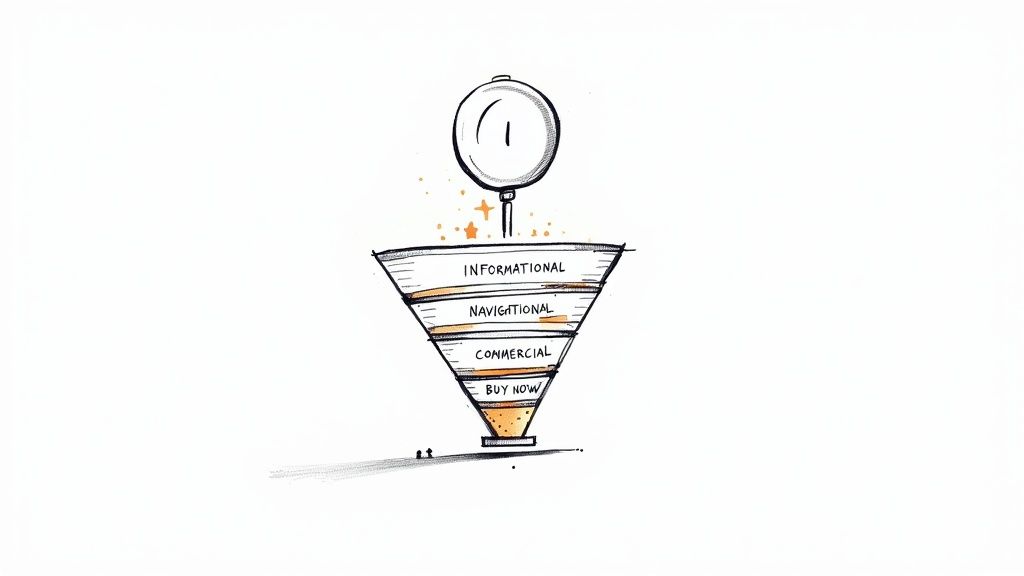
Search intent typically falls into four main categories, each representing a different stage of the buyer's journey. Targeting them correctly is a game-changer. For Informational intent, users are looking for answers. They're not ready to buy. Think queries like 'how to manage projects'. This is top-of-funnel content. Don’t push a hard sale here; you'll just annoy them. For Navigational intent, users are trying to get to a specific website. For example, 'Asana login'. Unless you're Asana, bidding on this is a waste.
With Commercial intent, users are comparing options and are close to a decision. Queries like 'best project management software' show they are in the market and evaluating solutions. This is where you want to be with compelling, feature-rich ads. Finally, for Transactional intent, users are ready to buy now. These are the money keywords: 'buy running shoes online' or 'plumber near me'. The intent is crystal clear, and your ad and landing page should make the purchase process as frictionless as possible.
Matching your keyword bids and ad creative to these distinct stages is how you maximize relevance and stop wasting ad spend. You wouldn’t propose marriage on a first date, so don’t serve a 'Buy Now!' ad to someone asking an informational question. It's just bad form and worse business.
2. Ad copy testing and optimization (A/B testing)
If you’re not continuously testing your ad copy, you’re just guessing. This is one of the most fundamental SEM best practices because your ad is the first handshake with a potential customer. Getting it right isn't about having a single 'perfect' ad; it’s about a relentless, data-driven process of iteration to discover what messaging actually persuades users to click and convert.
This process directly boosts your CTR and Quality Score, which lowers your cost-per-click and improves your ad position. A well-optimized ad doesn't just get more clicks; it gets the right clicks from users who are more likely to become customers. It’s the difference between shouting into the void and having a meaningful conversation.
Implementing a testing framework
A systematic approach is crucial. Randomly changing headlines won't give you clear insights. Instead, isolate variables and run controlled experiments to understand what drives performance. To craft compelling ads, consider exploring various ad copy frameworks that can guide your creative process.
- Isolate One Variable: Don't test a new headline, a new description, and a new call-to-action all at once. Test one element at a time. For example, pit one headline against another while keeping everything else identical.
- Leverage Responsive Search Ads (RSAs): Google’s RSAs are a built-in testing machine. Provide multiple headlines and descriptions, and let the algorithm identify the highest-performing combinations. This automates much of the heavy lifting.
- Test Emotional vs. Logical Triggers: Does your audience respond better to urgency or social proof? Do they care more about features or benefits? These are the questions that A/B testing answers.
- Establish a Clear Winner: Run your tests long enough to achieve statistical significance. A test with only a handful of clicks is just noise. Aim for at least a week or a few hundred conversions before declaring a winner and moving on to the next test.
Don't let your ad copy get stale. What worked last month might not work today. Consistent testing ensures your messaging stays sharp, relevant, and effective. If you're looking for an efficient way to manage this, you can learn more about how an ad builder can streamline your A/B testing process with dynares.
3. Quality score optimization
Ignoring Quality Score is like trying to win a race while carrying a bag of rocks. It’s a metric Google uses to rate the quality and relevance of your keywords and ads, and it directly impacts how much you pay per click (CPC) and where you rank. Treating it as an afterthought is one of the fastest ways to overspend and underperform.
This metric is your direct line of communication with Google’s algorithm. A high Quality Score tells Google your ad and landing page are exactly what the user is looking for, and in return, the platform rewards you with lower costs and better ad positions. It’s a core component of effective SEM best practices because it forces you to align your entire funnel, from keyword to conversion, with user needs.
The three pillars of quality score
Google is pretty transparent about what goes into this score. It's not some mystical black box. It boils down to three core components that you have direct control over. The first is Expected Click-Through Rate (CTR), which is Google's prediction of how likely your ad is to be clicked. You can influence it with compelling, relevant ad copy that speaks directly to the search query.
The second is Ad Relevance. Does your ad make sense for the keyword it’s triggered by? If someone searches for 'men's black running shoes', your ad shouldn't talk about your general shoe collection. It needs to be hyper-specific to earn a high score.
The third pillar is Landing Page Experience. What happens after the click? Your landing page must be relevant, easy to navigate, and provide a good user experience. A B2B company that mirrors the exact language from its ad copy onto its landing page can drastically improve relevance, often cutting CPCs by as much as 40%. A slow-loading, confusing page will tank your score, no matter how good your ad is.
Think of it this way: Google’s business model depends on users finding what they want. By optimizing for Quality Score, you're not just playing by their rules; you're aligning your business with the user's goal. This alignment is what separates profitable campaigns from money pits.
4. Bid strategy optimization (automated and manual)
Your bidding strategy is the engine that drives your campaign performance. Choosing the wrong one is like putting diesel in a petrol car; it won’t get you far, and you’ll waste a lot of money in the process. This isn't just about setting a max CPC and hoping for the best. Effective bid management, whether manual or automated, is a critical SEM best practice that directly controls your budget efficiency, ad visibility, and ultimately, your return on investment.
This process is so fundamental because it tells Google's algorithm what you actually care about. Do you want raw traffic, conversions at a specific cost, or the highest possible revenue for every dollar spent? Getting this right ensures your budget is allocated intelligently to achieve your specific business goals, rather than just being spent.
Choosing the right engine for your goals
Your campaign goal dictates your bidding strategy. There’s no single best option; the right choice depends on your objective, budget, and the amount of conversion data you have. Trying to use a ROAS-focused strategy with zero conversion data is a recipe for disaster.
Manual CPC/ECPC is your training ground. You start here to gather data, understand your cost-per-conversion, and get a feel for the auction dynamics. Enhanced CPC (ECPC) is a good middle step, giving the algorithm some freedom while you maintain most of the control. Once you have a steady stream of conversions (at least 15-30 per month), you can use Maximize Conversions to tell Google to get as many conversions as possible within your daily budget. It’s great for lead generation campaigns where you want to maximize volume.
Target CPA (tCPA) takes it a step further. You tell Google to get conversions, but not to pay more than a certain amount per conversion. It’s perfect for scaling lead flow predictably. Target ROAS (tROAS) is the holy grail for e-commerce. You tell Google you want a specific return on ad spend, for example, a 5x return. It requires robust conversion tracking with dynamic revenue values to work effectively.
Don't just set it and forget it. Start with manual or Maximize Conversions to build a data foundation. Once you have enough historical performance, you can graduate to more sophisticated strategies like tCPA or tROAS. This methodical approach is how you turn paid search from a cost center into a predictable, profitable growth channel.
5. Negative keywords implementation
If you’re not aggressively managing negative keywords, you’re basically telling Google it’s okay to spend your money on completely irrelevant clicks. It's one of the most critical SEM best practices for controlling costs and boosting ROI. Think of it as building a fence around your campaigns to keep out window shoppers, tire-kickers, and anyone else who has zero intention of converting.
This is a non-negotiable part of campaign hygiene. Ignoring negative keywords is a direct path to a bloated cost-per-acquisition (CPA) and a weak return on ad spend (ROAS). By telling Google what not to show your ads for, you refine your targeting, improve your Quality Score by increasing relevance, and ensure your budget is spent only on the traffic that actually matters.
Building your defensive wall
Proactive negative keyword management is the difference between a finely tuned machine and a money pit. The goal is to filter out irrelevant searches before they ever have a chance to cost you a click. A B2B SaaS company that only offers paid plans should add 'free' and 'open source' as negative keywords. This immediately stops you from paying for clicks from users who will never become paying customers. A luxury brand selling high-end furniture must add negatives like 'cheap' and 'discount'. This ensures their ads are shown to buyers who align with their premium price point, not bargain hunters.
A law firm specializing in corporate law should add negative keywords like 'divorce lawyer' or 'personal injury attorney'. This prevents them from wasting money on clicks for services they don't even provide. If your recruitment agency only places full-time C-level executives, negatives like 'internship' and 'entry-level' are essential to filter out the wrong candidates.
Regularly combing through your Search Query Report is where you'll find the gold. Look for the queries that make you scratch your head and wonder, why on earth did my ad show for that? Add them to your negative lists immediately. This simple, consistent action will save you a fortune and make every other part of your SEM strategy work better.
6. Ad extensions and structured data implementation
Thinking your ad is just a headline and two description lines is a rookie mistake that will get your lunch eaten by the competition. Ad extensions are the easiest, fastest, and cheapest way to increase your ad's real estate on the SERP, improve your Quality Score, and give users more reasons to click your ad instead of someone else's.
This is a fundamental part of modern SEM best practices because it makes your ad more useful. You're giving users shortcuts to what they want, whether it's a specific product page, a phone number, or a list of your services. Google rewards this utility with better ad rank and often a lower cost-per-click. It's a no-brainer.
Maximizing ad real estate and relevance
Ad extensions are dynamic snippets of information that append to your core ad text. Using them is like getting a free upgrade from a standard hotel room to a suite; you get more space and better features at no extra cost per click.
- Sitelink extensions: These are direct links to specific pages on your site. An e-commerce store should use these for product categories. Don't just send everyone to your homepage and hope for the best. Guide them.
- Callout extensions: These are short, non-clickable text snippets for highlighting key value props. A SaaS company would use these for features like '24/7 Support' or 'No-Contract Plans'. Think of them as bullet points for your business.
- Structured snippets: These let you highlight specific aspects of your products or services using a predefined header. A local contractor might list services like 'Roofing Repair' or 'Gutter Cleaning'. It provides context at a glance.
- Promotion & price extensions: These are brilliant for creating urgency and showcasing transparency. A retailer can use a promotion extension for a sale, while a service provider can use price extensions to display costs for different packages.
The goal is to use every relevant extension type available. Layering at least three or four different extensions on your campaigns is a baseline requirement for any serious advertiser. They improve visibility, boost CTR, and provide users with a richer, more informative ad experience. Neglecting them is just leaving money on the table.
7. Audience targeting and segmentation
Bidding on the right keywords is only half the battle. If you're showing your perfect ad to the wrong people, you're just flushing your ad spend down the drain. This is where layering on sophisticated audience targeting becomes a non-negotiable part of modern SEM best practices. It's about moving beyond just what people search for and focusing on who is searching.
This strategic layering is how you transform a good campaign into an incredibly profitable one. It allows you to tailor your bids, ad copy, and offers to specific groups of people, dramatically increasing relevance and ROAS. When you know who you're talking to, your message lands with far greater impact, preventing wasted impressions on users who were never going to convert anyway.
Layering audiences for precision
The real power isn’t in just picking one audience type; it’s in the combination. By layering and segmenting, you can deliver hyper-personalized messages at scale. To effectively target your audience in SEM, a deep understanding of customer segmentation analysis is crucial.
Your warmest audiences are from Customer Match & Remarketing. Upload lists of existing customers or subscribers to re-engage them. Remarketing targets past website visitors, allowing you to bring them back. Google's In-Market & Affinity Audiences are also powerful. Google knows who is actively researching products like yours (In-Market) and who has a strong, long-term interest in a related topic (Affinity). A B2B company could target 'In-Market for CRM Software', while a travel agency targets those with an affinity for 'Luxury Travel'.
Then there are Lookalike Audiences. This is where you scale. You can create lookalike audiences based on your best customer lists or converters. Google's algorithm finds new users who share characteristics with your top-performing segments. Finally, Custom Intent Audiences let you build your own audience by telling Google to target people who search for specific keywords or browse certain types of websites. This gives you granular control.
Combining these signals is key. For example, you might target an in-market audience but increase your bid by 30% for users who are also on your remarketing list, as they are far more likely to convert. This level of segmentation is how you outsmart competitors, not just outspend them.
8. Geographic targeting and local campaign optimization
If you're treating your entire country or state as a single market, you're not just inefficient; you're ignoring the fundamental truth that all business is local. Running a national campaign for a service that's hyper-local, like plumbing, is an absurd waste of money. This SEM best practice is about surgically targeting users based on where they physically are, ensuring your ads are seen only by the people who can actually buy from you.
This isn't just for small local shops; it's a critical strategy for national chains with physical storefronts, service-area businesses, and any company where a customer's location impacts their purchasing decision. When you get geographic targeting right, your ad relevance skyrockets, your cost-per-acquisition plummets, and you stop paying for clicks from people a thousand miles away who will never, ever convert.
Mastering location-based bidding and messaging
Effective geo-targeting is more than just selecting a country in your campaign settings. It's about granular control and localized messaging that resonates with a specific community. Don't lump all your locations into one campaign. Create separate campaigns for distinct geographic regions like major cities or states. This gives you granular control over budgets, bidding, and ad copy. A national pizza chain should have a different campaign for New York than for Los Angeles.
Use location bid adjustments to bid more aggressively in your highest-value areas and reduce bids in lower-performing zones. A dental practice can bid +50% in its primary service zip code and -30% in an outlying suburb. Make your ads feel local by including the city or neighborhood in your headlines. An ad that says 'Emergency Plumber in Austin' is infinitely more compelling to someone in Austin than a generic one. You can also get ultra-specific with Radius and Polygon Targeting around business locations or even a competitor's storefront. A retail store can use this to run a special promotion for people within a 5-mile radius, driving immediate foot traffic.
9. Conversion tracking and attribution modeling
If you’re running campaigns without accurate conversion tracking, you’re flying blind. It's like trying to navigate a ship in a storm without a compass. You’re spending money, getting clicks, but have no real idea what’s actually driving sales, leads, or any meaningful business outcome. This is one of the most critical SEM best practices because it's the only way to prove ROI and make intelligent optimizations.
Proper tracking connects your ad spend directly to results. It tells you which keywords, ads, and campaigns are actually making you money and which are just draining your budget. Without this data, every decision you make is a guess, and guessing is a terrible business strategy. You need to know precisely what a lead is worth to you and whether your campaigns are hitting that target.
Implementing a bulletproof tracking system
Setting this up correctly from day one separates the amateurs from the pros. It’s not just about tracking a single thank you page anymore; it’s about understanding the entire customer journey. First, track multiple conversion goals, not just the final purchase. Set up micro-conversions like 'add to cart' or 'newsletter signup' to get more data points. Second, assign dynamic conversion values. A $500 purchase is not the same as a $50 purchase. This is non-negotiable for e-commerce to see your actual return on ad spend (ROAS).
Third, close the loop with offline data. If your sales happen over the phone or in person, your online data is incomplete. Use tools to upload offline conversion data back into Google Ads. You can learn more about how to streamline conversion uploads to get a full picture. Finally, test attribution models. Don't just stick with the 'Last Click' default. Experiment with models like 'Data-Driven' to better understand how different touchpoints contribute to the final conversion.
10. Landing page optimization and conversion rate optimization (CRO)
Sending highly qualified traffic from your ads to a generic homepage is one of the fastest ways to kill your return on ad spend. It's a complete disconnect. The goal isn't just to get the click; it's to secure the conversion, and that happens on the landing page. This is where Conversion Rate Optimization (CRO) becomes a non-negotiable part of your SEM best practices.
A dedicated, optimized landing page ensures the conversation you started in the ad continues seamlessly. It reassures the user they're in the right place, directly addresses their needs, and guides them toward a single, focused action. This message match between ad and page is critical for your Quality Score, user experience, and ultimately, your bottom line. Ignore this, and you're just paying to disappoint potential customers.
Optimizing for conversions
Creating a high-converting landing page is part science, part art. It’s about removing friction and building trust. The difference between a 2% and a 5% conversion rate might not sound like much, but it can completely change the economics of a campaign.
- Message match is mandatory: Your landing page headline must echo your ad copy. If your ad promises the best project management software, your landing page better say the same thing, not 'Welcome to Our Company'.
- Remove all distractions: Your landing page has one job. Get rid of the main navigation menu, footer links, and anything else that could pull the user away from the primary call-to-action (CTA).
- Speed Is a feature: A page that takes more than three seconds to load is a conversion killer. Compress images, leverage browser caching, and keep the code clean. Users will not wait.
- Build trust instantly: Add social proof like customer logos, testimonials, and industry awards. Trust badges for security and privacy are essential, especially if you're asking for personal information.
Getting this right requires a dedicated focus. Creating and testing these pages can be a bottleneck, which is why we built a landing page creator to streamline the process, letting you focus on the strategy instead of the setup. It’s about building a frictionless path from click to conversion.
| 10-Point SEM Best Practices Comparison | ||||
|---|---|---|---|---|
| Tactic | 🔄 Implementation Complexity | ⚡ Resources & Speed | 📊 Expected Outcomes | 💡 Ideal Use Cases / ⭐ Key Advantages |
| Keyword Research and Intent Alignment | Medium–High — requires analysis & ongoing updates | Tool-dependent; initial 1–3 weeks, continuous refresh | Higher CTR, improved Quality Score, better ROI () |
Ideal: New campaigns, e-commerce, SaaS, local search Advantage: Increases relevance; reduces wasted impressions |
| Ad Copy Testing and Optimization (A/B Testing) | Low–Medium — iterative test setup and analysis | Needs traffic and creative variants; ongoing 2-week cycles | Increases CTR & conversions; scalable learnings () |
Ideal: Campaigns with sufficient volume; promotional pushes Advantage: Cost-effective wins; identifies best messaging |
| Quality Score Optimization | High — landing page + technical & content work | Requires dev resources; 2–4 weeks to see change | Lower CPC, better ad rank and efficiency () |
Ideal: High CPC accounts; mobile-heavy campaigns Advantage: Reduces costs; improves visibility and ad health |
| Bid Strategy Optimization (Automated and Manual) | Medium — strategy selection and monitoring | Immediate start; needs conversion history for automation | Better ROI and real-time allocation () |
Ideal: Accounts with conversion data; scaling campaigns Advantage: Automates bidding; optimizes to goals with ML |
| Negative Keywords Implementation | Low–Medium — systematic list building & review | Quick initial setup (≈1 week); ongoing maintenance | Reduces wasted spend; improves CTR and CPA () |
Ideal: Broad-match campaigns; brand protection Advantage: Highly cost-effective filtering of irrelevant traffic |
| Ad Extensions and Structured Data Implementation | Low — configuration within ads interface | Fast to implement (2–3 days); minimal cost | Increased CTR and visibility (typical +15–20%) () |
Ideal: Most accounts; e-commerce; local businesses Advantage: Expands ad real estate; free relevance signals |
| Audience Targeting and Segmentation | Medium–High — data collection and segmentation | Needs first-party data; privacy considerations; 1–2 weeks | Higher conversion rates; efficient spend () |
Ideal: Retargeting, lookalikes, high-value customer expansion Advantage: Enables personalized messaging; better budget allocation |
| Geographic Targeting and Local Campaign Optimization | Low–Medium — location setup and bid adjustments | Quick initial setup (~1 week); requires accurate location data | Improved local relevance and store visits () |
Ideal: Multi-location businesses; local service providers Advantage: Reduces out-of-area spend; boosts local conversions |
| Conversion Tracking and Attribution Modeling | High — technical setup and validation | Technical (GA4/GTM/API); 1–2 weeks + ongoing checks | Accurate ROI, better bidding and attribution () |
Ideal: Data-driven optimization; long sales cycles; offline sales Advantage: Enables evidence-based decisions and automated bidding |
| Landing Page Optimization and CRO | High — design, dev, and testing cycle | Resource-intensive; initial 2–3 weeks; continuous testing | Significant conversion uplift (often 50–300%) () |
Ideal: Paid traffic funnels, high-value conversions Advantage: Maximizes value of paid traffic; improves Quality Score |
Okay, now go execute.
Information is cheap. Execution is everything. You've just worked through a founder’s-level blueprint of the SEM best practices that actually move the needle in paid search. But reading this article and nodding along changes nothing. The real value is zero until you put these ideas into action.
The gap between an average Google Ads account and an exceptional one isn’t some guarded secret or a single magic bullet. It’s the relentless, intelligent, and consistent execution of the fundamentals we've covered. It's about treating your SEM strategy not as a static setup but as a dynamic system that requires constant refinement and optimization. Your competitors are likely doing the basics; your job is to out-execute them on every single front.
From information to action
Don't let this become another browser tab you close and forget. The path to mastering these SEM best practices is paved with small, deliberate actions. Pick one thing. Just one. Don't try to overhaul your entire account overnight. That's a recipe for burnout and chaos. Instead, commit to implementing one key practice this week. Maybe it’s a deep dive into your Quality Scores, a ruthless audit of your negative keyword lists, or setting up your first serious ad copy A/B test.
Obsess over the details. True excellence lies in the granular details. It’s about ensuring every ad group is tightly themed, every piece of ad copy speaks directly to user intent, and every landing page delivers a seamless, high-converting experience. This is where the real wins are found. Finally, measure, learn, iterate. You cannot improve what you do not measure. Make sure your conversion tracking is flawless. Dig into your attribution models. Use that data not just for reporting but to fuel your next strategic move. Every click, every conversion, every bounce is a piece of feedback. Listen to it.
The reality is that most marketers know they should be doing these things. The difference is the discipline to actually do them, day in and day out. This commitment is what separates the campaigns that break even from the ones that print money and build empires.
The scaling challenge: from manual grind to intelligent automation
Now, let's be candid. Applying these SEM best practices across an account with a few dozen keywords is manageable. But what happens when you need to scale? When you're managing thousands, or even tens of thousands, of keywords?
Suddenly, the task of creating a unique, hyper-relevant ad and a perfectly matched, high-converting landing page for every single keyword becomes a monumental, soul-crushing bottleneck. Manually, it's a brute-force problem that’s frankly impossible to solve effectively without a massive team and an even bigger budget. You end up making compromises, grouping keywords that shouldn't be grouped, and sending traffic to generic pages. Your Quality Score suffers, your CPCs rise, and your ROAS plummets.
This is the exact problem I became obsessed with solving, and it's why we built dynares. We saw that the core principle of relevance at scale was the biggest unsolved challenge in paid search. The mission is to automate the tedious, repetitive production work so that you, the strategist, can focus on what truly matters: high-level strategy, creative thinking, and growing the business. But whether you use sophisticated tools or grind it out with spreadsheets and grit, the goal remains the same.
You have the playbook. You understand the principles. Now, stop reading and start building. Be smarter, be faster, and be more relevant than your competition. Good luck.
Ready to apply these SEM best practices at scale without the manual grind? dynares uses AI to automatically generate hyper-relevant ads and perfectly matched landing pages for every single one of your keywords, ensuring maximum Quality Score and conversion rates. Stop building pages and start building your business by visiting dynares to see how it works.