
Let's be blunt: that global ecommerce conversion rate of 2-3% you see everywhere is practically useless.
It’s like comparing a Formula 1 car to a city bus and calling the average speed a meaningful vehicle benchmark. It’s a dumb metric that misleads founders and marketers, and I see people obsess over it constantly.
Chasing a one-size-fits-all number is a recipe for bad decisions and misguided strategy. It’s the business equivalent of asking how long is a piece of string with zero context.
Why most conversion rate benchmarks are useless
Your store's conversion rate is deeply personal. It’s shaped by a handful of critical factors that a single global average completely ignores.
The real story isn't in some blurry average but in the specifics of your business. A 1% conversion rate can be phenomenal for one store and disastrous for another. It all comes down to a few key drivers.
Factors that actually matter
Your industry, traffic source, and price point are what really dictate your conversion rate. A €5,000 piece of designer furniture just doesn't sell the same way as a €20 bag of coffee. One is a deep consideration purchase; the other is a low-friction impulse buy. Their conversion rates will never be the same.
Similarly, a visitor from a branded Google search has sky-high intent. They will almost always convert at a much higher rate than someone who casually clicked a general awareness ad on Instagram. Lumping them together just hides the truth about your channel performance.
This is why we need to move past the vanity metrics. We’ve written before about the fundamentals of what a good conversion rate really is, and it always, always comes back to context.
The most dangerous number in marketing is a single, unqualified average. It encourages you to compare your unique business against a blurry composite of everyone else, leading to either false confidence or unnecessary panic.
Ultimately, your goal shouldn't be to hit some mythical industry number. It should be to build a system for continuous improvement.
Stop admiring the problem or chasing irrelevant benchmarks. Instead, use specific, contextual data to find your real growth opportunities. In this guide, we're cutting through the noise to give you that actionable framework. Let’s get to it. 🚀
Average ecommerce conversion rates by industry
Alright, you came for the numbers. Let's get straight to them. But a quick warning: treating these benchmarks as a simple target to hit is a mistake. Think of them as a strategic starting point.
Knowing how different sectors perform helps you set realistic goals and, more importantly, get inside the head of your specific buyer.
Not all shopping carts are created equal. Some industries, like food and beverage, run on impulse and habit, which naturally leads to higher conversion rates. Others, like luxury goods or home furniture, involve a much longer, more considered customer journey. The data reflects that reality.
This diagram shows the main digital factors that shape these industry-specific numbers.
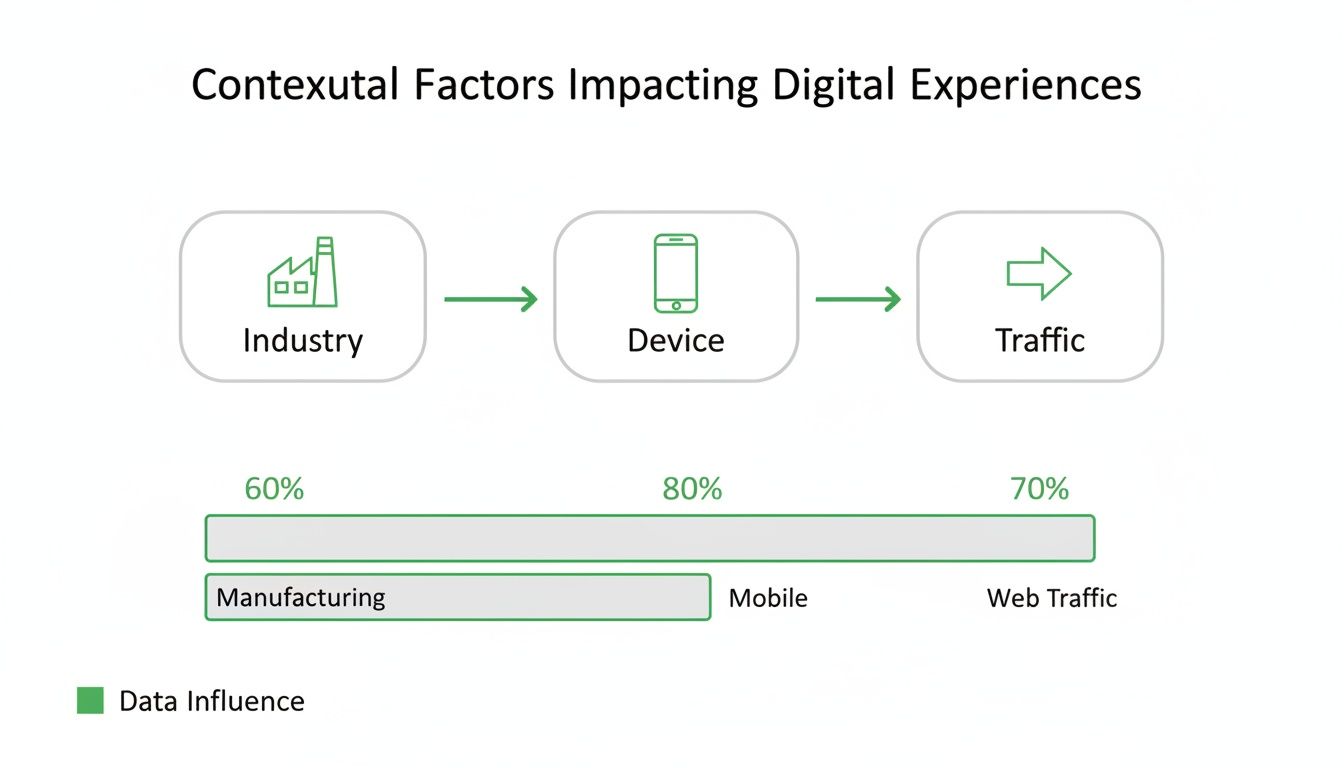
The takeaway here is simple. Your industry, the customer's device, and where they came from are the three biggest levers. You can't change your industry, but you have absolute control over how you build experiences for different devices and traffic sources.
Here's a breakdown of the latest industry benchmarks to give you a clearer picture of the field.
2026 average ecommerce conversion rates by industry
A comparative look at conversion rate benchmarks across key ecommerce sectors, broken down by overall, desktop, and mobile performance based on aggregated 2025-2026 data.
| Industry | Average Conversion Rate (Overall) | Desktop Conversion Rate | Mobile Conversion Rate | Key Drivers |
|---|---|---|---|---|
| Food & Beverage | ~6.0% | ~6.8% | ~5.4% | Impulse buys, subscriptions, high repeat purchase frequency. |
| Beauty & Personal Care | 3% - 5% | ~4.5% | ~3.8% | Habitual reordering, high trust from reviews and UGC. |
| Fashion & Apparel | ~3.0% | ~3.5% | ~2.7% | Trend-driven, but held back by fit uncertainty and returns. |
| Pet Care | 2% - 4% | ~3.2% | ~2.5% | Mix of necessity (food) and considered purchases (health). |
| Electronics & Appliances | ~2.0% | ~2.4% | ~1.8% | High variance; low-ticket accessories vs. high-ticket research. |
| Home & Furniture | ~1.4% | ~1.7% | ~1.2% | High AOV, long research cycles, low purchase frequency. |
| Luxury & Jewelry | ~1.0% | ~1.2% | ~0.8% | Extremely high AOV, requires immense trust and brand equity. |
These figures show that context is everything. A 1.4% conversion rate in furniture can be far more profitable than a 4% rate in a lower-margin vertical. Now, let's dig into what drives these numbers.
High-performing industries
In the dog-eat-dog world of ecommerce, Food & Beverage consistently crushes it, with an average conversion rate of around 6%. It’s the clear standout performer in multiple benchmark reports from 2025-2026. Data from the past year shows the sector holding a steady 6%, with some analyses pointing to desktop hitting 6.8% and mobile a very healthy 5.4%. These numbers are all about high-frequency, low-consideration buys like snacks, drinks, and meal kits that fuel impulse purchases and subscriptions. You can see more details in these 2026 conversion rate benchmarks on dynamicyield.com.
Beauty & Personal Care is another strong performer, usually landing in the 3%–5% range. This is an industry built on habit and routine. Routine-driven purchases are a huge part of this; when someone runs out of their favorite moisturizer, they reorder. This creates predictable demand and a very loyal customer base. The industry is also powered by high trust from social proof, reviews, and user-generated content.
Mid-range performers
Fashion & Apparel sits in a more moderate spot, with benchmarks often hovering around 3%. It's a huge, cutthroat market where trends change on a dime and customer loyalty can be thin.
The biggest killers here are fit and returns. Customers can't try anything on, so there's built-in uncertainty. This is where rich media, seriously detailed size guides, and customer photos make all the difference.
When a customer is looking at a €300 jacket, they aren't just buying an item; they're trying to avoid the hassle of a return. Your job isn't just to sell the jacket, it's to sell them confidence in their decision.
Pet Care is another interesting mid-range player, typically converting between 2%–4%. This sector is a hybrid, blending the necessity of food with the careful consideration you see in health products.
Lower-converting (but high-value) industries
Finally, we have the high-consideration verticals. These are the sectors where the average ecommerce conversion rate by industry looks low on paper, but the average order value (AOV) is through the roof.
Think about Home & Furniture. The benchmark is around 1.4%, but a single conversion could easily be worth thousands. Nobody impulse-buys a sofa. People spend weeks, sometimes months, researching. For these industries, a low conversion rate isn't a sign you're failing. It’s a direct reflection of a complex buying process. Your goal isn't a quick sale; it's to guide the customer through their research, build unshakable trust, and be the only logical choice when they’re finally ready to pull the trigger.
Where your conversion funnel is probably breaking
Feeling a bit deflated after looking at those industry benchmarks? Don't be. Let's have a frank talk about why most stores bleed conversions. It almost always comes down to a few common, fixable problems that are quietly killing your momentum.

It’s easy to blame a low conversion rate on your product or pricing. But the real culprits are usually far more fundamental—and thankfully, easier to fix. These are the silent killers lurking in your funnel, creating friction and shoving potential customers out the door. Just spotting them is the first step toward plugging the leaks for good.
The ad-to-page disconnect
This is the big one. You write a hyper-specific Google Ad for a men's black merino wool turtleneck sweater, but clicking it dumps the user onto a generic Men's Sweaters category page. That’s not a journey; it’s a brick wall.
Now the user has to start their search all over again, wading through dozens of sweaters they don't want. The specific intent that drove the click has evaporated. It's just lazy marketing, and it's costing you a fortune in wasted ad spend.
When a user clicks your ad, they've told you exactly what they want. Failing to deliver on that specific promise on the very next page is like a salesperson turning their back on a customer's direct question. It instantly shatters trust and kills the sale.
This disconnect is a conversion assassin. It tells the customer you either don't get what they're looking for, or you just can't be bothered to show it to them.
Your mobile experience is a clunky afterthought
Mobile often drives the majority of ecommerce traffic—sometimes over 70%. Yet for so many brands, the mobile experience feels like a shoddy port of their desktop site. Buttons are too tiny, menus are a navigational nightmare, and checkout forms feel like they were designed for a keyboard and mouse, not two thumbs.
This is a massive problem when you realize a huge chunk of your paid traffic is coming from users on their phones. Slow load times are another killer. If your mobile page doesn't load almost instantly, you’ve lost them before they even see a product. If you're bleeding customers to a slow site, check out our guide on how to improve page load speed.
One-size-fits-all is a losing strategy
You’re sending every single visitor to the exact same landing page, no matter where they came from. Just think about how dumb that is for a second.
A visitor from a branded search knows you and trusts you; they need a fast lane to purchase. A visitor from a cold Instagram ad has never heard of you; they need social proof and reasons to trust you. A visitor from a competitor comparison keyword is actively sizing you up; they need to see your unique selling points, front and center.
Hitting them all with the same generic page is a huge missed opportunity. It’s the digital equivalent of giving the same sales pitch to a loyal repeat buyer and a first-time window shopper. You're completely failing to meet people where they are in their buying journey.
Spotting where your funnel is breaking is just the start. You can find actionable strategies on how to improve ecommerce conversion rate and drive sales to turn these leaks into actual revenue. Fixing these core issues isn't about chasing some mythical average ecommerce conversion rate by industry; it's about building a smarter, more customer-focused experience that actually works.
How to actually improve your conversion rates
Alright, let's move from theory to action. We've diagnosed the problems; now it's time for the solutions.
This isn't another guide telling you to improve your UX. This is the practical, no-fluff playbook for PPC managers, agency owners, and anyone paid to turn clicks into customers. We're going to focus on a few high-impact pillars you can start working on today.
These are the moves that separate the brands that lead their category from those who just track the average ecommerce conversion rate by industry.
Nail your ad-to-page message match
This is where most campaigns quietly bleed out. You spend all that time and money crafting the perfect ad with a specific promise, only to dump the user on a generic page that completely ignores why they clicked. It’s lazy, it’s disrespectful to the user, and it’s a colossal waste of ad spend.
Imagine someone searches for waterproof trail running shoes for wide feet. They click your ad because it promises exactly that. If the landing page is a generic Men's Shoes category page, you've already lost. You created friction and forced them to start their search all over again. That's a lost sale, 100% of the time.
Perfect message match means the headline, hero image, and core value prop on your landing page directly mirror the ad that brought the user there. This seamless journey from keyword to click to conversion is the single most powerful thing you can do. It tells the customer, I heard you, and here's exactly what you asked for.
The moment a user clicks your ad, they've given you a gift: their exact intent. To ignore that intent on the landing page is to throw that gift in the trash. Message match isn't a nice-to-have—it's the foundation of a profitable campaign.
To truly blow past your industry's benchmarks, you need a solid grasp of how to improve website conversion rate by creating a frictionless path from the very first click.
Build a powerful testing framework
Let’s be clear: a real testing framework is not about changing button colors. That’s rearranging deck chairs on the Titanic. Meaningful testing is about challenging your core assumptions and swinging for the fences with big ideas based on user intent.
Instead of testing minor design tweaks, focus on what actually moves the needle. A powerful framework gets you real answers to business-critical questions, not just a local maximum on a CTA color.
Here’s what you should be testing:
- Your core value proposition: Does free shipping pull harder than next-day delivery? Does a social proof claim like 50,000+ happy customers beat an authority claim like as seen in Vogue?
- Your primary offer: Pit a discount (20% off) against a value-add (free gift with purchase) for the same product. See which one your audience actually values more.
- Social proof formats: Does a wall of star ratings work better than three in-depth customer testimonials with photos? Test them head-to-head.
This kind of testing delivers real insight into your customer's psychology. It's about learning what they truly want, not just what color they’re more likely to click.
Use technology to scale personalization
Manually creating a unique landing page for every ad in your campaign is a terrible idea. It’s an unscalable, soul-crushing task that no team can sustain. It's 2026—we have technology to solve this.
This is where you have to think like a tech operator, not just a marketer. The goal is to deliver a perfectly tailored experience at a scale that was previously impossible. Modern platforms can automate the creation of thousands of unique landing pages, letting you nail that perfect message match without burning out your team.
Platforms like dynares can analyze your Google Ads campaign and automatically generate a corresponding landing page for every keyword or ad group. The system can inject the user's exact search term into the page's headline and copy, creating instant relevance. AI can even help write compelling copy that matches the intent behind the keyword, whether it's informational, transactional, or comparative.
Adopting this approach isn't just about efficiency; it's a strategic shift. It frees your team from tedious manual work so they can focus on high-level strategy, creative, and analysis. Stop doing the robot's work and start building the machine that does it for you. 💡
How we use AI to scale hyper-relevant landing pages
Let me pull back the curtain and show you how we’re applying these principles with our own tech at dynares. This isn't a sales pitch; it's a look under the hood. Honestly, I think the old PPC model is broken: create a few generic landing pages for hundreds of keywords and just hope for the best.
We thought that was a stupid approach. So, we built an AI platform that generates a unique, high-intent landing page for every single keyword in a Google Ads campaign. It’s about moving from tedious, manual work to an intelligent, scalable system that drives real revenue.

From manual drudgery to intelligent automation
The core problem we saw was a fundamental lack of relevance at scale. A marketing team simply can't manually build a dedicated landing page for every single keyword variation. It's not just inefficient; it's impossible.
Our system automates this entire process. It analyzes public data to match the client's brand voice, injects the exact search term into the page, and creates coordinated ads and pages almost instantly. This means you stop forcing users into generic funnels and start building perfect, one-to-one journeys for them.
This tech-driven approach is how you escape the trap of just meeting the average ecommerce conversion rate by industry. You create a system that is inherently more relevant and, therefore, higher-converting than what your competitors are doing manually. It's about building a machine that wins for you.
A practical example in fashion
Let's make this tangible. Imagine a fashion brand running a campaign with hundreds of long-tail keywords. In the old model, a user searching for a men's linen blazer for a summer wedding would be lucky to land on a Men's Blazers category page. That's a huge disconnect.
With our platform, that same user lands on a page with the headline: Men's Linen Blazers for a Summer Wedding. The copy speaks directly to that need, the images feature models in summer wedding settings, and the entire experience validates the user's specific intent.
The results are immediate and predictable. Google Quality Scores rise because the ad-to-page relevance is perfect. Cost-per-clicks (CPCs) drop as a result, and conversion rates increase because you've removed all the friction. It's not magic; it’s just perfect alignment.
This level of granularity is the key. You're no longer just selling a product; you're solving a specific problem for a specific person at a specific moment.
The real impact on performance
So, what does this actually do for a business? It changes the entire economic model of your paid advertising. Instead of battling rising CPCs with incremental improvements, you fundamentally improve the efficiency of every dollar you spend.
It comes down to a few key outputs:
- Drastically improved relevance: Every visitor feels like the page was made just for them, which builds instant trust and reduces bounce rates.
- Higher quality scores: Google rewards this relevance with better ad positions at a lower cost, giving you a competitive edge.
- Measurable conversion lift: When you remove friction and deliver exactly what was promised, more people buy. It's that simple.
This is the future of performance marketing—a shift from managing campaigns to architecting systems that optimize themselves. If you're curious about the nuts and bolts, you can learn more about how our AI landing page builder works in practice.
The goal is to empower teams to focus on strategy, not on the mind-numbing task of manual page creation. It’s about using technology to do what humans can't: deliver perfect relevance at an infinite scale. That's how you stop chasing averages and start setting new benchmarks for your industry. 🚀
Your action plan for the next 90 days
Alright, we've waded through a lot of data and theory. But benchmarks and averages are just interesting trivia until you do something with them. Execution is the only thing that actually pays the bills.
Let's turn all this talk into a simple, no-nonsense plan you can start today. The point isn't to magically hit some generic average ecommerce conversion rate by industry. The goal is to build a rhythm—a repeatable process of smart, focused iteration. That's how you stop being average and start leading.
This is your 90-day sprint to build that muscle.
Month 1: Find the biggest leak
Your first 30 days are about one thing: finding the single biggest, most obvious point of friction in your funnel. Forget the small stuff for now. Use the data from this guide to go on a diagnostic mission and find the most painful leak.
Is your mobile checkout experience a total train wreck? Do your top-spending ad campaigns point to landing pages that feel completely disconnected from the ad? Be brutally honest with yourself. Pick one—and only one—major problem to attack. The goal here is clarity, not a sprawling to-do list.
Month 2: Test something that matters
Now you have your target. Month two is for focused, intentional experimentation.
Come up with a clear hypothesis based on the problem you found. For example, if your ad-to-page relevance is a mess, your hypothesis might sound like this: Creating a dedicated landing page for our top ad group that perfectly mirrors the ad's headline and offer will increase conversions by 20%.
This is where most people get it wrong. They waste time testing button colors. That’s a distraction. You should be testing your core value proposition. Test a radically different offer. Test the hell out of your social proof. Make a big, meaningful swing based on a real insight you have about your customers.
Run one significant A/B test based on that strong hypothesis. Let it run until you have a statistically significant result. One good test is worth a dozen half-hearted tweaks.
Month 3: Scale the win or scrap the loser
By the beginning of month three, you'll have a clear result from your experiment. There are only two outcomes, and frankly, both of them are wins.
If you found a winner, fantastic. Now your job is to scale that learning. If the new landing page crushed it, apply that same structure to your other high-priority ad groups. If the new offer was a hit, start integrating it across more of your marketing. Don't just celebrate the win—multiply it.
If the test failed, this is also a win. You just paid to learn something incredibly valuable about what doesn't work for your audience. That's critical intelligence. Ditch the losing variant, form a new hypothesis based on what you just learned, and get ready for your next 90-day cycle.
Stop admiring the problem. Stop getting mesmerized by benchmark reports. Go fix one thing. Then the next. And the one after that. This is the work. Let's go. 🚀
Frequently asked questions
Here are a few common questions I get about ecommerce conversion rates, answered directly without the usual marketing fluff.
What is a 'good' ecommerce conversion rate?
Honestly, the word ‘good’ is relative and often misleading. A 0.5% conversion rate for a shop selling €5,000 custom furniture is fantastic. On the other hand, an 8% rate for a subscription snack box might just be average for its niche.
Instead of obsessing over some universal number, focus on two things that actually matter: are you performing at or above the specific benchmark for your industry, device, and traffic source? And is your rate trending up over time?
Continuous improvement is a far more practical and ambitious goal than hitting an arbitrary number someone posted online. The real win is beating your own past performance.
How does traffic source affect conversion rates?
Massively. The intent behind the click is everything.
Traffic from a branded search, where someone types your company's name directly into Google, will always convert highest. That person is already sold on you; they just need a clear path to the checkout. Traffic from highly targeted email campaigns and comparison shopping engines will also be strong.
Don't let low-intent awareness traffic drag down the perceived performance of your high-intent campaigns. Segment your analytics by channel and judge each one on its own merits.
On the flip side, traffic from top-of-funnel social media ads will naturally have a much lower conversion rate. That’s not a failure; it’s just a different audience with different intent. If you're not segmenting, you're looking at a blended, useless average. You can read more about this in our guide on what a conversion in marketing truly means.
How can I quickly improve ad-to-page relevance?
The fastest way is to stop doing it manually and use a tool that automates it. It's 2026; creating landing pages one by one is a dumb and unscalable approach.
A platform like dynares can generate thousands of landing pages perfectly matched to individual keywords, ensuring the page headline reflects the user's exact search query. This creates instant relevance.
Manually, the best you can do is create tightly-themed ad groups and build a dedicated landing page for each one. It's painfully time-consuming, but it’s still lightyears better than dumping all your valuable paid traffic onto the homepage and hoping for the best.
Ready to stop wasting ad spend on generic landing pages? dynares uses AI to automatically build a hyper-relevant page for every single ad, boosting your Quality Score and conversions. Get a demo and see how it works at https://dynares.ai.