
Let’s cut to the chase: if your PPC and SEO teams are siloed, you’re just lighting money on fire. It’s not a simple mistake; it’s a strategic failure that’s more common than you’d think. I’ve seen it a hundred times in the European tech scene.
Think of it this way: PPC is your rapid-response recon team and SEO is your long-term empire builder. It’s time they started sharing the same map.
Your marketing teams are fighting a pointless war
I see it constantly—one team bidding on keywords the other is desperately trying to rank for, with zero communication between them. This internal turf war is one of the dumbest, most self-sabotaging things a business can do. You're literally paying to compete against yourself while your actual competitors get a free pass.

This guide isn’t about corporate fluff. I’m giving you the unfiltered truth about why making PPC and SEO work together is no longer a ‘nice-to-have’—it's the core of any intelligent growth strategy today. Instead of debating which is better, SEO or Google Ads, it's far more productive to focus on how they must complement each other to actually win.
We'll cover how to stop the infighting and start building a unified search presence that dominates your market. The goal is to create a system where each channel makes the other stronger.
I’ll share the frameworks that top tech companies and lean startups are using to turn paid data into an organic traffic machine, and vice-versa. This is about building a powerful feedback loop. You can learn the fundamentals in our guide to what is paid search marketing, but here, we’re focused on putting it all together.
Here’s a simple way to look at it:
- PPC finds the gold. It provides immediate data on what messages convert and which keywords have real commercial intent.
- SEO builds the fortress. It uses those insights to build long-term, compounding organic assets that drive sustainable traffic.
- Together, they own the territory. You get short-term wins and build a long-term moat around your business.
It’s time to get your teams on the same side. Let's get to work.
Use ppc data as your seo crystal ball
Stop guessing which keywords are worth your SEO team's blood, sweat, and tears. It’s a slow and expensive way to build a content strategy. Instead, think of your PPC account as a high-speed market research lab. You can see what actually converts—not just what drives clicks—in days, not months.
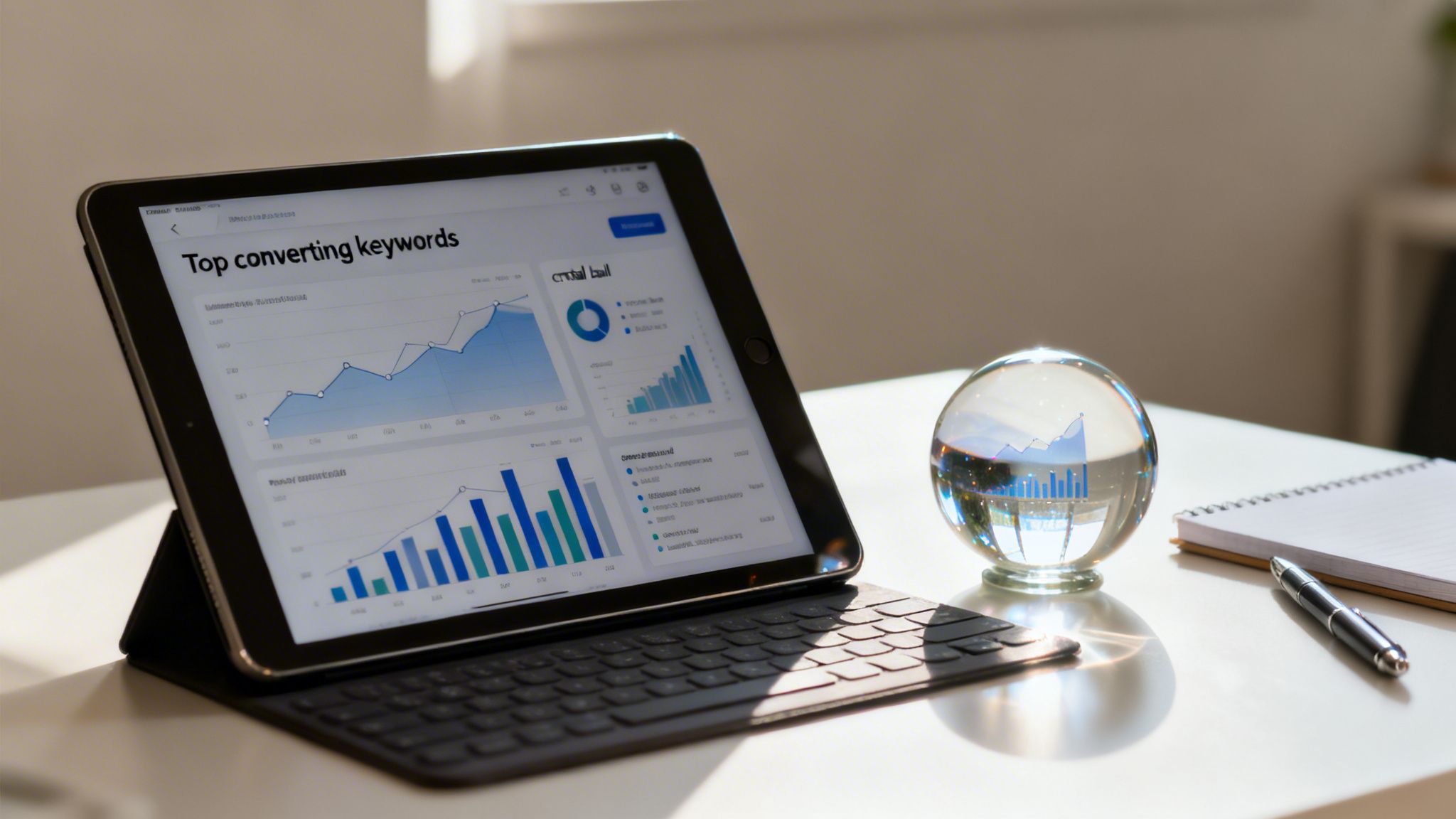
This isn't just a nice theory; it's about building a practical, data-driven feedback loop. You’re de-risking your SEO investment by validating user intent with a small ad budget before you commit to the long game of ranking organically. This is how you build a content roadmap that’s practically guaranteed to have an audience that buys.
PPC gives you immediate feedback. When you see that Google Ads on the search network has an average conversion rate of 4.40%, you know you're getting precise data on what resonates with your audience. You find the keywords driving the most conversions, and suddenly you have a list of goldmines waiting to be claimed with organic traffic.
Find your golden keywords
The first and most obvious win here is keyword intelligence. Your Google Ads search query report is a direct line into your customers' minds, showing you the exact phrases people type before they open their wallets. This is raw, unfiltered data on commercial intent.
Stop treating your SEO keyword list like a theoretical wish list. Your highest-converting paid keywords are your new SEO priority list. Period.
While your SEO team is digging for long-tail opportunities, your PPC manager already has a list of them—complete with conversion rates and cost-per-acquisition data. These aren't just guesses; they are proven money-makers. A deep dive into your paid search analysis can reveal surprising audience behaviors and lock in your strategy.
Test your messaging at speed
Keywords are only half the battle. The other half is messaging. What headlines grab attention? Which value propositions actually make people click and convert? A/B testing ad copy is standard practice in PPC, but those learnings rarely make it over to the SEO side.
This is a massive missed opportunity. Here’s a simple process to fix it:
- Identify Winning Ad Copy: Go into your PPC campaigns and find the ads with the highest click-through rates (CTR) and conversion rates. What specific phrases, benefits, or calls-to-action are working?
- Inject Into SEO: Systematically update your organic meta titles, descriptions, and on-page H1s with this proven messaging. You’re no longer guessing what might work; you're deploying copy that you already know resonates with your audience.
- Optimize Landing Pages: Does a particular landing page from a PPC campaign convert exceptionally well? Analyze its structure, copy, and offer. Replicate those winning elements on your core organic landing pages.
This simple feedback loop turns your entire search presence into a conversion-optimized machine. You can explore how advanced keyword research features can streamline this process even further. By using paid search as your testing ground, you’re making your organic efforts smarter, faster, and far more likely to deliver a real return.
Dominate the SERP with a one-two punch
Settling for just one spot on the search results page is playing it safe. The real prize is owning the whole conversation—grabbing both the top paid ad and the #1 organic result for the keywords that actually make you money. This isn't an ego trip; it's about building an unshakeable brand presence and maximizing every single click you can get.
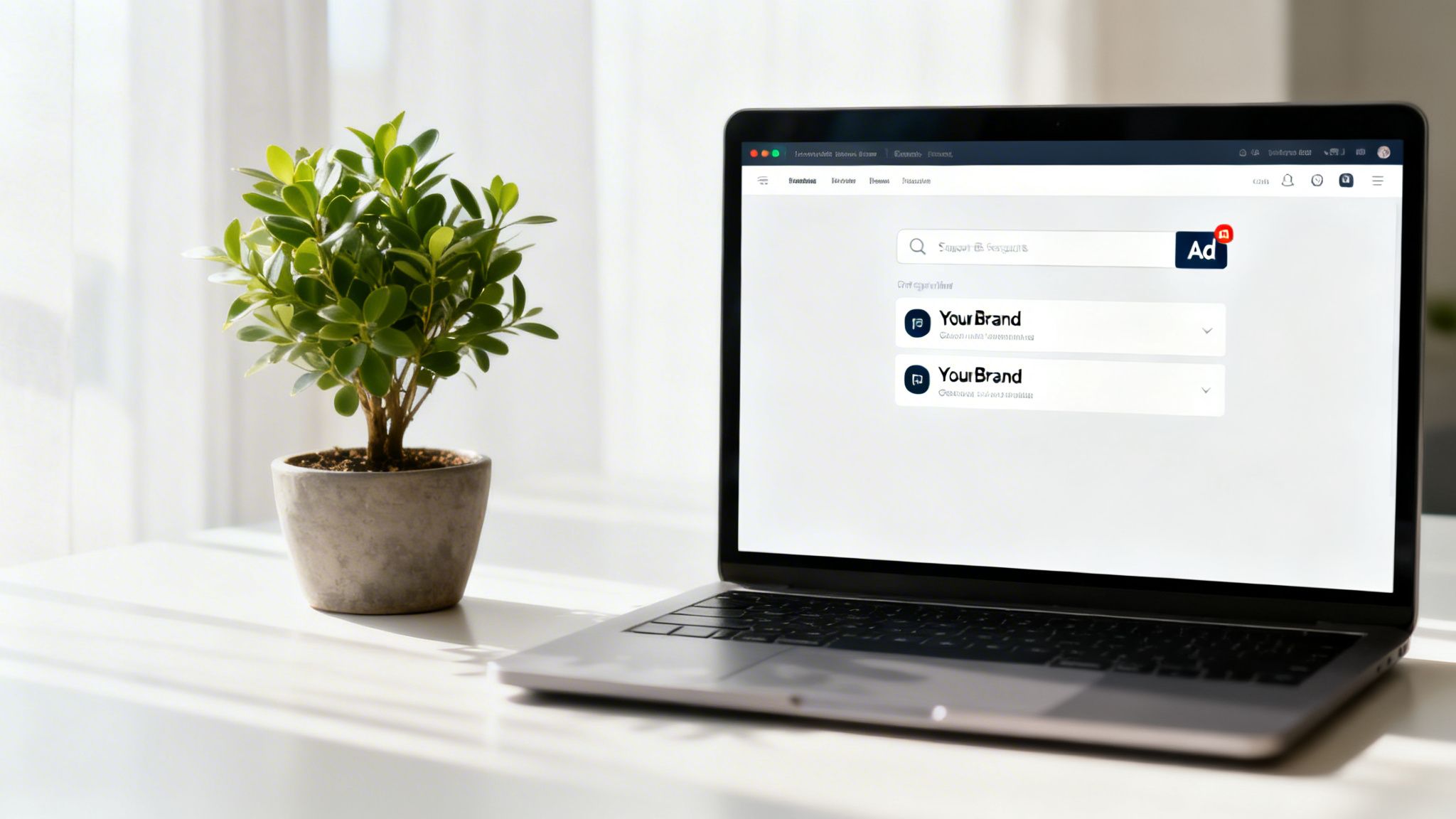
Think about it from the user's perspective. They search for a solution and see your brand twice. First in the ads, then right below it in the organic listings. That’s a powerful psychological shortcut. It instantly frames you as the authority, the default answer.
This isn’t just theory. It’s a practical way to push your competitors so far down the page they might as well be on page two. The combination of PPC and SEO working together is how you go from being an option to being the only credible choice.
Execute a pincer movement on the SERP
Think of your search strategy like a military pincer movement. Your PPC ads are the fast-moving cavalry, capturing high-intent traffic from the minute you launch. They get you immediate visibility and data.
At the same time, your SEO efforts are the heavy infantry, systematically grinding their way up the rankings to secure the high ground for the long haul.
When you target the same valuable keywords with both, you create a powerful flywheel. The ad brings in quick conversions, while the organic result builds sustainable, low-cost traffic and trust. You get the short-term wins and the long-term security.
Owning both the paid and organic top spots for a keyword doesn't cannibalize your traffic. It starves your competitors of oxygen. You take up more screen real estate, push them below the fold, and double your chances of earning the click.
This is especially critical for defending your own brand name. If a competitor is bidding on your keywords and you're not, you're just letting them steal customers right from under your nose. It’s a bad look.
When to bid on your own brand
Bidding on your own brand name, even when you rank #1 organically, feels wrong to a lot of people. They’re mistaken. It’s one of the smartest plays you can make, both for defense and offense.
Defensive Play: Your competitors are absolutely going to bid on your brand name to poach customers. By placing your own ad at the top, you build a defensive wall, making it way more expensive and less effective for them to siphon off your traffic.
Offensive Play: You get total control over the message. Your ad copy can push a new feature, a limited-time promotion, or send users to a specific high-converting landing page that isn't your homepage. It gives you surgical control over the user journey.
Total Domination: Seeing your brand in the top ad spot and the top organic result is the ultimate power move. It screams market leader and significantly boosts the total clicks you get from that search.
This isn't about wasting money on clicks you might have gotten for free. It’s a strategic investment to own your market and ensure that when someone looks for you, they find you—and only you. That’s how you build a brand that lasts.
Talking about synergy is one thing. Actually making it happen is another. Let’s be real: your old workflow of patched-together spreadsheets and endless email chains isn’t going to cut it if you're serious about this. It's an inefficient system that practically guarantees your teams stay in their own worlds.
If you want to make PPC and SEO working together a reality, you need an infrastructure that’s actually built for it. I’m talking about a modern tech stack that automates the repetitive work and finally bridges the gap between your paid and organic search teams. This goes way deeper than just looking at the same keyword reports in SEMrush.
Moving beyond basic research tools
The usual tools like Ahrefs and SEMrush are fantastic for research and analytics. They’re essential, don't get me wrong. But they are fundamentally passive—they show you data, but they don't do the integration for you. You still need a human to connect the dots and manually implement what they find, which is exactly where the process always breaks down.
The real shift happens when you move from analysis to automation. The companies growing the fastest aren’t just looking at data; they're using platforms that act on it in real-time. This is where the next generation of marketing tech comes into play.
The goal isn't just to have your PPC and SEO teams talk to each other. It's to build a system where the data from one channel automatically and intelligently fuels the actions of the other, without a human bottleneck.
This is about building a machine, not just managing campaigns. It requires a stack that can handle real-world complexity and scale without needing an army of marketers to run it.
The power of programmatic ad and landing page generation
This brings us to the core problem: getting granular, but at scale. It’s easy to create one perfect ad and a matching landing page. It’s a manual nightmare to create 10,000 of them, each one hyper-relevant to a specific long-tail keyword. This is where platforms like dynares are completely changing the game.
Imagine this workflow: you identify a list of 5,000 high-intent, long-tail keywords. An AI-powered system instantly generates a unique, optimized ad for each of those keywords. At the same time, it creates a perfectly matching, high-converting landing page for every single one of those ads.
This creates a perfect message match from the ad click all the way to the conversion, which is exactly what you need to boost Google Ads Quality Scores and slash your CPC. But the magic doesn't stop there. Those thousands of new landing pages aren't just for PPC. They become a massive library of keyword-rich, intent-focused content that can be indexed and used for your SEO strategy, letting you build topical authority at a speed that was never possible before.
This kind of automation won't be optional for long. We’re already seeing how AI-fueled collaboration is cutting costs and boosting efficiency. With paid search commanding 39% of marketing budgets and businesses seeing 47% of global purchases influenced by this kind of synergy, the platforms that enable it are quickly becoming the new standard.
Building the full stack for integration
So, what does this ultimate stack actually look like? It’s not just one tool, but a connected ecosystem designed from the ground up for a unified search strategy.
It starts with a Keyword & Data Foundation using your standard tools like SEMrush, Ahrefs, and Google Keyword Planner. They're still your starting point for initial research and keeping an eye on competitors.
Then comes the Programmatic Creation Engine. This is the heart of the operation. A tool like dynares handles the automated generation of ads and landing pages at scale. It makes sure your messaging is consistent and feeds conversion data back into the system. You can even explore the specifics of the Google Ads integration to see exactly how it works.
Finally, you need an Analytics & Attribution Hub. Google Analytics 4 (GA4) and a CRM like HubSpot are crucial for tracking the entire user journey. This is where you measure blended CAC and finally see how paid traffic influences organic conversions, and vice-versa.
This is the infrastructure you need to stop just talking about synergy and start executing it. It’s about using technology to build a system that’s smarter, faster, and far more effective than any siloed team could ever hope to be. This is how you win. 🚀
A practical playbook for getting started today
Alright, enough theory. Time to get your hands dirty.
This is the part where we stop talking about synergy and actually get PPC and SEO working together—like, this week. Forget the year-long strategy sessions and endless slide decks. This is about building small, smart habits that stick.
I'm not giving you a 50-point checklist that gathers digital dust on your desktop. Instead, here are the simple, high-impact moves you can make right now to get the flywheel spinning. This is for the PPC managers, SEO specialists, and agency owners who are ready to build something better.
Create one source of truth
The biggest reason your teams aren't aligned is because they're looking at different scoreboards. The PPC manager is obsessed with CPA and ROAS, while the SEO specialist is chasing rankings and organic traffic. It’s a dumb, siloed way to work. You need one shared dashboard that forces everyone to look at the same reality.
Build a dead-simple dashboard in Looker Studio or your tool of choice. It just needs to pull from Google Ads and Google Search Console, showing these metrics side-by-side for your top 20 commercial keywords:
- Paid Clicks vs. Organic Clicks: What's the total traffic we're getting for this keyword, not just what my channel brought in?
- Paid CTR vs. Organic CTR: Which ad copy and meta description combo is actually convincing people to click?
- Paid Conversions & CPA: What does it really cost to get a customer from this term on the paid side?
- Current Organic Rank: Where are we today, and are we moving up or down?
When both teams stare at the same data, the conversation shifts from my channel is better to how do we completely own this keyword? It’s a small change that makes a massive difference. You stop defending territory and start conquering it together.
This simple visualization shows the whole loop: use data to find the right keywords, create high-quality ads and content to match, and then scale what works.
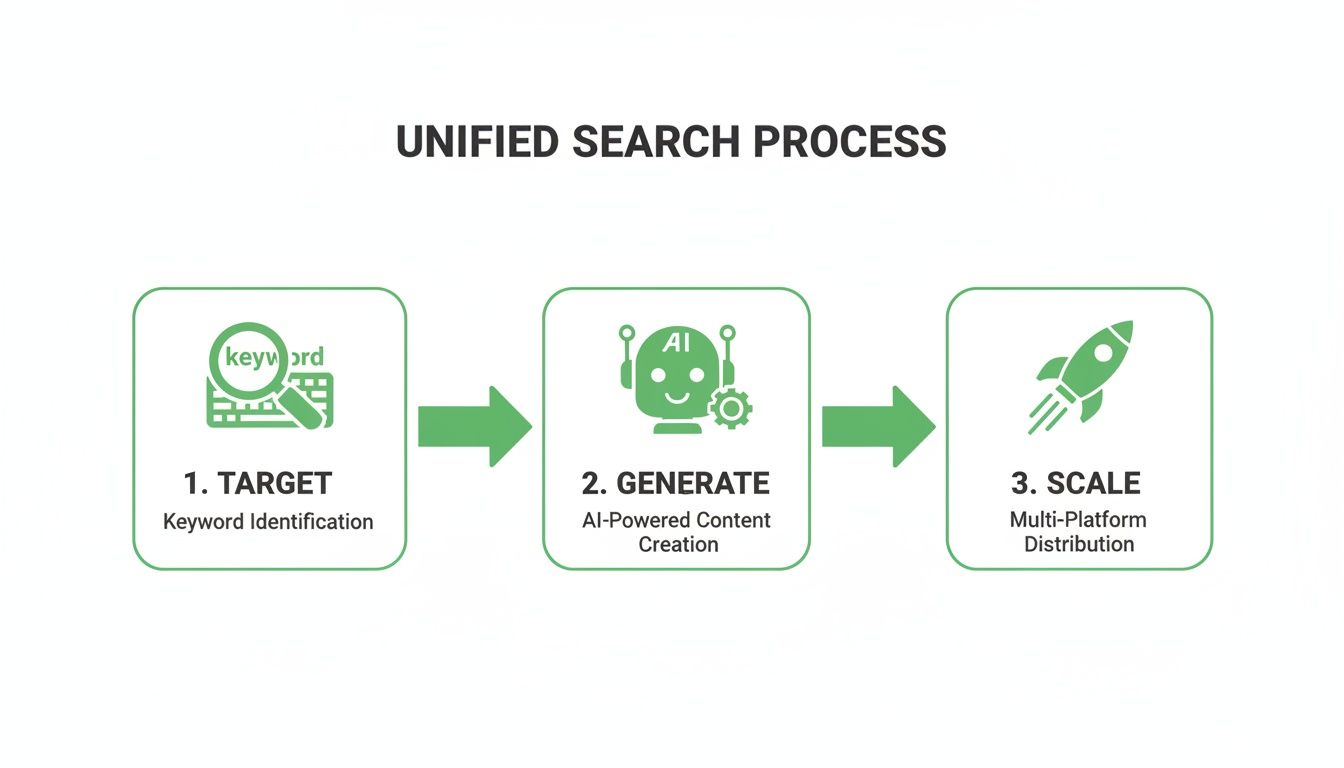
The insight here isn't complicated. Each step feeds the next, creating a loop of continuous improvement instead of a string of one-off campaigns.
Run your first 'keyword test' sprint
This is my favorite quick win. You can pull it off in a single week and walk away with immediately valuable data. The goal is to use PPC to rapidly validate which keywords are worth your SEO team's time.
First, your SEO team picks a handful of 5-10 "maybe" keywords. These are the terms they think could drive business but aren't sure enough to spend months building content for. Then, the PPC manager sets up a small, tightly focused campaign targeting only these keywords. The budget can be tiny—just enough to get statistically meaningful click and conversion data.
After 5-7 days, look at the numbers. Which keywords drove clicks? More importantly, which ones actually led to conversions or valuable actions? Which ad copy had the highest CTR? The keywords that converted are now priority #1 for the SEO team's next content sprint. The ones that bombed get put on the back burner. You just de-risked your entire content strategy with real-world, dollars-and-cents data.
You can dramatically speed up the process with tools that shorten the content creation part. For a closer look, check out our guide on automated content creation to see how you can go from insight to a published page at scale.
This simple sprint builds the muscle of collaboration. It gives both teams a shared win and proves the value of an integrated approach with hard numbers, making it way easier to get buy-in for bigger projects down the road. It’s practical, it’s fast, and it works.
The future is integrated, or it's irrelevant
Let's zoom out and be blunt. The world of search is getting messier, not cleaner. Between AI summaries rewriting the SERP on the fly, a constant stream of new ad formats, and user behavior that changes overnight, betting everything on a single channel is just asking to go extinct.
If you’re still caught up in the PPC vs. SEO debate, you’re already behind.
The future of acquiring customers isn't about picking a winner. It's about deeply understanding a person's entire journey—from their first vague thought to the moment they pull out their credit card. The companies that win the next decade won’t be the best at just PPC or just SEO. They'll be the ones who master using the data from one to make the other devastatingly effective.
Stop managing channels and start managing a system
Getting your search efforts to talk to each other isn't just a nice-to-have; it's the first real step toward building a growth engine that can actually withstand the chaos. You're trying to build a flywheel, not just run two campaigns in parallel. This isn't some fluffy marketing tactic. It's a core business philosophy for anyone serious about building a modern, tech-driven company.
The goal is to build a system where PPC and SEO working together is the default state. Paid acquisition makes your organic presence stronger, and a strong organic presence systematically lowers your customer acquisition costs.
Think of it this way: When you run a PPC campaign, you’re buying data. When you invest in SEO, you’re building an asset. It is profoundly stupid not to use the data you just paid for to make the asset you're building more valuable.
Every click, every conversion, every piece of ad copy that hits the mark is a signal. Ignoring those signals in your long-term organic strategy isn't just a missed opportunity—it's lazy.
Building your flywheel, brick by brick
So what does this integrated future actually look like on a Tuesday afternoon? It’s not about some grand, abstract PowerPoint strategy. It's about a series of tangible, connected actions that build on each other.
Data is the connective tissue: PPC data on what converts and how people search should directly feed your SEO content calendar. Stop guessing what to write about; just follow the money.
SERP domination is the standard: Owning both the paid and organic spots for your most valuable keywords becomes the baseline. It cements your authority and pushes your competitors so far down the page they may as well not exist.
Blended CAC is your North Star: You stop obsessing over channel-specific ROI and start tracking your blended Customer Acquisition Cost. This is the one number that tells you if your entire search system is getting more efficient over time.
This setup creates a self-reinforcing loop. Paid ads test the messaging that you then use to perfect your on-page SEO. Stronger organic rankings boost your domain authority, which in turn can lead to better Quality Scores and cheaper clicks in your paid campaigns.
Each side makes the other better. That's the whole game.
This is the mental shift we all need to make. It’s a more ambitious, more intelligent way to approach growth. The businesses clinging to their silos will be outmaneuvered by leaner, smarter competitors who get it. In the modern world, the whole is always greater than the sum of its parts. Stop managing channels. Start building your system.
Alright, let's tackle some of the most common questions I hear when talking about getting PPC and SEO to actually work together. These are the things people ask when the webinar ends and they need to make a real decision on Monday morning.
Should I bid on keywords I already rank #1 for organically?
Yes. Almost always, yes.
The old-school way of thinking is to worry about cannibalization. That's a mistake. The modern way to think about it is total SERP domination. It’s both an offensive and a defensive play.
Defensively, it's brutally simple: you block competitors from slapping their ad directly above the organic spot you fought so hard for. It’s madness to pour all that effort into SEO just to let someone with a credit card steal the first click. Don't let them.
Offensively, you own more screen real estate, you control the message with nimble ad copy, and you can direct traffic to purpose-built, high-conversion landing pages. This isn't about stealing clicks from yourself. It's about expanding your territory. Studies have shown this strategy increases your total clicks from the search results page, building massive brand credibility in the process.
What's the first step for a small team with limited resources?
Forget the complex software and pricey consultants for a moment. The first, most important step costs you nothing but a little discipline: start sharing data.
Your biggest obstacle isn't your budget; it's the silos between your teams.
Here’s the simplest, most practical first move you can make today. Create a shared dashboard—a Google Sheet works just fine—with two columns: your top 10 highest-converting paid keywords and your top 10 target organic keywords. This becomes your shared source of truth.
Next, schedule a 30-minute meeting every two weeks. The only agenda item is, What did we learn from paid search that can shape our content, and what organic insights can help refine our ad targeting? That's it. It costs zero dollars and builds the foundational habit of communication. Small, consistent actions are what build a real system.
How do you measure the combined ROI?
You have to stop looking at channel-specific ROI as your only North Star. If you keep measuring PPC and SEO in separate vacuums, you'll keep managing them that way. It's time to think bigger.
Start tracking a blended CAC (Customer Acquisition Cost) across both search channels. It’s a simple metric, but it’s incredibly powerful.
Blended Search CAC = (Total PPC Spend + Total SEO Resource Costs) / Total Customers Acquired From All Search
Watch this number over time. As your SEO efforts gain traction—fueled by the insights you're feeding it from PPC—your organic traffic will rise. You can then strategically pull back on paid spend for certain keywords. The result? Your blended CAC should go down.
This is the metric that proves the financial value of an integrated system. It shifts the conversation from which channel won? to how much more efficient is our entire search marketing engine becoming? That's the question your CEO or founder actually cares about.
Ready to stop talking about synergy and start building a system that executes it at scale? dynares uses AI to automatically generate thousands of coordinated ads and matching landing pages, turning your PPC data into a conversion machine. See how it works at dynares.ai.