
Let's get straight to it: AI copywriting is using artificial intelligence to generate human-like text for marketing. It's not about firing your writers. It's about giving them a ridiculously powerful co-pilot to handle the heavy lifting, from ad variations to entire blog drafts.
So what is AI copywriting, really?
Alright, let’s cut through the buzzwords. When we talk about AI copywriting, we're talking about Large Language Models (LLMs)—massive AI systems trained on an incredible amount of text and data from the internet.
Think of an LLM as an expert assistant who has read nearly every book, article, and website ever published.
You give this assistant a specific instruction, a prompt, and it uses its vast knowledge to predict the most logical sequence of words to create a response. This simple process completely changes the game for a founder or a PPC manager. Content creation shifts from a slow, manual grind to a rapid, iterative process.
Before we go deeper, it helps to understand the bigger picture of what AI generated content is to get the full context.
A co-pilot, not an autopilot
The biggest misconception is that you just press a button and get perfect, ready-to-publish copy. That’s not how it works. The reality is more like a collaborative dance between you and the machine.
You bring the strategy, the brand insight, and the final creative judgment. The AI brings the speed and scale.
This partnership is catching on fast. The global AI copywriting tool market was valued at around USD 1.5 billion in 2023 and is projected to hit USD 5.6 billion by 2032. This isn't some niche trend; it’s a fundamental shift driven by the need for faster, more personalized marketing. The goal isn't to automate your creativity away. It's to automate the tedious parts so you can focus on the high-impact strategic thinking that actually grows your business.
How does this work in practice?
So, what does this look like day-to-day? It’s all about efficiency and getting more shots on goal.
- Ideation: Instead of staring at a blank page, you can generate dozens of angles for a new campaign in minutes.
- Drafting: Get a solid first draft of an ad, landing page, or email that you can then refine and polish. Many platforms offer pre-built copywrititng templates that give you a structured starting point.
- Variation: A/B testing becomes effortless. Need 20 different headlines for a Google Ad? The AI can generate them instantly, letting you test more hypotheses and find winning combinations much faster.
To make the difference clear, here’s a quick comparison of how AI-powered copywriting stacks up against the old-school manual approach.
| AI copywriting vs. traditional copywriting at a glance | ||
|---|---|---|
| Metric | Traditional Copywriting | AI Copywriting |
| Speed | Slow. Days or weeks for a single campaign. | Fast. First drafts and variations in minutes. |
| Scale | Limited. Hard to produce high volume. | Massive. Can generate thousands of variations. |
| Cost | High. Agency retainers or per-project fees. | Low. Typically a monthly SaaS subscription. |
| Consistency | Variable. Depends on the individual writer. | High. Can adhere strictly to brand voice rules. |
| Human Oversight | Built-in. Every word is human-created. | Essential. Requires editing and strategic direction. |
As you can see, the value isn't in replacing human thought but in executing on it at a speed and scale that was previously impossible. It's about taking a solid strategy and multiplying its impact without multiplying your headcount.
How AI actually generates content
So, what's really going on inside this "black box"? You don't need a computer science degree to get it, but if you're a founder, you should understand the basics of the tech you're putting your budget behind. Let's pull back the curtain.
At the core of AI copywriting are Large Language Models (LLMs), like GPT-4. The easiest way to think about an LLM is to imagine an incredibly smart assistant who has read nearly every book, website, and article ever published. Seriously. It's digested a huge chunk of the internet's text.
When you give this assistant an instruction—what we call a prompt—it doesn't "think" like a human. Instead, it uses that massive knowledge base to play a high-stakes game of prediction. It calculates the most statistically likely sequence of words to create a coherent and relevant answer to your request. If you want to go a little deeper, understanding the fundamentals of Natural Language Generation (NLG) is key to seeing how these tools produce such human-like text.
This is exactly why prompt engineering has become such a big deal. It’s not some dark art; it's just the skill of asking the right questions to get the right answers. A vague prompt gets you generic, useless mush. A specific, context-rich prompt gets you sharp, relevant copy.
The human-in-the-loop workflow
It's a huge mistake to see AI as a magic button you just push for perfect copy. The real power comes from a collaborative workflow where the AI does the heavy lifting and you provide the strategic direction and final polish. It’s a partnership, not a replacement.
This flowchart shows the simple but powerful process in action.
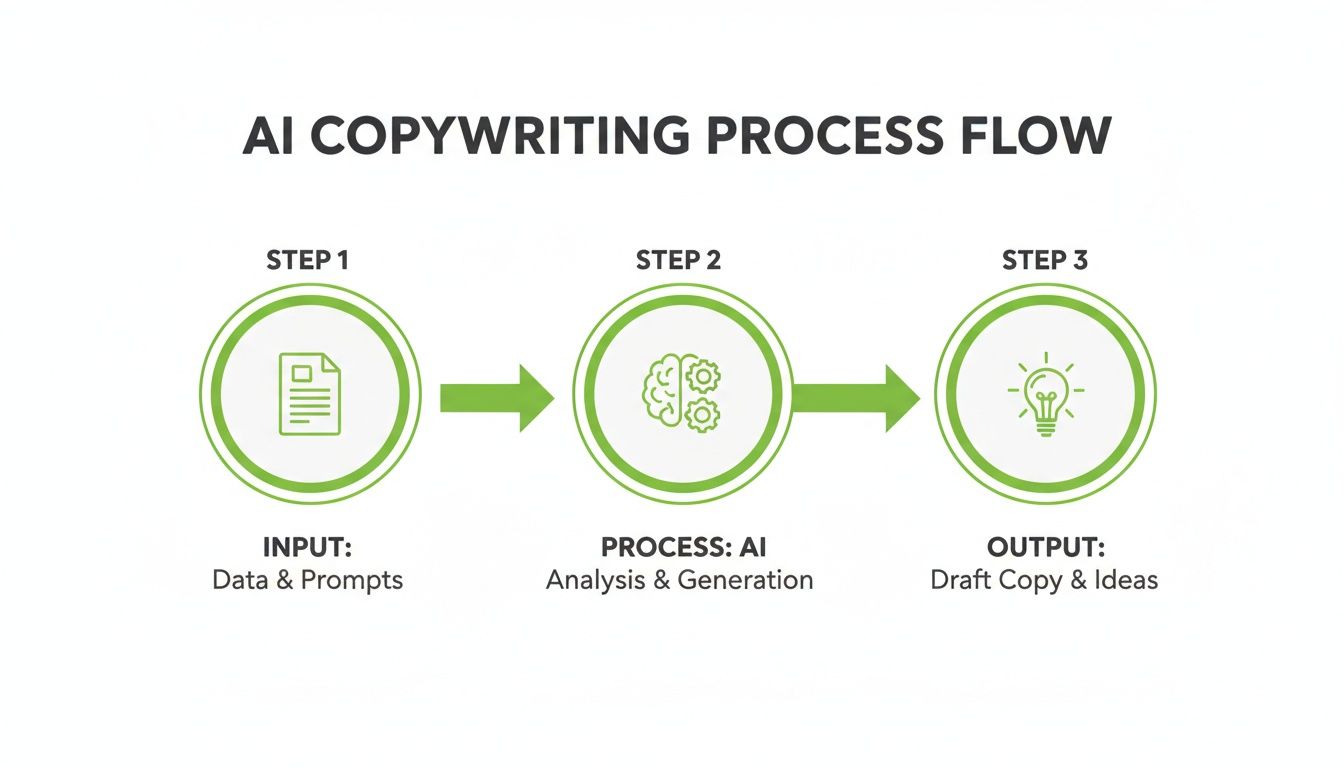
The visual breaks it down into three core steps: you provide clear inputs, the AI processes them to generate outputs, and your team refines the results into something you can actually use.
This loop—input, generation, refinement—is where the magic happens. You’re not just accepting the first thing the AI spits out. You’re guiding it, iterating, and shaping its output until it fits your exact needs. The quality of your AI-generated copy is a direct reflection of the quality of your input and the rigor of your review. Garbage in, garbage out. Strategy in, results out.
From prompt to polished copy
Let’s walk through what this actually looks like for a marketing team day-to-day. The process isn't complicated.
It all starts with a detailed brief. This isn't just "write an ad for my product." It includes the target audience, their key pain points, your unique value proposition, the desired tone of voice, and a clear call to action.
The AI takes that brief and spins up multiple variations. For example, our own platform has an integrated ad builder designed to generate dozens of on-brand ad variations for Google Ads in minutes based on these specific inputs.
Then, your team steps in to review the options. They might mix and match headlines, tweak the descriptions, and ensure the copy perfectly aligns with the brand’s voice. This human touch is completely non-negotiable for producing high-quality work.
This isn’t about replacing your team’s creativity; it’s about amplifying it. The AI handles the grunt work of generating options, freeing up your people to focus on strategy, editing, and making sure the final product connects with customers on a human level. It’s a powerful force multiplier.
Using AI copywriting to get real results
Theory is cool, but in the real world, business runs on results. Let's get into the practical ways you can actually use AI copywriting to make a tangible impact, specifically where it matters most for performance marketing: Google Ads and landing pages.
Forget the abstract examples. This is about moving the needle.

For a PPC manager, the most immediate win is speed and volume for testing. Instead of spending hours painfully writing a handful of ad variations, you can generate dozens of distinct headlines and descriptions in minutes.
This isn't just about saving time; it's about radically increasing your capacity for A/B testing so you can find winning combinations faster.
Supercharging your Google Ads workflow
Let’s be honest, the manual process of creating ad groups with unique, relevant copy for every keyword is a soul-crushing grind. This is exactly where AI shines. It’s not about replacing the strategist; it’s about giving them superpowers. Here's how you can put it to work immediately: generate mass variations, brainstorm new angles, and refresh stale ad copy in minutes.
Building higher-converting landing pages
The same principles apply to landing pages. Manually writing unique, persuasive copy for different audience segments is incredibly time-consuming. AI turns this bottleneck into a streamlined process.
The data backs this up; AI-powered copywriting has been shown to boost click-through rates by 38% on ads while slashing cost-per-click by 32%. It’s clear these tools sharpen precision, which is why 93% of marketers are using AI to speed up content production. If you're curious about this, read more about these AI marketing statistics and see the impact for yourself.
Think of AI as your optimization engine. It allows you to test value propositions, calls-to-action, and benefit statements at a scale that would be impossible with a purely manual approach. This dramatically accelerates your learning and optimization cycles.
With the right setup, you can connect your ads directly to messaging-matched landing pages—a crucial step for maximizing conversions. We've explored the practical side of this in our guide on AI-powered landing pages for Google Ads.
It’s all about creating a seamless, persuasive journey from the first click to the final conversion. The goal is to move beyond generic, one-size-fits-all pages and toward a highly personalized experience for every user segment. That's how you win.
The good, the bad, and the realistic
Alright, let's have a real conversation. AI copywriting isn't a magic button, and anyone selling it like that is, well, selling something. As a founder, I'm a tech optimist, but I’m also painfully grounded in what actually works. You need to see both sides of this coin before you jump in.
The upside is huge, no doubt. The sheer speed is a different class of productivity. What took a human team days of writing, editing, and back-and-forth now takes minutes. This lets small, sharp teams punch way above their weight, scaling content in a way that was flat-out impossible before. It’s a massive cost-efficiency play and a serious edge if you're trying to outrun bigger, slower competitors.
The good: the obvious wins
Let’s tick off the benefits, because they are game-changing. These are the practical advantages you'll feel almost right away.
- Unmatched speed: Go from a terrifyingly blank page to multiple drafts in seconds. This isn't just a small improvement; it's a fundamental shift in how fast you can move.
- Massive scale: Need 50 unique ad variations for a single campaign? Or distinct product descriptions for 1,000 different SKUs? AI handles this kind of volume without even blinking. No human team could ever do that affordably.
- Cost-effectiveness: When you can generate more content with the same headcount, your cost per asset drops through the floor. That frees up your budget for the things humans do best: strategy, creative direction, and distribution.
This shift is fueling some serious market growth. The copywriting sector is on track to hit USD 27.96 billion in 2025 and is projected to climb to USD 42.83 billion by 2030, with AI being a huge driver. If you're curious, you can explore more about this market evolution.
The bad: the critical limitations
Now for the hard part. Ignoring the weaknesses of AI copywriting is a recipe for expensive, embarrassing mistakes. I've learned these lessons the hard way so you don't have to. The tools are powerful, but they have some serious blind spots.
AI is a phenomenal executor of well-defined tasks. It’s a terrible strategist. It lacks the intuition, emotional depth, and lived experience that create truly great copy. Never mistake its fluency for genuine understanding. This is where the human touch is completely non-negotiable.
The biggest issues are its lack of true creativity, the emotional disconnect in its writing, and its tendency to just make things up. AI can "hallucinate" facts with absolute confidence, so for any content where accuracy is critical, human verification isn't just a good idea. It's mandatory.
The goal isn't to pick a side between humans and AI. That's a dumb, pointless argument.
The smart play is to build a hybrid workflow. Let the technology handle the grunt work—the first drafts, the endless variations, the scaling. Your people provide the strategic oversight, the creative spark, and the final polish that makes it all work. That’s how you actually win.
A practical framework for PPC managers and agencies
Alright, for those of us deep in the trenches of performance marketing, theory is nice, but frameworks that actually work are everything.
Integrating AI into your PPC workflow can either be a massive force multiplier or a chaotic mess. Let's make sure it's the former. This isn't about some complicated, top-down mandate. It's about giving your team a simple, practical system to get the most out of AI copywriting without torching quality.
Establish clear guardrails
First things first, you need rules of engagement. Without them, you’re just inviting inconsistent output, off-brand messaging, and a whole lot of wasted time cleaning up the mess.
Here are the non-negotiables I’d put in place from day one:
- AI is for ideation, not finalization: Use AI to generate a firehose of ideas, headlines, and description variations. It’s a brainstorming partner, not the final decision-maker. The final copy that goes live must be reviewed and approved by a human. Period.
- The human editor is mandatory: Every single piece of AI-generated copy needs a human pass. Your team is there to check for brand voice, tone, compliance, and factual accuracy. This step is absolutely critical and cannot be skipped.
- Systematize your prompts: Don't let everyone just wing it with their prompts. Create a shared library of proven, high-quality prompts for different tasks—like generating benefit-driven headlines or writing ad descriptions for a specific audience. This ensures consistency and much better output. For a deeper look at managing these workflows, check out our solutions built for PPC managers.
Augment, don't automate
The mindset shift here is crucial. The goal isn’t to replace your team's skills; it's to give them a powerful lever to pull. You're looking to augment human expertise, not automate it away.
AI handles the 80% of grunt work—the repetitive variations and messy first drafts. This frees up your team's brainpower to focus on the 20% that actually drives results: strategy, creative direction, and deep customer insight.
This approach lets your sharpest people spend less time on tedious tasks and more time on the high-level thinking that actually wins campaigns. It’s about making your best people even better and faster. That’s how you scale intelligently.
The future of AI and human creativity
The real magic ahead isn't about AI versus human copywriters. It's about collaboration. You can forget all the dystopian nonsense about robots taking creative jobs; this is a future where creatives are amplified, not replaced.
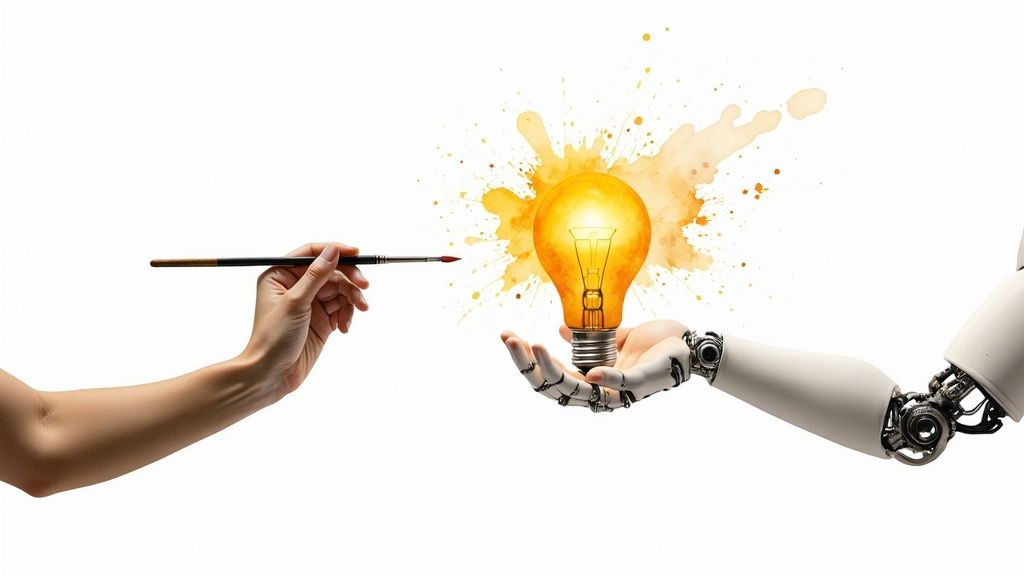
I’m convinced AI will take over the 80% of copywriting that's formulaic and repetitive—the basic product descriptions, the daily social media updates, the simple ad variations. It’s the grunt work that drains creative energy and slows everything down.
This shift frees up human writers to finally focus on the 20% that actually drives the business forward.
Where humans will always win
As a founder, this is what gets me incredibly excited. It means my team can spend less time pushing pixels and more time on the strategic thinking that grows the company. The future of creative work will be built on skills AI simply can't replicate.
- High-level brand strategy: Defining the soul of a brand, its core message, and its real position in the market.
- Deeply empathetic storytelling: Crafting the narratives that build genuine emotional connections with customers.
- Groundbreaking creative concepts: Coming up with the big, bold ideas that cut through the noise and define a category.
We are at the very beginning of a massive shift in how creative work gets done. The opportunity isn't just about efficiency; it's about elevating the role of creativity to a more strategic, impactful level.
This isn’t just speculation. It's about reallocating our most valuable resource—our team's brainpower—to the problems that matter most. We can let the machines handle the volume while our people deliver the value. The opportunities unfolding right now are immense, and frankly, I can’t wait to see what we all build with them.
Frequently asked questions about AI copywriting
Alright, let's get into the questions that always come up when teams start poking around AI copywriting. No fluff, just straight answers to help you figure out what's real and what's not.
Will AI replace human copywriters?
No. But it will replace the most tedious, mind-numbing parts of the job.
It's a tool, not a strategist. A skilled copywriter who understands how to steer AI will be infinitely more valuable than one who pretends it doesn't exist.
Think of it like a calculator for a mathematician. The calculator handles the basic arithmetic so the human can focus on solving the actual complex problem. We're heading toward a future where AI does the grunt work, freeing up your team to think about strategy, positioning, and creative angles—the stuff that actually moves the needle.
Can Google detect AI-generated content?
This one comes up a lot. The short answer is: sometimes, but it’s the wrong question to ask.
Google has been very clear that its goal isn't to penalize AI content; it's to penalize low-quality, unhelpful content, no matter who or what wrote it.
If you just copy-paste generic mush from an AI tool, it’s going to perform poorly because it’s bland, unoriginal, and unhelpful. But if you use AI as a first-draft machine and have a human editor refine it, add unique insights, and make sure it genuinely solves a problem for the reader, you'll be fine. The real question isn't, "Was this written by AI?" It's, "Is this content valuable to the person who clicked?" Focus on making great stuff, and you won’t have to waste time worrying about the algorithm.
How do I get started with AI copywriting?
Jumping in is way less complicated than you'd think. You don't need a massive budget or a team of data scientists to get started. Don't try to automate your entire content strategy on day one. Pick a specific, high-volume task that’s currently a bottleneck. A perfect example is generating headline variations for your Google Ads. Pick the right tool for that specific job, and most importantly, train your team how to write effective prompts and how to review the output. It's a new skill, so treat it like one and invest the time.
Ready to see how AI can supercharge your Google Ads? dynares generates thousands of messaging-matched ads and landing pages to boost your conversions and ROAS. See it in action.


