
Let's have a frank conversation. Most plumbing internet marketing is a complete mess—a tangled knot of confusing reports that never seem to lead to more jobs.
The hard truth? The old playbook is broken, especially in a market where every single click matters when someone has a burst pipe at 2 AM.

Why your current marketing is probably broken
As a tech entrepreneur who scales businesses for a living, I see this chaos as a massive opportunity. The problem isn’t the internet; it’s the outdated way most plumbing companies use it. Many are just throwing cash at generic Google Ads, using websites that look a decade old, and completely ignoring the goldmine of local search.
It’s a dumb way to operate in a cutthroat, immediate-need industry. You’re not selling software subscriptions; you’re selling a solution to a crisis. Your marketing has to reflect that urgency and precision.
The disconnect between spending and results
Too many plumbers get stuck paying a fortune to agencies that don't actually deliver. You see reports filled with vanity metrics like impressions and clicks, but your phone isn't ringing any more than it did last year. This isn't just frustrating; it's a fundamental business failure.
When you get this right, the results are staggering. Some agencies are getting jaw-dropping results by ditching the old rules. A partnership with In-House Plumbing, for example, skyrocketed their site traffic by 140%, search traffic by 344%, and online leads by 148%—all without spending a dime more. You can see how they did it in this plumbing marketing case study on Thrive Agency's website.
This proves that with the right strategy, serious growth isn't just possible; it's predictable.
The goal isn't just to get leads. It's to get the right leads—the high-margin, emergency jobs that actually grow your bottom line—and to do it so efficiently that your competition can't keep up.
Shifting from random tactics to a real system
This guide is my direct, no-fluff playbook to fix the broken model. We’re going to build a high-performance marketing machine, applying the same principles I use to scale tech companies but tailoring them for the urgent, practical world of plumbing.
No jargon, just actionable strategies to own your local market and get your phone ringing off the hook. This is how you stop wasting money and start building a predictable engine for growth.
Let's get to it.
Alright, let's talk about Google Ads for plumbers. This is the raw engine for those high-value emergency leads. But if you get it wrong, you’re not marketing—you're just burning cash in a very expensive bonfire. I see it all the time, and frankly, it’s a terrible way to run a business.
The single biggest mistake plumbers make is lumping every service into one giant, messy campaign. They’ll mix keywords for emergency leak repair, water heater installation, and drain cleaning all together. This is a fundamentally broken strategy that guarantees you’ll waste your budget.
Just think about it. The person frantically Googling because their basement is flooding has a completely different mindset than someone casually researching the cost of a new tankless water heater. When you lump them together, you end up showing the same generic ad to both of them. You fail to connect with either, and you convert almost nobody.
Your entire campaign structure has to reflect this reality of user intent.
The modern way to structure campaigns
The old way of building one campaign for plumbing is dead. The smart, efficient approach is to build a structure around specific service categories and the urgency behind them. This isn't just about being organized; it's about putting your budget behind your most profitable jobs.
You need separate campaigns that actually mirror how your business makes money. A solid starting point is to segment by service type and customer intent.
- Emergency services: This is your top priority. These campaigns should target keywords like '24/7 plumber near me' or 'burst pipe repair cost.' The ad copy, the landing page, and your bidding should all scream "call us now."
- Installations & upgrades: This is for planned projects—think 'tankless water heater installation' or 'new faucet installation.' The customer here is less panicked and more focused on price and quality. Your messaging needs to hit on value, financing options, and expertise.
- General repairs & maintenance: This bucket catches everything else, from 'clogged drain service' to 'annual plumbing inspection.' While these are often lower-urgency, they provide a consistent stream of revenue and can easily lead to bigger jobs down the road.
When you separate your campaigns like this, you gain massive control. You can push more budget to your high-margin emergency services and bid more aggressively for those crisis-driven keywords, all without overpaying for someone just kicking tires on a new toilet.
Smart keywords and bidding, not dumb budgets
Once your campaigns are properly segmented, you have to get ruthless with your keywords and bidding. This is where the money is won or lost. In the world of plumbing internet marketing, a staggering 65% of homeowners now search online before hiring a plumber. With that much competition, precision is everything.
First off, forget about broad match keywords. They are a recipe for attracting DIY researchers and people looking for parts—clicks that will cost you money and never, ever convert into a job. You need to be focused on phrase match and exact match keywords that signal clear commercial intent.
Stop bidding for clicks. Start bidding for jobs. Your goal isn't website traffic; it's profitable calls. This mental shift changes everything about how you manage your ad spend.
This is also where you ditch outdated bidding methods like Manual CPC. It’s time to embrace Google's AI with Smart Bidding strategies. For plumbing businesses, two strategies are incredibly effective.
Setting up this kind of value-based tracking is non-negotiable for anyone serious about scaling their business. If it sounds complicated, don't worry—we have a complete guide on how to set up Google Ads conversion tracking that walks you through it. This is the foundation for an intelligent ad account that prints money instead of burning it.
Creating ads and landing pages that convert
Alright, let's get into the digital handshake. From the moment someone clicks your ad, you have maybe nine seconds to convince them you're the right plumber to call. Most plumbers completely fumble this with generic ads and one-size-fits-all websites. It's lazy, and it’s costing you jobs.
The key to winning this tiny window of opportunity is message match. It’s a simple concept: the search term, your ad headline, and your landing page must all tell the exact same story.
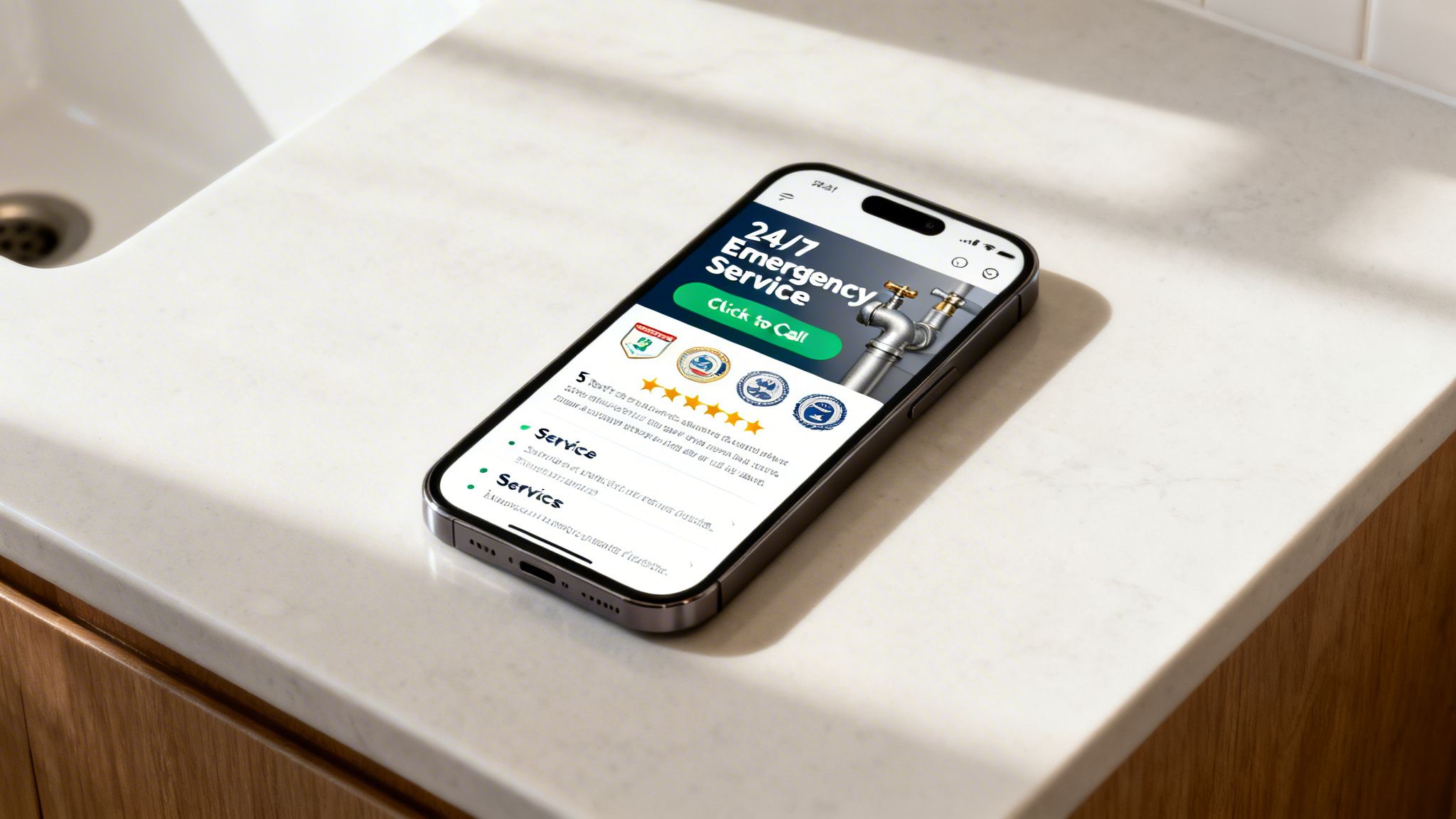
If someone searches for '24/7 emergency plumber,' your ad needs to promise emergency service, and the page they land on better scream 24/7 Emergency Service with a massive, impossible-to-miss, click-to-call phone number. No exceptions.
Writing ad copy that solves a problem
When a pipe has burst and water is flooding a basement, nobody cares about your company's founding story from 1985. They care about one thing: how fast you can get there to fix it. Your ad copy has to speak directly to that immediate, high-stress problem.
Forget the fluffy branding. Your headlines need to be a direct solution. Think 24/7 Emergency Plumber | We'll Be There in 30 Mins or Burst Pipe Repair Experts | Call Now for Fast Service. This isn't the time for clever creativity; it's the time for speed and clarity.
The most powerful ad copy for a plumber isn't clever—it's a promise. A promise of speed, reliability, and a solution to the customer's current nightmare.
The anatomy of a high-converting landing page
Once a potential customer clicks, they must land on a page that instantly reinforces that promise. Sending them to your generic homepage is a rookie move. It forces them to hunt for information, and trust me, they won't. You need dedicated landing pages for each core service. To really make your ads and landing pages effective, you have to understand how to increase website conversions.
A solid plumbing landing page isn't complicated. It’s a purpose-built machine designed for one single action: getting a call or a form submission. Here’s what it absolutely must have:
- A clear, dominant headline: This has to match the ad they just clicked. If the ad said "Water Heater Repair," the headline should be "Fast & Reliable Water Heater Repair."
- An unmissable call-to-action (CTA): I’m talking about a huge phone number at the very top of the page that is click-to-call on mobile. Don't make them look for it.
- Essential trust signals: Immediately show them you're legit. This means your license number, insurance info, and any badges like Google Guaranteed or Top-Rated on HomeAdvisor.
- Real customer reviews: Sprinkle in a few recent, authentic reviews from local customers. Social proof is incredibly powerful when someone is making a quick, high-stakes decision.
This isn't about beautiful design; it's about functional, trust-building design. We're not trying to win awards here; we're trying to win jobs. For more on this, you might find our deep-dive on building a converting landing page useful.
Using AI to find the perfect message
Now, this is where things get really interesting. Manually testing every combination of ad copy and landing page elements is a slow, painful process. But with modern AI tools, you can run these experiments at a scale that was impossible just a few years ago.
Imagine being able to test thousands of variations of your headlines and page copy automatically. An AI system can rapidly identify which messages resonate most strongly with which audiences for specific keywords.
For example, it might discover that for "emergency plumber" searches after 10 PM, the headline "Available Now for Immediate Dispatch" gets a 25% higher click-through rate than a more generic one. This is the future of plumbing internet marketing. It’s about letting machines do the heavy lifting of optimization so you can focus on the human side of your business—delivering great service.
This is how you build a marketing engine that doesn’t just compete, but completely dominates.
Dominating local search beyond paid ads
Paid ads are great for getting the phone to ring right now. But let's be blunt: if that's your only strategy, you're just renting customers from Google.
Owning the local search landscape is how you build a real, long-term asset. It’s about creating a presence so strong in your service area that when someone has a burst pipe at 2 AM, your business is the one they find first. It all starts with your Google Business Profile (GBP).
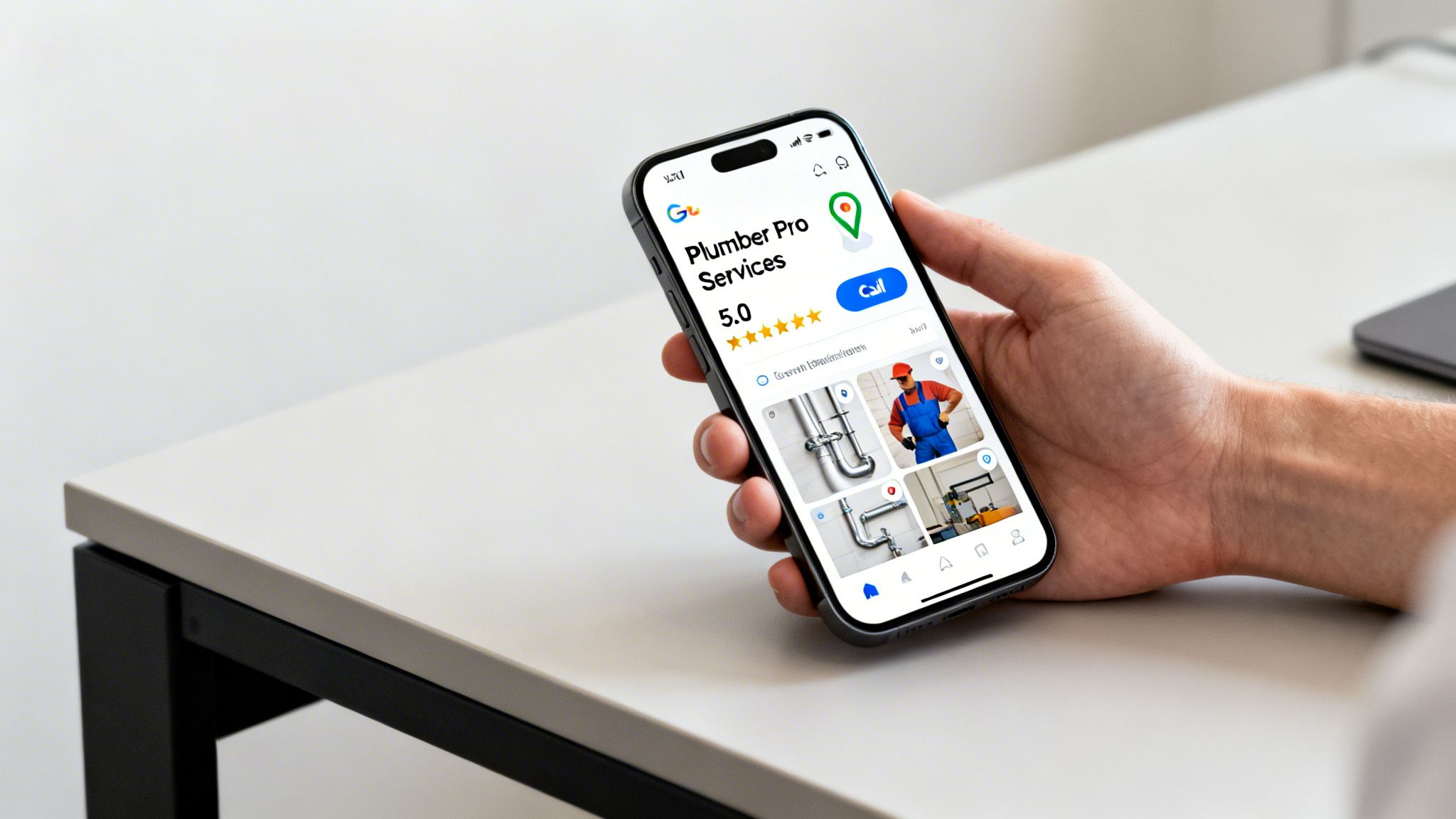
Thinking of this as just a map listing is a huge mistake—it’s your new, most important homepage. Get this right, and you'll generate high-intent calls without spending a penny on clicks.
Treating your GBP as your new homepage
Your GBP is often the very first interaction a potential customer has with your business, especially on their phone. Optimizing it isn't optional; it's mission-critical for any serious plumbing internet marketing effort. The good news? Most of your competitors are lazy here, which gives you an easy opening to pull ahead.
Treat it with the same seriousness you would your main website. That means optimizing every single field and keeping it active.
This isn’t just about filling out a form. It's about signaling to Google that you are the most relevant, active, and helpful plumber in your area. For a deeper dive on this, check out our guide on what search intent is in SEO and why it's so important for local visibility.
Your Google Business Profile isn’t a digital business card. It's an active sales and marketing channel. Neglecting it is like leaving your best salesperson at home.
The unspoken power of reviews and photos
Now for the part most businesses get wrong: ongoing engagement. A static GBP profile will slowly sink in the rankings. The two most powerful levers for staying at the top are your reviews and your photos.
First, reviews. They are the single biggest ranking factor for the local map pack. Having a steady stream of recent, positive reviews is non-negotiable. Don't just hope for them; build a system. A simple follow-up text or email after a job is completed—with a direct link to your GBP review page—can work wonders.
Second, photos. Consistently upload new, geo-tagged photos. This shows Google your business is active and provides visual proof of your work. Ditch the stock images. Show your team on the job, your branded vans, and before-and-after shots of your work. It builds immense trust with potential customers.
Building your local SEO foundation
Beyond your GBP, your own website needs to be a fortress of local relevance. This is where you reinforce all the signals you're sending through your Google profile. The goal is simple: make it painfully obvious to both users and search engines which specific areas you serve.
This isn't complex theory. It's a practical, actionable checklist. By systematically optimizing your GBP, encouraging reviews, and building out location-focused content on your site, you create an organic marketing engine that brings in leads long after you’ve turned off your paid ads.
Using data and AI to scale your business
This is where most plumbing marketing falls apart. If you’re not tracking what actually happens after the click, you’re flying blind.
And if you’re just counting form fills as “leads,” you’re missing the entire story. It’s an amateur move.
The real money, the kind that lets you actually scale your business, comes from tracking revenue. Did that “emergency leak repair” lead from your ads turn into a $500 patch job or a $5,000 whole-house repipe? Knowing the answer changes everything.
Ditching vanity metrics for real revenue data
Let’s be direct. Your cost per lead is a mostly useless number on its own. It tells you nothing about the quality of the jobs you’re booking.
You could be getting cheap leads all day long. But if they're all for low-margin, time-sucking tasks, you’re not building a business—you’re just staying busy and losing money.
The goal is to stop counting leads and start counting cash. This means setting up conversion tracking that ties your ad spend directly to the value of the job you booked.
This isn’t just about making prettier reports. It's about giving Google’s AI the right fuel to work with. When you start feeding it real revenue data, you unlock a much smarter way to run your campaigns.
Stop celebrating a low cost per lead. Start obsessing over your Return on Ad Spend (ROAS). If you’re spending $1,000 to generate $10,000 in profitable jobs, that’s a business you can actually grow.
Unleashing the power of value-based bidding
Once you’re feeding real job values back into Google, the game changes. You can finally move to value-based bidding strategies like Target ROAS (Return on Ad Spend). This is a whole different league than just bidding for clicks or generic leads.
You're no longer telling Google to just "get me leads for $50 each."
Instead, you’re giving it a much more powerful instruction: "For every $1 I spend on ads, I expect $7 back in revenue."
Google’s algorithm then gets to work, analyzing thousands of signals from your past high-value customers. It starts finding more people who look just like them—the ones in the right zip code, searching at the right time of day, on the right device, who are far more likely to need a high-margin emergency service than a simple faucet fix.
Let AI do the heavy lifting
This data-first approach is the perfect foundation for bringing in more AI to automate and scale your marketing. This is where you can build an almost unfair advantage over your competitors.
Imagine a system that doesn't just run the ads you wrote but works 24/7 to improve them. This isn't science fiction; it's a practical reality for plumbing businesses that want to grow without getting buried in spreadsheets. There are now plenty of AI tools for digital marketing that can supercharge this whole process. You can explore some of the best AI tools for digital marketing in our detailed guide.
This is how you build a predictable lead-generation machine for 2026 and beyond. It’s about creating a system that gets smarter with every dollar you spend, freeing you up to do what you do best: run your plumbing business.
Frequently asked questions about plumbing marketing
People ask me about plumbing marketing constantly, and most of the answers they get are garbage. They're usually vague, theoretical, or just plain wrong.
So, here are the straight answers to the questions I hear most. No fluff, just what actually works in the real world.
How much should a plumber actually spend on marketing?
Anyone who gives you a single magic number is selling something. The common advice you'll hear is to budget 5-10% of your total revenue for marketing. If you’re trying to grow fast or just starting out, pushing that to 12-15% isn’t unreasonable.
But that’s just a benchmark. The only number that really matters is your Return on Ad Spend (ROAS). If you put $1 into your ads and get $5 back in profitable jobs, the question isn't "what's my budget?" It's "how can I spend more?"
Stop obsessing over the budget percentage. Focus on the return. That's how you scale.
Is SEO or PPC better for getting jobs?
This is the wrong question. It's like asking if a plumber needs a wrench or a pipe cutter. You need both for different jobs, and they work best together.
- PPC (like Google Ads) is your sprinter. It's how you get in front of someone whose pipe just burst. They aren't browsing; they're clicking the first credible plumber they see. That's PPC, and it's essential for grabbing high-intent emergency work right now.
- SEO is your marathon runner. This is the long game. Good SEO builds your company's authority, credibility, and generates a steady flow of organic leads over time. It’s what reduces your long-term reliance on ad spend and builds a sustainable business asset.
Start with PPC for immediate cash flow. While those campaigns are running, invest in a solid SEO foundation. One gets you jobs this week; the other makes sure you're still getting jobs five years from now.
What's the one metric I should actually care about?
Booked job revenue. That's it.
It’s easy to get distracted by metrics that make agencies look busy—clicks, impressions, cost per lead. These are diagnostic tools, nothing more. They don't pay your technicians or buy new trucks.
A lead isn't a win. A completed, profitable job is a win. The only thing that truly matters is how much real-world revenue your marketing is generating.
If you’re serious about growth, understanding how to get plumbing leads that actually turn into money is the whole game. You have to track revenue back to the exact campaign, ad, and keyword that brought it in. There's no other way to know what's really working.
This simple process is how you stop guessing and start building a predictable growth engine.
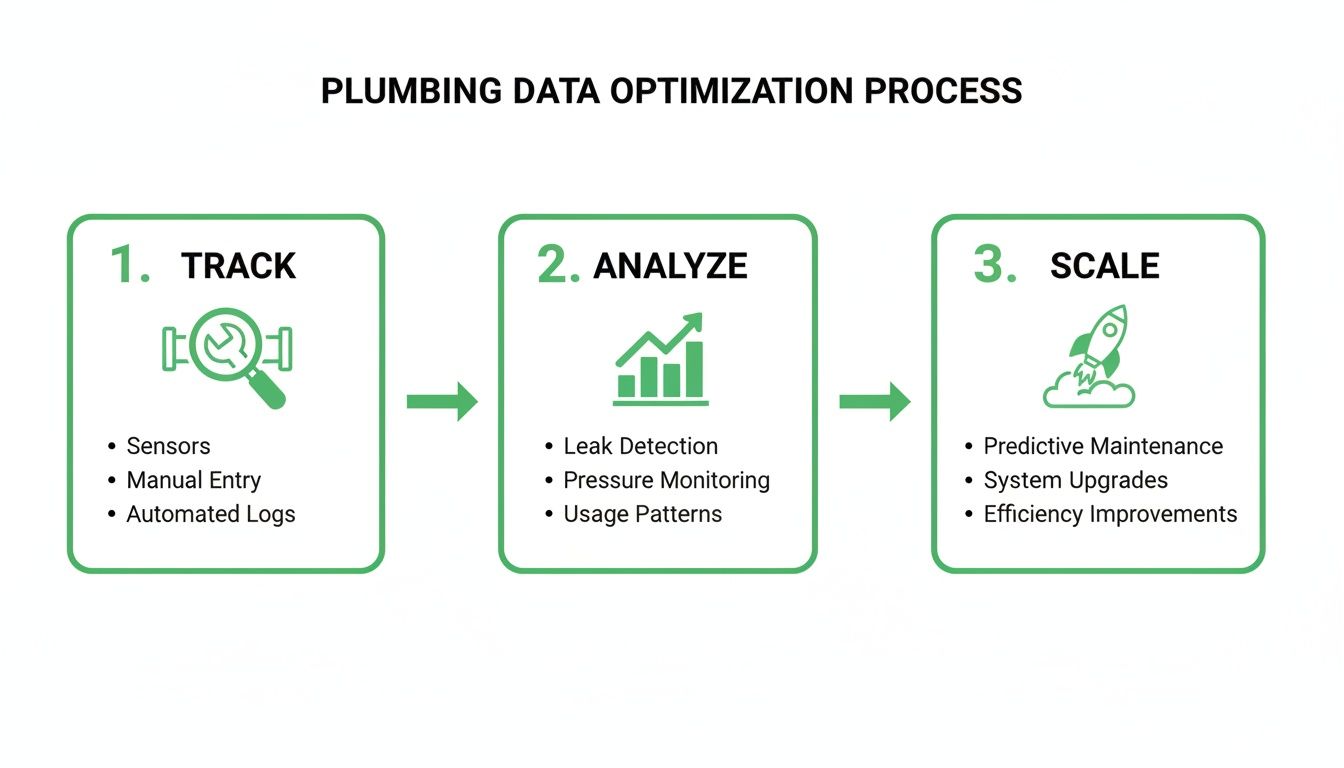
It's a feedback loop: track your actual booked jobs, analyze what drove the most profitable ones, and then scale your investment in the winners. Simple, repeatable, and incredibly effective.