Google Ads Landing Page Optimization: Stop Burning Money on Dumb Mistakes

Google ads landing page optimization isn't about making your homepage look a little nicer. Let's be real. It's the craft of building a targeted, relevant, and ridiculously smooth web page that delivers exactly what your ad promised.
The whole point is to create a focused experience built for one thing: conversion. When a user clicks your ad and finds precisely what they were searching for, Google rewards you with a higher Quality Score and lower costs. Simple as that.
Your Google Ads are bleeding money and your landing page is why
Let's be direct. You're pouring cash into Google ads, but your conversion rates are a running joke. You're probably pointing fingers at keywords or ad copy, but the real culprit is your landing page. It's the silent killer of your ROAS.

Most founders treat their landing page like an afterthought—a generic bucket that gets the same stale message no matter who clicks. This is a fundamentally broken approach that actively sabotages your campaigns.
Sending highly specific, intent-driven traffic to a generic page is like paying for a premium espresso machine and then brewing instant coffee. It's just dumb. 🤷♂️
The high cost of being lazy
This isn't just about a poor user experience. There's a real financial penalty for this laziness. Google's Quality Score algorithm is built to reward relevance and punish generic, slow, or disconnected pages.
When there's a disconnect between your ad and your landing page, your Quality Score plummets. A low Quality Score directly translates into higher costs-per-click (CPCs). I call this the 'stupidity tax'. You are literally paying more for the exact same click than a competitor who took the time to create a relevant post-click experience.
You're in a bidding war where relevance is your strongest weapon, and you're showing up with a butter knife.
The stunning gap between good and bad landing pages
The data tells a brutal story. Landing pages tailored specifically for Google ads traffic can dramatically outperform generic pages. Average conversion rates from PPC search ads hit around 10.9%, while display ads hover at just 4-5%. That gap highlights why it's critical to match the page to the keyword.
In fact, unoptimized landing pages often drag search ad conversion rates down to a painful 3-6%. Meanwhile, top performers can push past 14.7%. To truly improve Google Ads performance, you have to fix this disconnect.
This isn't just theory; it's the fundamental reality of the ad auction. The path to a better return on ad spend starts the moment a user lands on your site. If you want to stop the bleeding and transform your performance, you need to learn the secrets of effective landing pages.
Aligning your pre-click promise with your post-click experience
The real magic in Google ads happens before anyone even clicks your ad. It all comes down to a simple, powerful promise: what a user sees in your ad must be exactly what they find on your landing page. This is the heart of what we call message match.
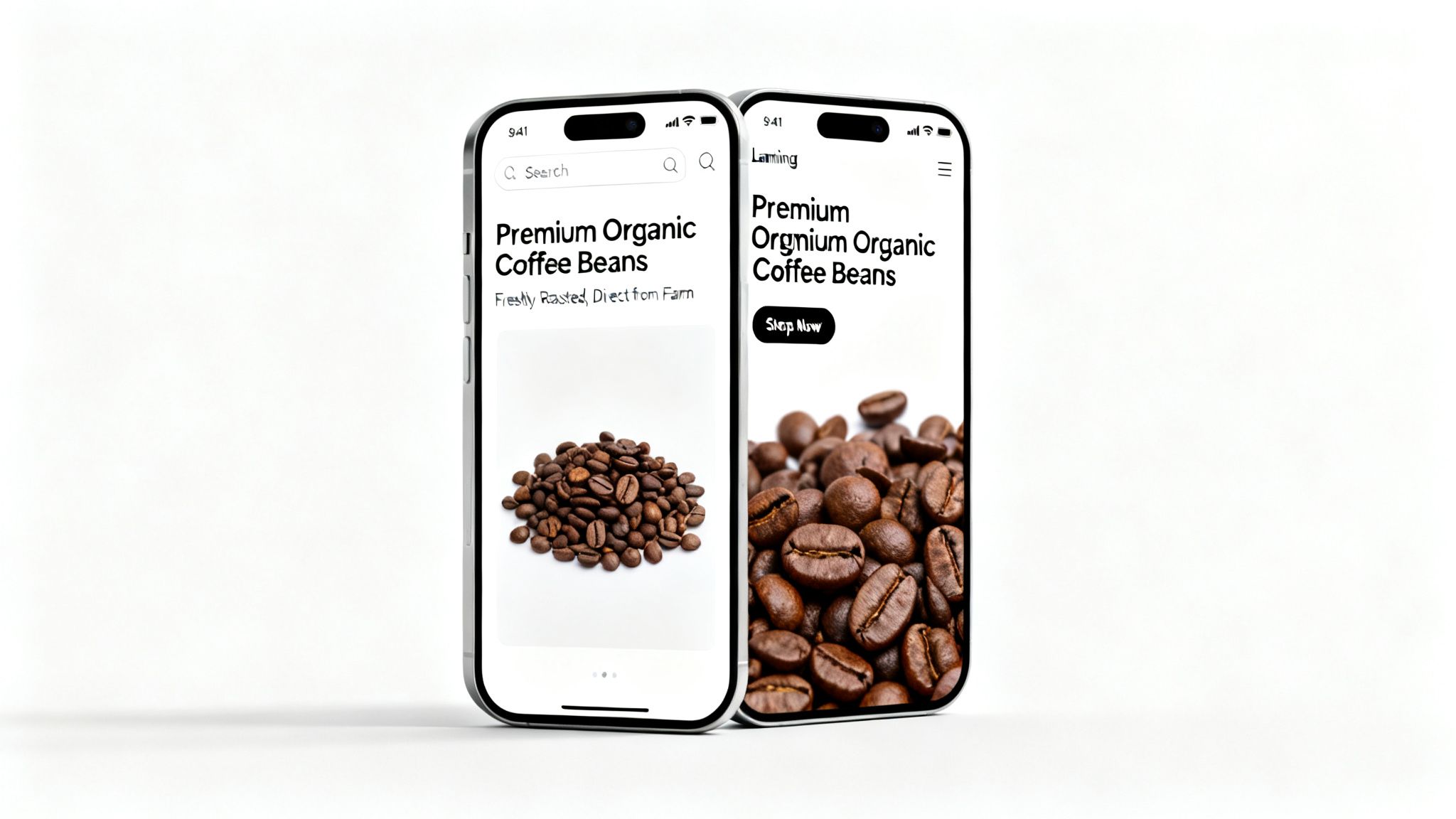
This isn’t just about repeating keywords—that’s the lazy approach. True alignment is about mirroring the user’s intent, the specific offer, and the underlying problem they’re trying to solve. You’re essentially telling them, ‘Yes, you’re in the right place. We get you.’
That first-glance confirmation is critical. If a user clicks an ad for emergency roof repair service and lands on a page talking about general home contracting, they're gone in seconds. You’ve just wasted your ad spend and created a negative brand experience.
Deconstructing user intent
To nail this, you have to get inside your user’s head. What are they really looking for when they type that query? It’s rarely just a product; it’s a solution to a specific need.
- Informational intent: Someone searching for ‘SaaS pricing models comparison’ isn’t ready to buy. They need data, a blog post, or a guide. Your landing page should educate, not sell.
- Commercial intent: A query like ‘best CRM for small businesses’ signals they're evaluating options. They're looking for feature lists, reviews, and social proof. Your page needs to help them compare and build trust.
- Transactional intent: When someone searches for a ‘HubSpot integration agency quote,’ they are ready to act. That page better be brutally efficient: a clear headline, a simple form, and a direct CTA. Anything else is friction.
Understanding this distinction is step one. For a deeper dive into the mechanics, our guide on how to create a landing page that truly connects with your audience is a great next stop. Your goal is to translate that specific intent into a headline, hero image, and opening copy that instantly confirms the user has found their answer.
This respect pays off directly in your campaign performance. Google sees the high relevance and low bounce rates, rewards you with a better Quality Score, and your CPCs start to drop. You’re no longer fighting the algorithm; you’re working with it.
The founder’s dilemma: automation vs. insanity
Now for the practical problem every founder or marketer faces. Manually creating thousands of perfectly matched landing pages is an operational nightmare. It's slow, expensive, and just doesn’t scale—especially for agencies managing multiple accounts.
This is where automation becomes your best friend. Instead of grinding out pages one by one, modern platforms can programmatically generate unique, high-intent landing pages for every ad group or even specific keywords. It's how you win without burning out your entire team.
This isn’t about building one perfect page. It's about building a system that creates thousands of perfect pages on the fly, each one a direct answer to a user's question. That’s how you scale relevance and dominate the auction. It’s ambitious, yes, but it’s the future of paid acquisition. 🚀
Designing for conversion, not for your portfolio
Let’s get one thing straight. Your landing page has a single job: get the conversion. That’s it. It’s not a portfolio piece for your designer, and it's definitely not the place for your marketing team's failed creative writing experiments.

Too many pages suffer from 'design by committee'—they're cluttered, confusing, and try to be everything to everyone. The result? They end up converting no one. We're going to get ruthlessly practical and strip away all that noise.
It's about clarity over cleverness. Speed over style. Every single element on the page must serve the ultimate goal of conversion. If it doesn't, it gets cut. No exceptions.
The non-negotiable core elements
Forget the flashy animations and jargon-filled paragraphs for a minute. Every high-converting landing page, no matter the industry, is built on a few non-negotiable pillars. Getting these right is 80% of the battle.
A single, compelling headline. A crystal-clear value proposition. Real, undeniable social proof. One obvious Call-to-Action (CTA).
This isn’t rocket science, but you'd be amazed how many businesses get it wrong. For a solid rundown, check out these practical steps to creating a great PPC landing page.
Master the psychology of your forms
Your form is the final gateway to conversion, but most companies treat it like a minefield. The friction you introduce here can absolutely kill your lead flow. Every extra field you add is another reason for a user to bounce.
Think about it from their perspective. They've clicked your ad, they're interested, but they are not ready to give you their life story. Asking for a phone number upfront for a simple ebook download? That's a dumb move. It screams, I'm going to have a salesperson call you relentlessly. 🙄
A much smarter play is progressive profiling. Start by asking for the bare minimum—usually just an email. Once you have that initial conversion, you can ask for more information on the thank you page or in later interactions. This builds trust and drastically cuts down the initial friction.
Your form isn't a data-harvesting tool; it's the start of a conversation. Treat it with the respect it deserves and ask only for what you absolutely need to take the next step.
Your information hierarchy and visuals
Now, let's talk about what the user actually sees. The visual hierarchy of your page dictates the user's journey. You need to guide their eyes from the headline to the value prop, through the social proof, and straight to the CTA.
Remove every distraction. That means no navigation menu leading them back to your main site and no junk-drawer footer with links to your careers page. A landing page is a closed loop.
When it comes to visuals, choose function over flair. A high-quality static image that clearly shows the product or the outcome is often better than a slow-loading, auto-playing video. That said, a short, compelling video can sometimes outperform everything else—pages with video can see an 86% lift in conversions. You have to test what works for your audience. For a deeper dive into effective layouts, check out our piece on landing page design best practices.
Personalization is a conversion powerhouse, too. One study found that personalized CTAs outperformed generic ones by a staggering 202%. This is exactly why static pages feel so inefficient, especially for agencies managing multiple accounts. This is where a platform like dynares flips the script, dynamically tailoring copy and layout based on keyword intent, turning average click-to-conversion rates into a reliable lead generation machine.
The technical foundation: speed, mobile, and tracking
You can have the most persuasive, beautifully designed landing page in the world, but if it takes five seconds to load on a 4G connection, it’s completely worthless. Let’s be blunt: the majority of your ad clicks are coming from mobile devices, and those users have precisely zero patience.
This is where the real work begins, moving beyond copy and design into the technical guts of your page. This isn’t a ‘nice-to-have’ for a better user experience; it's a massive, non-negotiable factor in your Quality Score. Google punishes slow pages with higher costs. Period.
Nail your page speed or pay the price
Every single second of load time is a battle for your visitor’s attention. A page that takes from one to three seconds to load sees the probability of a bounce increase by 32%. Push that to five seconds, and the bounce probability jumps to a staggering 90%.
That’s a catastrophic loss of clicks you paid good money for.
So, how do you fix it? This isn’t about chasing a perfect 100/100 score on a testing tool; it's about being faster than your competition. It really comes down to a few fundamental, high-impact actions. Aggressively compress your images. Minimize your code. Leverage browser caching.
These aren't just developer tasks; they are core marketing responsibilities. For a deeper dive, check out our guide on how to improve page load speed for your campaigns.
From basic tracking to true revenue optimization
Now for the part that separates the amateurs from the pros: tracking. It’s absolutely not enough to just track a lead submission in Google ads. That tells you nothing. You need to know exactly which keyword, ad, and landing page variant generated that lead.
This is where most agencies and in-house teams fall flat on their face. They track volume but have no idea what’s actually driving value. The goal isn't just to get leads; it's to get leads that turn into money. 💰
To do this, you need a robust setup. We use Google Tag Manager (GTM) to manage all our tracking scripts without needing a developer for every tiny change. The workflow involves passing campaign data through hidden fields in your forms.
- Capture UTM parameters: Use hidden form fields to automatically capture the source, medium, campaign, content, and term for every single lead.
- Push data into your CRM: When a lead submits a form, this data gets passed directly into your CRM (like HubSpot or Salesforce) and attached to their contact record.
- Close the loop: Once a sale is made, you know exactly which keyword and ad generated that revenue. You can then use Google's Offline Conversion Import feature to upload this data back into your ad account.
This process completely transforms your campaigns. You’re no longer optimizing for cheap leads that never close. You're optimizing for high-value customers, letting Google’s machine learning find more people just like them.
This is the stuff most people get wrong, but it’s where the real competitive edge lies. It’s how you build a truly antifragile customer acquisition machine.
Building a testing machine that never sleeps
Optimization isn't a one-time project you check off a list. It’s a continuous process.
Your market shifts, your competitors get smarter, and user behavior evolves. If you're not constantly testing and improving, you're not just standing still—you're actively falling behind.
The idea of building a testing machine can feel overwhelming for busy founders. We’re all short on time. But I’m not talking about some massive, complicated system. I’m talking about a practical framework for A/B testing that actually moves the needle, not just keeps you busy.
Focus on what actually matters
Let’s be brutally honest: most A/B tests are a complete waste of time.
Testing button colors from red to green is a classic example of looking busy while achieving nothing. Unless you have millions of visitors, that tiny change won't produce a statistically significant result. It’s dumb. 🤦♂️
Instead, focus on high-impact tests that can produce big swings in performance. These are the elements that fundamentally alter a user's perception of your offer and their motivation to act. Your headline. Your core offer. Form length and fields. Page layout and hierarchy.
These are the kinds of tests that provide real insights. They challenge your core assumptions about what your customers want. This is where real Google ads landing page optimization happens.
Run tests with a purpose
Every test needs a clear, strong hypothesis. Don't just throw things at the wall to see what sticks.
A good hypothesis follows a simple structure: If I change [X], then [Y] will happen, because of [Z].
For example: If we change our headline from 'Best CRM Platform' to 'Stop Losing Sales with Our CRM,' then our conversion rate will increase, because the new headline addresses a specific pain point instead of making a generic claim.
Even when a test fails and the variant doesn't win, a strong hypothesis ensures you still learn something valuable. You might discover that your audience responds better to positive framing than to pain-point agitation. That’s a powerful insight for your entire marketing strategy.
Also, please don't be the rookie who calls a test after just 50 visitors. You need to reach statistical significance, which means you have enough data to be confident the result isn't just random chance. Use a calculator to determine your required sample size before you start the test, and don't peek at the results until you get there.
This diagram outlines the core technical process that enables reliable testing.
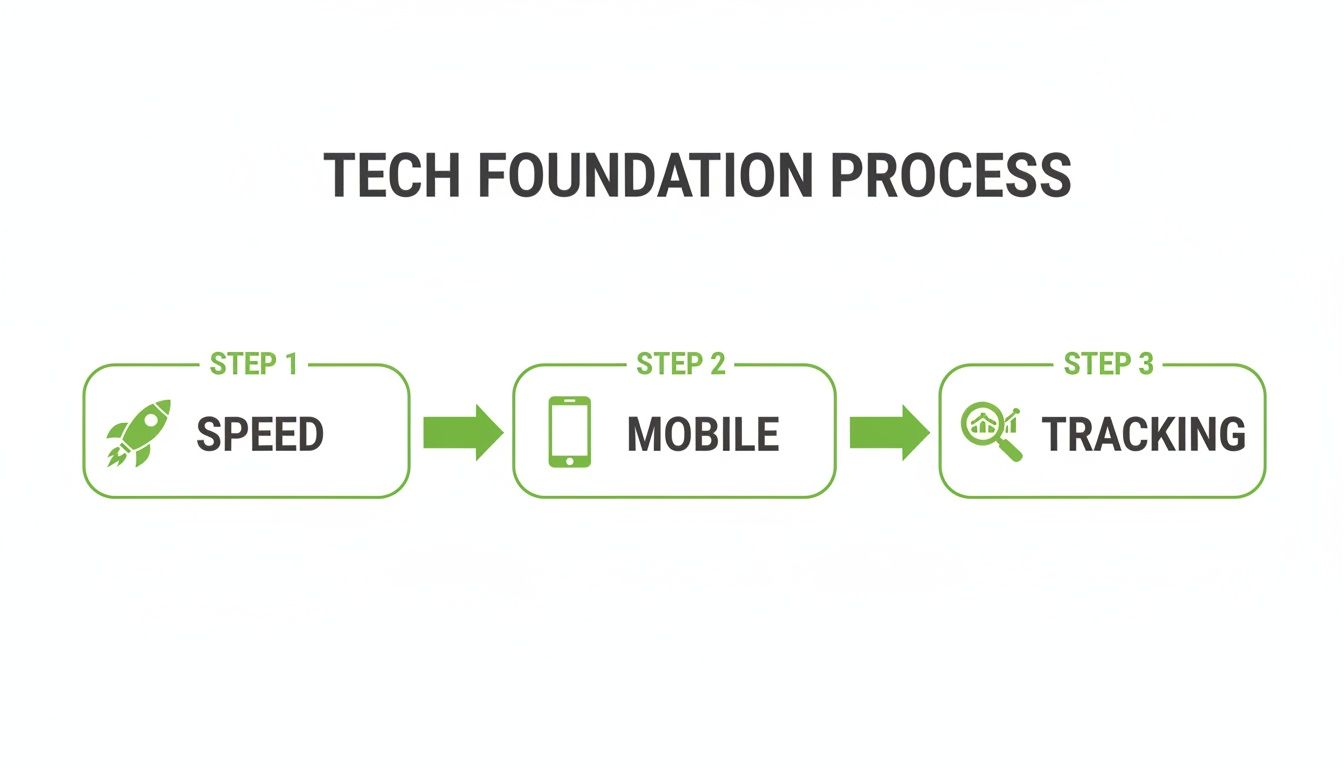
This flow underscores that a solid technical foundation in speed, mobile-friendliness, and tracking is a non-negotiable prerequisite for any meaningful optimization work.
Put your testing on autopilot
Manual A/B testing is slow, clunky, and prone to human error. It’s also completely unnecessary. This is where you build a system that gets smarter on its own.
Modern tools, like our own at dynares, can run these experiments in the background for you. They can automatically test different headlines, images, and CTAs, monitor the results, and dynamically shift traffic to the winning variant.
This creates a powerful flywheel effect.
Your campaigns are always running on the best possible assets, constantly adapting to user feedback without you needing to manually check in every day. It's about building a system for relentless, automated improvement—not just running sporadic tests when you have a spare afternoon. That’s how you build a machine that never sleeps.
Got questions about landing pages? let's clear them up
Alright, let's wrap this up by tackling a few of the questions I get asked all the time. No fluff, just straight answers to the things that seem to trip people up the most.
How many landing pages do I actually need for Google Ads?
Honestly, this is the wrong question. It's not about hitting some magic number; it’s about achieving brutal relevance. Thinking in terms of how many keeps you stuck in a manual, project-based mindset that just doesn't scale.
The real answer? You should have a unique landing page experience for every ad group, and ideally, for every high-value keyword. The goal is a perfect message match between the promise in your ad and what the user sees the second they land.
If your campaign has five ad groups targeting different problems, you should have at least five distinct landing pages. For a decent-sized account, this can easily mean hundreds of pages.
Of course, trying to build and manage this by hand is a recipe for burnout. It’s why automation is the only way forward. Modern platforms programmatically generate these tailored pages, letting you achieve hyper-relevance without hiring a small army of developers.
So, the right answer isn't a number—it’s as many as it takes to be surgically relevant to what the user actually searched for.
What’s a good conversion rate for a Google Ads landing page?
Anyone who gives you a single, definitive number is just guessing. Conversion rates vary wildly by industry, the offer you’re making, and how hot the traffic is. A good rate is a moving target, not a static benchmark.
The only benchmark that truly matters is your own, and whether it's getting better month over month. That said, if your search campaign is converting below 3%, you almost certainly have a leak in your ad-to-page experience that needs fixing.
Stop chasing industry averages you found in some random blog post. Focus on building a system of continuous improvement through A/B testing. Your only real goal is to consistently beat last month's conversion rate.
Don't chase vanity benchmarks. The most important metric is your own progress. A 4% conversion rate that grew from 2% is a massive win. A 10% rate that has been stagnant for a year is a sign of complacency.
Can I just use my website’s homepage as a landing page?
Please, no. This is one of the most common—and most expensive—mistakes in PPC. I see it all the time, and it makes me want to tear my hair out. 😫
Your homepage is built for exploration. It has a navigation bar, multiple CTAs, links to your 'About Us' page, and a broad, all-encompassing message. It’s a brochure, designed to serve everyone and convert no one.
A landing page, on the other hand, is a closing tool. It has one job, and one job only: conversion.
Sending expensive, highly-targeted ad traffic to a generic homepage is like paying for a qualified sales lead to visit your office, only to leave them in a crowded lobby and hope they find the right meeting room on their own. It’s a massive waste of intent, attention, and money.
Always, always use a dedicated, purpose-built landing page for your ad campaigns. If you genuinely care about performance and ROAS, there are no exceptions.
Building this kind of hyper-relevant, high-performing system manually is a monumental task. At dynares, we built a platform that automates the entire process—from generating thousands of keyword-matched ads and landing pages to running A/B tests and optimizing for revenue.
Stop guessing and start converting. Check us out at https://dynares.ai.


