
Alright, let's have a real chat. Most articles on advertising copy are filled with academic nonsense that doesn’t work when you’re burning your own cash on Google Ads. As a European entrepreneur building tech, I’ve learned one thing: theory is useless without execution. You need copy that converts, not copy that sounds clever. The difference is the margin between scaling and failing.
We spend millions on ads, and the single biggest lever we have is the quality of our copy. It’s not just about stringing words together; it’s about psychology, structure, and a deep understanding of intent. A great ad stops the scroll, answers a question before it's fully formed, and makes the click feel inevitable. A bad ad is just expensive noise.
This isn't another generic list. This is a breakdown of the exact frameworks we use, the ones that have survived thousands of A/B tests and driven real revenue. We’ll look at a real example of advertising copy for each core strategy, break down why it works, and show you how to apply it. Understanding your platform is also part of the battle; knowing the deep differences between Facebook Ads vs Google Ads is critical, as the best copy for one can completely fail on the other.
The goal here isn't to impress you; it's to give you a playbook you can use tomorrow to make your ads better. We'll cover everything from classic AIDA and PAS frameworks to copy that uses specificity, social proof, and emotional triggers to drive action. No fluff, just actionable tactics. Let's get into it. 🚀
1. Benefit-driven AIDA copy (Awareness, Interest, Desire, Action)
The AIDA model is one of the oldest frameworks in marketing, and for good reason: it works. It guides a potential customer through the psychological stages of a purchase decision, starting with grabbing their Attention, building their Interest, creating Desire, and finally prompting Action. This isn't just some abstract theory; it's a practical blueprint for structuring your ad copy, especially within the tight character limits of Google Ads. A well-executed AIDA structure provides a logical and persuasive flow that can seriously boost click-through and conversion rates.
When you align your ad copy with this framework, you're essentially mapping your message to the user's decision-making process. The goal is to move them from 'What is this?' to 'I want this now' in just a few lines of text. Dropbox's classic 'Get your files anywhere' is a perfect example of advertising copy that combines Desire (access files everywhere) and Action (get them) into a single, powerful benefit. Similarly, Slack’s 'Where work happens' is a masterclass in combining Attention and Interest in a single, concise headline. It piques curiosity while immediately establishing its core purpose.
Strategic takeaways
Your headline (or the first line of your social ad) is your hook. This is where you grab Attention. It needs to be punchy, relevant, and directly address the user's search query or pain point. Follow this immediately with copy that builds Interest by explaining how you solve their problem. Then, create Desire by highlighting the unique benefits or emotional payoff they’ll get. Finally, the Action is your call-to-action (CTA). Don't get fancy; just be direct. Tell them exactly what to do next.
How to apply this
Ready to put this into action? Here’s a simple, effective approach:
- Attention (Headline 1): Inject your highest-intent keyword here. Match the user’s search query as closely as possible to improve your Quality Score.
- Interest (Headline 2 / Description 1): Briefly introduce your solution or unique selling proposition. What makes you different?
- Desire (Description 1): Focus on the emotional value or the ultimate benefit. How will their life or business improve?
- Action (Description 2): Use a clear, commanding CTA. 'Get a Free Quote,' 'Shop Now,' or 'Start Your Trial.'
By systematically testing different benefit angles within the AIDA structure, you can pinpoint the exact messaging that resonates with specific audience segments. This method turns copywriting from a guessing game into a repeatable process.
2. Problem-Agitation-Solution (PAS) copy
The PAS framework is a classic for a reason: it’s direct, empathetic, and brutally effective. It starts by identifying a customer's Problem, then pours salt on the wound by Agitating that pain point, and finally presents your product as the only logical Solution. It's a powerful psychological sequence that works incredibly well for search ads because it connects with users who are actively looking for relief. They already know they have a problem; you just need to show them you understand the real cost of that problem before offering the cure.
This framework cuts through the noise by leading with empathy. Instead of shouting about features, you're whispering, 'I see your problem, and I know how much it sucks.' For example, Grammarly's ads don't just say 'Fix typos'; they agitate the fear of bad first impressions that a poorly written email can create. Similarly, Calendly doesn’t sell a scheduling tool; it sells the end of endless email chains and the frustration that comes with them. This is a perfect example of advertising copy that moves beyond the functional and into the emotional core of a user's need.
Strategic takeaways
Your goal is to make the user feel seen. The Problem statement should mirror their search query or internal monologue. This builds instant rapport. The Agitation phase is where you differentiate; you dig into the consequences of inaction. What are the secondary effects of this problem? Wasted time? Lost revenue? Damaged reputation? Finally, the Solution is a concise, clear promise of relief. Keep it simple and focused on the outcome.
How to apply this
Here's a straightforward way to build a PAS-based ad:
- Problem (Headline 1): State the user's pain point directly. Match your keyword cluster here (e.g., 'Chaotic Customer Support?').
- Agitation (Headline 2 / Description 1): Twist the knife. Highlight the consequences ('Losing Customers & Revenue?'). A/B test different agitation angles to see what hits hardest.
- Solution (Description 1): Introduce your product as the clear, simple answer. ('Zendesk Unifies Your Support').
- Action (Description 2): Provide a clear escape route with a strong CTA ('See a Demo' or 'Start Your Free Trial').
The real magic of PAS is in the agitation step. By using keyword intent analysis, you can identify the specific frustrations tied to a search query and tailor your agitation copy to address that exact pain. This turns a generic ad into a highly personal message that feels like it was written just for them.
3. Number-driven specificity copy
Vague promises are cheap. 'Better results' or 'faster service' mean absolutely nothing because they’re not measurable. Number-driven specificity cuts through the noise by using concrete data, percentages, and quantifiable outcomes to build immediate credibility. Instead of just claiming your product is good, you're proving it with hard numbers. This is a powerful example of advertising copy because it replaces subjective marketing claims with objective, trustworthy facts, a strategy that often boosts both click-through and conversion rates.

This approach works because the human brain is wired to trust specifics. A headline like Zapier’s 'Save 5 hours/week on admin' is instantly more compelling than 'Save time on admin tasks.' It allows the user to visualize the direct impact on their own life or business. Similarly, a claim like 'Cut ad spend waste by 40%' gives a performance marketer a clear, tangible goal to aim for. The numbers do the heavy lifting, making your value proposition less of an opinion and more of a fact.
Strategic takeaways
Your primary goal here is to translate your product’s features into quantifiable outcomes. Focus on what the user gains or saves. This means prioritizing metrics like cost reduction, time saved, or lead generation. The more specific the number, the more believable it often becomes; '42% increase' can sometimes perform better than a rounded '40%' because it feels more authentic and less like a marketing guess. Always connect your number to a timeframe for maximum impact, like 'Get 3x more leads in 90 days.'
How to apply this
Ready to make your copy more credible? Here’s how to do it:
- Headline 1: Lead with your strongest, most impressive number. 'Get 3x More Leads' or 'Save 5 Hours/Week.'
- Headline 2: Add context or a secondary benefit. 'With Our Automated Platform.'
- Description: Reinforce the core number and explain how it's achieved. Use another data point if possible. '92% of users reduce admin time in the first 30 days. Automate tasks in <10 minutes.'
- Ad Extensions: Use Sitelinks or Callouts to cite third-party validation. 'Verified by TrustRadius' or 'Gartner Cool Vendor 2023.'
Using specific numbers turns your value proposition from a vague promise into a tangible, believable outcome. This is especially potent for B2B SaaS, finance, and performance-based services where ROI is everything. This method isn't just about sounding smart; it’s about building trust from the very first impression.
4. Social proof & trust-building copy
Nobody wants to be the first person to try a new product or service. Social proof copy works by showing prospects that others have already used and trusted your brand, which immediately lowers their guard and makes them more open to your message. Based on Robert Cialdini's persuasion principle, this strategy leans on the basic human tendency to follow the crowd. When you show that smart, successful people or a large number of peers already use your product, you’re not just selling; you’re de-risking the decision for the next customer. This approach is an absolute workhorse for B2B SaaS, service businesses, and high-ticket ecommerce.
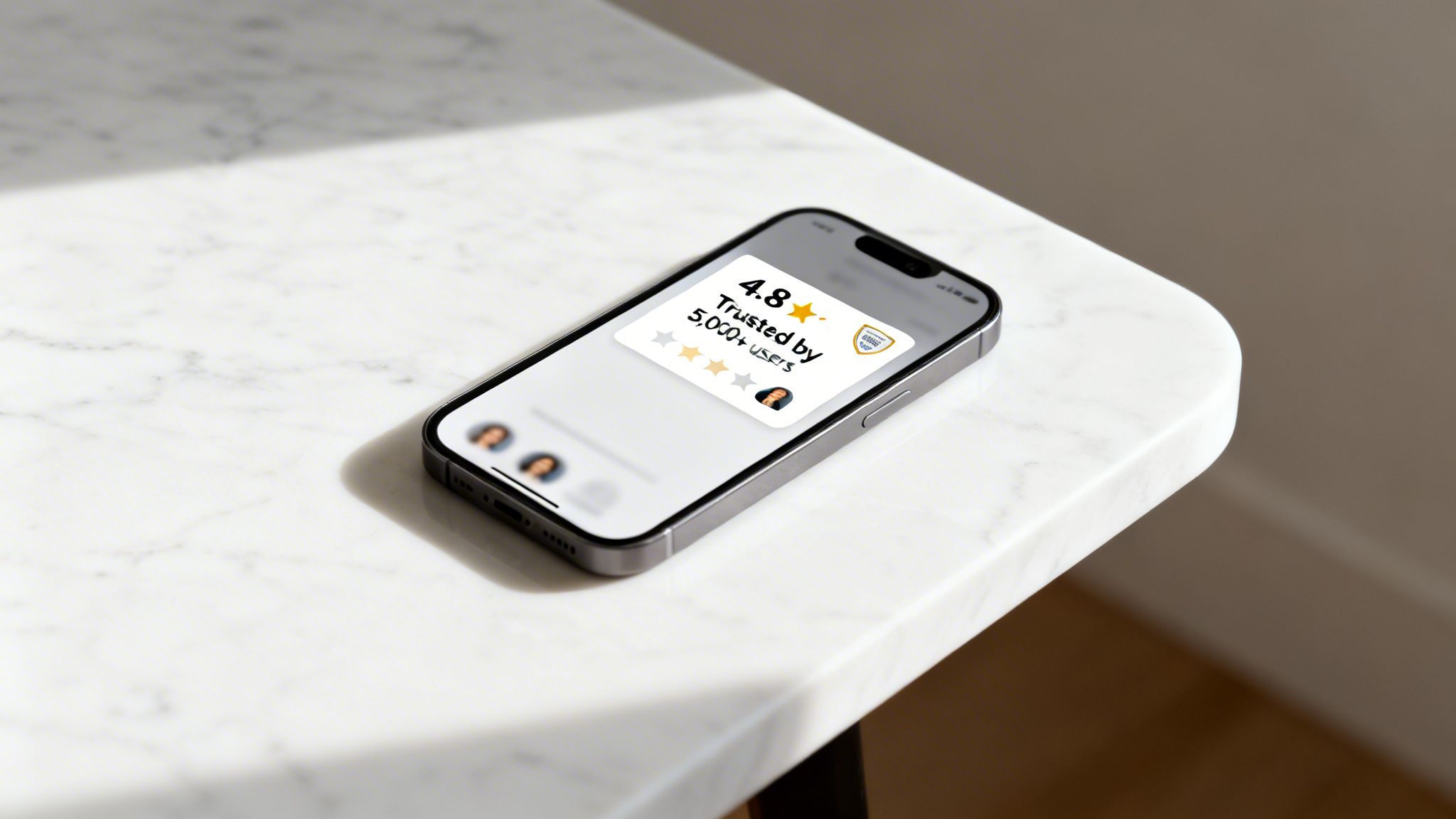
This type of ad copy builds instant credibility. Seeing 'Join 100,000+ happy customers' or 'Rated 4.9★ by 1,200+ clients' acts as a mental shortcut, telling the user your offering is a safe bet. For B2B, this is even more critical. Copy like 'Used by Google, Amazon, Microsoft' or 'G2 Leader for 5 consecutive years' tells a potential buyer that industry leaders have already vetted your solution, making their internal business case much easier to justify. It’s a powerful signal that overcomes skepticism before it even takes root.
Strategic takeaways
Your social proof needs to be specific and relevant to the audience you're targeting. For B2B, peer proof like 'Trusted by 500+ ecommerce agencies' is often more effective than generic celebrity endorsements. The key is to match the proof to the prospect’s context. Always ensure the social proof in your ad is front and center on the corresponding landing page to maintain a consistent trust signal. This isn't a set-it-and-forget-it tactic; update your numbers every 30-60 days to reflect growth. An outdated customer count looks sloppy and can hurt credibility.
How to apply this
Ready to build some trust? Here’s a simple framework to get started:
- For B2B/SaaS: Use Headline 1 or 2 to feature client logos or award badges. 'Trusted by Google & Microsoft' or 'G2's #1 Choice 2024.'
- For Ecommerce/D2C: Lead with customer numbers or ratings. 'Join 100,000+ Happy Customers' or 'Shop Our 4.9★ Rated Collection.'
- For Service Businesses: Focus on verified reviews. '4.9 Stars on Google | 500+ Reviews.'
- Combine with a Benefit: Don't just state the proof; tie it to a result. 'Trusted by 500+ Agencies to Triple Their ROAS.'
The real power of social proof comes from its specificity. Instead of saying 'customers love us,' say 'Rated 4.9/5 by 1,257 verified buyers.' For concrete strategies on leveraging social proof, explore powerful B2B testimonial ad examples to inspire your copy. Testing different types of proof, like user counts vs. industry awards, will reveal what builds the most confidence with your audience.
5. Urgency & scarcity-driven copy
Urgency and scarcity are powerful psychological triggers that tap into our fear of missing out (FOMO). This copy technique works by creating time-based or inventory-based pressure to speed up the customer's decision-making process. Done right, it can significantly lift conversion rates, but it's a double-edged sword. If you use it dishonestly, you risk torching your brand's credibility and even violating Google Ads policies. The key is authenticity and operational readiness.
This is a classic example of advertising copy rooted in Robert Cialdini's scarcity principle. It convinces people that an opportunity is more valuable simply because it's limited. Whether it's 'Early bird pricing ends Friday' for an event or 'Only 5 spots left' for a coaching program, the message is clear: act now or lose out forever. This isn't just about creating panic; it's about framing your offer as an exclusive opportunity that demands immediate attention.
Strategic takeaways
Urgency and scarcity are not just sales gimmicks; they are framing devices. They change the context of the purchase from 'Should I buy this?' to 'Should I buy this now?' This shift is crucial for overcoming procrastination. Your job is to make the cost of inaction feel greater than the cost of taking action. But remember, the urgency must be real. If customers see the same '24-hour flash sale' every week, they'll quickly learn to ignore it.
How to apply this
Ready to add some fire to your copy? Here’s a straightforward way to do it:
- Be Specific: Vague urgency like 'Limited Time Offer' is weak. Use concrete details like 'Sale Ends Midnight PST' or 'Just 3 Left in Stock.'
- Pair with Value: Don't lead with fear alone. Always connect the urgency to a clear benefit. For example, 'Save 40% Before It's Gone' is better than just 'Offer Ending Soon.'
- Match the Landing Page: Ensure your landing page reflects the ad's urgency. If your ad says '24-hour flash sale,' your site needs a countdown timer or a clear banner reinforcing that message.
- Test Against a Control: Always run A/B tests with a non-urgency version of your copy. This is the only way to know if it’s truly boosting performance or just attracting low-quality leads.
Urgency can sometimes spike lead volume while lowering lead quality. Keep a close eye on your downstream metrics, not just the initial conversion rate. This approach turns a powerful tactic into a measurable growth strategy.
Stop theorizing and start testing
Alright, we’ve just walked through some of the core frameworks for crafting advertising copy that actually works. We dissected everything from the classic AIDA and PAS structures to more tactical approaches like using hard numbers, social proof, and emotional triggers. You've seen real examples of advertising copy and the strategic thinking behind them. The worst thing you can do now is just nod, think 'that was interesting', and close this tab.
That's intellectual entertainment, not a growth strategy. The gap between knowing this stuff and actually getting results is action. Theory is comfortable, but testing is where the money is made. All the analysis in the world means nothing until you put a new headline in front of a real audience and see if it converts better than the old one.
So, here's your homework. Don't try to master all these frameworks at once, that’s a recipe for getting overwhelmed and doing nothing. Just pick one.
- Find a lagging campaign: Look at your Google Ads account. Which ad group has a decent impression share but a garbage CTR? Start there.
- Choose one framework: Is the current ad bland and benefit-driven? Test a Problem-Agitation-Solution (PAS) variant against it. Are your headlines too vague? Inject some number-driven specificity.
- Run a clean A/B test: Duplicate your existing ad, change only the headline or description based on the new framework, and let it run. Let the data tell you what your audience actually responds to.
This isn't about finding a magic bullet. It's about building a system, a 'testing muscle.' The most successful performance marketers I know are not brilliant creative writers. They are relentless, systematic testers. They understand that the best example of advertising copy for their specific audience is discovered through iteration, not written perfectly on the first try. They treat copy like a scientist treats a hypothesis, it’s a starting point to be proven or disproven with data.
Ultimately, your customer doesn't care about frameworks. They care about their problems, their goals, and whether you seem to understand them. These structures are simply tools to help you communicate that understanding more clearly and persuasively. Be direct, be specific, and always, always focus on the customer's intent and their state of mind when they see your ad. Now stop reading and go build something that converts. 🙌
Tired of manually A/B testing copy variants? We built dynares to automate this entire workflow. It generates and tests thousands of ad and landing page variations based on these proven principles, so you can stop guessing and start scaling. Check out dynares and see how it works.


