
Google Ads lead generation is, at its core, the process of turning a search into a sales opportunity. You use paid ads to find people actively looking for what you sell, pull them to a dedicated landing page, and get them to hand over their contact details.
Simple enough, right?
Let's get real about Google Ads lead generation
Okay, let's cut the fluff. Most of the advice out there on Google Ads lead gen is a rehash of the same tired tactics that barely move the needle. You're here because you want to build a machine—something that scales and generates actual revenue, not just a pile of useless email addresses.

As a founder building tech, I’ve learned the hard way how easy it is to burn cash on vanity metrics. This isn’t about chasing cheap leads. This is a playbook for building a high-intent, high-efficiency system from the ground up.
The mindset shift required to win
Before we even touch campaign settings or keyword lists, we need to get the foundation right. The single biggest mistake I see is treating Google Ads like a generic traffic source. It’s not.
It’s a direct line to people telling you exactly what problem they have, right now. The mindset shift is from buying clicks to solving problems.
Every search query is a question. Someone is out there looking for a solution, a product, or an answer. Your job is to be the best, most relevant answer they find. This isn't just about outbidding the competition; it's about being more aligned with their intent than anyone else.
The goal isn't just a click. The goal is to start a conversation with someone who has a problem you can solve, and to make it so compelling they want to give you their contact information.
This requires a completely different level of thinking. It means you stop obsessing over click-through rates (CTR) in a vacuum and start caring deeply about lead-to-customer conversion rates. It’s a full-funnel perspective, not a top-of-funnel one.
What this playbook will cover
I’m not going to waste your time with theoretical nonsense. This is a practical guide built on what actually works when you’re spending your own money and need to see a real return. We’ll skip the basics you can find anywhere and get straight to the core components of a successful google ads lead generation engine.
This is the grunt work that separates the amateurs from the pros. Forget the tiny, incremental tweaks for a second. We're starting with the foundation that separates the businesses treading water from the ones that scale aggressively.
Ready to build something that actually works? Let’s get into it.
Nailing your campaign structure and keyword strategy
This is where most people get it wrong. Seriously. They dump a hundred keywords into one massive ad group, point it at a generic landing page, and then wonder why they’re burning cash.
That’s not a strategy; it’s just lazy.
A killer campaign structure is about mirroring user intent with obsessive precision. Think of it like organizing a library—you don’t just throw all the books in one giant pile and hope people find what they need. You categorize them by theme, genre, and author so the right book finds the right reader.

The grunt work you do here pays off exponentially. We’re talking lower CPCs, higher Quality Scores, and leads that actually want to talk to you. Let's build a foundation that doesn't crumble under pressure.
The thematic campaign framework
First thing's first: forget about building campaigns around your product features. Nobody cares about your features yet. They care about their problems. Your campaigns should be built around the themes of those problems.
Let’s say a SaaS company sells project management software. A campaign called "PM Software" is a waste of money. Instead, you build campaigns around the user's pain points.
- Campaign 1: Team Collaboration Issues: Target keywords like "how to improve team communication" or "best software for remote team projects." The ad copy and landing page speak directly to solving collaboration chaos.
- Campaign 2: Missed Deadlines & Task Tracking: Go after terms like "task tracking app for small business" or "project timeline management tool." The entire funnel is about hitting deadlines and gaining control.
- Campaign 3: Branded & Competitor Terms: This needs its own campaign to capture high-intent searchers already looking for you or your direct competitors. The intent is different, so it needs its own budget and messaging.
This thematic structure ensures that every keyword, ad, and landing page is perfectly aligned. That alignment is exactly what Google’s Quality Score algorithm loves, and it’s what users respond to. It’s the difference between a vague whisper and a crystal-clear message.
Uncovering high-intent keywords
Once you have your themes, it’s time to hunt for keywords that signal someone is ready to buy, not just browse. This means going deep on long-tail keywords and really understanding the psychology behind the search query.
Broad keywords like "CRM software" are expensive and attract a ton of window shoppers. But a long-tail keyword like "hubspot alternative for real estate agents" is pure gold. That person knows what they want, has a specific need, and is likely in the evaluation stage. You can read more about how our tools help with this kind of in-depth keyword research.
The magic isn't in finding thousands of keywords. It's in finding the few dozen that signal a user is on the verge of making a decision. Focus on commercial intent modifiers—words like 'quote,' 'pricing,' 'demo,' 'trial,' 'alternative,' and 'for [industry].'
Match types that work for you
Don’t just throw every keyword in as a broad match and hope for the best. That’s a recipe for disaster. You need a disciplined approach to match types to control who sees your ads.
Here’s a practical starting point I use for most new accounts:
- Phrase Match: This is your workhorse. It gives you a good balance of reach and relevance, capturing searches that include the meaning of your keyword.
- Exact Match: Save this for your highest-intent, best-performing keywords. It gives you maximum control and typically results in higher conversion rates.
- Broad Match (with caution!): Only use broad match if you have a sophisticated bidding strategy (like Target CPA or ROAS) and a robust negative keyword list. Without those guardrails, it will drain your budget on irrelevant clicks.
This structured approach is non-negotiable for success. Google Search Ads are the undisputed leader in paid lead generation for a reason; nearly 70% of marketers rank them as the top channel for conversions from paid traffic. With an average search conversion rate of 4.61%, it’s a platform built for capturing high-intent users—but only if you use it right.
To really get ahead, you can even explore advanced strategies like using AI to enhance dynamic lead segmentation for even sharper targeting. This is how you move from just getting leads to getting the right leads.
Creating ads and landing pages that actually convert
Alright, let's get into the most common—and frankly, laziest—mistake I see in Google Ads. You can spend days perfecting keywords and campaign structures, but if you send that high-intent traffic to a generic landing page that looks like it was designed in 2008, you've wasted every dollar.
Think of it this way: your ad is a promise. Your landing page is where you deliver on that promise.
Any disconnect between the two, and you lose. It really is that simple. All that hard work on the front end goes straight down the drain.
Writing ad copy that doesn't suck
The goal here isn't to be clever; it's to be brutally clear. You have a few precious lines of text to convince a real person with a real problem that you are the solution. No pressure, right? 😉
Generic, boring copy is just expensive charity for Google. Your ad has to speak directly to the searcher's pain point and dangle an immediate, compelling solution right in front of them.
And please, use ad extensions. They are free real estate. Sitelinks, callouts, and structured snippets make your ad bigger, push competitors down the page, and give users more reasons to click. Not using them is just leaving money on the table.
Your ad copy isn't just about getting a click. It's about getting the right click. A well-written ad pre-qualifies the visitor, so the person who lands on your page knows exactly what to expect. That means a better, more motivated lead for you.
The anatomy of a high-converting landing page
Now for the delivery. Your landing page is not your homepage. I'm going to say that again: your landing page is NOT your homepage. A homepage is a jack-of-all-trades, juggling a dozen different jobs and linking out to every corner of your site.
Your landing page has one job, and one job only: get the conversion.
This principle is called "message match." The headline on your landing page must echo the promise in your ad. The imagery, the offer, the language—it all has to create a seamless, frictionless journey from click to conversion. If a user clicks an ad for "real estate CRM software" and lands on a generic "business software" page, they're gone in a heartbeat.
The most effective landing pages for Google Ads lead generation are ruthlessly focused. The biggest mistake I see founders make is offering too many choices. Kill the main navigation menu. Get rid of the links to your blog or 'About Us' page. It's one page, one purpose.
- A Killer Headline: Reiterate the promise from your ad. Make it impossible to misunderstand.
- Compelling Sub-Headline: Briefly explain the core benefit or outcome.
- A Frictionless Form: Only ask for what you absolutely need. Name and email are often enough to start a conversation. Every extra field you add is another reason for someone to bail.
- An Irresistible Call-to-Action (CTA): "Submit" is a conversion killer. It’s lazy. Try "Get My Free Demo" or "Download the Guide Now." Make it active and benefit-driven.
- Social Proof: Logos of companies you work with, real customer testimonials, or case study stats build instant trust.
Getting this alignment right isn't a "nice-to-have"—it's the foundation of a profitable campaign. It reduces bounce rates and ensures the expensive traffic you're buying has the best possible chance to convert.
If you want to go deeper, check out our complete guide on landing page design best practices.
The goal is simple: make the decision to convert feel like the obvious, easy, and smart next step. Anything that distracts from that single action is hurting your performance. Get rid of it.
Tracking what matters and optimizing for revenue
Let's talk about the single biggest thing that separates amateurs from pros in the Google Ads lead gen game. It’s not bid strategy. It’s not ad copy.
It’s tracking.
If you're still tracking "leads" as one giant, generic conversion goal, you’re flying blind. It's a dumb way to operate because you're telling Google that a lead from a "download our free guide" pop-up is just as valuable as one from a "request a custom quote" form.
They are absolutely not the same. The real pros track revenue, not just form fills. This is where you stop optimizing for cheap leads and start optimizing for actual profit.
Moving beyond simple conversion tracking
Your goal isn't just to get a form submission; it’s to get a customer. The data you feed back into Google’s algorithm needs to reflect that reality.
The algorithm is incredibly smart, but it's only as smart as the data you give it. This is no longer a "nice-to-have" for serious lead gen campaigns; it's a must-have.
When you feed real sales data back into your account, you unlock the power of value-based bidding strategies like Target ROAS (Return On Ad Spend). Instead of telling Google "get me leads for $50," you can tell it "for every $1 I spend, I want to make $5 back." That’s a fundamentally different—and far more powerful—way to scale your campaigns.
The power of offline conversion imports
So, how do you actually do this? The mechanism is called Offline Conversion Imports. This is how you connect the dots between an online click and an offline sale.
When a lead becomes a paying customer in your CRM (like HubSpot or Salesforce), you need a way to send that information back to Google Ads.
This tells Google's algorithm exactly which keywords, ads, and audiences are producing actual revenue, not just tire-kickers. The journey from ad to paying customer becomes a closed loop.
This flow visualizes how a potential customer moves from seeing your ad to converting on your landing page.
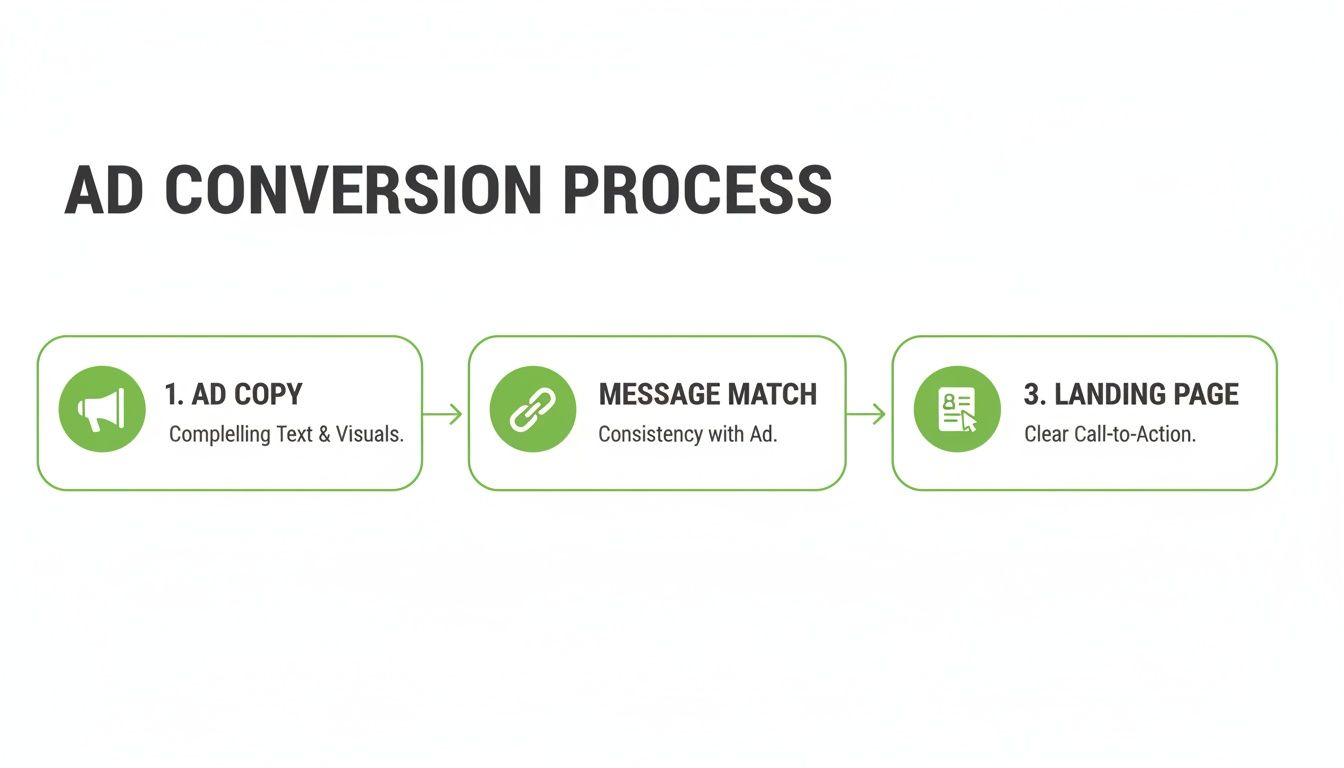
This simple visual hammers home the importance of message match—the ad's promise has to be perfectly fulfilled on the landing page to seal the deal.
Assigning dynamic values to leads
Even if you can't track every sale down to the exact dollar, you can still be smarter than just counting all leads as equal. A solid middle ground is to assign different values based on the lead source.
The core idea is simple: Not all leads are created equal. Your tracking should reflect their potential value. A demo request is worth more than a newsletter signup, and your Google Ads bidding strategy needs to know the difference.
By assigning these values, you're giving Google a much clearer signal about which conversions matter most. The algorithm can then prioritize finding users who are more likely to request a demo over those who just want a free ebook. It’s a huge step up from basic conversion counting. For a more detailed walkthrough, you might be interested in our guide on the full Google Ads conversion tracking setup.
Setting this up is work, there's no sugarcoating it. It requires connecting your marketing stack and thinking critically about your sales cycle. But the payoff is immense. It's how you build a predictable, scalable, and truly profitable lead generation engine with Google Ads.
Using automation to scale your winners
You can't scale a winning Google Ads strategy by doing everything by hand. It's just not possible.
Once you’ve found a formula that works—the right keywords, the right ads, the right landing pages—the game shifts completely. It’s no longer about finding what works; it’s about applying leverage and automation to do more of it.
This is where AI-driven campaigns like Performance Max (PMax) enter the picture. A lot of marketers are skeptical of PMax because it can feel like a black box. You hand over your assets, your audience signals, and your budget, and Google's algorithm just… does the rest.
But here’s the truth from the trenches: it’s incredibly powerful if you feed it the right signals. That high-quality conversion data we just talked about—the offline sales and lead values—is the premium fuel PMax needs to perform. Without it, you’re just giving it junk food and hoping for a miracle.
Strategically testing performance max
Whatever you do, don't just turn off your successful Search campaigns and dive headfirst into PMax. That's a rookie move that can tank your pipeline overnight.
The smart approach is to run them against each other in a controlled test.
Let it run and gather data. The goal is to see if Google's AI, with access to its full inventory (Search, Display, YouTube, Discover), can outperform your meticulously crafted Search campaign. Sometimes it will, sometimes it won't. But you have to test to find out.
The point of automation isn't to replace your strategic thinking. It's to free you from the tedious, manual work of bidding and budget adjustments so you can focus on the bigger picture—strategy, creative, and the customer journey.
The data shows this shift is paying off, especially for lean teams. In 2025, Google Ads lead generation has shown remarkable resilience, with the average conversion rate projected to climb to 5.2%. Performance Max campaigns, now used by an estimated 50% of advertisers, have been a game-changer, delivering up to 18% more conversions by tapping into broader audiences and automated bidding.
Using automated rules as guardrails
Even outside of PMax, automation can be your best friend. Google Ads' automated rules are simple 'if-then' statements that can manage your account 24/7. Think of them as a junior PPC manager who never sleeps and never makes a mistake.
I like to think of them as guardrails for my accounts. You set the rules once, and the system executes them flawlessly, freeing you from constant manual health checks.
Building these systems is how you truly scale. It’s not about working harder; it’s about building smarter, automated funnels that optimize themselves. For more on this, check out our guide on moving from spreadsheet hell to automated PPC funnels with AI.
The end goal is to build an engine that runs and improves itself, letting you focus on the high-level growth strategy that actually moves the needle.
A few common questions
Alright, let's tackle some of the questions that always come up when you're in the trenches running Google Ads for lead gen. Here are some straight answers to what I hear most often from founders and marketers.
Is Google Ads still effective for B2B lead generation?
Yes, absolutely. In fact, it's one of the most powerful channels out there—if you do it right. The trick is to stop thinking like a B2C marketer and get inside the head of a business buyer.
They aren't impulse buying a pair of sneakers; they're researching a solution to a painful, expensive business problem. This means your keyword strategy has to be laser-focused. Forget broad, generic terms like "project management software." You want the long-tail gold, like "project management software for construction firms" or "smartsheet alternative with better reporting." That's where the real intent is.
The B2B sales cycle is also much longer, so your ads and landing pages shouldn't be screaming "Buy Now!" They need to offer high-value assets that solve a small piece of the prospect's problem immediately. For B2B, Google Ads isn't about closing the deal on the first click. It's about starting a valuable conversation with the exact right person at the exact right company.
How much should I budget for a new campaign?
This is the million-dollar question, isn't it? The honest—if slightly frustrating—answer is: it depends entirely on your industry, your target keywords' cost-per-click (CPC), and how fast you want to grow.
There's no magic number, but there is a practical way to figure it out. Don't just pull a number from thin air. You have to work backward from your goals.
Stop asking, "What should my budget be?" and start asking, "How many customers do I need, and what am I willing to pay for each one?" This simple shift changes your mindset from seeing ads as a cost center to treating them as a strategic investment.
This simple formula gives you a reality check. If the average CPC in your industry is $5.00, you know immediately that your conversion estimates are way too optimistic or your target CAC is unrealistic. You have to adjust the model.
As a starting point, aim for a budget that lets you get at least 100-200 clicks per week. Anything less, and you'll be waiting forever to gather enough data to make smart decisions.
Performance max vs. search campaigns: which is better?
This isn't an either/or fight; it's a "when and why" situation. Thinking of them as competitors is the wrong frame. They are different tools for different jobs, and they work best when used together.
Search Campaigns are your scalpel. They're all about precision. You control the keywords, the ad copy, and the bids with meticulous detail. This makes them perfect for capturing high-intent demand—people who are actively looking for exactly what you sell, right now.
Performance Max (PMax) is your sledgehammer. It's built for reach and scale. You feed Google your creative assets and audience signals, and its AI goes to work finding customers across all of Google's channels (YouTube, Display, Discover, Gmail, you name it). It’s fantastic for generating new demand and uncovering pockets of customers you didn't even know existed.
Here’s my current playbook:
- Start with Search: Build your foundation with tightly-themed Search campaigns. This is how you capture that bottom-of-funnel, high-intent traffic and establish your most reliable source of quality leads.
- Layer on PMax: Once you have a steady stream of conversions and sales data flowing, launch a PMax campaign. Feed it your best-performing Search audiences and customer lists as signals to give the algorithm a strong head start.
- Measure Incrementality: Run them side-by-side and watch the data. Is PMax bringing in net-new customers, or is it just cannibalizing your Search traffic? Your numbers will tell the story.
Use Search to harvest existing demand and PMax to create new demand. They're two sides of the same coin in a truly robust google ads lead generation strategy.
At dynares, we're building the tools to automate this entire process—from creating thousands of hyper-relevant ads and landing pages to tracking revenue and optimizing for pure profit. If you're tired of the manual grind and want to build a truly scalable Google Ads engine, check out what we're doing at https://dynares.ai.


