
Let's get straight to it: to improve Google Ads performance, you need a disciplined framework. It all starts with a rock-solid account structure, a smart keyword strategy, and ruthless negative keyword management. This isn’t about small tweaks; it’s about plugging the massive leaks draining your budget before you even get a chance to compete.
Why your Google Ads account is probably leaking money
Let's be real for a minute. Most Google Ads accounts are a mess.
As a founder, you're either running them yourself between a million other tasks or you've handed them off to an agency that might just be asleep at the wheel. The platform’s complexity isn’t an accident; it's practically designed to make you spend more if you aren't paying close attention. It's also why a simple audit often uncovers huge, glaring opportunities.
This isn’t about just tweaking a few keywords and calling it a day. The real problem is usually a fundamental misunderstanding of how the system works. I’m cutting through the noise to share the exact framework I've used to scale my own tech companies and turn ad spend into a predictable growth engine.
The common traps that catch founders
We’re going to expose the common traps founders fall into, from lazy account structures to blindly trusting every single one of Google's automated suggestions. This is a practical, ground-up way to stop burning cash.
This diagram shows the simple but devastating flow of how most ad accounts fail. It starts with a messy structure, which leads to over-reliance on automation, and it ends with you burning through your budget with little to show for it.
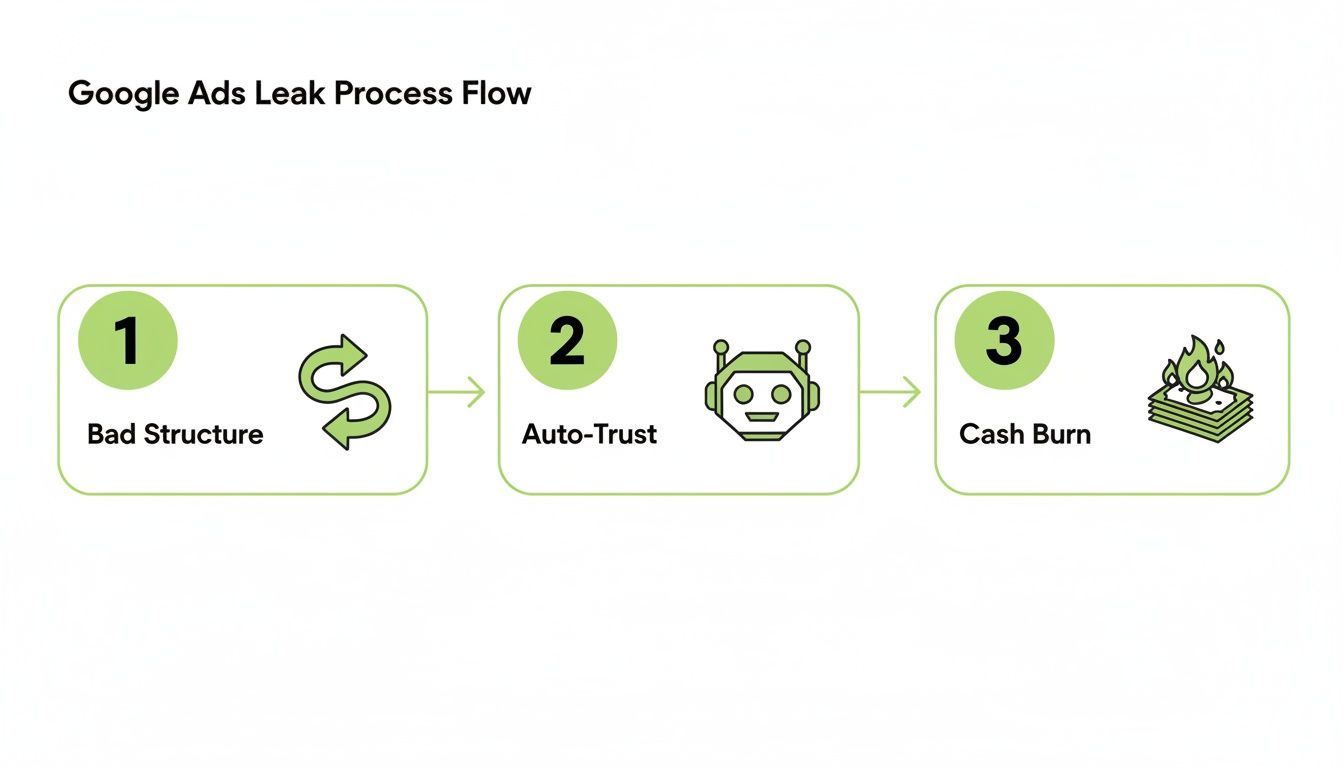
Fixing the foundation is the only way to break this cycle and build a system that generates actual returns.
The stakes here are incredibly high. Google Ads is still the most dominant advertising platform on the planet. A recent analysis in ad spend revealed that while the average cost-per-click (CPC) is $2.69, it can spike dramatically in competitive niches like software.
Getting this right means you can compete effectively. Getting it wrong means you're just funding your competitors' growth.
To give you a quick cheat sheet, here are the most common ways I see accounts bleed money. Look for these signs in your own campaigns.
| The Problem | Why It Happens | What to Look For |
|---|---|---|
| Messy Account Structure | Campaigns are created without a clear strategy, lumping different intents, products, or geos together. | Broad ad groups with dozens of unrelated keywords. Low Quality Scores. A single landing page for the entire account. |
| Wrong Match Types | Over-reliance on Broad Match without proper negative keyword lists lets Google match your ads to irrelevant searches. | High impression volume but low click-through rates (CTR). A Search Terms report full of garbage queries. |
| No Negative Keywords | Forgetting to actively block irrelevant search terms. It's the #1 cause of wasted ad spend, hands down. | Spending money on clicks for terms like free, jobs, reviews, or competitor names you don't want to target. |
| Broken Tracking | Conversions aren't tracked correctly, or you're only tracking top-of-funnel actions like form fills instead of actual sales. | Smart Bidding optimizes for junk leads. You have no idea which keywords are actually driving revenue. |
Spotting these issues is the first step. The good news is that every single one of them is fixable with a bit of discipline.
Shifting from a cost center to a growth engine
The goal is to transform your ad account from a painful line item on your P&L into a genuine growth machine. This requires a systematic approach, not just random acts of optimization. It starts with understanding that every dollar you save on an irrelevant click is a dollar you can reinvest into acquiring the right customers.
The biggest mistake I see is treating Google Ads like a slot machine. You put money in, pull a lever, and hope for the best. That’s a dumb strategy. It’s an intricate system that rewards discipline, structure, and relentless testing.
To truly nail this, you have to own your data. Here are the core pillars we’re going to rebuild from the ground up:
- A bulletproof foundation: We’ll structure campaigns and ad groups for clarity and control, not for Google’s convenience. This is where you win or lose the game before it even starts.
- Intent-driven keywords: It's time to move beyond the obvious, expensive keywords. We'll find the long-tail queries that signal real buying intent and separate the tire-kickers from the customers.
- Data-driven decisions: Implementing flawless tracking is non-negotiable. You can't optimize what you can't measure. If your tracking is a mess, check out our guide on how to use Google Tag Manager to get your data in order first.
Building a bulletproof account structure
Let's get straight to the point: a chaotic account structure is a direct path to wasted spend and garbage data. It's the boring foundation that changes everything.
If your campaigns, ad groups, and keywords are a tangled mess, no amount of bidding wizardry or clever ad copy will save you. You're just optimizing a leaky bucket.
Forget the old, tired debates like SKAGs vs. Themed Groups. The game has changed. Google's AI is more aggressive now, and our structures need to evolve with it. What worked five years ago is a recipe for failure today. We need a structure that gives the AI enough data to learn, while still giving us—the humans—the control we need to steer the ship.

The goal here is to build something logical, scalable, and—most importantly—transparent. You should be able to look at your account and know exactly what’s working, what’s not, and why. This isn’t just about neatness; it's about clarity of performance.
The modern campaign blueprint
A modern, effective account structure is built around user intent, not just keywords. Think about the person behind the search query. What are they trying to accomplish? Are they just researching solutions, actively comparing prices, or are they ready to buy right now?
Grouping your campaigns around these stages of intent is far more powerful than just lumping them together by product feature.
Here’s a practical way to think about it:
- High-intent campaigns: These are your money-makers. They target keywords that scream "I'm ready to buy," like brand names, competitor comparisons (dynares vs competitor x), or long-tail phrases with transactional words (saas lead gen software pricing). The budget for these campaigns should be protected at all costs.
- Mid-funnel campaigns: This is where you capture people who are problem-aware but not yet solution-aware. They're searching for things like how to lower cpc on google ads or best way to automate landing pages. Your goal here is to educate and build trust, not necessarily to close the deal on the first click.
- Brand campaigns: This is non-negotiable. You must bid on your own brand name. It protects your turf from competitors who will absolutely bid on it, and it captures the warmest possible traffic. These campaigns are usually incredibly efficient and provide a baseline of high-quality conversions.
This approach organizes your spending logically. You can be aggressive with budgets on your high-intent campaigns and use the mid-funnel campaigns to fill the pipeline and build your audience. It gives you levers to pull that are tied directly to business objectives.
Demystifying match types and keywords
Let’s talk keywords and match types, but without the textbook jargon. Over the last few years, Google has blurred the lines between Broad, Phrase, and Exact Match so much that their original definitions are almost useless.
Here’s how they actually behave in the wild now:
- Broad match: This is the Wild West. Use it with extreme caution and only when paired with Smart Bidding strategies like tCPA or tROAS. It gives Google’s AI maximum freedom to find users it thinks are relevant. Without a massive negative keyword list, this is the fastest way to burn your entire budget on junk traffic. Seriously.
- Phrase match: This has become the new workhorse for most accounts, offering a good balance of reach and relevance. It matches your ads to queries that include the meaning of your keyword. Think of it as Broad Match with guardrails—it’s flexible, but not completely out of control.
- Exact match: Don't let the name fool you; this is no longer exact. It now includes close variants, synonyms, and queries with the same intent. It's the most restrictive option you have, perfect for those high-intent, must-win keywords where you want maximum control.
The biggest mistake you can make is taking Google's keyword match type definitions at face value. Think of them as suggestions of control, not absolute rules. Phrase Match is your safest and most effective starting point for almost everything.
Finding the right keywords is really about digging for intent. Go beyond the obvious head terms your competitors are all bidding on. Look for long-tail, high-intent phrases—those three-to-five-word queries that signal someone knows exactly what they're looking for. Your Search Terms report is your best friend here; it's a goldmine of real user language you can turn into new keywords.
The unsexy discipline of negative keywords
Finally, let's discuss the most critical and overlooked part of any strategy to improve Google Ads performance: negative keywords.
This isn't a one-time task; it's an ongoing discipline. It is the single most effective way to stop wasting money.
From day one, you should have a master negative keyword list applied to all campaigns. This should include universal terms you never want to show up for. Things like:
- Irrelevant intent: free, jobs, careers, review, guide, tutorial, diy
- Low-quality traffic: cheap, torrent, download
- Competitors (if not a specific strategy): competitor names you don’t want to target
Then, on a weekly basis, you need to dive into your Search Terms report. This report shows you the actual queries people typed before clicking your ad. Scour this for irrelevant searches that slipped through the cracks. Every single one is a budget leak. Add it as a negative.
It's a simple, repetitive task, but the cumulative impact on your ROAS is massive. It’s the difference between a profitable account and one that just breaks even.
Crafting ad copy that actually converts
Your ad copy is your frontline soldier. If it's generic, boring, or sounds like it was written by a committee, it's completely invisible. We spend all this time perfecting our account structure and keyword lists, only to fall flat with copy that doesn't connect. It's a huge, unforced error.
The goal isn't just to get a click; it's to get the right click from a user who understands what you're offering. This means your headlines and descriptions must speak directly to their pain points and, more importantly, match their search intent. It's a conversation you're starting, and your ad is the opening line.
Beyond just keywords
Great ad copy isn't about keyword stuffing. It's about psychology. You need to tap into the fundamental triggers that drive human action without sounding like a sleazy, late-night infomercial marketer. Let's be better than that.
There are three classic triggers that always work if used authentically:
- Social proof: People trust other people. Instead of saying We're the best, try Join 10,000+ happy customers. Use real numbers, testimonials, or awards to build instant credibility. It shifts the claim from your opinion to a collective fact.
- Urgency: Why should someone act now? Limited-time offers, countdowns, or scarcity (Only 3 spots left) create a compelling reason to stop scrolling and engage. Just be honest; fake urgency is transparent and kills trust.
- Loss aversion: People are more motivated by the fear of losing something than the prospect of gaining something. Frame your offer around what they'll miss out on. Stop wasting ad spend often hits harder than Increase your ROAS.
Weaving these elements into your copy makes your ads resonate on an emotional level. It's the difference between an ad that's seen and an ad that's felt—and clicked.
A structured approach to testing ads
Forget random A/B tests. Throwing spaghetti at the wall to see what sticks is a dumb way to manage your budget. We need a structured, systematic approach, and Responsive Search Ads (RSAs) are the perfect tool for this, if you use them correctly.
Most people just dump 15 headlines and 4 descriptions into an RSA and let Google's black box figure it out. That's lazy. A smarter approach is to use pinning strategically to control the experiment.
Think of your RSA as a testing laboratory, not a suggestion box. You are the scientist directing the experiment. Pinning a high-performing headline to Position 1 gives you a stable control variable, allowing you to test other headlines in Position 2 and 3 to see which combinations perform best.
Here's a simple framework to get started:
- Pin your core message: Identify your single most important value proposition or call-to-action. Pin this headline to Position 1. This ensures your core message is always visible.
- Test variations in position 2: Use the second headline position to test different angles. One week, test social proof headlines. The next, test urgency-based headlines. Isolate the variables so you know what's actually working.
- Iterate and replace: After a few weeks, review the data. Keep the winning combination, discard the losers, and introduce new challengers. It's a continuous cycle of improvement, not a one-and-done setup.
This method gives you the benefits of Google's machine learning without completely surrendering control. It's about combining human strategy with machine execution to systematically improve your Google Ads performance. Building out these variations manually can be a grind, which is why tools with an integrated ad builder for Google Ads like the one on https://dynares.ai/features/ad-builder are becoming essential for scaling this process effectively.
Your creative is a performance lever
Finally, a quick word on quality. Good enough creative is a recipe for failure. Your ad copy and any associated assets (like images or sitelinks) aren't just filler; they are critical performance levers. A strong call to action, for example, can make or break a campaign. It's crucial for driving results, and exploring these 8 high-converting call to action examples can dramatically improve the effectiveness of your ad copy.
High-quality, relevant creative directly impacts your Quality Score, which in turn lowers your CPC and improves your ad rank. Investing time and thought into your copy isn't a luxury; it's a direct investment in the financial efficiency of your campaigns. It separates the winning campaigns from the ones that just burn cash.
Optimizing landing pages to close the deal
You can have the best ads in the world, with a perfect account structure and flawless copy, but if your landing page sucks, you're just lighting money on fire. The click is only the first step; the conversion happens on your turf. It's a shocking waste of ad spend to send great traffic to a page that can't close the deal.
Let's be brutally honest: most ad-specific landing pages are an afterthought. They're usually just a slightly tweaked homepage, cluttered with navigation, competing offers, and mixed messages. That's a dumb approach. A dedicated landing page has one job—to convert the user from that specific ad.
Message match and a single CTA
The absolute, non-negotiable foundation of a high-converting landing page is message match. The headline on your landing page needs to be a direct echo of the ad the user just clicked. If they clicked an ad for AI-Powered Lead Gen Software, your page better say something incredibly similar right at the top.
Anything else creates immediate cognitive dissonance. The user wonders if they're in the right place. That tiny moment of confusion is all it takes for them to hit the back button.
From there, the entire page must be ruthlessly focused on a single call-to-action (CTA). Do you want them to book a demo? Fill out a form? Download a PDF? Pick one.
Your landing page is not a buffet. It's a set menu with one dish. Every element—every image, every sentence, every button—must support that single conversion goal. Remove everything else. No navigation bar, no footer links to your blog, no social media icons. Zero distractions.
The non-negotiables for conversion
Once you've nailed the core message, a few technical and UX elements are just table stakes. Getting these wrong will absolutely murder your conversion rates, no matter how great your offer is.
- Blazing-fast page speed: Every millisecond counts. A slow-loading page is the digital equivalent of a rude salesperson. Users will leave before your pitch even loads. Use Google's PageSpeed Insights, compress your images, and get your load time under two seconds. Seriously.
- Mobile-first, not mobile-friendly: Over half of all web traffic is mobile now. Your page shouldn't just work on a phone; it needs to be designed for a phone first. This means big, tappable buttons, simple forms, and text that's readable without pinching and zooming.
- Trust Signals Everywhere: People are skeptical online. You have to build trust instantly. This means weaving in testimonials, customer logos, security badges, and clear guarantees. These aren't just decorations; they are crucial for overcoming user anxiety and making them feel safe enough to convert.
Getting these fundamentals right is critical. The whole ad ecosystem is getting more expensive. Performance data from 2025 shows that while the global average conversion rate crept up to 7.52%, the average cost per lead also climbed to a hefty $70.11. You're paying more for each shot, so you'd better make it count.
A simple audit for better performance
Think of your landing page as the final handshake in a sales process. You've done all the hard work to get them in the room; don't fumble the close. Improving your landing page relevance is one of the fastest ways to see a direct impact on your bottom line. We have a whole guide that dives deeper into this connection. Another powerful technique is leveraging effective video landing pages to engage visitors and explain your value prop in seconds.
Here’s a quick checklist to audit your own pages. Be honest with yourself—where are you falling short?
- The 5-second test: Can a new visitor understand what you offer and what they're supposed to do within five seconds? If not, your headline and CTA are too complicated.
- The "One Thing" rule: Is there only one primary action a user can take? Or are you distracting them with links to About Us or your career page? Kill them.
- The form friction Test: Is your form asking for too much? For an initial lead, you probably just need an email. Each extra field you add causes a drop-off. Keep it brutally simple.
Fixing these common mistakes is how you turn more of that expensive traffic into actual revenue and seriously improve Google Ads performance.
Using AI and automation to intelligently scale
Let's just be direct: manual campaign management is a dead end. If you're not using AI and automation to scale your Google Ads, you’re already behind. You’re bringing a spreadsheet to a gunfight, and it’s a dumb way to compete.
But this isn’t about blindly trusting Google's black box. Far from it. This is about using technology as a strategic lever—a force multiplier for your own expertise. It's about combining your human strategy with relentless machine execution.
The old days of tweaking bids on a handful of keywords every morning are over. The game now is about feeding the machine the right data and setting the right strategic direction, then letting it do the heavy lifting at a scale no human ever could.
Making smart bidding work for you
First, let's talk about Google's own tools. Smart Bidding strategies like Target CPA and Target ROAS can be incredibly powerful, but only if you give them clean, accurate data to work with. They're only as smart as the information you feed them.
This is where flawless conversion tracking becomes non-negotiable. If your tracking is a mess and you're feeding the algorithm garbage—like low-quality leads or vanity metrics—it will happily go out and find you more garbage. Your job is to define what a win actually looks like (a qualified lead, a profitable sale) and ensure that's precisely what the algorithm is chasing.
Here’s the reality of modern Smart Bidding:
- tCPA (Target Cost Per Acquisition): This tells Google to get you as many conversions as possible at a specific cost. It’s great for lead gen when you know exactly what a lead is worth. But set the target too low, and you'll starve the campaign of volume.
- tROAS (Target Return On Ad Spend): This is the go-to for e-commerce or any business where conversion values differ. You tell Google you want a specific return for every dollar you spend (e.g., a $5 return for every $1 spent). This requires you to pass back dynamic conversion values—a non-negotiable for it to work.
- Maximize Conversions/Conversion Value: Think of these as the training wheels of Smart Bidding. They work to get you the most conversions or value within your budget. They're useful for new campaigns to gather data before you dial in a more specific tCPA or tROAS target.
The key is to give the machine a clear objective and the right fuel. Without accurate conversion data, you’re just letting a blind robot drive your very expensive car. It won't end well.
Automating ad creative at scale
The next level of automation goes way beyond bidding. It’s about automating the creation and testing of ads and landing pages at a scale that is simply impossible for a human team to match. This is where you can build a massive competitive advantage.
Think about it: generating unique, relevant ads and landing pages for hundreds or even thousands of long-tail keywords is an operational nightmare. It's the kind of spreadsheet hell that kills productivity and leads to generic, low-performing campaigns. This is precisely where you can escape from spreadsheet hell to automated PPC funnels with AI.
The future of PPC isn't about one person writing one ad. It's about one person defining a strategic framework that allows an AI to generate and test ten thousand ad variations, find the winners, and scale them automatically. That's the real leverage.
Imagine being able to automatically generate ad variants from your best-performing blog content or dynamically update ad copy with real-time data like inventory levels or pricing. Tools are emerging that do exactly this, turning your strategic inputs into thousands of coordinated assets. This systematic approach is how you truly improve Google Ads performance in a meaningful way.
The ever-smarter machine
And this trend is only accelerating. Google's own AI advancements are continuously reshaping what’s possible. For example, Google's 2025 progress in AI advertising has given us more powerful tools. The introduction of Smart Bidding Exploration allowed advertisers to use flexible ROAS targets, leading to an average 19% lift in conversion rates. Meanwhile, Performance Max campaigns are finally becoming less of a black box, with new reporting that gives us actual insights into channel performance and search terms. You can find out more about Google's 2025 PPC updates and how they’re providing more control.
The message is clear: the machines are getting smarter, and our job as founders and marketers is to become better strategists. We need to focus on the inputs—the data, the creative angles, the core value proposition—and let automation handle the execution and optimization at a massive scale. Those who adapt will win. Those who don't will become a footnote.
As a founder, I get cornered about Google Ads all the time. It’s this weird mix of being an absolute necessity and a source of incredible frustration. So let's cut the BS and tackle the questions I hear most often.
How long does it take to improve Google Ads performance?
Forget about magic buttons. Anyone promising instant results is selling you a fantasy.
That said, you can score some surprisingly big wins in the first 30 days. This is the triage phase, where you’re just plugging the most obvious, gaping leaks in your budget. Think building a solid negative keyword list, axing your insane match types, and stopping bids on total garbage traffic. It’s damage control, and it works fast.
But for the real, lasting improvements—the kind that moves your conversion rate and ROAS—you need to give it 60-90 days of disciplined, consistent work. You need enough data to make smart calls, test your ad copy until it sings, and dial in your landing pages. It’s a system you build over time, not a one-and-done fix.
Should I trust Google’s automated recommendations?
Treat them with extreme skepticism. It’s that simple.
Let’s be real for a second: Google's number one customer is its shareholders, not you. A huge chunk of their recommendations are engineered to do one thing: get you to spend more money. The constant nudge to upgrade keywords to Broad Match without a bulletproof negative strategy is the classic cash-burning trap. It’s a lazy, dumb suggestion.
My rule is simple: never, ever blindly hit 'apply all'. Period. Run every single suggestion through the filter of your actual business goals.
- Potentially useful: Spotting new keyword ideas or flagging profitable ad groups that could use more budget.
- Usually terrible: Automatically applying Broad Match everywhere, adding redundant keywords, or creating auto-generated ad assets that sound like they were written by a depressed robot.
Use the recommendations tab as an idea farm, not an instruction manual. You’re the founder. You know your business better than their algorithm ever will.
What’s a good ROAS for Google Ads?
This question is a trap. The so-called industry standard of a 4:1 ROAS ($4 back for every $1 spent) is a completely meaningless vanity metric. If you’re chasing a generic number like that, you’re already making bad decisions.
Stop asking what’s good and start calculating your break-even ROAS.
A good ROAS is any number that makes your business profitable. Full stop. It's your number, not some benchmark from a blog post. Know your margins, know your customer lifetime value (LTV), and work backward from there.
An e-commerce store with razor-thin margins might need a 5:1 ROAS just to keep the lights on. On the other hand, a high-growth SaaS company with a massive LTV could be thrilled and wildly profitable with a 2:1 ROAS on the initial acquisition. Focus on your own P&L, not what you think everyone else is doing.
Is Performance Max a black box I should avoid?
It absolutely used to be, and frankly, it was a terrible product for anyone who values control and transparency. For a while, you just threw money into it and prayed. Thankfully, enough advertisers screamed about it that Google was forced to add back some visibility.
You can now add campaign-level negative keywords, get much better asset-level reporting, and see some channel performance data. It’s still a black box compared to a standard Search campaign, but it's no longer a complete mystery.
My advice for founders is this:
- Test it cautiously. Start with a small, tightly controlled budget.
- Feed it only your highest-quality conversion data. Garbage in, garbage out.
- Never, ever let it run without adult supervision and regular check-ins.
Performance Max can be a powerful tool for discovering new customer pockets, but it needs a very short leash. If you just set it and forget it, I promise it will find creative new ways to burn your cash.
At dynares, we think scaling Google Ads shouldn't be a manual, soul-crushing process. Our AI platform automates the creation of high-intent ads and matching landing pages for every keyword, so you can stop living in spreadsheets and start driving actual revenue. See how we do it.


