
Pay per click for small businesses is an advertising model where you pay only when someone actually clicks your ad. So, is it a growth engine or a cash burner?
The blunt answer: it can be either. And the outcome has almost nothing to do with your budget and everything to do with your strategy.
Is PPC a growth engine or a cash burner?
Let’s be real. As a founder, your time and cash are the two things you can’t afford to waste. The last thing you need is to pour money into a marketing channel that feels like a black hole.
A lot of small businesses get torched by pay-per-click advertising and walk away convinced it's a system rigged for big companies with bottomless budgets. That’s a fundamentally wrong assumption.
The truth is, PPC isn't magic; it's a measurable system. If you build it the right way, it becomes a predictable revenue engine. The key is to stop thinking of it as buying ads and start thinking of it as buying a direct line to customers who are actively searching for the exact thing you sell. You're meeting them at the precise moment of need. That’s incredibly powerful.
The real cost of a click
So, what are you actually paying for? The whole system runs like a lightning-fast auction. Every time someone types a search into Google, an auction happens in milliseconds to decide which ads get shown.
But here’s the twist: it’s not just about who throws the most money at it. Google cares, almost obsessively, about the user's experience.
Your bid is only one piece of the puzzle. The other, more important piece is your Quality Score. This is Google’s rating of how relevant your keywords, ad copy, and landing page are to the search. A high score can get you a better ad position for less money than your competitors are paying.
This is the part most founders miss entirely. They try to brute-force their way to the top with high bids, which is a dumb and expensive mistake. Your goal isn’t just to win the auction; it’s to win the right auction, profitably. For a deeper look, understanding what Google Quality Score really cares about in 2026, beyond the usual nonsense is critical.
The entire system is built to reward advertisers who give searchers what they want. When you focus on quality and relevance, you can flip pay per click for small businesses from a cost center into a reliable growth lever. For those looking to dive deeper into the overarching strategies of online advertising, a comprehensive guide to paid ads marketing can provide valuable insights.
Building your first campaign without wasting money
Alright, let's talk about where most founders go wrong. They treat Google Ads like a slot machine—they throw in a bunch of keywords, pull the lever, and hope for the best.
Then they’re shocked when their credit card bill is through the roof and they have nothing but a bunch of useless clicks to show for it.
We're not doing that. This is your no-nonsense guide to building a lean, effective pay-per-click campaign from scratch. We’re focusing on the absolute essentials to get right from day one, so you can build a system that generates leads, not just invoices.
First thing’s first: structure is everything. A messy campaign structure is like trying to build a house on a swamp. It’s going to sink, and it’s going to be expensive.
Start with search and forget the rest
When you open Google Ads, you’ll be bombarded with options: Search, Display, Shopping, Video, Performance Max. It’s intentionally overwhelming.
Ignore all of them except for one: Search.
The Search network is where you find people with high intent—they are actively typing your solution into a search bar. The Display network, on the other hand, is about interrupting people while they’re browsing other websites. It’s great for brand awareness, but for a small business focused on conversions, it’s a quick way to burn your budget. We’re hunting, not just fishing.
The process is straightforward: someone searches, an auction happens, and if your ad is relevant enough, they see it and click.
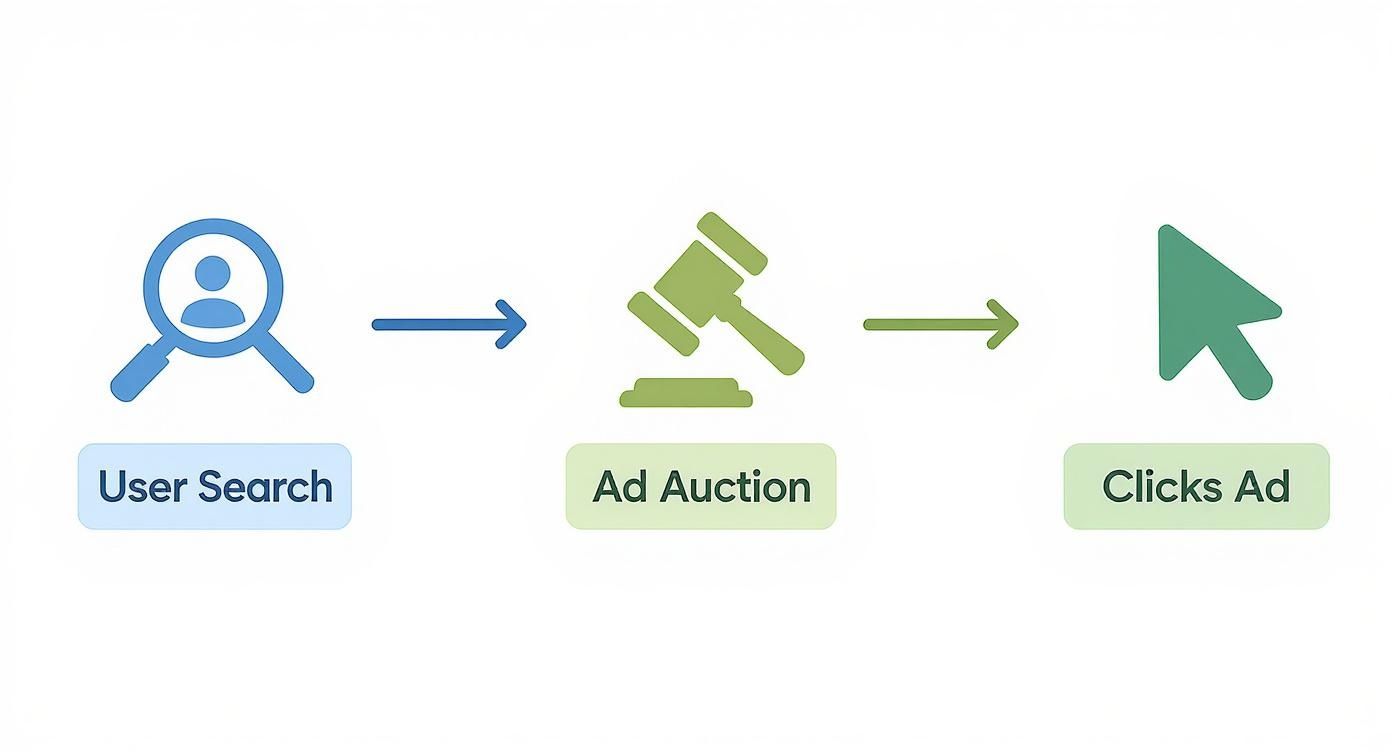
This simple flow from search to auction to click is where you have the most control and can get the most immediate feedback on what's working.
The power of tight ad groups
Once you have your Search campaign, you need to organize it. The biggest mistake is dumping all your keywords into one giant ad group. That’s just lazy. It guarantees your ads will be irrelevant to most searches.
Instead, you need to create tightly themed ad groups. Think of them as small, hyper-focused containers. Each ad group should contain only a handful of very similar keywords.
- Ad Group 1 Theme: "Custom CRM Software"
- Keywords: "custom crm software for startups", "build a custom crm", "bespoke crm solution"
- Ad Copy: Mentions custom CRM software directly in the headline.
- Ad Group 2 Theme: "CRM for Sales Teams"
- Keywords: "crm for small sales teams", "sales team crm platform", "best crm for salespeople"
- Ad Copy: Mentions CRM for sales teams directly in the headline.
This structure ensures that when someone searches for "crm for small sales teams," they see an ad that speaks directly to that need. This relevance is what gets you higher Quality Scores and lower costs.
Your most valuable players: keyword match types
Next up are match types. This tells Google how closely you want a user's search to match your keyword. There are three you need to know, but only two you should use at the start.
Broad Match is Google’s default setting because it makes them the most money, not you. It will show your ad for all sorts of vaguely related searches and drain your budget on irrelevant clicks. Avoid it like the plague when you’re starting out.
Your focus should be on these two:
- Phrase Match "[keyword]": This shows your ad for searches that include the meaning of your keyword. It's a great middle ground, giving you reach while maintaining control. If your keyword is "[crm for small business]", your ad might show for "best crm for small business" or "small business crm software".
- Exact Match [[keyword]]: This is your sniper rifle. It shows your ad only for searches that have the same meaning or intent as your keyword. Using [[crm software for startups]] ensures you only appear for people searching for exactly that.
Start with a small, curated list of Phrase and Exact match keywords. You can always expand later once you have data. The global PPC advertising spend is projected to hit $351.55 billion in 2025, and with average conversion rates for search ads around 4.2%, every click must count.
Finally, the cardinal sin of PPC for small businesses is sending paid traffic to your homepage. Your homepage is designed for everyone; your paid traffic needs a page designed for one thing: conversion.
Every ad group needs its own dedicated landing page that mirrors the promise made in the ad. If your ad says "Custom CRM Software," the landing page better scream "Custom CRM Software." A powerful AI-powered ad builder can help create these coordinated ads and pages at scale, ensuring your message is always consistent from click to conversion.
Setting a pragmatic budget and bidding strategy
So, how much should I spend?
It's the first question every founder asks. The internet is littered with gurus shouting to spend as much as you possibly can. That isn't a strategy; it's a lazy way to burn through your cash.
The real answer isn't some magic number. It's a logical process. We're not going to guess. We're going to build a budget from the ground up, based on real data and what your business can actually stomach. This is all about making calculated bets, not just throwing money at a wall and hoping something sticks. For a deeper dive on making every dollar count, resources like this guide on how to Help Advertising Small Business On A Budget are invaluable.
Start with what a customer is worth
Before you spend a single euro, you have to know your numbers. Specifically, you need a rough handle on your Customer Lifetime Value (LTV) and what you're willing to pay for a new customer—your acceptable Cost Per Acquisition (CPA).
If a new customer is worth €1,000 to your business, are you willing to spend €100 to get them? €200? €500? That number is your North Star. It dictates everything that follows.
Forget about industry benchmarks for a minute. Your CPA target is unique to your business, your margins, and how fast you want to grow. Don't let anyone tell you what you should be spending; figure out what you can spend and still build a profitable company.
Once you have that target CPA, you can work backward. Pop into Google's Keyword Planner and look at the estimated Cost Per Click (CPC) for your main keywords. If your target CPA is €200 and you convert 5% of clicks into paying customers, you'll need 20 clicks to land one customer. That means you can afford to pay up to €10 per click (€200 / 20 clicks). Simple math, powerful direction.
Demystifying bidding strategies
Google will happily try to push a dozen different automated bidding strategies on you. Most of them are black boxes designed to make them more money. When you're just starting out, what you need is control and clarity, not complexity.
Let's cut through the noise. There are really only two bidding strategies you should even consider at the beginning:
- Manual CPC (Cost Per Click): This is you, in the driver's seat. You set the absolute maximum you’re willing to pay for a click. It's more hands-on, sure, but it gives you total control and forces you to understand what's actually happening. You're not just hoping an algorithm figures it out for you.
- Enhanced CPC (eCPC): Think of this as Manual CPC with a little AI co-pilot. Google can adjust your bids up or down slightly if it thinks a specific click is more or less likely to convert. Only flip this switch after you have some reliable conversion data flowing into your account. Without that data, it’s just guessing with your money.
The goal isn't to win every auction; it's to win the profitable ones. Starting with Manual CPC teaches you the discipline of bidding based on performance, not ego.
Your secret weapon for lower costs
Here’s a fact that separates the campaigns that print money from the ones that bleed it: you don't have to outbid your competitors to outrank them.
The key is your Quality Score.
Think of Quality Score as your reputation with Google. It’s a simple rating from 1 to 10 based on how relevant your keywords, ad copy, and landing page experience are to the searcher. A high score is a signal to Google that you’re giving people exactly what they want.
And Google rewards you for it. Big time. A high Quality Score can dramatically lower your CPC, meaning you pay less than your competitors for a better ad position. This is how a nimble startup can outmaneuver a big, lazy incumbent. While spending ranges vary, small businesses typically earn $2 for every $1 spent on PPC, and a high Quality Score is absolutely crucial to hitting that kind of ROI.
Ultimately, a strong budget and bidding strategy depend on clean, accurate data. Making sure your wins are tracked correctly is non-negotiable, which is why tools that handle automated conversion uploads to Google Ads are so valuable for understanding your true performance.
Writing ads and landing pages that actually convert
Alright, let's talk about the single fastest way founders light their marketing budget on fire. You can spend days crafting the perfect campaign, targeting the right keywords, and setting a smart budget. Then, you link an ad that says one thing to a landing page that says another.
That disconnect—that tiny moment of friction where the user thinks, wait, this isn't what I clicked on—is where you lose. Your ad makes a promise. Your landing page must deliver on it, instantly and without confusion.
This is all about creating a seamless journey from the search result to the conversion. It’s not about being a world-class copywriter; it’s about clarity, consistency, and respecting the user's intent.
Crafting ad copy that gets the right clicks
Your ad has one job: attract the right people and repel the wrong ones. You are not trying to get every possible click; you're trying to get the profitable clicks.
Forget clever, award-winning slogans for a minute. Focus on these three fundamentals and you'll beat 90% of the lazy advertisers out there.
- Mirror the User's Search: If someone searches for "emergency plumber in Berlin," your ad headline should practically scream, "Emergency Plumber in Berlin." It sounds almost insultingly simple, but this direct reflection confirms to the user that they are in the right place.
- Highlight Your Unique Value: What makes you the obvious choice? Is it your 24/7 availability? Your fixed-rate pricing? Your 100+ 5-star reviews? Pick one powerful differentiator and put it front and center.
- Include a Crystal-Clear Call to Action (CTA): Tell people exactly what you want them to do next. "Get a Free Quote," "Book an Appointment Online," or "Download the Guide." Don't be vague; be directive.
This isn't just about getting clicks; it's about pre-qualifying the visitor before they even hit your site. The ad's job is to filter for intent.
The anatomy of a high-converting landing page
Now for the second half of the equation. Once they click, the landing page has to seal the deal. This is where so many small businesses drop the ball, sending paid traffic to their generic homepage. That’s a dumb move.
Your homepage is a brochure for everyone. Your landing page should be a focused sales pitch for a specific person with a specific problem. It needs to be a direct continuation of the conversation your ad started.
A great landing page has a single, obsessive focus. It's designed to do one thing and one thing only—get a conversion. Every element, from the headline to the button, should serve that singular goal. Anything that distracts from that goal must be eliminated.
This tight alignment between your ad and your page is the core of what Google calls "landing page experience"—a major component of your Quality Score. Improving it is one of the fastest ways to lower your costs. For a deeper analysis, our guide on how to improve landing page relevance to lower your CPC and boost ROAS is a must-read.
Before you spend a single dollar, use this checklist to make sure your ad and landing page are working together, not against each other.
| Ad Copy and Landing Page Checklist | ||
|---|---|---|
| Element | Ad Copy Check | Landing Page Check |
| Headline / Main Message | Does the headline directly mirror the user's likely search term? | Does the headline on the page match the promise made in the ad copy? |
| Value Proposition | Is a clear, unique benefit highlighted (e.g., 24/7 Service)? | Is that same benefit explained or reinforced immediately on the page? |
| Call to Action (CTA) | Is the CTA specific and action-oriented (e.g., Get a Free Quote)? | Is the CTA prominent, easy to find, and consistent with the ad's offer? |
| Consistency | Does the language in the ad set a clear expectation? | Does the page feel like a direct continuation of the ad's conversation? |
| Focus | Is the ad tightly focused on a single offer or solution? | Does the page have a single goal, free of distracting links or offers? |
| Proof | Does the ad mention social proof (e.g., 100+ 5-star reviews)? | Does the page feature real testimonials, case studies, or logos to build trust? |
A quick audit with this table can save you a ton of wasted ad spend by catching disconnects before they cost you customers.
Finally, and this is non-negotiable: your page must be flawless on mobile. More than half of all web traffic comes from mobile devices. If your page is slow, broken, or hard to navigate on a phone, your campaign is dead on arrival. Test it yourself. If it’s a pain to use, you’re just lighting cash on fire. No excuses.
Measuring what matters and ignoring vanity metrics
Data is a founder’s best friend, but it can also be a massive distraction. You don't have time to get lost in a sea of dashboards and endless columns of numbers. You need to know one thing: is this making me money?
Let’s cut through the noise. Most of the metrics inside Google Ads are just vanity. They look impressive, but they don't pay the bills. Clicks, impressions, average position—these are indicators, not outcomes. Focusing on them is a dumb way to run a business.
The only way to know if your pay-per-click strategy is working is to measure what actually matters. And that starts with one non-negotiable step.
Set up conversion tracking first
If you take only one piece of advice from this entire guide, let it be this: set up conversion tracking before you spend a single euro. Launching a campaign without it is like flying a plane with no instrument panel. You’re blind, burning fuel, and you have no idea if you’re heading in the right direction.
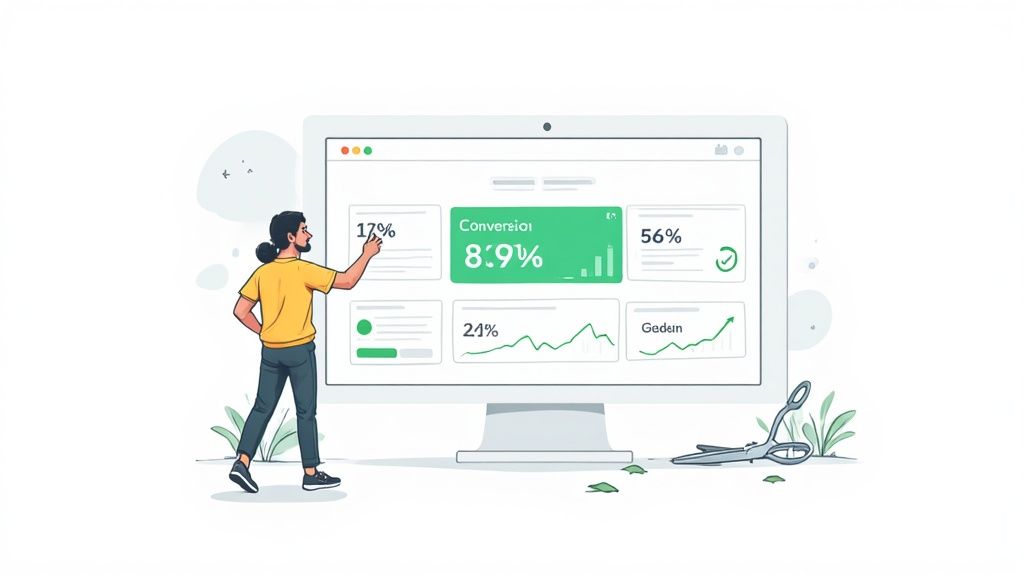
This is not optional. It is the absolute foundation of a profitable campaign.
A conversion is simply the most valuable action you want a user to take on your site. It’s the finish line. For most small businesses, it falls into one of these buckets: making a purchase, submitting a form, or making a phone call.
Define what a win looks like for your business and make damn sure you’re tracking that specific action. Everything else is secondary.
The metrics that actually drive decisions
Once your tracking is locked in, you can ignore almost everything else and focus on the handful of metrics that tell the real story. These are the numbers that connect your ad spend directly to your bottom line.
Your goal isn't to get the cheapest clicks; it's to acquire customers at a profitable cost. This is the fundamental mindset shift that separates founders who build scalable growth engines from those who just tinker with ads.
Forget about a low Cost Per Click (CPC). It’s a classic vanity metric. You can get €0.10 clicks all day long, but if none of them turn into customers, you've just wasted your money. The metric that truly matters is your Cost Per Acquisition (CPA), also known as Cost Per Conversion.
This number tells you exactly how much you’re spending to get one new customer or lead. If your CPA is lower than what a customer is worth to you, you’re profitable. It’s that simple.
A couple of other metrics help you diagnose why your CPA is what it is:
- Conversion Rate (CVR): The percentage of clicks that result in a conversion. A low conversion rate is a red flag that something is broken between your ad and your landing page.
- Click-Through Rate (CTR): This measures how many people who see your ad actually click on it. A high CTR is a good sign that your ad copy is resonating with the keywords you're targeting.
It's worth noting that people clicking on paid ads are often ready to buy. Data shows that paid search visits are 35% more likely to convert than visits from organic search. The average Google Search ad CTR hovers around 3.17%, which is way higher than banner ads, making it a powerful channel for capturing intent. You can learn more about these PPC statistics and how they impact campaigns to see the full picture.
Using data to make smart moves
With this handful of metrics, you can start making intelligent, data-driven decisions instead of just guessing. Your job as a founder isn’t to stare at the dashboard all day; it’s to look at the right data for 20 minutes a week and take decisive action.
- Kill the Losers: Sort your keywords by CPA. See any that are spending money but not generating any conversions? Pause them. They’re dead weight.
- Feed the Winners: Find keywords with a great CPA and a high conversion rate? Give them more budget. These are your workhorses. Double down on what’s already proven to work.
- Optimize the Middle: Got keywords with a decent number of clicks but no conversions? Dig deeper. Your ad copy might be misleading, or your landing page might not be delivering on the promise.
This ruthless process of cutting waste and reallocating resources to what works is the core of effective PPC management. It transforms your ad spend from a speculative expense into a calculated investment in growth.
How to scale and automate when you're a lean team
Once you get a campaign to actually turn a profit, the game changes. All that heavy lifting to get the foundation right is done. Now, the mission isn't about building anymore—it's about optimizing and scaling.
But let's be real. You're a founder. You don't have a team of analysts staring at dashboards all day, and you definitely don't have time to do it yourself. This is where you have to work smarter, not just harder. The goal is to build a semi-automated growth engine, not some complex machine you can't even manage.
The single biggest mistake I see founders make here is "setting and forgetting." They get a campaign working, breathe a huge sigh of relief, and then ignore it for a month. When they finally look again, their costs have shot through the roof. PPC is never a passive investment; it needs a regular pulse check.
Your 20-minute weekly check-in
You don't need hours. All it takes is 20 focused minutes once a week to keep the machine tuned up. This isn't about some deep, soul-searching analysis. It's a pragmatic routine to stop the bleeding and double down on what’s actually working.
Here’s your entire agenda for that meeting (even if it's just a meeting with yourself):
- Dive into the Search Terms Report: This report is an absolute goldmine. It shows you the actual search queries people typed that triggered your ads. You will inevitably find irrelevant searches burning through your cash. Add every single one to your negative keywords list. No exceptions. This is the most effective five-minute action you can take all week.
- Pause the Underperformers: Take a quick scan of your keywords and ads. See anything that's spending money but has zero conversions for a few weeks? Pause it. Be ruthless. Don’t get emotionally attached to a keyword you thought was going to be a home run. The data doesn't lie.
- Check Your Budget Pacing: Are you on track to spend your monthly budget? If you're underspending, your bids on winning keywords might be too low. If you're overspending, it's probably because of those losers you just paused.
That’s it. That’s the entire routine. It’s simple, it's effective, and it stops tiny problems from turning into massive budget drains.
Simple automation that actually works
Once you've got the weekly check-in down to a habit, you can start layering in some simple automation. I'm not talking about expensive, complicated software that requires a PhD to operate. I'm talking about basic rules you can set up right inside Google Ads.
The goal of automation for a lean team is to handle the obvious, repetitive tasks so you can focus on strategy. Think of it as your digital assistant, not your replacement.
Here are a couple of battle-tested rules to get you started:
- Auto-Pause High-Cost, No-Conversion Keywords: Set up a rule that automatically pauses any keyword that has spent, say, €50 in the last 30 days without a single conversion. This acts as a safety net to catch those bleeding keywords before you even get to your weekly check-in.
- Get Notified of Big Changes: Create a rule that emails you if the average CPC of a top campaign jumps by more than 25% week-over-week. This is your early warning system for new competitor activity, and it means you don't have to live in the dashboard.
This pragmatic approach—a disciplined weekly review paired with smart, simple automation—is exactly how you scale PPC without hiring an entire department. You build a system that works for you, freeing you up to do what you do best: run your business.
Common PPC questions from founders
Alright, let's cut through the noise and tackle the questions I hear all the time from other founders who are on the fence about PPC. These aren't textbook hypotheticals; they're the real, boots-on-the-ground concerns you have when your own money is on the line.
How long does it take to actually work?
You'll see traffic the day you launch. Don't confuse that with results. That's a rookie mistake that burns a lot of cash.
Honestly, expect it to take 2-3 months of real-world testing, data gathering, and tweaking to know if a PPC channel can be a profitable engine for you. Anything less is just gambling. You need that time to let the data tell you what's working, not just your gut feeling.
Can I really compete with big companies?
Yes. Full stop. Anyone who tells you otherwise doesn't get how the game is played today. This isn't just about who has the biggest budget; it's about who's the most relevant and the fastest.
As a small business, your agility is your superpower. You can go after niche, long-tail keywords the big brands ignore. You can write hyper-specific ad copy that speaks to a single pain point and build a landing page for it overnight. Big companies are often too slow and bureaucratic to even try.
Google’s Quality Score is literally designed to reward this kind of relevance. It lets you win better ad positions for less money than a lazy competitor with deep pockets.
What's the single biggest mistake founders make?
Easy. Treating PPC like a stock they can "set and forget." Founders are swamped, so they launch a campaign, check a box, and don't look at it again for a month.
By then, they’ve torched a ton of money on clicks that were never going to convert and have zero idea what actually worked. PPC needs active management, especially in the first few months. You have to steer it. It’s not a self-driving car.
Ready to build a PPC engine that scales without the manual grind? dynares uses AI to automatically create thousands of high-converting ads and landing pages, ensuring you never waste a click. See how it works.


