
Alright, let's talk about conversion optimization consultants.
Your conversion rates are flat, ad spend feels like you're just setting money on fire, and someone on a call mentioned CRO. Now you're wondering if you should shell out for an expensive consultant.
Before you write that five-figure check, let's have a real talk.
Do you really need a conversion optimization consultant?
Most founders I see jump to hiring a consultant when the real problem is a fundamental mismatch between their ads and their landing pages. It’s a dumb move. This is my candid take on when bringing in an expert makes sense versus when you're just throwing money at a systemic issue that needs a more scalable fix.
I'll share some hard truths from my own experience building and scaling products. We'll break down the signs that you might be ready for outside help, versus the red flags telling you to get your own house in order first.
This isn't about bashing consultants—many of them are brilliant. It's about being smart with your resources.
A great expert can be a game-changer. I’ve seen top CRO agencies deliver 20-40% conversion lifts without touching a full website redesign, just by focusing on targeted, data-backed tweaks. Some clients even report an 18x ROI from these efforts, turning small changes into massive revenue.
When it makes sense to hire an expert
Bringing in a consultant isn't always the right first move. It often comes down to a few core questions about your team's skills, their available time, and how complex your funnels have become.
Here are a few scenarios where hiring a pro is a smart play:
- You have solid traffic—say, over 50,000 monthly visitors—but your conversion rate is stubbornly low, and your team is out of ideas.
- Your team is great at what they do, but they lack deep expertise in statistical analysis, qualitative user research, or formal A/B testing methodology.
- You're launching a major new product or entering a new market and need to get the user journey right from day one, without wasting months on trial and error.
This flowchart gives you a quick visual for thinking through the decision.
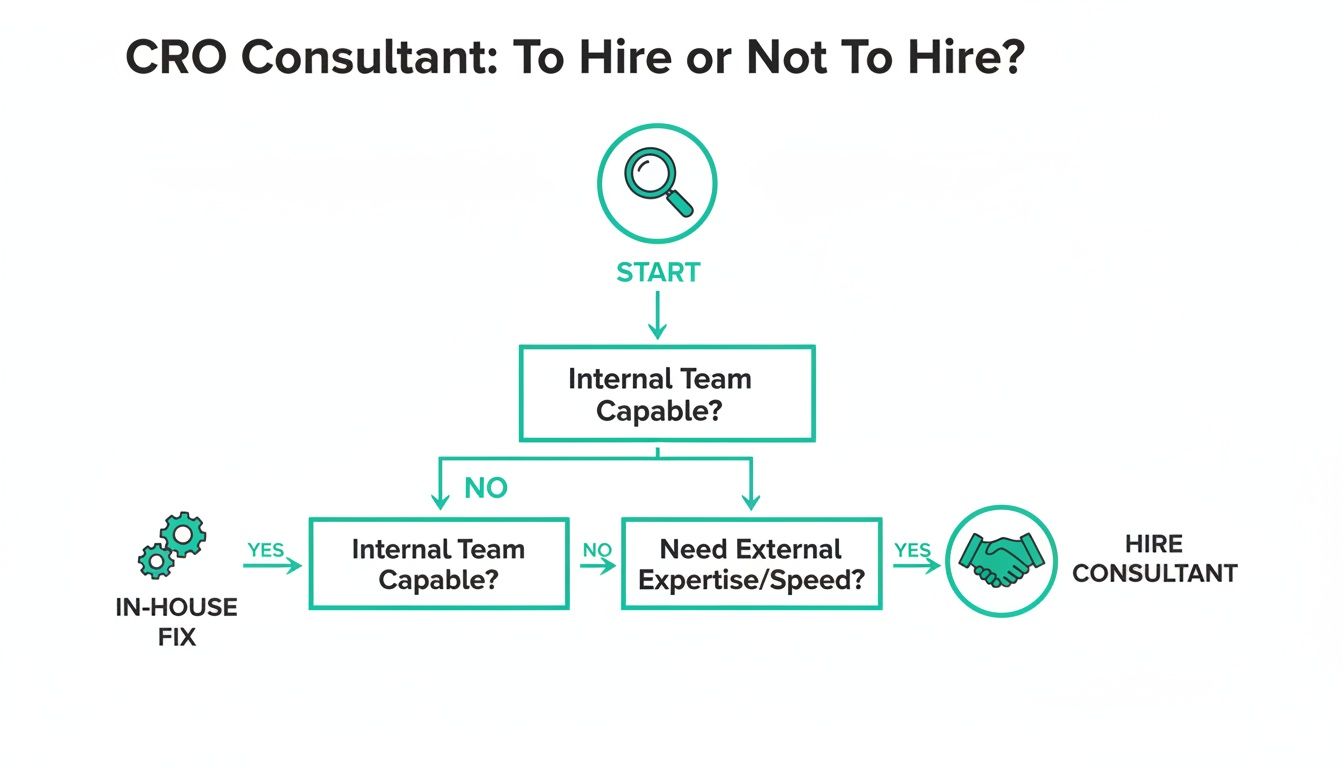
The key takeaway? Consultants are best used for complex, strategic problems—not for basic execution your team should be able to handle.
Consultant vs. platform: a quick gut check
Sometimes, the choice isn't just between hiring a consultant and doing it yourself. A dedicated platform can fill the gap, especially when your needs are more about scale and execution than high-level strategy. Here's a quick way to think about it.
| Scenario | Hire a Consultant | Use a Platform (like dynares) |
|---|---|---|
| You have deep, complex strategic questions. | ✅ | |
| You need to scale relevant landing pages for dozens of keywords. | ✅ | |
| Your team lacks deep statistical or research expertise. | ✅ | |
| Your bottleneck is dev/design time for page creation. | ✅ | |
| You're launching a major product and need a new GTM strategy. | ✅ | |
| You need to automate conversion uploads for better bidding. | ✅ | |
| Your traffic is under 20k/month and conversions are zero. | ❌ (Fix product/offer first) | ❌ (Fix product/offer first) |
This isn't an exhaustive list, but it should help you figure out which direction to lean. If your problem is we don't know what to do, a consultant might be the answer. If it's we know what to do, but we can't do it fast enough or at scale, a platform is likely a better fit.
Red flags before you hire
On the flip side, hiring a consultant can be a complete waste of money if you haven't sorted out your own foundations. If you see these signs in your business, hit pause and fix them first.
A consultant can't fix a broken product or a nonexistent strategy. They are multipliers; they amplify what's already there. If you give them a mess, they’ll just give you an expensive, optimized mess.
Before you even think about outreach, make sure you have the absolute basics in place. This means having clear business goals, a real understanding of your customer, and a product that actually delivers on its promises.
For a deeper dive, check out our guide on how to build conversion-optimized websites from the ground up.
If your landing page copy has nothing to do with your ad copy, that's where you start—not with a five-figure monthly retainer. Get your house in order first.
Finding the right expert without getting ripped off
Alright, you’ve decided a consultant is the right move. Now for the hard part: finding someone who can actually move the needle, not just a smooth talker with a slick PowerPoint deck.
The market is absolutely flooded with CRO experts. It's wild out there.
I’m going to walk you through my personal vetting process, one I’ve refined over years of hiring (and, unfortunately, firing) agencies and freelancers. We'll get past the polished case studies and figure out how to spot real strategic depth. This is about finding a partner who generates profit, not just invoices.

Look for process, not just promises
The biggest mistake I see founders make is getting star-struck by a case study. A 200% lift sounds amazing, but it’s completely meaningless without context. Was that a lift on a button color for a page with 100 visitors a month? Useless.
Instead of chasing big numbers, drill down on their process. A true pro doesn’t just show up and start guessing with A/B tests. They operate from a structured, research-first methodology.
The goal of a great consultant isn't to run tests; it's to generate validated customer insights that lead to growth. The tests are just the tool they use to get there.
Look for a process that blends both quantitative and qualitative research. They should want to dig into your analytics, sure, but they should also be obsessed with watching user recordings, reading support tickets, and talking to your actual customers.
Anyone who wants to immediately start throwing A/B tests at your homepage without doing the homework first is a massive red flag. 🚩
Smart questions to ask that cut through the bullshit
During the interview, your job is to ask sharp, direct questions that force them to reveal how they think. Ditch the softballs like tell me about your successes. That's just an invitation for them to brag.
Here are a few I use to separate the pros from the pretenders almost immediately.
- How do you decide what to test first? A weak answer is, “We look for low-hanging fruit.” A strong answer involves a specific prioritization framework, like P.I.E. (Potential, Importance, Ease) or I.C.E. (Impact, Confidence, Effort). They should explain how their initial research would feed into that framework to score ideas.
- Walk me through a failed experiment and what you learned. Everyone has tests that flop. If they claim they don’t, they’re either inexperienced or not being honest. The best optimizers I know have learned far more from their losses than their wins.
- What data and access would you need in the first 30 days? This question reveals if they have a plan or if they’re just going to wing it. They should have a list ready: Google Analytics, backend sales data, customer support chat logs, and—ideally—a plan to interview your sales or support team.
- What’s your opinion on statistical significance? Listen for a nuanced response here. A pro will talk about sample size, statistical power, test duration, and the risks of calling tests too early. If they just say we wait for 95% significance, they're likely just following a script without understanding the statistics behind it.
Understanding the price tag
Finally, let's talk money. Pricing for CRO consultants is all over the map, but it generally falls into one of three buckets. Knowing these helps you benchmark the proposals you get.
- Monthly Retainer: This is the most common model. You pay a fixed fee each month (think $5,000 - $20,000+) for an agreed-upon scope of research, strategy, and a certain number of experiments.
- Project-Based: This is a fixed price for a specific deliverable, like a full conversion audit or a series of tests on your checkout flow. This can range from $5,000 for a small audit to $50,000+ for a comprehensive program.
- Performance-Based: This model sounds great because you only pay for results, like a cut of the revenue uplift. In practice, it can get incredibly messy and lead to fights over attribution. I’d advise using this model with extreme caution.
Your goal isn't to find the cheapest option. It’s to find the one that delivers the most value. A great consultant who costs $15,000 a month but doubles your conversion rate is a bargain. A cheap one who does nothing is a very expensive mistake.
Running a trial project that actually tells you something
Never, ever sign a long-term contract with a conversion optimization consultant without a trial. It’s just bad business. But a poorly defined trial is equally useless. You need to structure a pilot project that gives you a clear signal on whether this relationship is actually worth your time and money.
The point of a trial isn't to fix your entire business in 30 days. It's to validate the consultant's process and see if they produce quality insights. This is a test of their thinking, their communication, and their execution—not just their ability to get one lucky win.
Defining a high-impact scope
Don't try to boil the ocean. The most common mistake is giving a consultant a vague goal like increase our overall conversion rate. It's way too broad and sets them up to fail.
Instead, pick one specific, high-leverage area of your funnel for the trial.
This could be improving the sign-up flow for your B2B demo request page, reducing friction in the first two steps of your e-commerce checkout, or increasing clicks from a specific product category page to individual product pages.
Pick a single metric that matters for that one area. This sharp focus gives them a clear target and makes it dead simple to measure their impact. It also contains the risk.
Setting crystal-clear goals
Success in a 30- or 60-day trial isn't always a massive conversion lift. While a nice uplift is great, it’s not the only thing you should be looking for. Honestly, sometimes the most valuable outcome is the quality of their research and the strategic roadmap they build.
Your success KPIs for the pilot should be a mix of outcomes and process quality.
By the end of a well-run trial, you need a definitive hell yes or hell no answer, backed by data. Anything in between is a failure of the trial's design.
A successful trial might mean the consultant delivered a comprehensive research report with actionable insights, launched one statistically valid A/B test (even if it didn't win), and communicated their progress clearly every week. That's a huge win, because it proves their process works.
For a closer look at the mechanics of testing, you might find our guide on split testing for landing pages useful.
What to give and what to expect
You can't hire a great consultant and then starve them of the resources they need to succeed. To get a clear signal, you have to do your part.
- What you provide: Grant them read-only access to your analytics (GA4), your ad accounts, and your CRM. Give them access to user behavior tools like Hotjar or FullStory if you have them. Most importantly, make a key team member available for a few hours a week to answer questions.
- What you expect in return: Insist on a clear communication cadence from day one. A weekly 30-minute check-in and a brief written update are standard. At the end of the trial, you should receive a final report summarizing their research, the tests they ran, the results (good or bad), and their strategic recommendations for the next 90 days.
This structure removes ambiguity. It ensures that when the trial is over, you have everything you need to make a smart, informed decision. No maybes allowed.
The metrics that matter and the ones that don't
This is where so many founders get it wrong. It’s dangerously easy for a consultant to drown you in a sea of vanity metrics that look fantastic in a report but do absolutely nothing for your bottom line.
Let's cut through the noise.
A 20% lift in conversions sounds great until you realize it’s a 20% lift in garbage leads. Now your sales team is wasting more time, your cost per qualified lead is actually going up, and you’re paying someone to celebrate a failure.
Your job is to anchor every conversation to real business impact, not superficial wins.
Lagging indicators are your north star
Lagging indicators are the scoreboard. They tell you if you actually won the game. They’re slow to change, but they are the only numbers that truly matter to the health of your business.
Insist that your consultant’s primary goals are tied directly to these:
- Revenue Uplift: The ultimate metric. How much more money did we make as a direct result of their work? This is the king of all KPIs.
- Return on Ad Spend (ROAS): For every dollar spent on ads, how many did we get back? This ties the consultant’s work directly to the efficiency of your paid budget.
- Customer Lifetime Value (LTV): Are the new customers you're acquiring sticking around longer or buying more over time? This is the real test of conversion quality.
A good conversion optimization consultant doesn't just focus on the click; they focus on the customer. Their work should result in more profitable, long-term relationships, not just a one-time transaction.
Leading indicators are your GPS
While lagging indicators are your destination, leading indicators are the turn-by-turn directions. They are the on-site user behaviors that tell you if you're headed in the right direction, long before the revenue numbers catch up.
A good consultant uses these to validate their hypotheses along the way. You should expect to see them reporting on things like Lead-to-Close Rate, Cost per Qualified Lead (CPL), Add-to-Cart Rate, and Funnel Drop-off Rate.
These numbers can vary wildly by industry. B2B eCommerce might average a 1.8% conversion rate, while legal services can hit 7.4%. An expert knows this context is key. With 74% of marketers focused on converting leads, you need a full-funnel view to make those numbers climb in your specific market.
Ultimately, you need a balanced view. Focusing only on revenue is like driving while only looking at the horizon. Focusing only on clicks is like staring at your speedometer and ignoring the road. Great conversion optimization consultants help you do both.
For a deeper dive, check out our guide on essential metrics and reporting frameworks for growth.
When a platform is a smarter, more scalable choice
Alright, so what if hiring one of the many conversion optimization consultants out there isn't the right move at all? As a tech founder, I'm biased toward systems and scale. I believe technology should be the answer for repetitive, high-volume problems.
Consultants are brilliant for complex, one-off strategic challenges. If you need to map out a go-to-market strategy for an entirely new product, a great consultant is worth every penny. But optimizing hundreds—or thousands—of Google Ads landing pages? That’s a systems problem, not a human-scale one.
Recognizing a systems problem
This is where a dedicated platform becomes a no-brainer. If your biggest headache is creating perfect message match at scale, running endless tests across countless keywords, and personalizing user journeys from the ad click all the way to conversion, a human just can't keep up. That’s not a knock on their skill; it’s a limitation of biology.
Let’s be brutally honest. A consultant might spend a month doing deep research to launch one or two high-impact tests on your homepage. That's great. But what about the other 99% of your landing pages tied to PPC campaigns? They’re left to bleed money every single day.
A consultant might land you a 20% lift on your top 5 pages. A platform can get you a 15% lift across 5,000 pages, automatically. It's about trading a few big, manual wins for thousands of smaller, automated gains that compound into a massive impact.
This is the point where technology offers a fundamentally better solution. It's just the right tool for the job. You wouldn't use a handcrafted screwdriver to assemble an Airbus A380; you'd use automated robotics. The same logic applies here.
Comparing scalability, speed, and cost
Let's break down the real-world differences. When you're managing a massive Google Ads account, your biggest bottlenecks are always speed and scale.
- Speed: A consultant needs weeks for research, building hypotheses, creating mockups, waiting on developers, and then waiting again for statistical significance. An AI-powered platform like dynares can generate, test, and optimize thousands of ad-and-page combinations in the time it takes you to get a project brief approved.
- Scale: A human can realistically optimize a handful of pages per month. A platform can handle every single keyword in your account, ensuring every user gets a relevant experience. That’s something that's simply impossible for a person or even a small team.
- Cost: A top-tier consultant could charge €15,000 a month to focus on your main funnel. For that price or less, a platform can optimize the entire long-tail of your paid search, finding new revenue from keywords you've been ignoring for years.
The choice becomes pretty clear once you define the problem correctly. If your issue is a lack of strategic direction, hire a human brain. If your issue is a lack of execution horsepower and an inability to stay relevant at scale, you need a machine. For those interested in the tech, our overview of conversion rate optimisation software explores this in more detail.
A platform isn’t here to replace smart marketing; it's a force multiplier. It finally lets you execute the strategy you always knew you needed but never had the resources for. It’s about moving from talking about personalization to actually doing it—for every single click.
That’s how you win in paid search today. It’s not about having the best ideas; it’s about having the best system for execution.
Frequently asked questions about CRO
Alright, let's tackle some of the common questions I get about the whole world of conversion optimization. Here are my quick, no-BS answers.
How much do conversion optimization consultants cost?
Honestly, the pricing is all over the map. You can find a freelancer on Upwork for €100/hour or a top-tier agency that won’t get out of bed for less than €20,000 a month.
It really breaks down into three models:
- Hourly: This works for quick, specific tasks. You should expect to pay anywhere from €100–€300/hour for a decent independent consultant.
- Project-Based: This is common for one-off jobs like a full website audit or a series of A/B tests. A small audit might start at €5,000, while a comprehensive program could easily hit €50,000+.
- Retainer: This is the most common setup for ongoing work. Fees typically range from €5,000–€20,000+ per month, depending on the scope of work and the team involved.
My advice? Get at least three or four quotes. It’s the only way to get a real feel for the market rate for the level of expertise you actually need.
What's the difference between CRO and UX?
People love to use these terms interchangeably, but they aren't the same thing at all. It's a fundamental misunderstanding of the disciplines.
Think of it like this: User Experience (UX) is broad. It's the entire feeling a person gets when they interact with your product or website. Is it enjoyable? Is it intuitive? Is it frustrating? UX is the whole vibe of a retail store—the lighting, the music, the layout.
Conversion Rate Optimization (CRO) is a hyper-focused subset of UX. It has one specific commercial goal: get more users to take a valuable action, like buying something or signing up. CRO is about making sure the checkout line is fast, the credit card machine works perfectly, and the cashier helps you finish the transaction.
Good UX makes people happy to browse your site. Good CRO makes sure that happiness turns into business. You need both, but they are different skills.
How long does it take to see results from CRO?
Anyone who promises you immediate results is selling snake oil. Run. 🏃♂️
A proper CRO process takes time because it’s based on research and data, not just guessing what might work. A realistic timeline looks something like this: Research & Discovery (1-4 weeks), Hypothesis & Test Build (1-2 weeks), and Running the Test (2-6+ weeks).
This part depends entirely on your traffic volume. You have to run a test long enough to get a statistically significant result. Don't let anyone call a test early just to show you a win.
Realistically, you're looking at 2-3 months before you see the first meaningful, validated lift from a single test. Sustainable improvement is a marathon, not a sprint. If you want to understand the nuts and bolts, exploring actionable conversion rate optimization tips can give you a better sense of what this process actually involves.
If managing consultants, running one-off trials, and waiting months for insights feels too slow and manual for your paid search campaigns, it’s probably because it is.
For scaling Google Ads, a system is always better than a person. At dynares, we built an AI platform that automates the creation and optimization of thousands of high-intent landing pages. It’s designed to give you the scale and speed that no consultant can match.
See how it works at https://dynares.ai.


