
Let's be direct. If you're reading this, you’ve probably hit a wall with your manual PPC campaigns. The early wins were great, but now you’re either drowning in spreadsheets or watching your performance go completely flat. This is the exact moment people start searching for pay per click software.
When manual PPC management is holding you back
So, you’re running campaigns on Google Ads. Managing a handful of keywords? Easy. A hundred? Annoying, but doable. A thousand? It's a full-blown crisis.
That’s not a personal failure; it’s a scaling problem. Let's get real: trying to manually manage large-scale PPC in 2026 is a losing game. It’s like trying to build a skyscraper with a handsaw. It’s not just slow—it’s fundamentally broken.
The core issue is relevance at scale. Google rewards you for creating a seamless path from a user’s search query to your ad to your landing page. When you have ten keywords, that’s easy. You can hand-craft ten perfect ads and ten matching landing pages.
But when you have thousands of potential search terms, this meticulous alignment becomes impossible for any human.

The pain points I see every week
I talk to marketing teams constantly, and the same struggles pop up again and again. It’s not about a lack of skill; it's about being given an impossible task. The manual approach forces compromises that directly hurt your bottom line.
These are the most common symptoms that your process is the bottleneck:
- Wasted Ad Spend: You’re forced to group hundreds of distinct keywords under one generic ad that sends traffic to a single, vague landing page. This mismatch leads to low Quality Scores, higher CPCs, and clicks from people who were never going to convert.
- The Spreadsheet Abyss: Your life revolves around massive Excel or Google Sheets files. You spend more time exporting, pivoting, and VLOOKUP-ing data than you do on actual strategy. This is what I call spreadsheet hell, and you can learn more about escaping it in our guide on moving from spreadsheets to automated PPC funnels.
- Flatlined Performance: Your metrics—CTR, conversion rate, ROAS—are stuck. You've tried tweaking bids and rewriting ad copy, but nothing moves the needle because the underlying structural problem remains. You can’t optimize what you can’t manage granularly.
A quick look at the two worlds shows just how different the approach—and the ceiling for performance—really is.
Manual PPC vs software-driven PPC
| Aspect | Manual Management | Software-Driven Management |
|---|---|---|
| Scalability | Limited. Breaks down with more keywords, campaigns, or ads. | High. Manages thousands of elements with rule-based automation. |
| Relevance | Low. Generic ads and landing pages for broad keyword groups. | High. Can create specific ads and pages for each keyword or intent cluster. |
| Efficiency | Poor. Dominated by repetitive, low-value tasks like data entry and reporting. | Excellent. Automates grunt work, freeing up time for high-level strategy. |
| Bidding | Reactive. Manual bid adjustments based on delayed data analysis. | Proactive. Automated, real-time bid adjustments based on performance data. |
| Testing | Slow and difficult. Launching new variants is a major project. | Fast and easy. A/B tests and experiments can be launched in minutes. |
| Performance | Often hits a performance plateau that is hard to break through. | Built for continuous improvement, optimizing for deep metrics like ROAS. |
The table doesn't lie. While manual management can get you started, it inherently puts a cap on your growth and profitability. The real problem isn't the clicks you're paying for; it's the intent you're ignoring. Every time a user's specific search leads to your generic landing page, you're not just losing a conversion—you're telling Google your ads aren't relevant.
This isn’t about working harder. It’s about recognizing when the tool you’re using—in this case, manual effort—is no longer right for the job.
The search for pay per click software begins when the pain of managing the status quo finally outweighs the fear of change. It's a signal that you're ready to stop fighting the platform and start working with it.
Let’s get one thing straight: when people talk about pay per click software, they’re not talking about one neat little tool. It’s an entire category of software built to solve the biggest headaches in paid search. The term itself is almost misleading—it sounds like you’re just buying a simple utility.
Think of it like this: trying to run Google Ads by hand is like trying to build a house with just a hammer and a handsaw. You can do it. But it’s slow, exhausting, and your results are capped by how many boards you can physically cut and how many nails you can drive in a day. It's a terrible use of your time.
PPC software is your set of power tools. It’s the nail gun, the circular saw, the laser level. You’re still the architect—you make the big strategic calls—but the software does the brutal, repetitive work with a speed and precision you could never hope to match on your own. It’s an amplifier for your brain, not a replacement for it.
It’s an automation engine
At its heart, this software is all about automation. It takes the mind-numbing manual tasks that eat up 80% of a PPC manager's day and hands them off to an algorithm that never gets tired, bored, or needs a coffee break. This isn't just about clawing back hours; it's about freeing up your brain to focus on the things that actually move the needle.
This is critical in a market that gets more cutthroat by the day. With the global paid search ad market set to blow past $351.5 billion in 2025 and keep climbing, you can bet competition and costs are only going one way: up. Trying to compete with manual workflows in that environment is a recipe for getting crushed. You can dig into the data and see exactly why automation is no longer optional.
The whole point of good pay per click software is simple: automate the predictable so you can strategize about the exceptional. It handles the 'what' and 'how' so you can focus on the 'why'.
This isn't just about scheduling a few reports. We're talking about executing complex decisions based on live data, which brings us to what these tools actually do.
The core jobs of PPC software
Forget the endless feature lists vendors throw at you for a minute. Most great PPC software is built to do a few critical jobs exceptionally well. If a tool doesn’t nail these, the rest is just noise.
- Automated Bidding: This is the most obvious job. Instead of tweaking bids in a spreadsheet, you let an algorithm do it for you. It can adjust bids 24/7 based on performance, time of day, device, location, and dozens of other signals. It’s fighting the cost-per-click (CPC) war for you while you sleep.
- Campaign and Ad Generation: Here’s where it gets interesting. The best tools don't just manage existing campaigns; they help you build them at a scale that is humanly impossible. Imagine creating a unique, hyper-relevant ad and landing page for every single one of your 1,000 keywords. That's the power we're talking about.
- Tracking and Analysis: Modern software goes way beyond just clicks and impressions. It tracks what happens after the click—conversions, revenue, even customer lifetime value—and then feeds that data right back into the bidding and ad-building engine. This creates a powerful feedback loop that constantly improves performance.
Ultimately, the goal isn't just to make your life easier. It's to solve the fundamental challenge of paid search platforms like Google Ads, where relevance is everything. Your Quality Score, your CPC, and your conversion rate all come down to how well you match the user's search intent with your ad and landing page.
Trying to do that manually at any real scale is a fool's errand. Using the right software to do it is just smart business. It’s about building a better, more efficient engine for growth. That's it. 🚀
The PPC software features that actually matter
Every pay per click software vendor is going to hit you with a long list of features. Let's be honest: most of it is just noise. It's marketing fluff designed to make their tool sound more impressive than the next one. They’ll talk about dashboards, reports, and a million tiny settings you’ll never touch.
We’re entrepreneurs and marketers, not feature-checkers. We care about what actually moves the needle—what grows the business. So, let's cut through the noise and talk about the capabilities that genuinely matter when you're looking at a new platform.
Forget vanity metrics and look for true integration
The first thing to look for is seamless Google Ads integration. This sounds obvious, but you'd be surprised how many tools get it wrong. It’s not just about pulling in data; it's about a deep, two-way connection. Can the software not only read performance data but also push changes back to Google Ads instantly?
This includes automatically uploading conversion data with accurate revenue values. Why? Because it lets Google's own bidding algorithms, like Target ROAS, optimize for profit, not just for cheap leads. Without this, you’re flying half-blind.
Another non-negotiable is robust tracking that goes beyond surface-level metrics like clicks and impressions. These are vanity metrics. You need a tool that tracks what happens after the click, all the way to a sale, and ties that revenue back to the specific keyword and ad that generated it.
It's not about how many clicks you get. It’s about how many of the right clicks you get. The right software helps you tell the difference by connecting ad spend directly to revenue, not just leads.
The core jobs of any worthwhile PPC software—bidding, ad management, and automation—all work together to hit this goal. This diagram gives you a simple map of how they connect.
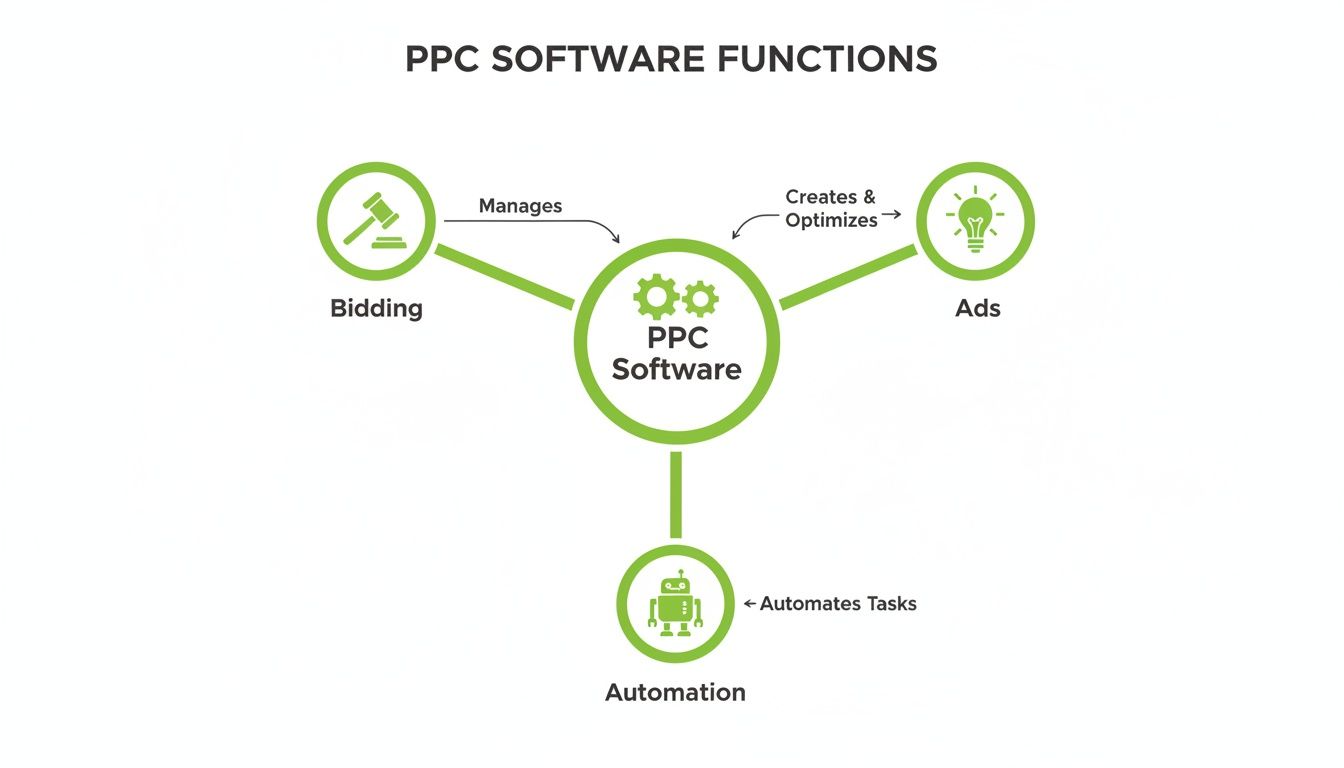
This visual breaks down how a central software hub coordinates these three critical jobs to drive a successful campaign. If you have a weak link in any of those three areas, the whole system falters.
The most overlooked feature: ad-to-page relevancy
Now for the one thing most people completely miss: ad-to-page relevancy. This is the secret weapon. It’s not enough to have a great ad. The landing page that follows must continue the exact same conversation that started with the user’s search.
Think about it. If someone searches for AI-powered CRM for small law firms and your ad promises exactly that, but the landing page is a generic page about your CRM, you've just broken the promise. The user is confused, the bounce rate goes up, and Google’s Quality Score for your ad plummets. You end up paying more for a click that was never going to convert anyway.
This is where modern pay per click software creates an almost unfair advantage. The best platforms solve this problem by automatically generating a unique, high-intent landing page for every single keyword or ad group.
- Keyword Injection: The exact search term the user typed appears in the headline and body of the landing page.
- Dynamic Content: The page's messaging, images, and call-to-action can change based on the ad that was clicked.
- Instant Creation: This isn't a manual process. The software generates thousands of these coordinated ad-and-page combinations instantly. Our own campaign optimizer is built around this very principle.
This isn’t just a convenience. It’s a fundamental shift in how you run PPC. By ensuring a perfect message match from search to ad to page, you're giving Google exactly what it wants: maximum relevance. The result? Higher Quality Scores, which directly lead to lower CPCs and better ad positions. More importantly, you give the user exactly what they want, which skyrockets your conversion rates.
Effective PPC software gives you the tools and insights to implement the strategies found in a practical guide to improve PPC performance. It’s about building a system, not just running ads. Don't let shiny objects distract you; focus on these core capabilities that deliver real, measurable results. 🚀
How to evaluate PPC software without getting played
Alright, let's talk about choosing the right pay per click software. This isn't like picking a new coffee machine; it's a big commitment that can either supercharge your growth or become a very expensive, frustrating paperweight.
So, let's get it right.
I see it all the time: people get sold on a slick demo and a long list of features. That is the absolute worst way to evaluate a tool. Every vendor has a beautiful dashboard. What separates a game-changing platform from a dud is what happens after you sign up.
You need a practical framework to see past the marketing and figure out what actually matters for your business.
Look beyond the feature list
Instead of asking 'what features does it have?', you need to start asking better questions. The criteria that truly separate a partner from a vendor are about growth and alignment, not just buttons in an interface.
When I evaluate any piece of tech, especially something as core as PPC software, I have a gut-check list.
- Does it actually scale with your ambition? I'm not talking about going from 10 campaigns to 20. I mean, can this tool handle it when you want to test 100,000 keywords instead of 1,000? A tool that’s cheap today but breaks under pressure tomorrow is a complete waste of time and money.
- Does it play well with others? Your business is an ecosystem of tools. Your PPC software can't live on an island. Does it integrate smoothly with your CRM, like HubSpot or Salesforce? Can it push conversion data back into Google Ads? If it creates data silos, it's just creating more work.
- Is the pricing honest? I’ve seen all the tricks. The teaser rate that balloons after three months. The hidden fees for premium support. The per-user costs that punish you for growing your team. Look for transparent, value-based pricing that aligns with your success. If the pricing model feels confusing, walk away.
These questions cut through the noise. They force you to think about the software not just as a monthly subscription, but as a potential long-term partner in your growth.
A great tool with terrible support is a terrible tool. Full stop. You're not just buying software; you are buying access to the team behind it.
Look for vendors who act like partners. Do they offer a proper, live demo, or just a pre-recorded video? Is there a real onboarding process with a human being? Do they offer strategic advice or just technical support? This is where the real value is.
Run a pilot test before you commit
Never, ever buy a major piece of software based on a sales demo alone. A demo is a performance; a pilot is reality.
The only way to know if a tool will work for your business is to test it with your data, your campaigns, and your team. This is your chance to validate their claims before you're locked into a contract.
Set up a small, controlled test. Pick a specific campaign or product line to run through the new software. If you're looking to expand your team's capabilities, our guide on choosing the right PPC software for agencies offers more specific advice on structuring this kind of evaluation.
Your pilot should aim to answer a few simple questions:
- Did it deliver on its core promise? If the vendor claimed it would lower your CPC, did it? If they promised higher conversion rates, where's the data?
- Is it easy for your team to use? A powerful tool that no one can figure out is completely useless.
- Did their support team show up when you needed them? This is a critical test of their commitment and your future relationship.
Choosing the right pay per click software is a strategic decision, not a tactical one. Don't get played by slick marketing. Focus on scalability, integration, honest pricing, and genuine partnership. Run a pilot, trust your own data, and choose a tool that will help you build toward the future you're aiming for. ✨
The hidden costs of inefficient PPC management
It's easy to stick with the status quo. It’s comfortable. But in PPC, being comfortable is also incredibly expensive. This isn't just about a few wasted clicks; it's a wake-up call about the mountains of cash you're burning with inefficient campaign management.
Every single dollar you waste on an irrelevant click, a poorly matched keyword, or a low-converting landing page is a dollar your competitor can now use to outbid you tomorrow. It's a zero-sum game, and you're funding their success with your own inefficiency.
The real cost isn't what you spend—it's what you waste
Let’s be direct. The biggest hidden cost in PPC isn’t your ad budget; it's the opportunity cost. It’s the revenue you didn’t earn because your process is broken. It's the market share you didn't capture because you were too busy wrestling with spreadsheets to focus on strategy.
The costs are compounding, especially now. Recent data shows engagement costs are exploding, with Google Search CPCs jumping a massive 45% on average from 2024 to 2025. With 90% of users seeing Google ads, flawless execution is the only way to survive, let alone win.
This isn't meant to be alarmist; it’s just the reality of the market. We have to be brutally honest about where the leaks are in our funnels. A huge source of these hidden costs comes from wasted ad spend on irrelevant searches. Learning to effectively manage negative keywords can help to cut wasted ad spend and immediately improve your efficiency.
Connecting inefficiency to your bottom line
It’s easy to think, ‘So what if my conversion rate is 1% instead of 2%?’ This kind of thinking is a trap. That small difference isn't small at all when you run the numbers. It’s a financial disaster disguised as a minor rounding error.
Investing in the right pay per click software isn’t an expense. It's an investment in efficiency, profitability, and competitive advantage. It's plugging the holes in your bucket so you can finally start filling it up.
Let's put some real numbers on this. Imagine you spend $10,000 a month at a $5 CPC. At a 1% conversion rate, you get 20 conversions. Your cost per acquisition is $500. By improving relevance and getting that rate to 2%, you get 40 conversions. Your cost per acquisition drops to $250.
You've just doubled your output and halved your CPA with the same exact budget. That's not a small lift; it’s a complete transformation of your business economics. This is the real impact of moving from inefficient manual management to a streamlined, software-driven approach. It’s about building a system that turns rising costs into your competitive moat. 🚀
The future of paid search is strategic automation
Let's get one thing straight. The future of paid search isn't about becoming a master knob-turner in the Google Ads interface. It’s about becoming a strategist who directs an army of automated tools. Anyone still clinging to the old way of doing things is going to get left behind, fast.
A lot of marketers have this nagging fear that AI is coming for their job. Frankly, that’s the wrong way to look at it. AI won't take your job. But a marketer who actually knows how to use AI? They absolutely will. Your role is shifting from doing the grunt work to directing the work.
From leads to revenue
The entire game is changing. For years, we’ve been obsessed with optimizing for clicks and leads. We pat ourselves on the back for a low cost-per-lead (CPL) without even knowing if those leads are any good. That era is over. It’s a vanity metric, and it’s quietly costing you a fortune.
The future is about optimizing for one thing: actual, measurable revenue. This means the best pay per click software has to do more than just generate a lead. It has to follow that lead through your entire sales funnel and report back on its real, cold-hard-cash value. Only then can you tell the algorithms to find you more profitable customers, not just cheap ones.
The most important shift in PPC is moving from 'How many leads did we get?' to 'How much revenue did those leads generate?' A tool that can't answer the second question is already obsolete.
This demands a system that connects the dots all the way from the keyword to the click, the conversion, and the closed deal. If your tools can’t do that, you’re flying blind.
Privacy, data, and your new unfair advantage
We’re also walking into a new world of privacy. Third-party cookies are on their deathbed, and regulations are getting tighter. While this is a good thing for consumers, it's a huge headache for marketers who built their strategies on external data. The answer is simple: first-party data is the new gold.
This is the data you collect directly from your customers and prospects. Modern PPC software doesn’t just help you collect it—through things like custom forms on your landing pages—it helps you turn it into smarter campaigns. It’s about building a marketing engine you own and control, navigating this new landscape instead of being a victim of it.
My vision for the future of paid search is one where technology handles the monumental, mind-numbing task of granular optimization. This is what machines are built for. This frees up smart, creative people like you to focus on the work that actually matters.
- High-level strategy: What new markets should we enter? What’s our core message that no one else can copy?
- Creative thinking: What’s a bold new ad angle we can test? How can our brand truly stand out from the noise?
- Customer understanding: Who are our best customers, and what do they really want from us?
This isn’t some far-off fantasy; it's happening right now. For those looking to get ahead of the curve, our deep dive on Google Ads automation tools breaks down how to put this mindset into action today. The goal is to let automation handle the tactics so you can finally own the strategy. That’s how you win. ✨
A few common questions about PPC software
Alright, let's tackle a few of the questions I hear all the time about pay-per-click software. People are naturally skeptical, and they should be. You want to know you're making a smart investment, not just buying into the latest hype.
Here are the straight answers.
Can PPC software completely replace a human manager?
No. And honestly, it’s the wrong goal. Anyone selling you that dream is selling you a fantasy.
The best PPC software isn't a replacement for a smart human; it's a force multiplier. It acts as a co-pilot, automating the soul-crushing, repetitive work that burns out even the best campaign managers.
Think bid adjustments every five minutes, pulling the same reports every Monday morning, or creating a thousand ad variations by hand. The software handles that machine-scale work. This frees up the human manager to focus on what actually matters: strategy, creative angles, market analysis, and finding the next big growth opportunity.
Think of it as giving a great strategist superpowers, not making them obsolete. The software handles the grunt work; the human provides the strategic genius and creative spark.
That partnership is where the magic happens. A 'set it and forget it' solution that promises to remove the human element entirely is a recipe for mediocre results.
Is pay-per-click software only for large enterprises?
Not anymore. Maybe five or ten years ago, that was the case. The first-generation tools were incredibly expensive, clunky, and needed a dedicated team just to run them.
Thankfully, that world is long gone.
Today, some of the most powerful platforms are designed specifically for small-to-medium-sized businesses and scaling agencies. The trick is to find a tool with a pricing model that fits your current budget but has the runway to grow with you.
Here’s how to think about it:
- Start with your current ad spend: Look for solutions with a reasonable entry point or even a free tier that lets you prove the concept.
- Focus on ROI, not just cost: If a platform costs $500 a month but saves you $2,000 in wasted spend and helps you generate $5,000 in new revenue, it’s not an expense—it’s a profit center.
- Check the upgrade path: Make sure the platform can handle 10x your current campaign volume without trapping you in a ridiculously expensive enterprise contract you don't need.
For most smaller teams, the efficiency gains alone deliver a positive return on investment almost immediately.
How long does it take to see results?
This always varies, but let's get real. You're not going to flip a switch and see revenue triple overnight. That said, you can see meaningful results much faster than you might think.
Quick wins often show up in the first few weeks. Things like better Quality Scores from improved ad-to-page message match, or a more stable cost-per-acquisition (CPA) from smarter, automated bidding. These happen fast.
But the truly game-changing results—the major lifts in ROAS and scalable revenue growth—typically build over 2-3 months. This gives the system enough time to gather data, run meaningful tests, and optimize your campaigns based on real-world feedback from your customers.
Ready to see what strategic automation can do for your campaigns? dynares is built to turn your Google Ads into a predictable revenue engine. Get your demo and start building smarter campaigns today.


