
PPC campaign management is the whole messy, ongoing process of making sure you’re not just burning cash on clicks but actually generating a return. It's everything from the initial keyword research and budget fights to the late-night ad copy tests and conversion tracking headaches.
In short, it’s all the work that happens after you click launch.
Why PPC campaign management feels harder than ever
Let's be brutally honest: running PPC campaigns in 2026 isn't what it used to be. It’s a bloodbath out there. Costs are rising, the competition is insane, and platforms like Google Ads are constantly changing the rules.
If you feel like you're working twice as hard just to keep your head above water, you're not imagining it.
The days of picking a few keywords, setting a budget, and watching leads roll in are long gone. Winning today takes a much deeper level of strategic thinking and technical skill. The game has changed, and if you're still managing campaigns like it's 2022, you’re going to get left behind.
The pressure is on
The biggest shift? The constant pressure from the finance department to prove every single dollar spent.
Just getting more leads is a dumb goal, and your CFO knows it. They want to see a direct line from ad spend to revenue. If you can't show it, your budget is the first on the chopping block.
A recent global report found that for 68% of PPC professionals, the top priority is now improving campaign efficiency and profitability—a clear sign of C-suite scrutiny. At the same time, 53% of experts say that managing campaigns is harder now than it was two years ago, blaming fierce competition and tricky platform algorithms. You can see the full breakdown in the 2026 State of PPC report.
This pressure forces us to move beyond vanity metrics. Clicks and impressions are meaningless without conversions that actually turn into business.
Algorithm shifts and automation's double-edge
Platforms like Google are pushing automation hard. It sounds great in theory.
But here’s the catch: these automated systems need clean, high-quality data to work. If you feed them garbage, you'll get garbage results—just faster and at a much greater scale.

This means your job as a manager has shifted from endless manual tweaking to high-level strategic oversight. You need to focus on what the machine can't do. Your value is no longer in clicking buttons but in building the strategic framework that allows automation to succeed.
It's a harsh truth, but it's the key to survival and growth in this field. If you're not thinking like a strategist, you're just a highly paid data entry clerk for Google's algorithm.
Building a campaign structure that doesn’t suck
Most PPC campaign structures are a total mess. They’re either so simple they’re completely useless or so complicated they become impossible to manage. Let's be honest: a bad structure is a silent killer, slowly bleeding your budget dry with high CPCs and garbage traffic.
We’re going to fix that. The goal is to build a campaign architecture that actually scales, makes sense for lead generation, and keeps Google’s algorithm happy. Forget the old-school, outdated advice—this is a practical blueprint for lean teams who need results, not complexity.
Ditch the old playbook
First, we need to throw out the one keyword per ad group (SKAG) playbook. Years ago, it was the gold standard. Today, with Google's machine learning and keyword matching getting much smarter, it’s just a bad idea. It creates a sprawling, unmanageable account structure that splinters your data and starves automated bidding strategies.
Instead, we’re going to build a theme-based structure. Think of it like organizing a library. You don't create a separate shelf for every single book. You group them by topic—fiction, history, science. This is exactly how we should organize our PPC campaigns.
When you group closely related keywords into thematic ad groups, you send a crystal-clear signal to Google about what your ads are for. This drives up relevance, improves Quality Scores, and ultimately, lowers your costs. This is the foundation of modern PPC.
The theme-based blueprint
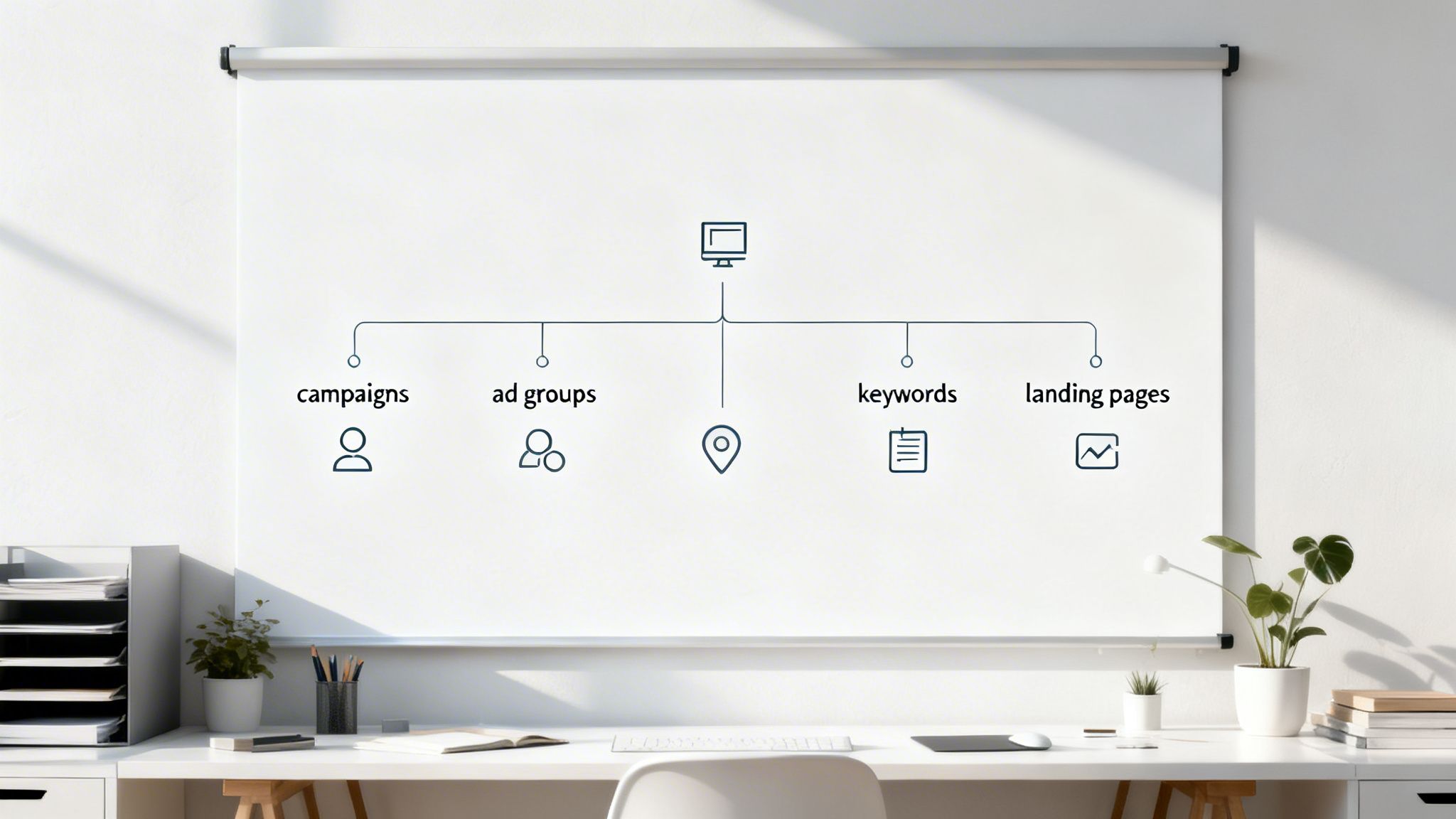
Here’s a simple but powerful way to structure your account for real-world performance. It’s all about aligning your structure with user intent and your business goals. Think of it as a hierarchy, from broad to specific.
- Campaigns (The Library): Campaigns are for your highest-level business objectives. This could be by product line, service category, or even geographic regions if you have different targets. Each campaign gets its own budget and settings, so this separation is critical for control.
- Ad Groups (The Shelves): Inside each campaign, you’ll create ad groups based on specific keyword themes. For example, if you have a campaign for "Project Management Software," your ad groups might be "Agile PM Tools," "Kanban Board Software," and "Gantt Chart Solutions."
- Keywords (The Books): Within each ad group, you place a tight cluster of closely related keywords. In our "Kanban Board Software" ad group, you’d have terms like "kanban software," "best kanban tools," and "trello alternatives." If you want to dive deeper, you might be interested in our guide on how to find the right keywords for PPC.
This structure keeps everything clean and logical. It makes it incredibly easy to write hyper-relevant ads for each ad group, which is exactly what Google wants to see. A tight, theme-based structure gives the bidding algorithms clean, consolidated data to learn from. You’re not just making your life easier; you’re feeding the machine what it needs to get you cheaper, better-quality leads.
Audit your current setup
So, how does your current structure stack up? Be honest. It’s easy to inherit a messy account and just keep patching it up, but that’s a recipe for failure. Here’s a quick checklist to audit your campaigns and see where you stand.
- Is there a clear logic? Could a stranger look at your campaign names and immediately understand what’s inside? If not, it’s too complicated.
- Are your ad groups tightly themed? Look inside an ad group. Do all the keywords share the same core intent? Or is it a random dumping ground for anything that seemed remotely related?
- Is data fragmented? Do you have dozens of ad groups with only a handful of clicks and impressions each? If so, you’re starving the algorithm of the data it needs to optimize.
If you answered no or I'm not sure to any of these, it’s time to rebuild. It might feel like a lot of work upfront, but a solid foundation is the only way to build a PPC engine that actually scales. Stop tweaking a broken system and build one that’s designed to win from the start. 💪
Aligning keywords with your landing page
Let’s get straight to it. This is where at least 90% of PPC campaigns quietly bleed money and fail. It’s the massive, jarring disconnect between the promise in your ad and the reality of the landing page a user hits.
Sending high-intent traffic to a generic, one-size-fits-all page is like inviting a VIP to a party and then making them get their own drink from a cooler in the garage. It’s a terrible experience, a total waste of ad spend, and an epic missed opportunity. 🤦♂️
We’re going to dig into what marketers call message match. This isn't some fluffy, abstract concept; it's the glue that holds your entire PPC funnel together and one of the single biggest levers you have for boosting conversion rates.
The power of a seamless journey
Think about this from the user's perspective for a second. They search for something incredibly specific, like "agile project management software for startups." They see your ad, which perfectly mirrors their search, and they click, expecting to find the answer to their problem.
Instead, they land on a generic homepage talking about all ten of your company’s products. The headline doesn’t match, the copy is vague, and now they have to hunt for the information they came for. What do they do? They hit the back button in under three seconds.
You just paid for that bounce.
A seamless journey from keyword to conversion isn't a nice-to-have—it's non-negotiable. The search query is a direct line to your customer's intent. Your job is to honor that intent by giving them exactly what they asked for, instantly.
This tight alignment does more than just keep users from bouncing. Google actively rewards you for it.
When your landing page experience is highly relevant to your keywords and ads, your Quality Score improves. This directly lowers your cost-per-click (CPC) and helps you secure better ad positions. You literally get a discount for not wasting people’s time.
Here's the idea in its simplest form: what the user searches for is what they should see on the page.
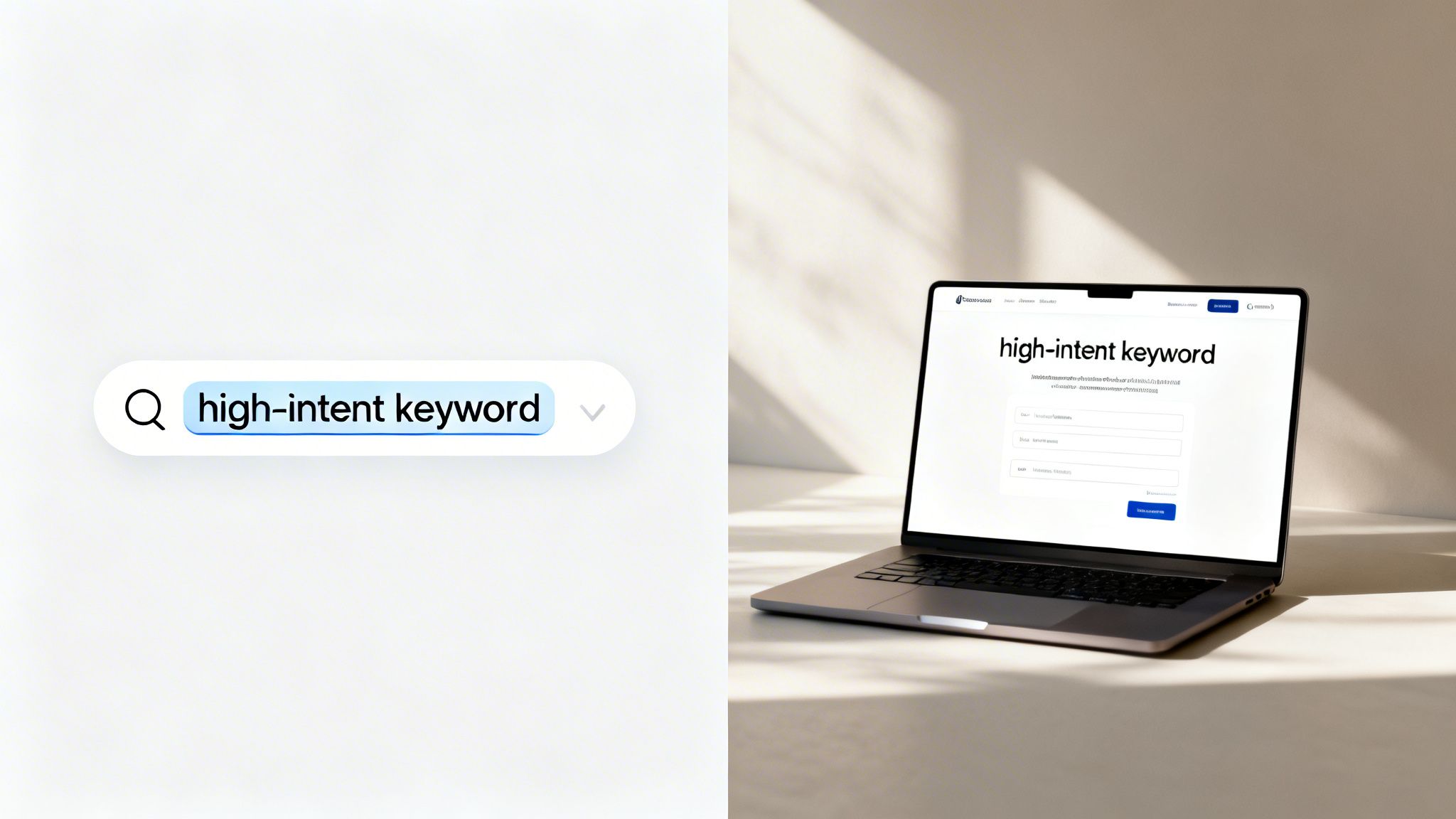
This image perfectly captures the principle. The journey from search bar to landing page should feel like one continuous thought.
Building hyper-relevant experiences at scale
Okay, so this is where you might be thinking, do I seriously need to build a unique landing page for every single keyword? No, absolutely not. That's a surefire way to drive yourself and your dev team insane. It’s completely unscalable.
The real trick is to work smarter, using smart templates and automation.
Modern platforms—including our own here at dynares—let you build dynamic landing pages. You create a master template, and the system automatically swaps out key elements like headlines, copy, and even images to perfectly match the user's search query or ad group.
This gives you the power of personalization without the soul-crushing manual labor. It's the difference between being busy and being effective.
To really drive home the difference this makes, let's look at the numbers.
Impact of landing page personalization
| Metric | Generic Landing Page (The Old Way) | Personalized Landing Page (The Smart Way) |
|---|---|---|
| Relevance | Low - page doesn't match specific query | High - headline & copy mirror the ad |
| Bounce Rate | High (50-70%+) | Low (25-40%) |
| Quality Score | Below Average (1-4/10) | Above Average (7-10/10) |
| Cost-Per-Click | Inflated | Lowered by 20-50% |
| Conversion Rate | Low (1-3%) | High (5-15%+) |
| Return on Ad Spend | Unpredictable, often low | Predictable and maximized |
The table makes it pretty clear. One approach burns cash and frustrates users; the other builds a genuine lead generation engine. After aligning keywords and personalizing the page, the next step involves optimizing landing pages for conversions to ensure every element works to drive action.
This isn’t just a nice-to-have; it's how you unlock real ROI. The data consistently shows that PPC delivers an average $2 for every $1 spent—a solid 200% ROI—but only when it’s optimized correctly. Personalization is a huge piece of that puzzle, especially since 81% of consumers do online research before buying. For a deeper dive into modern marketing data, the latest findings from HubSpot are always a great resource.
To nail your message match, focus on these three things:
- Headline: The main headline on your page must echo the promise of your ad and the user's search term. No exceptions.
- Body Copy: The benefits and features you highlight should directly address the pain point implied by the keyword.
- Call-to-Action (CTA): The CTA has to be the logical next step. If someone searches for a "Gantt chart software demo," your button should say "Get a Free Demo," not "Learn More."
Getting these details right is the foundation of modern, profitable PPC. If you're just starting and want a solid primer, our guide on how to create a landing page that converts is the perfect place to begin.
Tracking conversions that actually matter
Let’s get real about what success means in PPC. If you’re high-fiving the team over last month's form submissions, you’re probably celebrating vanity metrics. Most of those leads are junk, and if your tracking stops at the thank-you page, you're flying blind.
You’re optimizing for activity, not impact. This is one of the most common—and expensive—mistakes in the game. To get real results and prove your value, you have to track conversions that actually matter to the business: qualified leads, sales opportunities, and closed deals.
Why your leads are probably junk
The whole point of lead generation is to fuel the sales pipeline, not just fill a spreadsheet with email addresses. The problem is that standard PPC conversion tracking is lazy. It fires a pixel when someone fills out a form, tells Google job done, and calls it a day.
This approach is fundamentally broken because it treats a demo request from your ideal enterprise customer the same as a student downloading an ebook for homework. You end up telling Google to get you more form fills, which often means it finds you more low-quality, low-intent traffic simply because it's cheaper to convert.
The goal isn’t to get the most leads; it's to get the right leads. You need to connect your ad spend all the way to revenue. This is how you stop defending your budget and start demanding more of it.
This requires a closed-loop system where your ad platform and your CRM are in constant communication. To prove your PPC efforts are profitable, you first need to know how to calculate marketing ROI—it's the foundation for making data-driven decisions that actually grow the business.
A real-world tracking workflow that works
Building a bulletproof tracking system isn't as complicated as it sounds. It’s about connecting the right tools to create a single source of truth. Here’s a practical workflow using common tools like Google Tag Manager (GTM) and a CRM like HubSpot.
The magic starts in an interface like this, your GTM container. This is where you configure the tags that capture user actions on your site and pass them to your analytics and ad platforms.
Think of GTM as your command center for tracking. Instead of hard-coding dozens of scripts onto your site, you manage everything here. It ensures your data is consistent and lets you deploy new tracking events without begging a developer for help.
Here’s the step-by-step logic:
- Initial Click & Lead Capture: A user clicks your Google Ad and lands on your page. They fill out a form, and GTM captures this event, along with the user’s unique Google Click ID (GCLID). This ID is then passed into your CRM (like HubSpot) through a hidden form field.
- Lead Qualification in the CRM: The lead now lives in HubSpot with its GCLID attached. Your sales team works the lead, qualifying it as an MQL, creating a deal, and eventually marking it as closed-won with a specific revenue value.
- Passing Value Back to Google Ads: This is the game-changer. You set up an integration (either native or through a tool like Zapier) that automatically sends this conversion data back to Google Ads. You don't just send the conversion; you send its actual monetary value.
This closes the loop. Now, Google Ads doesn't just know which keywords and ads are generating leads; it knows which ones are generating actual revenue.
This allows you to unlock powerful bidding strategies like Target ROAS (Return on Ad Spend), which is essential for any serious PPC campaign. You can dig into the technical details in our guide on Google Ads conversion tracking.
This is what separates professional PPC managers from amateurs. Amateurs chase clicks. Professionals chase profit. It takes a bit of setup, but the payoff is a campaign that optimizes itself for what really matters—the bottom line. 🚀
If you're still tweaking bids by hand or manually rotating ad copy every week, you're falling behind. It's that simple. The way forward in PPC isn't about letting a robot run your strategy—that’s a recipe for disaster. It’s about using automation as a tool to amplify your own expertise.
This means you set up smart systems to handle the repetitive, tedious work. That frees you up to focus on the things that actually require a human brain: high-level strategy, creative angles, and getting inside your customer's head. You stop being a button-pusher and become the architect of the entire machine.
Let’s break down what that actually looks like day-to-day.
Let the machines handle the bidding
Bidding is the most obvious place to start. Ad platforms like Google Ads have invested billions into their bidding algorithms. Trying to out-muscle them with manual CPC adjustments is usually a mix of wasted time and misplaced ego.
But here’s the catch: these systems are only as smart as the data you give them. If you’ve done the hard work of setting up clean, value-based conversion tracking, you can unlock a totally different level of performance.
This is where automated bid strategies like Target CPA (tCPA) and Target ROAS (tROAS) become your best friends.
- Target CPA: You tell Google exactly what you’re willing to pay for a specific action, like a qualified lead. The algorithm then works 24/7 to hit that number. This is perfect when all your leads have a similar, predictable value.
- Target ROAS: This is the next evolution. You tell Google the return on ad spend you need to hit (say, 500%). The system then hunts for the highest-value conversions, prioritizing clicks that are more likely to turn into bigger deals.
Trying to use these strategies with messy data is like giving a supercomputer a blurry, out-of-focus photo and asking it to identify a specific person. The results will be a mess. But feed it clean data, and it's like giving it a high-resolution image—it can make incredibly precise decisions.
Generating and testing ad variants at scale
Winning at PPC isn't just about bidding on the right keywords; it’s about finding the right message that connects with a real person. But manually testing hundreds of headline and copy combinations is a soul-crushing task. It's slow, inefficient, and you'll never test enough versions to find the absolute best performers.
This is another area where automation is a game-changer. Platforms like our own, dynares, were built to solve this exact problem. You give the system your core brand rules and keyword targets, and it can automatically generate and test thousands of coordinated ad variants and their matching landing pages.
This isn't about set it and forget it. It’s about creating a framework for constant, data-driven experimentation at a scale no human team could ever hope to manage. The machine does the testing; you analyze the insights to make smarter strategic moves.
Instead of guessing which headline works best, you’re letting real-world data decide. The system automatically shifts budget to the winning combinations, so your campaigns are always running the strongest possible creative. Think of it as a Darwinian cage match for your ad copy—only the fittest survive.
For anyone looking to escape that manual grind, our article on moving from spreadsheet hell to automated PPC funnels offers a practical look at making this shift.
Smarter budget and campaign management
Automation goes well beyond just bidding and creative. You can build a system of rules to manage your campaigns so you don’t have to stare at them all day. This frees you from the daily slog of checking budgets and pausing duds, letting you focus on actual growth.
Here are a few practical rules you can set up:
- Budget Guardrails: Create a rule that automatically pauses a campaign if it spends a certain amount without a single conversion. This is your safety net to prevent a bad ad from quietly emptying your wallet over a weekend.
- Performance Alerts: Set up a notification if a key metric, like your Cost Per Lead, suddenly jumps by more than 20%. This lets you jump on problems immediately, not discover them a week later in a report.
- Keyword Culling: Automate pausing keywords that have a low Quality Score or have spent money without converting after a reasonable threshold. It’s like automated spring cleaning for your account.
By building these systems, you’re creating an intelligent layer of oversight for your campaigns. It's the only scalable way to run PPC in a world where speed and data are everything. It finally lets you step back from the tactical weeds and start working on the business, not just in it.
Alright, we’ve talked enough theory. Theory is nice, but execution is what pays the bills.
Let's walk through a real, end-to-end workflow for launching a new lead generation campaign using a modern tech stack. No fluff—just a practical playbook you can actually use.
We're going to connect all the dots we've discussed: campaign structure, message match, tracking, and automation. The goal is to build a high-performing PPC engine that doesn't require you to live inside the Google Ads interface. It’s about building a system so you can focus on strategy, where your brain actually makes a difference.
The step-by-step playbook
This is the exact flow we use to launch new campaigns, designed for speed and scale. It moves logically from defining the inputs to automating the outputs, ensuring every piece is connected and tracked from the start.
Let's get into it.
1. Define Your Guardrails (The Inputs)
It all starts here. Before you even think about keywords, you need to lock down the core components of the brand and offer. These are the non-negotiables.
- Brand Guidelines: Voice, tone, color palettes, and core value propositions. This keeps everything on-brand and prevents your ads from looking like they were made by a stranger.
- Offer Details: What are you actually promoting? A demo? A trial? A consultation? Nail down the specific CTA and the value behind it. Be painfully clear.
- Target Keyword Themes: Brainstorm the main themes your customers search for. We’re not building a massive list yet, just identifying the primary topics like "CRM for small business" or "AI sales tools." Think in categories, not just single keywords.
2. Automate Content Generation
This is where you stop doing dumb, repetitive work. Manually creating hundreds of ads and landing pages is a dead end. It’s a guaranteed way to burn out and produce mediocre work.
We use a platform like our own, dynares, to do the heavy lifting.
- Feed the system your brand guidelines and keyword themes.
- The platform then automatically generates hundreds of coordinated ads and perfectly matching landing pages. Each one is tailored to a specific keyword intent, ensuring that critical message match from click to conversion.
3. Deploy and Connect the Tech Stack
With your assets ready, it's time to set up the plumbing. This is about making sure data flows seamlessly between your tools, because disconnected data is useless.
- Campaign Push: Push the new campaigns, ad groups, ads, and keywords directly into Google Ads. No more manual CSV uploads.
- Tracking Setup: Implement tracking via Google Tag Manager (GTM). This is crucial. We make sure that when a lead converts, their GCLID (Google Click ID) is captured and sent to the CRM.
- CRM Integration: Ensure all leads from your new landing pages flow directly into a CRM like HubSpot. The GCLID must be passed along as a hidden field. This is the key that unlocks the connection between ad spend and actual sales outcomes.
This process is about shifting from manual, reactive work to a more automated, strategic approach to PPC campaign management.
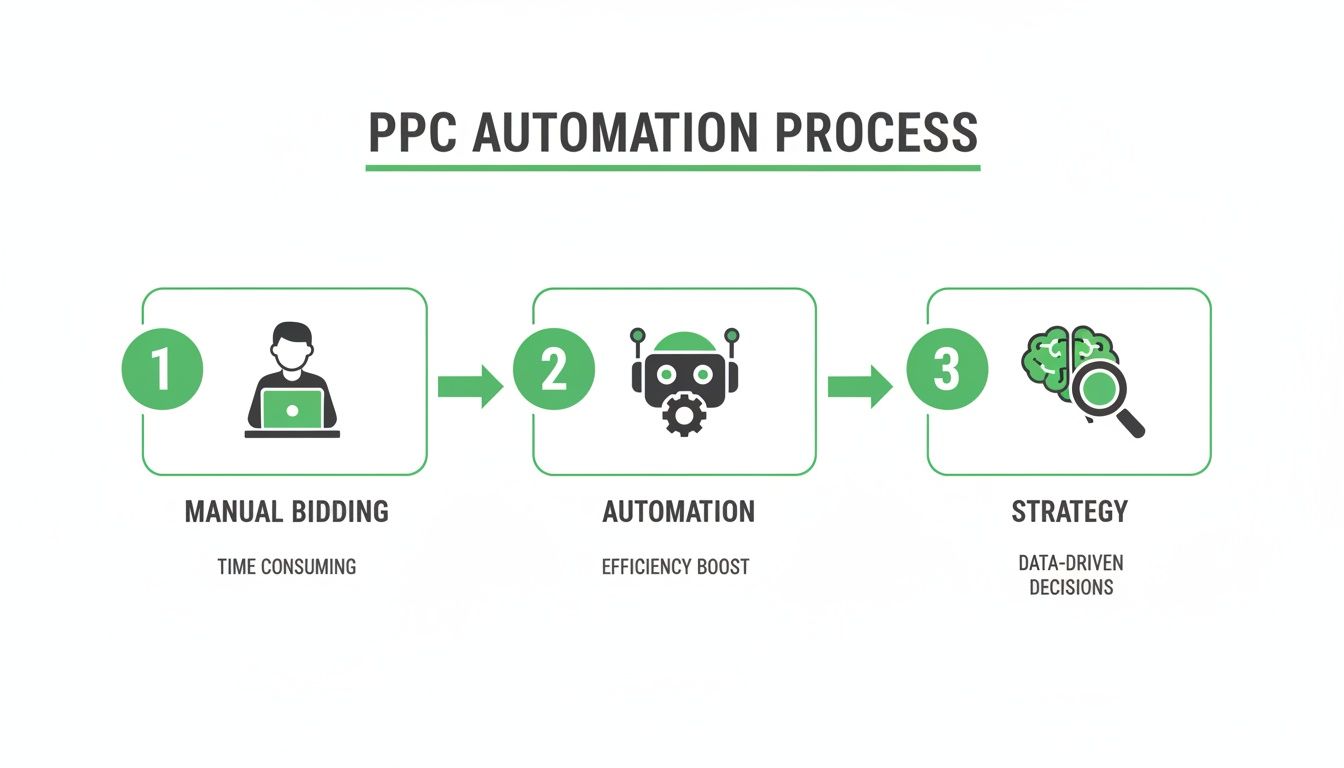
This shift is what allows you to escape the tactical weeds. It frees you up to focus on high-level strategy and growth, where human insight actually matters.
Closing the loop with HubSpot
The final piece of the puzzle is making sure revenue data flows back to your ad platform. Your dashboard in HubSpot will show you exactly how leads are progressing through the sales funnel.
When a deal is marked closed-won in HubSpot, an automation triggers. That automation sends the conversion event—along with its real monetary value—back to Google Ads.
This is the holy grail for PPC managers.
You're no longer telling Google to "get more leads." You're telling it to "get more revenue." This completely changes the optimization game and finally lets you prove your ROI to the C-suite without a 20-slide deck full of excuses. 🔥
Alright, let's wrap this up by tackling a few of the questions I get asked all the time about running modern PPC campaigns. It’s easy to get buried in the details, so let's clear the air on a few things that actually move the needle.
How much should I spend on PPC?
Honestly, that’s the wrong question to be asking. It’s not about how much you pour into the top of the funnel, but how efficiently that money turns into actual business at the bottom.
Don't just light a pile of cash on fire and hope for the best. That’s not a strategy, it’s a donation to Google.
Start with a budget you can afford to test with. Your only job is to prove the model—to validate the entire path from click to closed deal with real conversion data. Once you have a predictable, positive return on ad spend (ROAS), then you can hit the gas and scale your budget with confidence.
Is AI going to replace PPC managers?
No. But PPC managers who refuse to use AI are absolutely going to be replaced by the ones who do. It’s that simple.
Think of AI as the most powerful analyst you've ever hired, not your replacement.
It’s a tool that's absolutely brilliant at crushing the repetitive, data-heavy work that used to eat up 80% of our day. This frees you up to focus on the things a machine can't touch: high-level strategy, creative angles, and deeply understanding your customer’s world. Embrace it or get left in the dust. 🚀
What's the most common mistake in PPC?
The biggest and most expensive mistake is obsessing over vanity metrics. Clicks and impressions feel good on a dashboard, but they don't pay the bills. The only things that matter are qualified leads and revenue.
A very close second is lazy message match—that jarring gap between what your ad promises and what the landing page delivers.
I guarantee if you fix just those two fundamental problems, you're already ahead of 90% of your competition.
At dynares, we built our platform to solve these exact problems. It automates the tedious work and connects the dots from click to revenue, so you can finally focus on strategy and growth. If you're tired of running your campaigns from a spreadsheet, see how we can help you scale at https://dynares.ai.


