
Running PPC campaigns without the right tools is like trying to build a rocket with a hammer and duct tape. You might get something off the ground, but it’s going to be inefficient, expensive, and probably explode on the launchpad. The default Google Ads interface, while powerful, simply doesn't scale well for ambitious teams managing multiple accounts or complex campaigns. Manually pulling reports, crunching numbers in spreadsheets, and A/B testing ad copy is a massive time sink that kills your team’s strategic output. It’s a dumb way to work in 2024.
The real challenge isn't just managing campaigns; it's optimizing them for profit at scale. This means constantly finding an edge through better bidding, smarter ad creative, and deeper analysis. That's where a solid stack of PPC optimization tools comes in. These platforms automate the tedious work so you can focus on high-level strategy, a problem we’re obsessed with solving at dynares.
This guide cuts through the marketing fluff to give you a candid, practical breakdown of the best tools on the market. We'll look at everything from all-in-one automation suites to specialized analytics and competitive intelligence platforms.
My goal is to give you a clear, actionable resource to help you choose the right tech, stop wasting time on manual tasks, and start getting better results from your ad spend. Let’s get into it.
1. dynares
Let’s be direct. The biggest disconnect in PPC is almost always the gap between a specific ad and its generic landing page. dynares is one of the few PPC optimization tools that solves this problem head-on, and it does so at scale. It’s an AI-first platform designed to automate the entire Google Ads workflow, from keyword research and ad copy all the way to generating a unique, high-intent landing page for every single keyword. This isn't just about saving time; it's about fundamentally improving ad relevance and performance.
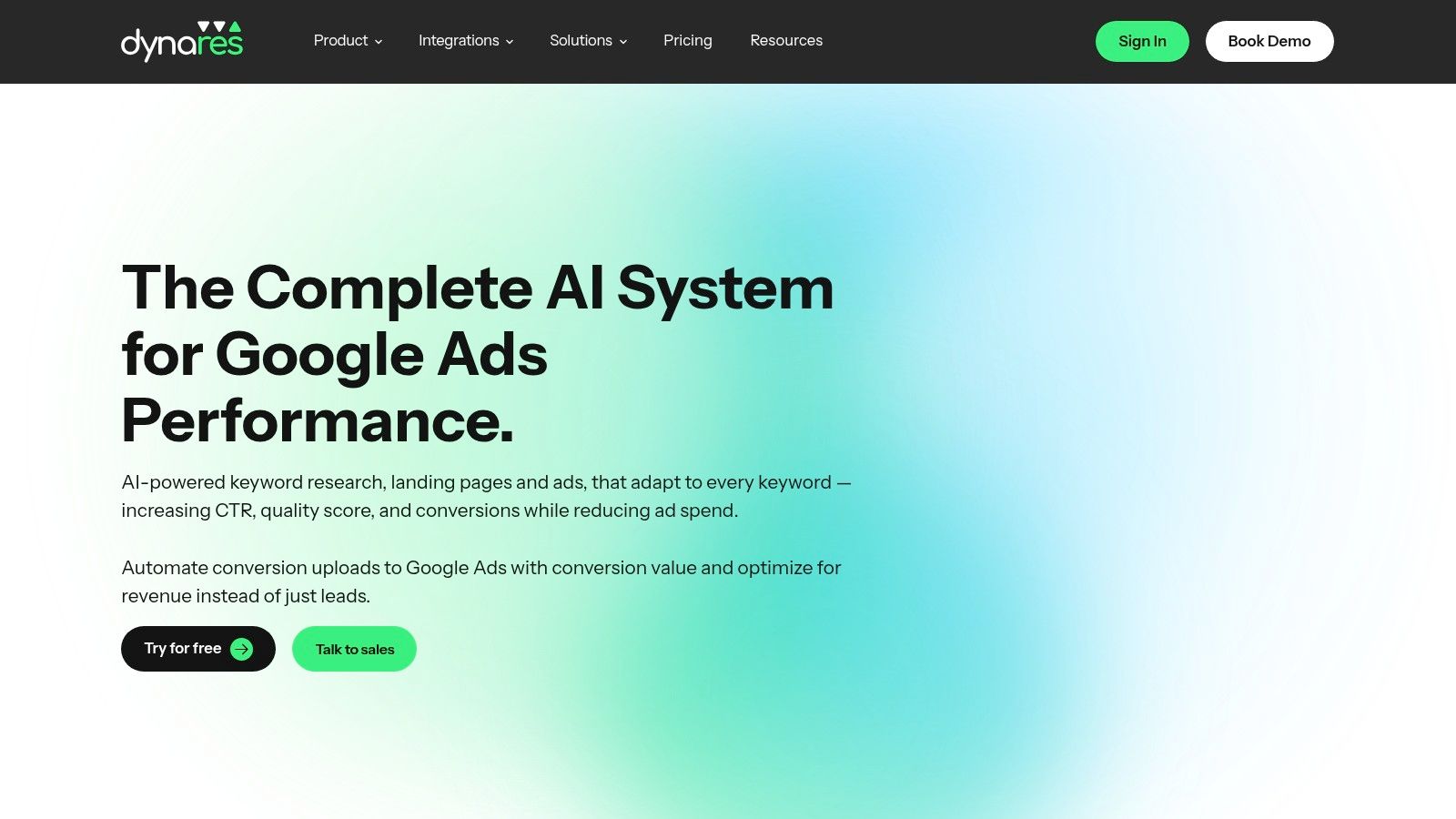
The system automatically A/B tests these combinations, analyzes performance in real time, and crucially, uploads conversion values back to Google Ads. This allows you to optimize your campaigns for actual revenue, not just lead counts, which is a massive advantage for anyone serious about ROAS. It's a genuine end-to-end solution for performance-focused teams.
Standout features
- Keyword-to-page automation: Its core strength is generating tailored ads and landing pages for each keyword, dramatically boosting Quality Score and conversion rates. This is a game-changer for accounts with large keyword sets.
- Revenue-aware optimization: The ability to upload conversion values to Google Ads means your bidding strategy can be based on real business impact. You're no longer flying blind, optimizing for leads that don't convert to customers.
- Integrated toolset: It includes builders for templates, pages, and forms, alongside native integrations with Google Ads, Google Tag Manager, and HubSpot, making it a cohesive part of your existing stack.
Quick setup tip
When you first connect your Google Ads account, start with a single, high-traffic campaign. Let dynares generate the pages and ads, but spend some time in the template builder to input your brand guidelines (logos, colors, fonts). This ensures the AI's output feels like it came from your team from day one. It's a small step that makes a huge difference. For more granular advice, you can find a lot of good info on landing page optimization best practices that applies here.
Pricing and access
dynares operates on a freemium model. There’s a Free tier for getting started, a Starter plan at around €29/month, a Pro plan for agencies at €243/month, and a Business plan at €765/month, with discounts for annual billing. Enterprise options with dedicated onboarding are also available, making it accessible for everyone from solo operators to large agencies.
2. Optmyzr
Optmyzr is one of the originals in this space, a mature PPC management platform built by ex-Google Ads folks. It layers on top of Google, Microsoft, and Amazon Ads, focusing on automation, rules, and deep reporting to help you manage campaigns at a larger scale. This isn't a tool for beginners who want a completely hands-off solution; it’s for serious practitioners who want more control.
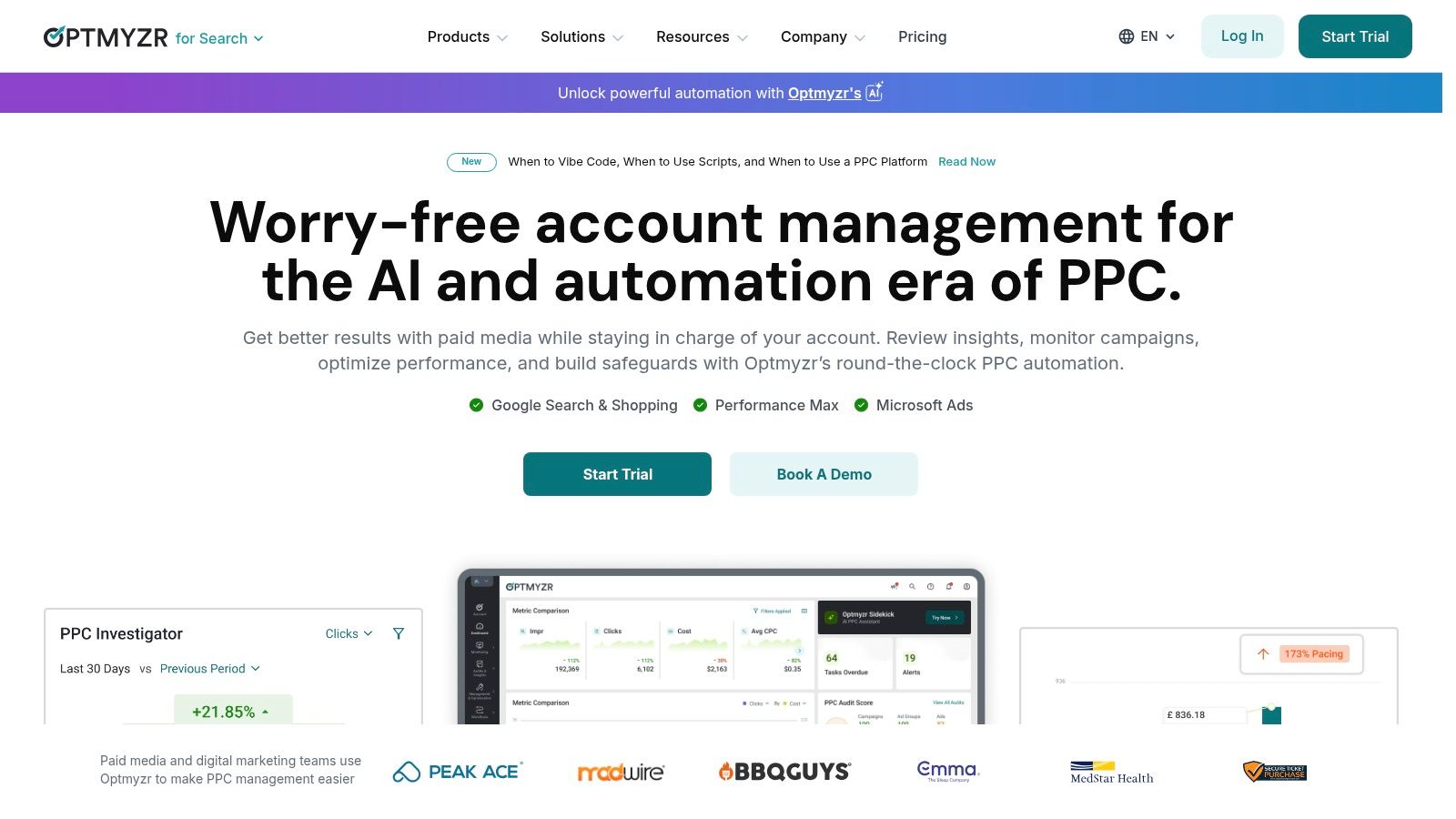
The platform’s strength lies in its Rule Engine and one-click optimizations. Think of it as an expert assistant that constantly scans your accounts for opportunities, then presents them for your approval. This saves an incredible amount of time compared to manually digging through accounts.
Best use cases
- Agencies & power users: The ability to apply custom rules and workflows across dozens of client accounts is a massive time-saver. Budget pacing and multi-account reporting are designed for agency life.
- In-house teams at scale: If you're managing significant ad spend and complex account structures, Optmyzr gives you the controls to maintain performance without hiring another three people.
Pros & cons
It offers deep control for PPC experts, with broad coverage across the major ad platforms. Its AI-assisted suggestions are layered on top of the rules, which gives you both automation and granular control. However, there’s a learning curve. New PPC managers might find it a bit overwhelming at first. Pricing also scales with your ad spend, so it can get pricey for smaller accounts.
How it compares to dynares
Optmyzr is a PPC manager’s toolkit, giving you more powerful ways to manage existing campaigns. Dynares, on the other hand, automates the entire funnel from the start, generating the ads and the corresponding landing pages with AI. While Optmyzr helps you optimize what you’ve built, Dynares builds the optimized assets for you. Exploring various Google Ads optimization tools can clarify which approach fits your workflow.
3. Adalysis
Adalysis is a laser-focused tool for anyone serious about the scientific side of PPC, especially ad testing and Quality Score. It hooks directly into Google and Microsoft Ads and acts as your always-on auditor, running checks to spot issues before they cost you real money. It’s less about flashy AI promises and more about giving you the hard data to make statistically sound decisions.
Its core strength is its Automated Ad Testing. Adalysis goes beyond simple A/B testing by analyzing performance down to the asset level for RSAs and alerting you when a winner is found with statistical significance. This removes the guesswork and confirmation bias that often creep into manual ad copy analysis.
Best use cases
- Data-driven marketers: If you live and breathe performance data, you’ll love this. It gives you deep diagnostics on Quality Score, n-gram analysis for search terms, and robust testing frameworks.
- Agencies needing scalable audits: The ability to run customizable audits and set up alerts across unlimited client accounts in a single MCC is a huge efficiency gain. It finds the low-hanging fruit for you.
Pros & cons
It’s one of the best PPC optimization tools for ad testing and Quality Score analysis, period. The pricing model is also fair, including all features and unlimited users, so you don't get nickel-and-dimed. The downside? The interface is dense and can feel a bit clinical at first. It’s built for function over form, which means there’s a learning curve to uncover all its power. Pricing is also tied to spend, so you have to pick the right tier.
How it compares to dynares
Adalysis is a diagnostic and testing engine. It helps you find and fix problems within your existing campaign structure, making sure your ads and keywords are performing as well as they can. Dynares operates a level above this; it automates the creation of the entire campaign, including the ads and their matching landing pages. While Adalysis helps you meticulously test your ad copy, Dynares generates and tests the whole funnel from the start, which is a different approach to a solid Google Ads campaign optimization strategy.
4. Opteo
Opteo positions itself as a smart, simple assistant for Google Ads management. Instead of overwhelming you with a massive toolkit, it focuses on delivering a prioritized feed of actionable “Improvements.” It’s designed for speed and efficiency, making it perfect for lean teams or agencies that need to quickly spot and fix issues without getting bogged down in manual data analysis.
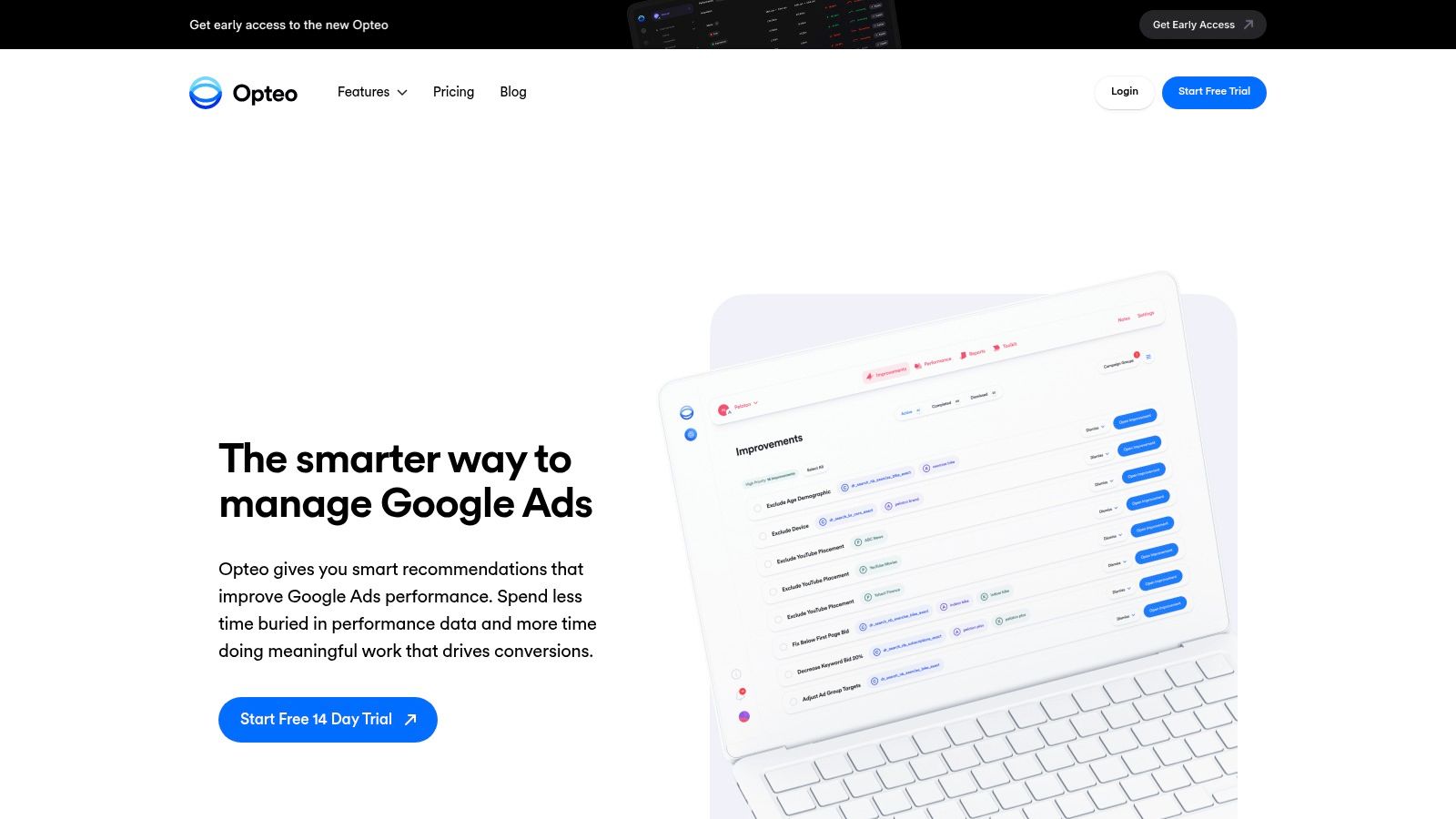
The core experience is its Improvements feed. Opteo constantly scans your account for opportunities like adding negative keywords, adjusting bids, pausing poor performers, or testing new ad copy. You review the suggestions and push them live to Google Ads with a single click. It’s a very practical workflow that saves a ton of time on daily account maintenance.
Best use cases
- Agencies with junior members: It’s a fantastic training tool. It guides newer PPC managers toward best practices and helps them build the right optimization habits.
- Lean in-house teams & SMBs: If you don't have a dedicated PPC expert, Opteo acts as your specialist, surfacing critical issues you might otherwise miss. It provides the 80/20 of account optimization.
Pros & cons
The setup is incredibly fast, and you see value almost immediately. Its transparent, tier-based pricing is refreshing, and the user interface is clean and intuitive. The main limitation is that it’s Google Ads only, so no support for Microsoft or Amazon Ads. The data refresh cycle can also be slow (up to 24 hours) on lower-tier plans, which can be a drag if you need real-time adjustments.
How it compares to dynares
Opteo is an optimization layer that helps you manage what’s already running in Google Ads. It’s a maintenance and improvement tool. Dynares takes a much bigger swing by automating the entire campaign creation process from the ground up, generating the ads and the landing pages they point to. While Opteo suggests tweaks, Dynares builds the whole engine for you. Understanding the different kinds of Google Ads automation tools helps you decide if you need a co-pilot or a full-on autopilot.
5. TrueClicks
TrueClicks is built for agencies and in-house teams that live and breathe quality assurance. Instead of focusing on building new ads or landing pages, it acts as a monitoring and auditing layer, constantly checking your accounts against a massive list of best practices. It’s a tool for maintaining hygiene and catching mistakes before they cost you money.
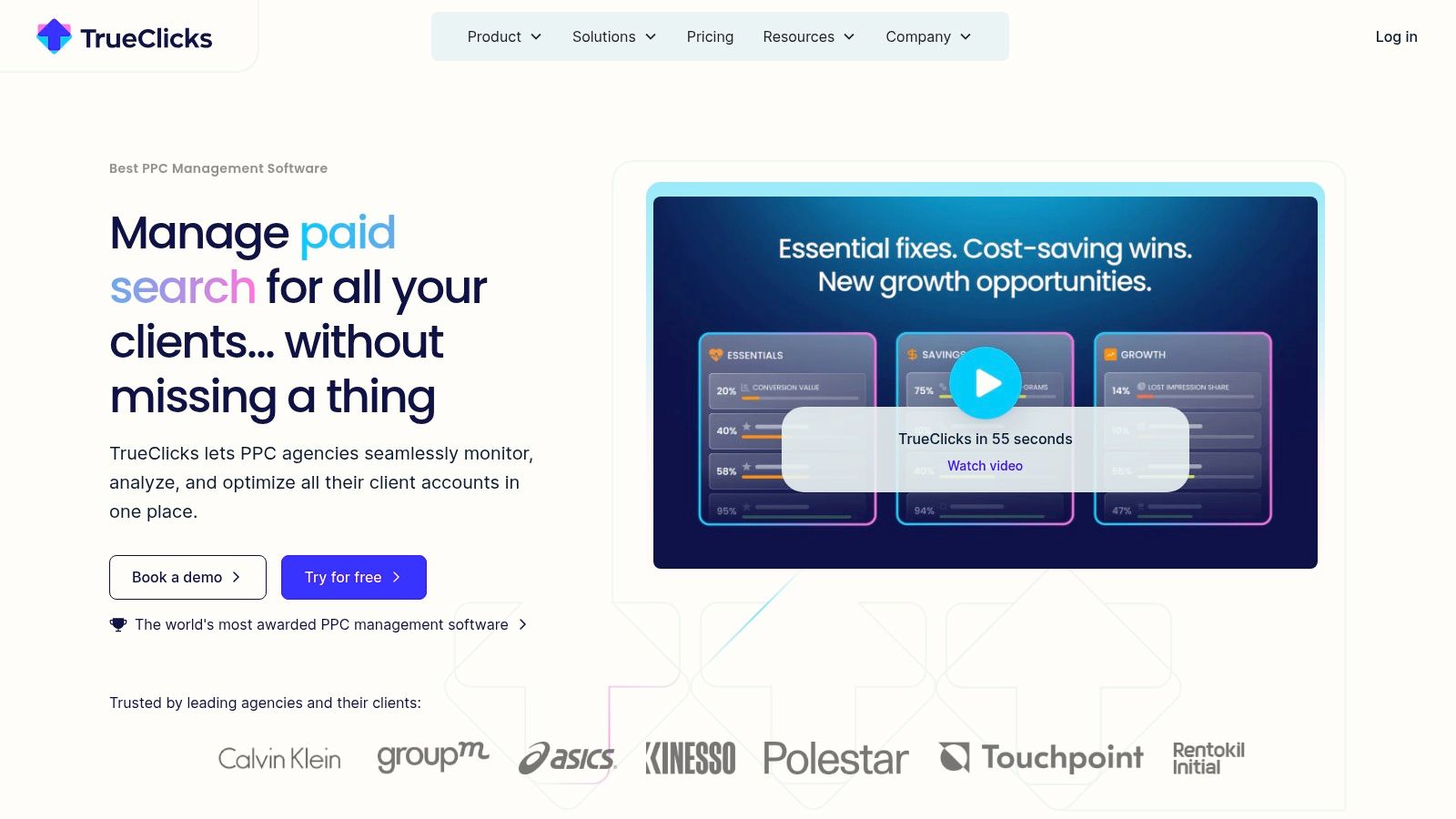
The platform’s core is the TrueClicks Score, a single metric that grades your accounts based on over 100 checks. This score gives you a quick, objective view of an account’s health, making it easy to spot which clients or campaigns need immediate attention. From there, you can use its bulk "Fix" workflows to resolve common issues across multiple accounts at once.
Best use cases
- PPC agencies: Ideal for standardizing quality control across your entire client portfolio. The cross-account dashboards and task assignment features make it simple to manage team responsibilities and report on account health.
- Large in-house teams: When you have multiple PPC managers working on different campaigns, TrueClicks helps enforce a consistent standard of work and prevents costly errors from slipping through the cracks.
Pros & cons
It excels at multi-account monitoring and QA, providing a clear, actionable audit of your PPC efforts. The low barrier to entry for a trial means you can see its value quickly. On the flip side, its focus is squarely on monitoring and fixing, not creative generation or bid automation. Adopting its advanced features might require a shift in your team's existing workflow and processes.
How it compares to dynares
TrueClicks is your account’s health inspector, ensuring everything you've already built is up to code. It helps you maintain and audit existing structures at scale. Dynares is the architect and builder, creating the ad-to-landing-page funnels from the ground up with AI. You’d use TrueClicks to audit the campaigns that Dynares builds and manages, making them complementary parts of a modern PPC stack.
6. Shape (shape.io)
Shape is a laser-focused tool built for one of the most stressful parts of PPC management: budget pacing. It’s designed almost exclusively for agencies and in-house teams that juggle numerous client accounts or complex departmental budgets. Its entire purpose is to prevent the dreaded overspend or underspend conversation at the end of the month.
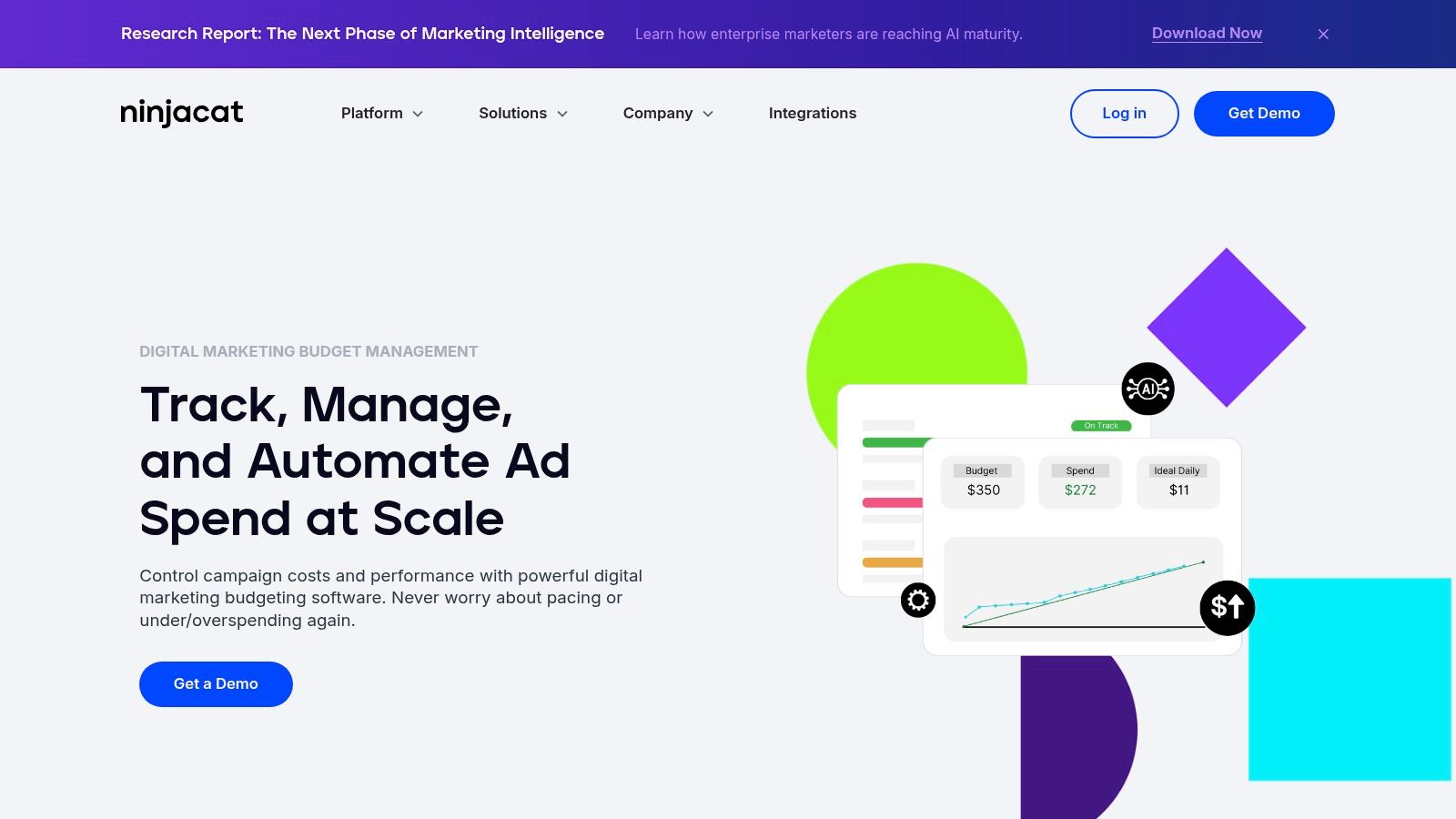
The platform plugs into your ad accounts and uses historical and real-time data to project spending. Its "CruiseControl" feature then automates daily budget adjustments to keep you on track. It’s a set-it-and-forget-it solution for the financial side of PPC, giving managers back the time they’d otherwise spend in spreadsheets.
Best use cases
- Agencies with many clients: Managing 20, 50, or 100+ budgets manually is a recipe for disaster. Shape centralizes this, providing a single dashboard for pacing across all accounts and platforms.
- Large organizations with strict budgets: When you have fixed quarterly or annual budgets that cannot be exceeded, Shape’s proactive alerts and automated rollovers are a lifesaver.
Pros & cons
It’s purpose-built for budget pacing and does it exceptionally well. The automation significantly reduces the risk of human error in managing spend, which scales perfectly for large client portfolios. The only catch is its intentionally narrow scope. This is not a full-stack optimization suite for keywords or ads. Pricing is also geared toward agencies and enterprise, which might be steep for small teams.
How it compares to dynares
Shape is a financial control tool; it automates the budget management process. dynares automates the creative and conversion optimization funnel. You would use Shape to make sure you spend your $10,000 budget correctly, while dynares works to generate the highest return from that $10,000 by creating and testing the ads and landing pages. They solve completely different, but equally important, PPC problems.
7. Google Search Ads 360 (SA360)
When you're running ads at an enterprise scale, managing campaigns across Google, Microsoft, and other engines becomes a serious coordination challenge. Google Search Ads 360 (SA360) is Google’s own answer to this problem. It’s a unified search management platform built for large, complex advertisers who need a single source of truth for bidding, reporting, and workflow management. It's not for the faint of heart; it's a beast designed for big budgets and even bigger ambitions.
The real power here comes from its native integration with the rest of the Google Marketing Platform. By using Floodlight tags, you get a unified view of conversions across search, display, and video, allowing for much smarter cross-engine bid strategies. This is one of the more powerful PPC optimization tools for teams that live inside Google’s ecosystem.
Best use cases
- Large enterprises: Companies with massive ad spends across multiple search engines and international markets use SA360 for centralized control and governance.
- Agencies with major clients: It provides the infrastructure to manage sophisticated, multi-engine strategies and report on performance from a single dashboard, which is critical for top-tier clients.
Pros & cons
SA360 offers enterprise-grade automation and is the gold standard for integration within the Google Marketing Platform. The cross-engine bidding capabilities are top-notch. But it's complex. You'll need training and dedicated processes to get the most out of it. The pricing model, often tied to ad spend and handled via Google or resellers, makes it inaccessible for smaller advertisers.
How it compares to dynares
SA360 is an enterprise command center for managing existing, large-scale search campaigns. It’s about optimizing massive, complex structures. Dynares operates at the very beginning of the process, using AI to generate the actual ad creative and landing pages that feed into those campaigns. You would use Dynares to create high-performing ad assets and then potentially manage the scaled campaigns within a platform like SA360.
8. Semrush Advertising Toolkit
Semrush is a beast in the SEO world, but its Advertising Toolkit is a serious contender for PPC managers focused on the pre-launch and research phases. It’s less about live campaign management and more about competitive intelligence. It gives you a clear view of what your rivals are doing across search, display, video, and social before you spend your first euro.
The platform’s real value is in its competitor ad research and keyword planning tools. You can see your competitors' ad copy, find out what keywords they're bidding on, and even get an estimate of their spend. This kind of market recon is invaluable for crafting a strategy that hits the ground running.
Best use cases
- Strategy & planning: Perfect for mapping out a new campaign. You can build your entire keyword list, group it, and find negatives before you ever open Google Ads.
- Competitive analysis: Agencies use this to show clients exactly what the competition is up to. In-house teams use it to find gaps in the market and avoid costly mistakes.
Pros & cons
It provides wide-ranging market and competitor visibility that's integrated with the rest of the Semrush ecosystem. The PPC Keyword Tool simplifies campaign setup. However, this is a planning and intelligence tool, not a real-time optimizer for live campaigns. Some of the most valuable datasets are also locked behind higher-tier plans, which can be expensive.
How it compares to dynares
Semrush helps you plan a better attack by spying on the competition. It answers the question, what should I do? dynares takes that a step further and actually builds the assets for you. While Semrush gives you the intel to build a solid campaign, dynares generates the ads and landing pages, tests them, and optimizes the full funnel with AI, turning your strategy into a live, high-performing system. Checking out different PPC optimization tools will highlight this difference between planning and automated execution.
Visit Semrush Advertising Toolkit
9. SpyFu
SpyFu isn't an execution platform but a competitive intelligence tool that gives you a behind-the-scenes look at your competitors' search advertising strategies. It digs up historical data on which keywords they've bought, the ad copy they’ve run, and estimates of their monthly spend. This makes it an essential reconnaissance tool before you ever spend a dollar.
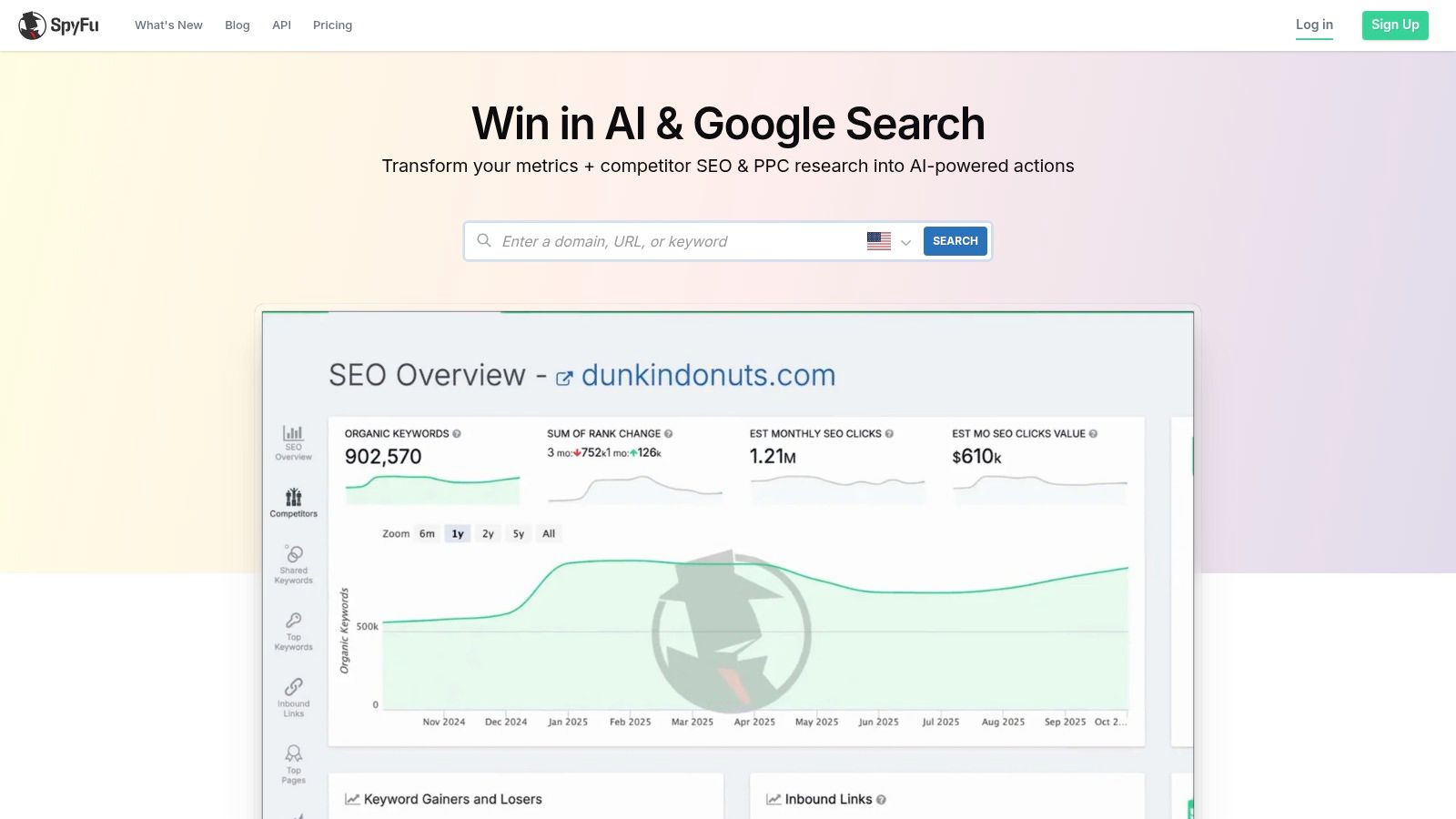
Its core value is in reverse-engineering success. By analyzing what has worked (and failed) for others in your niche, you can build a stronger initial strategy, find keyword gaps, and get inspiration for ad copy. It's one of the best PPC optimization tools for pure research and planning.
Best use cases
- Pre-launch research: Before building a campaign, use it to estimate the competitive landscape, find profitable keywords your rivals use, and identify negative keywords from their past mistakes.
- Agency pitches: Quickly assemble data for a prospective client, showing them where their competitors are eating their lunch and how you can fix it. It makes you look sharp.
- Ongoing strategy refinement: Monitor competitor ad tests and keyword shifts to stay ahead of market trends and adjust your own campaigns accordingly.
Pros & cons
SpyFu is very affordable, with generous search limits on mid-tier plans. It’s excellent for brainstorming, initial keyword discovery, and building a business case for PPC. The catch is that the data is all third-party estimates; it's a compass, not a GPS. You need to validate its findings with your own first-party data. It's also a research tool, not an optimization or management platform.
How it compares to dynares
SpyFu gives you the intel to build a great campaign strategy; Dynares takes a strategy and builds the actual campaign assets for you. You would use SpyFu to research competitor messaging and find keywords, then plug those ideas into Dynares to generate the corresponding ad variations and landing pages. SpyFu tells you what might work, while Dynares builds and tests what will work.
10. iSpionage
If you want to know what your competitors are doing in paid search, iSpionage is your spyglass. It’s a competitive intelligence tool designed to reverse-engineer PPC strategies. It shows you who is bidding on your keywords, what their ad copy looks like, and what their landing pages are doing. This is less about live account automation and more about informing your own strategy by seeing what’s working (or not working) for others.
The platform’s real value comes from its ability to track competitor funnels over time. You can see historical ad copy and even view screenshots of their landing pages to spot A/B tests and strategy shifts. It’s a great way to shortcut your own creative testing by learning from your rivals’ budgets.
Best use cases
- PPC strategists & copywriters: Perfect for quickly gathering ad copy ideas, unique selling propositions, and offers that are already running in your market. It helps answer the "what should we test next?" question.
- Agencies during client pitches: You can walk into a new business meeting with a full report on the prospect's top three competitors, their ad spend estimates, and keyword gaps. It makes you look sharp.
Pros & cons
This tool provides practical, actionable insights into competitors' ad creatives and landing page strategies. The historical data is gold for understanding market trends. However, the data coverage can be spotty, especially in smaller or niche markets. It’s also a research platform, not an active optimization engine, so it won’t manage bids or pause keywords for you.
How it compares to dynares
iSpionage is purely a research tool. It gives you the intelligence to build a better campaign by spying on competitors. dynares takes that concept and automates the execution. Instead of just showing you a competitor's landing page, dynares will generate a high-performing one for you based on your ad, automatically A/B test it, and feed the conversion data back to Google. Use iSpionage for ideas; use dynares to turn those ideas into optimized assets instantly.
11. Adthena
Adthena is a different beast entirely. It’s not about tweaking bids or managing campaigns directly; it's an enterprise-grade search intelligence platform. Think of it as a spy satellite for your PPC landscape, giving you a top-down view of who is bidding on what, where your brand is vulnerable, and what market shifts are happening in real-time. It’s for high-stakes advertisers who need to dominate their search landscape.
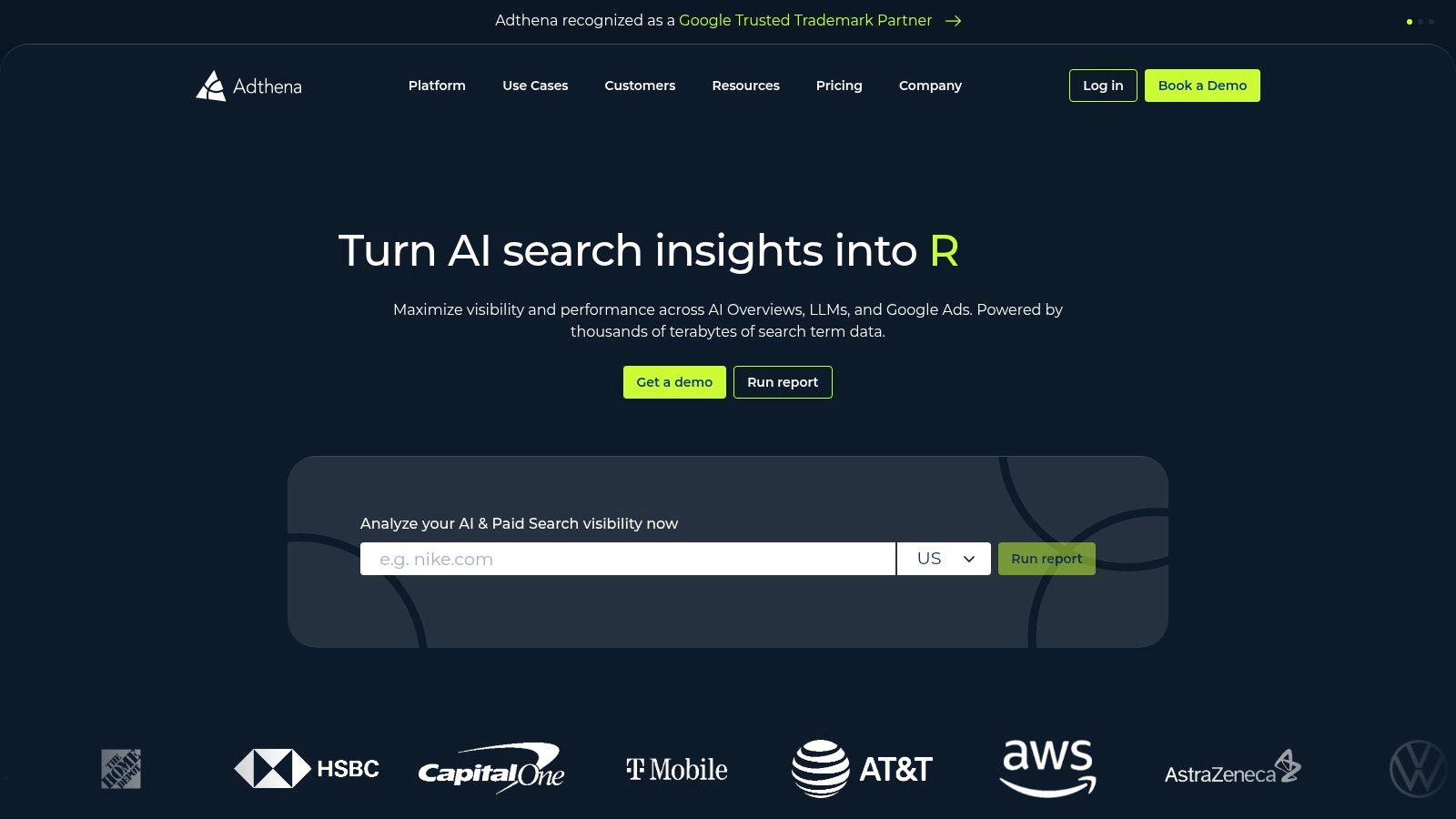
The platform’s core value is its competitive landscape mapping and brand protection. It shows you exactly which competitors are encroaching on your branded terms, helps you find gaps in the market, and provides the data to justify bigger budget asks. It’s less of a day-to-day PPC optimization tool and more of a strategic weapon.
Best use cases
- Large enterprises: For brands spending millions, understanding market share and competitor strategy is crucial. Adthena provides the intel to defend your turf and expand.
- Highly competitive niches: If you're in a cutthroat market like insurance or finance, knowing every move your rivals make is a significant advantage. The brand protection alerts alone can be worth the price.
Pros & cons
Adthena delivers market-level insights you can’t get from Google Ads alone. Its brand protection and competitor monitoring are exceptionally strong for safeguarding high-value keywords. But it’s enterprise-focused, which means tailored pricing, annual contracts, and a cost that puts it out of reach for most SMBs. It can be overkill if you just need campaign management.
How it compares to dynares
Adthena is about high-level market intelligence and competitor analysis. It answers the question, what is everyone else doing? Dynares, in contrast, is an execution engine. It answers the question, how do I build and launch winning ad campaigns and landing pages right now? Adthena gives you the map; Dynares gives you the high-speed vehicle to conquer the territory you've identified.
12. Lunio
Lunio is a different breed of PPC optimization tool. It doesn't adjust your bids or rewrite your ad copy; instead, it focuses on protecting the integrity of your campaign data by blocking click fraud and invalid traffic (IVT). It works in real-time to detect bots, competitors, and other non-genuine clicks, preventing them from wasting your budget and polluting your conversion data.
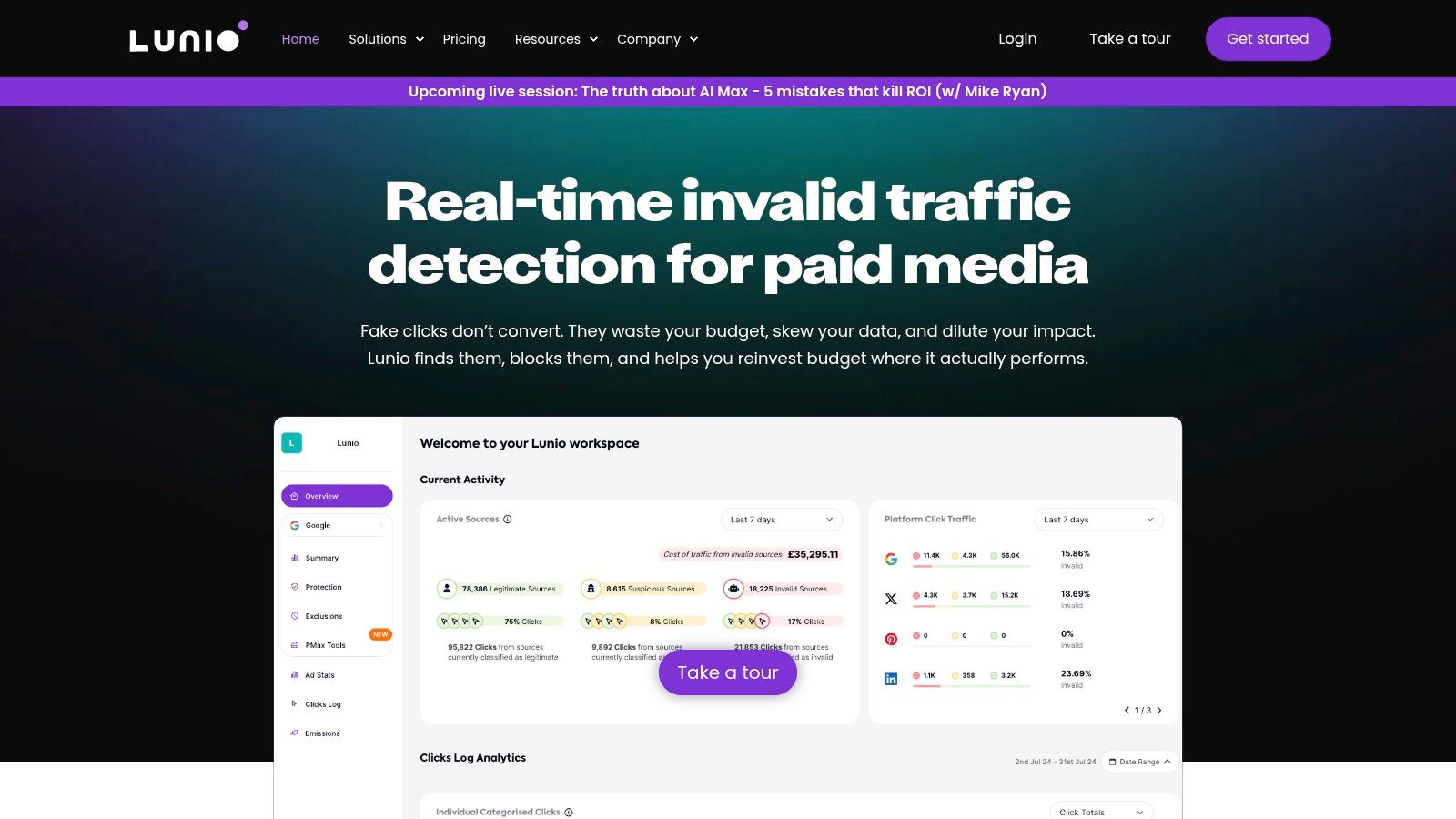
The core idea is simple: if you feed Google’s Smart Bidding algorithms cleaner data, they will make better decisions. By automatically excluding the IP addresses and devices associated with invalid traffic, Lunio ensures your ad spend is only directed toward legitimate, potential customers, which directly improves the signal quality your campaigns rely on for optimization.
Best use cases
- High-volume campaigns: The more traffic you have, the more susceptible you are to IVT. Lunio provides essential protection at scale.
- Competitive niches: If you’re in a market where competitors are known to click on ads to drain budgets, this is a must-have defensive layer.
- Performance-focused advertisers: For those obsessed with data purity, Lunio helps ensure your analytics and automated bidding systems are working with the most accurate information possible.
Pros & cons
Lunio directly protects your ad budget from being wasted on fraudulent clicks. It cleans the data used by automated bidding strategies, leading to better long-term performance. The downside is that it's another platform to manage and pay for. The ROI can be hard to measure directly and varies based on your industry and traffic sources. Pricing is also custom and can be a significant investment for accounts with smaller spends.
How it compares to dynares
Lunio is a shield, protecting your campaigns from external threats so your existing tools can perform better. Dynares, by contrast, is a creator, building the entire ad-to-landing-page funnel from scratch with AI. You would use Lunio to ensure the traffic going to your Dynares-built pages is legitimate. The two are complementary; Lunio cleans the traffic, while Dynares optimizes the conversion path for that clean traffic.
Top 12 PPC optimization tools comparison
| Product | Core focus & key features | UX & performance ★ |
Value & pricing 💰 |
Target audience 👥 |
Unique selling point ✨ |
|---|---|---|---|---|---|
| dynares 🏆 | AI-generated per-keyword ads, landing pages, forms; Auto A/B; conversion-value uploads | — high CTR/Quality Score lifts reported | 💰 Free → Enterprise (Starter ~€29/mo; Pro ~€243/mo; Business ~€765/mo) | 👥 PPC managers, agencies, SMB growth teams | ✨ Revenue-aware bidding + per-keyword pages at scale |
| Optmyzr | Rule engine, Campaign Automator, cross-engine automations & reporting | — powerful for experienced users | 💰 Tiered; scales with spend & add-ons | 👥 Power users, large agencies | ✨ Deep controls + one-click optimization actions |
| Adalysis | 100+ audit checks, stat ad testing, Quality Score diagnostics, budget forecasts | — strong testing & diagnostics | 💰 Spend-based tiers; all features included per plan | 👥 Analysts, agencies focused on QA | ✨ Robust ad testing & QS analysis |
| Opteo | Prioritized "Improvements" feed, push-to-Google, alerts, client reporting | — quick setup, easy workflow | 💰 Transparent tiers; free trial available | 👥 Agencies, lean PPC teams | ✨ Fast time-to-value with push-to-Google changes |
| TrueClicks | Cross-account monitoring, best-practice scoring, bulk "Fix" workflows | — excellent for multi-client oversight | 💰 Competitive; demo/docs for easy trial | 👥 Agencies managing many clients | ✨ Best-in-class QA & bulk remediation |
| Shape (shape.io) | Budget Pacer, CruiseControl daily adjustments, cross-platform spend controls | — purpose-built pacing UX | 💰 Custom/enterprise (mid-hundreds+/mo typical) | 👥 Agencies with complex/multi-client budgets | ✨ Automated proactive budget pacing |
| Google Search Ads 360 (SA360) | Enterprise cross-engine management, Floodlight, GMP integrations | — enterprise-grade scale & governance | 💰 Enterprise pricing via Google/resellers | 👥 Large enterprises, global teams | ✨ Native Google Marketing Platform integrations |
| Semrush Advertising Toolkit | Competitor ad intelligence, keyword discovery, PLA insights | — broad market visibility | 💰 Included in Semrush plans; some gated features | 👥 Market researchers, planners | ✨ Cross-channel competitor & PLA intelligence |
| SpyFu | Competitor keyword/ad history, spend estimates, negative keyword discovery | — budget-friendly intel tool | 💰 Low-cost tiers; unlimited searches on mid plans | 👥 Small agencies, DIY marketers | ✨ Affordable historical competitor data |
| iSpionage | Competitor ad + landing page tracking, campaign builder | — useful creative/landing insights | 💰 Mid-range pricing | 👥 Creatives, agencies testing messaging | ✨ Landing page change history & screenshots |
| Adthena | Market-level competitive mapping, brand protection, geo insights | — enterprise intelligence UX | 💰 Annual/enterprise contracts | 👥 High-spend advertisers, brands | ✨ Market-share style competitive maps & alerts |
| Lunio | Real-time IVT/click-fraud detection & exclusion, IP/device blocking | — protects signal quality for bidding | 💰 Custom pricing (enterprise focus) | 👥 Advertisers needing fraud protection | ✨ Real-time invalid-traffic exclusion for cleaner bidding |
Final thoughts
So, there you have it. A deep dive into the world of PPC optimization tools, from all-in-one automation platforms like Optmyzr to specialized competitors and auditing software like Adthena and TrueClicks. The sheer number of options can feel overwhelming, but that's a good problem to have. It means the ecosystem is mature, and there's a solution for almost every problem, budget, and team size.
The biggest mistake I see people make is thinking a tool will magically solve all their PPC problems. It won't. These tools are amplifiers, not replacements, for a solid strategy. If your underlying campaign structure is a mess, or you don't understand your customer, no amount of bid automation will save you. The real power comes from pairing human expertise with machine efficiency.
How to pick your tool stack
Choosing the right tool isn't about finding the "best" one, but the one that's best for you. Start by diagnosing your biggest bottleneck. Is it the time spent on manual bid adjustments? Is it a lack of insight into competitor strategies? Or is it the struggle to create and test ad creative and landing pages at scale?
Your answer points to the category of tool you need most.
- For time-saving & automation: Look at platforms like Optmyzr, Adalysis, or Opteo. These are fantastic for agencies and in-house teams managing multiple accounts, helping to streamline routine checks and implement changes quickly.
- For competitive intelligence: Tools like SpyFu, iSpionage, and Adthena are your go-to. They give you a window into what your rivals are doing, which is invaluable for refining your own positioning and keyword strategy.
- For holistic campaign creation & optimization: This is where tools like our own, dynares, come in. If your core problem is the disconnect between ads, landing pages, and conversion tracking, you need a solution that bridges those gaps with AI.
Ultimately, you need to understand where your ads send traffic. An amazing ad that leads to a terrible landing page is a waste of money. To truly maximize the return on investment from your PPC campaigns, remember that effective optimization goes beyond just ad management. Exploring complementary resources such as these top conversion rate optimization tools can provide further insights. A well-optimized funnel is where the real money is made.
The future of PPC is undeniably centered around AI and automation. Google is pushing it hard with Performance Max and its own internal bidding algorithms. The job of a PPC manager is shifting from a manual "button-pusher" to a strategic "system operator". Your value comes from feeding the machine the right data, setting the right strategic direction, and interpreting the outputs to make smart business decisions. Embracing PPC optimization tools isn't just about efficiency; it's about staying relevant.
Don't be afraid to experiment. Most of these platforms offer free trials. Use them. Get your hands dirty, connect your accounts, and see which interface clicks with you. The perfect tool stack is one that you'll actually use, one that makes your job easier and your campaigns more profitable. Get out there and start building. 🚀
I built dynares to solve the most frustrating part of PPC: the gap between the ad and the conversion. If you're tired of manually building landing pages and want to use AI to generate and test entire ad-to-page funnels automatically, you should check out dynares. It's the kind of PPC optimization tool I wish I had years ago.


