
Let's be honest. Most PPC advice is garbage, rehashed nonsense from 2015 that doesn’t work for ambitious founders scaling tech products. You're not trying to just get clicks; you're building an empire, and every euro (or whatever currency you're using) has a job to do.
This isn't another 'ultimate guide' filled with fluff. This is a founder-to-founder breakdown of the 10 core ppc advertising strategies that actually drive revenue and help you scale aggressively.
We're going to skip the basic stuff. You already know keywords are important. Instead, we'll dive straight into what separates a money-pit campaign from a revenue-generating machine. I've personally burned millions on Google Ads over the years, learning these lessons the hard way so you don't have to. This is a practical, no-BS playbook for turning your ad spend into predictable growth.
This article is your field guide. We'll cover everything from structuring your campaigns for ruthless efficiency to optimizing your bidding like a pro. Each section is a strategy you can implement right away. For those looking to go even deeper, you can explore these additional PPC advertising strategies for more advanced tactics.
Think of this as the conversation we’d have over coffee if you asked me how to stop wasting money on Google and start winning. No theory, just action. Let’s get to what works. 🚀
1. Keyword research & selection: The unsexy foundation of profit
Let’s be brutally honest: keyword research is the least glamorous part of PPC. No one gets excited about spreadsheets. But ignoring it is like building a skyscraper on quicksand. It’s the single fastest way to incinerate your ad budget with zero return. Getting your keywords right isn’t just good practice; it’s the entire game.
This strategy is about digging into your customer's psychology. You’re not just finding words; you’re decoding intent. What phrase does a person about to buy use versus someone just starting their research? The difference between "running shoes" and "buy Brooks Ghost 15 men's size 11" is the difference between losing money and printing it.
Implementation steps
Getting this right requires a structured, no-nonsense approach. Brainstorm a seed list of obvious keywords, then expand aggressively using tools like Google Keyword Planner or Ahrefs to uncover long-tail variations your competitors are missing.
Then, you must meticulously categorize these keywords by user intent.
- Informational: "how to choose running shoes"
- Commercial: "best trail running shoes review"
- Transactional: "Brooks Ghost 15 sale"
Finally, add negative keywords relentlessly. If you sell premium running shoes, exclude terms like "cheap" and "free." This isn’t a one-time task; it’s a continuous process of refinement. Your goal is obsessive relevance between the query, your ad, and your landing page. Anything less is a wasted click.
2. Ad copy optimization and testing: Your direct line to the customer’s brain
If your keywords are the foundation, your ad copy is the front door. Having the perfect keywords with bland, generic ad copy is like building a beautiful store with a sign that just says "Store." You've done the hard work of showing up, but you’ve given people zero reason to come inside. Ad copy isn't about being a clever wordsmith; it's about being a ruthlessly efficient communicator.
This strategy is about turning your ad into a scientific experiment. You’re isolating variables, forming a hypothesis ("This headline with a number will get more clicks"), and testing it. You're trying to find the precise combination of words that triggers a response. It’s the difference between an ad that gets ignored and an ad that feels like it’s reading the searcher’s mind.
Implementation steps
The goal is continuous improvement, not random guesswork. Start by creating at least two distinct ad variations for each ad group, but only change one element at a time. Test your main headline first—it has the biggest impact. Once you have a winner, that becomes your new control, and you move on to testing the description or the call-to-action.
Track your Click-Through Rate (CTR) and Conversion Rate meticulously.
- Headlines: Test direct benefits vs. questions. "Save 25% on Running Shoes" vs. "Need New Running Shoes?"
- Descriptions: Test different unique selling propositions. "Free Shipping & Returns" vs. "Expert-Fitted In-Store."
- Calls-to-Action (CTAs): Test urgency vs. value. "Shop Now" vs. "Find Your Perfect Fit."
Systematize this. Use tools like Google's responsive search ads or get more advanced with platforms designed to streamline this workflow. Our ad builder at dynares helps accelerate this testing loop. Never stop testing; your first idea is almost never your best.
3. Bid strategy optimization: Stop guessing and start winning
Your bid strategy is the engine of your PPC campaigns. Get it wrong, and you're either overpaying for every click or you’re invisible. Setting a max CPC and hoping for the best is a rookie move that guarantees mediocrity. Modern bid management is about letting data, not gut feelings, dictate how much you're willing to pay.
This isn't just about saving money; it's about allocating your budget with surgical precision. It’s the difference between blindly throwing money at keywords and strategically investing in clicks that are statistically most likely to convert. A B2B lead gen company should be obsessed with their Cost Per Acquisition (CPA), while an e-commerce store needs to live and die by its Return On Ad Spend (ROAS).
Implementation steps
First, if you're launching a new campaign, start with Manual CPC or Enhanced CPC. This forces you to understand your baseline costs before an algorithm makes assumptions. You need at least 30-50 conversions before you even think about handing the keys over to Google's AI. This initial data is your truth serum.
Once you have enough conversion data, graduate to automated strategies. Here's how to approach it:
- Target CPA (Cost Per Acquisition): Ideal for lead generation. Set your target based on what you can afford to pay for a lead while remaining profitable.
- Target ROAS (Return On Ad Spend): The go-to for e-commerce. If you need a 500% return to be profitable, set your target ROAS to 500%.
- Maximize Conversions: Use this when your main goal is volume, and you're less concerned with the cost of each conversion. It’s great for scaling.
Don't forget to layer on bid adjustments. If you know customers convert more on mobile between 7 PM and 9 PM, tell Google to bid more aggressively then. This is how you outperform lazy competitors.
4. Quality score improvement: Google’s tax on laziness
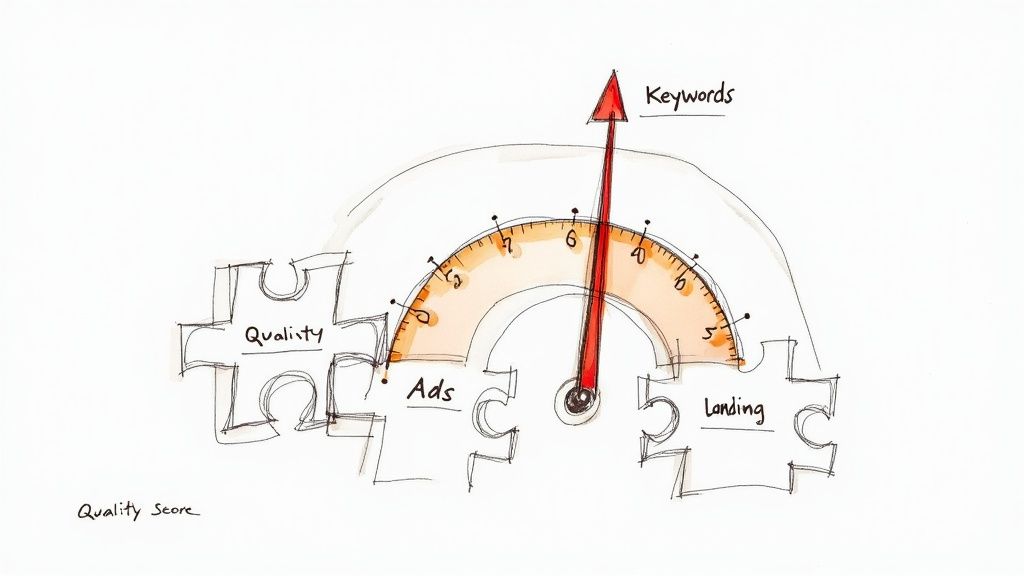
Let's call Quality Score what it is: Google's way of rewarding advertisers who aren't lazy and punishing those who are. A low Quality Score means you pay a premium for every click because Google thinks your ads are irrelevant. A high score gets you discounts and better ad positions. The choice is simple.
This strategy is about obsessively aligning every component of your campaign. It forces you to think from the user's perspective, ensuring the journey from search query to ad to landing page is a seamless, hyper-relevant experience. It's not about gaming an algorithm; it's about being genuinely useful to the searcher, which is exactly what Google wants.
Implementation Steps
Achieving a high Quality Score requires discipline. Start by creating tightly themed ad groups, often with as few as 5-20 highly related keywords. This prevents a single generic ad from serving against a wide range of queries, which is a classic cause of low relevance.
Next, ensure your ad copy and landing page are mirror images of the user's intent.
- Ad Relevance: Write compelling headlines that include your target keywords. Use ad extensions like sitelinks to provide more context.
- Landing Page Experience: The page must load fast (under 3 seconds) and continue the "scent" from the ad. The headline should echo the ad's message. A solid customer segmentation strategy helps you tailor these pages for maximum impact.
- Expected CTR: This is Google's prediction of your ad's performance. Continuously test ad variations to find what drives the highest click-through rates.
Regularly prune underperforming keywords with low scores. They are dead weight, dragging down the rest of your account. Improving Quality Score is one of the most effective ppc advertising strategies for lowering costs without just throwing more money at the problem.
5. Audience segmentation and targeting: Stop shouting into the void
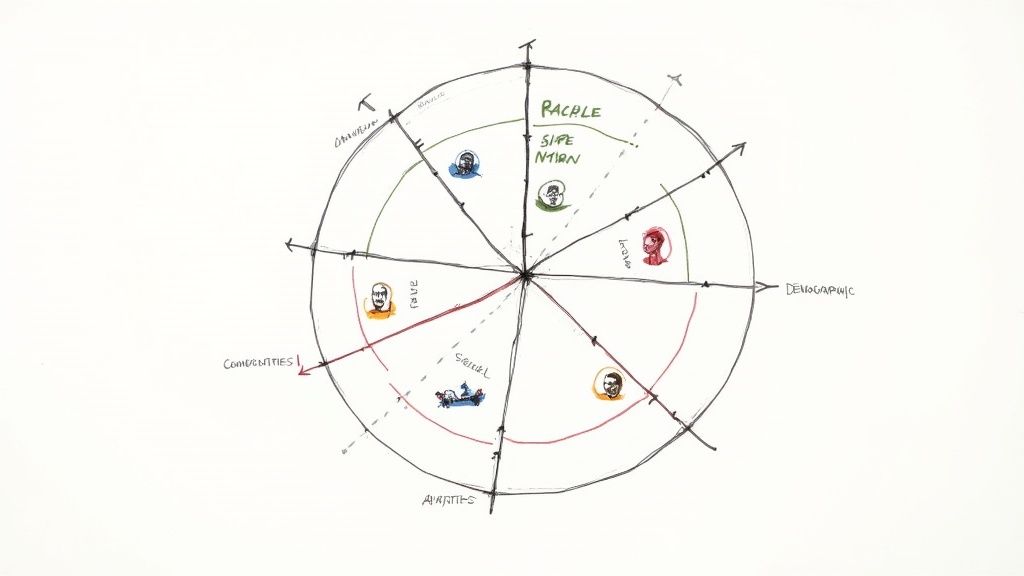
Running PPC without audience targeting is like setting up a billboard in the desert. You're spending money, sure, but you're shouting at sand. The default strategy of blasting ads at everyone who types in a keyword is a relic of the past. The real leverage in modern PPC isn't just what people search for, but who they are.
This strategy is about moving from a one-size-fits-all message to a bespoke conversation. You divide your market into hyper-specific groups based on their demographics, behaviors, and interests, then tailor your ads to them. A B2B SaaS company shouldn't show the same ad to a C-suite executive as it does to a junior analyst. One cares about ROI; the other cares about features. Ignoring this is just lazy.
Implementation steps
Getting surgical with your targeting is non-negotiable. Start by connecting your first-party data, like from your CRM, to build custom audiences. These are your warmest leads. From there, you can build powerful lookalike audiences to find new users who mirror your top converters.
Next, layer these audiences with other targeting signals for precision.
- Demographics: Target high-income brackets for luxury goods or specific job titles for B2B software.
- In-Market Audiences: Reach users actively researching products like yours right now.
- Remarketing Lists (RLSAs): Create campaigns specifically for people who have visited your site but haven't converted, offering them a unique incentive.
Finally, create separate campaigns for your highest-value segments. Give your remarketing audience a different bid and a more direct call to action than a brand-new prospect. Your goal is to make each person feel like your ad was created just for them.
6. Landing page optimization and relevance
Paying for a click and sending that traffic to your generic homepage is professional malpractice. It's the digital equivalent of inviting a VIP to a five-star restaurant and seating them in the kitchen. Your landing page isn’t just a destination; it's the entire closing argument. Failing here means everything you did before—keyword research, ad copy, bidding—was a complete waste of money.
This strategy is about creating a seamless, frictionless journey from ad click to conversion. The user clicked your ad because it promised a specific solution. Your landing page must deliver on that promise instantly and persuasively, without distractions. It’s about message match, user experience, and a laser-focused call to action.
Implementation Steps
Creating a high-converting landing page is a science. First, ensure message match is perfect: the headline on your landing page should almost mirror the headline of the ad the user just clicked. This immediately confirms they're in the right place.
Next, ruthlessly eliminate friction.
- Remove Navigation: Get rid of the main website header and footer. The only way out should be through your call-to-action (CTA).
- Single, Clear CTA: Have one primary goal and make the button for it unmissable.
- Optimize for Speed: A slow page kills conversions. Compress images and use fast hosting.
- Build Trust: Add social proof like testimonials or customer logos to build immediate credibility.
Finally, test relentlessly. Test different headlines, button colors, and copy. For those looking to streamline this, a dedicated landing page creator can significantly accelerate testing.
The ad only earns the click; the landing page earns the conversion. A high Quality Score and low CPC are impossible without a landing page that’s perfectly aligned with your ad.
7. Remarketing and retargeting campaigns: The art of the second chance
Let’s get one thing straight: most website visitors will not convert on their first visit. It’s not personal, it’s just human behavior. Ignoring these users is like having a great first date and never calling again—a massive, wasted opportunity. Remarketing is your chance to re-engage warm leads who already know who you are.
This strategy is about continuing the conversation. Someone abandoned their shopping cart? Show them an ad with the exact product they left behind, maybe with a small discount. Someone read a blog post about a specific service? Follow up with a case study ad that proves your value. You’re not shouting into the void; you’re talking to an audience that has already shown interest.
Implementation steps
Effective remarketing is about segmentation, not blasting everyone with the same ad. First, ensure your tracking pixels (like the Google Ads tag) are correctly installed to start building your audience lists.
Next, create audience segments based on user behavior. Don't be lazy here; granular is better.
- All Visitors (30 days): A broad audience for brand awareness.
- Product Page Viewers: People who showed interest in specific items. Use dynamic remarketing to show them those same products.
- Cart Abandoners: Your lowest-hanging fruit. Target them aggressively with an incentive to complete their purchase.
Finally, use frequency capping to avoid annoying your audience into oblivion. Showing the same ad 20 times a day is a fast-track to brand hatred. Aim for 5-10 impressions per user per week. Remarketing isn’t about stalking users; it’s about providing timely, relevant reminders that guide them back to conversion.
8. Campaign structure and organization: The blueprint for scalability
Let’s be honest, a messy Google Ads account is a money pit. A disorganized campaign structure is the digital equivalent of stuffing receipts into a shoebox and hoping your accountant can figure it out. It’s a guaranteed path to wasted spend, poor Quality Scores, and an inability to understand what’s actually working. Without a logical blueprint, you’re just guessing.
This strategy is about creating a deliberate, hierarchical system that mirrors your business logic. It allows you to control budgets with precision, tailor ad copy for maximum relevance, and get clean data that tells a clear story. For an e-commerce store, this might mean separating campaigns by product category. For a B2B SaaS company, it could mean organizing by solution type.
Implementation steps
A clean structure isn’t an accident; it’s engineered. Start by separating your brand campaigns (searches for your company name) from your non-brand campaigns (searches for what you sell). The intent and cost-per-click for these are wildly different and must be managed independently.
Next, build a logical hierarchy and stick to a strict naming convention.
- Campaigns: Organize by broad themes like product line, service type, or stage of the customer journey.
- Ad Groups: Group highly-related keywords together. Aim for 5-20 tightly-themed keywords per ad group to ensure your ads are hyper-relevant.
- Keywords & Ads: Write specific ads for each ad group that speak directly to those keywords.
Finally, consider creating separate campaigns for different match types. The performance of an exact match keyword is fundamentally different from a broad match one, and they deserve separate budgets. A disciplined campaign structure is your single greatest lever for control and clarity.
9. Conversion tracking and analytics: Stop flying blind
Let's get real: running PPC ads without accurate conversion tracking is like driving a race car blindfolded. You're burning fuel (your budget) and making a lot of noise, but you have no idea if you're even on the track. This isn't just a best practice; it's the non-negotiable prerequisite for any campaign that aims to be profitable. If you can't measure it, you can't improve it.
This strategy is about creating a direct link between your ad spend and your business outcomes. It’s the data-driven nervous system of your operation. You need to know precisely which keywords, ads, and campaigns are delivering actual value—a Shopify purchase, a B2B demo request, or a qualified lead. Without this data, every optimization you make is just a guess.
Implementation steps
Setting this up correctly requires meticulous attention to detail. First, deploy both Google Ads conversion tracking and Google Analytics 4 (GA4) goals simultaneously. This creates redundancy and gives you a more holistic view. The easiest way to manage this is with Google Tag Manager.
Next, define and track multiple conversion types to understand the full picture.
- Macro Conversions: The primary goal, like "Purchase" or "Demo Booked." Assign a real monetary value to these.
- Micro Conversions: Secondary actions that indicate interest, like "Add to Cart," or "Newsletter Signup."
Finally, validate your setup religiously. Use Google's Tag Assistant to confirm your tags are firing correctly and conduct test conversions every month. Consistent and accurate data is the bedrock of all successful ppc advertising strategies. You're not just tracking clicks; you're tracking business results.
10. Negative keywords and search term management
Think of your ad budget as a high-pressure water pipe. Without negative keywords, you’re letting that pipe spray water everywhere. Negative keywords are the valves that direct the water only where it can grow something valuable. Neglecting them is arguably the fastest way to waste money in PPC. It’s a non-negotiable part of the job.
This strategy is about actively telling Google what you are not. It's a process of elimination that refines your targeting with surgical precision. By regularly reviewing your Search Terms Report, you’re eavesdropping on what the market is actually typing, giving you a direct line into their real-time intent. This isn't just about blocking irrelevant terms like "free" or "jobs"; it's about sculpting your traffic to attract only the most qualified buyers.
Implementation steps
First, create a foundational negative keyword list before you launch. For a software company, this would include terms like "open source," "tutorial," and "free alternative." For a premium e-commerce brand, it means blocking "cheap" and "discount." This is your first line of defense against budget leakage.
Next, make a weekly habit of diving into your Search Terms Report. Your goal here is twofold:
- Identify New Negatives: Spot irrelevant queries wasting clicks and add them as negative keywords.
- Discover New Keywords: Uncover valuable, high-intent search terms you missed and add them to performing ad groups.
Finally, organize your negatives into shared lists within Google Ads. A "Universal Negatives" list can be applied across all campaigns, while campaign-specific lists handle more nuanced exclusions. Proactive search term management is the immune system of your PPC account.
| 10-Point PPC Strategy Comparison | |||||
|---|---|---|---|---|---|
| Strategy | Implementation Complexity | Resource Requirements | Expected Outcomes | Key Advantages | Ideal Use Cases |
| Keyword Research and Selection | Medium (ongoing research & updates) | Moderate — keyword tools and analyst time | High precision and ROI |
Targets high-intent users; reduces wasted spend | Search campaigns, e-commerce, local services |
| Ad Copy Optimization and Testing | Medium — iterative A/B testing | Moderate — copywriters and sufficient traffic | Improves CTR and conversions |
Data-driven messaging uplift; reduces ad fatigue | High-traffic campaigns, product launches, CRO-focused |
| Bid Strategy Optimization | Medium — strategic and algorithmic | Moderate–High — conversion data and bidding tools | Increases efficiency and ROI over time |
Automates bids; scales performance and control | Large accounts, ecommerce peak seasons, lead gen |
| Quality Score Improvement | High — multidisciplinary optimization | High — dev, design, content, and time | Significant CPC reduction and better ad rank |
Lower CPCs, improved visibility, better Quality Score | Accounts with high CPCs or low QS; long-term growth |
| Audience Segmentation and Targeting | Medium — setup and analysis | Moderate — customer data platform and analytics | Higher relevance and lower CPA |
Personalized messaging; reduced wasted spend | B2B targeting, lifecycle campaigns, lookalikes |
| Landing Page Optimization and Relevance | High — design, dev, and testing | High — designers, devs, CRO tools | Strong conversion uplift and QS gains |
Boosts conversions; lowers cost-per-conversion | Paid funnels, high-value offers, product pages |
| Remarketing and Retargeting Campaigns | Medium — audience setup and sequencing | Moderate — tracking pixel and creative assets | Very high conversion lift with warm audiences |
Lower CPA; higher ROAS from repeat exposures | Cart abandoners, past visitors, dynamic product ads |
| Campaign Structure and Organization | Medium — planning and maintenance | Low–Moderate — strategist time | Better control, attribution, and QS |
Easier optimization, budget control, scalability | Multi-product accounts, agencies, scaling campaigns |
| Conversion Tracking and Analytics | High — technical setup and validation | High — dev, analytics, CRM integrations | Essential for accurate ROI and bidding |
Enables attribution, smart bidding, data-driven decisions | E-commerce, lead gen, any performance-driven advertiser |
| Negative Keywords and Search Term Management | Low — regular maintenance | Low — analyst reviews and shared lists | Reduces wasted spend; improves CTR and QA |
Eliminates irrelevant clicks; improves Quality Score | Search campaigns, high-spend accounts, brand protection |
Stop tinkering. Start building a system.
Alright, we’ve covered a lot. Ten distinct, high-impact PPC advertising strategies that can genuinely move the needle for your business. From the foundational work of keyword research to the ongoing optimizations of bidding, ad copy, and landing pages. Each one is a critical lever.
But let’s be brutally honest. Reading a listicle won’t magically boost your ROAS. The gap between knowing these strategies and systematically executing them is where most businesses fail. It’s easy to get bogged down in the day-to-day, tweaking bids here, adding a negative keyword there, and feeling productive. This is the tinkerer's trap. You're busy, but are you making scalable progress?
The real unlock isn't just doing these ten things. It's building a cohesive system where they all work together. A system where your keyword insights inform your ad copy, which is perfectly aligned with your landing page, all tracked with pristine data that feeds back into your bidding algorithms. It’s a flywheel, not a checklist.
From manual effort to system architecture
As a founder, your job isn't to be the best person at manually pulling search term reports. Your job is to be the architect of a customer acquisition engine. The strategies we've discussed are the components of that engine.
- The Foundation: Your campaign structure, keyword strategy, and conversion tracking are the chassis. Without a solid, logical setup, everything is built on sand.
- The Performance Core: Your bid strategies, ad copy testing, and Quality Score improvements are the engine's pistons. They are responsible for the raw power and efficiency.
- The Intelligence Layer: Audience segmentation, remarketing, and negative keyword management represent the onboard computer. This is how you steer and avoid costly wrong turns.
Viewing your PPC efforts through this lens changes the entire game. You stop asking, "What should I do today?" and start asking, "How can I make this system smarter and more self-sufficient?"
The real leverage: Technology and mindset
You can absolutely implement every single one of these PPC advertising strategies by hand. You can spend your evenings in Google Analytics and your mornings A/B testing headlines in a spreadsheet. But that's a finite game, limited by the hours in your day. It doesn't scale.
The true competitive advantage is leveraging technology to execute these strategies relentlessly and at a scale no human could. It’s about creating a system that tests hundreds of ad variations, not just two. A system that adjusts bids in real-time based on a dozen signals. A system that automatically builds hyper-relevant landing pages for your top ad groups.
This isn't just about efficiency; it's about effectiveness. When you automate the tactical execution, you free up your strategic thinking to focus on the bigger picture: market expansion, competitive positioning, and high-level creative strategy. That is the ultimate goal. Stop being an operator in the machine and start being the architect of it. Now go build something. ✌️
Tired of manual tinkering and ready to build a truly scalable PPC system? dynares is an AI-powered platform designed to automate the most critical and time-consuming PPC advertising strategies, from ad creation to landing page generation. See how you can build a more intelligent, efficient growth engine by visiting dynares.


