
Let's get one thing straight: automated content creation is not about firing your creative team and letting robots write soulless copy. That’s a dumb way to think about it.
The reality is far more powerful—it’s about giving your best people superpowers to operate at a scale that was previously impossible.
What automated content creation really is
Forget the generic AI article spinners you’ve seen. I’m not talking about tools that churn out mediocre blog posts that read like they’ve been translated five times.
Real automated content creation, especially in the world of paid search, is a strategic system. It’s about generating thousands of hyper-relevant, on-brand assets in seconds.
Imagine this: for every single keyword in your Google Ads campaign, you have a perfectly matched ad, a corresponding landing page, and a tailored form. Not just a handful of variations, but thousands. Each one is designed to speak directly to a user's specific search intent. That’s the game we’re playing now.
This isn't just a marginal improvement; it’s a fundamental shift in how we approach performance marketing. We're moving from a world of manual, tedious campaign builds to an era of precision and scale. It’s less about brute-force effort and more about smart, system-driven execution.
From manual grind to strategic advantage
For years, PPC managers have been stuck in a painful loop. You identify a set of keywords, then you or your team manually write ad copy, build a generic landing page, and hope for the best.
If you wanted to get granular, you’d create a few dozen variations, but it was always a trade-off between precision and sanity. There just aren’t enough hours in the day to do it properly by hand. This old way is broken.
The true value of this technology isn't just speed; it's the ability to achieve a level of message-matching that directly impacts your bottom line. Better relevance leads to higher Quality Scores, which means lower CPCs and, ultimately, a better return on your ad spend.
This shift allows ambitious teams to stop focusing on the mind-numbing task of copying and pasting text and start focusing on what actually moves the needle: strategy, analysis, and growth. You can explore a broader range of keywords and test more hypotheses without drowning in operational work.
For those interested, you can read more about how this connects to the broader world of automated content marketing in our other guides.
So, what does this look like in practice? It involves:
- Systematizing brand guidelines: You teach the machine your brand’s voice, tone, and rules once, ensuring everything it creates is consistent.
- Leveraging dynamic templates: Instead of building pages from scratch, you create smart, reusable components that can be assembled in infinite combinations.
- Connecting data to creation: The system uses keyword data to dynamically inject the right terms into ads and landing pages, ensuring perfect alignment.
This approach gives small, agile teams the power to compete with massive corporations by being smarter and faster, not by outspending them. It’s about working smarter, not harder. 🤘
How it works for paid search campaigns
Alright, let's get into the nuts and bolts. This is where automated content creation stops being a concept and starts making you money, especially if you live and breathe paid search like I do.
The process is surprisingly straightforward but incredibly powerful. It’s not magic; it’s just smart technology doing the heavy lifting.
You start by feeding the system the core ingredients: your keyword lists, your brand guidelines (colors, fonts, logo usage, tone of voice), and a clear picture of your target audience. Think of it as giving the AI its strategic brief.
From there, the platform gets to work. It pulls from public data to get a feel for your industry's language and your brand’s unique voice, making sure the content it creates doesn't sound generic. Then, almost instantly, it generates thousands of coordinated ads and landing pages, all perfectly synced up.
The power of perfect alignment
Think about the traditional PPC workflow for a minute. You build a handful of ads and point them all to one, maybe two, landing pages. It’s always a compromise.
You can’t possibly build a unique landing page for every single keyword—it would take months of dev time. So you settle for good enough.
That compromise is exactly where you lose money. A user searching for emergency plumbing services has a completely different intent than someone searching for bathroom renovation cost. Sending them both to the same generic plumbing homepage is lazy and, frankly, ineffective.
Automated content creation fixes this fundamental problem. It ensures every ad is perfectly matched to its landing page, right down to the specific keyword. This one-to-one alignment has a massive impact on your Google Ads Quality Score. Google sees this level of relevance and rewards you by lowering your cost-per-click (CPC). Your ad budget suddenly goes a lot further.
If you want to dig deeper into escaping this manual grind, check out our guide on moving from spreadsheet hell to automated PPC funnels with AI.
The diagram below shows this modern workflow in action, moving from basic human inputs to AI-powered execution and strategic publishing.
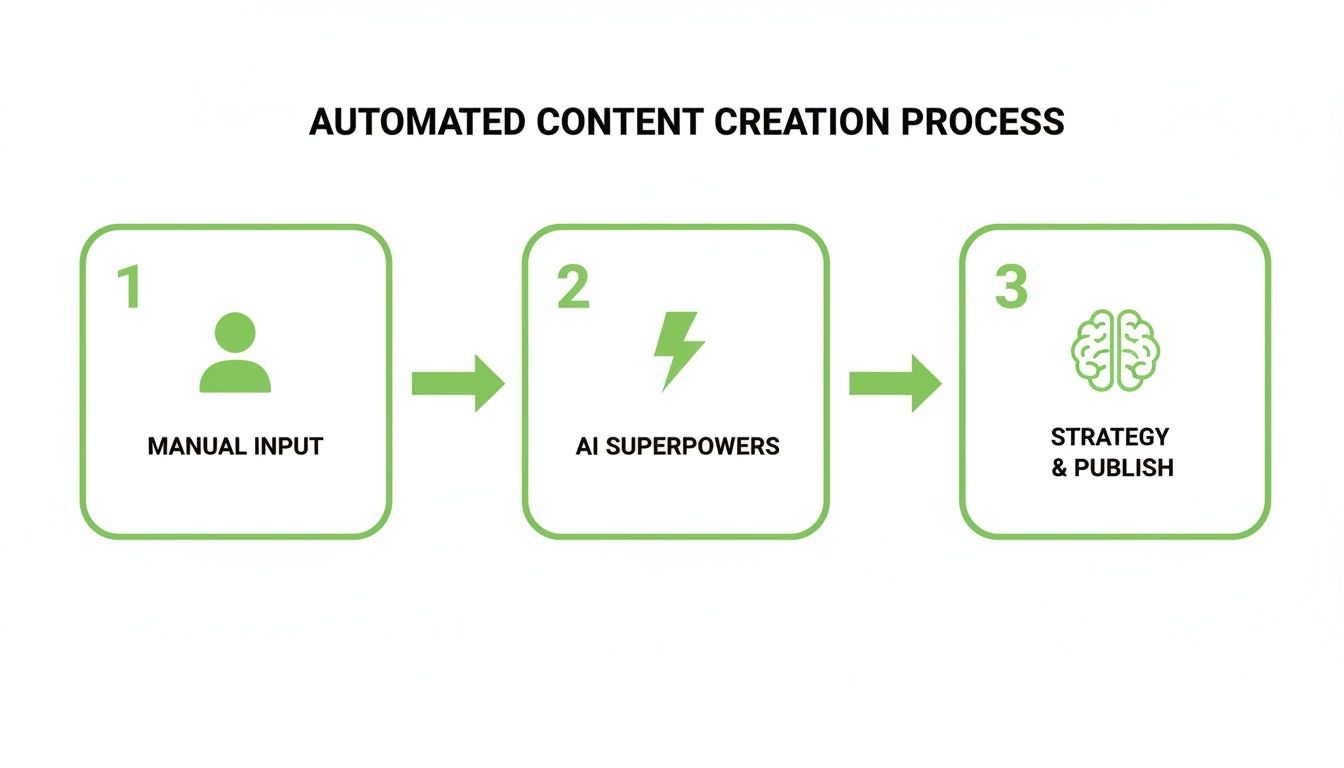
This process isn't about replacing humans. It's about taking human strategy and using machine efficiency as a force multiplier to execute it at a scale that was previously impossible.
Beyond copy and paste at scale
This isn't just about speed; it’s about intelligence. The explosive growth of AI in marketing is undeniable, with the global market for AI-powered content creation projected to hit $10.59 billion by 2033.
In major markets like the US and Europe, 80% of marketers already use AI for content creation. They're not just playing with new toys; they report significant weekly work hour savings and productivity boosts of up to 40%.
The real breakthrough is using AI not just to write, but to build. The system doesn’t just generate text; it assembles entire campaign funnels—ads, landing pages, and forms—that are pre-wired for tracking and analytics from the start.
To get the best results, especially with more advanced systems, you need to get good at prompt engineering. It's the difference between giving vague instructions and giving the AI a precise blueprint to follow.
This is how you move from generating generic, fluffy content to producing high-intent assets that actually convert. For any team serious about getting a real return on their ad spend, it’s a total game-changer. 🚀
The payoff is huge, but so are the risks
Let's be real: when you get automated content creation right, the upside is massive. We're talking about a level of scale and operational speed that was pure fantasy just a few years back. This isn't a small step up; it's a complete change in how you run paid search.
The most obvious win is just raw efficiency. Forget spending weeks grinding out campaign builds by hand. With a smart system, you can spin up thousands of perfectly coordinated ads and landing pages in the time it takes to grab a coffee. This frees up your best people from soul-crushing production work so they can focus on strategy and analysis—the stuff that actually drives growth.
But it goes way beyond just speed. You unlock a degree of personalization that's flat-out impossible to do manually. When you can tailor your message for every single high-intent keyword, you're meeting customers with the exact language they just typed into Google. This isn't some fluffy nice-to-have; it directly wires your campaigns for better performance.
The upside is huge (and measurable)
When this clicks, the results show up in your P&L, not just in some vanity dashboard. We're talking about tangible business outcomes that make the finance team take notice.
Better message match between your ad and landing page is a direct input for higher Quality Scores in Google Ads. And a better Quality Score isn't just a number; it's Google’s algorithm rewarding your relevance by giving you a discount on your cost-per-click (CPC). Your budget suddenly goes further, and your campaigns get more profitable overnight.
This relevance creates a domino effect right down the funnel. It leads to higher click-through rates, increased conversion rates, and a massive improvement in your return on ad spend (ROAS). You’re not just spending less; you’re earning more from every single dollar you invest.
The bottom line is this: smart automation allows smaller, hungrier teams to achieve a level of operational excellence that used to be reserved for giant companies with bottomless budgets. It’s a true force multiplier.
The real-world risks of doing it badly
Now for the reality check. This isn't a magic button. If you jump in with the wrong tools or a set it and forget it mindset, you can do more harm than good. There are real dangers if you just chase the hype without thinking.
The biggest risk? Creating a sea of generic, soulless content. We’ve all seen it—AI-generated copy that feels hollow and completely misses the point. Using a dumb tool that just spins text without understanding intent or brand voice is a fast track to alienating your audience.
People are smart. They can spot inauthentic, robotic content a mile away, and it’s a major turn-off. Over-relying on bad automation can make your brand feel impersonal and untrustworthy, completely torpedoing your marketing efforts.
This is where the human element is still absolutely essential. Your brand's voice is one of your most important assets, and any automation platform you use must be able to learn and perfectly replicate it. Automation should handle the scale, but the strategy and creative spark must remain human-led.
Choosing the right platform is everything. Dumb tools just generate text. Smart platforms build entire, coherent funnels that respect your brand and your customers' intelligence. Making the right choice is the difference between scaling excellence and scaling mediocrity. Choose wisely. 🚀
How to implement this without disrupting your workflow
Alright, let’s get practical. Adopting new tech can feel like a massive headache, especially when your team is already running at full speed. The last thing you need is a tool that requires a three-month integration project and a team of developers. That’s just not how modern businesses operate.
The whole point of automated content creation is to make your life easier, not more complicated. The good news is that the best platforms are built for exactly that. It's about a seamless transition that starts showing value fast, without derailing your entire operation.
Think of it less like ripping out your current workflow and more like slotting in a powerful new engine.
Start with the low-hanging fruit
The quickest way to get started is by tackling the fundamentals. This is where you lay the groundwork for the system to do its magic. Don't overthink it; just focus on giving the machine the right instructions so it can start generating on-brand assets right away.
Your first moves are simple and straightforward:
- Connect your accounts: Hook up your Google Ads account to the platform. This lets the system pull in your existing campaigns, ad groups, and keyword lists.
- Set up your brand guidelines: This is non-negotiable. Upload your logos, define your color palette, set your fonts, and provide examples of your brand's voice. This one-time setup ensures everything the AI creates feels like it came from your team.
- Create your first templates: Forget building pages from scratch. Instead, design a few core, reusable templates. Think of these as modular blueprints the AI can then populate with tailored content.
This initial setup shouldn't take more than an afternoon. Once it's done, you've essentially automated the most tedious parts of campaign creation forever. You've taught the machine the rules, and now it’s ready to play.
Let the system do the heavy lifting
Now that the foundation is in place, you can start using the features that truly change the game for PPC teams. This is where you move from simple setup to intelligent optimization.
The time and cost savings from this kind of smart integration are transforming how marketing teams work. Studies show that employees can save over two hours per week, with some organizations reporting 40% productivity gains overall. For performance marketers, this means tasks get done 55% faster at 40% lower costs.
The real power isn't just in creating assets faster; it's in letting the system test and optimize them for you. This closes the loop between creation and performance, ensuring your campaigns are always improving without constant manual intervention.
For instance, you can use smart keyword grouping to automatically bundle related search terms. This ensures a user searching for emergency roof repair gets a different landing page than someone searching for new roof cost estimate. The system handles this granularity for you.
Then, you can turn on features like automatic A/B testing. The platform will continuously generate and test new headlines, copy variations, and calls-to-action, automatically pushing traffic to the winning versions. Your campaigns get smarter and more profitable while you sleep.
This is about making a strategic choice to focus on results, not on repetitive tasks. For anyone looking to level up their toolkit, our guide on the best AI tools for digital marketing can point you in the right direction.
This is how you implement automated content creation without causing chaos. You start small, systematize your brand, and then gradually hand over the repetitive optimization tasks to the machine. It’s a smooth, logical process that delivers value at every step.
Measuring what matters to prove your ROI
Let's get straight to the point. Chasing vanity metrics like clicks or impressions is for amateurs. If you’re serious about building a business, the only thing that actually counts is the impact on your bottom line.
When you bring automated content creation into your paid search workflow, you have to prove its worth with real business results. This isn't about looking busy; it's about making every dollar you spend work harder for you.
We need to move past simply counting leads. A thousand low-quality form fills are worthless if none of them turn into paying customers. The real goal here is revenue optimization, and the best platforms are built for exactly that.
Connecting automation to your bank account
The game-changer is the ability to connect your marketing efforts directly to actual revenue. Modern automation tools don't just generate landing pages; they can pass conversion values straight back into your Google Ads account.
This is a massive deal. It means you stop optimizing for vague leads and start telling Google's algorithm to find you more high-value customers. You’re no longer just guessing which keywords drive profit; you have the data to prove it.
This shift in focus moves the conversation from marketing expenses to marketing investments. When you can draw a direct line from your automated campaigns to revenue growth, you've won.
The KPIs that actually matter
Forget the fluff. When you implement a smart automation strategy, there are a few key metrics you need to obsess over. They tell the complete story of your performance, from the initial click to the final sale.
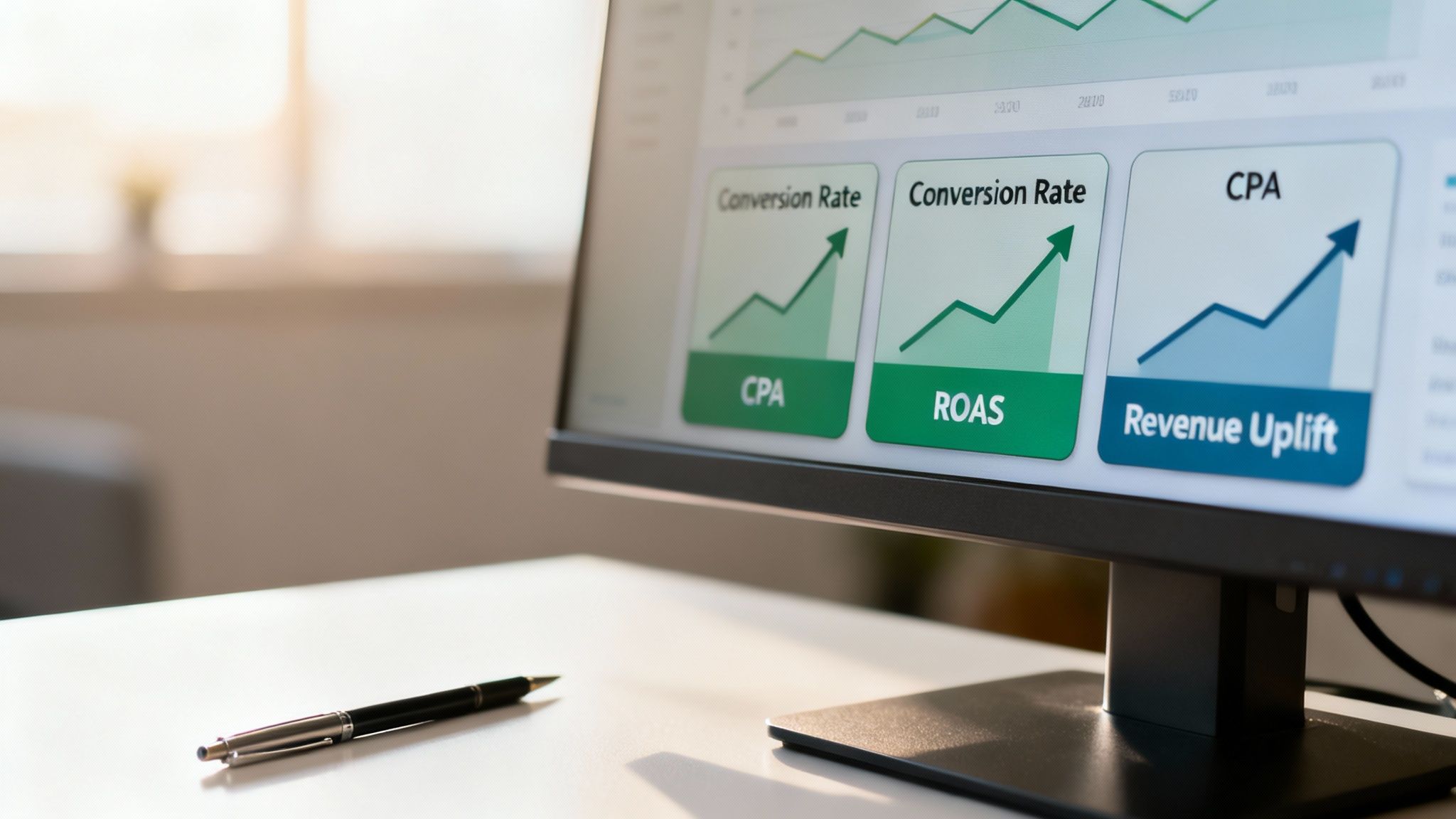
- Conversion rate: With hyper-relevant ads and landing pages, you should see a significant lift here because you’re removing friction.
- Cost per acquisition (CPA): As your Quality Scores go up and your CPCs come down, your cost to acquire a customer should drop.
- Return on ad spend (ROAS): This is the ultimate proof of profitability. By lowering your CPA and increasing conversion value, your ROAS will climb. This is the number your finance team really cares about.
- Overall revenue uplift: At the end of the day, this is what it's all about. Are you generating more actual revenue than you were before?
The goal isn’t just to get better at marketing; it's to build a more profitable business. These KPIs are your compass, telling you if you’re heading in the right direction. If you need a refresher, we've covered how to calculate ROAS the right way in another guide.
The effectiveness of AI in driving these outcomes is becoming clearer every day. In fact, over 17% of top-ranking content on Google is now AI-generated, proving it can deliver relevance without penalty. This is crucial for PPC managers using AI to build keyword-specific pages that boost Quality Scores and drive conversions. Users are reporting 55% faster task completion and 40% cost reductions, which directly feed into a better ROAS.
Having the right data is everything. It's how you prove what you’re doing is working and make the case for doing more of it. 📈
The future is automated but still human
As a European entrepreneur building tech products, I'm incredibly optimistic about where things are heading. So let's get one thing straight: this wave of automated content creation isn't about replacing talented marketers with robots. That’s a fundamentally dumb and short-sighted way to see it.
The real point is augmentation, not replacement. It’s about building tools that handle the repetitive, mind-numbing, and scalable tasks that machines are exceptionally good at. This frees up human talent to focus on what we do best: strategy, creative thinking, empathy, and building genuine customer relationships.
Augmentation over automation
The future isn't a choice between a machine and a person; it's about creating a powerful partnership between the two. The machine can generate thousands of keyword-aligned landing pages in minutes, a task that would crush a human team. But the human sets the brand voice, defines the strategy, and interprets the results to make smarter decisions next quarter.
This technology will continue to become more accessible, giving smaller, more agile businesses the power to compete on a level playing field with massive corporations. It’s a democratization of powerful marketing tools.
The goal isn't just to create more noise. It's to use automation to deliver more relevant, helpful, and timely messages that build better connections with customers, not just bombard them with generic content.
Keeping the human in the loop
As these tools evolve, the importance of human oversight will only grow. A machine can follow instructions perfectly, but it can't tell you if those instructions are leading you in the right strategic direction. That’s our job.
The future of marketing isn't about choosing between the efficiency of automation and the creativity of humanity. It's about combining the very best of both. The companies that figure this out are the ones that are going to win. 🚀
Got questions? let's get real
Let's clear up a few common questions I hear all the time about automated content creation. This is the part where I give you the straight answers so you can move forward with confidence. No sugarcoating, just the facts.
Will automated content get my site penalized by Google?
No, and this is a fear we need to put to rest.
Google doesn’t care how you create your content; it cares if your content is high-quality, relevant, and helpful to the user. That’s it.
For paid search, where you're matching a landing page to a very specific keyword, AI-generated content often performs better than a generic manual page because its relevance is dialed up to 11. High-quality, relevant content that serves user intent performs well, period.
The penalty myth comes from the old days of spammy, low-quality article spinners. Modern automated content creation for performance marketing is a completely different game. It’s about precision and relevance, not spam.
Is this only for large enterprises with big budgets?
Not anymore. It’s true that this kind of tech started out in the enterprise world, accessible only to companies with massive budgets and dev teams. But that’s changing fast, and honestly, it’s about time.
Modern platforms are making this technology affordable and accessible for ambitious startups and mid-sized businesses. The goal is to level the playing field, allowing smaller, more agile teams to compete on performance and efficiency, not just on the size of their bank account.
Does this replace my marketing team?
Absolutely not. Anyone who tells you that is either trying to sell you snake oil or doesn't understand marketing. It doesn't replace your team; it supercharges them.
Think about it this way: what is the most valuable use of your top marketer's time? Is it manually copying and pasting headlines into hundreds of ad variations, or is it developing the overarching campaign strategy?
This technology automates the repetitive, low-value grunt work. It liberates your team from the spreadsheet hell of manual campaign builds so they can focus on what really matters: high-level strategy, deep creative direction, and insightful performance analysis.
It’s about making your best people more powerful, not redundant. It’s a tool that lets them focus on being strategists and creatives instead of production line workers. 🚀
Ready to see how dynares can multiply your team's impact without the manual grind? Generate thousands of high-intent ads and landing pages, optimize for revenue, and prove your ROI. Get started with dynares today.


