
Let's get straight to it. Paid search marketing is paying to put your website at the top of Google, right when someone is looking for exactly what you sell.
Think of it as renting a billboard on the busiest digital highway in the world. But you only pay when a potential customer drives by, rolls down their window, and yells, "I need to buy that thing you sell, right now!"
So, what is paid search marketing exactly?
This isn't about vague brand-building that might pay off in a few years. It’s a direct line to people with high intent at the exact moment they need a solution. It's the go-to channel for founders who need to generate leads and sales, fast. If you're building a business, you need a predictable way to get in front of people ready to pull out their credit card. Paid search delivers exactly that.
The whole system is built on a simple but powerful idea: a real-time auction for customer attention. Understanding this auction is the first step to mastering a channel that can completely change your growth trajectory.
The auction for attention
Every time you search on Google, a lightning-fast auction happens behind the scenes. Advertisers bid on keywords—the specific phrases people type—to earn a spot at the top of the search results page.
But here’s the crucial part: it’s not just about who pays the most. That would be a terrible system, rewarding the richest advertisers, not the most relevant ones.
Instead, Google rewards advertisers who provide the best experience for the user. This is where most beginners get it wrong. They think it's all about budget, but it's really a game of relevance and quality. The core components are pretty simple:
- Your bid: This is how much you're willing to pay for a single click on your ad.
- Your ad quality: Google’s score of how relevant your ad and landing page are to the searcher's query. A higher score means you can actually pay less for better positions.
- User intent: The ultimate goal is to perfectly match your solution to the user's problem.
This auction model has been the engine of online advertising since the early 2000s when Google launched AdWords. It shifted the industry from fixed-fee listings to the pay-per-click (PPC) model we know today, charging advertisers only when someone actually clicked their ad. It was a massive innovation.
Today, with Google controlling around 89.62% of the global search market, it’s the default performance channel for almost every serious business on the planet. If you're into the numbers, you can explore more digital marketing stats on SEOPROFY.
Paid search vs organic search at a glance
So you've got paid search (PPC) and organic search (SEO). Both get you on Google, but they work in completely different ways. One is like buying a front-row ticket to a concert; the other is like earning it by becoming the most popular band in town.
Here’s a quick, no-nonsense comparison of the two main ways to get traffic from search engines, highlighting the fundamental differences in cost, speed, and placement.
| Attribute | Paid Search (PPC) | Organic Search (SEO) |
|---|---|---|
| Placement | Top of the page, above organic results. Usually marked with "Ad" or "Sponsored." | Below the paid ads. Placement is earned based on relevance and authority. |
| Cost | You pay every time someone clicks on your ad (pay-per-click). | The clicks are "free," but you invest in content, technical fixes, and link-building. |
| Speed | Almost immediate. You can start getting traffic within minutes of launching a campaign. | It's a long game. It can take months or even years to rank for competitive terms. |
| Control | High. You have direct control over ad copy, landing pages, bids, and targeting. | Indirect. You can influence rankings, but Google's algorithm has the final say. |
| Longevity | Short-term. The moment you stop paying, your ads and traffic disappear completely. | Long-term. Once you rank, you can get consistent traffic for a long time with maintenance. |
At the end of the day, they aren't enemies—they're two sides of the same coin. The smartest marketers use them together. Paid search gives you instant data and traffic you can use to inform your long-term SEO strategy, while strong SEO builds a sustainable foundation that reduces your reliance on ad spend over time.
How the paid search auction really works
Ever wondered why certain ads snag that top spot? It’s not some dark magic. The entire paid search system runs on a lightning-fast, real-time auction every single time someone hits ‘enter’ on a search.
But here's the kicker, and where most people get it wrong: the highest bidder doesn't always win.
Let's get one thing straight: just throwing more money at Google is a lazy, expensive strategy. To win consistently, you have to understand the game you’re playing. It's not a simple auction; it's a weighted auction where relevance is king.
The infographic below breaks down the basic hierarchy. Paid search exists to capture customer attention, and it does that through this real-time auction model.
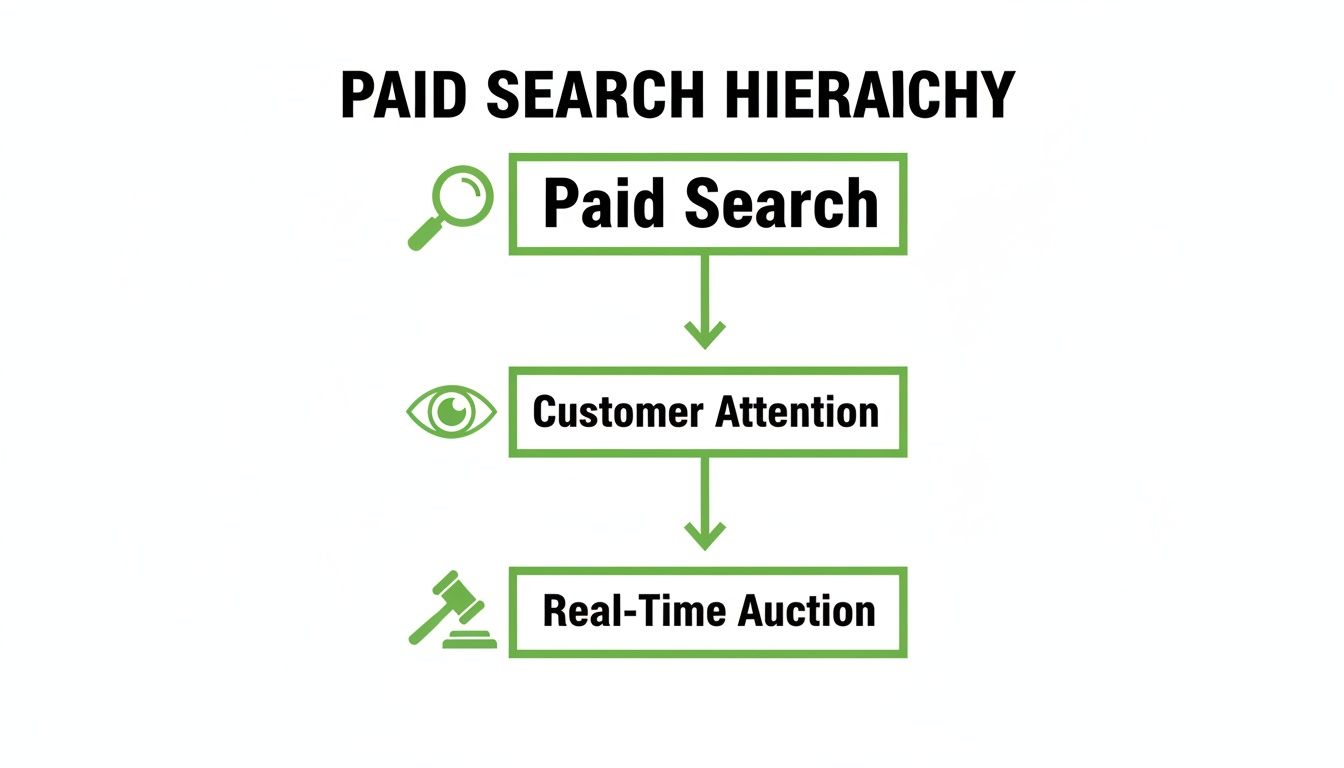
The whole system is designed to connect a user's search query with the most relevant advertiser in a dynamic, competitive environment.
Bids, keywords, and match types
The foundation of any campaign starts with keywords. These are the search terms you're willing to pay for. If you sell project management software, you're bidding on terms like "best PM tool for startups" or "Trello alternative." This is your buy-in to the auction.
Your bid, or maximum cost per click (Max CPC), is the most you're willing to pay for a single click. But you also need to tell Google how it should match your keywords to user searches. This is where match types come in. They are a balancing act between reach and relevance. Starting too broad is a classic rookie mistake that just sets your cash on fire.
Your secret weapon: Quality score
So, if it’s not just about the highest bid, what else matters? The answer is Quality Score.
This is Google’s rating, from 1 to 10, of the overall quality and relevance of your ads, keywords, and landing pages. Think of it as your reputation score within the auction. A high Quality Score is your secret weapon.
It’s Google’s way of rewarding advertisers who provide a great experience for its users. A high score means you get better ad positions for less money. A low score means you'll overpay for worse positions, or you might not show up at all.
Your Ad Rank, which determines your position on the page, is calculated by a simple formula: Max CPC Bid x Quality Score. This is exactly why a competitor with a lower bid but a higher Quality Score can outrank you. They're playing the game smarter, not richer.
Google is a business, and its business is providing the best answers. If your ad is super relevant and your landing page delivers exactly what the user was looking for, Google is happy. That user will trust Google more and keep coming back. By rewarding you with a higher Quality Score, Google aligns its interests with yours.
Getting this right isn't just a best practice; it's the core of running profitable campaigns. We actually dive deeper into this critical metric in our guide on what Google Quality Score really cares about, cutting through the usual nonsense.
Ultimately, understanding these mechanics is fundamental. Paid search isn't about outspending your rivals; it's about out-thinking them by focusing on relevance and user experience. Get that right, and you'll build a scalable, profitable customer acquisition machine.
Focus on metrics that actually matter
Ad platforms are designed to drown you in data. Seriously, it's overwhelming. But here’s a hard truth: most of it is just noise. As a founder, you don’t have time for vanity metrics that make you feel good but don’t pay the bills.
Let's cut through the fluff and focus on the numbers that directly impact your profit and loss.
Sure, the basics are important. You need to know your Click-Through Rate (CTR)—the percentage of people who see your ad and actually click it—and your Cost Per Click (CPC). These are your entry-level diagnostics. But stopping there is like a doctor only checking your temperature and ignoring your blood pressure.
They tell you if your ads are interesting and affordable, but they say nothing about whether you're actually making money. That's where the real game is played.
The metrics that move the needle
To really understand if your paid search efforts are working, you need to graduate to business-level metrics. These are the numbers I live and die by because they tell me if my investment is paying off.
- Cost per acquisition (CPA): This is the total cost you pay to get one new customer. You calculate it by dividing your total ad spend by the number of new customers (or conversions). If you spend €1,000 on ads and get 10 new customers, your CPA is €100. This number tells you if your customer acquisition is sustainable.
- Return on ad spend (ROAS): This is the holy grail. For every euro you put into ads, how many euros in revenue do you get back? If you spend €1,000 and generate €5,000 in revenue, your ROAS is 5x. This metric is the ultimate proof that your advertising is a profit center, not a cost center.
Everything else is secondary. Impressions? Who cares. Clicks? Useless without conversions. CPA and ROAS are what separate a professional growth strategy from a hobbyist burning cash.
Why quality score is your efficiency lever
Now, let's circle back to Quality Score. We touched on it before, but it's so critical it deserves its own spotlight. Why? Because it’s the single most powerful lever you have to improve both your CPA and ROAS.
A high Quality Score lowers your CPC, which directly lowers your CPA.
A better ad experience for the user means Google rewards you with cheaper clicks. It's that simple. By improving your ad relevance and landing page experience, you make your entire paid search machine more efficient. You spend less to acquire each customer, which instantly boosts your ROAS.
Ignoring Quality Score is like trying to drive a car with the handbrake on. You'll move forward, but you'll be burning fuel and fighting resistance the entire way. Focus on it relentlessly.
Setting realistic benchmarks
It’s also important to ground your expectations in reality. Knowing industry averages helps you understand if you’re on the right track or if something is seriously broken. For example, the average Google Ads click-through rate often falls in the 3–6% range, while typical conversion rates are around 2.5–3%.
Any tool or strategy that can lift your conversion rate from, say, 2.5% to 3.5% can improve your ROAS by more than 40%. You can check out more paid vs. organic search statistics to get a clearer picture of the landscape.
Of course, none of this matters if you can't measure it accurately. Properly setting up conversion tracking is non-negotiable. Without it, you're flying blind, making decisions based on feelings instead of facts.
If you're unsure about the technical side, take the time to learn. Our guide on Google Ads conversion tracking setup is a good place to start.
Ultimately, paid search is a game of numbers. But it's about focusing on the right numbers—the ones that tell you if you're building a profitable business, not just a busy one.
Winning or losing on the landing page
Getting the click is only half the battle. This is where so many founders screw up, and it drives me crazy. They spend a fortune on beautifully crafted ads, win the auction, and then dump that expensive, high-intent traffic onto their generic homepage.
It's a complete waste of money. I’m not exaggerating. Your landing page has one job, and one job only: convert the click into a customer. This is the post-click experience, and it's where you either make money or burn it.

This simple concept separates the amateurs from the pros in paid search. You can have the best keywords and the highest bids, but if your landing page doesn't deliver, your entire campaign will fail. It’s the final, critical link in the chain.
The power of message match
The single most important principle here is message match. It’s incredibly simple but profoundly powerful. It means the promise you make in your ad is delivered instantly and obviously on the page the user lands on.
If your ad says "50% Off Blue Running Shoes," the landing page better have a giant headline that screams "50% Off Blue Running Shoes." It shouldn't be a page with all shoes, or a generic sale page. It needs to be specific.
When a user clicks your ad, they have a specific question or need in mind. Your landing page must immediately confirm they are in the right place. Any disconnect, any confusion, and they'll hit the back button without a second thought—and you just paid for that click.
This seamless transition is crucial for two reasons. First, it reassures the user and guides them smoothly toward conversion. Second, Google's algorithm loves it. A strong message match is a huge component of a high Quality Score because it signals a great landing page experience.
Essentials of a high-converting page
Building a landing page that converts isn't about flashy design or clever tricks. It's about clarity, focus, and psychology. A great page removes all friction and makes it incredibly easy for the user to say yes.
Here are the non-negotiable elements you need to nail down:
- A crystal-clear headline: This is the first thing people read. It must grab their attention and instantly confirm they are in the right place by matching the ad's message.
- Compelling and scannable copy: Nobody reads long blocks of text. Use short paragraphs, bullet points, and bold text to explain the benefits of your offer and why it solves the user's problem.
- Strong social proof: People trust other people. Use testimonials, case studies, customer logos, or review ratings to build credibility and reduce anxiety.
- A single, obvious call-to-action (CTA): This is the most critical part. Your page should have one goal—get a form fill, a purchase, a download—and your CTA button should be impossible to miss. Don't give users too many options; guide them to the one action you want them to take.
Creating a unique, hyper-relevant landing page for each ad group isn't just a best practice; it's the difference between a 1% and a 10% conversion rate. This is where you turn clicks into cash. For a deeper dive into this topic, you can review our guide on landing page design best practices for more actionable tips.
Expensive mistakes every founder makes
Look, we've all been there. Paid search can feel like a money pit if you don’t know what you’re doing. I’ve burned more cash than I’d like to admit learning these lessons, so let me save you the trouble. This isn't some theoretical list; it's a field guide to screw-ups.
This is about avoiding the dumb mistakes that drain your bank account with nothing to show for it. If you can sidestep these common traps, you’re already ahead of 90% of the competition. Let’s get into it.
The broad match budget bonfire
The most classic rookie error is leaning too heavily on Broad Match keywords. It seems easy—just give Google a keyword, and it will find related searches for you. In reality, you’re giving the algorithm a blank check to spend your money on completely irrelevant traffic. It's the fastest way to set your budget on fire. 🔥
I once saw a SaaS company selling "project management software" using broad match. They were paying for clicks from people searching for "construction project management" and "home renovation projects." Total waste.
The fix is simple: start with Phrase and Exact Match to be specific. You want to target the precise terms your ideal customers are actually typing into the search bar. This gives you control and ensures your ads are only shown to a relevant audience. Use Broad Match strategically, if at all, in a separate, low-budget campaign purely for keyword discovery.
Ignoring your negative keyword list
This one is the silent killer of profitability. A negative keyword list tells Google which search terms you don't want your ads to show for. Not using one is like leaving the back door of your shop wide open for people who have no intention of buying anything.
Think about it: if you sell premium "running shoes," you absolutely want to add negative keywords like "free," "cheap," and "used." Otherwise, you're just paying for clicks from bargain hunters who will never buy your high-end product.
Ignoring negative keywords isn’t just a small oversight; it’s financial negligence. Regularly review your search terms report and add irrelevant queries to your negative list. This is a five-minute task that can literally save you thousands.
Broken or nonexistent conversion tracking
This is the most painful mistake of all because it makes every other effort pointless. If you aren't accurately tracking conversions—whether that's a sale, a form submission, or a phone call—you are flying completely blind. You have no idea which keywords, ads, or campaigns are actually making you money.
You end up making decisions based on gut feelings and vanity metrics like clicks, which is a terrible way to run a business. You might pause a high-performing campaign because its CPC looks high, without realizing it's the one driving all your best customers.
You absolutely must have conversion tracking set up correctly from day one. It is non-negotiable. It’s the only way to know what’s working, calculate your ROAS, and make intelligent, data-driven decisions to scale your business. Anything less is just gambling.
How AI is changing the paid search game
Let’s be honest for a second. Trying to manage paid search manually, especially once you start to scale, is becoming a losing battle. You just can’t compete with the algorithms and the sheer volume of data.
It’s like trying to win a Formula 1 race on a bicycle. You can pedal as hard as you want, but you’re going to get lapped.
This is where AI-powered platforms are stepping in. As someone building in this space, I can tell you exactly where this is headed: the game is shifting from managing campaigns to managing the systems that manage campaigns.
The end of manual campaign building
The biggest bottleneck in paid search has always been creating relevance at scale. Manually building a unique, high-converting landing page and ad copy for every single keyword is an impossible task for any sane human.
For an AI, it’s trivial.
Imagine a system that writes the ad copy, builds the landing page, and A/B tests everything—running thousands of micro-experiments in real-time to find the winning combination.
This isn’t science fiction; it’s what’s happening right now. AI is finally solving the relevance problem by automating the creation of the entire post-click experience. This allows lean teams to hit a level of performance that used to be reserved for massive companies with huge marketing departments.
The future of paid search isn’t about being a better campaign manager. It’s about using tools that can execute a perfect strategy, thousands of times a day, without getting tired or making human errors. It's about letting the machine handle the tactics so you can focus on strategy.
Achieving hyper-relevance at scale
The core principle of paid search hasn’t changed: the more relevant your ad and landing page are to the user’s query, the better your results. A higher Quality Score, lower CPC, and a better conversion rate all stem from relevance.
AI just lets you achieve this at a scale that was unimaginable a few years ago.
For a long time, the standard approach was to group similar keywords into ad groups and point them all to the same generic landing page. It was a compromise—a necessary evil because doing anything more granular was just too time-consuming. But that compromise leaves a lot of money on the table.
AI completely breaks that limitation. It allows for a one-to-one relationship between a keyword and its landing page. This is the holy grail of paid search.
Someone searches for "CRM for small real estate agencies"? They get a landing page with testimonials from real estate agents and copy that speaks their language. Someone else searches for "best CRM for solo consultants"? They get a different page highlighting features for freelancers and individual pricing plans.
This level of personalization was once a pipe dream. Today, it’s becoming the new standard. If you're still doing things the old way, you’re going to get left behind. There are plenty of excellent Google Ads optimization tools out there that are already making this a reality.
The bottom line is this: AI isn't here to replace marketers. It's here to augment them. It takes over the tedious, repetitive work and frees up human creativity for high-level strategy, brand, and customer insights.
Embrace it, or get ready to compete with those who do. It’s that simple.
Frequently asked questions about paid search
Alright, let's wrap this up with a quick-fire round. I get asked these questions all the time about paid search marketing, so here are my straight, no-fluff answers to help you get started or just get unstuck.
How much should I budget for paid search?
There’s no magic number. Anyone who tells you otherwise is selling something. Don't ask "what's the right budget?" Instead, ask "what can I afford to test and learn with?"
Start small, maybe €500-€1000 a month. The goal isn't to spend money; it's to find a profitable formula.
Once you achieve a positive Return on Ad Spend (ROAS)—for example, for every €1 you spend, you get €3 back—your budget is no longer a cost. It becomes an investment you can scale aggressively.
How long does it take to see PPC results?
The speed of paid search is one of its biggest advantages. Unlike SEO, which can take months to show any signs of life, you can get traffic and clicks within hours of launching your first campaign. It's almost instant gratification.
However, seeing initial data is completely different from achieving profitability. Expect it to take a few weeks or even a couple of months to gather enough data to properly optimize your campaigns.
You need that time to refine your keywords, improve your Quality Scores, and dial in your landing pages to reach a stable, profitable ROAS. Be patient with the optimization process, but expect initial traffic and data very quickly. This early feedback is pure gold for refining your strategy.
Is paid search better than SEO?
This is a dumb question because it sets up a false choice. It's not about better or worse. They are different tools for different jobs, and the best founders use them together. Thinking of it as a competition is a rookie mistake.
Here’s how I see it:
- Paid search (PPC) is your special forces unit. It’s built for speed, precision, and capturing high-intent ground immediately. You use it to get immediate results and test your assumptions fast.
- Organic search (SEO) is your long-term infrastructure project. It's about building authority, trust, and a sustainable source of traffic that becomes a powerful asset over time.
A smart approach uses both in harmony. Use PPC to generate immediate revenue and gather data on what converts, then use those insights to inform your long-term SEO strategy. One is a sprint, the other is a marathon. You need to be good at both to win the race. 🚀
Ready to stop wasting money and start getting real results from your Google Ads? At dynares, we built an AI platform that automatically creates a high-converting landing page for every single keyword. It’s the relevance machine you need to scale your lead generation. Check out dynares.ai and see how it works.


