
Let’s be honest—most Google Ads accounts I’ve seen are a complete mess. They're a tangled web of old campaigns, mismatched keywords, and generic ad copy that just bleeds money day after day.
The typical approach? Tweak a few bids, pause a keyword, and pray. But that’s just gambling with your marketing budget.
Stop treating Google Ads like a slot machine
True Google Ads campaign optimization isn’t about finding some magic button or a secret tactic. It's a systematic process. It’s about building a scalable engine where every click has a purpose and every euro is accountable.
We’re not just chasing clicks here. We're building a predictable pipeline for high-quality leads.
This guide is my unfiltered playbook for doing just that. I’m laying out everything from structuring your campaigns for maximum clarity and control to using automation in a way that actually helps, not hinders.
I’ll share what I've learned from years in the trenches building tech and scaling businesses—the hard lessons, the non-obvious wins, and the frameworks that let you step back while your campaigns drive real growth.
This isn't about theory. It’s a practical, no-fluff framework to get your campaigns in order. We’re going to dismantle the old way of thinking and build something that actually works.
Your foundation for success
Before you touch a single bid or write one line of ad copy, you need to get the core pillars of a high-performing account right. Without these, you're building on sand. The goal is to create a system that is both intelligent and resilient.
- Structure is strategy: A messy account is an unprofitable one. Simple as that. Your campaign structure dictates your ability to control messaging, budgets, and targeting. Get it wrong, and you're fighting the system from day one.
- Data quality over quantity: Garbage in, garbage out. Google's bidding algorithms are only as smart as the conversion data you feed them. If you’re not tracking what matters, you're just optimizing for noise. Our guide on setting up Google Ads conversion tracking can be a lifesaver here.
- Message-to-market match: The journey from ad click to conversion must be seamless. Any disconnect between your ad's promise and your landing page's delivery is a leak in your funnel, and you’re paying for every drop.
Forget chasing fleeting tactics. The real win comes from building a solid foundation—a clean structure, compelling creative, and a frictionless conversion path. That's how you build a resilient, profitable machine that stands the test of time.
Get your account structure right or go home
Seriously, if your account structure is a mess, nothing else you do is going to matter. You simply can't optimize chaos.
The foundation of any killer Google Ads setup is a logical, granular structure. It’s what gives you surgical control over your messaging, your budget, and ultimately, your profitability. Just lumping everything together and hoping Google figures it out is a classic rookie move that costs a fortune.
This isn't just about staying organized; it's about relevance. When your keyword, ad copy, and landing page are all perfectly aligned, your Quality Score skyrockets. This isn't a small tweak—it fundamentally changes your unit economics and is how you make paid acquisition truly scalable.
A solid foundation is everything. For anyone needing to go deeper, this guide on account structure in pay per click campaign management is a great resource. The principles are straightforward, but it takes discipline to follow them.
Architecting campaigns for intent
The big idea here is to segment your campaigns based on user intent. A person searching for "best CRM for startups" has a completely different mindset than someone searching for a specific brand name. Lumping them into the same ad group is just plain lazy.
You have to map your keywords to the user's journey. High-intent keywords—those with "buy," "pricing," or "demo" in them—deserve their own campaigns and more aggressive budgets. They represent people who are ready to act now.
This segmentation is also crucial for your messaging. It lets you write highly specific ad copy that speaks directly to the search query, which in turn boosts your click-through rate (CTR) and, you guessed it, your Quality Score.
The quality score leverage effect
Let's talk about the direct financial impact of getting this right. Quality Score isn't some vanity metric; it directly determines how much you pay for every single click. Google's auction rewards advertisers who provide a great user experience with significantly lower costs.
Your account structure is the blueprint for your entire paid acquisition engine. A solid structure gives you control, improves relevance, and directly lowers your costs. A messy one just bleeds money and creates headaches.
Think of Quality Score as a discount (or a penalty) on every click you buy. This table gives you a quick look at how incremental improvements in Quality Score dramatically reduce your Cost Per Click (CPC), directly impacting campaign profitability.
| Quality Score | Average CPC Discount/Premium | What This Means For You |
|---|---|---|
| 10 | -50% | You're paying half of what your average competitor pays for the same ad position. Maximum efficiency. |
| 7-9 | -15% to -28% | You have a solid competitive edge, consistently paying less per click and getting more for your budget. |
| 5-6 | 0% (Baseline) | You're paying the market average. It’s okay, but there's a huge opportunity to lower your costs. |
| 2-4 | +25% to +150% | You're being penalized for poor relevance. Every click is costing you significantly more than it should. |
| 1 | +400% | Your ads are barely eligible to show, and you're paying a massive premium. This is an account emergency. |
It's a powerful lever. An advertiser with a Quality Score of 10 pays up to 50% less per click than an average advertiser, while someone with a score of 1 could pay up to 400% more. The difference is staggering.
A higher Quality Score literally makes your budget go further. Securing the top ad position can skyrocket your click-through rates, but it often comes at a premium. Ads in Position 1 see an average CTR of 7.94%, which drops sharply to 4.55% for Position 2 and just 2.55% for Position 3. This steep decline shows why every bit of optimization is so critical.
The truth about keywords and bidding in an AI world
The old days of obsessively tweaking manual bids and curating endless keyword lists are over. Let's just admit it. If you're still spending your days nudging bids by a few cents, you're playing a game that ended years ago.
Your job isn't to outsmart the algorithm anymore—it's to feed it the right signals so it can do the heavy lifting for you.
This is exactly where most people get it wrong. They flip on Target CPA or Maximize Conversions, cross their fingers, and then wonder why their results are mediocre. The problem is simple: garbage in, garbage out. Your automated bidding strategy is only as good as the conversion data you provide and the strategic framework you build around it.
It’s no surprise that over 80% of campaigns are now powered by some form of Smart Bidding. The shift is massive. This means we can't rely on gut feel anymore; AI demands high-quality signals to thrive, and when it gets them, the results can be fantastic. You can explore more insights about the dominance of AI in paid search on uproas.io.
Intent is the only keyword metric that matters
Forget search volume. Seriously, it's a vanity metric that will lead you straight to a pile of worthless leads. I've seen countless accounts blow their budgets on high-volume, generic keywords that attract tire-kickers, not customers.
The real game is in identifying commercial intent. You need to get inside your customer's head and figure out what they type when they are ready to solve a problem—a problem your product fixes. The difference between "what is CRM" and "best CRM for real estate agencies" is the difference between an academic query and a buying signal.
Diving deeper into keyword strategy is fundamental. You can check out our guide on finding the right keywords for PPC to build a stronger foundation.
Choosing your weapons: match types and bidding strategy
Once you’ve got your intent-based keywords, you need to decide how to use them. Match types are your control levers, and pairing them with the right bidding strategy is crucial for effective Google Ads campaign optimization.
Broad match has a terrible reputation, and honestly, for a long time, it deserved it. In the past, it was a fantastic way to burn through cash on irrelevant searches. But in today's AI-driven world, it's a different beast entirely.
Paired with a smart bidding strategy like Target CPA and a robust set of negative keywords, broad match can be a powerful tool for discovery. It can uncover new, profitable search queries you would have never found on your own.
The most common mistake I see is optimizing for the wrong goal. A cheap lead is not a good lead. A form fill from a student doing research is not the same as a demo request from a qualified decision-maker.
This leads to the most important point of all: your bidding strategy is completely dependent on your conversion tracking.
If you tell Google to get you "conversions" and you're tracking every single form fill as equal, it will happily find you the cheapest, lowest-quality form fills on the planet. You have to move beyond just tracking leads. You need to track value.
A booked demo is worth more than a newsletter signup. When you start telling Google that a demo is worth €500 and a signup is worth €5, the algorithm starts working for your business goals, not just your vanity metrics. This is how you move from generating leads to generating predictable revenue.
Why your ad copy and landing pages are failing
Let's get straight to the point. Your ad is a promise, and your landing page is the fulfillment of that promise. If there's a disconnect between the two, you lose. It's that simple.
Yet, I constantly see incredibly generic, boring ads pointing to equally generic homepages. It’s lazy marketing, and it’s a fantastic way to burn through your budget with nothing to show for it. You're essentially inviting someone to a specific party and then dropping them off in the middle of a random city. It’s a terrible user experience.
Ad strength is not a vanity metric
Achieving 'Excellent' ad strength in your Responsive Search Ads (RSAs) isn't about patting yourself on the back. It’s a direct lever for performance.
The whole point of RSAs is to give Google's AI a rich inventory of headlines and descriptions to test. When you provide a wide variety of assets that speak to different user pain points, value propositions, and calls to action, you allow the system to assemble the perfect ad for each individual auction.
Creative quality is the unsung hero of Google Ads campaign optimization. Hitting 'Excellent' RSA ad strength can drive up to 15% more conversions, according to Google's own benchmarks. Your job is to feed the machine diverse, high-quality inputs—think multiple headlines for each value prop, variations for pain points, and different CTAs. If you see assets with a 'Poor' rating, don't hesitate—pause them immediately.
You also need to use every ad extension available to you. Sitelinks, callouts, structured snippets—these aren't optional add-ons. They are tools to dominate the SERP real estate, push your competitors down the page, and give users more reasons to click your ad instead of theirs. Not using them is like going into a fight with one hand tied behind your back.
The landing page is the other half of the battle
Then comes the landing page. All that work getting the click means nothing if the destination is a letdown. A truly optimized experience is all about creating a seamless, frictionless path from the ad to the conversion.
This is where the concept of message match becomes non-negotiable. The headline on your landing page must mirror or closely echo the promise made in the ad copy. The content must directly address the user's search query, and the form should be as simple and painless as possible to complete.
The moment a user has to think, 'Wait, is this what I clicked on?', you've already lost. Any friction, any confusion, any disconnect in the user journey is a hole in your funnel that you're paying to fill.
A few things that drive me crazy and should be eliminated immediately:
- Generic headlines: If your page headline is something like "Welcome" or just your company name, you’re doing it wrong. It needs to be specific and relevant to the ad they just clicked.
- Asking for too much information: Does your sales team really need to know someone’s favorite color to qualify them? Kill every unnecessary field in your form. Each one you remove can boost your conversion rate.
- Slow load times: In a world of instant gratification, a page that takes more than three seconds to load is practically an eternity. People will just hit the back button and go to your competitor.
Manually creating thousands of unique ads and matching landing pages for every keyword is impossible, especially when you're trying to scale. It’s a massive bottleneck that kills agility and performance. This is precisely the kind of problem we focused on solving with automation—ensuring perfect message match at scale is achievable. If you want to dive deeper, check out our guide on Google Ads landing page optimization.
Ultimately, your ads and landing pages are two sides of the same coin. Neglecting one while perfecting the other is a pointless exercise. They must work in perfect harmony to turn clicks into valuable leads for your business.
Building your optimization and scaling engine
Alright, let's get to the part everyone thinks is magic but is actually just disciplined, relentless work: optimization. This isn't a one-and-done task you check off a list. It's a continuous loop of testing, learning, and iterating. You need a system—an engine—that's always refining your campaigns.
If you’re not systematically testing, you’re just guessing. And in the world of paid acquisition, guessing is an incredibly expensive hobby.
The entire process boils down to optimizing the core user journey: from someone seeing your ad, to engaging with your landing page, and finally, becoming a lead.
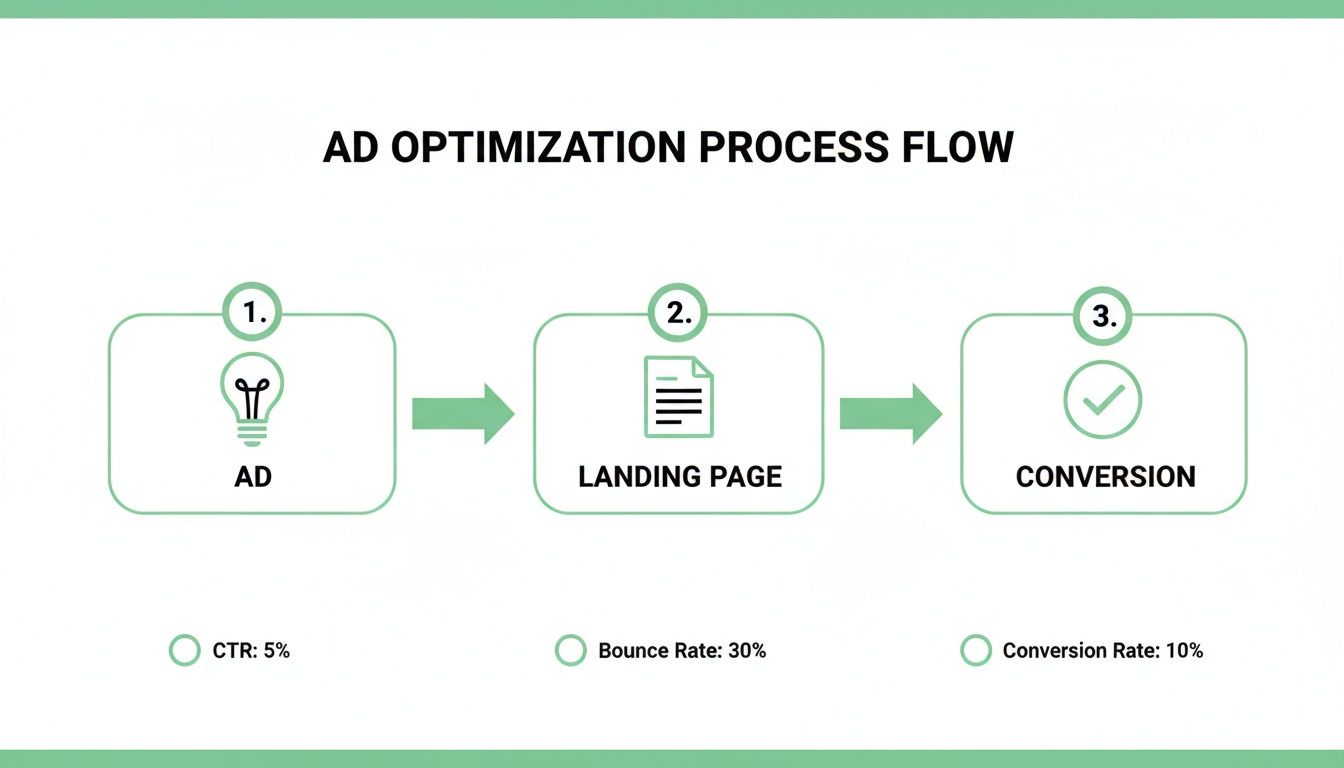
Think of each step as a potential leak in your funnel. Even small improvements at each stage compound to create massive gains in your overall conversion rate and cost-per-lead.
Adopt a ruthless testing culture
You need to develop a rigorous A/B testing culture. I'm not talking about randomly changing a button color on a whim and calling it a day. I mean running structured, disciplined experiments with clear hypotheses.
You should be testing everything that impacts the user's path to conversion. The goal is to run these tests until you hit statistical significance, which is just a fancy way of saying you're confident the results aren't a fluke. This is how you build a library of what actually works for your audience, not what you think should work.
The most underrated optimization tactic
Now for my favorite, and easily the most overlooked, part of Google Ads campaign optimization: a proactive negative keyword strategy. This is one of the fastest and most effective ways to slash wasted spend and instantly improve your lead quality.
Every time someone clicks your ad from an irrelevant search, you're paying for nothing. It's a direct drain on your budget. Regularly combing through your search terms report isn't optional; it's fundamental.
Optimization isn't just about finding what works; it's about aggressively eliminating what doesn't. Your negative keyword list is just as important as your target keyword list.
Think of it like this: your keywords open the door for traffic, and your negative keywords act as the bouncer, making sure only the right people get in. If you sell enterprise software, search terms containing "free," "jobs," or "template" are likely eating your budget for breakfast. Block them.
This creates a powerful, self-reinforcing loop. By cutting out irrelevant traffic, you improve your click-through rate and conversion rate on the traffic that does matter. This sends strong positive signals back to Google, which can improve your Quality Score and lower your costs.
Connecting the dots with automation
Finally, you tie it all together with automation to create a self-optimizing system. The real breakthrough comes when you connect your CRM directly to your ad platform. This isn't a nice-to-have; it's how you scale intelligently.
When a lead converts, their journey has just begun. You need to track what happens next. Which leads turn into qualified opportunities? Which ones become paying customers? This is the data that truly matters.
By uploading this post-conversion data back into Google Ads, you teach the algorithm what a truly valuable lead looks like for your business. This allows you to move beyond optimizing for cheap form fills and start optimizing for actual revenue. Your bidding strategies become exponentially smarter because they're based on business outcomes, not just surface-level marketing metrics.
This is the engine. You test relentlessly to improve front-end conversion rates, use negative keywords to protect your budget, and feed back-end data to Google's AI to make it smarter. You can learn more about how to get this set up in our guide to Google Ads automation tools. It's a continuous cycle that allows you to step away from the spreadsheets and focus on high-level strategy.
Winning the long game with smart systems
Look, trying to optimize a Google Ads campaign can feel like you're drinking from a firehose. The platform is always changing, and there’s always some new bidding strategy or feature to get your head around. But the principles that actually make you money never change: relevance, value, and a dead-simple user experience.
The future of this game belongs to whoever can blend human strategy with machine execution most effectively. It’s all about building systems that can scale, feeding the AI clean and meaningful data, and never, ever losing sight of the actual customer on the other side of the screen.
This isn't about handing over the keys and giving up control; it's about amplifying your strategic impact.
Building for tomorrow, not just next week
Stop chasing fleeting tactics or getting distracted by shiny new features. The real, durable win is in building a solid foundation that lasts.
- Nail the fundamentals. A clean account structure, ads that don't suck, and a frictionless path to conversion are your pillars. Get these right, and the rest of the system starts to work for you, not against you.
- Embrace smart automation. Use automation not as a lazy replacement for your brain, but as a force multiplier for your best ideas. Let it handle the mind-numbing grunt work so you can stay focused on high-level strategy.
- Remember, human insight is your edge. The machine can process data at a scale we can't even imagine, but it can't understand your customer's deepest fears, hopes, and motivations. Your empathy and strategic vision are the ultimate unfair advantages.
This is how you build a resilient, profitable lead generation machine that stands the test of time. It’s about creating an engine that gets smarter with every click, every conversion, and every piece of data you feed it. That's how you win the long game.
Frequently asked questions
Alright, let’s tackle a few common questions that always come up when talking about Google Ads campaign optimization. I'm giving you the straight answers, no fluff.
How often should I actually optimize my campaigns?
Forget the rigid schedules. The right rhythm for optimization isn't about ticking boxes every Tuesday; it's about having a system. You want to avoid making random, knee-jerk changes based on a few hours of data.
Here’s a practical breakdown that works:
- Daily: This is just a quick, five-minute health check. Is anything on fire? Are costs suddenly spiking? Did a campaign stop spending? You're just looking for disasters before they happen.
- Weekly: This is where the real work gets done. You should be digging into your search term reports, finding irrelevant queries, and adding them as negative keywords. This is also your time to review ad copy performance—pause the losers, write new challengers, and keep the tests running.
- Monthly/Quarterly: Now you zoom out. This is for bigger, strategic shifts. Look at performance by device, location, or audience segments. Is it time to reassess your core bidding strategy? Does it still actually align with your business goals?
Patience is a massively underrated skill in this game. Good optimization is a process, not an event.
Is manual bidding ever a good idea anymore?
Honestly, for about 95% of advertisers running lead gen campaigns at any kind of scale, the answer is a hard no. It’s a dumb fight to pick.
Google's Smart Bidding algorithms have access to thousands of real-time signals that no human could ever process. We're talking about the user's device, their location, browser, time of day, and past search behavior—all factored into the bid for a single auction.
Trying to outsmart that with manual CPC bids is like trying to beat a calculator at multiplication. You will lose.
The only time it might make sense is in very specific, low-volume scenarios where you need absolute, granular control over every single click and cost. But for a business that wants to grow, your job isn’t to fight the AI. It's to feed it the right data so it can do its job better.
What's the biggest mistake people make in lead gen campaigns?
This one is easy: optimizing for the wrong thing.
Most advertisers get completely obsessed with lowering their Target CPA and chasing cheap leads. This is a trap. When you do this, you’re just training Google’s algorithm to find you low-quality users—the people who will happily fill out a form for a free PDF but will never, ever become a paying customer.
The real game-changer is optimizing for value.
This means tracking the conversions that actually matter to your business—like qualified leads, booked demos, or closed deals—and then feeding that value data back into Google Ads. When you tell the algorithm that a booked demo is worth €500 and a simple ebook download is worth €5, everything changes.
The algorithm stops working for your surface-level marketing metrics and starts working for your actual business goals. This is the shift from just doing marketing to actually driving revenue.
Ready to stop building campaigns by hand and start building a real optimization engine? At dynares, we built the platform to automate the entire process—from generating thousands of unique, high-intent ads and landing pages to tracking and uploading conversion values automatically.
See how it works at https://dynares.ai.


