
Let's be real for a second. Pouring your hard-earned cash into Google Ads without a rock-solid plan to convert that traffic is just setting money on fire. You see the clicks rolling in, you watch the impression count climb, but the revenue needle stubbornly refuses to budge. This is exactly where most marketing campaigns fall apart—right at the finish line.
What is CRO software anyway?

Let's cut through the jargon. Conversion rate optimisation (CRO) software isn't some magic wand you wave to instantly get more customers. Think of it as a professional toolkit designed for one specific job: turning the website visitors you already have into actual revenue.
Forget the buzzwords. At its core, CRO is about understanding what your visitors truly want and then giving it to them, plain and simple. We're talking about practical tools that let you test different headlines, build landing pages that actually convert, and pinpoint exactly why people are leaving your site without buying.
This isn't some nice-to-have extra. It's the absolute foundation for scaling any business online. It's about making smart decisions with real data, not just guessing and hoping for the best.
Moving beyond guesswork
The old way of doing things—launching a page and crossing your fingers—is dead. It's an expensive habit that torches budgets and stalls growth. You can have the best ad campaign in the world, but if your landing page doesn't seal the deal, you've wasted every single dollar you spent getting that person there.
This is where a methodical approach, powered by the right tools, changes the entire game. The goal isn't just to bump conversions by a few percentage points. It’s to build a machine that continuously learns from user behaviour and gets smarter over time.
You start asking better questions because you finally have the data to get real answers. Is my headline clear? Does it actually match the promise I made in my ad? Is my call-to-action (CTA) compelling, or is it a generic 'Submit' button that inspires absolutely zero action? Is this form too long, scaring off perfectly good leads?
Answering these questions isn't a matter of opinion; it's a matter of testing. CRO software gives you the framework to run these experiments scientifically, turning your website from a static brochure into a dynamic, conversion-focused asset. The first step, of course, is ensuring your data is clean—check out our guide on getting your Google Ads conversion tracking setup right from the start.
The massive opportunity you’re missing
Let’s be brutally honest. If you're driving paid traffic without a CRO strategy, you're operating at a huge competitive disadvantage.
The market for conversion rate optimisation software is exploding for a reason. Its value shot up from around US$771 million in 2018 and is projected to hit nearly US$1.93 billion by 2026. That's not just hype; it's a clear signal that smart businesses are investing heavily in data-driven optimization.
This isn't about chasing the latest trend. It’s a fundamental shift in how we approach growth. It's about respecting the traffic you've already paid for and finally maximizing its potential. It's about building a more efficient, more profitable business, one that turns prospects into customers with precision. That's the future, and it’s time to get on board. 🚀
The core toolkit: what CRO software actually does
Alright, let's get under the hood. When you invest in conversion rate optimization software, what are you really getting? It's not some magic go-faster button. Think of it as a professional mechanic's toolbox—a collection of powerful, specialized instruments designed to work together.
Each tool has a very specific job, and knowing how and when to use them is what separates the amateurs from the pros who consistently turn clicks into customers. We're going to look at this from the perspective of a busy founder or a PPC manager who just needs to get results, fast.
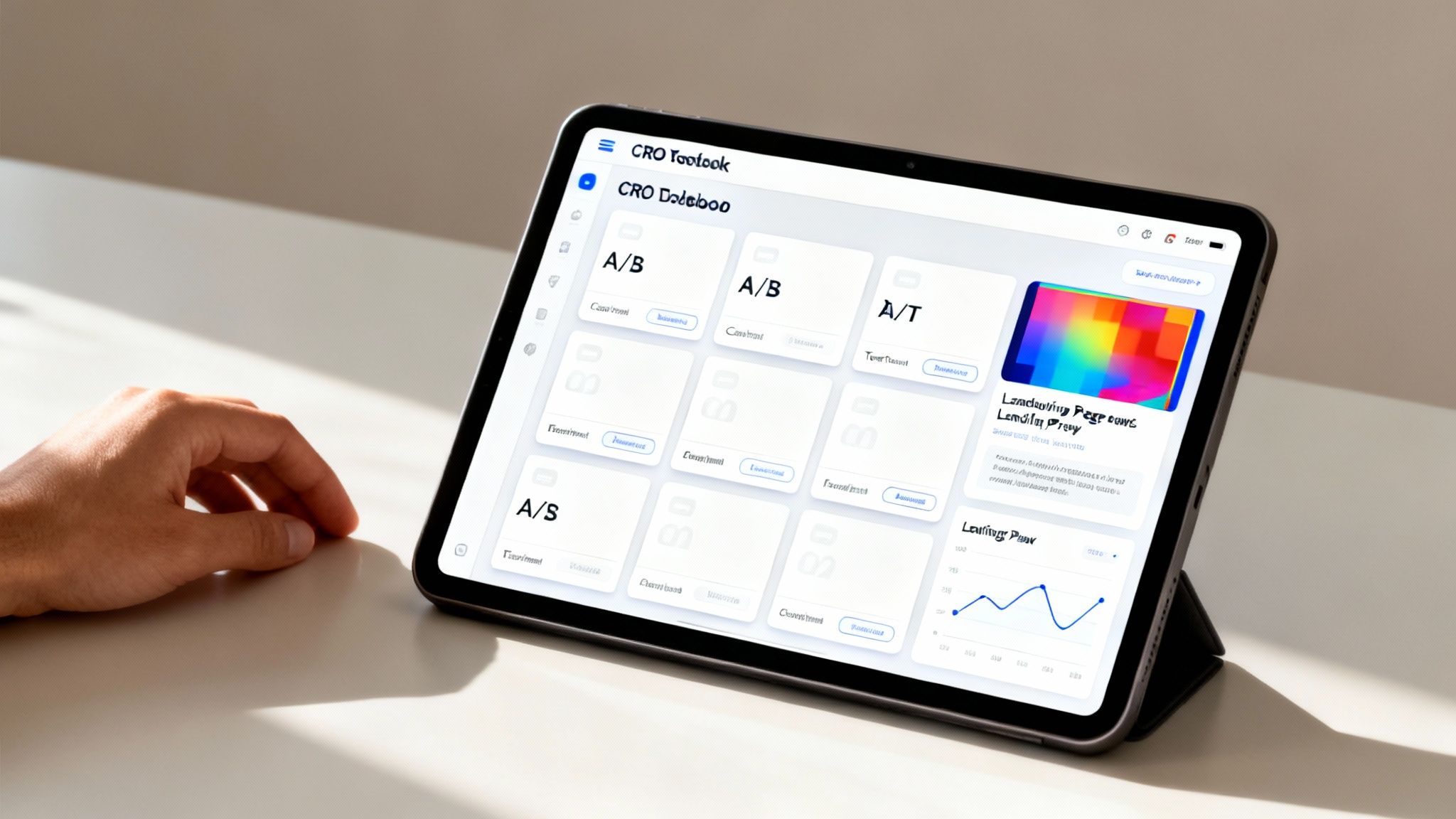
This relentless focus on ROI is precisely why the market is booming. North America is leading the charge, commanding over 40% of global revenue—that’s USD 608.48 million in 2024 alone. With projected growth of 10.4% annually through 2031, it's clear that businesses are doubling down on these tools as customer acquisition costs keep climbing.
For anyone managing a Google Ads budget, this isn’t just a passing trend; it's a fundamental strategic shift. You can find more details on this regional growth and what it means for the industry on cognitivemarketresearch.com.
Let's break down the essential capabilities you'll find in any serious CRO platform.
Essential CRO software capabilities at a glance
This table cuts through the jargon, showing you the core functions of CRO software and explaining their direct impact on your marketing performance.
CapabilityWhat It DoesWhy It Matters for a PPC CampaignA/B TestingPits two versions of a page against each other to see which one converts better.Stop guessing. Data-backed proof of what headline, offer, or image actually drives more leads or sales from your ad spend.Landing Page BuildersAllows marketers to quickly create and launch campaign-specific pages without needing developers.Ensures perfect message match from ad to page, which improves Quality Score, lowers CPC, and boosts conversion rates.PersonalizationDynamically changes page content based on visitor data (e.g., location, traffic source, behavior).Makes a generic site feel like it was built for one specific person, dramatically increasing relevance and trust.Behavioral AnalyticsUses tools like heatmaps and session recordings to show how users interact with your site.Moves beyond what happened to reveal why it happened, pinpointing the exact friction points that are killing your conversions.Experiment ManagementA central hub to plan, prioritize, launch, and analyze all your optimization tests and ideas.Keeps your testing program organized and ensures you're learning from every experiment, building momentum instead of chaos.Attribution & ReportingConnects your test results directly to revenue and key business metrics.Proves the financial impact of your optimization work, turning CRO from a "cost center" into a clear revenue driver.
Each of these capabilities is a piece of the puzzle. When they work together, you create a powerful system for continuous, data-driven growth. Let's dig a little deeper into the most important ones.
1. The heart of CRO: experimentation and testing
This is where you stop guessing and start knowing. Experimentation tools provide the scientific method for making website changes without accidentally tanking your sales.
The star of the show is A/B testing, also known as split testing. It’s a beautifully simple concept: you show 50% of your visitors one version of a page (Version A, the control) and the other 50% a different version (Version B, the variation). The only difference might be the headline, the button color, or the main image.
The software then tracks which version gets more conversions. It’s a direct, head-to-head battle where the data picks the winner. No more arguments in marketing meetings about which headline feels better. The numbers don't lie.
2. The money-maker: page building and personalization
Let's be blunt: sending expensive PPC traffic to a generic homepage is lazy marketing. It’s like inviting someone to a fancy dinner and handing them a paper plate. A dedicated landing page builder is your fastest path to better results and higher Quality Scores on Google Ads.
These builders let you create specific, campaign-focused pages in minutes, not weeks. They are crucial for achieving message match—making sure the promise in your ad is the first thing a user sees on the page. You can see how a dedicated landing page creator can be a total game-changer for your campaigns.
Personalization takes this a step further by dynamically changing content based on who is visiting. This turns a generic website into an experience that feels like it was built for one specific person—an incredibly powerful way to boost conversions.
3. The "why": analytics and user behavior insights
Standard analytics (like Google Analytics) tell you what happened. For example, 70% of users left your pricing page. CRO analytics tools are designed to help you figure out why it happened.
These are the less glamorous but absolutely essential parts of the toolkit. You can’t fix a problem you don’t understand. Behavioral analytics tools are like putting on a pair of glasses that let you see your website through your customers' eyes.
Here’s what you get:
- Heatmaps: Visual overlays showing exactly where users click, move their mouse, and how far they scroll. It's the quickest way to see if your most important call-to-action is being completely ignored.
- Session Recordings: Anonymous recordings of real user sessions. You can literally watch people getting stuck, rage-clicking a broken link, or struggling to find information. It can be painful to watch, but it's pure gold for finding friction points.
- Funnel Analysis: This maps out the key steps a user takes toward conversion (e.g., Homepage → Product Page → Cart → Checkout) and shows you exactly where the biggest drop-offs occur. This tells you where to focus your optimization efforts for the biggest impact.
How to choose a vendor without getting ripped off
The market for conversion rate optimisation software is absolutely flooded. Every vendor promises you the moon, wrapped in a slick dashboard with a million features you’ll probably never touch.
It’s incredibly easy to get distracted by the shiny new toy and lock yourself into an expensive annual contract you immediately regret. Let's cut the crap and talk about how to make a smart investment.
This isn’t about just buying another piece of software; it’s about choosing a partner for growth. You need a tool that works for you, not one that creates more work for your team. A bad choice here doesn’t just cost you money—it costs you time, momentum, and countless missed opportunities.
Beyond the marketing hype
First things first, ignore the marketing fluff. Every website will tell you their tool is AI-powered and industry-leading. It's meaningless noise. Instead, focus on the fundamentals that will actually impact your daily workflow and your bottom line.
Here’s a no-nonsense checklist of what really matters:
- Integrations are non-negotiable: If the tool doesn’t seamlessly connect with your core stack—Google Ads, Google Analytics, and your CRM—it's a non-starter. A clunky integration that requires manual data exports is a recipe for disaster and will kill adoption within your team.
- The UI must be intuitive: Can your marketing manager or a junior PPC specialist run a simple A/B test without needing a data scientist and a two-week training course? If the user interface is a complex mess, your team will avoid using it, and your expensive subscription will gather digital dust.
- It has to be fast: Some CRO tools can seriously slow down your website. A slow site kills conversions and torpedoes your SEO efforts. Run a page speed test on their demo or trial pages before you even think about signing a contract.
Understanding the true cost
Pricing models in this space can be intentionally confusing. Unlimited is almost never actually unlimited. You need to dig into the fine print and understand exactly what you're paying for, because hidden costs can bite you hard later on.
For a transparent breakdown of what to expect, you can learn more about different pricing tiers and their features.
Look out for common traps like traffic-based pricing, where a successful ad campaign could cause your bill to skyrocket. Or feature gating, where the cheap plan lacks the one critical feature you actually need. And don't get surprised by hefty setup fees after you've already committed.
The 2 AM test
Finally, think about support. When a critical test on your highest-traffic landing page breaks at 2 AM on a Saturday, who are you going to call? Is support handled by a real human who understands your problem, or are you stuck with a chatbot and a 48-hour ticket response time?
A great product with terrible support is a terrible product. When things go wrong—and they will—the quality and accessibility of customer support will be the only thing that matters.
Choosing the right conversion rate optimisation software is a strategic decision. Don't let a slick sales demo rush you. Be practical, be skeptical, and choose the tool that will genuinely help you scale.
A realistic roadmap for getting started
Buying new conversion software is the easy part. The real work—where most people fail spectacularly—is actually plugging it in and getting a return on your investment.
So, let's build a simple, actionable roadmap. This is for lean teams that need to move fast and see results, not some theoretical framework from a textbook. It’s a grounded, step-by-step guide to building momentum without getting lost in the weeds. The goal here is to get early wins, prove this whole thing is worth it, and create a system you can build on.
Phase 1: the foundation
Before you even think about running a single A/B test, you have to get the basics right. Seriously. If you mess this up, all your future data will be complete garbage.
- Install tracking codes correctly: This is non-negotiable. Whether it’s your CRO tool’s snippet, Google Tag Manager, or event tracking, triple-check that it’s installed on every single page and firing correctly. One misplaced tag can invalidate months of work.
- Define your primary conversion goal: What's the one action that matters most? A demo request? A completed checkout? Be ruthlessly specific. This becomes your North Star metric, guiding every test you run.
- Set your baseline: You can't know if you're winning if you don't know the score. What’s your current conversion rate for that primary goal? Document it. This number is your benchmark for success.
Phase 2: find the low-hanging fruit
Okay, your foundation is solid. Now it’s time to find the easiest wins.
Your goal isn't to redesign the entire website overnight. It's to find the one or two pages where a small tweak will have the biggest impact on the bottom line. Think about the 80/20 rule: where does most of your high-intent traffic land? It's usually your homepage, a main product page, your pricing page, or a high-volume landing page from a big Google Ads campaign.
Pick one. Just one. Don't try to boil the ocean. Use your analytics to find the page with high traffic but a disappointing conversion rate. That’s your target.
Phase 3: form a solid hypothesis
This is where you go from just staring at data to forming a testable idea. A hypothesis isn't a random guess; it's a simple, clear statement that connects a specific change to an expected outcome.
The structure is simple: I believe that [making this specific change] will result in [this measurable outcome] because [this reason].
This format forces you to think clearly. It stops you from just throwing ideas at the wall to see what sticks. A few examples: changing button text from 'Submit' to 'Get My Free Quote' will increase submissions because it highlights the value. Or adding testimonials to a pricing page will increase sign-ups because it provides social proof.
Your first hypothesis doesn’t need to be brilliant. It just needs to be simple, specific, and measurable. Your first test is about learning the process, not hitting a home run. Build momentum with these small wins, and you’ll create the foundation for a powerful optimization program. 🚀
A day in the life: the PPC manager's workflow from ad to conversion
For those of us living and breathing Google Ads, conversion optimisation software isn’t some fluffy, nice-to-have. It’s a competitive necessity. Pouring money into ads without an equally powerful system to convert that traffic is just malpractice—it's how you lose clients and burn through your own budget.
Let's walk through a concrete example of how this actually works. This is where the theory stops and the revenue starts.
From a vague click to a high-intent lead
Imagine you’re running ads for a client offering 'emergency plumbing services in London.' It's a high-stakes, high-cost keyword. Every single click is expensive, and every wasted click is painful.
The old way is to send all that traffic to a generic services page and hope for the best. That’s a terrible idea, and it’s why so many campaigns fail.
The smart way is to use CRO software to create a perfect, seamless journey. The headline on the landing page should scream: "Emergency Plumber in London? We'll Be There in 60 Minutes." The form should be dead simple: Name, Phone Number, Problem. The call to action needs to be unmissable: a massive button that says "Call Now for Immediate Service."
This tight alignment between ad and landing page is what Google rewards with a higher Quality Score. And a better Quality Score isn't a vanity metric—it directly translates to a lower cost-per-click (CPC). You're literally paying less for better traffic.
The power of continuous experimentation
Now, here's where the magic really happens. You've got your dedicated landing page, but is "Call Now for Immediate Service" truly the best CTA? Maybe users want a price estimate first. Instead of guessing, you run a simple A/B test.
The software splits your ad traffic 50/50 between the two pages and tracks which one generates more qualified leads. After a few days, the data gives you a clear winner. If Version B gets 25% more conversions, the system can automatically start sending 100% of the traffic there. No manual work needed.
This visual shows the simple, powerful process that underpins any successful CRO strategy: tracking visitor behavior, identifying bottlenecks, and then testing solutions.
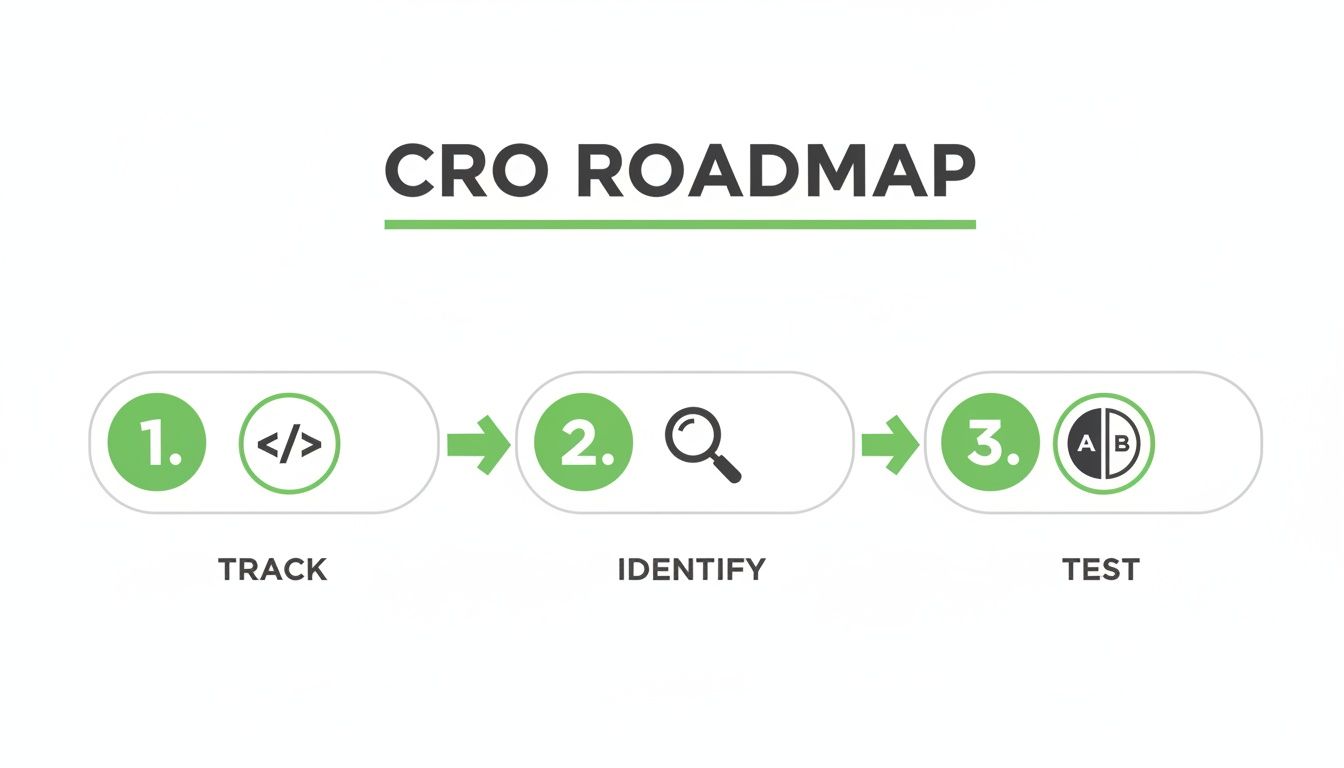
This workflow transforms CRO from a series of random guesses into a systematic engine for improvement, connecting every action to a measurable result.
This is the feedback loop that separates the pros from the amateurs. You aren't just running ads; you're building an intelligent system that learns, adapts, and improves with every single click. You can learn more about how this applies specifically to paid search in our deep dive on solutions for PPC managers.
The final piece is connecting all this activity back to what really matters—revenue. By feeding conversion data back into Google Ads, you’re not just optimising for cheap clicks or form fills. You're telling Google's algorithm to find you more people who look like your best, most profitable customers.
This is how you stop burning cash and start building a truly scalable, efficient customer acquisition machine. It’s about connecting ad spend directly to revenue in a measurable, undeniable way. And frankly, any other approach is just leaving money on the table.
Why I'm building dynares: a better approach to paid acquisition
After years of running agencies and scaling businesses, I kept slamming into the same wall. Marketers pour a fortune into ads but send all that expensive traffic to a handful of generic, one-size-fits-all landing pages. It’s wildly inefficient. It's a massive waste of potential.
That’s why I’m building dynares. It’s the platform I wish I had back when I was managing millions in ad spend and living in spreadsheet hell.
We’re taking a fundamentally different approach. Traditional CRO software gives you tools to manually test pages. That's fine, but it’s slow and it doesn’t scale. Our platform uses AI to automatically generate thousands of coordinated ads and matching landing pages—one for every single keyword you target.
It’s all about creating a perfect, unbroken line of relevance from the ad click all the way to the conversion.
A smarter system for growth
Our system pulls public data to fine-tune the voice and tone for each page, ensuring a perfect message match. This isn't about just spinning up endless, mindless variations. It's about creating surgically precise experiences that speak directly to what a user was searching for just moments before.
My vision for dynares aligns with the principles of an AI-Driven Playbook for Faster Wins in improving website conversion rates, showing how machine learning can directly impact your bottom line.
The old way is asking, which of these two pages works better? The new way is asking, how can we create the perfect page for every single user, instantly?
We automate the A/B testing, so the system is always learning and optimizing in the background. It’s a machine built for one purpose: turning ad spend into revenue as efficiently as humanly possible.
Optimizing for what really matters: revenue
The goal isn't just more leads; it's higher-value leads. A form fill from a tire-kicker is not the same as a demo request from a qualified enterprise buyer. We get that distinction, which is why our system is built to connect directly with real business outcomes.
Here’s how we’re breaking away from the old model:
- Radical Message Match: We don't just recommend changes; we build thousands of unique, keyword-specific ad-and-page combinations from the ground up. The result is a seamless user journey that feels tailor-made.
- Automated Optimization: Our platform continuously tests and allocates traffic to the winning variants. You're always running the best possible version without lifting a finger.
- Revenue-Focused Reporting: We upload conversion values back into Google Ads, allowing you to optimize your campaigns for actual revenue, not just cheap leads. This closes the loop between what you spend and what you earn.
This is a system built for scale, for performance, and for people who are tired of doing things the old way. It's about building a smarter, more automated future for paid acquisition. 🚀
Alright, let's get into a few of the questions that always come up when we're talking about CRO software. No fluff, just straight answers based on what we see in the wild.
How much should I expect to pay?
Honestly, the prices are all over the map. You can find simple tools for heatmaps or basic pop-up surveys that start around $30-$100 a month. Easy.
But for the all-in-one platforms—the ones with serious A/B testing, personalization, and deep analytics—you're looking at a range from a few hundred to several thousand dollars a month. The price tag is almost always tied to your website traffic volume.
My advice? Start with what you can actually afford and prove the ROI before you go big. Don't get roped into a massive annual contract for some complex enterprise tool your team isn't ready for. The best tool is the one that gets used every day, not the one that just looks good on an invoice.
How long does it take to see results from CRO?
This one depends entirely on your traffic. If you have thousands of visitors pouring in every day, you can get a statistically significant result from an A/B test in a week or two. It's just a numbers game.
If you're just starting out with low traffic, it could take months to validate a single test. That's just the reality of it.
The key is to be strategic. Don't waste time testing the color of a button on a forgotten page. Focus on your highest-impact pages first—your homepage, main service pages, or your top-performing PPC landing pages. Get some wins on the board quickly. CRO is a long-game, not a quick hack. It’s about building a system for continuous improvement, not finding a single magic bullet.
Can CRO software hurt my SEO?
This is a common fear, but the short answer is no—not if you do it right. Google actually encourages A/B testing because it leads to a better user experience. They're on your side here.
Modern conversion rate optimisation software uses JavaScript to show different versions to users. It doesn't create duplicate pages, so there's no SEO penalty to worry about.
The only real danger is site speed. If your testing tool is clunky and slows your site to a crawl, that will hurt your rankings. But a well-implemented CRO strategy usually improves SEO by boosting engagement signals like time on page and lower bounce rates.
At the end of the day, what's good for the user is good for Google. And making your site better for users is the entire point of CRO. 🚀
At dynares, we're building an AI-powered system that automates this entire process, from ad creation to landing page optimization, so you can focus on revenue, not just clicks. See how it works at https://dynares.ai.


