
So, you want to know what it really costs to advertise online. The honest answer? It's a complete minefield.
But let's get straight to the point: the cost of online advertising is exploding. In 2024 alone, global digital channels are on track to capture over US$790 billion—more than double what was spent in 2019.
Let's get real about the cost of online advertising
If you’re just starting to explore paid advertising, you need to understand you’re walking into a brutal, high-stakes arena. This isn't a space for dabblers anymore. Platforms like Google and Meta have become cash-printing machines for a simple reason: the competition for attention is ferocious, and costs are constantly climbing.
If you’re throwing money at ads without a watertight strategy, you’re just setting your cash on fire. Fast.
The scale of this market is staggering. Global advertising spend hit a jaw-dropping US$1.1 trillion in 2024, a solid 7.3% jump from the previous year. Digital channels now dominate the game, gobbling up 72.7% of that total—a massive leap from just under half in 2018. The shift accelerated post-COVID, and it's not slowing down.
This chart drives the point home. It shows just how dramatically digital ad spend has grown between 2018 and 2024.
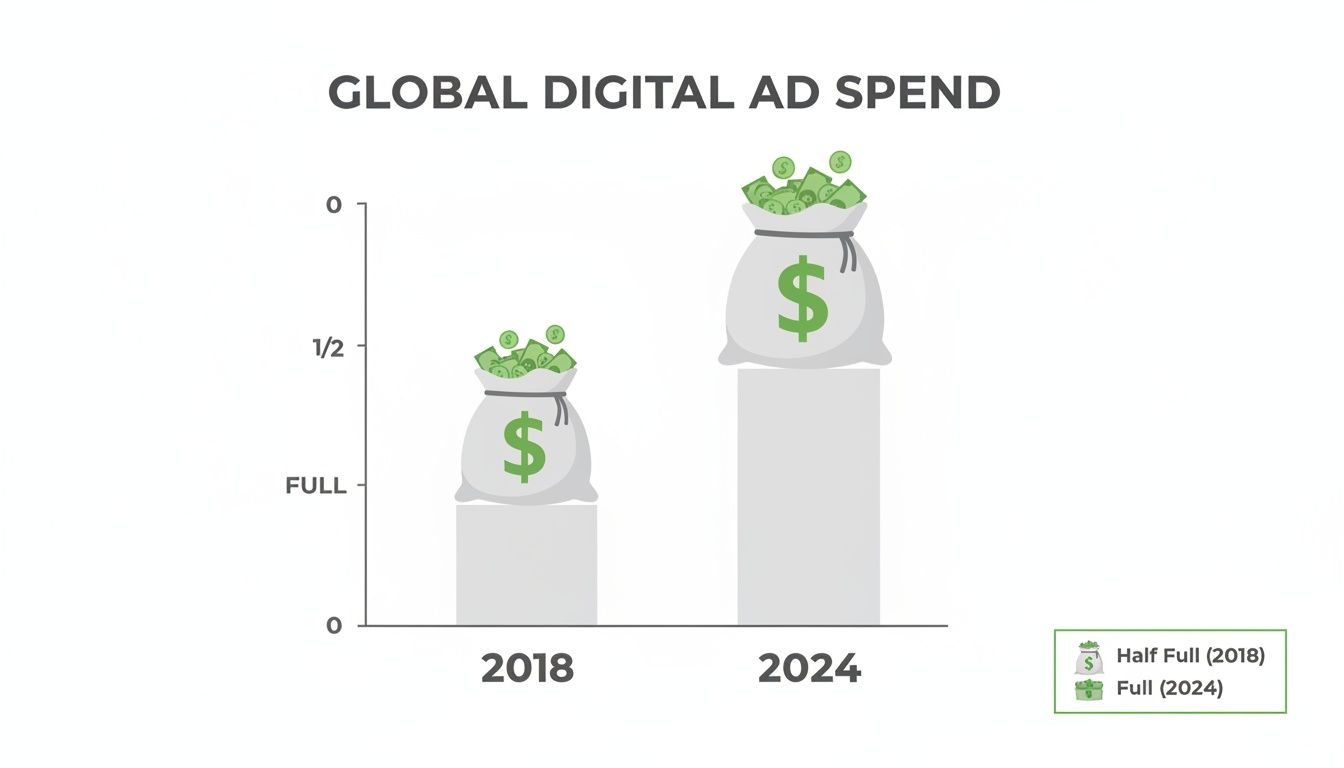
The visualization makes it painfully clear: the money flowing into digital ads has ballooned, intensifying competition and driving up costs for everyone.
What this means for you
This guide isn't about simply buying clicks; it's about building a smart, scalable growth engine for your business without getting burned. We’ll look at the typical cost benchmarks you can expect across major channels, from search to social, to give you a realistic starting point.
But more importantly, we'll get into why those average numbers are mostly useless without understanding the context behind them. Your costs will be shaped by a few key factors.
My goal here is to arm you with a founder’s mindset. We’re not just looking at expenses; we’re dissecting a core business investment. Let’s get into it.
How ad pricing models will make or break your budget
Alright, let's talk about the alphabet soup that actually matters to your bank account: CPC, CPM, and CPA. Getting your head around these isn’t some academic exercise; it literally dictates your entire financial strategy and determines if your ad budget fuels growth or just gets flushed away.
These models are the basic language of online advertising. Think of them like different ways to pay for a taxi. You could pay by the mile (CPM), pay every time the driver honks (CPC), or only pay when you actually arrive at your destination (CPA). One of these is obviously better for you, right?
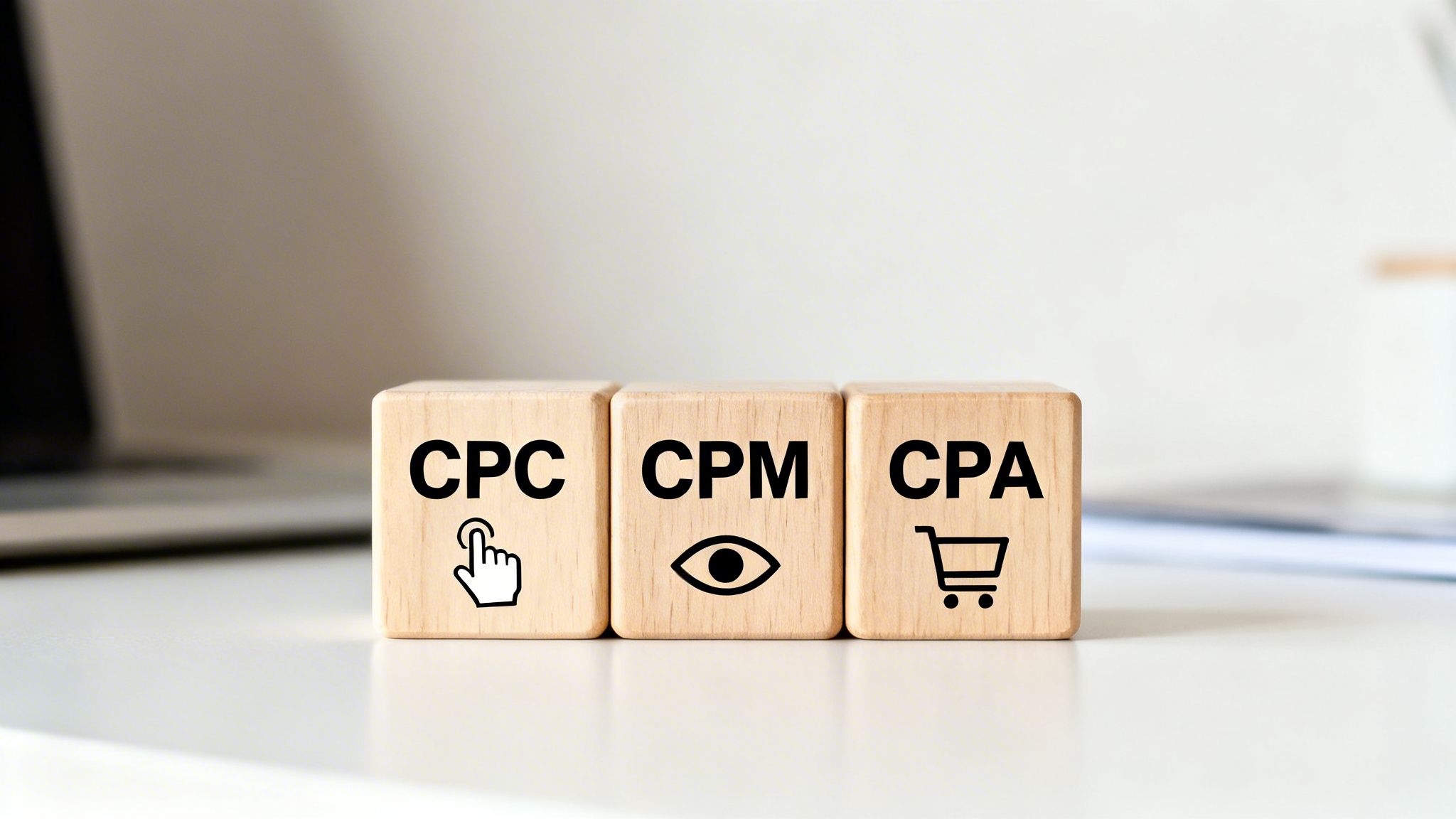
Most platforms will happily nudge you toward the first two options because it’s easy money for them. It’s on you to be smarter.
The three core pricing models
So what do these models actually mean for your business and your cash flow? Let's break it down without the usual marketing fluff.
- CPM (Cost Per Mille): This is Cost Per 1,000 Impressions. You’re essentially paying for eyeballs. It’s a tool for big-budget brand awareness campaigns where the only goal is to get your name out there. But for most of us trying to sell a product, it's a vanity metric. You pay whether anyone cares or not.
- CPC (Cost Per Click): The default for search ads on platforms like Google, this is where you only pay when someone is interested enough to actually click your ad. This is a massive step up from CPM because you’re paying for expressed intent, not just a passive glance. Someone actively searching for a solution is a much warmer lead.
- CPA (Cost Per Acquisition): This is where it gets serious for performance-focused businesses. You only pay when a specific, valuable action happens—a sale, a qualified lead signing up, or a demo booking. This model directly aligns your spending with actual business results. It’s the holy grail.
The platforms will try to keep you focused on CPC, but the pros know the real game is obsessively optimizing toward a target CPA. That’s how you build a predictable growth engine.
Why a low CPC can be a dumb move
Here’s a hard-won lesson: obsessing over a low Cost-Per-Click is one of the fastest ways to burn through your budget with nothing to show for it. I see founders bragging about their €0.20 clicks all the time, but when I ask about their sales, it’s crickets. 🦗
Why? Because cheap clicks almost always come from low-quality traffic. You might be bidding on broad, irrelevant keywords or targeting an audience that has zero intention of ever buying from you. You end up with a ton of window shoppers and no paying customers.
A high CPA can actually be fantastic if the customer lifetime value (LTV) supports it. Paying €200 to acquire a customer who will spend €2,000 with you over the next two years is an incredible deal I’d take all day long.
It’s all about aligning your spending model with your business goals, not just chasing the cheapest metrics the platforms dangle in front of you. To really nail this, you have to understand the relationship between what you pay and what you get. For a deeper dive, you might be interested in our guide on what cost-per-conversion really means for your bottom line.
Ultimately, your goal isn't to get the most clicks for your money. It's to acquire the most valuable customers for your money. That shift in perspective changes everything.
Why your ad costs are so high and how to fix them
Feeling the sting of high ad costs? You're not alone. If it feels like you're paying more to get in front of customers, it’s because you are. The competition is absolutely brutal.
But here’s the direct truth: it’s not just market forces. Specific, controllable factors are very likely driving your costs through the roof. Let's dissect them one by one so you can stop wasting money and start reinvesting it where it actually drives growth.
This entire ecosystem is on a rocket trajectory. Global digital ad spending is projected to cross $750 billion in 2025 for the first time, making up over 75% of all media ad spend.
For those of us in the trenches—PPC managers, agencies, and growth teams—this means the fight for attention is only going to get more intense.
So, if you can’t control the market, what can you control? A hell of a lot, actually.
The silent killers of your ad budget
The biggest drains on your ad spend aren't always obvious. They're subtle leaks that, added together, can sink your entire campaign. Here are the main culprits I see founders and marketers wrestling with constantly.
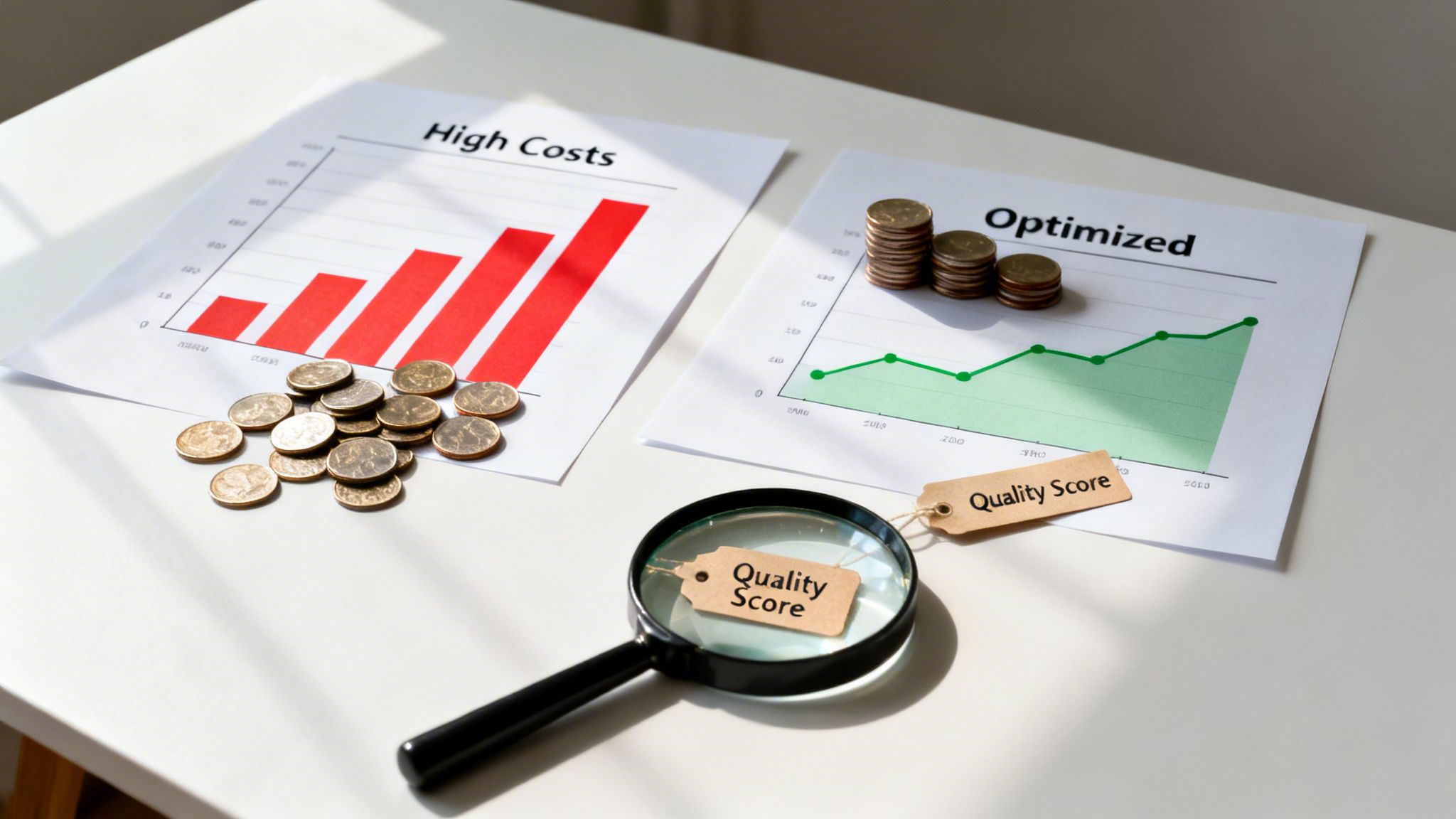
First up is Quality Score. Think of it as Google’s relevance rating for your ads, keywords, and landing pages. A low score is literally a tax you pay for lazy advertising. Google wants to show users relevant results, so if your ad experience sucks, they make you pay a premium for the privilege of showing it.
Second is audience targeting. If you're too broad, you're paying to show your ads to people who will never, ever buy from you. It’s like trying to sell expensive steak to a room full of vegans. It doesn’t matter how good your ad is; you’re talking to the wrong people, and you’re burning cash with every single impression.
Finally, there’s the ad-to-landing-page disconnect. You run a killer ad promising a specific solution, a user clicks, and they land on a generic homepage. That disconnect shatters trust and your conversion rate plummets. You’ve paid for the click, but you've completely failed to deliver on the promise.
Your audit checklist for lower ad costs
Okay, enough theory. Here’s a practical checklist you can use right now to audit your own campaigns and start plugging those leaks. Be honest with yourself as you go through it.
- Is your Quality Score a disaster? Check your Google Ads account. Anything below a 7/10 means you have work to do. A low score directly increases your CPC. For an in-depth look, check out our guide on what Quality Score is and how to improve it.
- Are your keywords hyper-relevant? Stop using broad match keywords just because they get a lot of impressions. Focus on long-tail, high-intent keywords that signal someone is ready to solve a problem now.
- Does your ad copy match user intent? Your ad headline should feel like a direct answer to the user's search query. If someone searches for CRM for small law firms, your ad shouldn't just say Best CRM Software.
The goal isn’t just to spend less on the cost of online advertising; it’s to stop wasting money. Every euro you save on a useless click is a euro you can reinvest into a click that actually generates revenue.
This isn’t about finding some magic button. It’s about being disciplined and focusing on relevance at every single step of the user journey. Fix these fundamentals, and I guarantee you'll see your ad costs drop while your results improve. It's not sexy, but it works.
How to calculate your real ROI, not vanity metrics
Let's be brutally honest for a minute. Clicks, impressions, and even leads are mostly vanity metrics.
They feel good to report in a meeting, and they make graphs go up and to the right. But they don't pay the bills. They don’t keep the lights on or fund your next big product push.
The only metric that truly matters is profit. A close second is Return On Ad Spend (ROAS).
This section is a hands-on workshop. We're going to get out the calculator and run the numbers together because a shocking number of founders simply don't do this. They spend on ads, but they don't invest in predictable growth.
From spending to investing: the basic formulas
Before you spend another euro on ads, you need to know your numbers. This isn't complex calculus; it's the fundamental business math that separates the founders who make it from those who don't. The cost of online advertising is only half the equation—the other half is what you get back.
Here are the three simple formulas you absolutely must know:
- Break-Even Point: This is the ROAS you need just to get your money back. It's calculated as
1 / Profit Margin. If your profit margin is 25%, your break-even ROAS is1 / 0.25 = 4. That means for every €1 you spend, you need to generate €4 in revenue just to not lose money. - Target CPA (Cost Per Acquisition): This is the maximum you can afford to pay for a new customer. The basic formula is
Customer Lifetime Value (LTV) - Cost of Goods Sold (COGS) - Other Variable Costs. A simpler version isAverage Order Value x Target Profit Margin. - Actual ROAS (Return On Ad Spend): This is the ultimate measure of your campaign's efficiency. The formula is simply
Total Revenue from Ads / Total Ad Spend. A ROAS of 5x means you're generating €5 for every €1 you spend.
Let’s run the numbers: a real-world example
Theory is nice, but let's make this concrete. Imagine you're a European SaaS founder. You decide to spend €1,000 on a new Google Ads campaign.
z
Here's how the funnel plays out:
- Spend: You invest €1,000.
- Leads: The campaign generates 50 demo requests (leads).
- Conversions: Your sales team is solid and converts 10% of those leads, resulting in 5 new customers.
- Revenue: Each customer is worth €500 in the first year. Your total revenue from this campaign is
5 customers * €500/customer = €2,500.
So, what’s your ROAS? You use the formula: €2,500 Revenue / €1,000 Ad Spend = 2.5x. This is your real return. Not 50 leads, but €2,500 in the bank. For a much more detailed breakdown, you might be interested in our guide on how to calculate ROAS the right way.
The crucial final step is passing this revenue data back to the ad platforms. When you tell Google or Facebook that a certain type of click led to a €500 sale, you empower their AI to stop chasing cheap leads and start hunting for profitable customers. This is how you build a true growth machine.
My playbook for smarter ad spend with automation
Trying to run ad campaigns manually in 2026 is like trying to build a skyscraper with a hammer. It's painfully slow, shockingly inefficient, and you'll get crushed by competitors using modern tools. It’s just a dumb way to operate when better options are staring you in the face.
The future of performance marketing is a human-plus-machine partnership. Machines do the heavy lifting—the repetitive grunt work—while humans focus on the big picture: strategy, creative direction, and understanding the customer. This isn't about replacing talented marketers; it's about giving them superpowers. 🚀
This is how you turn the rising cost of online advertising from a threat into an opportunity. While others are complaining about climbing CPCs, you can build a system so efficient and relevant it essentially sidesteps the issue. Here's my playbook.
Automate the grunt work
First, automate everything that is repetitive and soul-crushing. Creating thousands of unique ads and landing pages, one for every single keyword in your campaign? That is a job for an algorithm, not a person. Expecting a human to do this perfectly is insane, and it’s where most campaigns fail the relevance test.
This is exactly what we're building at dynares. It’s a system designed to generate hyper-relevant ads and landing pages at a massive scale. You give it your keywords and brand guidelines, and it creates a unique, coordinated experience for each search query.
This level of granularity gives you two massive advantages.
It boosts your Quality Score automatically. When your ad, keyword, and landing page are perfectly aligned, Google rewards you with a higher Quality Score, which directly lowers your cost-per-click.
It increases your conversion rate. A user who clicks an ad for AI software for legal contracts and lands on a page with that exact headline is far more likely to convert than one who lands on a generic homepage. It’s just common sense.
This isn’t a small tweak; it’s a fundamental shift in how you run paid search. It's about delivering a one-to-one experience at a one-to-many scale.
Test relentlessly and let data win
Second, you have to test relentlessly. And I mean everything. Headlines, calls-to-action, button colors, page layouts, form fields—if a user sees it, you should be testing it. Manually setting up A/B tests is a slow, clumsy process. You might manage a handful of tests a month, and by the time you have a winner, the market has already moved on.
Automation changes the game entirely. It allows you to run hundreds or even thousands of micro-experiments simultaneously across your campaigns. The system can automatically allocate more traffic to winning variations in real-time and kill the losers without any human intervention.
You’re not guessing what works anymore. You’re letting the data declare the winner, definitively. This data-driven approach removes ego and opinion from the equation and replaces it with cold, hard results.
This is where the human-machine partnership shines. The AI handles the execution and optimization at a speed no human ever could. This frees up the marketing team to do what they do best: deep customer insight, strategic planning, and creative direction.
Ultimately, this playbook isn't just about reducing the cost of online advertising. It’s about building a smarter, faster, and more scalable growth engine for your business. You stop fighting the system and start using technology to make it work for you. That’s how you win.
Your action plan to stop burning cash on ads
So, what's the big takeaway here? Online advertising costs aren't some fixed number you just have to swallow. They are a direct, dynamic result of your strategy—or the lack of one.
You really have two choices. You can sit back and complain about rising CPCs, or you can build a system to outsmart the market. The lazy, old-school approach of 'set it and forget it' is dead. To win now, you have to be smarter, faster, and more relevant than everyone else bidding for your customer’s attention.
This isn’t about finding a secret hack. It’s about a fundamental shift in how you think about growth.
Adopt a system-first mindset
Winning in this environment means embracing technology and automation. It's about obsessing over the entire customer journey, from the first keyword they type to the moment they become a paying customer. And it means being ruthlessly data-driven, focusing on actual profit, not feel-good vanity metrics like clicks or impressions.
The goal isn't just to find cheaper clicks; it's to build a predictable, scalable customer acquisition machine that fuels your company's growth. That’s the only thing that matters.
Your job as a founder or marketer isn't to manually tweak every bid and keyword. Your job is to design the machine that does it for you, so you can focus on strategy.
My advice is simple and actionable
If you're feeling overwhelmed by all the moving parts, don't be. The path forward is straightforward, even if it requires a little discipline. Here’s my no-BS advice for getting started and turning your ad spend into a true growth investment.
- Start Small, Prove the Model: Don't just throw a massive budget at an unproven funnel. Dedicate a small, controlled amount to test your core assumptions. Find a profitable combination of a keyword, an ad, and a landing page before you even think about scaling up.
- Measure What Actually Matters: Forget impressions. Track your Cost Per Acquisition (CPA) and Return On Ad Spend (ROAS) like your business depends on it—because it does. If you can’t draw a straight line from your ad spend to revenue, you’re just gambling.
- Scale What Works, Kill What Doesn't: Once you find a winning formula, pour fuel on the fire. At the same time, be ruthless about cutting campaigns, ad groups, or keywords that aren't delivering a positive return. Don't get emotionally attached to a failing ad.
Finally, don't be afraid to invest in tools that give you real leverage. Your time is your most valuable asset. If a piece of software can automate the tedious tasks and give you a competitive edge, it often pays for itself almost instantly.
The game has changed. You're not just buying ads anymore; you're building a system.
Now, go build it.
A few questions I hear all the time
I get a lot of questions from founders trying to make sense of the wild world of online advertising costs. The answers aren't always what they hope for, but they're the truth.
Too many people are hunting for a magic bullet—a single number to solve all their problems. The reality is, the cost of online advertising is a moving target. It depends entirely on your strategy, your market, and frankly, how smart you're willing to be.
Let's dig into some of the most common ones I hear.
How much should we budget for online ads?
Stop asking this question. There’s no magic number, and anyone who gives you one is selling you something. A much better way to approach it is to work backward from your goals, not forward from some budget that just feels safe.
How many new customers do you actually need each month to hit your revenue targets? Start there.
Don't just pull €500 out of thin air because it feels comfortable. Anchor your budget in your business objectives and a cost-per-acquisition you know you can live with.
Is Google Ads or Facebook Ads cheaper?
This is the wrong question, and it points to a fundamental misunderstanding of how paid acquisition works. It’s not about which platform is cheaper—it's about which one is more profitable for your specific business.
Google Ads is often more expensive per click, but that’s because you're capturing people who are actively searching for a solution right now. The intent is sky-high. Facebook Ads is often cheaper per click, but you're interrupting someone scrolling through photos of their cousin's wedding. The intent is way, way lower.
A B2B SaaS company will almost certainly find a better ROAS on Google. A D2C e-commerce brand with a beautiful, visual product might absolutely crush it on Instagram. One isn't inherently better or cheaper; they just serve different purposes.
The only way to know for sure is to test. Set aside a small, experimental budget for both platforms, run them for a month, and measure the Cost Per Acquisition (CPA) and ROAS. The data will give you a clear, unbiased answer on where your money should go.
Can I do online advertising with a small budget?
Absolutely. But you have to be ten times smarter and more disciplined than the folks with massive budgets. When you have a small budget, you can't afford to waste a single click. This forces you to master the fundamentals.
Here’s how you win when you're small: be hyper-focused, nail your audience, and perfect the experience. Your landing page has to be flawless because you simply can't afford to lose a single click to confusion.
A small budget is actually a fantastic training ground. It forces you to build a profitable advertising funnel at a small scale. Once you've done that, convincing yourself (or your investors) to get a larger budget becomes a much, much easier conversation.
If you're tired of manually managing campaigns and want to build a system that delivers hyper-relevant ads and landing pages at scale, you should check out dynares. We built it to automate the grunt work, so you can focus on strategy and growth. Learn more and see how it works at https://dynares.ai.


