
Figuring out your return on ad spend is simple on the surface. You divide the total revenue you made from your ads by the total amount you spent on them. That's it. This one number tells you if your advertising is a money-printing machine or an expensive bonfire.
Why ROAS is the only metric that really matters
Let's be direct: if you're spending money on ads and can't tell me your ROAS, you're flying blind.
This isn't some fuzzy vanity metric like impressions or clicks; it's the absolute core measure of profitability for your ad campaigns. It’s the one number that directly answers the question, "Is this actually working?"
Too many founders and marketers get lost in the weeds, obsessing over things like cost-per-click (CPC) or click-through rate (CTR). But those are just small pieces of a much bigger puzzle. You can have a fantastic CTR and still be losing money hand over fist. ROAS cuts straight through that noise.
The simple math behind your ad profitability
Let's say you're looking at a €10,000 monthly ad budget. The formula is refreshingly simple: ROAS = Revenue from Ads / Cost of Ads.
If that €10,000 spend brings in €40,000 in revenue, your ROAS is 4:1. This means you’re getting €4 back for every €1 you put in—a benchmark many performance marketers see as a solid target.
This basic calculation is your first step toward financial clarity. It’s the baseline that should inform every decision you make about scaling budgets, pausing campaigns, or doubling down on what’s working. Without it, you’re just gambling with company money.
The ROAS vs ROI distinction many get wrong
It’s crucial not to confuse ROAS with its bigger-picture cousin, Return on Investment (ROI). They aren't interchangeable, and mixing them up will lead you to the wrong conclusions.
ROAS measures the gross revenue from a specific ad campaign. It's a tactical metric for judging the effectiveness of specific ads or keywords. ROI, on the other hand, looks at the overall business profitability. It accounts for all your costs—ad spend, salaries, software, cost of goods sold, agency fees, you name it. It answers, "Is the entire marketing effort actually profitable?"
A high ROAS doesn't automatically guarantee a positive ROI. You could have a 4:1 ROAS, which sounds great, but if your product has thin profit margins, you might still be losing money after all other business costs are factored in.
This distinction is why focusing on ROAS is so critical for campaign-level decisions. It allows you to optimize your advertising machine in isolation, making it as efficient as possible. From there, you can zoom out to ensure the broader business model is sound.
If you’re looking to make that machine even more efficient, check out our guide on how to improve Google Ads performance.
Getting real with your ROAS numbers
Alright, theory is great, but let's get our hands dirty. Numbers don't lie, and if you're not comfortable running them, you're going to get left behind. This is where we separate the founders who think they're making money from the ones who know they are.
Let’s start with a dead-simple example.
Imagine you’re running a direct-to-consumer brand selling ridiculously comfortable sneakers. Last month, you spent €5,000 on a Google Ads campaign. You check your Shopify dashboard, and it shows that campaign directly generated €20,000 in sales.
The math here is straightforward:
ROAS = €20,000 (revenue) / €5,000 (ad cost) = 4
This means for every euro you pumped into that campaign, you got four euros back in gross revenue. We usually express this as a 4:1 ROAS. That’s a solid, healthy return for an e-commerce brand. Easy enough, right? This is the basic calculation any founder should be able to do in their sleep.
Moving beyond simple calculations
But what if you're not selling sneakers? What if you're a B2B SaaS company, and your conversions aren't direct sales but leads? This is where most marketers screw up. They treat every lead as equal, which is just plain dumb.
A person who downloads a free whitepaper is not the same as someone who books a 30-minute demo with your sales team. Not even close. If you treat them the same, your ROAS calculation is a work of fiction.
This is why we need to use a weighted ROAS. It’s about assigning a realistic monetary value to different types of conversions based on their likelihood of turning into actual revenue.
Here's how you can start thinking about this for a B2B or lead-gen business:
- Ebook download: Maybe only 1 in 100 of these leads ever becomes a customer, and your average customer lifetime value (LTV) is €5,000. So, the value of this lead is roughly €50.
- Webinar sign-up: These are usually more engaged. Perhaps 1 in 20 becomes a customer. The value here is €250.
- Demo request: This is the golden ticket. These leads are hot. If 1 in 4 demo requests converts, each one is worth a whopping €1,250.
By assigning different values, you're not just counting leads; you're measuring the potential revenue pipeline your ads are building. This is how you start optimizing for profit, not just for clicks or form fills.
Let's put this into practice. Say in a month you spent €10,000 on ads and got:
- 100 Ebook Downloads (100 x €50 = €5,000 value)
- 20 Webinar Sign-ups (20 x €250 = €5,000 value)
- 8 Demo Requests (8 x €1,250 = €10,000 value)
Your total weighted revenue is €20,000. So, your weighted ROAS is €20,000 / €10,000 = 2:1. It's not as flashy as the e-commerce example, but it's a much more honest and actionable number for a B2B business.
This approach is fundamental, and while our focus here is on ROAS, it's worth understanding the broader principles of how to calculate marketing ROI to enrich your financial analysis even further.
Moving from spreadsheets to a more automated system can make this process far less painful, especially as you scale from spreadsheet hell to automated PPC funnels with AI.
Setting up conversion values to track true ROAS
Look, any calculation is useless if the numbers you’re plugging in are garbage. Knowing the ROAS formula is one thing; feeding it with accurate data is where the real magic happens.
This is what separates the amateurs from the pros. The secret isn't some complex bidding strategy—it's setting up rock-solid conversion tracking with real, assigned values.
Without this, you’re basically telling Google’s algorithm to chase cheap clicks or form fills. That’s a dumb game to play. You don’t want more leads; you want more profit. By assigning a real monetary value to each conversion, you give the algorithm the exact data it needs to find high-value customers, not just window shoppers. It's a fundamental shift from optimizing for busywork to optimizing for actual revenue.
This visual breaks down the basic flow, connecting your revenue and cost to the final ROAS number.
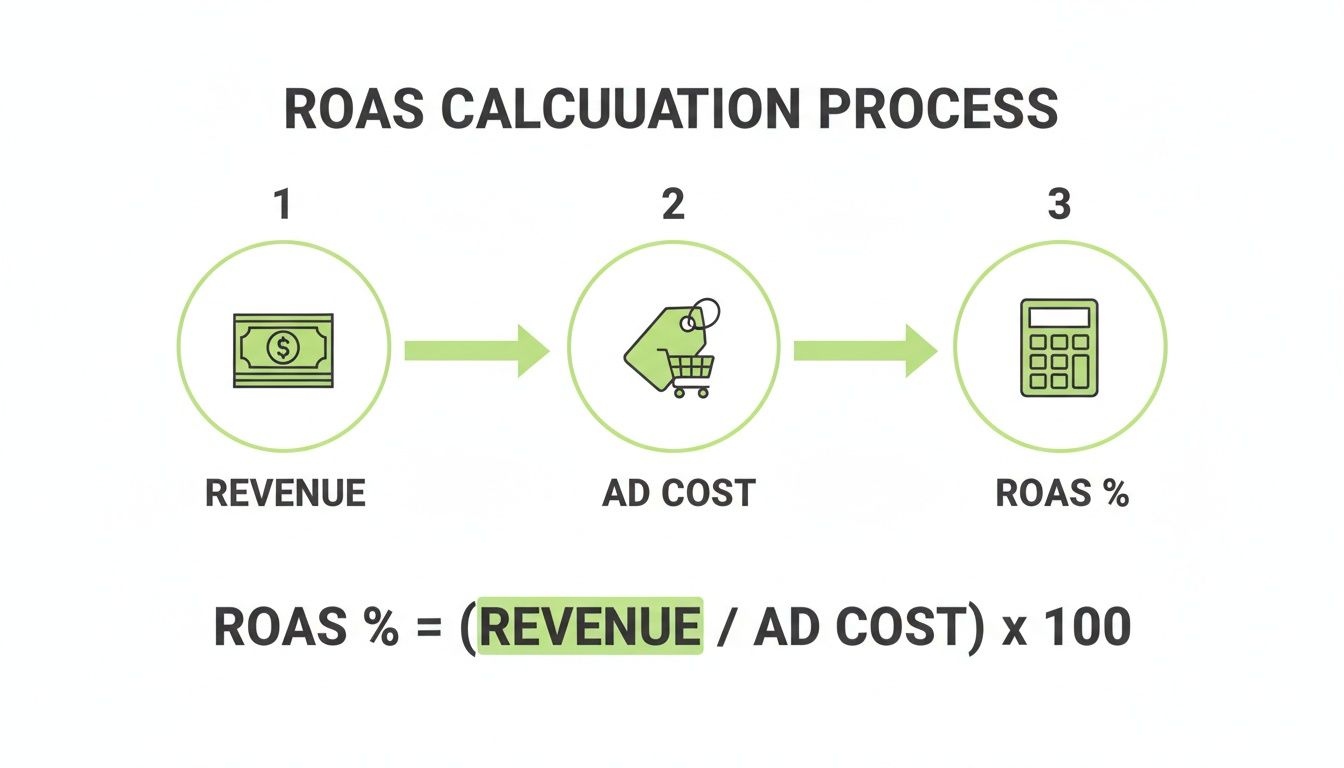
The process looks simple, but its power comes from the quality of the data you feed into that "Revenue" step.
Defining your conversion values in Google Ads
First things first, you need to define what a conversion is actually worth to your business. This is a breeze for e-commerce, where the value is simply the order total. For lead-gen businesses, it requires a bit more thought, like we talked about with weighted values.
Once you've got those numbers, you can set them up in Google Ads.
- Static values: If every conversion has the same value—say, a service business where every new client is worth a predictable €1,000—you can set a static value. You just tell Google Ads that every time someone fills out your "Request a Quote" form, it’s worth €1,000. Simple and effective.
- Dynamic values: For e-commerce, this is non-negotiable. Dynamic values pull the actual cart total for each transaction. This gives Google precise, real-time revenue data, letting its smart bidding algorithms work their magic by bidding more aggressively for users likely to make larger purchases.
Getting all this configured correctly can be a bit of a maze. For a detailed walkthrough, you can find a solid Google Ads conversion tracking setup guide that covers the nitty-gritty technical steps.
Closing the loop with offline conversions
Here's where most companies completely drop the ball. What happens when a lead from a Google Ad becomes a paying customer a month later after a few sales calls? If you don't tell Google about that final sale, its algorithm is flying blind.
This is where uploading offline conversions becomes absolutely critical. It’s the final piece of the puzzle that connects ad clicks to closed deals.
By importing offline sales data back into Google Ads, you’re giving the platform the full picture. You're training it to understand which keywords, ads, and audiences don't just generate leads, but generate actual paying customers.
Platforms like ours are built to automate this headache away. For example, using dynares, we can automatically push offline conversion data back to Google Ads, complete with the final contract value. This ensures the algorithm is always optimizing for what truly matters—closed revenue.
For B2B and high-ticket service businesses, it’s an absolute game-changer. This isn’t just a nice-to-have; it's essential for anyone serious about getting a true, profitable return on their ad spend.
Common mistakes that wreck your ROAS calculation
Alright, let's talk about the dumb mistakes that make your ROAS calculations a complete work of fiction. I’ve seen countless founders think they're tracking things correctly, but they’re making critical errors that lead to terrible decisions—like killing a profitable campaign or scaling one that's secretly burning cash.
You can't build a scalable business on bad data. The goal isn't just to calculate ROAS; it's to calculate it accurately so you can trust the number you’re reporting to your team or investors. This is your reality check.
Ignoring your full ad costs
This is one of the most common and laziest mistakes I see. People will meticulously track their ad spend on Google or Meta but conveniently "forget" about all the other costs that go into actually running the campaigns. Your true ad cost isn't just what you pay for clicks.
Your total advertising cost has to include everything that goes into making those ads run. If you don't account for these, your ROAS will be artificially inflated, and you're just lying to yourself about your profitability.
Think about these often-ignored expenses:
- Agency or freelancer fees: Are you paying a marketing agency or a PPC freelancer? Their monthly retainer or commission is a direct cost of advertising.
- Creative production: Did you hire a designer for ad creative or a copywriter for the ad text? That’s part of the cost.
- Software and tools: The subscription fees for your landing page builder, analytics tools, or automation software are all part of the investment.
Ignoring these costs is like calculating the profit on a product without including the cost of shipping. It’s just bad business.
Using the wrong attribution model
Attribution is a massive headache for everyone, but getting it wrong will completely wreck your ROAS. Most ad platforms default to a "last-click" attribution model, which gives 100% of the credit for a sale to the very last ad a customer clicked before buying.
This is an incredibly simplistic and often misleading way to view the customer journey.
A customer might see your ad on LinkedIn, watch a YouTube video a week later, and then finally search for your brand on Google and click an ad to buy. Last-click attribution gives Google all the credit, making your LinkedIn and YouTube efforts look like failures when they were actually essential.
If you only use last-click, you risk cutting the budget for top-of-funnel channels that are crucial for building awareness and introducing new customers to your brand. You’re essentially cutting off the start of the journey because you're only rewarding the finish line.
It's also why so many marketers get obsessed with PPC. ROAS isn't just a number—it’s the heartbeat of your campaign. It’s worth reading up on the latest trends in return on ad spend analysis to understand just how high the stakes are.
Actionable strategies to genuinely improve your ROAS
Alright, you know how to calculate your ROAS. That’s step one. Now for the fun part: making that number bigger.
This is where the real work—and the real growth—begins.
Forget the generic advice like "lower your CPC." That's obvious and not particularly helpful. We're talking about high-impact, strategic moves that turn good campaigns into genuine money-printing machines. This isn't about small tweaks; it's about building a smarter, more efficient advertising engine.

Go beyond basic keyword targeting
Stop bidding on broad, vague keywords. You're just burning cash. The key is to relentlessly focus on high-intent keywords—the phrases people type when they are ready to buy, not just browse. Think "emergency plumber near me" instead of "plumbing tips."
At the same time, you need to be ruthless with your negative keywords. Every irrelevant search that triggers your ad is a waste of money. Actively hunt for and exclude terms that attract the wrong audience. This simple cleanup can immediately boost your ROAS by plugging the leaks in your budget.
Create hyper-relevant ad experiences
Your ad and your landing page need to be perfectly aligned. If someone clicks an ad for "red running shoes" and lands on a generic shoe homepage, they're gone. It’s a terrible experience, and you just paid for that bounce.
This is where creating a seamless journey from ad to conversion is critical. We've seen firsthand how landing page relevance can slash CPC and boost ROAS. Every ad group should have a dedicated landing page that speaks directly to the user's search query. It's more work, but it’s how you win.
You’re not just buying a click; you’re starting a conversation. If the first thing your landing page says doesn't continue that conversation, you've already lost. Consistency is everything.
Leverage smart bidding with real data
This is where all our earlier work on setting up conversion values pays off. Once you’re feeding Google real revenue data, you can unleash its smart bidding strategies like Target ROAS (tROAS).
You’re no longer telling the algorithm to chase cheap clicks. You’re telling it: "Go find me more customers who will generate a 4:1 return." It’s a powerful shift that aligns the platform's machine learning with your actual business goals. For a deeper dive into enhancing the efficiency of your marketing spend, exploring a data-driven playbook for improving ecommerce conversion rate is essential.
Here are a few other levers you absolutely should be pulling:
- Audience segmentation: Don't treat all visitors the same. Create remarketing lists for cart abandoners, past purchasers, or high-value leads. Target them with specific offers and tailored messaging to bring them back.
- A/B test everything: Continuously test your ad copy, headlines, calls-to-action, and landing page layouts. Small changes can lead to significant improvements in conversion rates, which directly lifts your ROAS.
- Optimize for lifetime value (LTV): A low initial ROAS might be perfectly acceptable if you're acquiring a customer who will buy from you again and again. Understand your LTV and be willing to invest more to acquire the right kind of customer.
Your questions about ROAS answered
Alright, we’ve walked through the mechanics of ROAS, from the basic formula to the nitty-gritty of conversion values. But I know from experience that this is where the real questions start to pop up.
Think of this as a rapid-fire round to tackle the practical, "what-do-I-actually-do-now" stuff I hear from founders and marketers all the time. These are the details that separate a profitable ad account from one that just burns cash.
What is a good ROAS, anyway?
This is the million-euro question, and the only honest answer is: it depends. I know that feels like a cop-out, but it’s the truth. A “good” ROAS is completely tied to your profit margins, overhead, and business model.
You'll often hear people throw around 4:1 ROAS as a solid benchmark. For a high-margin software business, a 3:1 might be wildly profitable. But for a lower-margin e-commerce brand, a 5:1 ROAS might just be your breakeven point once you factor in the cost of goods, shipping, and fulfillment.
Don’t get hung up on some universal number. The only 'good' ROAS is one that leaves you with a healthy profit after all your costs are paid. Figure out your breakeven point first, and then work to crush it.
How long should I wait before judging a campaign?
Patience is a superpower in advertising. It’s so tempting to kill a campaign after a day or two of poor results, but that’s a classic rookie mistake. You have to give the ad platforms enough time to learn, gather data, and find their rhythm.
For Google Ads, this usually means at least 30-50 conversions over a 30-day window. And don't forget your sales cycle. If you’re selling a high-ticket B2B service, the journey from click to cash could take weeks or even months. You can't expect to see the final ROAS in 48 hours.
Resist the urge to be reactive. Let the data pile up before you make any drastic moves.
How do I factor in all my business costs?
This is where ROAS evolves into ROI, and it's where the real business operators shine. Your ROAS calculation is a fantastic measure of campaign efficiency, but your ROI tells you if the business is actually making money.
To get the true picture of profitability, you have to subtract all the other costs tied to that sale, like:
- Cost of goods sold (COGS)
- Shipping and fulfillment costs
- Agency fees or marketing team salaries
- Software subscriptions
This broader perspective is what separates marketers who are just driving revenue from those who are building a genuinely profitable company.
If you're tired of manually managing the complexities of Google Ads and want to ensure every campaign is optimized for true profitability, that's exactly why we built dynares. Our platform automates the creation of high-intent ads and landing pages, helping you boost your ROAS without the guesswork. See how it works at https://dynares.ai.


