
Let's be direct. You're pouring money into Google Ads and you're not entirely sure where it's all going.
On the surface, cost per click advertising feels straightforward: you only pay when someone actually clicks your ad. But in reality, it's a brutal, fast-moving auction where most founders and marketers are massively overpaying for every single click.
So you're burning cash on cost per click advertising
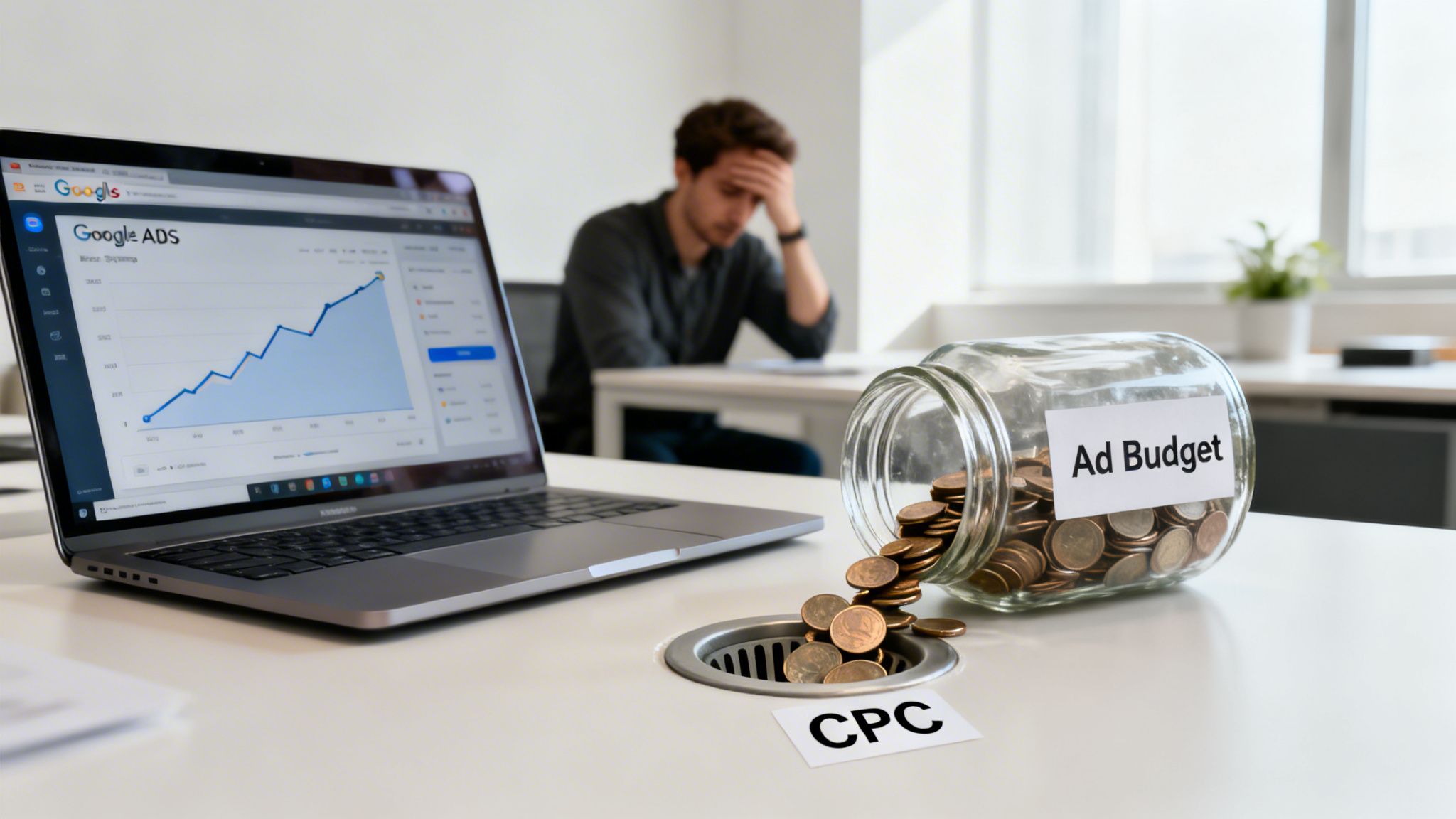
This isn’t a textbook lecture. We’re cutting through the noise to talk about what Cost Per Click (CPC) really is: a variable tax on getting your business in front of the right people. Obsessing over a rock-bottom CPC is a classic rookie mistake, but letting it spiral out of control is a fast way to kill your budget.
This is the grounded, practical take you actually need.
The scale of this game is staggering. Global PPC spending is on track to hit $218.3 billion in 2026. For small and mid-sized businesses, where 65% are already running PPC campaigns, that means the competition is only getting fiercer. Efficiency isn't a nice-to-have; it's everything.
The two CPC models (and why only one matters)
You’ll hear about two ways CPC works, but let's be real—only one of them will ever impact your business.
- Flat-rate CPC: An old-school model where a publisher sets a fixed price for every click. You might see this in some direct media buys or niche newsletters. It's rare and doesn't scale.
- Bid-based CPC: This is the auction model that powers Google, Meta, and every other major ad platform. Your cost is determined by what you and your competitors are willing to pay, plus a few other critical factors we’ll get into.
For 99% of tech founders and marketers, your entire world revolves around the bid-based, auction model. This is where you win or lose.
Why this is urgent now
The hard truth is that most businesses are just lighting money on fire. They launch campaigns without a clear strategy, watch their CPCs climb, and then scratch their heads wondering why their customer acquisition cost is through the roof.
It’s a dumb way to build a company.
This guide is designed to stop that. Think of it as the what they don't tell you briefing before we dive into the mechanics of winning this game. For broader strategies on launching and optimizing your business, including other marketing initiatives, you might find valuable insights at startrightnow.co.
We’re going to get practical, fast.
Understanding the Google Ads auction and your CPC
You’re staring at two numbers that make no sense. Your CPC is €3.42. Your top competitor’s is €1.95. For the exact same keyword.
This isn't a glitch. It's the Google Ads auction—a split-second judgment that decides who wins, who loses, and how much everyone pays for a click. If you don't get how this auction works, you’re not really managing a PPC account; you’re just gambling with it.
How Google decides who wins
The winner of the ad auction is not simply the advertiser with the biggest wallet. If that were the case, the search results would be a swamp of irrelevant, low-quality ads. That's a terrible experience for users, and Google knows it.
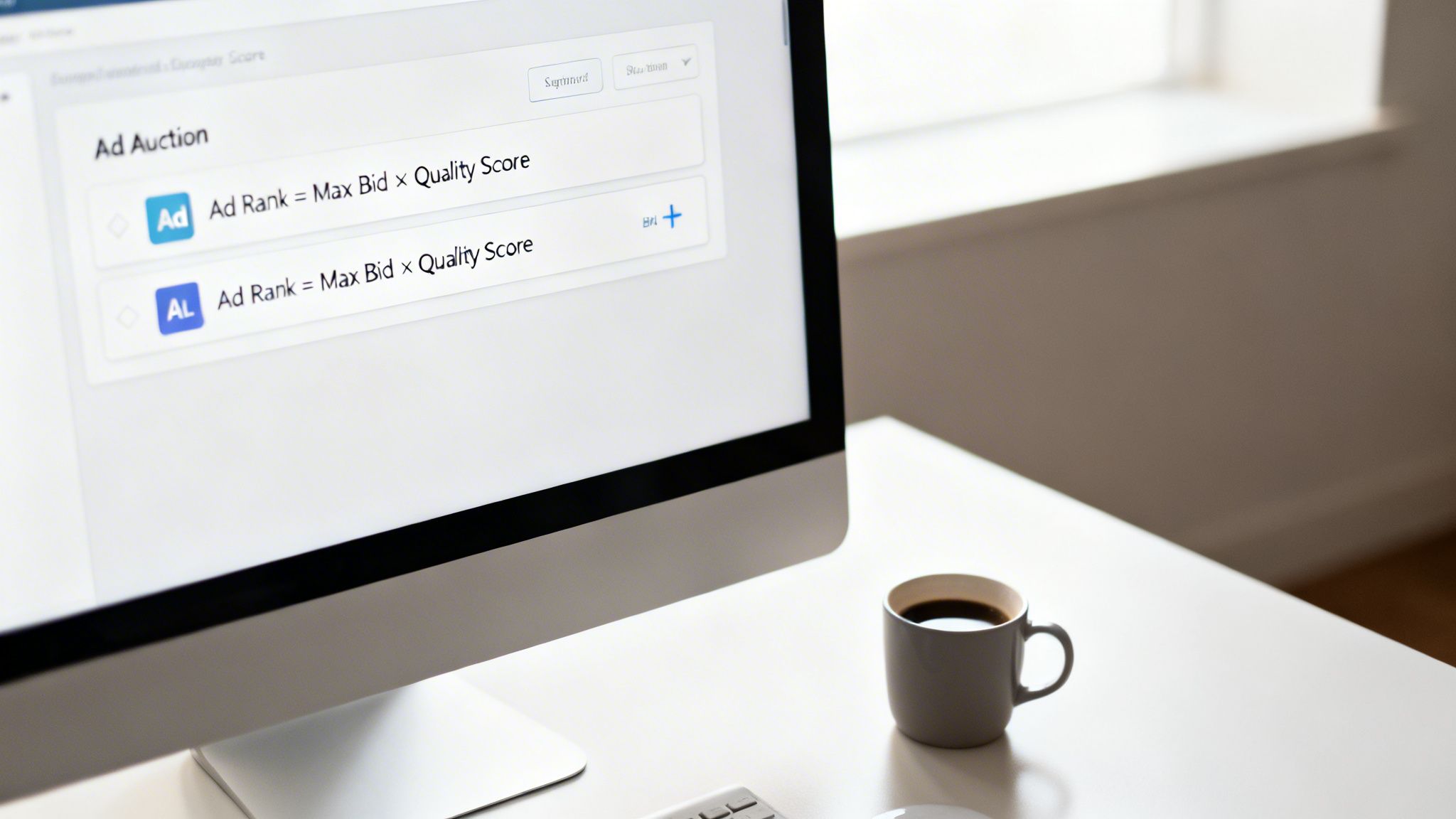
So, instead of a simple high-bid-wins system, Google uses a formula called Ad Rank. Think of Ad Rank as your total score in the auction. A higher score earns you a better position on the page.
Ad Rank = (Your Maximum Bid) x (Your Quality Score)
This little formula is the entire game. As you can see, there are only two levers you can pull: how much you’re willing to bid and how good Google thinks your ad and landing page are (Quality Score).
Just throwing money at your bids is the lazy, expensive route. It's precisely what Google wants you to do, but your P&L will absolutely hate you for it. The real leverage—the secret to winning at a lower cost—is in the second half of that equation.
The power of quality score: your secret discount
Your Quality Score is, without a doubt, the most important metric for wrestling your CPCs under control. It’s Google’s 1-10 rating of the quality and relevance of your keywords, ad copy, and landing pages. In simple terms, it's your reputation. And a good reputation comes with perks.
A high Quality Score acts like a massive discount on your clicks. It lets you achieve a high Ad Rank without having to bid through the roof.
In fact, it’s entirely possible for you to outrank a competitor who is bidding more than you, while you pay less for the click. Read that again. You can pay less to get a better position.
Google calculates this score based on three main ingredients: expected click-through rate (CTR), ad relevance, and landing page experience.
Improving these three areas is the most strategic work you can do in a Google Ads account. A strong Quality Score is a sign of a healthy, efficient campaign that works for everyone: the user finds what they need, you get a relevant customer at a lower cost, and Google protects the quality of its search results.
You can go deeper and learn more about what a Quality Score is and how to improve it in our detailed guide. It's time to stop just playing Google's game and start making the game work for you.
Why CPC is a vanity metric: focus on CPA and ROAS instead
Let's get one thing straight. Obsessing over a low CPC is one of the fastest ways to feel productive while achieving nothing. It's the ultimate vanity metric. Seeing a small number on a dashboard feels good, but it doesn't pay the bills or scale a business.
A low cost-per-click means nothing if those clicks don't turn into customers. It’s time to shift the conversation away from cheap clicks and toward the metrics that actually drive growth: Cost Per Acquisition (CPA) and Return on Ad Spend (ROAS).
The metrics that actually matter
I would take a €5 CPC that lands a €1,000 MRR client over a €0.50 CPC that brings in a thousand window shoppers any day of the week. It’s simple math. Your job isn't to get the most clicks for the least money; it's to acquire customers profitably.
Let's quickly define the two metrics that should be guiding your budget:
- Cost Per Acquisition (CPA): This is your all-in cost to get one new customer. You calculate it by dividing your total ad spend by the number of new customers you won.
CPA = Total Ad Spend / Number of New Customers. - Return on Ad Spend (ROAS): This shows you how much revenue you’re generating for every euro you put into advertising.
ROAS = Total Revenue from Ads / Total Ad Spend. A ROAS of 4x means you made €4 for every €1 you spent.
This shift in focus is what separates amateurs from professional growth marketers. It turns your ad budget from a line-item expense into a predictable profit engine. Once you know your numbers, you can pour more fuel on the fire with confidence.
From cost to profit: how to calculate your targets
So how do you figure out what a good CPA or ROAS target is for your business? Forget generic industry benchmarks—this is all about your specific unit economics. You just need to know your product’s price (and ideally, its Lifetime Value) and your profit margins.
Let’s walk through a SaaS example. Imagine your product costs €100/month, and the average customer sticks around for 12 months. That gives you a Lifetime Value (LTV) of €1,200. If your profit margin is 80%, your total profit per customer is €960.
In this scenario, you can decide exactly how much of that profit you’re willing to reinvest to acquire the next customer. If you set your target CPA at €300, you’re still banking €660 in profit per user. Now you have a clear goal: as long as you're acquiring customers for under €300, you have a profitable, scalable growth engine.
The question you should be asking isn't "Is my CPC low?" but rather "Is my CPC profitable?" It's a simple but powerful mindset shift. This approach is backed by solid data; businesses earn $2 for every $1 spent on PPC, which helps explain why 45-65% of small businesses are all-in on paid search. You can find more statistics on PPC performance and why it’s a powerhouse channel on PPC analytics.
The goal is to stop celebrating cheap clicks and start building a system that predictably turns ad spend into revenue. For a more detailed walkthrough, you can check out our guide on how to calculate ROAS the right way. This is where you graduate from simply managing campaigns to truly driving the business.
Diagnosing why your cost per click is sky-high
Feeling the pinch of sky-high CPCs? Let’s be real. If your cost per click is out of control, it’s almost never one single issue. It’s usually a collection of small, avoidable mistakes that add up to a huge dent in your budget.
This isn’t about pointing fingers. It’s a practical diagnostic to find and plug the leaks in your ad spend. We'll walk through the most common culprits one by one.
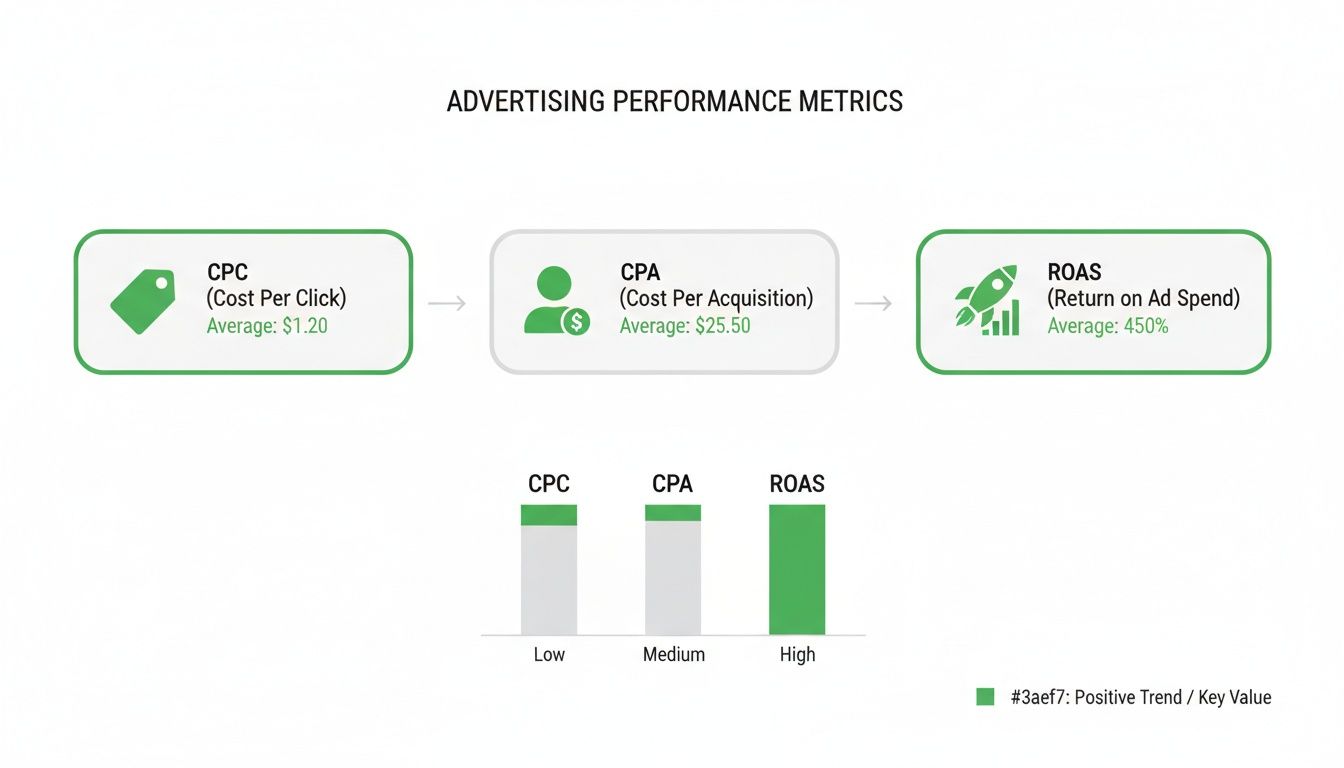
The goal is simple: a low Cost Per Click (CPC) and a low Cost Per Acquisition (CPA) should lead to a high Return on Ad Spend (ROAS). This graphic shows that ideal relationship, and it's what we're all chasing.
Your quality score is in the gutter
Let's be direct: if your Quality Score is tanking, you're essentially telling Google you don’t care about relevance. And Google will make you pay for that ignorance. A low score is a penalty tax, plain and simple.
It's the platform’s way of flagging that your keywords, ad copy, and landing pages just don't line up.
A low Quality Score is the most common—and most damaging—reason for a high CPC. Fix this, and you’ve solved a huge part of the problem. No bidding strategy in the world can make up for a fundamentally bad user experience.
Broad match keywords are burning your cash
Relying on broad match keywords without strict oversight is like handing Google a blank check and hoping for the best. It's a rookie move that drains your budget fast. You end up paying for clicks on searches like free marketing plan templates when you're actually selling a premium SaaS tool.
You're just hemorrhaging cash on irrelevant traffic from people who will never convert. Get serious about your keyword match types and build an aggressive negative keyword list.
Stop letting Google's defaults run your business. Broad match can be useful for discovery, but only when paired with a strict negative keyword list and smart bidding. Otherwise, you're just funding Google's bottom line.
Your ads are generic and no one clicks
Poor ad relevance and a low Click-Through Rate (CTR) are a toxic combination. If your ad copy is a generic snooze-fest that could be for any of your competitors, why would anyone bother to click?
It’s simple: no clicks mean a low CTR. A low CTR signals to Google that your ad is a poor match for the search query, and the algorithm punishes you with a lower Quality Score. That directly jacks up your CPC. You're literally paying a premium for being ignored.
A quick glance at CPC benchmarks shows why every click matters. The average CPC on the Google Search Network is $4.22, while the Display Network is just $0.60. That gap proves intent is everything. With CPCs rising in most industries, efficiency isn't optional.
Your ad needs to grab the user's attention and scream, I have the exact solution you're looking for!
Your landing page experience sucks
Finally, let's talk about where the click actually goes. A click is completely worthless if the landing page is a disaster. If your page is slow, confusing, or has nothing to do with the ad that brought them there, you’ve just paid for a bounce.
A bad landing page experience obviously kills your conversion rates. But it also murders your Quality Score, which—as we've established—drives your cost per click advertising through the roof.
A great landing page is fast, relevant, and trustworthy. Anything less is just a waste of a perfectly good click.
Practical tactics to lower your CPC without sacrificing quality
Enough theory. Let's talk about what you can actually do today to lower your cost per click without flooding your campaigns with garbage traffic.
This isn’t about some secret loophole or gaming the system. It’s about disciplined, focused work on the fundamentals that most accounts ignore.
Getting this right boils down to three areas: your keywords, your ads, and your landing pages. If you mess up any one of them, you’re just lighting money on fire. Let's break down the playbook.
Sharpen your keyword strategy
The fastest way to burn your budget is by bidding on lazy, broad keywords. You think you're casting a wide net, but you're really just paying for clicks from people who will never, ever buy from you.
The fix is to get ruthlessly specific.
This means ditching single-word, high-volume terms and embracing long-tail keywords. These are the longer, more precise phrases that signal real intent. Someone searching for SaaS is just window shopping; someone searching for inventory management SaaS for e-commerce is looking to buy.
Your goal is to build hyper-tight ad groups. Each ad group should only contain a small, tightly-themed cluster of keywords. This is what lets you write incredibly relevant ad copy—the first step toward a higher Quality Score and a lower CPC.
- Focus on intent: Don't just ask what they're searching for; ask why. Are they researching, comparing, or ready to pull out a credit card? Match your keywords and ads to that intent.
- Embrace match types: Stop letting Google’s broad match defaults run your campaigns into the ground. Use phrase and exact match to take back control.
- Build a ruthless negative list: Negative keywords are your best friends. They're like bouncers for your campaign, turning away irrelevant searches at the door. If you want to get serious, you need a comprehensive negative keywords list to slash wasted ad spend.
Write ad copy that demands to be clicked
Your ad copy has one job: get the right person to click.
If your ads are generic and boring, your Click-Through Rate (CTR) will be in the gutter, and Google will penalize you with a higher CPC. You are literally paying a premium for being uninteresting.
Good ad copy isn't about being clever; it's about being clear and relevant. It has to directly mirror the user's search and make a compelling promise. It needs to stand out and scream, I have the exact solution you're looking for!
A higher CTR is a direct signal to Google that your ad is relevant. The algorithm rewards this relevance with a better Quality Score, which directly lowers your cost per click. Better ads don't just get you more clicks; they make every click cheaper.
To make this happen, make sure your ad includes the primary keyword, highlights a unique benefit, and has a strong call to action (CTA). Don't just say Click Here. Tell people exactly what to do next: Get Your Free Demo or Download the Report.
Nail the landing page experience
This is the part most people get wrong.
You can have the perfect keywords and the most compelling ad in the world, but if the landing page sucks, you’ve just paid for a bounce. A click is completely worthless if the destination fails to deliver.
The single most important concept here is message match. The promise you make in your ad must be immediately obvious on the landing page. The headline on your page should echo the ad copy. If the user feels even a slight disconnect, they're gone.
Beyond message match, your page needs to be fast, clear, and trustworthy.
Fixing these three areas—keywords, ad copy, and landing pages—isn't a one-time project. It's a continuous process of optimization. But by focusing your energy here, you're not just lowering your CPC; you're building a more efficient and profitable growth engine for your business. It's hard work, but it’s the only work that matters in cost per click advertising.
How AI tools like dynares are changing the game
Let's be real for a moment. Manually optimizing thousands of keywords isn't just a pain; it's impossible to do well once you reach any kind of scale. This is where the future of cost per click advertising is heading, and it's a massive shift.
AI is the single biggest advantage we have in advertising right now. Full stop.
This isn't about firing your marketing team. It’s about giving them superpowers. Instead of drowning in spreadsheets and fiddling with bids, marketers can focus on strategy while the machines handle the soul-crushing, repetitive work. It’s the only sane way to grow in 2026 and beyond.
Beyond automation to true intelligence
Real AI optimization is so much more than just tweaking bids. Imagine a system that could generate a unique, high-intent landing page and a perfectly matched ad for every single keyword you bid on.
Just think about that for a second.
This isn't some far-off dream; it's exactly what platforms like Dynares are built to do. This level of granularity is something a human team could never, ever achieve. It guarantees a perfect message match from the user’s search to your ad to the final landing page, every single time.
The impact is immediate.
This kind of hyper-relevance sends your Quality Scores through the roof. And like we’ve covered, a higher Quality Score is a direct discount on your CPC. You're not just getting better leads; you're paying less for them because you're giving Google’s users a fundamentally better experience.
This is how you break the cycle of rising CPCs and build a real competitive moat. You’re not just out-bidding your rivals; you’re out-smarting them.
Closing the loop with revenue optimization
But the most advanced systems take it one step further. It's not just about getting more leads; it's about getting valuable leads that actually turn into revenue. This is where so many campaigns fall flat—optimizing for a cheap form fill instead of actual business impact.
Here’s how an intelligent system closes that loop:
- Continuous A/B testing: AI can run thousands of micro-tests on ad copy, headlines, and page layouts at the same time, automatically finding the winning combinations.
- Conversion value integration: The system tracks which keywords and ads drive actual sales, not just sign-ups, and feeds this crucial data back into Google Ads.
- Revenue-focused bidding: Armed with this data, Google’s own smart bidding algorithms can finally optimize for what really matters—ROAS. It can bid more for keywords that bring in high-LTV customers.
This creates a powerful, self-improving feedback loop where the entire campaign gets smarter and more profitable over time. For anyone serious about growth, seeing how an AI-powered Google Ads campaign optimizer can automate this whole process is a no-brainer. It's the difference between just managing a campaign and building a true growth engine.
Frequently asked questions about CPC
Alright, let's wrap this up by tackling some of the questions that always pop up when I talk about cost per click advertising. These are the things people ask me directly, so here are some straight, no-BS answers.
What is a good CPC?
With all due respect, this is the wrong question to be asking. It’s like asking, what’s a good price for a vehicle? A €50,000 truck is a bargain for a construction company and a financial disaster for a student.
A ‘good’ CPC is a profitable one. Period.
For a SaaS business selling a €10,000 annual contract, a €50 CPC that leads to a sale is incredible. For an e-commerce store selling a €20 t-shirt, a €2 CPC is a fast track to bankruptcy. Stop obsessing over industry benchmarks.
The only number that matters is your own. Calculate your target Cost Per Acquisition (CPA) based on your customer lifetime value and profit margins. Your CPC is only 'good' if it allows you to hit that CPA target profitably.
Should I just set a low max CPC bid to control costs?
No. This is a classic rookie mistake, and it’s a terrible strategy. Setting an artificially low bid sounds smart on paper, but it usually means you won't even get invited to the auction for valuable, high-intent searches.
It’s far better to focus your energy on improving your Quality Score. A high score is your real leverage—it lets you win better ad positions even with a lower bid than your competitors. Focus on relevance and quality, not just on being cheap.
How long does it take to see CPC go down after making changes?
You can see movement relatively quickly, which is one of the best parts of working in PPC. If you roll out brilliant new ad copy that boosts your Click-Through Rate, you could see a positive impact on your Quality Score and CPC within a matter of days.
However, bigger changes, especially those related to your landing page experience, might take a bit longer for the algorithm to fully process and trust.
A good rule of thumb is to give any significant changes 1-2 weeks to gather enough data for you to see a real trend. Don't make panicked, knee-jerk decisions every day. Be patient and let the data tell you what to do next.
If you're tired of the manual grind and want to see how AI can slash your CPCs by building hyper-relevant campaigns at a scale you can't match, you should check out dynares. We automate the entire process so you can focus on strategy, not spreadsheets. See how dynares works.


