
Let's be blunt: if you're spending money on ads, you need to know if it’s working. Cost per conversion (CPCv) is the one metric that tells you exactly how much you're paying to get a customer, a lead, or whatever action you've defined as a win.
Forget vanity metrics like clicks or impressions—this is about tangible results.
Defining cost per conversion without the jargon
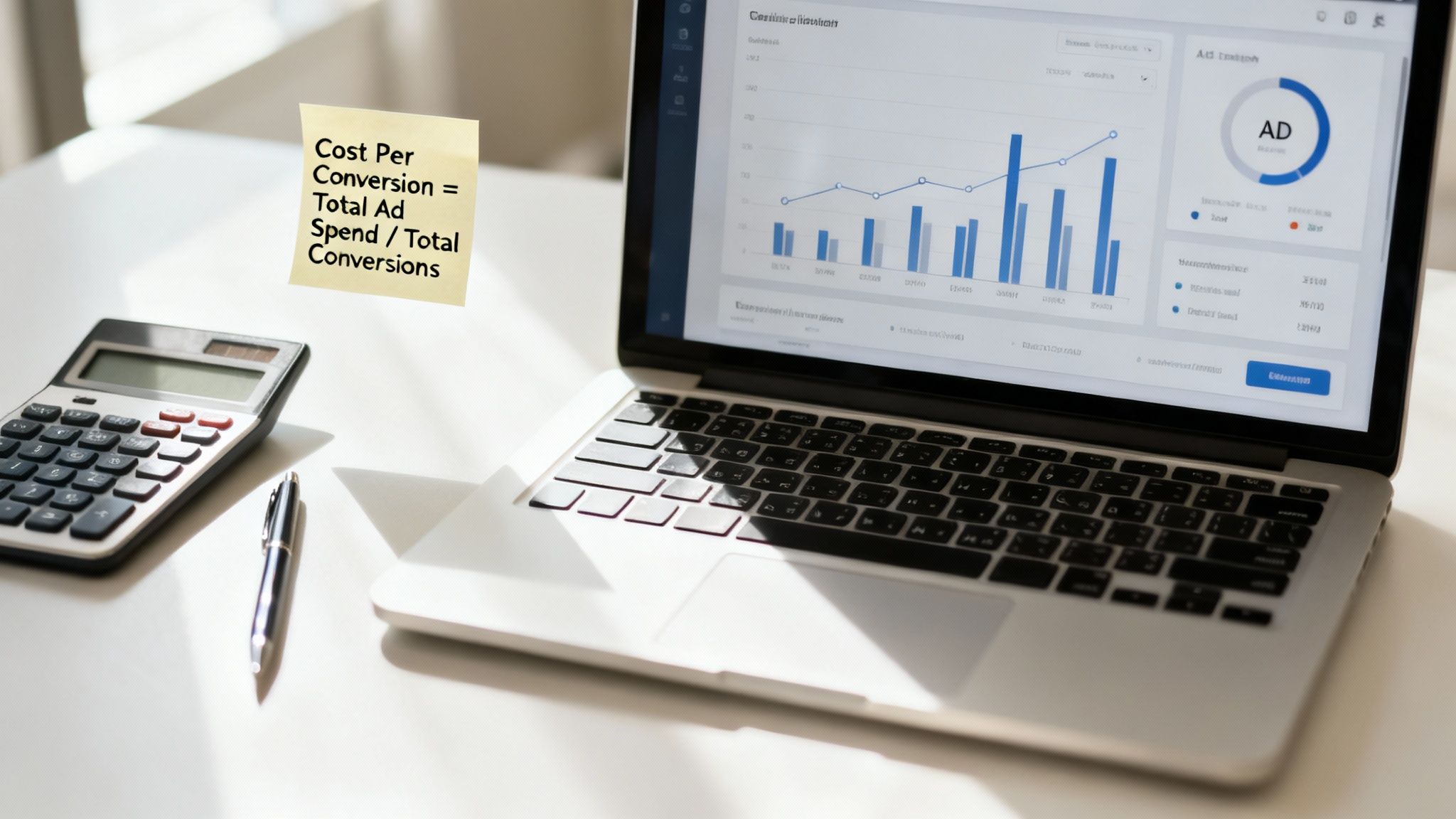
Alright, let's cut the fluff. Cost per conversion is the single most important number to determine if your advertising is a profit engine or a money pit. It answers a simple, brutal question: how much did you pay for that specific outcome?
The formula is dead simple:
Cost Per Conversion (CPCv) = Total Ad Spend / Total Number of Conversions
This number cuts through all the noise. It doesn't care how many people saw your ad or even clicked on it. It only cares about how many people took the action you wanted them to take. That action, or a conversion, is whatever you decide it is.
What counts as a conversion?
A conversion isn't always a sale. It's any valuable action a user takes that moves them closer to becoming a customer.
For a tech founder or a marketer, this could be any number of things:
- A user filling out a lead generation form.
- Someone signing up for a free trial of your SaaS product.
- A customer completing a purchase on your e-commerce site.
- A potential client booking a demo call.
Cost per conversion is the critical benchmark for PPC managers evaluating the efficiency of their Google Ads. Industry analysis for 2025 showed an average search ad conversion rate of 7.52% across major markets, showing just how effective these campaigns can be at driving leads.
To put it into practice, imagine a typical e-commerce campaign spends $10,000 and generates 100 sales. That gives you a CPCv of $100. You can see more of the latest Google Ads benchmarks on Wordstream.com.
This metric is your ground truth. It’s the starting point for understanding your return on ad spend (ROAS) and, ultimately, your profitability. If your CPCv is higher than the value you get from that conversion, you have a problem. If it’s lower, you have a scalable growth channel.
It really is that simple.
Why CPCv gets confused with other metrics
Let's be honest: the marketing world loves its acronyms, and it’s a minefield for anyone just trying to figure out what works. CPC, CPA, CPL—they all sound annoyingly similar. Confusing them isn’t just a simple mistake; it’s a classic error that leads to burning cash on the wrong outcomes.
This alphabet soup is why so many campaigns fail. Founders and marketers get obsessed with one metric without realizing it’s a vanity number or, worse, completely irrelevant to their actual business goals. You can have a fantastic cost per click (CPC), but if none of those clicks turn into leads or sales, you’re just paying for digital window shoppers.
Distinguishing CPCv from its cousins
To scale intelligently, you have to know precisely what you're measuring. Optimizing for the wrong metric is like training for a marathon by practicing your high jump—you’re working hard, but you’re not going to win the race.
Let’s draw a clear line in the sand between these terms:
- Cost Per Click (CPC) is simply the price you pay each time someone clicks your ad. It measures traffic, not results. A low CPC feels good, but it tells you nothing about the quality of that traffic.
- Cost Per Lead (CPL) gets more specific. It measures how much you pay for a potential customer’s contact information, like an email from a form fill. This is one type of conversion, but it isn't the only one.
- Cost Per Acquisition (CPA) is the sneakiest one because it's often used interchangeably with CPCv. The key difference is that CPA typically refers to the total cost to acquire a paying customer. CPCv is broader and can measure any defined conversion, including non-paying actions like a free trial signup or a demo request.
The core difference is intent. CPC measures interest, CPL measures a specific lead action, and CPCv measures any pre-defined win you care about. CPA is usually the final boss: the cost to get a paying customer on board.
You can see how Google Ads presents these options right in their campaign setup, pushing you to define your goal from the start.
This interface is designed to make you choose what matters—sales, leads, or website traffic—because the platform will optimize for that specific outcome. For more on this, check out our deep dive into the various metrics and reports that truly matter for your campaigns.
Understanding this distinction is the first step toward building a marketing engine that doesn’t just generate clicks, but generates actual revenue.
Calculating your true cost per conversion
Alright, let’s get our hands dirty. Forget the theory for a minute—this is about finding the actual numbers that tell you if your campaigns are winning or losing.
The good news? You don’t need a math degree. The formula is as straightforward as it gets: Total Cost / Total Conversions.
The real trick is knowing where to find those numbers and, more importantly, trusting them. If you’re running campaigns on a platform like Google Ads, this data is sitting right there in your dashboard. You'll find your total spend under the cost column and your conversions under the conversions column. Divide the first by the second, and you’ve got your CPCv. No more guesswork.
Real-world calculation examples
Let's make this tangible. The calculation itself never changes, but the context is everything. What's considered a great CPCv for an e-commerce store could be a total disaster for a B2B software company.
Here are a few scenarios to show you how it works in practice:
- E-commerce sale: You spend €500 on a Google Shopping campaign that brings in 20 sales. Your cost per conversion is €500 / 20 = €25. If your average order is €100 with a 50% margin, you just made money. That’s a solid win.
- B2B lead form: A LinkedIn campaign costs you €2,000 to promote a whitepaper, resulting in 50 downloads. Your cost per conversion (a lead) is €2,000 / 50 = €40. Now, the real question is what percentage of those leads eventually become customers. That’s how you’ll know if €40 was a good price to pay.
- SaaS demo request: Your Google Search campaign has a total cost of €1,500 and generates 10 demo requests. The cost per conversion here is €1,500 / 10 = €150. If one out of every five demos converts to a customer paying €2,000 a year, that €150 starts to look like a brilliant investment.
The point is, the calculation is the easy part. The real strategic thinking comes from defining what a valuable conversion actually is for your business and then judging the cost against its potential return.
Why your tracking must be flawless
Here’s the hard truth: if your conversion tracking is a mess, all of this is pure fiction. You simply cannot calculate your true cost per conversion with bad data. It's the classic garbage in, garbage out problem.
Broken tracking leads you to misattribute sales, under-report leads, or just fly blind, with no real clue what’s actually working. You end up making decisions based on fantasy numbers—and that’s the fastest way to burn through your budget.
Before you spend another euro, make sure your tracking is set up correctly. For a deep dive on getting this right, check out our guide on a bulletproof Google Ads conversion tracking setup in our article. This is the absolute, non-negotiable foundation for profitable advertising.
Understanding what a ‘good’ CPCv really means
So, you’ve got your cost per conversion number. Now what? Is €50 great? Is €200 a disaster?
The only real answer is: it depends entirely on your business. There’s no universal good CPCv, and anyone who tells you otherwise is probably trying to sell you something.
A good CPCv is completely relative. It’s defined by one thing and one thing only: your customer lifetime value (LTV). This is the total profit you expect to earn from a customer over their entire relationship with you. If you don't know this number, you're flying blind.
The golden rule is brutally simple: your CPCv has to be significantly lower than your LTV. If it costs you €100 to acquire a customer who will only ever pay you €80, you’ve just built a very efficient machine for losing money. That’s not a business; it’s a cash bonfire.
This flowchart breaks down the simple calculation, showing how your ad spend and conversions come together to give you a final CPCv.
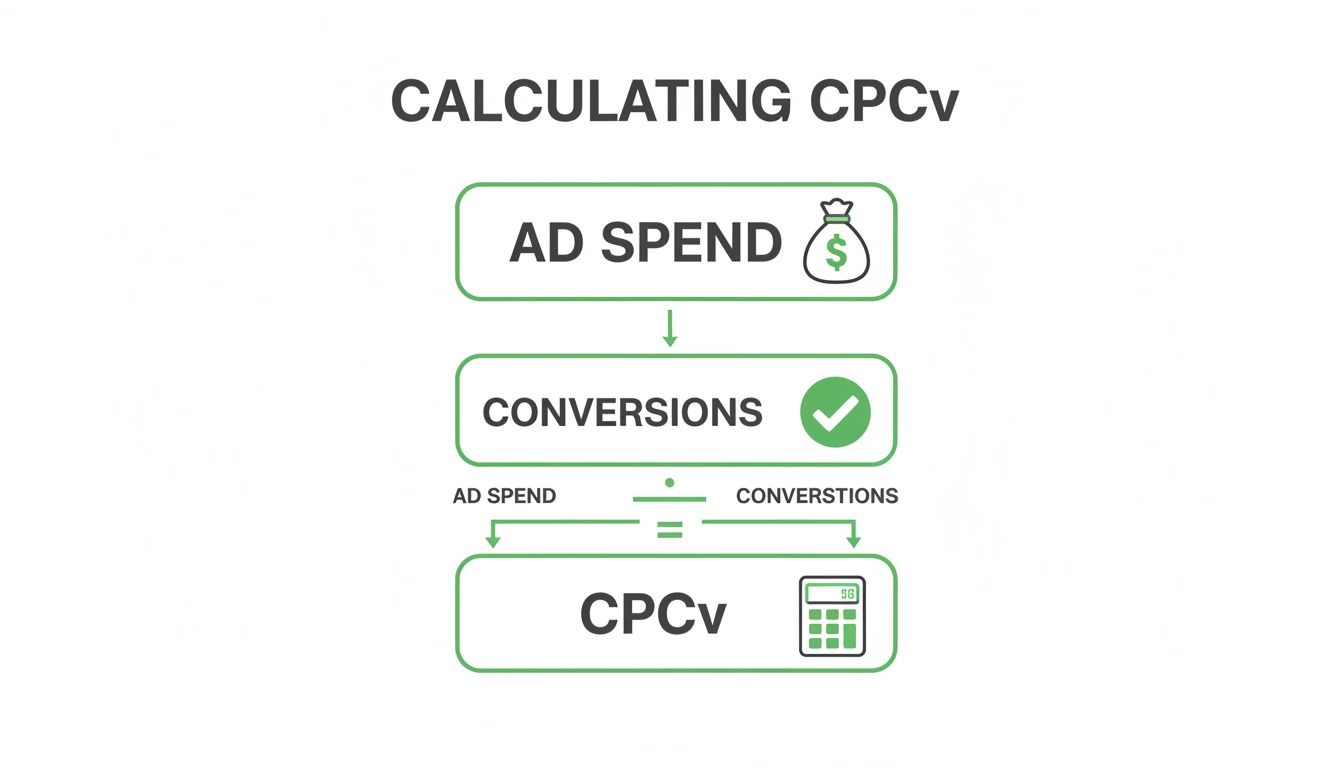
It’s a direct visual of what you spend versus what you get, reinforcing that every euro of ad spend needs to be justified by a real conversion.
Context is everything
Of course, industry benchmarks can give you a bit of context. For digital agencies, seeing how your CPCv stacks up is a good way to spot optimization gaps.
Data shows Google Ads CPCv often lands between $30-$90. The Display Network tends to be cheaper ($5-$50) because of lower intent, while Search campaigns can range from $10-$200. In hyper-competitive industries like finance or medical, costs can easily rocket past $300 per conversion thanks to intense bidding wars on high-value keywords. You can see a great breakdown of how costs vary across industries on KlientBoost.com.
But even with these numbers, the LTV rule is king. If your average LTV is $500, then a CPCv under $100 signals a healthy, profitable acquisition engine.
The question isn't what's a good CPCv? The real question is what CPCv can my business profitably sustain? Get that right, and you're on the path to building something truly scalable.
CPCv vs. customer lifetime value (LTV)
Thinking about your CPCv in relation to your LTV gives you a quick health check on your entire customer acquisition strategy. It tells you whether you're building a sustainable business or just buying expensive clicks.
CPCv to LTV ratioBusiness health signalRecommended actionHigh (e.g., 1:1 or worse)Unsustainable. You're losing money on every new customer. This is a red alert.Pause campaigns immediately. Re-evaluate your targeting, offer, and landing pages. You can't scale a loss.Moderate (e.g., 1:3)Healthy but room for growth. You have a profitable model, but efficiency gains will significantly boost your bottom line.Focus on optimization. Improve landing page relevance, ad copy, and bidding strategies to lower your CPCv.Low (e.g., 1:5 or better)Excellent! You have a strong, scalable acquisition engine. Each conversion is highly profitable.Time to scale. Increase budgets on your winning campaigns and explore new channels. You have a proven model.
This ratio is one of the most honest metrics in your business. It cuts through the noise of clicks and impressions and tells you if your marketing is actually making money.
To get a clearer picture, it’s also vital to understand the other side of the equation. Check out our guide on what is a good conversion rate to see how it works hand-in-hand with your CPCv.
Ultimately, your CPCv is a diagnostic tool. It tells you the health of your customer acquisition. Use it to make smart, strategic decisions—not just to compare yourself to others.
Practical ways to lower your conversion costs
Knowing your cost per conversion is one thing. Actually lowering it is where the real magic happens. A high CPCv isn't a death sentence—it's just a signal telling you it’s time to get your hands dirty and start optimizing.
Let's be direct: you don't need a thousand-point checklist. You just need to focus on the few things that actually move the needle. This is all about action, so let's dig into the high-impact areas that will drive down your costs.

Nail the message match
This is the lowest-hanging fruit, and it’s shocking how many advertisers get it wrong. Message match is the alignment between your ad copy and your landing page. Simple as that.
If your ad screams "50% Off AI-Powered Widgets" but the landing page headline just says "Welcome to Our Widget Store," you’ve created a jarring disconnect. That tiny moment of confusion is enough to kill a conversion on the spot.
Think of it like this: your ad makes a promise, and your landing page is where you deliver on it. The journey has to feel seamless and logical.
A perfect message match accomplishes two critical things: it reassures the user they’re in the right place, immediately confirming they clicked the correct link and it boosts your Quality Score in Google Ads. Google rewards relevance, and a higher Quality Score directly leads to a lower cost per click—and, by extension, a lower cost per conversion.
Don’t overthink it. Just make your ad and landing page speak the same language.
Clean up your data hygiene
Here’s a hard truth most marketers won't admit: garbage in, garbage out. If your conversion tracking is a mess, you're making decisions based on fiction. You simply cannot optimize what you can't accurately measure.
Improper tracking is the silent killer of marketing budgets. You might be shutting down a campaign that’s actually printing money or scaling one that’s secretly bleeding you dry, all because a tracking pixel was misconfigured.
Your data is your ground truth. Without clean, reliable tracking and attribution, you’re not doing marketing—you’re gambling.
Historical data, in particular, unlocks massive potential for cutting your cost per conversion. For founders and growth teams scaling paid search, analyzing past performance can slash acquisition costs by up to 25% by revealing hidden patterns.
For example, your data might show that weekends yield a 30% lower CPCv ($40 vs. $57 on weekdays). That insight alone lets you make bid adjustments that lead to immediate savings. Find out more about how historical data fuels better decisions on leadenforce.com.
Automate the heavy lifting
Manually creating a unique, relevant landing page for every single ad group is a nightmare. It's tedious, slow, and frankly, no human can do it effectively at scale. This is where technology becomes your unfair advantage.
Platforms like dynares are built to solve this exact problem. By automating the creation of ads and matching landing pages for every keyword, you can achieve perfect message match across thousands of variations without lifting a finger. The system injects keywords and tailors copy automatically, ensuring every user gets a hyper-relevant experience from click to conversion.
This level of automation has a direct impact on your bottom line by maximizing Quality Scores, boosting conversion rates and drastically lowering your cost per conversion.
This isn't about replacing marketers; it's about giving them superpowers. It lets you focus on high-level strategy while the machines handle the repetitive, detail-oriented work that actually drives your CPCv down.
The bottom line on cost per conversion
Alright, let’s land this plane. We’ve covered what cost per conversion is, how to calculate it, and even given you a solid framework for figuring out what a good CPCv actually looks like for your business. We also armed you with a handful of real-world tactics to start improving it.
If you only remember one thing from this entire guide, make it this: stop obsessing over clicks and start focusing on conversions. It’s a simple mental shift, but it fundamentally changes how you approach paid advertising.
Think of your cost per conversion as your north star. It’s the metric that tells you the unfiltered truth about whether your campaigns are actually working and, more importantly, if they’re profitable. In a world drowning in vanity metrics and noisy data, this is one of the few numbers that ties your ad spend directly to real business results.
In the end, the only thing that matters is whether your ad spend is generating more value than it costs. Your cost per conversion is the simplest, most direct measure of that equation.
Use it wisely. Work relentlessly to improve it. This is how you build what every founder and marketer dreams of: a scalable, profitable growth engine. That's the real end game here.
Now go make it happen. 🚀
Common questions about CPCv
Let's tackle a few of the questions that always come up when people start digging into cost per conversion. Getting these right will save you a lot of headaches down the road.
What’s the difference between CPCv and CPA?
People use these terms interchangeably all the time, but they really aren't the same thing. It’s a subtle but important distinction.
CPA (Cost Per Acquisition) is almost always about one thing: acquiring a new, paying customer. It’s the final step, the moment money changes hands.
Cost Per Conversion (CPCv) is much broader. A conversion can be any valuable action you decide to track—someone submitting a lead form, signing up for a free trial, or booking a demo call.
Here’s the easiest way to remember it: all acquisitions are conversions, but not all conversions are acquisitions. Nailing this difference is key to actually understanding how your funnel is performing from top to bottom.
How often should I check my cost per conversion?
Honestly? Not every hour. You'll drive yourself crazy and end up making terrible decisions based on tiny blips in the data. Don't be that person.
For most campaigns, a weekly check-in is the right rhythm. It gives you enough data to spot real trends without overreacting to the normal daily fluctuations. If you're running a massive-budget campaign or a very short-term promotion, checking every 2-3 days might be necessary, but for the vast majority of us, weekly is the sweet spot.
My cost per conversion is high. what’s the first thing I should fix?
Before you even think about touching your bids or tweaking your ad creative, go straight to your ad-to-landing-page relevance. This is almost always the biggest and fastest lever you can pull to bring down a high CPCv.
Just ask yourself a few simple questions: does the headline on my landing page perfectly mirror my ad copy? Is the page delivering exactly what the ad promised? Is the journey from click to conversion smooth and obvious?
Any friction or mismatch here will absolutely murder your conversion rate and send your CPCv through the roof. Fix the user's journey first, then worry about everything else.
Ready to stop guessing and start lowering your CPCv with perfect message match at scale? dynares automates the creation of hyper-relevant ads and landing pages for every keyword, so you can focus on strategy while the platform handles the execution. See how it works at dynares.ai.


