
Let's be blunt: lead generation technology isn't some abstract buzzword. It's the engine you build to turn ad clicks into revenue. It’s the system of software that finds anonymous website visitors, figures out who they are, and turns them into actual customers.
Getting this right is the difference between scaling your business and just setting your ad budget on fire.
Why your lead gen tech stack is everything
As someone who builds tech products, I see too many companies get this wrong. They either duct-tape together a chaotic mess of tools that don’t talk to each other, or they fall for a slick sales pitch and buy a massive all-in-one platform that does nothing particularly well. Both are dumb.
The truth is, your lead generation technology isn't a single piece of software. It’s an engine.
Imagine a factory assembly line. The raw material is a person clicking your ad. The finished product is a new customer. Every station on that line—from the landing page they see to the CRM where their data ends up—has to work in perfect sync. A single broken part can bring the whole operation to a standstill.
Moving beyond the old way
For years, lead generation was a manual, disconnected slog. You had one person running ads, another building generic landing pages, and a sales team complaining about the garbage leads they were getting. It was slow, inefficient, and impossible to scale. We're past that now.
The difference is stark when you see it side-by-side.
| Manual lead generation (the old way) | Technology-driven lead generation (the new way) |
|---|---|
| Generic, one-size-fits-all landing pages | Dynamic, per-intent landing pages |
| Manual data entry and CSV uploads | Automated data sync with CRM and ad platforms |
| Disconnected tools that don't share data | Integrated stack with seamless workflows |
| Slow, reactive optimization based on old data | Real-time, automated optimization |
| High-friction experience for prospects | Personalized, seamless user journey |
| Impossible to scale beyond a few key funnels | Built for scale from the ground up |
The old way was a numbers game based on brute force. The new way is a precision game. It’s about creating a seamless, personalized experience for every single prospect, at scale, by using intelligent automation.
Modern technology lets us automate the tedious work so we can focus on strategy. This isn't about replacing humans; it's about empowering them to do what they do best: think, strategize, and build relationships. The market is just too competitive to do it any other way.
And this isn't just a small trend. The global lead generation industry is projected to hit a staggering $295 billion by 2027, growing at a blistering 17% compound annual rate. The data shows businesses that properly integrate AI into their systems are seeing huge returns, with some slashing customer acquisition costs by up to 60%. You can dive into more lead generation statistics to see just how fast this space is moving.
The shift from cost to investment
Here’s the mindset shift you have to make: your lead generation technology is not a cost center. It's a revenue-generating asset, just like your best salesperson. To get it right, you need to understand its core components.
In this guide, we're skipping the high-level fluff. We’re getting into the practical guts of building a lead gen engine that actually works. We'll look at specific workflows, the KPIs that matter, and how to choose tools (like our own platform, dynares.ai) that won’t just create an expensive mess. Let's get to it. 🚀
The core components of a modern lead generation stack
A modern lead generation stack isn't one magic tool. It's an ecosystem, and if the parts don't work together, the whole thing is just a very expensive way to generate useless clicks.
Think of it like building a race car. You can’t just bolt a huge engine onto a stock frame with bad brakes and expect to win. Every component has to be engineered to work in concert. Get one part wrong, and you're left with wasted ad spend and a sales team wondering where the good leads are.
Let's break down the non-negotiable pieces.
Landing pages and forms: the frontline soldiers
First up are your landing pages and forms. This is where the first real handshake happens, where a curious clicker decides whether to become a lead.
Frankly, sending paid traffic to your homepage is just lazy. It’s a guaranteed way to burn cash and kill your conversion rates. The same goes for using one generic landing page for every ad you run.
Modern lead gen demands dynamic, intent-matched pages for every campaign—and ideally, for every ad group. If someone searches for enterprise CRM for finance, they better land on a page that screams, We built this for finance teams. Anything less is a failure. For anyone serious about this, exploring how an AI landing page builder can automate this process is a good first step.
Here’s what this layer absolutely must do:
- Dynamic content: The page's headline, copy, and images should instantly adapt to match the user's search query and the ad they clicked.
- Frictionless forms: Forms need to be simple and smart. Only ask for what’s absolutely necessary upfront. Multi-step forms or progressive profiling can make the process feel much less intimidating.
- Blazing-fast speed: Every millisecond counts. A slow page kills conversions, especially on mobile, where over 50% of web traffic now lives.
Ad automation and tracking: the brains of the operation
Next is ad automation and tracking—the brains of your entire system. This isn't just about scheduling ads. Real lead gen tech connects the dots with surgical precision, from the initial keyword search all the way through to the final conversion.
This is the central nervous system of your stack. It ensures that insights from one part of the system (like which landing page converts best) are automatically fed back to another (like your ad platform’s bidding algorithm). Without this connection, you’re just flying blind and making decisions on half the data. The goal is to create a closed-loop system where performance data from the bottom of the funnel directly informs the strategy at the top. You're not just buying clicks; you're buying data that makes every subsequent click more valuable.
CRM integration and analytics: the revenue engine
Finally, we have the CRM integration and analytics layer. This is where you actually make money. A stack without tight CRM integration is just a hobbyist's email collection tool.
It’s completely pointless to generate thousands of leads if you have no idea which ones are turning into actual customers. For B2B outfits, specialized tools are critical here, and learning how to start Mastering LinkedIn Sales Navigator can be a key part of identifying high-value prospects within your lead flow.
This final layer is what separates the pros from the amateurs. It’s about answering the one question that matters: which campaigns, keywords, and ads are generating real revenue?
When your CRM can tell your ad platform, Hey, that lead from the keyword 'industrial safety software' just became a €50,000 deal, your entire strategy shifts. You stop optimizing for cheap, low-quality leads and start optimizing for profit. This is how you build a real growth machine, not just a disjointed collection of expensive software.
Paid search is a brutal game. You’re paying for every single click, which means every impression, every keyword, and every landing page has to earn its keep. If your workflow is slow, manual, and disconnected, you’re not just being inefficient—you’re actively burning money.
The winners in paid search build something different. They create high-velocity, automated workflows that connect the dots from a user's first search all the way to them becoming a paying customer.
Let's get practical here. This isn't theory; it's about architecture. A winning PPC setup depends on a tight, real-time feedback loop between your ads, your landing pages, and your actual sales data. You need a system that can react and optimize faster than any human ever could.
This flow chart shows a simplified version of that architecture, moving from the initial click to the final analysis.
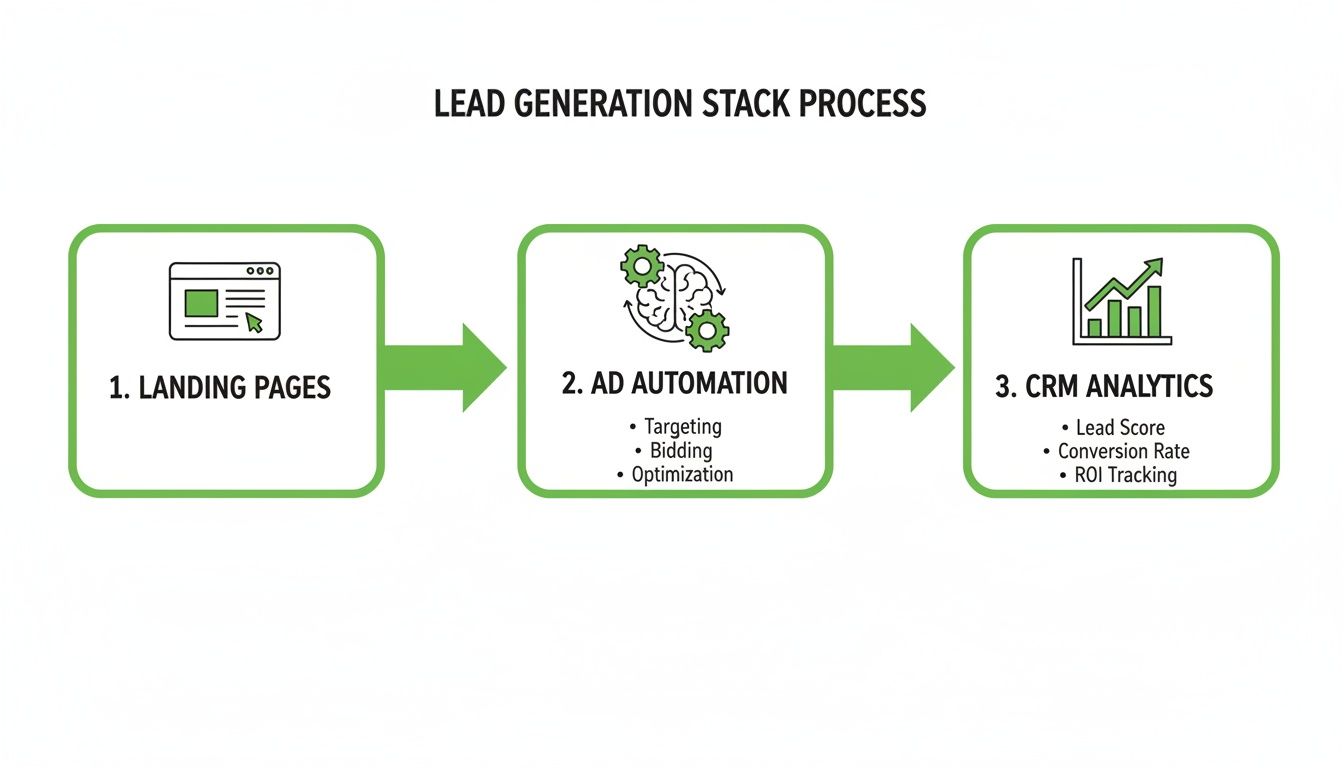
What you're seeing isn't three separate tools, but a single, integrated machine where each stage feeds the next. This closed-loop system is the heart of modern lead generation technology for paid search.
The power of intent matching at scale
Think about a real search. Someone types 'enterprise CRM for finance' into Google. A generic ad that dumps them on a generic CRM homepage is a completely wasted click. That user has a specific, high-value problem, and your job is to give them a specific, high-value answer.
Your workflow needs to perfectly mirror that intent:
- The ad: The headline must speak directly to "enterprise CRM" and "finance." No vague promises.
- The landing page: The hero section has to scream, "The Best CRM for Finance Teams," backed up by relevant case studies and features.
- The form: Even the form can be tailored, maybe asking about their current financial software.
Doing this by hand for a few of your most important keywords is tedious but manageable. But doing it for thousands of them? Impossible. This is exactly where automation platforms stop being a "nice-to-have" and become non-negotiable. They can generate thousands of these hyper-specific, coordinated ad-and-page combinations on the fly.
This is the core idea: a 1:1 relationship between the keyword, the ad, and the page. Getting this alignment right dramatically boosts your Quality Scores, which in turn lowers your CPC and improves your ad position.
Architecting the data flow
So, let’s map out the plumbing. The goal is to create a seamless flow of data that enables both automated optimization by the ad platforms and deep analysis by you. This isn't just for cleaner reporting; it’s the only way to truly understand your return on ad spend (ROAS).
Here’s the essential architecture:
- Google Ads to landing page: A user clicks an ad triggered by a specific keyword. The URL passes critical parameters—like the keyword, campaign ID, and ad group—to the landing page as hidden fields.
- Landing page to CRM: When the user submits a form, the landing page software captures their details along with all those hidden tracking parameters from the URL. This complete package is then instantly pushed into your CRM, like HubSpot or Salesforce.
- CRM back to Google Ads: This is the magic loop. When that lead eventually becomes a customer, your CRM updates their status. A well-integrated system then pushes this conversion event—along with its actual revenue value—back to Google Ads.
That final step is what separates winning campaigns from the ones that just tread water. It tells Google’s algorithm to stop optimizing for cheap leads and start optimizing for high-value customers. You move from fighting over cost-per-lead to focusing on what really matters: revenue. If you've ever been trapped in this manual nightmare, you might appreciate our guide on moving from spreadsheet hell to automated PPC funnels with AI.
It's an incredibly powerful feedback mechanism. The stats back this up. While inbound tactics like SEO can have high conversion rates, industry data shows only about 2% of B2B website traffic converts on its own. But when you combine the high intent of paid search with technology that creates perfectly coordinated assets for each keyword, you can completely transform your pipeline's performance.
This is how you finally give your highest-value keywords the five-star treatment they deserve.
Tracking KPIs that actually drive revenue
Alright, let's have a real conversation about metrics. Too many marketers are obsessed with vanity KPIs that look good on a slide but mean absolutely nothing for the business.
If your main metric is just Cost-per-Lead (CPL), you're playing a dangerous game.
A cheap lead that never converts isn't a win. It’s expensive noise that wastes your sales team’s time and pollutes your CRM. It’s time to move past the amateur metrics and focus on the KPIs that actually get you a bigger budget next quarter because they’re tied directly to revenue.
Moving beyond cost-per-lead
CPL is a starting point, a basic health check, but it’s a dumb metric to build your entire strategy around. It tells you how efficient you are at filling a database, not how good you are at generating money. We have to look deeper down the funnel.
The ultimate goal of lead generation technology isn't to get more leads; it’s to acquire more customers, profitably. It's a fundamental mindset shift from chasing volume to driving value.
This means getting comfortable with the KPIs that truly reflect business health. The ones that connect your ad spend to actual sales.
Here are the metrics that should be on your dashboard right now:
- Lead-to-customer rate: This is the big one. What percentage of the leads you generate actually become paying customers? This metric instantly tells you if your lead quality is good or just garbage.
- Customer acquisition cost (CAC): How much does it really cost you to acquire a new customer, not just a lead? You need to be able to track this down to the campaign, ad group, and even the keyword level.
- Return on ad spend (ROAS): This is the holy grail. For every euro you put into Google Ads, how many euros in revenue do you get back? This is the number your CFO actually cares about.
Measuring these isn't just about better reporting; it's about making better decisions. When you know your ROAS for a specific campaign is 5x, you can confidently pour more budget into it.
Closing the loop with your ad platforms
So, how do you track this stuff effectively? The secret is creating a closed-loop system where your sales data is passed back to your ad platforms. This is where your lead generation technology stack proves its worth.
When a lead becomes a customer in your CRM and you pass that conversion—along with its actual deal value—back into Google Ads, everything changes.
You're giving Google's algorithm the most valuable signal possible. You're telling it: Hey, stop finding me cheap form-fillers. Go find me more people like this person who just gave us €10,000.
This is how professional growth drivers operate. They teach the ad platforms to optimize for what makes the business money, not just what hits an arbitrary lead target.
For a deeper dive into connecting marketing spend to real results, you might find our guide on how to measure marketing ROI useful.
This shift from optimizing for leads to optimizing for revenue is the single most powerful thing you can do to scale your paid search efforts. It’s the difference between being seen as a cost center and becoming the undisputed revenue engine of your company. That’s the ambition we should all be aiming for. 📈
Common pitfalls that burn your marketing budget
I’ve seen too many ambitious companies pour a fortune into their lead generation technology only to see it go up in smoke. It's frustrating to watch, especially because it’s usually the same handful of dumb mistakes repeated over and over. Avoiding these traps is half the battle.

The number one budget killer? Building a 'Franken-stack'. This is what happens when you duct-tape a dozen different tools together that were never meant to communicate. You end up with a clunky, expensive mess that creates more problems than it solves.
This approach is a direct path to creating data silos—isolated islands of information where your ad data can’t talk to your sales data. The result is a broken customer journey and an operations nightmare. You’re left paying for multiple subscriptions that actively work against each other.
The great CPL lie
Another classic pitfall is obsessing over the wrong end of the funnel. I’m talking about being laser-focused on Cost-per-Lead (CPL) while completely ignoring lead quality. It’s a vanity metric that makes marketers feel good but often hides a much bigger problem.
A cheap CPL is a lie if the leads are worthless. Your sales team will tell you this directly. Getting a hundred leads for €1 each sounds great until you realize not a single one has the budget, authority, or need to buy your product.
You’re not just wasting ad spend; you're burning your sales team’s most valuable resource: their time. They end up hating the leads marketing sends over, and the internal friction grinds your growth engine to a halt.
You have to shift your focus from generating leads to generating pipeline. That means tracking metrics that actually connect to revenue, like Lead-to-Customer Rate and Customer Acquisition Cost (CAC).
The perils of automation without oversight
Automation is an incredible tool, but it's not a silver bullet. The "set it and forget it" mindset is another way smart people make dumb mistakes. Without human oversight, automation can easily run amok, wasting budget on autopilot.
You still need a strategist to review performance, challenge assumptions, and make intelligent adjustments. An algorithm can optimize a bad strategy just as easily as a good one. It needs a human partner to provide direction and context.
Here are a few other common, costly mistakes:
- Generic, one-size-fits-all landing pages: Sending high-intent traffic to a generic page is like throwing money away. Personalization isn’t a luxury; it’s a requirement for decent conversion rates.
- No meaningful A/B testing: If you’re not constantly testing your headlines, offers, and forms, you’re leaving money on the table. A lack of testing is a silent conversion killer that quietly drains your budget every single day.
- Ignoring mobile experience: With over half of web traffic coming from mobile devices, a clunky, slow-loading mobile page is simply unacceptable. It’s an instant deal-breaker for a huge portion of your audience.
These pitfalls aren't just technical issues; they are strategic failures. They stem from a lack of focus on what really matters: creating a seamless, valuable experience for your future customers and building a system that measures real business impact. Fix these, and you're already miles ahead of the competition.
How to choose the right tech vendors for your stack
Picking a new lead generation vendor is a high-stakes decision. Get it wrong, and you’re stuck with a slow, painful, and expensive mess to clean up. Get it right, and you’ve just found a partner that can actually accelerate your growth.
Don't get hypnotized by a flashy demo from a slick salesperson. A good demo can make even a terrible product look incredible for 30 minutes. You have to see past the marketing fluff and choose a tool that will become a core part of your growth engine, not another piece of expensive shelf-ware. This is about finding a true partner, not just buying software.
To do that, you need a practical framework—a set of tough questions to ask during those sales calls. Your goal is to figure out how their tech actually works and if it will genuinely solve your problems.
Cutting through the sales pitch
When you’re evaluating a new piece of lead generation tech, it’s easy to get lost in feature lists. Instead, anchor the conversation to the outcomes you need. A vendor should be able to clearly explain how their platform solves specific, tangible problems for teams like yours.
For example, if you’re a PPC manager, a huge chunk of your time is spent manually trying to align ads and landing pages. A platform like dynares solves this by automatically generating intent-matched ads and pages for every keyword. That’s a solution to a real-world headache, not just another feature on a pricing page.
Here are the core criteria to evaluate any potential vendor:
- Seamless integration: Does it play well with others? A tool that doesn’t integrate smoothly with your existing stack—like Google Ads, HubSpot, or Salesforce—is a non-starter. It’ll just create data silos and operational nightmares down the road.
- True scalability: Can this platform actually grow with you? Ask them how the system performs when you go from 100 leads a month to 10,000. Will the pricing scale predictably, or are there hidden fees that will cripple you later?
- Transparent pricing: Speaking of pricing, demand total clarity. Are there user limits, feature gates, or overage charges that are going to surprise you in three months? A good partner has a simple, transparent model that aligns with your success.
Finding a real partner, not just a provider
Beyond the tech itself, you are vetting the company behind it. The quality of their support can make or break your entire experience.
You need to know if they will have your back when something inevitably goes wrong. A vendor who disappears after the contract is signed is a liability, not a partner.
Ask about their support process. Do you get a dedicated account manager, or are you just another number in a generic ticket queue? What are their guaranteed response times? A company that invests in quality support is one that is invested in its customers' success. Finding the best tools is a crucial step; our guide on the best lead generation tools for B2B can help you create a shortlist.
Finally, think about the balance between automation and control. The right lead generation technology automates the tedious, repetitive work while leaving you in strategic control. It should empower you to focus on high-level strategy, not get bogged down in manual setup. The goal is to find a tool that makes you better at your job, not one that tries to do it for you.
I get asked all the time about building a modern lead gen engine. The questions are usually pretty similar, so let's just tackle a few of them head-on.
This isn’t about theory. It's about making smart decisions that actually grow your business, from someone who lives and breathes this stuff every day.
What's the first piece of lead generation technology a small business should invest in?
Honestly? Before you even look at a single piece of fancy software, get your foundation right. Your first real investment should be a solid landing page builder that hooks directly into your ad platform and a simple CRM. That’s it.
The goal isn't to build some complex, expensive machine on day one. It's to create a clean, measurable path from an ad click to a qualified lead. A tool that lets you spin up tailored landing pages quickly is the single biggest lever you can pull to improve conversion rates.
Avoid the bloated, all-in-one suites that promise the world but do a dozen things poorly. Focus on the core job: converting your paid traffic as efficiently as possible.
How much should I expect to spend on a tech stack?
This is the wrong question. The right question is, "What's the return on this investment?" Your lead generation tech should never be a cost center; it has to be a revenue multiplier.
Of course, you can start lean, and your spending will grow as you scale. But framing it as a cost is a mistake from the get-go.
A good rule of thumb is to measure the spend against the efficiency gains and the direct revenue lift. If a €1,000/month tool saves your team 40 hours of mind-numbing manual work and bumps your conversion rate by 20%, it's not a cost. It’s a high-return investment that pays for itself. Focus on the value it creates, not just the price tag.
Can AI really replace my marketing team?
No. And anyone who tells you otherwise is selling you snake oil. 🐍
AI is a ridiculously powerful force multiplier, not a replacement for human strategy and creativity. Think of it this way: AI excels at execution at scale. It can do things humans simply can't, like creating 10,000 unique, intent-matched landing pages for every single keyword in your account. But humans excel at strategy. AI still needs a smart strategist to set the direction, define the brand voice, interpret the results, and make the big-picture calls.
The future isn't AI vs. human. The future belongs to AI-empowered humans who will outperform everyone else. Your team’s job will evolve from tedious, repetitive setup to high-level growth strategy. That's an upgrade for everyone involved.
Ready to stop wasting time on manual PPC tasks and start focusing on what really matters? dynares uses AI to automatically build and optimize your Google Ads campaigns, creating high-intent landing pages and ads for every keyword to scale your revenue. See how it works.


