
You’re burning money on Google Ads.
The painful part is that the ad account often looks healthy at first glance. Keywords are tight. Click-through rate is decent. Search intent is there. Then the click lands on a page that feels generic, slow, or disconnected from the promise in the ad, and the economics fall apart.
In my experience reviewing hundreds of accounts, the problem is rarely the ad alone. It is the handoff. Teams pay for high-intent traffic, then send that traffic to broad, catch-all pages built to serve internal convenience instead of buyer intent. That kills conversion rate and weakens the feedback loop that should improve bidding over time.
Founders should treat this as an operating problem, not a design hobby. Button colours matter less than message match. Pretty templates matter less than production speed. What actually moves PPC is simple: can your team launch enough relevant pages, fast enough, with clean tracking tied back to revenue?
That is why I rate landing page systems differently from how they are often evaluated. I do not care who has the nicest editor. I care who helps you connect ad spend to pipeline without creating chaos in ops. If your workflow still depends on manually building pages one by one, you do not have a landing page strategy. You have a production bottleneck.
Start with the basics if your foundation is weak. These landing page design best practices are a useful baseline. Then fix the core issue: scale and relevance. If you need to produce keyword-specific pages without turning your team into a content factory, an AI landing page builder for PPC campaigns is the right direction.
More pages do not fix a bad offer. They do fix a bad match between search intent and destination experience. And for paid acquisition, that gap is where return disappears.
1. dynares
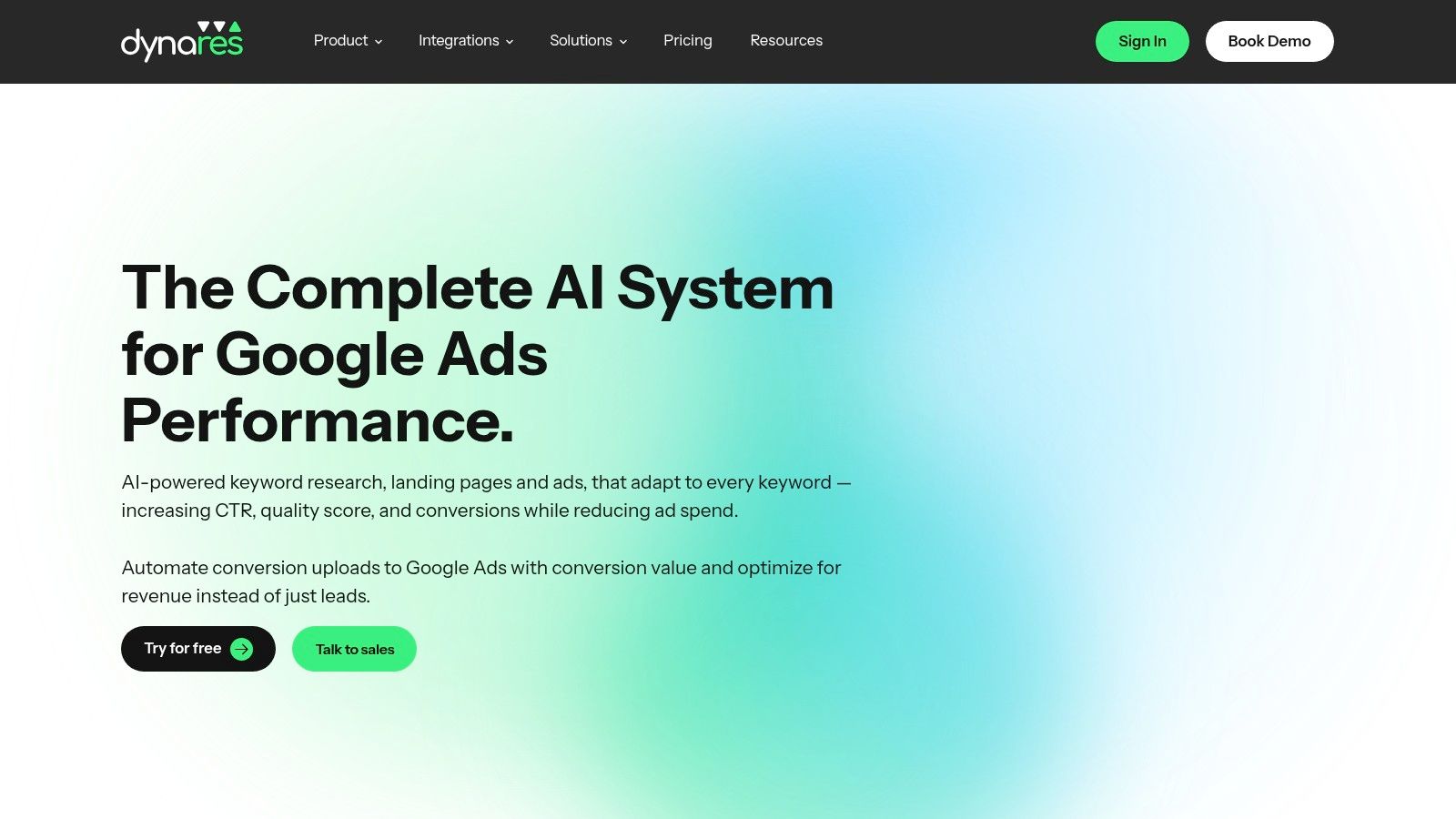
dynares is the only tool on this list that starts from the core problem many PPC teams have. Not “how do I make one page prettier?” but “how do I generate and optimize a large number of keyword-specific pages without hiring a small army?”
That shift matters. Most landing page optimization tools help you improve pages after you’ve already built them. dynares helps you create the actual system. It generates high-intent ads, matching landing pages, and forms designed for the keywords you care about. It also wires in tracking and keeps the workflow connected to Google Ads, Google Tag Manager, and HubSpot.
Why it stands out
If you run lead generation at any meaningful scale, message match is not a nice extra. It’s the whole game. dynares is built around that. You define your brand rules, your target keywords, and the structure you want. The platform uses that to produce coordinated ad and page combinations instead of leaving your team to build pages one by one.
The practical upside is obvious. You stop treating landing pages like isolated assets and start treating them like programmable infrastructure. That’s a much better way to scale.
Practical rule: If your PPC team handles large keyword sets, manual page production is already the bottleneck, even if nobody wants to admit it.
It also solves a problem that most tools barely touch. Revenue tracking. A lot of platforms stop at lead capture and basic conversion events. dynares can upload conversion events and values back into Google Ads, which means you can optimize for revenue and ROAS instead of pretending every lead is equal. That’s a serious advantage for teams that care about commercial outcomes, not vanity conversion volume.
A closer look at the AI landing page builder from dynares makes the positioning clear. This is built for Google Ads lead gen operators who need output, consistency, and control.
Where it fits best
This is a strong fit for agencies, performance marketers, SMB growth teams, and freelancers managing serious paid search accounts. It’s especially useful when campaigns span many services, locations, or intent clusters and the old one-page-fits-all approach has clearly broken down.
A few points matter in practice:
- Best for Google Ads lead gen: dynares is focused. That’s good if search is your main growth engine. It’s less ideal if you want one platform to orchestrate every paid channel under the sun.
- Built-in operational advantages: template builder, modular landing-page and form builders, Auto A/B Testing, and real-time analytics reduce the usual chaos.
- Human review still matters: AI speeds up the first draft and a lot more than that, but regulated industries and sensitive offers still need a human with a brain.
- Commercial clarity: transparent tiered pricing from free to enterprise is refreshing. You can easily understand the model before speaking to sales.
My blunt take: if you’re managing many keywords and still using generic builders as your main workflow, you’re doing too much manual labour for too little upside.
2. Unbounce
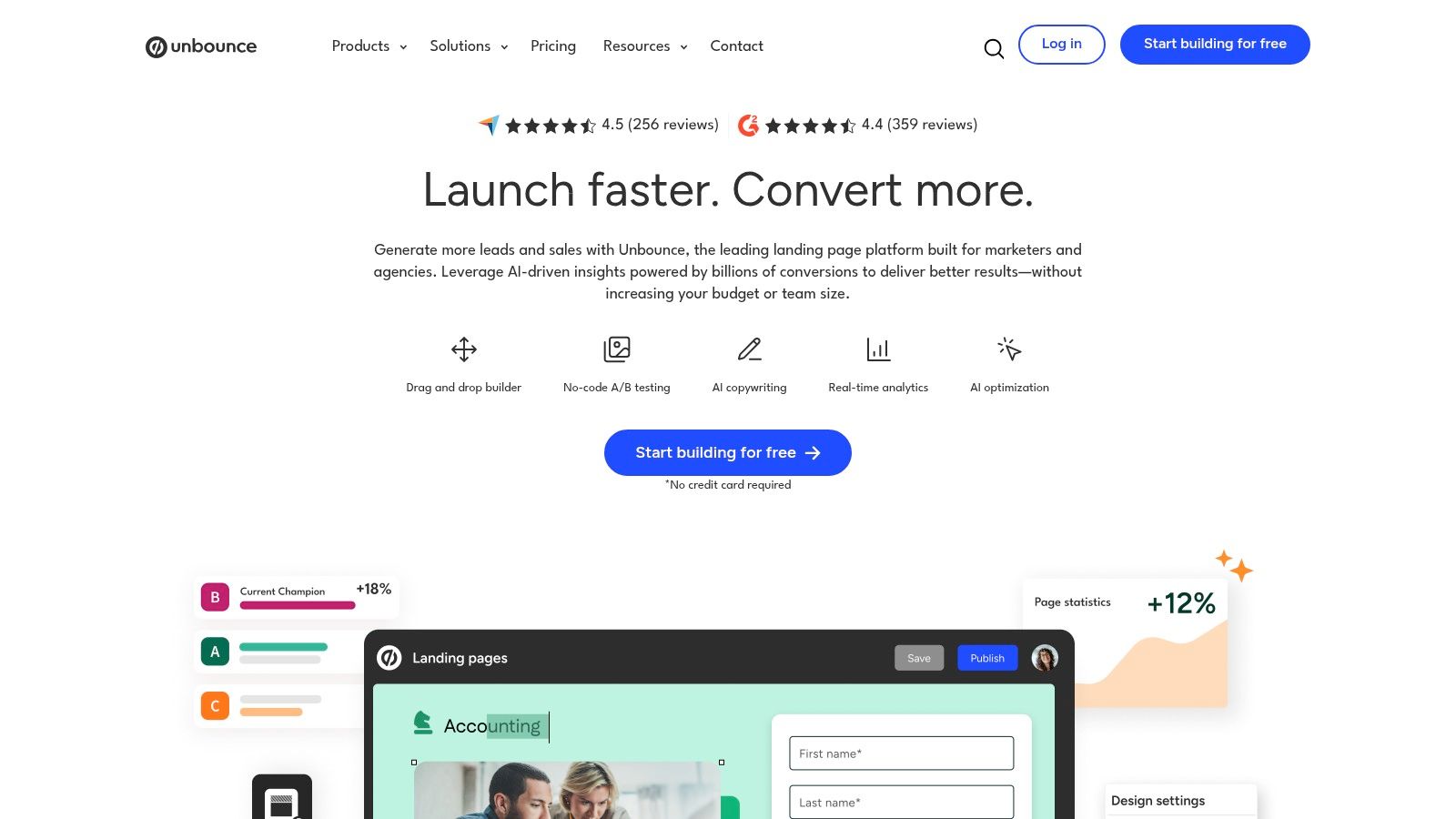
Unbounce is the tool many teams buy when they realise their CMS is too slow for paid acquisition. That instinct is usually right. PPC does not reward pretty workflows. It rewards shipping relevant pages fast, testing them hard, and protecting the link between click cost and revenue.
Unbounce still does that job well. You can build pages quickly, run A/B tests, use Dynamic Text Replacement to keep ad-to-page message match tight, and let non-technical teams publish without dragging developers into every campaign launch.
Where Unbounce earns its keep
Its real value shows up in search campaigns with lots of intent variation. If you are running multiple ad groups, services, or locations, Dynamic Text Replacement saves time and reduces the usual message drift that kills conversion rates. Smart Traffic can also help teams route visitors toward better-performing variants without building a custom optimisation stack.
I recommend Unbounce to operators who already have traffic and a testing habit. If your team launches a page, checks the conversion rate once, and then forgets it, you are paying for unused capability.
PPC landing pages usually fail for boring reasons. Weak message match, slow iteration, generic offers, and no testing discipline.
There is a ceiling, though. Once your account structure gets large, the platform starts to show its limits. Builders like this are good at page production. They are less good at handling scale across very large keyword sets, multi-client operations, or systems where page creation, testing, reporting, and revenue tracking need to work as one operating layer.
That is the founder view many articles skip. A landing page tool is not just a design tool. It sits directly in the path between media spend and cash collected. If the workflow is slow, fragmented, or too manual, margin disappears. That is also why a tighter operating model matters. These landing page optimization best practices for PPC teams are a useful reference before you start pushing more traffic.
My take is simple. Pick Unbounce if you want a proven PPC builder with strong message-match features and straightforward experimentation. Skip it if you need a system built for speed and scale across huge paid search programmes.
3. Instapage
Instapage is built for teams that have already outgrown the usual landing page builder playbook. Once paid acquisition becomes a serious line item, the problem stops being page design. The core problem is operational drag. Too many campaigns, too many approvals, too many duplicated assets, and no clean line between ad spend and page output.
Instapage addresses that with a post-click operating model. AdMap helps teams connect ads to pages with less guesswork. Instablocks and Global Blocks reduce repetitive production work. Built-in experimentation and analytics keep performance review closer to the page instead of buried across five tools and three dashboards.
That matters more than many teams admit.
Where Instapage earns its price
Instapage is strongest inside larger paid media setups where campaign volume creates friction fast. If your team is managing many audiences, offers, and stakeholders at once, reusable components and tighter collaboration controls save time every week. They also cut a more expensive problem. Inconsistent pages that weaken message match and waste paid traffic.
I also like the fact that it is designed for coordinated teams, not solo builders pretending they are enterprise software. Designers, performance marketers, copywriters, and clients can all work in the same system without turning every update into a mini production project.
From a founder's perspective, that is the point. A landing page platform should help you ship faster, test faster, and tie page decisions closer to revenue. If your PPC machine is scaling, the cost of slow execution is usually higher than the software bill. That is why platforms like dynares matter in this category too. The winners are the systems that reduce fragmentation between traffic, pages, experiments, and commercial outcomes.
My take
Instapage makes sense for mid-market and enterprise operators with meaningful PPC spend and a real need for governance. It is a serious tool for serious workflow problems.
I would not put it in an early-stage stack unless the team already has heavy traffic and clear process discipline. Smaller companies usually need speed and focus first. Larger companies need control without losing speed. Instapage is much better suited to the second job.
4. Leadpages
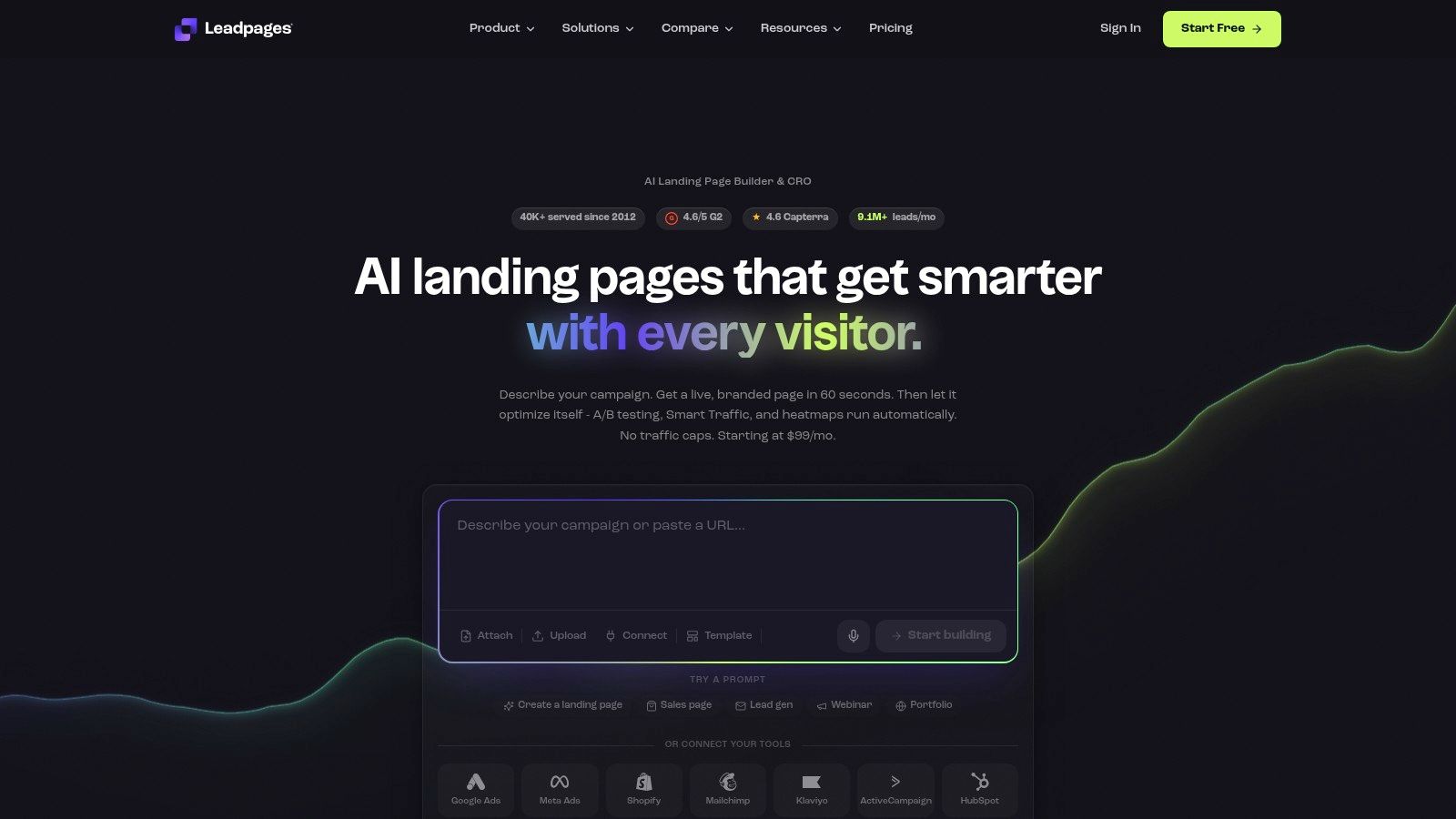
Leadpages wins on a point many teams ignore for too long. Shipping speed beats feature depth until your paid acquisition machine is large enough to justify more complexity.
That matters more than marketers like to admit. Founders paying the ad bill do not need another bloated toolkit with a steep setup curve. They need pages live fast, message match kept intact, and enough testing capability to improve conversion without turning every campaign into an internal project. Leadpages handles that job well with AI-assisted page creation, A/B testing, dynamic text replacement, popups, alert bars, and basic conversion tools in one stack.
Built for momentum
Leadpages is a practical fit for solo operators, small teams, and lean agencies that care about launch velocity. You can publish quickly, make edits without waiting on developers, and keep campaign operations simple enough that people use the platform instead of working around it.
That is the true value here.
As noted earlier in the article, low-code page builders can remove a huge amount of production drag. Leadpages fits that pattern. If your team still treats every landing page like a custom build, you are burning time that should go into offer testing, audience refinement, and revenue analysis.
The pricing also stays straightforward, which I respect. Founders need cost clarity. Surprise platform costs are annoying enough on their own. They are worse when the tool is supposed to save operational time.
My take
Leadpages is a good choice if your bottleneck is execution. It helps you get campaigns out the door, learn faster, and keep the stack manageable while PPC spend is still climbing.
I would not use it for a mature experimentation program where personalization, governance, and deep integration between traffic data and commercial outcomes are already central. That is where more connected systems pull ahead, including platforms like dynares that are built around the full path from ad click to revenue.
For early and mid-stage growth, though, Leadpages does what many companies need. It gets pages launched without wasting the team's attention.
5. Landingi
Landingi sits in a nice middle ground. It’s no-code, practical, and broad enough for teams that want more than a bare-bones builder but don’t want to jump straight into enterprise software. You get a visual editor, templates, smart sections, funnels, popups, forms, and A/B testing.
That mix makes it attractive for agencies and in-house teams running multiple brands or domains. Multi-domain support is especially useful if you’re managing client work or segmented campaigns where each destination has to look customized without becoming a maintenance nightmare.
What I like about it
Landingi feels operationally sane. It doesn’t try to pretend that every buyer needs cutting-edge AI orchestration. Sometimes you just need a builder that lets you create branded pages fast, launch funnels, and connect the usual stack without friction.
That said, there’s a ceiling. If your strategy depends on deep experimentation, advanced personalization, or a very tight feedback loop with ad platforms, Landingi won’t feel as powerful as more specialized systems.
A lot of teams don’t need the fanciest landing page optimization tools. They need fewer bottlenecks and cleaner execution.
My take
I’d recommend Landingi to small and midsize teams that want capability without bloat. It’s also a good fit for agencies that need to spin up client pages across multiple domains and keep onboarding straightforward.
I wouldn’t choose it for highly complex enterprise testing programs. I also wouldn’t choose it if the whole business depends on creating thousands of keyword-specific pages tied tightly to paid search. That’s a different game.
6. VWO
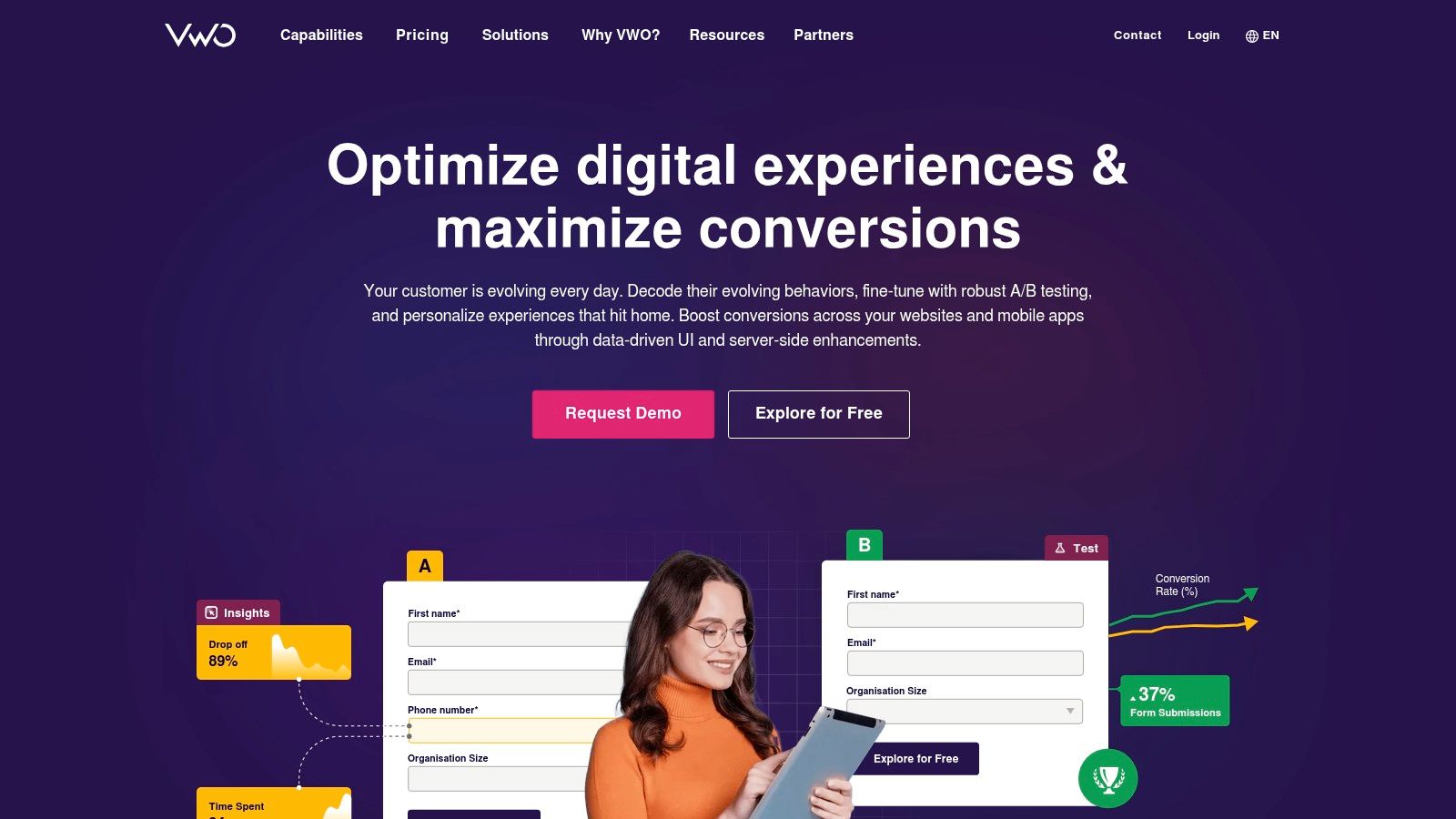
VWO is what you buy when you’re done guessing. This is a proper CRO platform, not just a page builder with a testing tab added for decoration. A/B tests, multivariate tests, split URL tests, heatmaps, session recordings, funnels, form analytics, and personalization are all part of the package.
That breadth is powerful if your issue isn’t page creation anymore. It’s diagnosis. You already have traffic. You already have pages. Now you need to understand where people hesitate, abandon, or get confused.
Where VWO earns its keep
The strong point here is visibility into user behaviour. You can test hypotheses, but you can also investigate them. That combination matters because lots of teams run tests without ever understanding why a page underperforms in the first place.
Analytics-heavy workflows are only getting more important. One industry data point I take seriously is that 67% of marketers rely on analytics for strategy insights, according to Digital Applied’s roundup of landing page conversion data. If you’re making PPC decisions with weak post-click insight, you’re flying half blind.
A useful companion read here is this guide on split testing landing pages. Tools don’t fix bad testing logic. Teams do.
My take
VWO is for companies that take experimentation seriously enough to build process around it. It’s especially good when marketing, product, and UX all need to look at the same data and make decisions from a shared set of observations.
The downside is complexity. A broad toolset can become a playground for endless analysis if nobody owns prioritisation. Use it when you have enough traffic, enough maturity, and enough discipline to keep the program sharp.
7. Optimizely Web Experimentation
Optimizely Web Experimentation is enterprise software in the traditional sense. Serious capabilities, strong governance, advanced targeting, multi-property support, and pricing that usually starts with a sales conversation you may or may not enjoy.
Still, there’s a reason big organisations use it. If you run experimentation across multiple sites, multiple teams, and multiple markets, governance matters. Permissions matter. Statistical confidence matters. Someone has to prevent the “everyone launches tests on Friday afternoon” situation.
Who should buy this
Optimizely makes sense when experimentation is no longer a side activity. It’s part of how the company ships and learns. Personalization, feature rollout options, multilingual governance, and collaboration controls help large organisations avoid chaos.
It also fits companies that blur the line between marketing experimentation and product experimentation. That’s where simpler landing page optimization tools start to feel cramped.
One thing I’d keep in mind. AI-generated variants are improving, but they still need context and data. Benchmarks cited by Digital Applied’s analysis of AI landing page performance note that AI-generated variants trained with first-party data match or beat human controls 48% of the time, while zero-shot AI underperforms expert copywriters. That’s the right lesson. AI is useful. Lazy AI is not.
For teams building a proper testing function, this primer on A/B testing software is a sensible starting point.
My take
Buy Optimizely if you need organisational control and extensive experimentation depth. Don’t buy it because somebody on the exec team likes premium software. That’s how you end up paying for capabilities your team never operationalises.
8. AB Tasty
AB Tasty is one of the more balanced platforms if your marketing and product teams both want a say. It covers client-side and server-side A/B testing, personalization, audience targeting, visual editing, SPA support, and feature flagging through Flagship.
That combination matters for modern stacks. Plenty of websites aren’t simple brochure sites anymore. They’re apps, hybrids, and weird Frankenstein systems stitched together over five years of “temporary” decisions. AB Tasty handles that reality better than tools built only for traditional marketers.
Why I’d consider it
If your front end is modern and your experimentation program cuts across acquisition and product experience, AB Tasty gives you flexibility. Marketing can personalise experiences. Product teams can test features. Engineering doesn’t have to treat growth requests like foreign objects.
That’s a smart position in the market because organizations increasingly want one experimentation layer across the customer journey, not separate toys for separate departments.
There’s no public pricing list, which is annoying but not unusual at this level. Expect custom deals and the usual sales process.
My take
AB Tasty is a good fit for companies with modern JavaScript-heavy environments and teams that want both growth and product experimentation in one place. If you only need to publish basic paid traffic landing pages, it’s overkill. If your business already treats experimentation as infrastructure, it’s much more interesting.
9. Convert Experiences
Convert Experiences knows what it is. That already puts it ahead of a lot of software in this category.
It focuses on testing. A/B tests, split URL tests, multipage tests, audience targeting, reporting, and deployment workflows are all here. If your team wants to improve paid landing pages without buying another oversized platform full of side features nobody uses, Convert is a sensible option.
I rate it highest for operators who care about control.
From a founder’s perspective, that matters. PPC economics get ugly fast when the testing stack is slow, unclear, or tied to bloated contracts. Convert keeps the proposition simple. Run experiments, get answers, ship winners, and keep engineering involved only where it adds value. That is a healthier setup than forcing every landing page decision through a full rebuild.
Where it makes sense
Convert is a strong fit for agencies, in-house growth teams replacing old experimentation tools, and companies that take privacy seriously without turning procurement into a six-month project. The transparent pricing helps. So does the platform’s clear position around first-party data and compliance-conscious setups.
That makes it easier to justify commercially.
If you are spending serious money on acquisition, you need to know the test platform will not become the bottleneck between media spend and revenue. Convert is built more like infrastructure than a shiny campaign toy. Teams that already have analytics, BI, or a system like dynares connecting spend to pipeline and sales outcomes will usually appreciate that approach.
There is a trade-off. Convert does not include heatmaps or session replay, so you will likely pair it with another tool for behavioural insight. Fine. Just be honest about the stack you need instead of pretending one platform should do everything.
My take
Convert is for disciplined teams. If you want privacy-first experimentation, fair pricing, and enough operational depth to support real testing programs, put it on the shortlist.
If you want one tool to cover page building, behavioural analysis, experimentation, and reporting in one interface, look elsewhere. Convert works best when you already know what problem you are solving.
10. Intellimize
Intellimize is for teams that want AI to do actual work, not just write mediocre headline suggestions. It combines AI landing pages, A/B and multivariate testing, audience targeting, and account-level personalization in a way that suits high-intent campaigns and ABM programs.
This isn’t just about testing one hero section against another. The promise is faster creation and optimization of segment-specific experiences without rebuilding the whole site by hand every week.
Where it gets interesting
Intellimize is a smart fit for B2B teams, high-consideration funnels, and campaign structures where audience relevance matters more than generic page polish. If you care about tailoring content at the segment or account level, that’s where it starts to earn attention.
One caution. AI still needs guardrails. The best use case is not “let the machine do everything.” It’s “let the machine generate and iterate faster inside a clear commercial framework.”
A practical signal worth noting is that 42% of companies already use AI tools and 30% plan to use AI for optimization, according to SEO Sherpa’s data on landing page platform growth and AI adoption. The direction is obvious. AI is moving from novelty to standard workflow. The winners will be the teams that use it with discipline.
My take
Choose Intellimize if personalization at speed is central to your acquisition strategy. It’s compelling for ABM and for paid teams targeting distinct high-value segments.
Don’t choose it if you just need a simple landing page builder with a couple of tests. That’s like buying a race car to drive to the supermarket.
Top 10 Landing Page Optimization Tools Comparison
Pick the tool based on the bottleneck in your paid acquisition system. If your problem is page production speed, buy speed. If your problem is experimentation discipline, buy testing depth. If your problem is connecting ad spend to revenue, stop buying prettier builders and start fixing the operating model.
| Product | Core features ✨ | Quality ★ | Value / Pricing 💰 | Target audience 👥 | Unique selling points 🏆 |
|---|---|---|---|---|---|
| dynares 🏆 | AI-generated keyword-specific ads, landing pages and forms; Auto A/B; real-time analytics; GA/GT/HubSpot integrations | 💰 Free to Enterprise; transparent tiers, demos and onboarding | 👥 PPC managers, agencies, SMB growth teams | ✨ ✨ Revenue-aware bidding with conversion value uploads. Scales thousands of coordinated assets | |
| Convert Experiences | A/B, split-URL, multipage tests; privacy-first options; detailed reporting | 💰 Transparent self-serve pricing, trial available | 👥 Agencies and privacy-conscious teams | ✨ Privacy-first testing with clear pricing | |
| AB Tasty | Client-side and server-side testing, personalization, SPA support, feature flags | 💰 Sales-led pricing, custom deals | 👥 Marketing and product teams, modern JS stacks | ✨ Balanced experimentation across marketing and product, with strong SPA support | |
| Optimizely | Advanced A/B and MVT, personalization, multi-site governance | 💰 Premium, sales-led pricing | 👥 Large enterprises with mature testing programs | ✨ Strong governance and scale for complex organizations | |
| Unbounce | Drag-and-drop pages, A/B testing, Smart Traffic, Dynamic Text Replacement | 💰 Tiered pricing. Can get expensive at high volumes | 👥 PPC teams that need fast builders and message match | ✨ Strong DTR and a mature template library | |
| Instapage | Post-click personalization, AdMap, reusable Instablocks, heatmaps | 💰 Enterprise-priced, sales-led | 👥 Enterprise teams with high-spend campaigns | ✨ Tight ad-to-page alignment and reusable components for scale | |
| Leadpages | AI page creation, drag-drop builder, A/B testing, popups and checkout | 💰 Flat, transparent pricing. Cost-effective for SMBs | 👥 Solopreneurs, SMBs, agencies | ✨ Fast AI-assisted page builds with simple pricing | |
| Landingi | No-code visual editor, funnels, A/B testing, multi-domain support | 💰 Competitive pricing. Good for high page volume | 👥 Agencies and businesses managing multiple brands | ✨ Easy onboarding and multi-domain publishing | |
| VWO | A/B and multivariate testing, heatmaps, session replay, personalization | 💰 Modular pricing, enterprise options | 👥 Dedicated CRO teams | ✨ Testing plus behavior analytics in one stack | |
| Intellimize | AI landing pages, A/B/n with automated optimization, account-level personalization | 💰 Sales-led, implementation fees possible | 👥 B2B ABM teams and high-value PPC marketers | ✨ AI-driven page generation and audience-level personalization |
A simple rule helps. Builders help you publish. Testing platforms help you learn. Integrated systems help you scale PPC without breaking the link between clicks, leads, pipeline, and revenue.
That is why dynares stands out from a founder’s perspective. It is not just another page editor with testing added on top. It connects ad creation, landing page generation, forms, experiments, and revenue feedback in one workflow, which matters once spend rises and manual production starts slowing growth.
Stop analyzing, start building
Look, you can spend another week reading reviews, or you can start fixing the actual leak in the bucket.
The perfect tool doesn’t exist. The right tool for your stage does. That’s a much more useful standard. Early on, the main job is getting pages live, learning quickly, and creating a clean enough workflow that your team doesn’t resent the process. Later, the job becomes sharper. Better message match. Better testing discipline. Better integration with bidding and CRM systems. Better revenue feedback loops.
That’s why most generic advice around landing page optimization tools misses the point. It treats every buyer the same. They aren’t. A solo founder launching lead gen pages has a completely different problem from an agency managing many accounts, and both have a different problem from an enterprise team running controlled experimentation across markets.
If you’re just starting, use a simple builder like Leadpages and get something live. If you already have meaningful traffic, invest in proper experimentation with a platform like VWO or Convert. If your setup is complex and cross-functional, tools like Optimizely, AB Tasty, or Instapage make more sense because governance and collaboration become real issues, not nice-to-haves.
But if you’re running Google Ads for lead generation and the pain is scale, then stop pretending manual page production is sustainable. It isn’t. That’s where dynares becomes interesting, because it changes the frame. Instead of asking how to make one good page, it asks how to build a system that can generate, test, and improve many keyword-matched pages while pushing useful conversion data back into the ad platform.
That founder’s perspective matters. Businesses don’t scale because they found the prettiest page builder. They scale because they remove bottlenecks. They create repeatable systems. They connect spend to revenue. They stop rewarding internal busyness and start rewarding commercial outcomes.
A few decisions should be obvious by now:
- If speed is your issue: choose a tool that helps non-technical teams publish fast and often.
- If insight is your issue: choose a platform with strong experimentation and behavioural analytics.
- If scale is your issue: choose software designed to generate and coordinate many pages, not just help you polish a few.
- If revenue quality is your issue: prioritize systems that can feed conversion values back into bidding platforms, not just count form fills.
One more thing. Don’t let “optimization” become an excuse for indecision. Too many teams hide behind dashboards, watch recordings for hours, and avoid the harder question: are we shipping enough experiments? That’s where progress comes from. Not from admiring your funnel in twelve different views.
The teams that win don’t know everything upfront. They launch faster, measure honestly, and correct course without ego.
Technology is useful when it gives operators an advantage. That’s the whole point. Better landing pages aren’t the end goal. Better economics are. Lower waste. Better quality leads. More revenue from the same spend. That’s what you’re buying when you buy one of these tools, or at least what you should be buying.
So yes, read reviews. Then stop. Pick a tool that matches your actual bottleneck. Launch pages. Run tests. Clean up the tracking. Feed revenue data where it belongs. If you need a reminder that experimentation should stay practical, not academic, this piece on testing offers effectively is a useful parallel.
Then get back to work. The market doesn’t reward elegant intentions. It rewards shipped systems.
If you’re tired of building generic pages by hand and want a smarter way to scale Google Ads lead generation, take a serious look at dynares. It’s built for teams that need keyword-specific landing pages, ads, forms, testing, and value-based conversion tracking in one operational system instead of five disconnected tools.