
Teams aren’t often arguing about search ads vs display ads because they love channel strategy. They’re arguing because the budget is tight, the pipeline target is real, and somebody just noticed that one channel has cheaper clicks.
That’s where the discussion usually goes off the rails.
One person points at display and says the clicks are cheaper, so why are we paying a premium for search. Another points at search and says display never closes, so kill it. Both are reacting to a spreadsheet. Neither is building a system.
My view is simple. If you treat search and display like rival line items, you’ll make bad decisions. If you treat them like connected parts of one acquisition engine, you’ll make better ones. Not because that sounds clever on LinkedIn, but because it matches how buyers move.
That awkward budget meeting
You know the one.
A dashboard is on the screen. Search is eating budget. Display looks cheap. Someone asks why you’re paying more per click in one channel when another channel can buy traffic for far less. Someone else says display is fluffy and should be cut because direct lead volume looks weak.
That’s the wrong fight.
Search and display solve different problems. Search captures demand that already exists. Display helps create familiarity, keep your brand in front of people, and bring back the visitors who didn’t convert the first time. Comparing them as if they should produce the same outcome from the same user state is dumb.
I’ve seen teams waste months trying to “pick the winner” instead of deciding what each channel is supposed to do. That’s how you end up with search campaigns stretched beyond relevance and display campaigns forced to hit direct-response goals they were never built for.
Practical rule: If your meeting starts with channel loyalty, you’re already off track. Start with the business objective, then assign the channel.
The other thing that breaks these conversations is cost obsession without context. Cheap clicks are not a strategy. Expensive clicks are not a problem if they convert into revenue. If your team needs a cleaner way to frame the economics before the next budget review, this breakdown of the cost of online advertising is useful.
The core question isn’t which channel is better in some abstract sense. It’s this: where in the buying journey are you trying to influence behavior, and what are you expecting the ad to do at that moment?
That’s where the conversation gets interesting.
The classic playbook everyone gets wrong
The standard explanation goes like this. Search is pull. Display is push. Technically correct. Strategically weak.
That definition is fine for a first-week marketing intern. It’s useless when you’re responsible for pipeline, CAC discipline, and a team that needs to make budget decisions without setting money on fire.
Why the textbook version fails
When people hear pull versus push, they make lazy decisions.
They say, we need leads now, so only run search. Or they say, our brand isn’t big enough, so let’s flood the internet with display. Both moves can fail badly because they ignore buyer timing, creative fit, and the fact that individuals don’t typically buy the first time they see you.
Search is not magic. It harvests intent. That’s powerful, but it only works when intent already exists.
Display is not useless. It plants memory, supports retargeting, and keeps you visible before the search happens. That matters a lot if your market is crowded and buyers don’t convert on first contact.
What these channels really are
Search is your demand capture layer.
A user types a problem into Google. You show up. If the keyword, ad, and landing page match the job they’re trying to get done, search can be brutally effective.
Display is your demand shaping and demand recovery layer.
People aren’t actively asking for you at that moment. They’re browsing, reading, comparing, procrastinating, doing everything except filling out your form right now. That sounds inefficient until you realise most markets need repetition and familiarity before high-intent action shows up.
The teams that win don’t ask which channel deserves the budget. They ask what job each channel should perform.
The bad assumptions that waste budget
Here’s where I see smart companies make avoidable mistakes:
- Treating search like infinite scale: Search is great until you run out of relevant demand, start widening match logic too far, and wreck relevance.
- Treating display like a direct-response clone: Sending cold display traffic straight to a hard lead form usually underperforms because the user didn’t wake up wanting your offer.
- Using the same KPI everywhere: Judging display by last-click conversion metrics alone misses why it exists in the first place.
- Ignoring sequence: A person who saw your brand yesterday and searches today is not the same as a totally cold searcher.
In 2026, the serious play isn’t search or display. It’s sequencing them properly, then automating the boring parts so a lean team can run the whole machine without becoming a spreadsheet support desk.
A practical comparison for people with goals
If you’re accountable for revenue, five criteria matter more than the usual marketing blog waffle. Intent. Reach. Cost. Conversion role. Creative flexibility.
Here’s the cleanest way to think about it.
| Criteria | Search ads | Display ads |
|---|---|---|
| User intent | High. Users are actively looking for a solution. | Low to medium. Users are consuming content, not actively shopping. |
| Reach | Limited by search volume. | Broad reach across websites and apps. |
| Cost model | Higher CPC because intent is valuable. | Lower CPC or CPM for broader exposure. |
| Primary job | Capture direct demand and drive leads. | Build awareness, retarget, and nurture. |
| Creative format | Mostly text-led and constrained. | Visual, flexible, better for storytelling. |
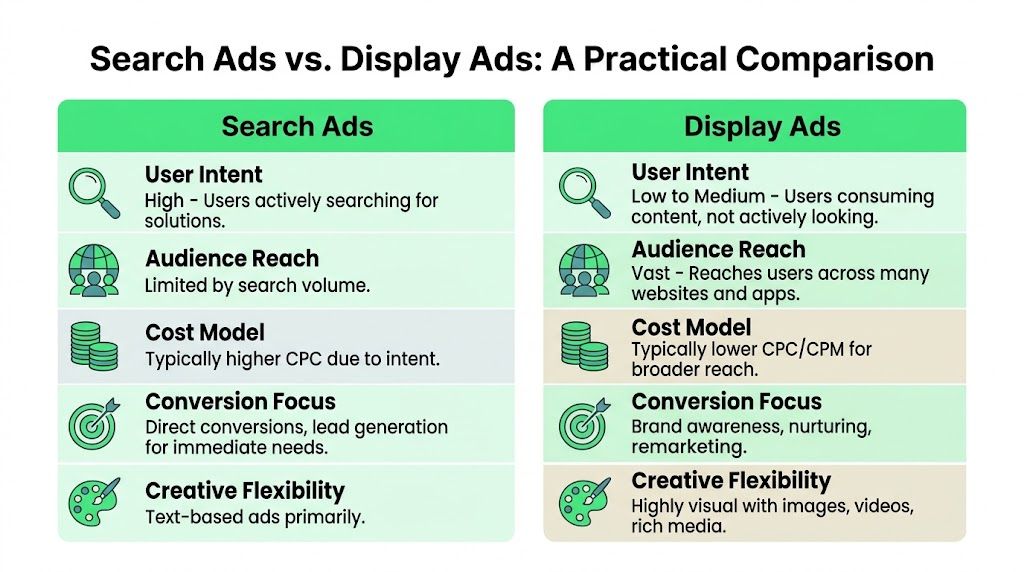
Intent decides everything
This is the big one.
Search wins when the buyer already knows they have a problem and is actively hunting for a solution. That’s why it consistently delivers stronger direct-response performance. Industry benchmarks put average search conversion rate at 4.40% versus 0.57% for display across industries, with average CPC at $2.41 for search versus $0.59 for display, according to Mediaplus on search ads vs display ads.
That gap tells you exactly what’s happening. Search traffic is expensive because intent is expensive. Display traffic is cheaper because you’re paying for attention earlier in the journey.
If your business needs immediate lead flow and there is active search demand, search should usually get the first serious budget allocation. That’s not controversial. It’s just reality.
Reach changes the role
Search only exists where people are searching. That makes it precise, but bounded.
Display reaches people while they browse content, use apps, and move around the web. That broader reach makes it weaker for immediate conversion and stronger for visibility, retargeting, and category presence. If your market is competitive, staying absent from that layer is often a mistake.
Cost without context is a trap
A lot of marketers get seduced by cheap display clicks. I get it. Lower CPC feels efficient.
It often isn’t.
If the traffic arrives with weak intent, you may be buying a lot of activity and very little business value. On the flip side, some teams panic at high search CPCs and slash spend right where the demand is hottest. That’s equally silly.
Judge the channel by the job. Search should earn its keep on direct revenue or qualified lead flow. Display should earn its keep by warming audiences, supporting return visits, and making branded demand easier to capture later.
Cheap traffic that doesn’t move the pipeline is still expensive.
Creative constraints matter more than most people admit
Search is often sold as a pure keyword game. It isn’t. It’s a messaging game under tight constraints.
You have limited copy space, highly competitive auctions, and often multiple advertisers chasing the same commercial intent. Small changes in wording can decide whether your ad gets clicked or ignored. That means creative quality matters, even in text-heavy formats.
Display gives you more visual freedom. Images, motion, stronger brand cues. That helps when the user doesn’t yet have enough intent to care about a plain-text promise. The visual format can carry the message in ways search cannot.
Measurement needs different expectations
At this point, teams sabotage themselves.
Search is usually easier to evaluate. The user searched, clicked, landed, and either converted or didn’t. The path is relatively clean.
Display is messier. It often influences rather than closes. If you expect display to perform like bottom-of-funnel search, you’ll shut it off before it does its actual job.
That doesn’t mean you give display a free pass. It means you define success properly. For display, that can mean audience quality, retargeting performance, and whether branded search demand becomes easier to capture after exposure.
My blunt recommendation
If you need one sentence, here it is.
Use search ads when you need to capture existing intent and protect revenue. Use display ads when you need to stay visible, retarget intelligently, and make future search clicks easier to win.
And stop pretending one channel should do both jobs equally well. That’s how teams burn budget and then blame the platform.
When to use search for lead generation and its hidden limits
Search is still the foundation of serious lead generation for one reason. You’re showing up when someone asks for help.
That’s the dream scenario in paid media.
If a user searches for an urgent service or a clear business need, search gives you a chance to meet them at the exact moment their intent is strongest. For lead gen teams, that’s hard to beat.

Where search is the obvious answer
Search deserves priority when the buyer problem is clear, urgent, and already expressed in language you can target. Local services. High-intent B2B categories. Replacement purchases. Problem-aware buyers.
Lead generation simplifies with a clear sequence. Keyword intent maps to ad copy. Ad copy maps to a landing page. The landing page maps to a form, a call, or a booked meeting.
If you’re building a search-first engine for pipeline, this guide on Google Ads lead generation is worth bookmarking.
The part people skip
Search doesn’t scale forever just because you add more keywords.
That’s the fantasy version. The real version is uglier. You expand coverage, ad groups get broader, landing pages get more generic, and your message stops feeling specific to what the user actually searched. Performance softens. CPC pressure feels worse. The team starts tweaking bids because it’s easier than fixing relevance.
That’s the hidden limit of search. It’s not just keyword volume. It’s your ability to maintain relevance at scale.
Search has a creative ceiling if you run it lazily
Search is often discussed as primarily a bidding problem. It’s partly a bidding problem. It’s also a creative operations problem.
As competition rises on high-intent keywords, the text format itself becomes a constraint. You don’t have much room. Everyone is making similar claims. If your messaging becomes stale, repetitive, or disconnected from the exact query, performance can decay even when the keyword is still valuable.
Art Unlimited makes this point well. Search allows granular optimization, but it’s still vulnerable to ad fatigue, and the ability to auto-generate coordinated ad variants optimized for each keyword is becoming a real frontier in performance work, as noted in their piece on creative variation and ad fatigue in search ads.
That’s a bigger deal than is often acknowledged.
- Keyword expansion breaks relevance: More coverage sounds good until the ad and page stop matching the search with enough precision.
- Text-only formats compress differentiation: You can’t lean on visuals to rescue mediocre messaging.
- Repeated auctions create fatigue: If users see near-identical copy over and over, familiarity doesn’t always help. Sometimes it just becomes wallpaper.
A short explainer helps if you want to reset how you think about high-intent search traffic:
My recommendation for founders and PPC teams
Use search aggressively for lead generation when there’s clear demand. But don’t confuse demand capture with a complete growth strategy.
If search is working, your next job isn’t just to spend more. It’s to preserve relevance as you scale. That means tighter keyword grouping, sharper copy, stronger landing page alignment, and faster creative testing than is typically managed manually.
Search prints money when relevance stays high. It gets expensive fast when relevance slips and nobody notices until the CPL report looks ugly.
That’s the hidden tax in search. Not the click price. The operational drag of keeping every keyword, ad, and landing page aligned once the account gets big.
How to actually use display for lead generation
Let’s say the quiet part out loud. Cold display traffic sent directly to a hard lead form often performs badly.
That’s not because display is broken. It’s because the user is in the wrong state of mind. They were reading, watching, browsing, or avoiding work. They were not actively asking for your product at that exact second.
So if your plan is to run banner ads to a generic form and pray, save yourself the pain.

Where display actually earns its keep
Display is useful for lead generation when you stop demanding that it behave like search.
Its best performance role is usually one of two things. Retargeting people who already visited but didn’t convert. Or warming specific audiences so that later clicks, searches, and revisits become more likely.
Instapage notes that display ads appear on over 2 million sites and reach 90% of global internet users. They also point out that direct conversion is low, around 0.59% for e-commerce, while the strategic value often shows up in assisted conversions and a 1-2% uplift in search favorability after exposure, according to their analysis of search ads vs display ads.
That’s the clue. Display is not just a traffic source. It’s an influence layer.
Two display plays I’d keep even in a tight budget
I wouldn’t recommend most display setups. I would absolutely keep these:
- Retargeting recent visitors: Someone clicked a search ad, browsed, then left. Display gives you another chance to stay in front of them with a clearer offer or reminder.
- Audience warming before search capture: Show your brand to a defined audience, then bid and message more intelligently when those people later search.
- Message reinforcement: Use visuals to make the value proposition easier to remember than a plain text search ad can manage alone.
The creative side matters here more than people think. Bad display creative gets ignored fast. Good display creative makes your brand feel familiar before the user is ready to act. If your team needs a refresher on what makes paid messaging work, this article on great ad copy is a solid place to start.
What not to do
A few anti-patterns deserve to die.
First, don’t judge display only by last-click leads. That blinds you to the way it supports later action.
Second, don’t target broadly with vague creative and then complain that the traffic quality is poor. Of course it is. You interrupted random people with a weak message.
Third, don’t build one retargeting ad and leave it untouched forever. Creative fatigue happens in display too. If your ads become wallpaper, users stop seeing them.
Display works best when it reminds, reinforces, and nudges. It usually fails when teams force it to close a conversation that hasn’t started properly.
My blunt view on display for lead gen
Use display to support lead generation, not impersonate it.
If someone already knows you, visited you, or fits a very specific audience profile, display can do real work. It can recover wasted search spend, improve recall, and make the eventual high-intent click easier to win.
If you expect cold banner traffic to behave like someone typing a problem into Google, you’re not doing strategy. You’re buying disappointment at scale.
The modern playbook combining search and display
The strongest paid acquisition systems don’t choose between these channels. They connect them.
The search ads vs display ads debate becomes much more useful. Not as a winner-takes-all argument, but as a sequencing problem. One channel creates familiarity and recoverable attention. The other captures explicit intent when it finally appears.
That loop is where the compounding effect lives.
The flywheel that actually makes sense
Here’s the model I like.
Display handles the early touch and the second chance. Search handles the active moment of demand. Then both channels work together again if the user doesn’t convert on the first attempt.
It looks simple on paper, but it’s far better than the usual silo setup where brand runs display, performance runs search, and nobody connects the dots.
- Start with targeted display exposure
Use display to stay visible to the right audience and to retarget people who already visited your site. You’re not demanding an immediate form fill from everyone. You’re building familiarity and keeping warm prospects from forgetting you. - Capture intent with search when timing turns
Later, when that same person searches, your brand is no longer a stranger. Recognition changes behavior. Your search ad feels safer to click. Your landing page feels less cold. That’s a very different user from someone who has never seen you. - Recycle non-converters instead of losing them
A lot of teams pay for search clicks, miss the first conversion, and then just accept the loss. That’s lazy. Put those users back into a display retargeting sequence and give yourself more chances to win the deal.
Scube Marketing puts the core logic nicely. Search shows stronger direct efficacy, with 4.40% conversion rate versus 0.57% for display, but the practical move is to define display’s role around top-of-funnel awareness and retargeting while using search to capture the high-intent demand that follows, as outlined in their article on blending search and display for ROI.
Why this beats channel tribalism
Channel tribalism is mostly ego. One team likes performance metrics. Another likes reach and creative. The buyer does not care about your internal org chart.
What matters is whether the user sees a coherent sequence. Familiar brand. Relevant message. Timely search ad. Strong landing experience. Follow-up if they hesitate.
If you want a practical wider view of how this fits into account structure and paid media planning, this roundup of PPC advertising strategies is a useful companion.
My operating principle
Don’t ask which channel wins. Ask whether they’re feeding each other.
Search should generate qualified visitors and intent signals. Display should keep those visitors warm and make branded recall easier. If one side isn’t improving the other, the system isn’t built properly yet.
That’s the shift from running campaigns to building an acquisition engine.
Building your automated ad engine at scale
This all sounds clean until you try to operate it with a lean team.
Then reality shows up.
You need lots of keyword-specific landing pages, plenty of ad variants, fast testing cycles, clean tracking, and a way to push real conversion data back into Google Ads. Most companies don’t fail because the strategy is wrong. They fail because the workload becomes ridiculous.

What a scalable setup needs
At a minimum, you need a system that can do four things well.
- Generate relevance fast: Keyword-specific ads and landing pages need to exist without a designer and developer manually rebuilding the internet every week.
- Test continuously: Teams need variants running all the time, otherwise they keep shipping opinions instead of evidence.
- Track revenue, not vanity: Form fills are fine. Closed-loop conversion feedback is better.
- Reuse winning building blocks: Good templates, forms, and page modules should not stay trapped in one campaign.
This is also where broader lead gen discipline matters. If you want an external resource that complements this thinking, 10 B2B lead generation best practices for 2026 is worth reading because it frames the bigger operational habits around speed, targeting, and follow-up.
The founder-level decision
You really have two choices.
You either hire enough people to brute-force the workflow, or you build with automation so a small team can operate like a much bigger one. I’m biased toward the second option because headcount alone doesn’t solve coordination. It often just creates more meetings.
The winning setup is boring in the best possible way. Inputs go in. Pages, ads, and forms get generated consistently. Tests run. Conversion data comes back. Weak variants get replaced. Strong variants stay live.
That’s the difference between a campaign and an engine.
What I’d implement first
If I were cleaning up a messy account today, I’d do this in order:
- Fix intent mapping first
Make sure high-intent keyword clusters each have a tightly matched ad and landing experience. - Automate variant production
Don’t rely on a team writing every ad and page manually once the keyword set gets large. - Build retargeting around real traffic behavior
Search visitors who bounced should not disappear into the void. Put them into a display sequence that reflects what they viewed. - Upload conversion outcomes back into Google Ads
Optimise toward business value, not just front-end lead quantity.
This is exactly why platforms like dynares are interesting right now. If you want to build a serious Google Ads engine without staffing up like a giant enterprise, dynares helps generate keyword-matched landing pages, ads, and forms at scale, run continuous testing, and feed conversion data back into the system so your campaigns optimise for revenue instead of guesswork.


