
Let's get one thing straight. The whole ROI vs. ROAS debate boils down to a single, critical difference: Return on Ad Spend (ROAS) is about revenue from your ads, while Return on Investment (ROI) is about the actual profit left over after all your costs are paid.
Chasing a high ROAS can feel amazing, but if your margins are thin or your overhead is high, you could be driving revenue straight into a loss. I’ve seen it happen too many times.
Why most founders get ROI vs ROAS wrong
Too many founders are absolutely obsessed with Return On Ad Spend. It makes sense—seeing a 4x ROAS on your Google Ads dashboard gives you a shot of dopamine. It feels like you’re printing money, making $4 for every $1 you put in.
But here’s the hard truth I’ve learned from being in the trenches: revenue is not profit. It’s a vanity metric if you don’t know what’s happening behind the scenes.
Return on Investment is the metric that actually keeps the lights on. 💡 It’s the grown-up in the room, forcing you to look at the entire business picture, not just the flashy campaign numbers on a screen.
The real game isn’t just about making revenue; it’s about keeping it. ROI is your truth serum—it tells you whether your growth engine is actually profitable or just burning fuel loudly.
Getting this distinction right is fundamental. It’s the difference between building a scalable, profitable company and building one that just looks good on a PowerPoint slide while bleeding cash.
The big picture vs. the campaign view
Think of it like this: ROAS is a tactical metric for your marketing team. ROI is a strategic metric for you, the founder. A killer ROAS can easily hide deeper problems in the business model.
A well-executed Google Ads conversion tracking setup is the first step to getting clean data, but it's only half the story. To really understand performance, you have to connect that ad data back to your actual business costs.
Here’s a simple way to frame the two perspectives:
| Metric | Focus | Primary Question It Answers | Scope |
|---|---|---|---|
| ROAS | Efficiency | "How effective is my ad campaign at generating revenue?" | Marketing Campaign Level |
| ROI | Profitability | "Is this entire initiative making the business money?" | Total Business Level |
A fantastic ROAS is worthless if your overall ROI is negative. We're building businesses to create value and profit, not just to give ad platforms our money more efficiently. Nailing this concept is the first real step.
Calculating the metrics that actually matter
Alright, let’s pop the hood and look at the formulas. The math here is what makes one metric dangerously simple and the other brutally honest.
ROAS: The deceptively simple metric
The Return on ad spend (ROAS) calculation is clean and easy, which is why everyone loves it. It's a tidy little number that fits perfectly on a dashboard.
- Formula:
Revenue from Ads / Cost of Ads
That’s it. But its simplicity is also its biggest flaw—it ignores the bigger picture, seducing you into chasing a metric that can easily mask deep profitability issues.
ROI: The formula that reveals the truth
Now, let's look at the formula that actually pays the bills. The Return on investment (ROI) calculation forces you to confront the reality of your business.
- Formula:
(Net Profit / Total Investment) x 100
The key phrase here is total investment. This isn't just your ad spend. It’s everything—your team’s salaries, software subscriptions, cost of goods sold (COGS), and any other operational cost tied to generating that revenue. If you want to dig deeper, this guide on how to calculate Return on Investment breaks down all the components.
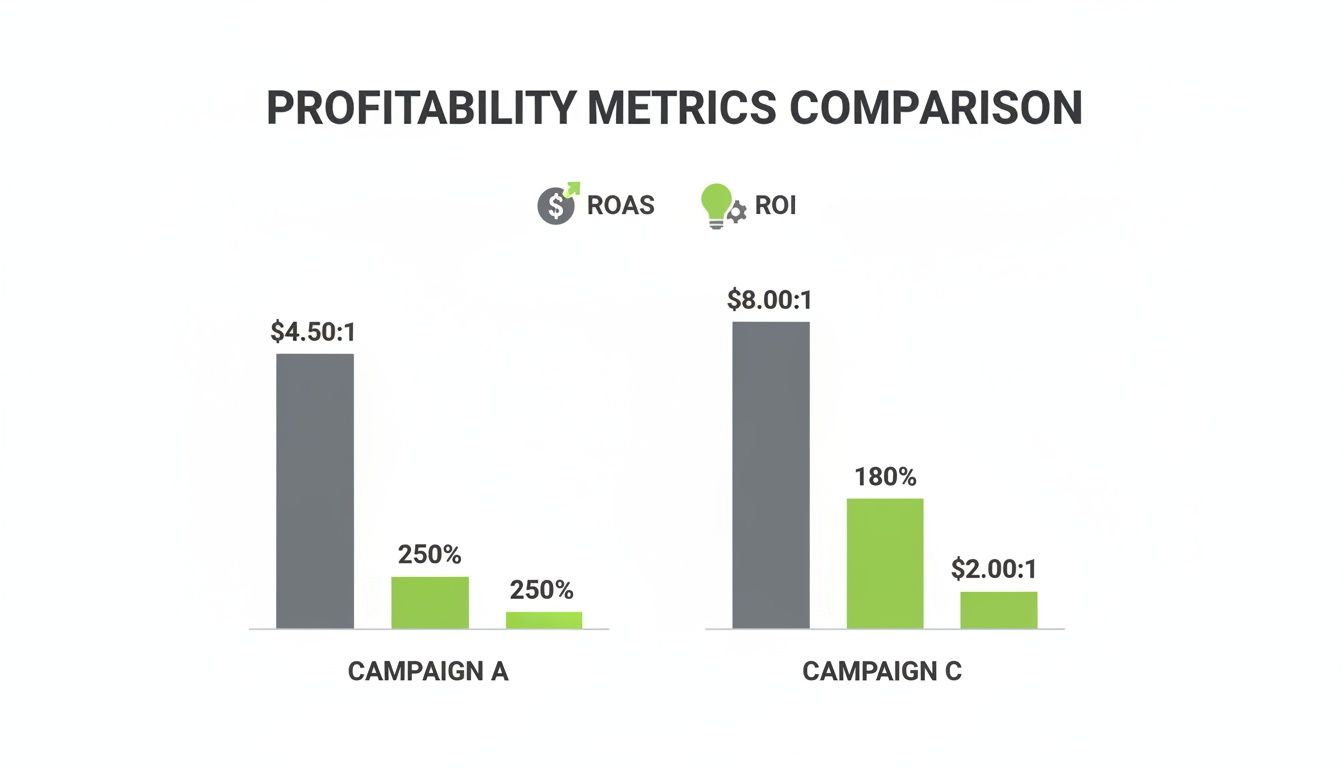
The chart below shows this fundamental difference. ROAS gives you a narrow view of ad efficiency, while ROI tells the complete story of business profitability.
Let's run a quick scenario.
Imagine you generate $40,000 in revenue from $10,000 in ad spend. Your ROAS is a solid 4.0x (400%), a number most marketers would be happy with. But let's say your other costs—salaries, software, COGS—add up to $28,000. Your total investment is now $38,000 ($10k ads + $28k costs).
This leaves you with a net profit of just $2,000, giving you an ROI of only 5.3%. That’s the critical difference between looking successful and actually being profitable.
ROAS vs ROI at a glance
This table breaks down the core differences in a way you can reference quickly.
| Metric | What It Measures | Formula | Key Takeaway |
|---|---|---|---|
| ROAS | The gross revenue generated for every dollar spent on ads. | Revenue from Ads / Cost of Ads | A campaign-level efficiency metric. High ROAS does not guarantee profitability. |
| ROI | The total profit generated from all investments made. | (Net Profit / Total Investment) x 100 | A business-level profitability metric. This is the number your CFO cares about. |
Ultimately, ROAS tells you if your ads are working, but ROI tells you if your business is making money.
Relying only on ROAS is like flying a plane with half the instruments missing. You can see your speed, but you have no idea if you’re gaining altitude or heading straight for the ground.
This isn’t just about numbers; it’s about survival.
You could have two campaigns with the exact same 400% ROAS. One might have low overhead and a fantastic ROI, fueling real growth. The other could be slowly bleeding your business dry, one "successful" campaign at a time. Using the right Google Ads optimization tools is critical for closing this gap and aligning ad performance with true business profitability.
How a high ROAS can mask a failing business
Alright, let's talk about the scenarios where ROAS actively lies to you. Chasing a high ROAS can feel great, but it can also lead to some disastrous business decisions if you're not paying attention to the full story. This is especially true for lead-gen businesses or any company with a complex sales funnel.
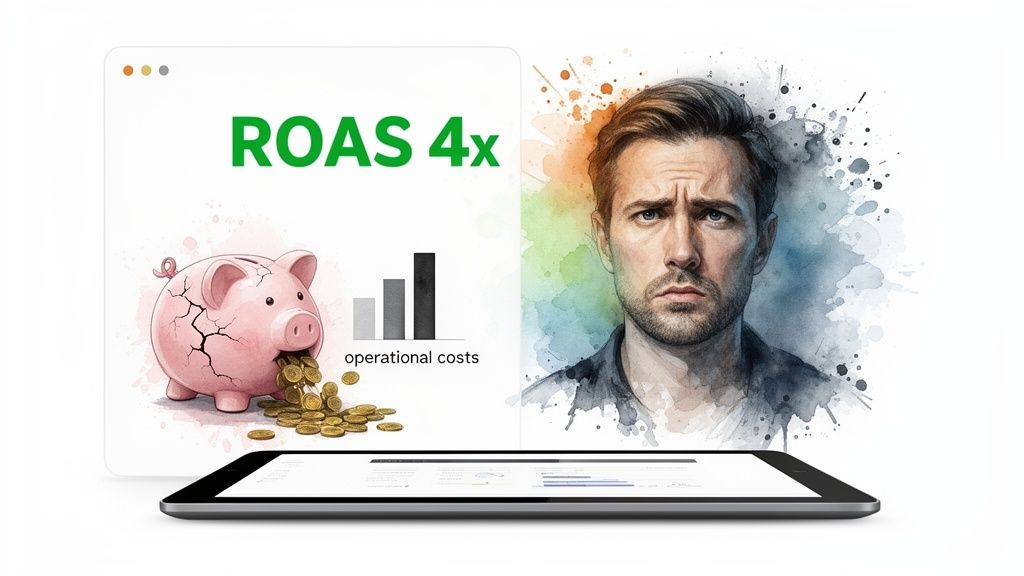
Imagine focusing on cheap, low-intent keywords. They might generate a ton of inexpensive clicks and leads, making your ROAS look fantastic on the surface. But if those leads never convert into actual high-value customers, your real ROI is plummeting.
The profitability blind spot
This is the core problem: ROAS is completely blind to profit margins. It treats all revenue equally, whether it comes from a low-margin product that costs a fortune to deliver or a high-margin digital service. The metric has no idea what your cost of goods sold (COGS) is, what you pay your team, or how much your software stack costs.
It only sees the ad spend and the top-line revenue that comes back. That’s a massive blind spot that can hide serious issues.
Think of ROAS as a tactical metric for your campaign managers, not a strategic one for you as a founder. Confusing the two is a classic—and very costly—mistake.
When you make strategic decisions based only on ROAS, you risk scaling the wrong parts of your business. You might pour more budget into campaigns that generate impressive revenue figures but are actually losing you money on every single sale once all costs are factored in.
A real-world example of ROAS deception
Let's look at a concrete example that shows how dangerous this can be. A classic PPC campaign might spend $100,000 to generate $250,000 in revenue, yielding a seemingly healthy ROAS of 2.50. But consider an engineering firm that split its budget, spending $75,000 on ads and another $75,000 on support staff and software to handle the new leads. They pulled in $160,000 in revenue.
The ROAS on ads alone hit 2.13, painting a decent picture.
However, the total ROI cratered to a minuscule 6.7%. This means they only made about $0.07 in profit for every dollar invested, a brutal reality check hidden by the vanity metric.
This is a wake-up call. Here’s what ROAS misses:
- Profit margins: It doesn’t know if you’re selling a 90% margin SaaS subscription or a 10% margin physical product.
- Customer lifetime value (CLTV): It ignores whether a customer will buy once and disappear or become a recurring source of revenue for years.
- Total customer acquisition Cost (CAC): It only accounts for the ad spend, not the salaries of the sales team or the cost of your CRM.
Improving your campaign's landing page relevance can lower CPC and boost ROAS, but that tactical win is meaningless if the fundamental business economics don't work. The goal isn't just to get a return on your ads; it’s to build a profitable, sustainable business.
Building a growth strategy on two metrics, not one
After the last few sections, you might think ROAS is useless. It’s not. In fact, it's a fantastic directional metric for your marketing team—the people in the trenches optimising campaigns day-to-day. Chasing ROI alone can make you slow and indecisive.
The key is to stop thinking in terms of ROI vs ROAS and start thinking about how they work together. It’s not a battle; it’s a partnership. You need both to build a powerful, sustainable growth engine that has tactical speed and strategic stability.
Tactical speed with ROAS
Let your marketing team live and breathe ROAS. It's the perfect metric for the front lines because it’s fast, directly tied to their actions, and available right inside the ad platforms.
This is the metric for the daily grind of campaign management:
- A/B testing: Quickly see which ad copy or creative brings in more revenue.
- Bid adjustments: Make real-time decisions on keywords and placements based on immediate returns.
- Audience refining: See which segments are responding best to your offers and double down on what works.
This allows your team to move quickly and optimize for efficiency without getting bogged down by complex profit calculations for every minor tweak. A 4:1 ROAS target for a specific campaign gives them a clear, actionable goal.
ROAS is your campaign-level speedometer, showing how fast you're generating revenue. ROI is your GPS, telling you if you're actually headed toward the destination of profitability. You need both to win the race.
Strategic stability with ROI
While your team chases ROAS targets, you, as the founder or head of marketing, must keep your eyes glued to ROI. This is the metric for big-picture, strategic decisions that determine the health and future of the business.
Use ROI for high-level planning and evaluation:
- Budget allocation: Decide which channels (Google Ads, Facebook, SEO) deliver the most profit, not just revenue.
- Scaling decisions: Know with confidence when a campaign is truly profitable enough to pour more fuel on the fire.
- Business health: Set the non-negotiable profitability floor—for example, requiring a minimum 60% ROI from the entire marketing effort.
This dual approach creates a vital feedback loop between the boardroom and the campaign manager. Your team uses ROAS to hit their tactical goals, and you use ROI to ensure those tactical wins are translating into real, sustainable profit. It’s how you build a business that’s both agile and built to last.
Using technology to bridge the data gap
So, how do we actually connect the dots between campaign data and real business profit?
Let's be honest, manually tracking total costs and trying to map them back to specific campaigns is a complete nightmare. This is exactly why so many founders give up and just stick with ROAS—it's easier.
But this is 2026. Smart technology is a founder's best friend, with tools that can automate this connection and move us beyond the spreadsheet hell that kills productivity and insight.
Creating a data feedback loop
Modern platforms don't just generate and optimize ads to chase ROAS; they create a powerful data feedback loop. This is the real game-changer.
By uploading actual conversion values or qualified lead scores back into your ad platforms, you’re teaching the algorithms what truly matters. You stop optimizing for more leads and start optimizing for more profitable leads.
This simple shift transforms Google's powerful bidding algorithms from a simple ROAS-chasing machine into an engine that drives real, measurable ROI.
Without this feedback loop, you're flying blind. You might be overestimating the value of your ad spend significantly. This is where Incremental ROAS (iROAS) comes in—it isolates the true lift your ads are generating. Globally, agencies often see a 15-20% ROAS overestimation without factoring in incrementality, which crushes ROI at higher spends.
Platforms that upload real conversion values—not just lead counts—are essential for aligning tactical ROAS with strategic ROI.
This isn't just about better reporting; it's about making your ad budget smarter. You're giving the machine the data it needs to find customers who will actually grow your bottom line, not just your revenue number.
From ad spend to intelligent investment
When you bridge this data gap, your entire approach to paid acquisition changes. Every dollar spent becomes a direct and measurable contribution to your bottom line. It’s how you scale intelligently and confidently.
For a truly profit-focused strategy, robust and secure data acquisition strategies are non-negotiable, ensuring all your calculations are based on complete and reliable information.
Here’s what this technological shift enables:
- Profit-driven bidding: Your automated bidding strategies start prioritizing users who are more likely to become high-value customers.
- Accurate channel evaluation: You can finally see which channels are delivering profitable growth, not just vanity metrics.
- Confident scaling: You know exactly when to pour more fuel on a campaign because you can see its true ROI, not just a flashy ROAS figure.
This is the future of performance marketing—one where technology eliminates the guesswork and connects every marketing action directly to business profit. It's how you build a business that not only grows fast but grows profitably.
Your action plan for profit-focused marketing
Theory is great, but execution is what matters. Enough talk—let's make this real with a clear, no-bullshit action plan. If you want to move from chasing revenue to building actual profit, this is your playbook.
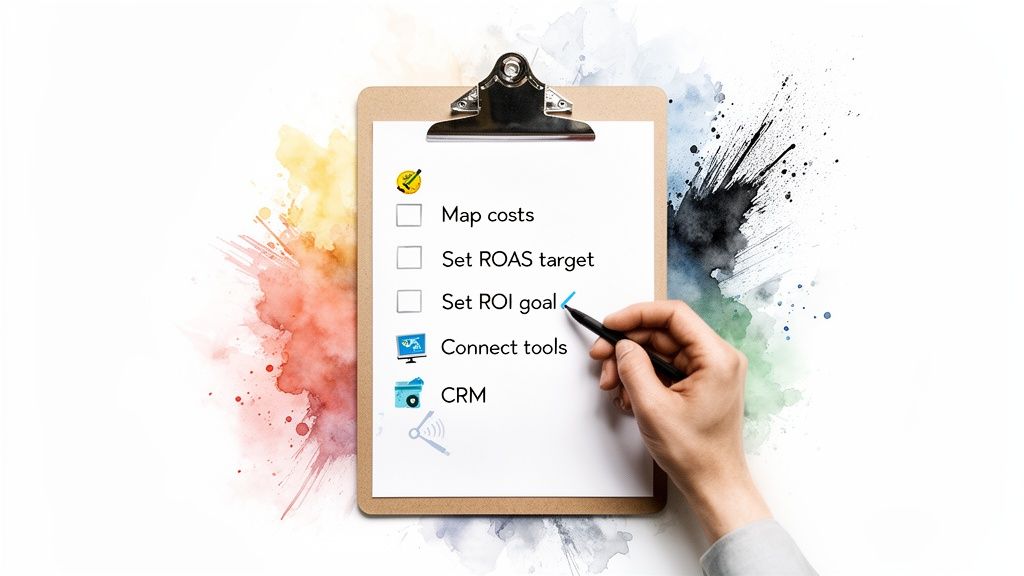
This isn’t about ditching ROAS. It's about making it smarter by pairing it with ROI to get a complete picture of your business's health.
Your immediate to-do list
First, map out every single cost that goes into a campaign, not just the ad spend. I’m talking about salaries, software licenses, overhead—everything. You can't calculate real profit if you don't know your real costs.
Next, you need to set up separate targets for your teams and for the business itself.
- For campaign managers: Give them a clear ROAS goal. This is their tactical North Star for daily optimizations and lets them move fast.
- For the business: Set a non-negotiable ROI goal for the entire marketing function. This is your strategic guardrail that ensures tactical wins translate to bottom-line growth.
This dual-metric approach keeps everyone aligned and focused. Your marketing team can zero in on campaign efficiency, while leadership watches overall profitability.
Stop celebrating revenue and start building real, sustainable profit. That's how you win in the long run. High revenue with zero profit is just a fast track to burnout.
Finally, connect your tools and build a simple dashboard that tracks both ROAS and ROI side-by-side. Make sure your CRM and ad platforms are talking to each other, especially if you're in lead generation. Start assigning dynamic values to leads based on their potential to close.
This level of clarity is the difference between guessing and knowing. Get it done. 👊
I see founders ask about this stuff all the time. Everyone's trying to figure out how to scale without setting money on fire. Let's run through a few of the most common questions so you can get back to building.
What is a good ROI for Google Ads?
Honestly? There is no magic number. A "good" ROI for your business is going to look completely different from mine. The only number that matters is the one dictated by your specific business model and, critically, your profit margins.
A SaaS company with 90% gross margins can run profitably on an ROI that would put an e-commerce store with 30% margins out of business. So stop looking for some universal benchmark to copy—it just doesn't exist.
The only intelligent way to figure this out is to work backward from your own numbers.
- Start with your customer lifetime value (CLTV).
- Then, calculate your total customer acquisition cost (CAC), including every single expense.
- A "good" ROI is whatever number ensures your CLTV stays significantly higher than your total CAC, leaving you with a healthy, sustainable profit.
If you absolutely need a generic starting point, aiming for a 50-100% ROI is a solid goal for a lot of businesses. But the real, honest answer is waiting for you in your own P&L sheet.
Can you calculate true ROI in Google Ads?
Nope, and that’s the whole point we’ve been discussing. The Google Ads platform is built to calculate ROAS, full stop. It only sees two things: the ad cost incurred on its platform and the revenue value you send back to it.
Google Ads has zero visibility into your other business costs—salaries, software, rent, cost of goods sold. It only knows what you tell it. Expecting it to calculate true ROI is like asking your speedometer to tell you how much fuel is in the tank.
To get your actual ROI, you have to merge your Google Ads data with your real financial data, whether that's in your accounting software or internal spreadsheets. This is exactly why connecting your tech stack and creating a single source of truth is so important.
Is it ever okay to only focus on ROAS?
From a founder's perspective? Almost never. The only real exception is in very specific, tactical situations where you've made a deliberate strategic choice to prioritize something else—like market share—over immediate profit.
A PPC manager might use a Target ROAS bidding strategy for day-to-day campaign management, but that should always operate under the assumption that the broader ROI goals have already been set by leadership. Another case could be an early-stage launch where the primary goal is rapid market penetration, and you're willing to burn cash for a limited time to get it.
But even then, a founder must be tracking the true ROI in the background to know exactly what that growth is costing. Flying blind on profitability is never a strategy.
At dynares, we built our platform to bridge this exact gap. We help you optimize for real business outcomes, not just flashy ad metrics, by making it easy to upload true conversion values back into Google Ads. Learn how dynares turns your ad spend into profitable growth.


