
Let’s get one thing straight: most B2B PPC advertising is a spectacular way to set money on fire.
Why? Because too many marketers treat a complex, high-stakes software sale like they're hawking a pair of sneakers. The hard truth is that B2B is a completely different game, played on a field with brutally long sales cycles and entire committees making the decisions.
Let's get real about B2B PPC advertising
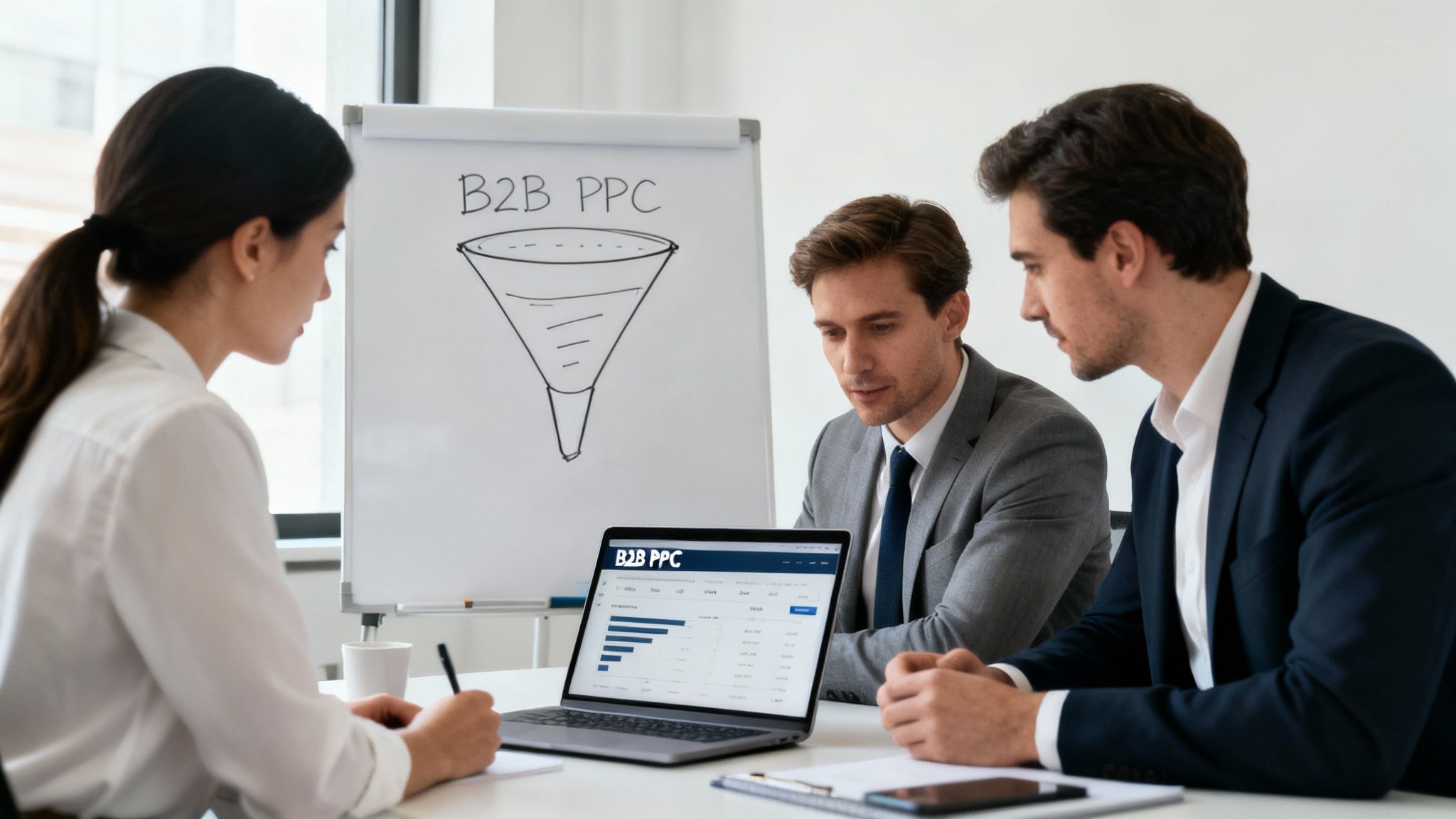
If you've run paid campaigns in this space, you know the feeling. You're burning through the budget with generic B2C tactics, chasing clicks that vanish into thin air. The buyer's journey feels less like a funnel and more like a maze, and your CFO is starting to ask pointed questions about whether digital ads even work.
Sound familiar? 😅
The problem isn't the channel; it's the playbook. Copy-pasting strategies from the consumer world is a recipe for disaster. You're not trying to trigger an impulse buy. You're trying to start a long-term, high-value relationship with another business. You can dive deeper into the fundamentals in our guide on what paid search marketing is and see why it’s so powerful when you get it right.
This guide is my unfiltered playbook for what actually works in B2B PPC. We're not talking about fluffy theories here. We're building a practical machine designed to turn clicks into qualified leads and, ultimately, measurable revenue.
What we are building here
Forget the usual advice. We're going to build a system that drives real growth. That means shifting your entire mindset from simply getting traffic to orchestrating a strategic conversation with potential partners. For teams looking to scale their expertise without bloating their payroll, leveraging specialized outsourced PPC campaigns can be a smart operational move.
The goal isn't just to generate leads. It's to generate leads that your sales team will actually thank you for—the kind that turn into closed deals and drive the business forward.
Let’s be clear: this isn't some get-rich-quick scheme for marketers. It demands discipline, a deep understanding of your customer, and a willingness to ignore the vanity metrics that plague our industry.
But if you’re ready to stop wasting money and start building a high-performance B2B growth engine, you're in the right place. Let's build something that matters.
Why your B2C playbook is killing your B2B campaigns
Let’s get straight to the point. The single biggest—and most expensive—mistake I see marketers make is taking a perfectly good B2C advertising playbook, applying it to a B2B product, and then wondering why they’re burning cash with nothing to show for it.
It’s like trying to sell a complex piece of enterprise software to someone in the checkout line at the grocery store. The context is wrong, the mindset is wrong, and the entire approach is fundamentally broken. You're not chasing an impulse buy; you're trying to earn the trust of a skeptical buying committee that will spend months deliberating a six-figure deal.
This isn’t about just tweaking your ad copy. It’s a total mindset shift. If you don't get this, you're not just being inefficient—you're actively proving to your CFO that digital advertising is a waste of time. And honestly, I wouldn’t blame them.
From impulse buys to strategic partnerships
The core difference is simple: B2C PPC targets an emotional, immediate need. Think 20% off sneakers or fast pizza delivery. The path from seeing an ad to pulling out a credit card can take minutes. It’s a transaction.
B2B is a completely different game. Your customer is often a group of people—a CFO, a Head of Engineering, a project manager—all with different priorities and pain points. They aren't looking for a quick fix; they're researching a solution to a complex business problem that could impact their entire company. Your ad isn't the finish line; it's the first handshake in a very long conversation.
A potential B2B buyer conducts about 12 Google searches before even thinking about making a decision. This amplifies the need for precise, intent-matched ads that build trust over time, not just scream for a click.
This is where the numbers get interesting. While 86% of industries face rising CPCs, B2B marketers who play the right game see incredible returns. Many see PPC as highly effective, with some reporting returns as high as $2 for every $1 invested. It’s a brutal, competitive space, but the rewards are there if you know the rules. You can find out more about these PPC statistics and see what’s possible.
The critical differences you cannot ignore
To make this crystal clear, let’s break down the fundamental differences between B2B and B2C PPC. Ignoring these is like navigating a new city with the wrong map. You’ll get lost, waste resources, and end up deeply frustrated.
Here’s a practical look at where things go wrong when you apply a consumer mindset to a business audience.
B2B vs B2C PPC: the core differences
FactorB2B PPC: The RealityB2C PPC: The Common MistakeBuyer IntentSolving a complex, long-term business problem (e.g., how to improve manufacturing efficiency).Fulfilling an immediate, often emotional, personal need (e.g., buy running shoes online).AudienceA small, specific committee of decision-makers defined by job title, company size, and industry.A broad demographic segment defined by age, interests, and general location.Sales CycleMonths or even years, involving multiple touchpoints like demos, whitepapers, and sales calls.Minutes to days, often ending in a direct online purchase with a credit card.Conversion GoalGenerating a highly qualified lead (MQL) like a demo request or a consultation booking.Driving an immediate sale or a simple transaction like adding an item to a cart.
Seeing it laid out like this makes the disconnect obvious, doesn't it?
Using B2C's wide-net approach in the B2B world means you're paying to attract a huge volume of unqualified traffic. You’re targeting interns with ads for enterprise security solutions. It’s a complete waste of money. Your strategy has to be built around precision, patience, and value—not volume and discounts.
Architecting your B2B account structure for intent
Alright, let's get down to the blueprint. Most B2B Google Ads accounts I see are a complete disaster. They look like a chaotic garage sale of keywords dumped into random ad groups with no rhyme or reason. It’s a mess, and it’s costing you a fortune.
We're going to build something clean, logical, and scalable. We're going to architect an account structure that actually reflects the B2B buyer's journey. This isn't just about organizing keywords; it's about mapping your entire PPC effort to your sales funnel. The goal is to capture high-value intent, not just random clicks.
Mapping campaigns to the sales funnel
Your B2B customer isn't making a snap decision. They go on a journey from being vaguely aware of a problem to actively seeking a specific solution. Your account structure needs to mirror this reality. Trying to hit every prospect with the same generic "Buy Now" message is just dumb.
Instead, think of your campaigns in distinct stages:
- Top-of-Funnel (ToFu): Prospects are just starting to research their problem. They're using broad keywords like "how to improve manufacturing efficiency". The goal here isn't a hard sell; it's to offer value with a guide or webinar.
- Middle-of-Funnel (MoFu): Now they know a solution exists, and they’re comparing options. Keywords become more specific, like "Salesforce vs HubSpot". Here, you can offer case studies or a free trial.
- Bottom-of-Funnel (BoFu): This is where the magic happens. These prospects are ready to buy. They're searching for branded terms, competitor names, and high-intent phrases like "dynares pricing". These are your most valuable keywords, and your ads should point directly to a demo or consultation page.
Structuring your account this way ensures your ad copy and landing pages are always hyper-relevant to where the prospect is in their journey. For more on this, it’s worth understanding the nuances of what search intent is in SEO and how it applies here.
Layering powerful B2B targeting options
Keywords are just one piece of the puzzle. The real power in B2B PPC advertising comes from layering sophisticated audience targeting on top of your keyword strategy. Google Ads offers some incredibly potent tools for this, especially when you think beyond basic demographics.
Your goal isn't just to get clicks; it's to get clicks from the right people at the right companies. This is how you stop wasting money on students, competitors, and job seekers.
Below is a diagram illustrating how fundamentally different the B2B and B2C PPC worlds are, which reinforces why this targeted approach is so critical.
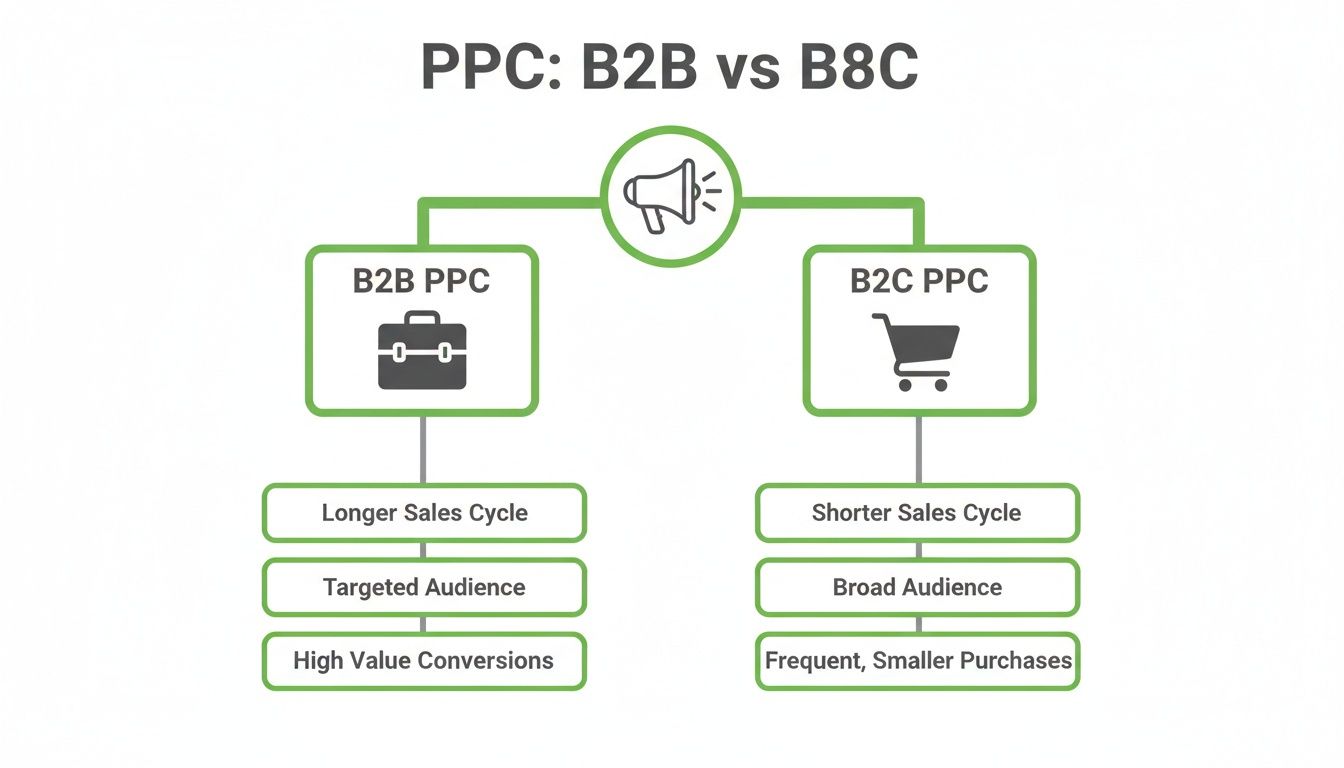
This visual breakdown makes it clear that B2B requires precision over volume, focusing on long-term value with a very specific, professional audience.
Building your targeting stack
To achieve this precision, you need to build a targeting stack. This means combining multiple signals to zero in on your ideal customer profile (ICP). Stop thinking about these as separate options and start thinking about how they can work together.
A well-architected account isn't a static thing. It's a living system designed to filter out the noise and deliver highly qualified, intent-driven leads directly to your sales team. This is the foundation for any successful B2B PPC advertising program.
By combining funnel-based campaigns with a multi-layered targeting stack, you move from shouting into the void to having strategic conversations with the exact people who can buy your product. It takes more work upfront, but the payoff in efficiency and lead quality is massive. This is how you build a PPC machine you can actually manage and scale with confidence.
Crafting ad copy and landing pages that convert
Let’s get straight to the point: your keywords and targeting can be flawless, but if your ad copy is a mess of corporate jargon and your landing page is a generic afterthought, you are literally setting money on fire.
This is where B2B PPC campaigns are won or lost.
Most B2B ads are a sea of vague promises and meaningless buzzwords. "Innovative solutions," "streamlined workflows," "paradigm-shifting technology." It all means nothing. We’re going to fix that, starting now.
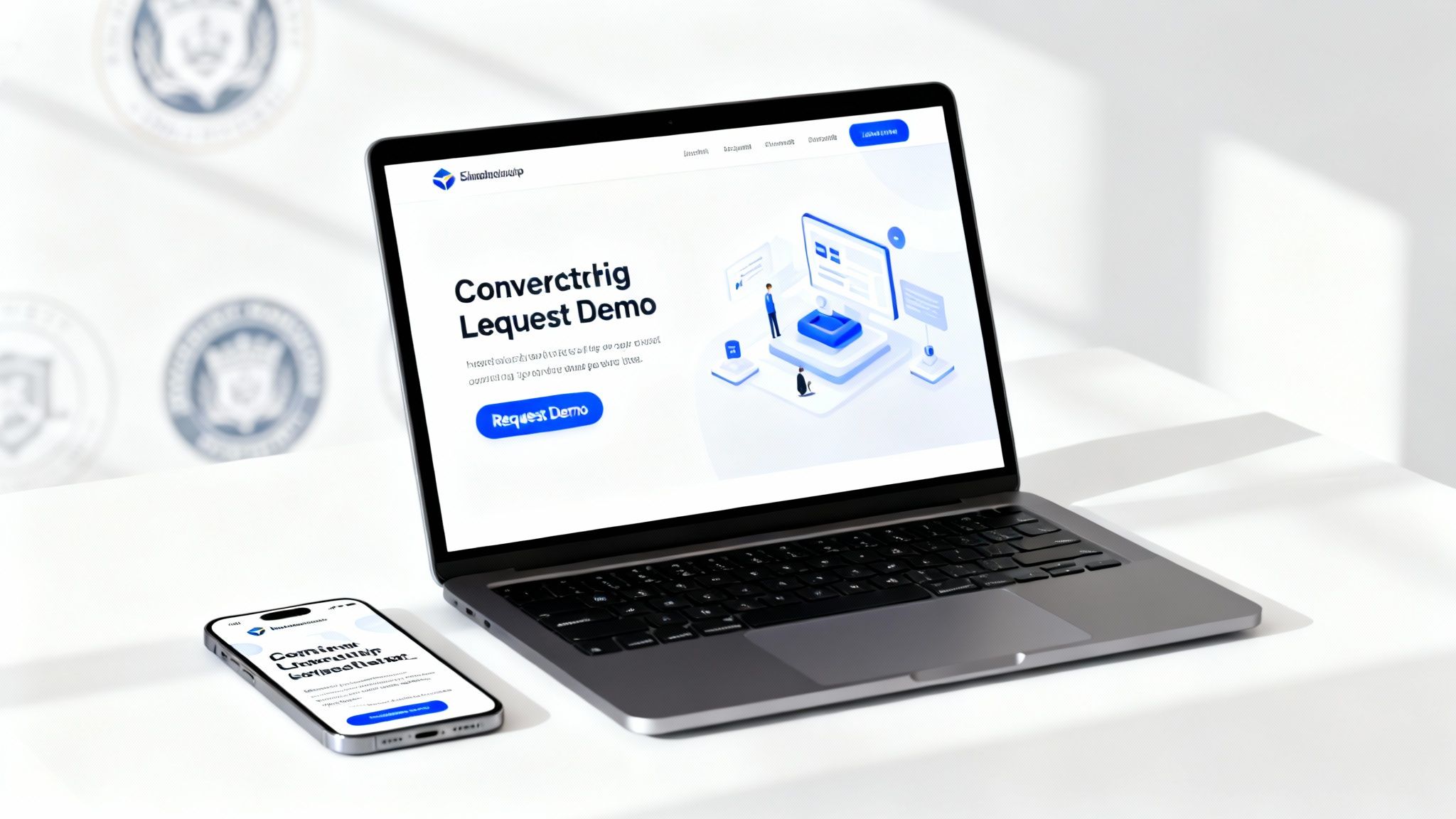
This is about writing direct, benefit-driven copy that speaks to a professional who has a real problem and is actively looking for a way to solve it. It’s about clarity, not cleverness.
The non-negotiable rule: message matching
The single most important principle here is message matching. It's the simple, unbreakable rule that the promise you make in your ad must be paid off the second someone hits your landing page. If they click an ad for "manufacturing efficiency software," the landing page better scream "manufacturing efficiency software."
It sounds obvious, but you’d be shocked how many companies burn a fortune on clicks only to dump everyone onto their generic homepage. It's lazy, disrespectful of the user's time, and an incredibly expensive mistake.
Your ad is the question, and your landing page is the answer. If the answer doesn't match the question, the user is gone in seconds, and you just paid for the privilege of frustrating them.
This alignment builds instant trust. The user feels understood, their search is validated, and they're far more likely to take the next step. A smooth, logical journey from search to conversion is the foundation of any high-performing campaign.
Writing B2B ad copy that doesn't suck
Forget everything you think you know about "professional" ad copy. Your audience is human. They're busy, skeptical, and looking for solutions, not poetry. Your only job is to be clear, direct, and valuable.
Your ad has one job: to earn a qualified click from the right person. That’s it. Stop trying to close the deal in three lines of text.
Designing landing pages for action
Once you've earned that click, your landing page has to keep the momentum going. A generic page is a conversion killer. Every ad group targeting a distinct intent should have its own dedicated landing page. Yes, it’s more work, but the payoff is massive.
A high-converting B2B landing page isn't about flashy design; it's about creating a frictionless path to a single goal—usually booking a demo or requesting a quote. For a deeper look, our team put together a great guide on how to create a landing page that converts that you should definitely check out.
To build trust and push for action, your page must include these critical elements:
- A Headline That Matches the Ad: Immediately reinforce that the user is in the right place. Consistency is everything.
- Benefit-Oriented Subheadings: Break down the value proposition into scannable chunks that address specific user needs and pains.
- Prominent Social Proof: This is non-negotiable in B2B. Display logos of well-known clients, showcase compelling case studies, and use testimonials with real names, companies, and titles. Nothing builds credibility faster.
- A Simple, Frictionless Form: Only ask for the information you absolutely need to qualify the lead. The more fields you add, the lower your conversion rate will be. Keep it lean.
- A Singular, Clear Call to Action: Don't distract them with links to your blog, social media, or other random pages. The landing page has one job. Make sure every element on the page supports that single objective.
By perfectly aligning your ad copy and landing pages, you create a powerful, cohesive experience. You respect your prospect's intent, build immediate trust, and make it incredibly easy for them to say yes. This is how you stop wasting clicks and start generating high-quality leads that your sales team will actually love.
Measuring what actually matters in B2B PPC
Okay, let's talk about the metrics that actually move the needle. Too many B2B marketers are obsessed with vanity metrics like Click-Through Rate (CTR) and Cost Per Click (CPC). Honestly? It’s a complete distraction.
Who cares if you got a cheap click if that click came from a student doing research for a term paper? In B2B, those numbers are mostly noise. Chasing a higher CTR is a dumb goal if it doesn't translate to pipeline. The only numbers that should keep you up at night are the ones that connect your ad spend directly to business results.
This is where we separate the amateurs from the pros. It's time to stop reporting on clicks and start talking about revenue.
Moving beyond vanity metrics
The only metrics that truly matter in B2B PPC are Cost Per Qualified Lead (MQL) and, ultimately, marketing-influenced revenue. Everything else is just a supporting character in the story. Your CFO doesn't care about your Quality Score; they care about the return on the company's investment.
Focusing on the right numbers completely changes how you manage your campaigns. It forces you to ask better questions: which keywords are bringing in leads that actually close? Which campaigns are attracting our ideal customer profile? This is how you build a case for a bigger budget and prove your worth. If you want a broader look at this, our team covered some great points in our guide on key metrics and reports for marketing.
Getting this right is non-negotiable. If you can't draw a straight line from your ad spend to a closed deal, you're not managing a growth engine—you're just running a cost center.
The good news is that when you do get it right, the results are undeniable. PPC delivers a stellar ROI for B2B, with businesses earning $2 for every $1 spent on Google Ads on average. For performance marketers fixated on ROAS, these numbers scream opportunity, especially when you consider that search ads can also boost brand recognition by 80%. You can dig into more of these compelling PPC performance statistics to see the potential. This efficiency is how you justify your spend and scale your efforts with confidence.
Choosing the right bidding strategy
Your bidding strategy is the engine that drives your campaign performance, and choosing the right one depends entirely on your data maturity. Don't let anyone tell you there's a single "best" way.
- Manual Bidding (When You Need Control): When you're launching a new campaign or have very little conversion data, manual bidding is your best friend. It gives you maximum control to set precise bids for specific keywords, preventing the algorithm from making wild guesses with your money. It's more hands-on, but it's the safest way to start.
- Target CPA (When You Have Data): Once you have a steady stream of conversions (at least 30-50 per month per campaign), it's time to let Google's AI do the heavy lifting. Target Cost Per Acquisition (CPA) uses machine learning to automatically find users who are likely to convert at your desired cost. This is how you scale efficiently without spending all day in the platform.
Closing the loop with offline conversion tracking
This is the holy grail. This is how you finally connect the dots between a click in Google Ads and a deal marked "closed-won" in your CRM. Offline conversion tracking is the mechanism that lets you send your real-world sales data back to Google.
It's a bit technical to set up, but it's an absolute game-changer. Instead of just telling Google a lead form was submitted, you can tell it which of those leads became a Marketing Qualified Lead (MQL), a Sales Qualified Lead (SQL), and eventually, a paying customer with a specific deal value.
This is how you make genuinely data-driven decisions. You stop guessing and start knowing exactly what’s working. It’s more work upfront, but it’s the only way to build a predictable, scalable, and wildly profitable PPC machine.
Scaling your wins with smart automation and AI
Once you’ve found a solid footing and you’re consistently pulling in qualified leads, the game changes. You can’t just keep grinding away at the same manual tasks and expect to grow. The real challenge is scaling your wins without having to scale your team—or your workload—at the same pace.
This is where smart automation and AI become your unfair advantage. I’m not talking about some fluffy, futuristic concept, but practical tech you can use right now to run circles around bigger, slower teams still stuck doing everything by hand.
This isn’t about replacing marketers; it’s about making them more powerful. It’s about freeing up your best people from the repetitive, soul-crushing work that leads to burnout so they can focus on high-level strategy and creative thinking. That's exactly how a lean, hungry team outmaneuvers a massive department.
Moving beyond basic bidding
Most people hear "automation" in PPC and their minds jump straight to bidding strategies. Frankly, that's table stakes now. The real leverage comes from automating the entire workflow, from creating the ads to optimizing the results. You have to think bigger.
We're talking about systems that can intelligently create and test ad variations at scale, ensuring you’re always running the most effective message without getting lost in a spreadsheet for hours.
Closing the loop with revenue data
The single most powerful use of AI in B2B PPC advertising is connecting your ad platform directly to your revenue data. It’s the final piece of the puzzle that allows for truly intelligent optimization.
Feeding actual revenue data from your CRM back into Google Ads is a complete game-changer. It teaches the algorithm to stop optimizing for cheap leads and start hunting for the prospects that turn into your most valuable customers.
This isn't just about tracking marketing-qualified leads (MQLs). It’s about pushing the final, closed-won deal value back to its source. This is how you stop optimizing for a low cost per lead and start optimizing for a high return on ad spend (ROAS).
This level of automation creates a powerful, self-improving feedback loop where the system learns which keywords generate the most revenue, automatically adjusts bids, and reallocates spend to what's proven to make you money.
This is how you build a PPC engine that doesn't just run; it evolves and gets smarter every single day.
Your B2B PPC questions, answered
Look, B2B PPC isn't rocket science, but it’s definitely not simple. When you’re in the trenches managing campaigns day in and day out, the same practical questions tend to pop up again and again.
Let's cut through the usual fluff and get you some direct answers. No sugarcoating, just what you need to know.
What's a realistic budget to start with?
Honestly, anyone who gives you a number without asking questions is guessing. The real answer comes from a different question: what’s your customer's lifetime value (LTV)?
If a new customer is worth €50,000, spending €5,000 a month to acquire a few of them is a no-brainer. But if your LTV is closer to €1,000, you obviously have to be much tighter with your spend.
As a general rule, a good starting point for a serious test is at least €3,000-€5,000 per month. Anything less, and you won’t get enough data to make smart decisions. You’ll just be guessing in the dark, and that’s a terrible way to spend money.
How long until I see results from B2B PPC?
Patience is the name of the game here. This isn't B2C where you see sales roll in overnight. Given the long, complex sales cycles in B2B, you need to think in quarters, not weeks.
Here’s a realistic timeline:
- Month 1: Expect to see some initial lead flow and gather baseline data. This month is all about learning what works and what doesn't.
- Months 2-3: You should start seeing Marketing Qualified Leads (MQLs) and maybe a few early Sales Qualified Leads (SQLs). This is where you begin optimizing based on actual performance.
- Months 4-6: This is when you can realistically expect to see the first deals entering the pipeline and potentially closing.
If you're not seeing any qualified leads by the end of month two, something is probably wrong with your targeting or messaging. But don’t expect to prove massive ROI in 30 days. It’s a marathon, not a sprint.
Should I target competitor keywords?
Yes, but you have to be smart about it. Bidding on your competitor's brand name can be a powerful way to capture high-intent traffic from buyers who are already deep in the market. They're literally one step away from making a decision.
The key is to offer a clear, compelling alternative, not just shout "we're better." Use your ad and landing page to highlight your unique value proposition or a key feature your competitor completely lacks. It’s an aggressive move, but when done right, it pays off.
Ready to stop wasting time and build a PPC machine that drives real revenue? dynares automatically creates thousands of high-intent ads and landing pages that are perfectly matched to your keywords, boosting conversions and ROAS. See how it works at https://dynares.ai.


