
Let's be real. As a founder, you need customers, not a money pit. Pay-Per-Click (PPC) is a powerful tool for growth, but it's also a minefield of jargon, bad advice, and agencies happy to burn your cash for zero results. Small business PPC services aren't magic; they are a system for buying targeted attention on platforms like Google and Meta.
The unfiltered truth about small business PPC
Alright, let’s cut through the noise. If you're running a small business, you've probably been told a dozen times you need to be doing PPC. The truth is, it can be a growth engine or a cash incinerator, and the difference is understanding what you're actually getting into.
At its core, PPC is about buying visibility. Unlike SEO, which is a long-term play for organic ranking, PPC puts you at the top of the search results now—if you're willing to pay for each click.
Think of it as renting prime real estate on Google's first page instead of building your own skyscraper. It's fast, it's direct, but it demands a sharp strategy.
Why everyone is doing it
The reason PPC has become almost non-negotiable for SMBs is simple: when it's done right, it works. Really well.
In fact, about 65% of small-to-medium enterprises are now running at least one PPC campaign. The data shows that businesses typically earn $2 for every $1 spent, a solid return by any measure. The catch? The required investment varies wildly, with monthly ad spends ranging from $100 to over $10,000.
For small businesses serious about growth on Google Ads, this can mean an annual budget of $108,000 to $120,000. And this isn't just about Google. The same principles apply across platforms, from Meta to LinkedIn. If you're running an e-commerce shop, understanding what PPC in Amazon is is just as critical.
The real cost of bad PPC
Here's my direct take: most "set it and forget it" PPC campaigns are dumb. They’re a lazy way for agencies to collect a retainer while your budget evaporates. Effective PPC is an active process of testing, learning, and optimizing.
The goal isn't just to buy clicks. It's to buy clicks from the right people at the right time that lead to actual revenue. Anything else is just donating money to Google.
Before you invest a single euro, you need a pre-flight check. This guide is exactly that. We’ll break down what you’re actually paying for, the different service models (and their red flags), and how to choose a partner who will treat your budget like their own. Let's get into it. 🚀
What you are actually paying for in a PPC service
When you hire someone to manage your ads, you're not just paying them to "run ads." Let's be blunt: if that's all they're doing, you're getting ripped off. A legitimate small business PPC service—whether it’s an agency, a freelancer, or a smart platform—is a multi-layered operation.
Think of it less like hiring a driver and more like bringing on a full pit crew for your growth engine. You're paying for strategy, execution, and relentless optimization. It's a continuous cycle, not a one-time setup. If any of these core components are missing, your campaign is driving with the handbrake on, burning cash with every single click.
Strategy and meticulous keyword research
This is the foundation. A good PPC strategy doesn't start with keywords; it starts with your business goals. Are you trying to get demo bookings? Sell a specific product? Generate leads inside a 20-mile radius? The answer dictates the entire campaign structure.
A strategy without deep keyword research is just guesswork. This isn't about grabbing a few obvious terms. It's about uncovering high-intent, long-tail keywords that your competitors are too lazy to find. It’s understanding searcher psychology—what problem is someone actually trying to solve when they type that phrase into Google?
A proper service will map out:
- Commercial Intent Keywords: These are the money phrases, where users are ready to buy or take action (e.g., "emergency plumber near me").
- Informational Keywords: These attract users earlier in their journey. They might not convert today, but they are your future customers if you can capture their attention now.
- Negative Keywords: Just as crucial, this is a list of terms you don't want to show up for. It’s the single fastest way to stop wasting money on irrelevant clicks.
Ad copy and landing page experience
Here’s a truth most agencies won’t tell you: a brilliant ad pointing to a terrible landing page is a complete waste of money. Full stop. The ad's only job is to get the right click. The landing page's job is to secure the conversion.
Your provider must be obsessed with the connection between the two. The message in the ad has to perfectly match the promise of the page. This 'message match' is critical for a high Quality Score, which Google uses to reward you with lower costs per click. If a user clicks an ad for "custom leather dog collars" and lands on a generic pet supplies page, they're gone in seconds. You just paid for that bounce.
A great ad earns the click, but a great landing page earns the customer. The two are inseparable. If your provider only talks about ad CTR and ignores landing page conversion rates, that’s a massive red flag. 🚩
Tracking and continuous optimization
Finally, you're paying for data and the intelligence to act on it. "Running ads" without proper tracking is like flying a plane with no instruments. You have no idea if you're gaining altitude or heading straight for a mountain.
This means setting up conversion tracking meticulously. You need to know exactly which keywords, ads, and campaigns are driving actual results—phone calls, form fills, purchases. Without this data, every decision is a guess. If you need a solid primer on this, our guide on setting up Google Ads conversion tracking is a great place to start.
Optimization is the ongoing process of using that data to improve. It's not a weekly task; it's a daily discipline of A/B testing ad copy, adjusting bids, pausing underperforming keywords, and analyzing search term reports to find new opportunities.
This relentless tweaking is what separates a campaign that generates a 2x return from one that achieves a 10x return. You're paying for expertise, yes, but more importantly, you're paying for active, data-driven management.
To wrap it all up, here’s a quick reference guide to the essential tasks that should be part of any comprehensive PPC service.
Core components of a PPC service
Service ComponentWhat It IsWhy It's a Non-NegotiablePPC StrategyThe blueprint that connects your business goals (e.g., leads, sales) to specific campaign actions and KPIs.Without a strategy, you're just throwing money at keywords hoping something sticks. It ensures every dollar spent has a purpose.Keyword ResearchThe process of finding the exact search terms your ideal customers use and identifying negative keywords to avoid waste.This determines who sees your ads. Good research attracts qualified buyers; bad research attracts window shoppers and wastes your budget.Ad CopywritingCrafting compelling, relevant ad text that grabs attention, speaks to the searcher's intent, and earns the click.The ad is your digital storefront sign. If it's boring, unclear, or irrelevant, no one comes inside, no matter how good your product is.Landing Page ExperienceEnsuring the page a user lands on after clicking an ad is fast, relevant, and makes it easy for them to convert.A great ad gets the click, but the landing page gets the customer. A bad page experience is the #1 reason for wasted ad spend.Conversion TrackingThe technical setup that measures valuable actions like form submissions, phone calls, or purchases originating from your ads.This is your navigation system. Without it, you're flying blind, unable to tell which campaigns are working and which are failing.Ongoing OptimizationThe daily and weekly discipline of analyzing performance data to make improvements—testing ads, adjusting bids, and refining targeting.A PPC campaign is never "done." Continuous optimization is what turns a decent campaign into a highly profitable growth engine.
If a potential provider can't speak confidently about every single one of these components, they aren't providing a complete service—they're just managing clicks. And your business deserves more than that.
Navigating PPC pricing models and contracts
Alright, let's talk about the part everyone gets nervous about: the money. How much should small business PPC services actually cost, and what are you committing to?
Pricing in this space is a total mess, making it incredibly easy for a founder to get locked into a bad deal.
This isn't a simple product with a fixed price tag. You're buying expertise and time, and providers have cooked up a few different ways to charge for it. Getting this wrong can bleed your marketing budget dry with nothing to show for it.
The goal here is to make you a smarter buyer. I want you to walk into any conversation with an agency or freelancer and know exactly what to look for, what questions to ask, and which proposals to throw straight in the bin. 🗑️
Common PPC pricing models
You'll mainly run into three models. Each has its place, but the incentives they create are wildly different. Understanding them is your first line of defense against getting taken for a ride.
- Flat Monthly Retainer: This is simple and predictable. You pay a fixed fee every month, regardless of your ad spend. It’s great for budgeting but can be dangerous if the agency gets lazy. If they collect their fee without delivering results, you lose.
- Percentage of Ad Spend: A very common model where the agency takes a cut (usually 10-20%) of what you spend on ads. This incentivizes them to scale your budget, which should align with your growth. The risk? They might encourage you to spend more just to boost their fee, even if the returns are dropping.
- Performance-Based Fee: This sounds like the dream, right? You only pay for results, like a fee per lead or a percentage of sales. It aligns incentives perfectly but is rare for small businesses because it requires deep trust and incredibly clear tracking, which can be complex to set up.
There’s also a hybrid model, combining a smaller flat retainer with a performance component. This is often a good middle ground, as it covers the provider’s base costs while still tying their success directly to yours.
The problem with long-term contracts
Now for my biggest pet peeve: long-term, iron-clad contracts. Let me be direct—these are a massive red flag.
If a provider tries to lock you into a 12-month contract from day one, run. Don't walk, run.
A great partner is confident in their ability to deliver results. They know that if they make you money, you'll stick around. They don't need to trap you in a legal document.
A contract should protect both parties, not serve as a cage for the client. A 30-day out clause is standard and fair. It gives the agency security while giving you the freedom to leave if they're not performing.
Demanding a long-term commitment before proving their value shows a fundamental lack of confidence. It suggests their business model relies on locking in revenue, not on earning it through performance. Don't fall for it.
Any good PPC process is a clear, continuous loop. This diagram shows the high-level flow from initial thinking to ongoing improvement.
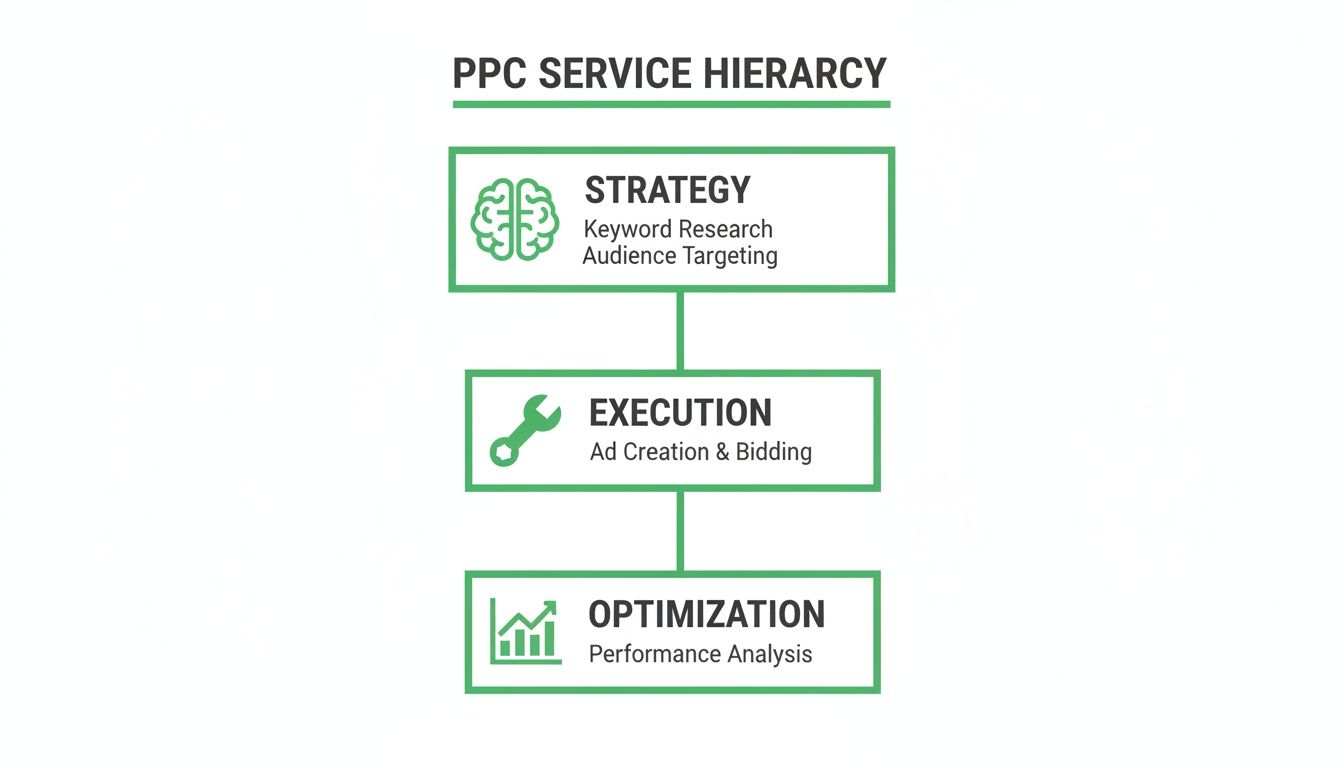
This illustrates that strategy, execution, and optimization aren't one-off tasks but an interconnected cycle that drives results. If a provider's contract or pricing model doesn't support this continuous effort, it's a poor fit. Choose a partner whose structure empowers this entire process, not just one piece of it.
Choosing your partner: agency vs. freelancer vs. platform
This is one of the most critical decisions you'll make. Who are you going to trust with your ad budget? Your choice here will have a direct—and sometimes brutal—impact on your growth.
You’ve basically got three paths: the traditional agency, the solo freelancer, or a modern tech platform.
Each has its place, but let's be honest, each also comes with some serious drawbacks depending on where your business is and how fast you want to move. Getting this right is about matching the model to your actual needs, not just picking the one with the slickest proposal.
The traditional agency model
Agencies look great on paper. They have a big team, a nice office, and a portfolio full of impressive logos. They promise a one-stop shop for everything, and for a huge corporation with a massive budget, they can be the right call.
But for a small business? It’s usually a different story.
The senior partners deliver the pitch, but your account gets handed off to a junior manager who’s likely overworked and learning on your dime. Communication gets bogged down in internal processes, and their high overhead is baked right into your retainer. You’re literally paying for their ping-pong table.
- Best for: Larger companies with big, stable budgets that need a wide range of marketing services and don't mind paying a premium for a full-service team.
- Worst for: Agile small businesses that need direct access to an expert, transparent communication, and can't afford to fund an agency's bloated operational costs.
The lone wolf freelancer
Hiring a top-tier freelancer can feel like a godsend. You get a direct line to a genuine expert, someone who lives and breathes PPC. They’re often more flexible and affordable than an agency, and can feel like a deeply integrated part of your team.
When you find the right person, this is a fantastic option.
The danger? A freelancer is a single point of failure. If they get sick, go on vacation, or just get overwhelmed with other clients, your campaigns can grind to a halt. More importantly, a solo operator has a natural ceiling on their capacity. If your goal is aggressive growth, you will outgrow even the best freelancer.
A great freelancer can get you from 0 to 1. But they often can't get you from 1 to 100. Their limited bandwidth becomes your growth bottleneck.
The modern tech platform
This is the new kid on the block, and it’s where my bias lies because it’s the future. AI-driven platforms are built to solve the core problems of the other two models. They offer the strategic power and scale of an agency without the insane overhead and human bottlenecks.
These platforms automate the repetitive, data-heavy work that bogs down human teams—like creating thousands of ad variations or generating a unique, high-intent landing page for every single keyword group.
This frees up human experts (either your team or theirs) to focus purely on high-level strategy, not mind-numbing spreadsheet work. The result is better performance, faster execution, and a cost structure that actually makes sense for a growing business.
- Best for: Ambitious businesses focused on scale, performance, and efficiency. You get the best of both worlds—smart automation for execution and human expertise for strategy.
- Worst for: Businesses that are philosophically opposed to technology or require an old-school, hands-on relationship with an account manager for every minor detail.
The agency model is particularly interesting to examine right now. You can learn more about how technology is changing the game for small business PPC services by reading about new solutions for PPC agencies that are helping them scale much more efficiently.
Ultimately, the right partner isn't just about who can run your ads today; it's about who can help you build a scalable growth machine for tomorrow. Choose wisely. 🚀
How AI is finally fixing PPC for small business
Let's be honest. The old way of running PPC is broken, especially if you're a small business. It's manual, it's slow, and frankly, it’s a clunky way to manage a complex system in this day and age. It just can't keep up anymore.
This is where technology—specifically AI—is finally changing the entire game. And we’re not talking about some far-off, futuristic idea. This is happening right now, and it's giving ambitious founders an almost unfair advantage.
The real bottleneck in traditional PPC has always been human capacity. A person can only write so many ads, build so many landing pages, or analyze so much data. That manual drudgery is a problem best solved by machines.
From manual labor to automated scale
Imagine being able to generate a unique, high-intent landing page—with perfectly matched ad copy and tracking—for every single one of your target keywords. Instantly. That’s not a dream; it's what modern AI platforms make possible today.
This is a fundamental shift from managing campaigns in spreadsheets to launching fully automated funnels. The scale is something no human team, no matter how brilliant, could ever hope to manage. We're talking about a level of detail that was previously impossible.
AI-powered systems handle the tedious parts of small business PPC services so you can focus on what actually matters: strategy.
AI isn’t about replacing marketers; it’s about giving them superpowers. It’s about letting them escape spreadsheet hell and focus on the big picture. You can explore this transition in our article about moving from spreadsheet hell to automated PPC funnels with AI.
The real-world impact on your bottom line
So, what does this actually mean for your budget? It means you get more for every dollar you spend.
The market has shifted, and costs are rising. The average cost per click for Google Ads recently hit $5.26, with CPC inflation running between 5-12% a year. At the same time, performance has improved to offset this. Data shows 65% of industries saw better conversion rates last year, with the average now sitting at 7.52%.
AI is the engine driving that efficiency, ensuring those more expensive clicks are far more likely to convert.
AI-driven PPC isn't just about efficiency; it's about competitive survival. While your competitors are manually tweaking a dozen ads, you can be automatically optimizing thousands, ensuring your budget is always working as hard as it possibly can.
This level of optimization directly impacts your Quality Score, which is Google's rating of how relevant your ads and landing pages are. A higher Quality Score means lower costs per click and better ad positions. AI excels at this because it can achieve a perfect 'message match' between a keyword, an ad, and a page at a massive scale.
To see how this works in practice, you can look into the various tools that help manage and track search performance, including some of the Best AI Search Tracker Tools available.
The future of growth isn't about outworking the competition; it's about out-thinking and out-automating them. Technology is finally leveling the playing field, allowing small businesses to deploy the kind of sophisticated campaigns that were once reserved for enterprise giants. It’s an exciting time to be building. 🚀
An actionable checklist for choosing a PPC provider
Alright, enough with the theory. Let’s get practical.
Choosing the right partner to manage your PPC budget is a high-stakes decision. You absolutely need to go into it with your eyes wide open. This isn't just about hiring a vendor; it's about finding a growth partner who gets what you're trying to do.
So, here’s my personal checklist for vetting any small business PPC service, whether you’re looking at an agency, a platform, or a freelancer. These are the direct questions you need answers to before you sign anything. No excuses.
Due diligence and track record
First things first, you need to verify their actual experience, not just their polished sales pitch. The goal here is to see concrete proof that they understand businesses like yours and aren't just going to learn the ropes on your dime.
- Case Studies and References: Ask for proof of results, specifically with businesses in your industry or with a similar business model. A portfolio stacked with e-commerce wins means nothing if you're a local service business.
- Team Expertise: Find out who, specifically, will be working on your account day-to-day. You need to know their level of experience, not just the impressive credentials of the senior person who closed the deal.
- Platform and Tool Proficiency: What tools are they using for research, management, and reporting? Competent pros use a professional stack. You can find some great overviews of modern Google Ads optimization tools to get a feel for what's current.
Onboarding, communication, and transparency
How they operate is just as important as the results they promise. A lack of transparency is the number one reason these partnerships fail. You need crystal clarity from the very beginning.
A great partner will make you feel smarter, not keep you in the dark. They should be able to explain their strategy in plain English, without hiding behind jargon. If they can’t, it’s a huge red flag. 🚩
- Ownership and Access: Will you have full ownership and administrative access to your ad accounts? The answer must be yes. This is non-negotiable. If they create accounts under their name, you're building their asset, not yours.
- Reporting and KPIs: Ask to see a standard report. It should focus on business metrics that actually matter—leads, cost per acquisition (CPA), return on ad spend (ROAS)—not just vanity metrics like clicks and impressions.
- Communication Cadence: How often will you meet, and who will you be speaking with? Establish a clear, regular schedule for strategy calls and performance reviews. Any ambiguity here just leads to frustration down the line.
Finding someone who is transparent, data-driven, and genuinely invested in your growth is everything. Use this checklist to filter out the noise and find a team that will actually move the needle for your business. 🚀
A few final questions I get all the time
Alright, let's wrap this up by hitting some of the most common questions I get from other founders. No fluff, just direct answers so you can move forward with confidence.
How quickly can I actually see results?
This isn't magic. You should expect it to take about 90 days to get meaningful data and see a clear direction.
The first month is all about setup and collecting a baseline. Month two is for initial testing and optimization—finding what works and what doesn't. By the third month, you should start seeing predictable patterns and, hopefully, a positive return.
Anyone promising you instant results is either lying or defining "results" with useless vanity metrics like impressions. Real business impact takes a little patience.
Seriously, how much should a small business budget for PPC?
There's no single number, but a dumb mistake is starting too small. You need to give the ad platforms enough budget to buy sufficient data so their algorithms can actually learn.
I’d say a minimum of $1,500 to $2,500 per month in pure ad spend is a realistic starting point for most local or niche businesses.
If you can't swing that, it's honestly better to wait and save up than to burn a few hundred dollars and conclude that "PPC doesn't work." It does, but you have to actually fund it for it to do its job.
Should I do SEO or PPC?
It's a false choice—the smart answer is both. They do different jobs.
PPC is your special forces team. You deploy it for speed and precision to capture specific, high-intent customers right now. You're paying for immediate access to the top of the search results.
SEO is your aircraft carrier. It takes a huge amount of time and effort to build, but once it's sailing, it's a dominant, cost-effective force that generates organic traffic for years to come.
The best strategy? Start with PPC to get immediate data and revenue, then reinvest those profits into your long-term SEO play. They work together, not against each other. It’s how you build a resilient growth engine. 🚀
Stop wasting your budget on manual campaign creation and start scaling your growth. At dynares, we built the AI platform to automate the tedious work so you can focus on strategy. See how it works at https://dynares.ai.


