
Search intent is the secret language between you and your customers. It’s the ‘why’ behind the words they type into Google, and frankly, it’s everything.
Getting this right is the difference between attracting customers who are genuinely interested and just burning cash on traffic that hits the back button in seconds. If you’re not thinking about intent, you’re not really doing SEO or PPC. You’re just guessing.
Stop burning cash on mismatched search intent
Let's be blunt. If your SEO and PPC strategies are still all about just matching keywords, you're running an outdated playbook. It’s a rookie mistake that guarantees high bounce rates, wasted ad spend, and a total disconnect with your audience.
You're basically shouting answers to questions nobody is asking. It’s dumb.
Think of it this way: someone searching for "best CRM for startups" is in research mode. They're weighing options. Hitting them with a hard "Buy Now!" call-to-action is like proposing on a first date. It’s awkward, premature, and just doesn't work. You haven't earned that trust yet.
The real goal behind the search
Understanding the why is the foundation for creating content and ads that actually connect. When you give searchers what they're looking for, you're also giving Google what it wants: a satisfied user. And Google rewards you for it.
This alignment has a direct and powerful impact on your bottom line:
- Better rankings: Google’s algorithm is built to reward content that satisfies user intent. When you match it, you get more visibility. Simple.
- Lower ad costs: In PPC, aligning your ads and landing pages to intent boosts your Quality Score. A higher Quality Score means you pay less for better ad positions. Learn more in our guide on landing page relevance.
- Higher conversion rates: When someone lands on a page that feels like it was made for their exact problem, they're far more likely to stick around and take action.
The data backs this up. A 2024 analysis shows that a staggering 52.65% of all Google searches are informational, while a tiny 0.69% are purely transactional. (Discover more SEO insights based on recent data).
This proves most of your audience isn't ready to buy the second they land on your site. They're looking for answers first. If you ignore this, you're missing the single biggest opportunity to build authority and guide them from curiosity to purchase.
The four flavors of search intent you must master
Alright, let's get practical. Search intent isn’t some mystical concept; it’s a framework for understanding what a searcher actually wants. There are really only four main flavors you need to master.
Getting this right is how you stop wasting time and money on mismatched campaigns. Each flavor represents a different stage in a person's journey, from a vague idea to a concrete decision. This is where user psychology meets campaign performance.
Below is a simple concept map visualizing how the user's "why" branches into these distinct needs.
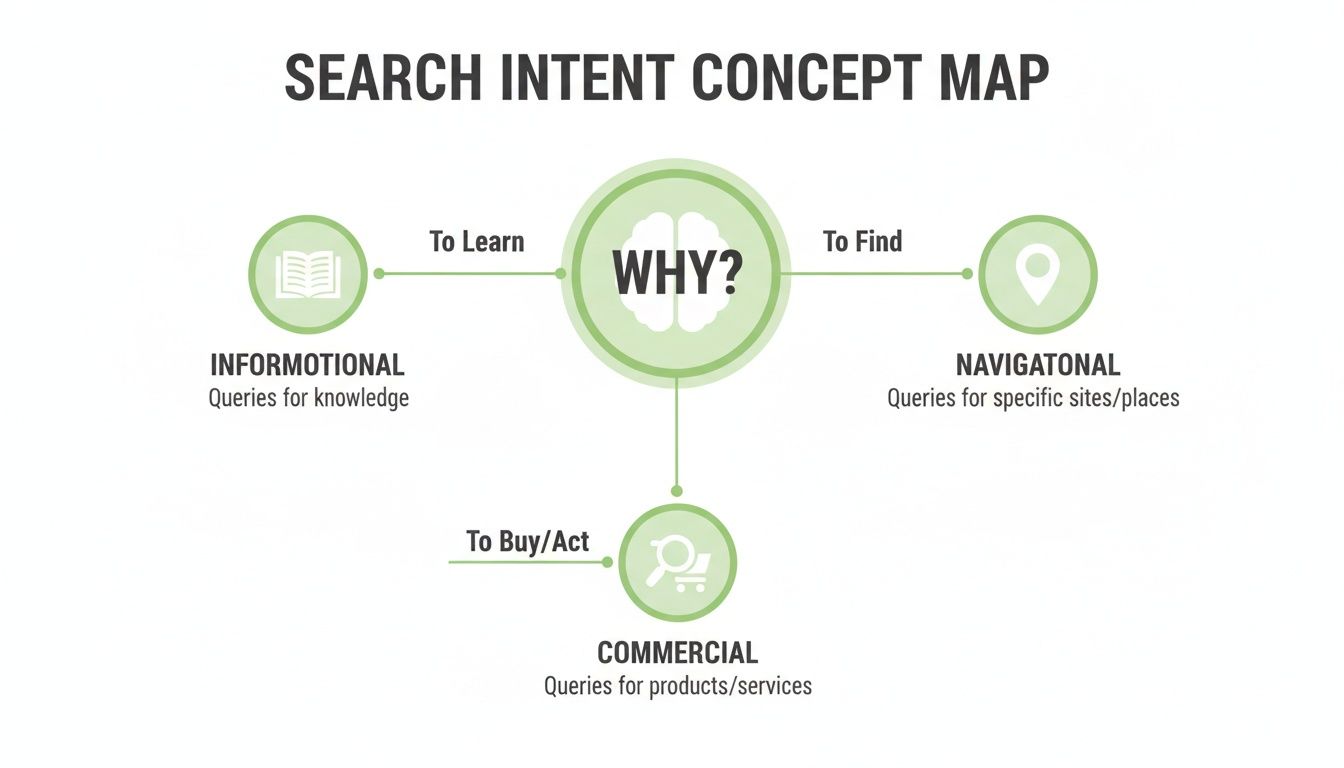
This map shows that every search starts with a fundamental goal, whether it's to learn something, find a specific place, or evaluate a potential purchase.
Informational and navigational intent
Let's start with the most common types.
Informational intent is when someone is just looking for answers. They have a problem or a question, and they want to learn. Think queries like “how to improve lead generation” or “what is customer acquisition cost.” This is your chance to be the expert by offering valuable blog posts, guides, or tutorials. You're building trust, not pushing a sale.
Navigational intent is much simpler. The user already knows where they want to go and is just using Google as a shortcut. Searches like “HubSpot login” or “dynares pricing” are purely navigational. The only goal here is to make sure your own branded pages rank at the top so existing customers or warm leads can find you easily. If they’re looking for you by name, don’t make them work for it.
Commercial and transactional intent
Now we're getting closer to the money. This is where most founders focus, but you can't win here without understanding the first two stages.
Commercial investigation: This is the comparison phase. The user has a strong interest but isn't ready to pull the trigger. They use keywords like "best crm for small business," "dynares vs competitor," or "lead generation software reviews." Your job is to provide clear, honest comparisons, case studies, and detailed feature pages that help them make an informed decision.
Transactional intent: This is the finish line. The user is ready to act now. They search for things like "buy dynares subscription" or "sign up for a free trial." The content they need is a frictionless, optimized landing page with a clear call-to-action. No fluff, no distractions—just a simple path to conversion.
Ignoring these distinctions is just lazy marketing. Sending someone with commercial intent to a generic homepage is a recipe for a bounce. Unfortunately, it happens all the time.
Mismatched pages can suffer bounce rates exceeding 70%, a clear signal to Google that you’re not delivering what users want.
To effectively categorize these needs, exploring customer segmentation strategies can provide valuable insights. This links back to our own work, where we conduct in-depth keyword research to map search terms to these specific intent categories.
How to decode search intent like a pro
Alright, theory is great, but let's get our hands dirty. How do you figure out the intent behind a keyword without just guessing?
It’s not magic; it’s detective work. You don’t need a bunch of complex tools, just a healthy dose of curiosity and a willingness to look at what Google is already telling you.
The search engine results page (SERP) is your roadmap. Seriously. Google has spent billions figuring out what people want to see for any given query. Your job isn't to reinvent the wheel—it's to look at the winning formula and adapt it.
This means you need to stop thinking about your own product for a second and focus entirely on what the search results are showing you. It’s about being strategic, not just busy.
Start with SERP analysis
The most direct way to understand search intent is to just search for your target keyword and see what shows up. What kind of pages is Google rewarding? This simple action tells you almost everything.
- Look at the content types: Are the top results long-form blog posts? Or are they product pages? Maybe they're comparison tables and ‘best of’ lists. The format of the top-ranking content is a massive clue.
- Analyze the top titles and meta descriptions: Pay attention to the language. Do titles use words like How To, Guide, or What Is? That’s informational. If you see Best, Review, or vs, you’re looking at commercial investigation.
- Check for SERP features: Does Google show a Featured Snippet, a ‘People Also Ask’ box, or a video carousel? These features are tailored to specific intents. A ‘how-to’ snippet, for example, screams informational intent.
Let's take the query "best crm for startups," which clearly has commercial investigation intent.

As you can see, the results are dominated by listicles and review sites—not direct product pages. This confirms the user wants to compare options before they commit.
Listen to keyword modifiers
Beyond the SERP, the little words people tack onto their core search term are pure gold. These keyword modifiers are explicit signals of intent that cut through any ambiguity.
They're the words that tell you exactly what’s on the user’s mind. They are a direct window into the user's brain, telling you exactly where they are in their journey.
Here’s a quick breakdown:
- Informational modifiers: how, what, why, guide, tutorial, tips, ideas
- Commercial modifiers: best, top, review, comparison, vs, alternative
- Transactional modifiers: buy, price, cost, discount, coupon, free trial
By building this repeatable process of SERP analysis and modifier spotting, you can confidently figure out a user's goal for any keyword. This way, you're not investing a single euro in ads or an hour on content until you're sure you're on the right track.
Once you learn how to decode search intent, you can apply this knowledge to effectively write SEO friendly blog posts that actually rank and resonate with your audience.
Putting intent into action: Your optimization playbook
Knowing the intent is one thing; acting on it is where the real work begins. It’s not enough to just figure out what users want—you have to build the entire experience around that need, from the first click to the final conversion.
This is where your strategy gets its hands dirty. Let’s be real, a generic, one-size-fits-all approach is just lazy marketing and a fantastic way to burn through your budget with nothing to show for it.
Tailoring your on-page SEO for intent
Your on-page elements—titles, headings, the works—are the first signals you send to both users and Google. If they don't line up with the searcher's goal, you've already lost. It's that simple.
- Informational intent: Your title tags and H1s should feel like answers. Think question-based phrases like How to... or What Is.... The content itself needs to be comprehensive, educational, and actually solve a problem.
- Commercial intent: Here, your on-page elements need to scream comparison and value. Use modifiers like Best, Review, or vs. in your titles. Structure your content with tables, pros/cons lists, and clear recommendations.
- Transactional intent: Be direct. Your titles should use action words like Buy, Order, or Sign Up. The page should be stripped of distractions, focusing on product details, pricing, and a massive, unmissable call-to-action button.
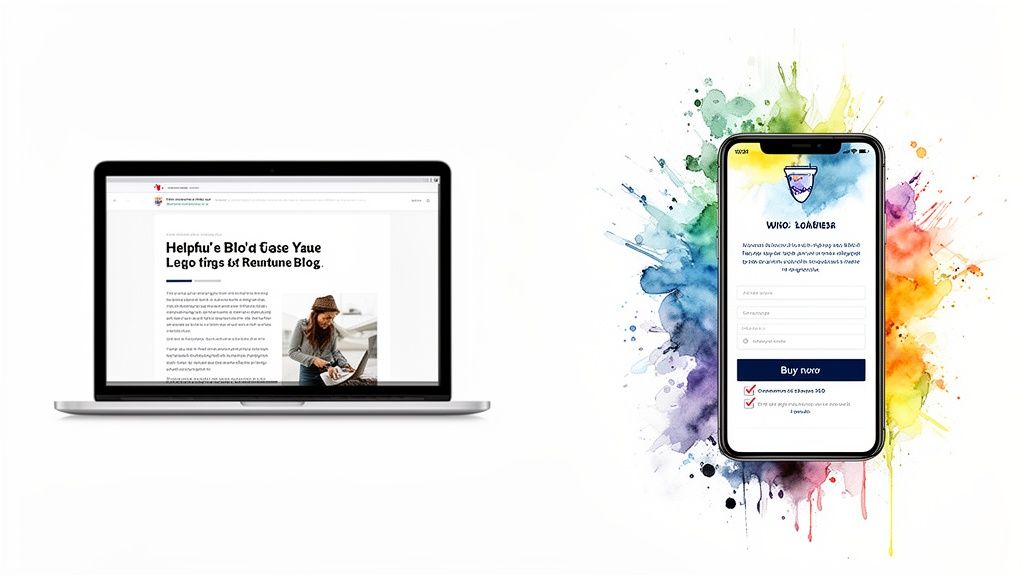
This image nails the two sides of the coin: a deep-dive informational blog post on a laptop and a slick, purchase-ready app on a phone. You need both, but you can’t mix them up and hope for the best.
Aligning ads and landing pages for conversion
Your Google Ads campaigns are where a mismatched intent really stings. You're paying for every click, so sending someone with transactional intent to a long-form blog post is literally throwing money away. The message in your ad has to be a perfect promise for what's on the landing page.
The core principle is simple: the ad sets an expectation, and the landing page must fulfill it instantly. Any disconnect is a guaranteed conversion killer and a direct hit to your Quality Score.
For example, an ad targeting "best CRM software review" should point to a detailed comparison page, not your homepage. In contrast, an ad for "buy CRM software" needs to lead directly to a checkout or pricing page where a purchase can happen in as few clicks as possible.
This level of alignment is non-negotiable. It keeps your Quality Score high, which lowers your costs, but more importantly, it shows you respect the user's time. For a deeper look, our guide on Google Ads conversion tracking setup shows how to measure the real-world impact of this alignment.
The future of automated intent alignment
Let’s be direct for a moment. Manually building a unique, perfectly aligned landing page for every single keyword variation is insane. It's not scalable, it's a terrible use of a founder's time, and frankly, it's a dumb way to work.
This is where a little vision and the right technology change the entire game. The future of high-performance marketing isn't about grinding harder on repetitive tasks. It’s about building smarter, automated systems that do the heavy lifting for you.
Building for scale, not for to-do lists
My team and I are obsessed with solving this exact problem.
Imagine a system that can automatically generate thousands of high-intent landing pages, each one perfectly tailored to the keyword that brought the user there. An informational query gets an educational page with a soft CTA. A transactional query gets a frictionless form and a clear path to purchase.
This isn't some far-off dream. This is what we’re building right now. By using AI to handle the grunt work of page creation, lean teams can achieve a level of personalization that was previously only possible for massive corporations with endless budgets.
The screenshot below gives you a glimpse of our platform, designed to turn keyword lists into conversion-focused funnels automatically.
What you’re seeing is the shift from manual campaign management to an intelligent, automated system that understands and acts on search intent at scale.
This is how you escape the spreadsheet hell that plagues so many marketing teams. Instead of spending weeks building out a handful of landing pages, you can launch thousands in minutes. This is more than just a productivity boost; it's a fundamental change in how we approach paid search. For anyone tired of the manual grind, our look into moving from spreadsheet hell to automated PPC funnels will resonate.
The goal isn’t just to make marketing faster. It’s to make it smarter and more effective by giving every single user an experience that feels like it was designed just for them.
This level of automation frees you up to focus on what actually matters: strategy, growth, and building a business that lasts. We're not just creating tools; we're building the infrastructure for the next generation of efficient, intent-driven marketing.
And honestly, it’s about time someone did. 🚀
Wrapping up: Common search intent questions
Alright, let's wrap this up by hitting a few of the most common questions I get asked. No fluff, just straight answers.
Can a single keyword have multiple intents?
Absolutely. This is called mixed intent, and it’s a real headache if you’re not looking for it. A broad keyword like "HubSpot" is the perfect example. Someone typing that in could be trying to log in (navigational), check pricing (commercial), or find tutorials (informational).
This is exactly why you have to analyze the SERP before you touch anything. Google's results will literally show you which intent it prioritizes for that query. If you see a mix of articles, product pages, and login links, that’s your cue to build a page that can serve more than one of those needs.
How does search intent affect Google Ads quality score?
Massively. Let’s be clear: a low Quality Score is basically a tax on bad marketing. It's heavily driven by your ad relevance and, critically, your landing page experience.
If your ad promises a solution to one problem and your landing page talks about something else entirely, users will bounce instantly. Google sees this as a terrible user experience and will slap you with a lower Quality Score. That means you pay more for every single click.
Aligning your ad copy and landing page to the user's intent isn't just best practice—it's the fastest way to improve your Quality Score and stop overpaying for clicks.
How often should I re-evaluate search intent?
Search intent isn't static; it shifts as markets, products, and user behaviors change. This is not a "set it and forget it" task. For your most important keywords—the ones that drive real revenue—I’d recommend reviewing the SERPs at least quarterly.
You also need to keep an eye on major Google algorithm updates. Those can completely reshape what kind of content gets rewarded, sometimes overnight. Staying on top of this is how you stay ahead of the competition.
At dynares, we're building the platform to automate this entire process, turning your keywords into perfectly aligned ads and landing pages at scale. If you're tired of the manual grind and want to see what AI-driven PPC looks like, check out what we're building at https://dynares.ai.


