
Let's be brutally honest. Automated content marketing isn't some fluffy, futuristic idea—it's a direct response to a fundamentally broken system. For paid search, it's about using technology to create hyper-relevant ads and landing pages at scale, finally closing the infuriating gap between what a user searches for and the generic page we force them to land on.
The brutal truth about manual PPC
If you’re a founder or running a growth team, you’ve felt this pain. I know I have. We spend countless hours trying to optimize our paid search campaigns, only to watch our Return on Ad Spend (ROAS) flatline. The advice is always the same: create more relevant landing pages.
So, what do we do? We build one-off pages for our top ad groups. It's a soul-crushing, unscalable nightmare. I've been there, staring at spreadsheets at 2 AM, trying to connect thousands of keywords to a handful of generic pages and wondering why we were burning cash so fast. This isn't a theoretical problem; it’s a real-world tax on your margins and your team's will to live.
The real cost of low relevancy
The core issue is the massive disconnect between a person's intent and the landing page experience you give them. When someone searches for "CRM for small law firms in London" and lands on a generic page about "CRM Software," you’ve already lost. That tiny moment of friction is all it takes to kill a conversion.
This mismatch has very direct consequences:
- Wasted Ad Spend: You’re paying for clicks from users who immediately bounce because the page doesn’t reflect their specific need.
- Tanking Quality Scores: Google penalizes this lack of relevancy, which means you pay more for the same ad position. It's a vicious cycle.
- Exhausted Teams: Your best people are stuck doing mind-numbing, low-impact work instead of focusing on actual strategy. A surefire way to burn out your top talent.
The old way of doing things—throwing traffic at a few static landing pages and hoping for the best—is fundamentally broken. It’s an expensive, inefficient relic from a time before we had the tools to do better.
This manual approach is more than inefficient; it's a strategic liability. I've seen teams caught in this exact loop, unable to scale their campaigns or enter new markets because the manual effort is just too damn high. We've written before about the journey from this exact kind of spreadsheet hell to automated PPC funnels with AI. This isn't about working harder; it's about acknowledging that the old model is busted and building a machine that actually solves the problem.
Building your automated content architecture
Alright, enough complaining. Let's start building the machine that actually fixes this mess.
Forget one-off campaigns; we’re architecting a scalable system. The mindset shift is from building pages to designing a system that builds pages.
Think of it like building with LEGOs, but for your paid search funnels. The goal isn't to build one perfect car. It's to create a collection of standardized bricks—wheels, chassis, windows, engine blocks—that can be instantly assembled into thousands of different cars, trucks, and spaceships on demand. This is the core of smart automated content marketing.
The traditional manual PPC process is a one-way street to low returns. It connects a specific user search to a generic page that completely fails to meet their intent.
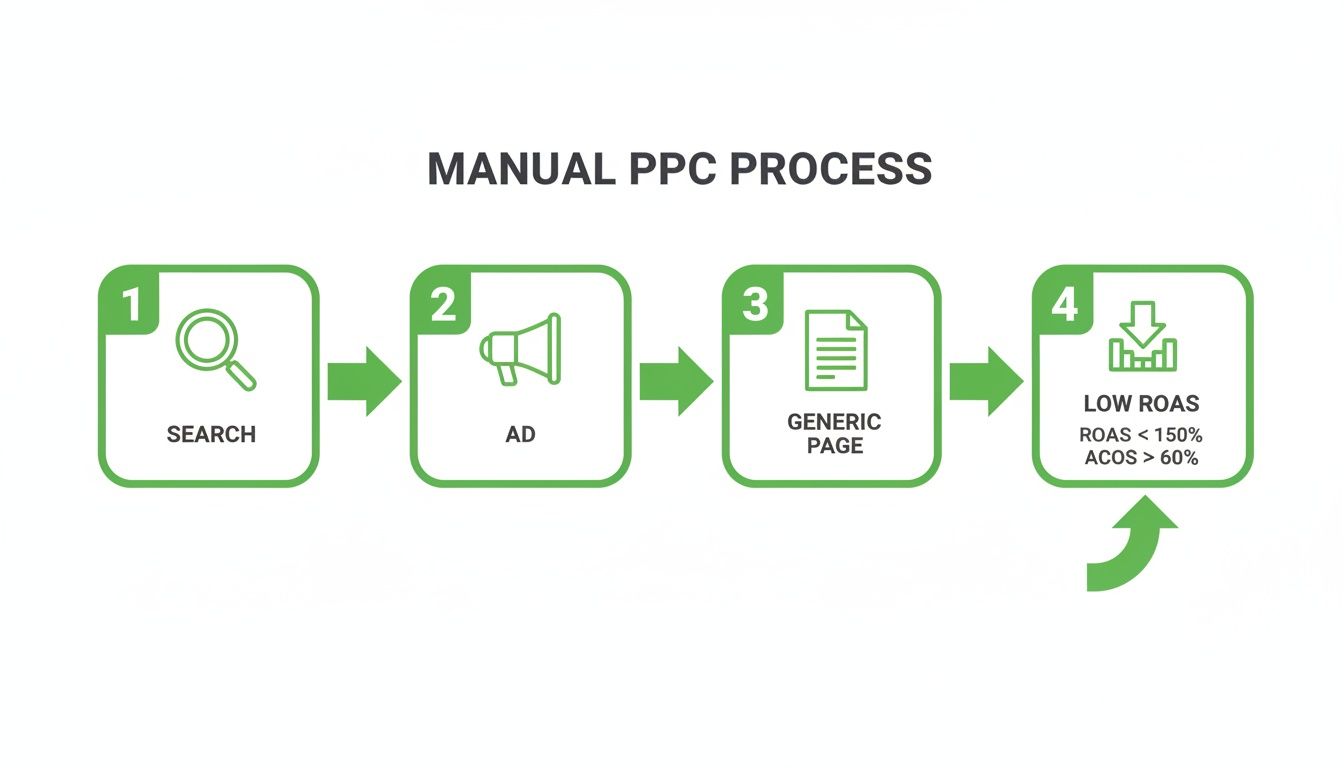
This linear, inflexible approach is exactly why so many campaigns bleed money. We're going to build something far more dynamic.
Master templates and modular blocks
The magic here is separating structure from content. You start by designing a master template. This is the skeleton of your landing page, where you lock in your brand’s non-negotiable elements. Once that’s solid, you create reusable content blocks. These are the modular components—the LEGO bricks—that an AI system can pull from to construct hyper-relevant pages instantly. You can see how these reusable, modular components work with our templates.
These blocks are designed for specific functions:
- Hero Section: A block for the main headline, sub-headline, and call-to-action button.
- Testimonial Block: A pre-styled component to drop in customer quotes and headshots.
- Feature List: A block designed to highlight key product features with icons and short descriptions.
- Lead Form: Your standardized lead capture form, ready to be deployed on any page.
Designing for scale from day one
By architecting your content this way, you give an AI system the power to become your co-pilot. You feed it the raw materials—brand guidelines, keywords, and value propositions—and it instantly generates thousands of unique, hyper-relevant ad-and-page combinations.
This approach transforms your campaign workflow. Instead of a series of manual, one-off tasks, you're building a repeatable, scalable engine.
Here’s a clear breakdown of the shift:
Manual vs automated content architecture for PPC
ComponentManual Approach (The Old Way)Automated Architecture (The New Way)Landing PagesOne generic page serves dozens of keywords.Unique, relevant pages generated for each keyword cluster.Design ProcessMarketers brief designers; devs build one by one.Marketers use pre-approved templates and modular blocks.Speed to LaunchWeeks or months for new campaign angles.Minutes or hours.TestingSlow and expensive; limited to a few A/B tests.Rapid, continuous testing of copy, offers, and angles.ScalabilityExtremely limited. Adding keywords requires more people.Virtually unlimited. Scale is managed by the system, not headcount.Ad-to-Page MatchWeak. Ads are specific, but pages are general.Strong. Ads and pages are generated together for high relevance.
Adopting an automated architecture isn't just about efficiency; it’s a strategic move to unlock performance that the manual model simply can't reach.
This isn't just a hypothetical advantage. The data shows that 82% of modern businesses are already embracing this kind of automation as a core strategy. Specifically, 67% are deploying AI tools for content and SEO. For PPC managers, this means top performers can generate $16.96 in revenue per recipient through automated workflows—a staggering 30x more than standard campaigns.
The whole point is to design a system where testing new angles, entering new markets, or targeting new personas is ridiculously fast. You're not starting from scratch every time; you're just telling the machine to assemble the blocks in a new combination. This is how you achieve scale without hiring an army.
Fueling the machine with smart content generation
An architecture is useless without fuel. Let’s get one thing straight: this is not about letting AI write soulless, generic copy that reads like it was churned out by a robot having a bad day.
That’s a dumb approach, and it doesn’t work. This is about using AI as a force multiplier for your expertise.
The whole point is to set up a system that combines your brand guidelines and keyword lists with real-time data to generate copy that's both on-brand and perfectly tuned to what someone just searched for. It’s about turning your strategic inputs into thousands of high-quality outputs, instantly.
Defining your voice so the AI doesn't sound dumb
First up, you have to teach the machine how to sound like you. An AI can’t read your mind, so you need to be explicit. It’s a classic Garbage In, Garbage Out problem.
This isn’t just about uploading a logo. It’s about codifying your brand’s personality into a set of rules the system can follow.
- Core Messaging: What are the key value propositions you always hit on? List them out.
- Tone & Style: Are you formal, witty, direct, technical? Provide clear examples of good and bad copy.
- Forbidden Words: What words or phrases does your brand never use? Tell the AI so it doesn't wander off into cringe territory.
The more guardrails you provide, the less the AI will stray into generic, unhelpful copy. A good system needs good constraints to work its magic. And to make sure all this automatically generated content is actually discoverable, an effective SEO tool is a must. A great one to have in your corner is the Rank Math SEO plugin, which helps optimize everything you create.
Prompts, keywords, and the human-in-the-loop
With your brand voice defined, you can start generating the actual copy. This is where you connect your keyword lists to your modular content blocks from the architecture phase. You're essentially creating smart prompts that tell the AI how to fill in the blanks in your hero sections, feature lists, and headlines.
The real magic of automated content marketing isn't just speed; it's the ability to inject dynamic keywords throughout the entire user journey. The ad, the headline, the body copy—they all align perfectly with what the user searched for.
This hybrid AI-human workflow is where the real wins are. By 2026, the global content marketing industry is projected to hit $107 billion in revenue, largely because of AI adoption. While 88% of marketers now use AI for content creation, workflows that blend AI generation with human oversight produce content that drives 5.44 times more traffic than pure AI output. This makes perfect sense, as 86% of marketers are already editing AI drafts before they go live.
This isn't about creating bottlenecks; it’s about establishing a fast, efficient review process. If you want to dive deeper into the nuts and bolts of this, you might be interested in our guide on what AI copywriting truly is.
You get the best of both worlds—AI's insane speed and a human's strategic oversight. That’s how you win.
Connecting the dots with integrations and tracking
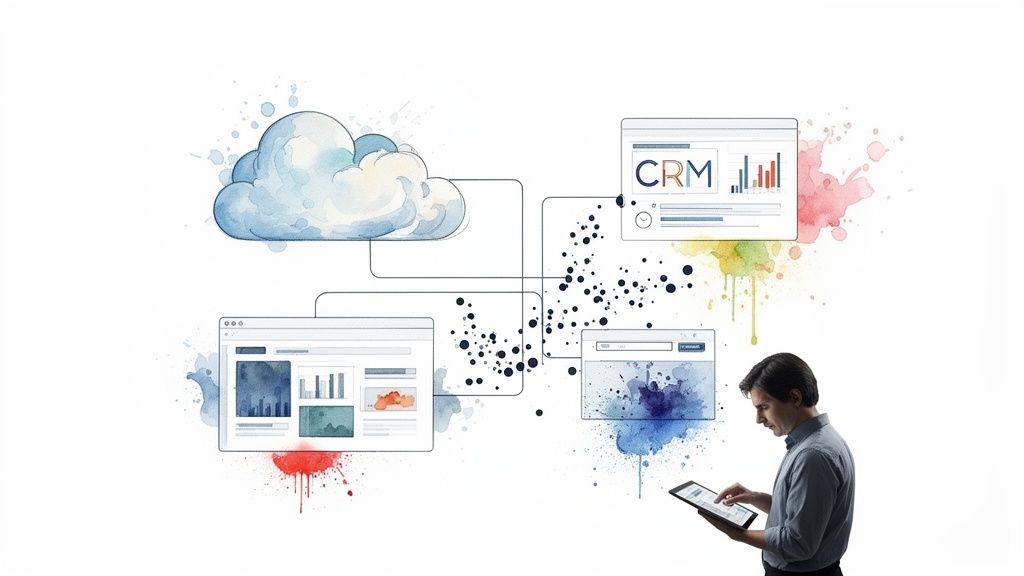
An automated content marketing system is completely useless if it’s a black box. Having thousands of brilliant, hyper-relevant landing pages doesn't mean a thing if you can't see what's actually working and what's just burning cash.
You need a seamless flow of data to measure what actually matters—revenue, not just clicks. This is where we get practical about the tech stack. If you don't connect the dots, you're flying blind, and that’s a dumb way to run a business.
Creating a closed-loop system
The goal is to build a closed-loop system where data flows freely from the initial ad click to the final sale and back again. This is what lets your team focus on high-level strategy instead of spending their days pulling reports from five different platforms.
Here’s the essential setup for any serious operation:
- Direct Google Ads Integration: Your system needs to talk directly to Google Ads. This is for pushing new ads and landing pages live and for pulling performance data back in so the system can learn and optimize.
- Powerful Event Tracking: You have to track every meaningful user action. This is where Google Tag Manager becomes your best friend. It lets you manage all your tracking tags without needing to poke a developer every five minutes.
- CRM Connection for Revenue Data: Pushing form fills into your CRM is basic. The real money is in pushing the conversion data—with actual revenue values—back into your analytics and ad platforms.
To really tie your automated content workflows together, integrating with powerful marketing automation platforms like Hubspot is often a critical step. It helps centralize lead data and track the entire customer journey from start to finish.
Why passing back conversion values is non-negotiable
Let's be crystal clear about this: if you are not passing real conversion values back to Google Ads, you are leaving an insane amount of money on the table. Without it, you’re optimizing for vanity metrics like lead volume, not actual profit.
Passing back conversion values is how you move beyond guessing and start letting Google's powerful algorithms optimize for your most valuable customers. You're telling the machine which leads are gold and which are garbage.
This simple data feedback loop is the difference between a campaign that just gets leads and a campaign that drives predictable, scalable revenue. It allows the algorithms to bid more aggressively for users who look like your best customers.
If you’re new to this side of tracking, you might want to check out our guide on how to use Google Tag Manager to get the foundation right. It's the central nervous system for all your tracking, and getting it wrong means your entire automated system will be built on shaky ground. Get the data right, and the rest of the machine can finally do its job.
Scaling and optimization without breaking things
So you've built the machine. The architecture is solid, the content engine is humming, and the data is flowing. Now what?
Building the system is one thing. Scaling it intelligently without everything descending into chaos is the real prize. This is where the magic of automated content marketing truly pays off, and honestly, it's the part that gets me genuinely excited.
We're moving from managing a handful of campaigns to orchestrating thousands of them. The goal is to let the system do the heavy lifting so you can focus on strategy, not spreadsheets.
A/B testing on autopilot
Let’s talk about testing. In a manual setup, A/B testing is slow, expensive, and you can only test a few big ideas at a time. With an automated architecture, you can run thousands of micro-experiments simultaneously. Imagine testing headlines, images, and CTAs across thousands of keywords, all at the same time.
It sounds complex, but the principle is simple: trust the data and let the system do the work.
This isn't just about making your existing campaigns a little bit better. It's about building a learning machine that constantly improves performance at a scale that's impossible for a human team to manage. You find winning formulas faster and apply them across your entire account instantly.
The real business impact
The efficiency gains are massive, but the real impact is strategic.
With this level of automation, lean growth teams can operate with an efficiency that was previously only available to companies with huge marketing departments. This is how you unlock explosive growth.
Suddenly, entering a new market isn’t a six-month project. It's a matter of loading a new keyword set and letting the machine generate the necessary campaigns overnight. That kind of agility is a massive competitive advantage.
The performance data on this is becoming undeniable. AI-driven automation delivers concrete edges, like 4.4x higher conversion rates from AI search visitors. Businesses are seeing 24% more organic traffic via AI SEO, and AI content is filling 17% of top Google spots. For those of us obsessed with ROI, the fact that 70% of marketers using AI for personalization report achieving over 200% ROI is the real headline. You can find more about the growing dominance of AI in marketing in this insightful guide.
This is where you stop thinking about incremental gains and start seeing massive uplifts in ROAS and real, tangible revenue. You’re no longer just managing ads; you're managing a growth engine. And that’s a much more interesting job. 😉
Alright, let's tackle a few common questions that always come up. I've been in these trenches, so here are the straight answers I wish I'd had.
Is this going to replace my marketing team?
Absolutely not. And if anyone tells you it will, they're selling you a fantasy. This is about elevating your team, not eliminating it.
Do you want your smartest people manually tweaking landing page copy all day? Or do you want them focused on high-level strategy, finding new creative angles, and getting deeper into the minds of your customers?
This kind of automation is a force multiplier. It handles the soul-crushing, repetitive work so your team can focus on the stuff that actually requires a human brain. Your PPC manager stops being a spreadsheet jockey and starts being a system architect—a far more valuable role.
How much technical skill is required to start?
Honestly, less than you'd probably guess. The whole point of modern platforms is to hide the messy code so you can focus on the marketing. If you understand the fundamentals of a good PPC campaign—keyword intent, ad-to-page relevance, conversion tracking—you've already got the strategic foundation.
You don't need to be a developer. You just need to think systematically. The system handles the deployment. Your job is to provide the strategic direction. It’s about being a great marketer, not a software engineer. Tools like Google Tag Manager make a lot of the technical side a point-and-click affair these days.
Can this actually work for a small business?
Yes. In fact, small businesses and lean teams have the most to gain from this. Why? Because you don't have the luxury of hiring a massive team to manually build everything. Automation is your leverage. It's how a two-person growth team can compete with a twenty-person marketing department.
For a startup, speed and efficiency are everything. Automated content marketing lets you test new markets, launch campaigns, and scale your efforts with a speed and capital efficiency that's impossible with the old, manual approach. It levels the playing field.
Sure, the initial setup takes some focused effort, but the payoff is huge. Instead of drowning in operational tasks, you get to spend your time actually growing the business. And that's the entire point, isn't it?
Ready to stop drowning in manual work and start building a real growth engine? See how dynares can automate your Google Ads campaigns from click to conversion. Get a demo today.


