
Let's cut the crap. A conversion isn't a "like" or a "view." It's a real action—the moment a user does something that moves them closer to becoming a customer.
It's the demo request, the form submission, the credit card swipe. These are the moments that actually matter for your bottom line. Anything else is just noise.
What Is a conversion in marketing, really?
Forget vanity metrics. A 'like' is a fleeting dopamine hit; a form submission is the start of a real conversation.
As founders and builders, we're here for the conversations that lead to revenue, not the ones that just stroke our egos. Chasing superficial numbers is one of the fastest ways to burn through cash with nothing to show for it. It's just dumb.
A conversion is the measurable proof that your marketing actually worked. It shows your message connected with someone enough for them to take that next valuable step. What that step is depends entirely on your business. For an e-commerce store, the ultimate conversion is a purchase. For a SaaS company like mine, it might be booking a demo or starting a free trial.
Defining what matters for your business
The key is to define your conversions around genuine user intent. This single focus separates the businesses that scale from the ones that just spin their wheels.
Think about it: what are the critical actions that signal someone is seriously considering your solution?
- Lead generation: This is when a user gives you their contact info, usually by filling out a form to get a resource or a callback. This action turns an anonymous visitor into a tangible sales opportunity. (We go deeper on this in our guide to what is lead generation in marketing).
- Sales/revenue: The clearest conversion of all—a customer completes a purchase. This is the end goal for most businesses and directly ties your marketing efforts to cold, hard revenue.
- Sign-ups: A user creates an account, subscribes to a newsletter, or registers for a webinar. This signals a higher level of commitment and opens up a direct line of communication for nurturing them toward a sale.

To make this crystal clear, here’s a quick breakdown of different conversion goals and what they really mean.
Conversion goals at a glance
| Conversion Type | What It Signals | Example Action |
|---|---|---|
| Lead (MQL) | Problem-aware, seeking info | Downloading an ebook |
| Sign-up | High interest, wants to engage | Registering for a webinar |
| Free Trial Start | Solution-aware, evaluating product | Creating a trial account |
| Demo Request | High intent, ready to talk sales | Booking a call with your team |
| Purchase | Decision made, ready to buy | Completing checkout |
Each of these actions tells you something different about where the user is in their journey.
Ultimately, knowing what a conversion is for your business is fundamental. You’ll see stats thrown around like the average Google Ads conversion rate being 7.52%, but that figure is almost meaningless without context. The automotive repair industry sees rates over 14%, while real estate lags at just 3.28%.
This massive variability is exactly why you have to define and track the actions unique to your customer journey. Don't chase someone else's numbers—define your own.
Macro vs. micro conversions: Why both matter
Let's get one thing straight: not all conversions are created equal. Thinking they are is a rookie mistake that costs founders a ton of time and money. Some conversions are massive wins, while others are the small, crucial steps that get you there.
This is the difference between macro and micro conversions.

A macro conversion is your primary goal. It’s the signed contract, the paid subscription, the completed checkout. Frankly, it's the reason your business exists—it’s the action that directly generates revenue.
The big wins: Macro conversions
These are the finish lines. They represent the final, most valuable action a user can take. For most of us building tech products, these look pretty similar.
- Requesting a demo: The user raises their hand and says, 'I'm interested enough to give you 30 minutes of my time.' This is a huge signal of intent.
- Starting a paid subscription: They’ve pulled out their credit card. This is the ultimate validation that you've built something people will actually pay for.
- Contacting sales: This is a direct invitation to start a commercial conversation. It’s a clear sign they see your solution as a potential fit for their problem.
But here’s the problem: if you only focus on these big wins, you're flying blind. You have no idea what’s happening in the entire journey leading up to that final click. That's where micro conversions come in.
The breadcrumbs: Micro conversions
Micro conversions are the smaller, incremental steps a user takes on their path to the big win. They're the digital breadcrumbs that show someone is moving in the right direction. Ignoring them is like trying to navigate a city with no street signs.
These smaller actions are leading indicators of future revenue. They show engagement and interest, giving you invaluable data on user behavior and the overall health of your pipeline.
Think of them as the supporting cast in your marketing strategy. They aren't the final sale, but they make the sale possible.
- Watching a demo video: They're actively educating themselves about your product.
- Downloading a whitepaper or case study: They're researching their problem and your solution.
- Signing up for a newsletter: They've given you permission to enter their inbox.
- Creating a free account: They're kicking the tires and exploring your platform.
Tracking these signals is how you spot friction points in your funnel. If thousands of people download a whitepaper but no one requests a demo, you've got a problem in the middle of your funnel. Maybe your content isn't compelling enough, or the next step isn't clear.
Without tracking micro conversions, you wouldn't even know where to start looking. It’s not just about the final sale; it’s about understanding and improving the entire journey. This is how you build a predictable, scalable growth engine.
The only conversion metrics that drive growth
Right, let's talk numbers. But not the boring kind that puts you to sleep.
If you're building a business, there are really only three conversion metrics you need to live and breathe. Get these right, and you're building a scalable growth engine. Get them wrong, and you’re just burning cash.
It all boils down to the simple relationship between what you spend and what you earn. Too many founders get obsessed with one metric and completely ignore the others, which is a fast track to nowhere.
Conversion rate (CR)
Your conversion rate (CR) is the most straightforward of the bunch. It’s simply the percentage of people who take the action you want them to take.
If 100 people visit your landing page and 5 of them request a demo, your conversion rate is 5%.
But here's the honest truth: a "good" conversion rate is a myth. It varies wildly by industry, traffic source, and the specific action you’re measuring. Don't chase someone else's benchmark; focus on consistently improving your own. A small lift from 2% to 3% is a 50% increase in leads or sales from the same traffic. That’s huge.
Cost per acquisition (CPA)
This is where things get serious. Your Cost per acquisition (CPA) tells you exactly how much it costs to get one new paying customer.
You don’t need a complicated formula for this: if you spend €1,000 on ads and get 10 new customers, your CPA is €100. Simple.
This metric forces you to be honest about your marketing efficiency. A high conversion rate is great, but not if your CPA is so high that you lose money on every single sale. Optimizing for a lower CPA is a constant battle, and it involves everything from improving your ad copy to using smart automation. In fact, many teams use specific Google Ads optimization tools to systematically lower their acquisition costs.
A low CPA looks fantastic on a spreadsheet, but it’s a vanity metric if the customers you’re acquiring aren’t valuable in the long run. This is the classic mistake of optimizing for cheap leads instead of profitable customers.
This leads us to the most important metric of them all.
Customer lifetime value (CLV)
Customer lifetime value (CLV) is your north star. It’s the total revenue you can expect to generate from a single customer over their entire relationship with your business.
Why is this the ultimate metric? Because it tells you how much you can afford to spend to acquire a customer in the first place.
- If your CLV is €1,000 and your CPA is €100, you’ve built a fantastic, profitable machine.
- If your CLV is €100 and your CPA is €150, you’re literally paying people to take your money. Your business is a sinking ship.
Balancing these three metrics is the entire game. The goal isn't just to get cheap conversions; it's to acquire high-value customers at a cost that makes sense for your business model. This simple interplay—CR influencing CPA, and CPA measured against CLV—is what separates the businesses that thrive from those that stagnate. Master this, and you're ready to scale.
How to track conversions without losing your mind
If you can't measure it, you can't improve it. It's a classic saying for a reason—it’s true. But let's be honest, conversion tracking can feel like a technical nightmare designed by sadists. 😅
The good news is you don’t need to be a coding genius to get a handle on it. The goal is simple: get clean, reliable data so you can make decisions with confidence, not just guesses.
The tools of the trade
Getting started with tracking usually involves a few key pieces. It's less intimidating than it sounds, and each layer adds more power and accuracy to your data.
- Website tagging: This is the most basic step. It's just a small snippet of code—a "tag"—from platforms like Google Ads or Meta that you place on your website. When a user completes an action, the tag fires and sends that info back to the ad platform. Simple.
- Google tag manager (GTM): Think of GTM as a toolbox for all your tracking tags. Instead of cluttering your website's code with dozens of individual snippets, you put one GTM "container" on your site. Then, you manage all your other tags from inside the GTM interface. It’s cleaner, easier, and a non-negotiable for any serious marketer. You can learn more about this powerful tool in our guide on how to use Google Tag Manager.
Relying solely on browser-based tracking (like the tags mentioned above) is becoming a massive liability. With privacy updates like iOS 14, cookie restrictions, and the rise of ad blockers, a huge chunk of your data is likely getting lost.
This is why more advanced teams are moving towards a more robust solution.
Why server-side tracking is the future
Server-side conversion uploads are the answer to the data loss problem. Instead of relying on the user's browser to report a conversion, your server sends the data directly to platforms like Google Ads.
This method is far more accurate because it can't be blocked by browser settings or ad blockers. It ensures your ad platforms get a much clearer picture of what's actually working, letting their algorithms optimize for real results, not just the conversions they happen to see.
This process flow shows you the key growth metrics that accurate tracking helps you measure and improve.
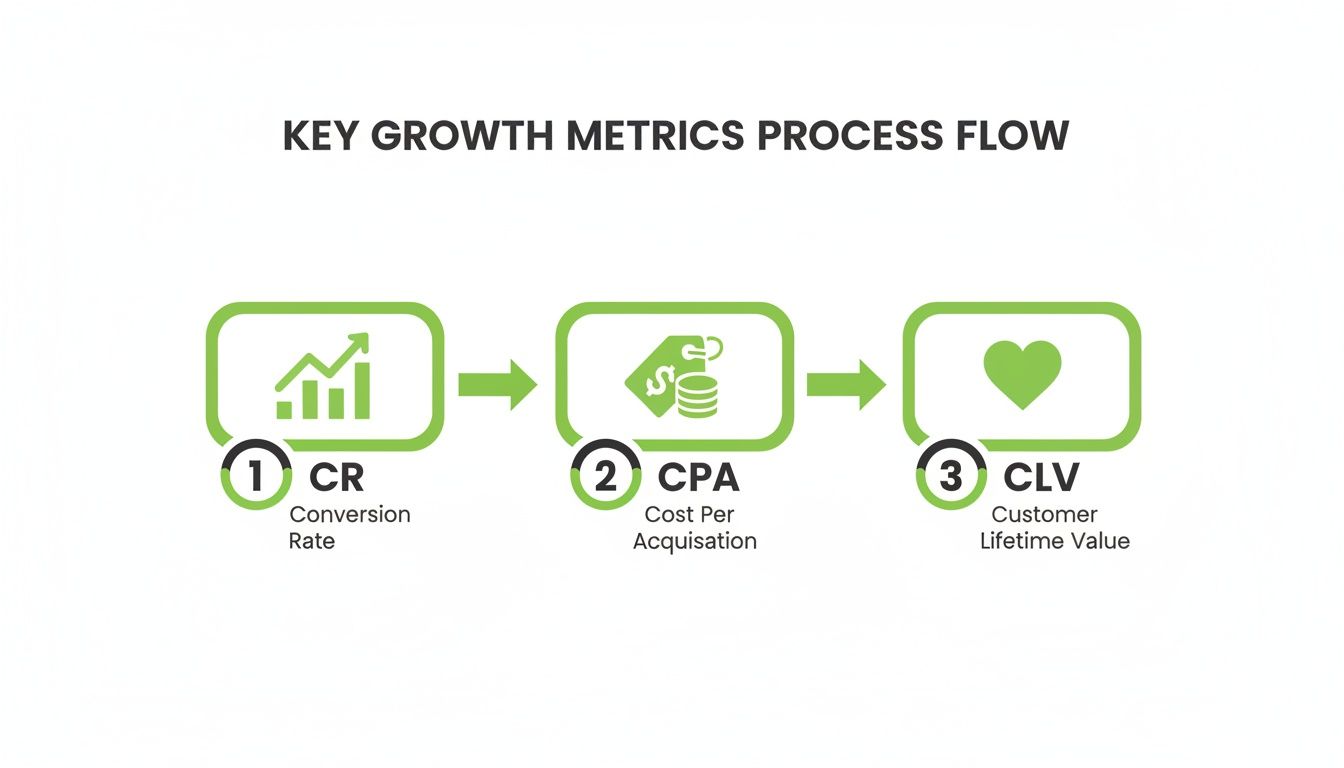
This journey from measuring Conversion Rate (CR) to managing Cost Per Acquisition (CPA) and ultimately maximizing Customer Lifetime Value (CLV) is what it's all about.
For B2B marketers, this is especially critical when bridging the gap between online leads and offline sales. While digital conversion rates often hover between 1.5% and 7.52%, the conversion rate for a subsequent sales call skyrockets to between 13% and 25%.
Understanding this full journey is impossible without reliable tracking that connects a digital click to a closed deal. It's how you prove why a channel like referrals—with its 25.56% call conversion rate—is so powerful.
Optimizing conversions the smart way
Getting conversions is one thing. Getting them efficiently and at scale is a whole different ballgame. This is where smart conversion optimization comes in—it’s not about tiny, endless A/B tests on button colors. It’s about making high-impact changes that actually move the needle.
Let’s start with the fundamentals. The non-negotiables. If you get these wrong, nothing else matters. You need a cohesive story from the first ad click to the final thank-you page.
The foundations of high-converting pages
Before you even think about fancy tools, get the basics right. It’s shocking how many companies pour money into ads that lead to a completely disconnected user experience.
- Message matching: Your ad promises one thing, and your landing page needs to deliver on it instantly. If your ad says 'AI-Powered SEO Tool,' the headline on your landing page better not say 'Your Digital Marketing Partner.' That disconnect is a trust killer.
- Blazing-fast page speed: Speed isn't a feature; it's a requirement. Data shows that landing pages loading in 2.4 seconds see a 1.9% conversion rate. That rate plummets to under 1% if the page takes 4.2 seconds to load. Every millisecond literally costs you money.
- Clean and clear design: Forget the clutter. A visitor should land on your page and know exactly what you do and what they should do next. If they have to think, you’ve already lost. For more on this, check out our guide on landing page optimization best practices.
Speaking of content, less is often more. Pages overloaded with text see conversion rates around 11.10%, while those with concise, punchy messaging can hit 14.30%. For a deeper dive into improving your site's effectiveness, learn how to improve website conversion rates and diagnose common issues.
The future is automated
Okay, here’s the blunt truth. Manually A/B testing every headline, button, and image is painfully slow. Frankly, in today’s world, it’s like trying to build a skyscraper with a hand saw. It’s a relic of an old way of thinking.
The future of optimization is automation and AI. For any team that wants to scale paid search without hiring an army of marketers, this isn't a luxury—it’s a competitive necessity.
This is about moving from a reactive, manual process to a proactive, automated one. It's about letting machines do what they do best—process massive amounts of data and iterate at a speed no human ever could.
Platforms like dynares are built on this exact principle. We automate the creation of thousands of high-intent landing pages, forms, and conversion uploads for Google Ads. Why? Because it allows you to test everything, everywhere, all at once—ensuring every click has the highest possible chance of converting. This is how you win at scale.
So, what's the real playbook for growth?
What's the one thing you should walk away with after all this? Thinking about conversions isn't just another box to check on a marketer's to-do list. It's a fundamental part of building a business that actually works.
It’s about getting obsessed with your customer's path from A to B and ruthlessly clearing out every single obstacle that stands between their problem and your solution. The goal is to build a machine—a reliable, predictable system that turns strangers into customers, not just rack up clicks for a vanity report.
My hope is you leave this guide not just with a few new definitions, but with a sharp, actionable way to think about growth. It’s time to stop chasing metrics that feel good and start building a real business engine powered by conversions that matter.
The future of growth is automated, it's smart, and it is relentlessly focused on results. It’s about building systems that generate predictable revenue, which frees you up to work on what really matters: building a better product and a stronger business.
This isn't just some high-level theory. It's the practical reality of how you scale a business today.
Now go build your machine.
Your questions answered
Alright, let's hit a few of the questions that come up all the time. I've heard these from founders, junior marketers, and even seasoned pros. Here are the straight-up, no-nonsense answers I’d give you if we were grabbing coffee.
What is a good conversion rate?
Honestly? It's a trick question. Chasing some universal "good" conversion rate is a complete waste of your time and energy.
Your number is totally dependent on your industry, traffic source, what you're selling, and who you're selling it to. A 1% conversion rate for a high-ticket B2B service might be absolutely fantastic, while a 5% rate for a free e-book download could be a disaster.
The only benchmark that truly matters is your own. Forget the industry reports. Focus on beating your numbers from last month. A jump from 2% to 3% isn't just a small win; it's a massive 50% increase in your pipeline from the exact same ad spend.
How do I start tracking conversions?
Don't overcomplicate it. If you're just getting started, nail down the fundamentals first.
- Install google analytics 4 (GA4): This is non-negotiable. It’s the foundation for understanding what people are actually doing on your site.
- Set up google tag manager (GTM): Think of GTM as a toolbox for all your tracking codes. It keeps your site's code clean and makes adding new tools way less painful.
- Define your main goal in GA4: Pick your most important macro conversion—like a "thank you" page visit after someone fills out your main form—and set that up as a conversion event inside GA4.
That’s it. Start there. Get that simple setup working reliably, and you’ll already be ahead of most of your competition.
What’s the difference between a lead and a conversion?
This one trips people up, but the concept is simple. A lead is just one type of conversion.
A conversion is any valuable action someone takes. A lead, on the other hand, is a very specific type of conversion where someone gives you their contact info, effectively raising their hand to say they're open to a conversation.
So, a lead is a conversion, but not all conversions are leads (think video views, key button clicks, or content downloads).
Ready to stop manually building landing pages and start scaling your Google Ads results? dynares uses AI to automate the creation of thousands of high-intent pages, forms, and conversion uploads, helping you drive real growth without the grunt work. See how it works at https://dynares.ai.


