
10 Conversion Rate Optimization Tools for PPC (2026)
10 Conversion Rate Optimization Tools for PPC (2026)
Your CRO toolkit is probably broken. Let’s fix it.
Let’s be honest. Most articles about conversion rate optimization tools are written for big internal marketing teams with giant budgets, long procurement cycles, and developers who apparently have time for everything. That’s not your reality if you run paid search.
Your reality is simpler and more painful. You launch a Google Ads campaign, traffic comes in with clear intent, and then the landing page fumbles the bag. Generic copy. Weak forms. No testing discipline. Tracking held together with duct tape. Money out, mediocre leads in.
This is why so many PPC accounts underperform. The ad account gets blamed, but the core problem sits one click later.
The good news is CRO is not some fluffy “culture of experimentation” exercise anymore. It’s a proper market. The CRO software market is valued at $1.7 billion in 2025 and projected to reach USD 5.0 billion by 2035, with marketers leaning most heavily on web analytics, UX testing, personalization, and content testing tools according to Future Market Insights. In plain English, serious teams are no longer winging it.
The bad news is most stacks are still a mess. PPC managers often stitch together analytics, heatmaps, landing pages, forms, and attribution with manual fixes. Dumb. It slows testing, muddies attribution, and kills ROAS.
This list is for people who care about paid traffic economics, not theory. Agencies. Founders. Performance marketers. People who need tools that help them scale ad-to-page relevance, improve conversion rates, and reduce waste.
If your pages keep breaking while you iterate, it’s also worth keeping an eye on visual regression testing tools. CRO gains disappear fast when a variant ships with layout bugs.
1. Optimizely Web & Feature Experimentation
Optimizely is what you buy when basic page testing is no longer enough and you need a serious experimentation system.
This is not the cute, lightweight tool for changing a button color and calling yourself data-driven. Optimizely is for teams running tests across websites, apps, and product surfaces with governance, process, and consequences if someone ships the wrong thing.
Why PPC teams should care
If you manage large paid search budgets, message match matters. So does speed. Optimizely gives you client-side web experiments, deeper audience targeting, and server-side experimentation through feature flags and SDKs. That means you can test the landing page, the signup flow, and even parts of the backend experience without juggling separate systems.
That matters when your funnel is more than a single form page.
The platform also appeals to teams that need stricter controls. Roles, permissions, documentation, and mature workflows are not sexy, but they stop chaos. Agencies with enterprise clients will appreciate that.
If your experiments regularly involve marketing, product, and engineering, cheap tools become expensive very quickly.
A few practical strengths stand out:
- Full-stack testing: You can experiment beyond front-end page edits and run tests in product logic or feature rollouts.
- Strong governance: Better fit for teams with approvals, permissions, and compliance headaches.
- Broad ecosystem: Documentation and partner support are mature enough that you are not guessing your way through setup.
Where it falls down
The downside is obvious. Pricing is enterprise-led, the learning curve is real, and non-technical teams can get lost if they try to use every capability at once.
For many PPC managers, Optimizely is overkill unless the paid funnel is tightly connected to the product experience itself.
Still, if you’re building a long-term testing machine and not just patching landing pages, it deserves a spot on the shortlist. Also, if your paid search strategy overlaps with organic experimentation, this guide on A/B testing for SEO is worth reading.
Website: Optimizely
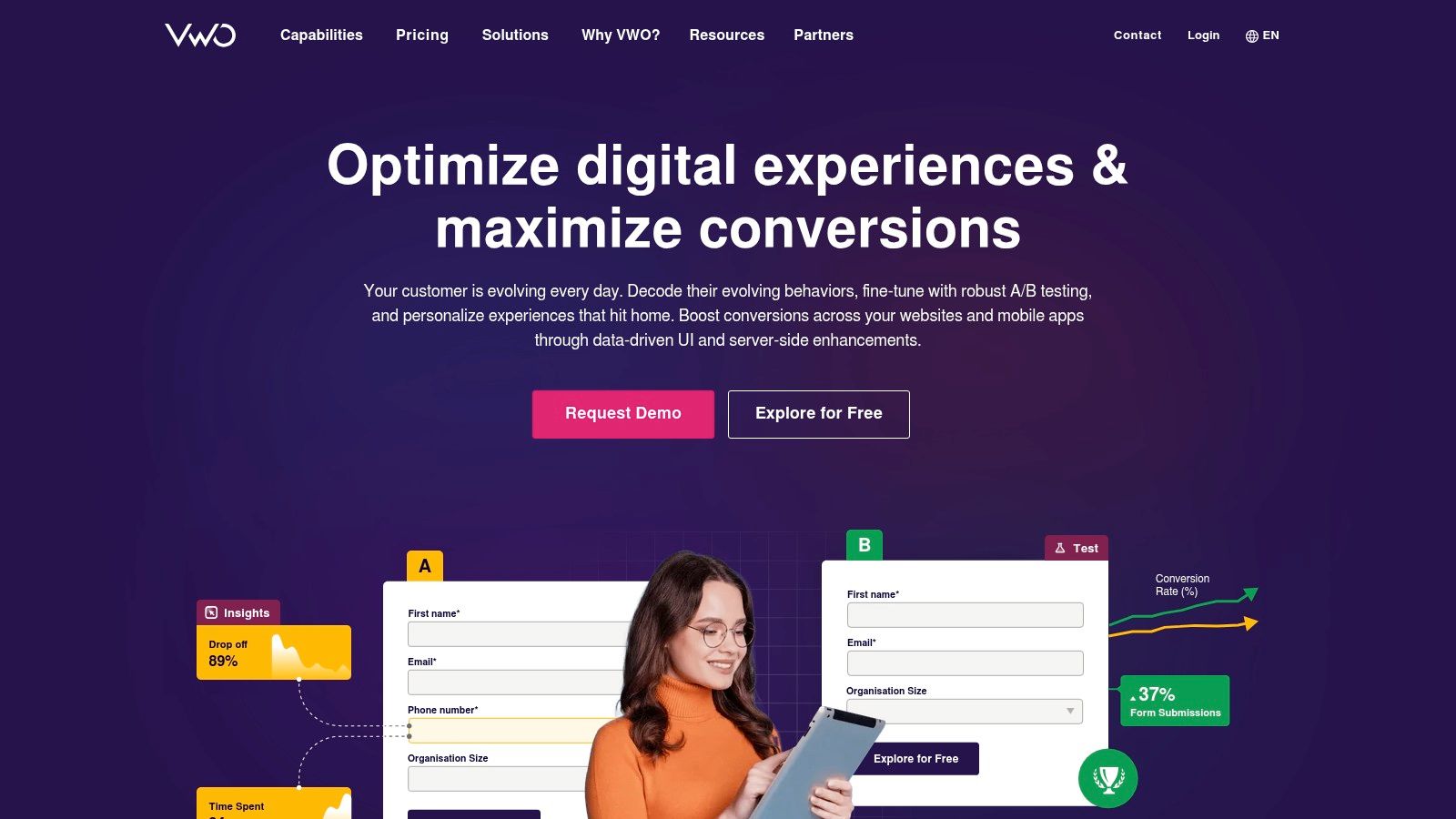
2. VWO
Your Google Ads campaign is fine. CTR is healthy. CPC is under control. Then the landing page starts bleeding conversions, and your team wastes half a day jumping between a testing tool, a heatmap tool, GA4, and recordings just to figure out why.
That is the problem VWO solves.
VWO is a practical choice for PPC managers and agencies that want testing, personalization, and behavior analysis in the same system. You can spot a drop in conversion rate, watch how visitors behave, and ship a test without stitching together a messy stack of point tools.
Why PPC teams like it
Paid traffic is expensive, especially on high-intent keywords. If the page misses on message match, layout, form flow, or trust signals, ROAS gets punished fast.
VWO helps because the insight layer sits close to the experimentation layer. You are not exporting screenshots from one tool and writing guesses in another. You can review heatmaps, session recordings, on-page behavior, and then turn those observations into tests or personalized experiences for specific audiences.
That makes it useful for agencies running multiple accounts with different traffic quality profiles. Branded search visitors behave differently from cold non-brand traffic. Competitor campaigns behave differently from bottom-funnel exact match terms. VWO gives you enough context to stop treating every landing page problem like a copy problem.
It also fits a real middle ground. Cheaper point solutions are fine if you only need one job done. But once you are testing offers, diagnosing friction, and tailoring experiences by audience, the handoffs start eating time. VWO cuts a lot of that operational drag.
Where it fits, and where it does not
If your team wants a cleaner all-in-one workflow, VWO makes sense. If your agency already has separate tools for replay, heatmaps, and experimentation, VWO can simplify the stack and reduce the usual coordination tax.
The tradeoff is focus. The platform covers a lot, so the interface can feel busy once your testing program matures. Someone needs to own setup quality, naming conventions, and experiment discipline or the account turns into a junk drawer.
For PPC teams, the bigger question is strategy. If you just need page-level tests, VWO is a strong option. If you want an end-to-end system that connects ads, high-intent keyword targeting, landing pages, and funnel automation more tightly, a tool built around that full flow will get you further than another collection of features.
- Best for unified CRO work: Testing, personalization, heatmaps, and recordings live in one place.
- Best for agencies cutting tool sprawl: Fewer platforms means fewer handoffs and fewer reporting gaps.
- Best for improving ROAS after the click: You can move from diagnosis to experiment quickly.
Website: VWO
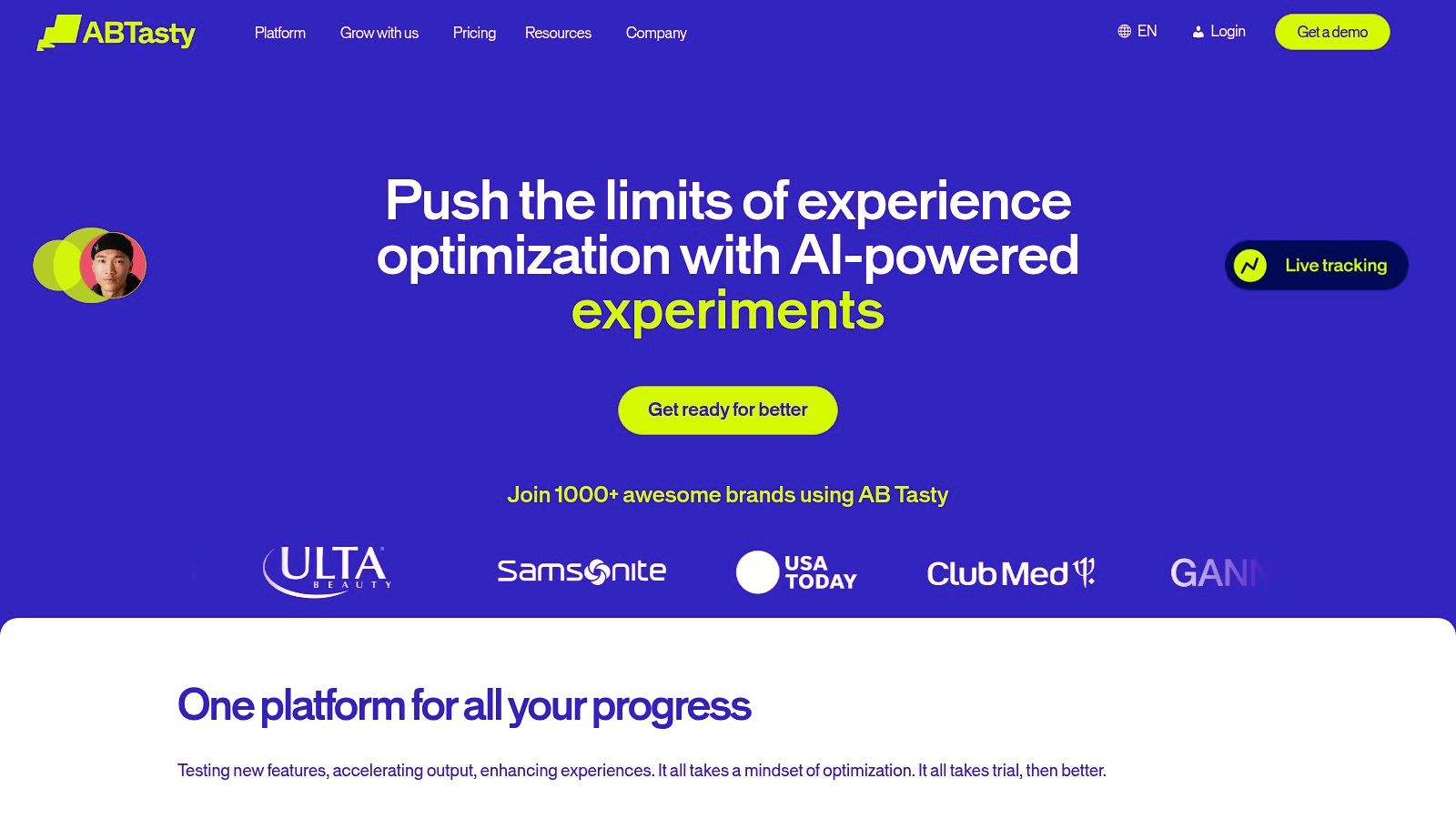
3. AB Tasty
AB Tasty sits in a useful middle ground. It’s not just for marketers testing headlines, and it’s not just for product teams rolling out features. It handles both.
That makes it valuable when your paid funnel doesn’t stop at the landing page. Maybe the ad drives to a page, then into signup, onboarding, or subscription logic. AB Tasty can support that broader flow through client-side experimentation, personalization, and server-side feature flags.
Good fit for mixed marketing and product funnels
Some conversion rate optimization tools are excellent until you need the product team involved. Then everything slows down. AB Tasty is better than most at avoiding that split.
You get web experimentation, personalization, feature experimentation and rollouts, targeting controls, and support documentation for more technical setups like SPAs and Shopify environments. That’s useful if your agency handles both lead gen pages and product-led experiences for clients.
I especially like tools that acknowledge test collisions. Overlapping experiments can poison results if nobody manages priorities. AB Tasty gives teams more control there.
What to watch
Client-side setups still need careful implementation. Anti-flicker handling and page performance are not optional. If your page already loads like it’s going through customs, adding experiments without discipline is a bad idea.
It’s also priced for mid-market to enterprise buyers, not solo freelancers looking for a cheap testing toy.
AB Tasty makes sense when paid acquisition and product experience are part of the same revenue path. If those teams operate separately, the platform can help force useful alignment.
Website: AB Tasty
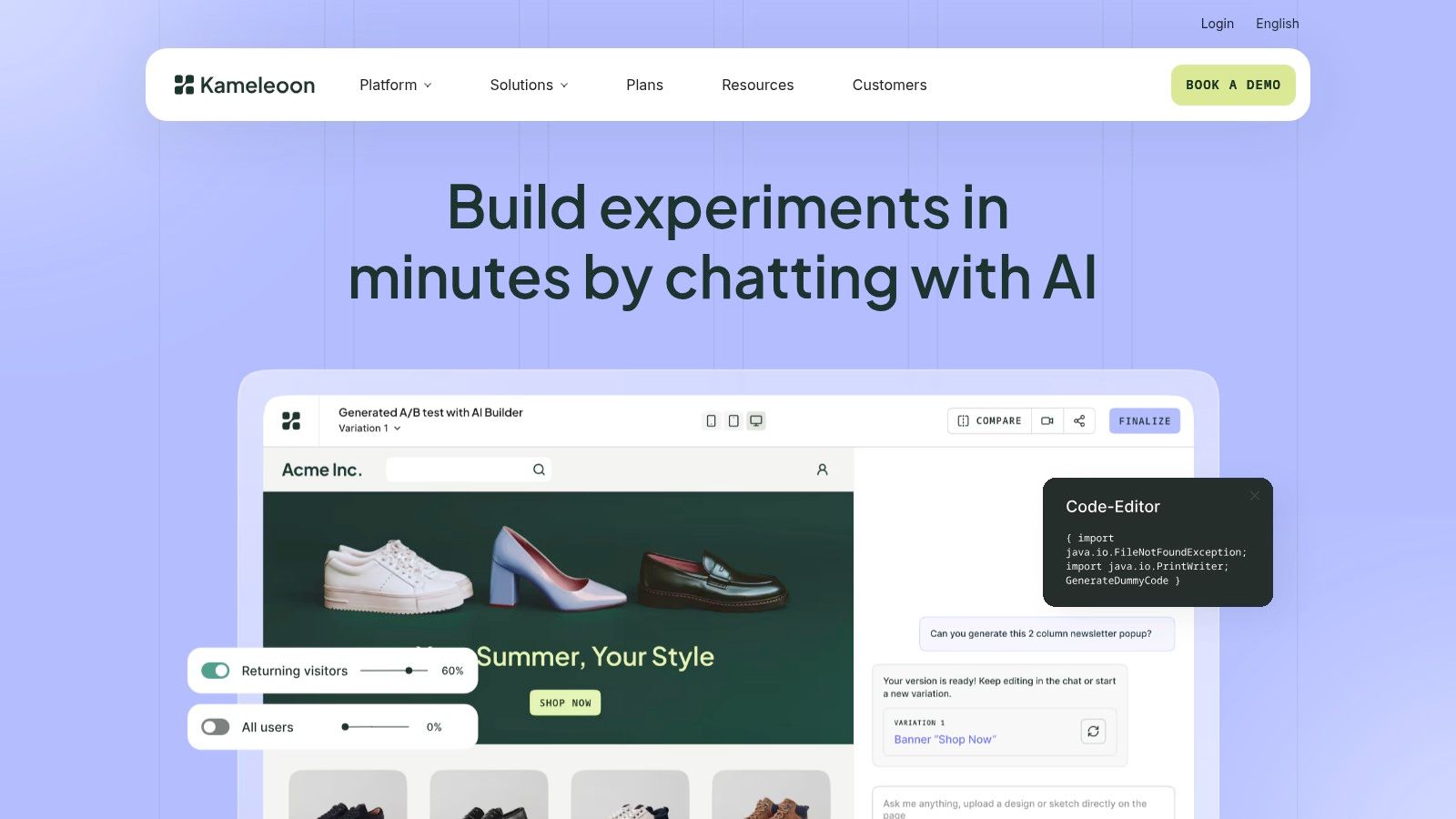
4. Kameleoon
Your PPC team launches a new high-intent campaign on Monday. By Tuesday, you already know the offer needs a sharper headline, a shorter form, and a different trust section. The usual problem is not ideas. It is getting tests built before the ad budget burns through another week.
Kameleoon is good at solving that bottleneck.
Its Prompt-Based Experimentation feature lets teams describe changes in plain language and generate test variants faster than the usual ticket queue allows. For agencies managing many landing pages across accounts, that speed matters because faster test cycles can improve ROAS before a campaign stalls.
Why PPC teams should care
Kameleoon is one of the better options if your work sits between paid media and product. You get web experimentation, personalization, feature flags, and rollouts in one platform, which makes it more useful than a basic page-testing tool.
That matters if your conversion path does not stop at the landing page. A lot of paid search funnels now run through signup flows, qualification logic, booking steps, and product interactions. Kameleoon can cover that broader path, while lighter point solutions usually tap out early.
It also has a stronger fit for teams that care about privacy and regional compliance, especially in Europe. If you manage client accounts across markets, that is not a side issue. It affects procurement, implementation, and how much legal back-and-forth you have to sit through.
Where it earns its keep
For PPC managers, a key benefit is production speed with enough control to keep experiments useful.
You can test messaging angles quickly, personalize experiences by audience segment, and connect website changes with product-side experiments if the funnel demands it. That makes Kameleoon more scalable than tools built only for simple button-color tests. And yes, your clients will still ask for button-color tests.
Where I’d be careful
AI-assisted test creation speeds up execution. It does not replace judgment.
Someone still needs to review copy, layout, QA, targeting rules, and analytics setup before launch. If you run expensive campaigns on high-intent keywords, sloppy experimentation can wreck a good page just as fast as it can improve one.
My take:
- Choose Kameleoon if test velocity is your growth constraint: It helps agencies and PPC teams ship more experiments without dragging developers into every small change.
- Choose it if your funnel spans ads, pages, and product steps: The mix of experimentation and feature control is useful when conversion does not end on page one.
- Skip it if you want a fully automated funnel system: Kameleoon is still an experimentation platform first. If your goal is end-to-end paid traffic handling for high-intent keywords, that is a different category, and tools like dynares are built for that job.
Website: Kameleoon
5. Convert Experiences
Convert Experiences is the tool for people who care about privacy, process, and not getting financially punished for managing lots of projects.
It does not have the loudest brand in the category. Fine. Loud is overrated. What matters is that Convert is practical for agencies and teams that need predictable experimentation across multiple sites without constant pricing drama.
Why agencies like it
The standout benefit is operational sanity.
You get client-side and full-stack experimentation, advanced targeting, collision prevention, and privacy-first defaults. Unlimited projects and variations on paid plans also make it easier to manage multiple client accounts without weird artificial constraints.
That agency angle matters. Many tools are technically capable but commercially annoying once you run several brands or domains. Convert is better suited to that reality.
Its privacy posture is also a stronger selling point in Europe, where “we’ll sort consent later” is not a strategy. It’s negligence with a nice haircut.
The tradeoff
The ecosystem is smaller than the biggest vendors, and if you want highly layered personalization stacks, setup takes thought. This is not a plug-in-and-forget platform.
Still, for disciplined teams that want clean experimentation and fewer surprises, Convert punches above its visibility.
One broader signal supports why this category keeps getting attention. SQ Magazine’s CRO statistics roundup notes that companies investing in CRO tools realize an average ROI of 223%, and that 69% of marketers use web analytics tools as the foundation of their stack. That does not mean every platform is equal. It does mean serious optimization work tends to pay for itself when teams use the tools properly.
Website: Convert Experiences
6. Hotjar
Your Google Ads campaign is doing its job. Clicks are coming in. CPC is tolerable. Then the landing page wastes the traffic.
Hotjar helps you catch that fast.
It gives PPC managers the stuff GA4 usually won’t: heatmaps, session recordings, on-page feedback, and surveys that explain why high-intent visitors stall, hesitate, or bail. If you manage paid traffic, that matters more than another pretty dashboard. You need to see where the page breaks the promise your ad just made.
Why PPC teams and agencies use it
Hotjar is a diagnosis tool. It answers behavioral questions that directly affect ROAS.
You can spot CTA blindness, dead clicks, weak form placement, confusing mobile layouts, and mismatches between ad intent and page content. That makes it useful during landing page triage, especially when a campaign looks healthy at the ad level but weak after the click.
It also helps agencies work faster. Instead of wasting a client call arguing over opinions, you can pull recordings, review scroll behavior, and show the actual friction. Much cleaner. Much less “I think users probably...”
The smart workflow is simple. Use Hotjar to find the problem, then push the fix into your testing platform or landing page builder. If you want a practical framework for that process, this guide on how to optimize website conversions is a solid next read.
Where it fits, and where it doesn’t
Hotjar is a point solution. A good one.
But it does not run experiments, manage landing page deployment, or automate the full paid-traffic funnel. That distinction matters for agencies trying to scale winning campaigns instead of just diagnosing losing ones. If your stack is fragmented, Hotjar gives you visibility, but you still need other tools to test, ship, and scale changes. That is the tradeoff between standalone insight tools and an end-to-end funnel approach.
Lower plans also come with session caps, so heavy-spend accounts can outgrow the cheaper tiers quickly.
Hotjar is one of the fastest ways to replace internal guesswork with evidence from real visitors.
Website: Hotjar
7. FullStory
FullStory is what I’d pick when the landing page problem might be a journey problem.
Hotjar is great for quick behavioral visibility. FullStory goes deeper into digital experience intelligence. You get session replay, funnels, segmentation, and AI-assisted analysis that helps surface patterns instead of forcing your team to manually comb through every session.
Why it’s strong for PPC and agencies
Paid traffic often exposes technical nonsense faster than any other channel. Broken flows, weird mobile issues, form glitches, confusing handoffs. FullStory is excellent at finding that kind of friction with more precision than a simple heatmap tool.
It’s especially useful when the conversion path spans multiple pages or app states. If your ad traffic lands on one page, jumps into a multi-step process, and drops in weird places, FullStory can help connect the dots.
The platform offers a generous number of monthly sessions and ample retention on the free plan. That’s enough for many teams to test the waters before committing.
The drawback
To get full value, you need event discipline. If your taxonomy is sloppy, you’ll still get replay value, but the analysis layer will be weaker than it should be.
- Great for complex funnels: Better when the issue is not isolated to one page.
- Great for debugging: Useful when paid traffic reveals functional issues.
- Less ideal for simple page swaps: If all you need is lightweight heatmaps, it may be more than necessary.
If your pages convert inconsistently and you need a more systematic process for fixing that, this guide on how to optimize website conversions is worth a read.
Website: FullStory
8. Unbounce
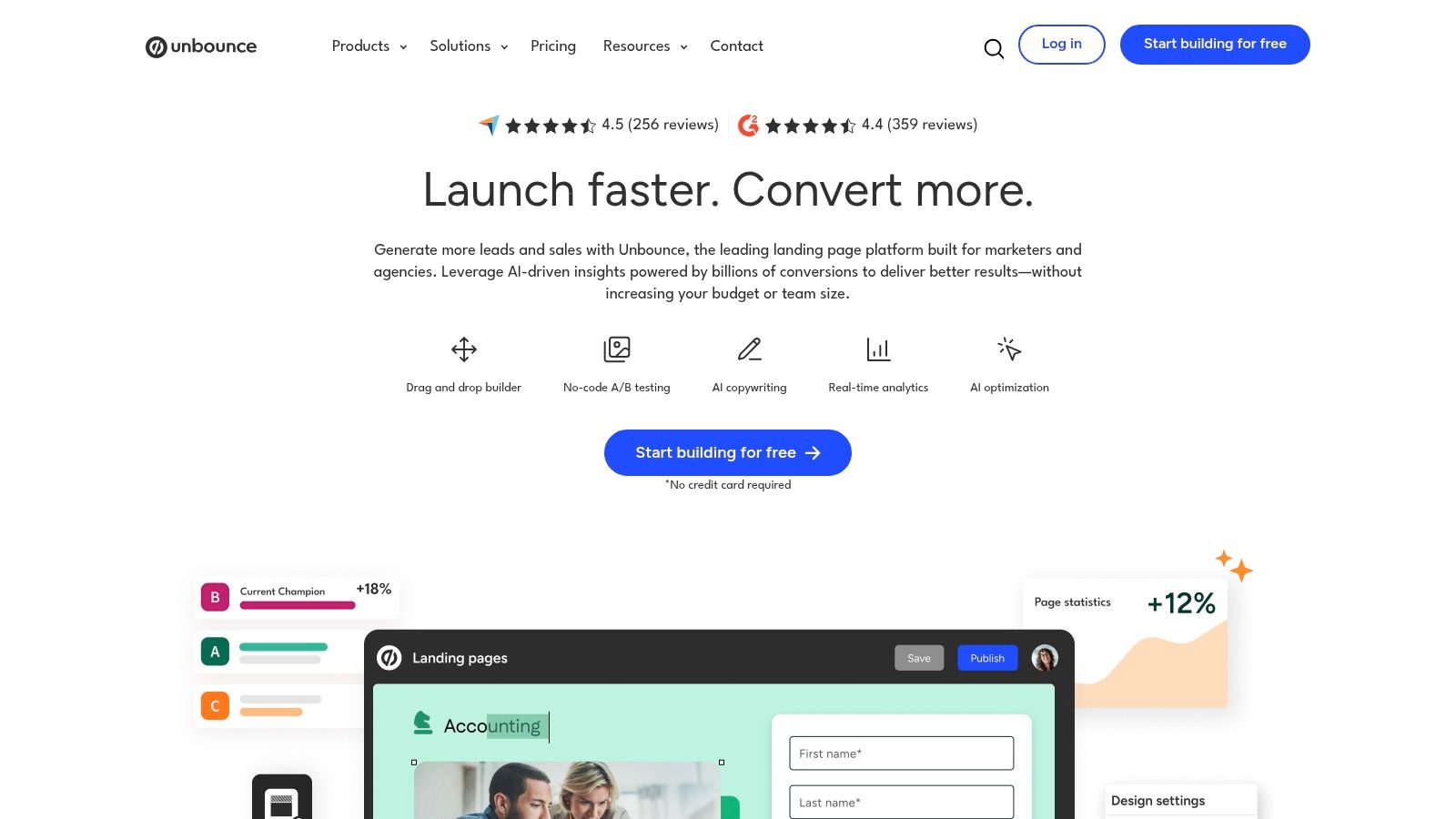
Unbounce is still one of the most practical landing page tools for PPC. Not because it’s magical. Because it respects speed.
When you need to launch pages fast, test variants, manage domains, and avoid begging developers for every campaign page, Unbounce does the job. That alone makes it valuable.
Why PPC managers keep using it
The core appeal is obvious. Drag-and-drop builder, forms, A/B testing, templates, and Smart Traffic for routing visitors to the variant most likely to convert.
For paid search teams, that means you can go from keyword cluster to live landing page without turning each iteration into a two-week project.
There’s also a broader trend behind tools like this. WhatConverts’ CRO tool roundup points to an emerging gap around AI-driven, real-time CRO for dynamic ad campaigns and mentions the need for better tooling around auto-generated and intent-matched landing pages at scale. Unbounce helps on the landing page side, especially for smaller programs, but it still sits more in the builder category than the full funnel automation category.
What to keep in mind
As traffic grows, plan limits and costs can climb. Also, advanced layouts sometimes need careful mobile QA. No drag-and-drop builder fully exempts you from checking the page like a sane person.
Unbounce is one of the easiest ways to improve message match without rebuilding your website.
If landing pages are your core bottleneck, this landing page conversion rate optimization guide goes deeper on what to fix after the page is live.
Website: Unbounce
9. Instapage
A familiar PPC situation. The ads are working, clicks are expensive, and now five people need to approve every landing page change before launch. Instapage exists for that kind of chaos.
It is built for post-click teams that care about speed, consistency, and stakeholder control. The builder is polished, reusable blocks save time, experimentation is built in, and the workspace structure makes more sense than lighter tools once you are managing multiple clients, brands, or campaigns at the same time.
Where it earns its keep
Instapage makes the most sense for agencies and larger in-house teams running serious paid traffic. The value is not just "you can build pages." Plenty of tools do that. The value is keeping page production organized when you have brand reviews, client approvals, shared assets, and dozens of active variations in flight.
That matters for ROAS.
If your team is buying high-intent clicks, sloppy workflow becomes a profit problem fast. A delayed update, a broken duplicate, or inconsistent message match across campaigns can waste expensive traffic before anyone notices. Instapage helps reduce that operational mess.
It is also a better fit for teams that obsess over post-click polish. Page layout control, collaboration features, and cleaner asset reuse give it an edge over simpler builders when campaign volume starts to sprawl.
Why some teams skip it
The price is the filter.
If you are a lean PPC team pushing a handful of pages live each month, Instapage can feel like buying enterprise furniture for a garage office. Nice, yes. Necessary, no.
It also stays in the landing page lane. That is fine if your bottleneck is production and approvals. If your real problem is scaling keyword-level relevance across ads, pages, and forms together, point solutions start to show their limits. That is where a more automated funnel approach stands apart from a premium page builder.
Instapage is a strong choice for agencies that need cleaner post-click operations, not just another page editor.
Website: Instapage
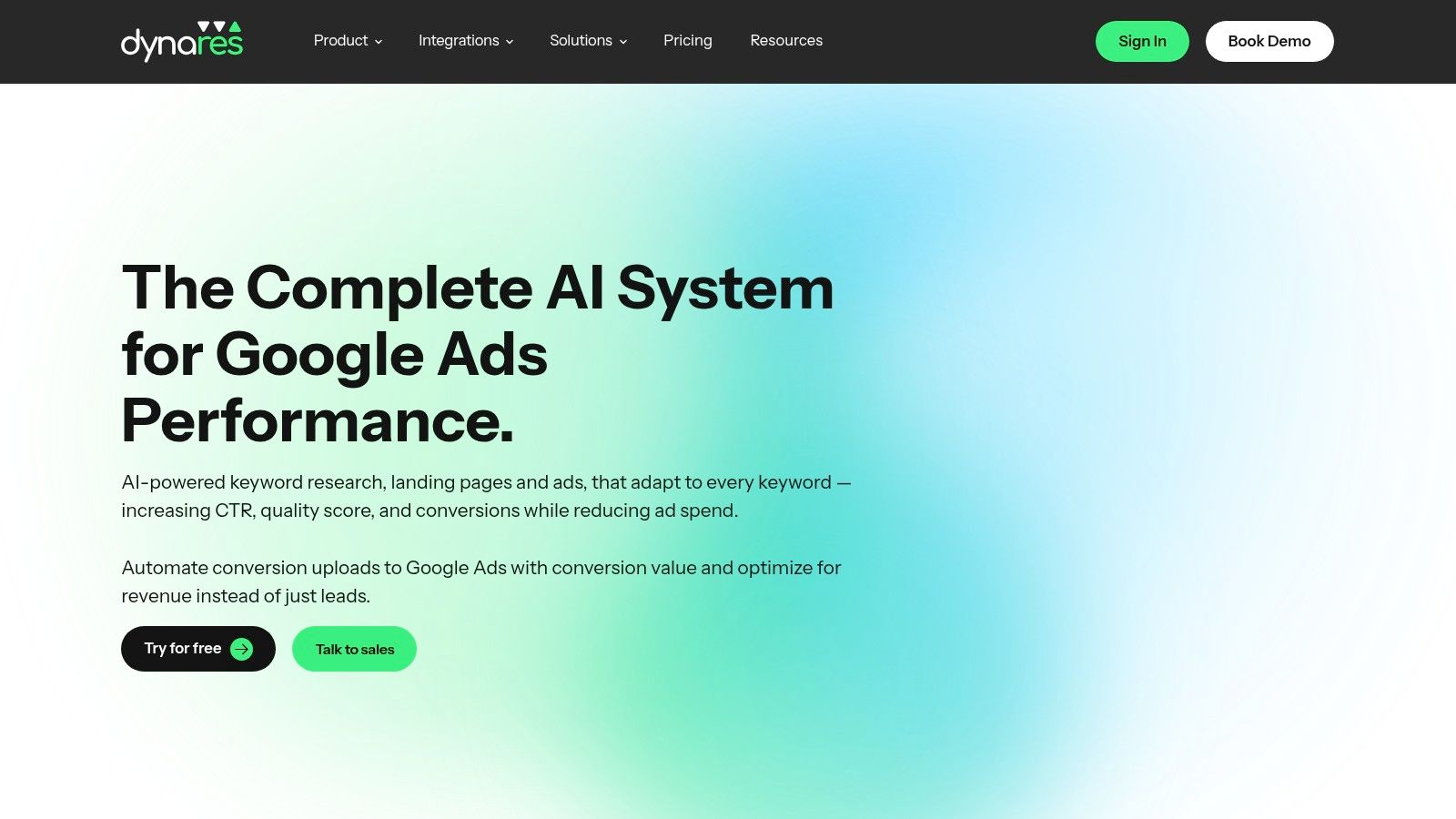
10. dynares
Most conversion rate optimization tools help you improve a page.
dynares is different. It helps you generate the right page, for the right keyword, with the right form, then keep optimizing it without manually rebuilding everything.
That distinction matters a lot if you run Google Ads at scale.
The usual PPC setup is clumsy. You buy clicks for many keyword themes, then push them into a small set of generic landing pages. After that, you try to recover performance with manual A/B tests, heatmaps, and reporting gymnastics. It sort of works. It also wastes intent.
dynares takes the opposite approach. Feed it your brand guidelines and target keywords, and it generates keyword-specific ads, landing pages, and smart forms automatically. It can produce large sets of coordinated variants, keep testing them through Auto A/B Testing, and use real-time analytics to keep stronger versions live.
Why it fits PPC better than general-purpose tools
This is the part generic CRO articles usually miss.
PPC managers do not just need “better pages.” They need ad-to-page relevance at scale. If you manage lots of keywords, geographies, service variants, or client accounts, the bottleneck is not insight. It’s production and coordination.
dynares is built around that bottleneck.
It supports bulk keyword research and clustering, reusable templates, modular forms, instant page and campaign generation, real-time analytics, and conversion uploads back into Google Ads with values. That last part matters more than many realize. Optimizing for revenue beats optimizing for raw lead counts.
There’s also a nasty industry gap here. PPC teams often deal with discrepancies between GA4, Google Ads, and CRO tools. Agencies report significant conversion underreporting due to mismatched tagging in these environments, highlighted by Clicks Geek. That kind of reporting mess inflates decision error. A platform that closes the loop from landing page to ad platform is not a nice-to-have. It’s operational hygiene.
Pricing and who should use it
dynares offers a free plan, then scales through paid tiers.
- Starter: €29/month, or €23/month billed annually, with 30 landing pages and roughly 5k pageviews
- Pro: €243/month, or €194/month billed annually, with 150 pages and roughly 50k pageviews
- Business: €765/month, or €612/month billed annually, with 500 pages and roughly 500k pageviews
The sweet spot is clear. PPC managers, agencies, SMB founders, freelance marketers, and lean growth teams that want scale without hiring more people just to maintain landing pages.
The honest pros and cons
The strengths are straightforward.
- End-to-end automation: It generates keyword-level ads, pages, and forms without the usual manual grind.
- Revenue-focused optimization: Conversion value uploads help optimize campaigns for ROAS, not vanity lead totals.
- Built-in testing and analytics: Auto A/B Testing and live feedback loops reduce slow, manual experimentation cycles.
- Workflow fit: Google Ads, Google Tag Manager, and HubSpot integrations are the right stack for lead gen teams.
The limitations are also present.
It is primarily Google Ads-centric, so it’s less useful if your main need is cross-channel orchestration across every ad network. And like any AI-assisted system, outputs still need review. Fast does not mean unsupervised.
Still, for the audience this article is written for, dynares is the clearest answer when the problem is scale, relevance, and ROAS. Not just page testing.
Website: dynares
Top 10 CRO Tools Comparison
| Tool | Core features | Quality (★) | Price & value (💰) | Target (👥) | Unique selling point (✨) |
|---|---|---|---|---|---|
| Optimizely Web & Feature Experimentation | Client & server-side A/B, feature flags, personalization, Stats Engine | ★★★★☆ | 💰 Enterprise / custom pricing | 👥 Large enterprises, engineering-led teams | ✨ Strong governance, sequential stats engine |
| VWO (Testing, Personalize, Insights) | A/B/n, personalization, heatmaps, session recordings, AI Copilot | ★★★★☆ | 💰 Modular plans; advanced bundles may be annual | 👥 CRO teams, mid‑market to enterprise | ✨ All‑in‑one testing + qualitative insights |
| AB Tasty (Feature Experimentation & Rollouts) | Web + server experiments, feature flags, targeting controls | ★★★★☆ | 💰 Custom (mid → enterprise) | 👥 E‑commerce, product + marketing teams | ✨ Unified marketing & product experimentation |
| Kameleoon | Prompt‑Based Experimentation (PBX), web experiments, flags | ★★★★☆ | 💰 Sales-assisted; PBX credit model | 👥 Marketers seeking rapid AI test creation | ✨ Natural‑language test generation (PBX) |
| Convert Experiences | Client & full‑stack testing, unlimited projects, privacy defaults | ★★★★ | 💰 Predictable agency pricing; paid tiers | 👥 Privacy‑minded teams & agencies | ✨ GDPR‑forward, collision prevention |
| Hotjar (Observe + Ask) | Heatmaps, session replays, surveys, user attributes | ★★★★☆ | 💰 Free → scalable paid tiers | 👥 CRO researchers, product managers, SMEs | ✨ Fast qualitative insights to inform tests |
| FullStory (DXI + Session Replay) | High‑fidelity replay, funnels, AI summaries (StoryAI) | ★★★★☆ | 💰 Generous free tier; custom paid plans | 👥 UX researchers, growth teams, enterprises | ✨ AI‑driven discovery + large free trial quota |
| Unbounce (Landing Pages + Smart Traffic) | Drag‑drop builder, forms, A/B testing, Smart Traffic AI | ★★★★ | 💰 Tiered plans; costs grow with traffic | 👥 PPC teams, small agencies, marketers | ✨ Smart Traffic routes visitors to best variant |
| Instapage (Landing Pages + Experimentation) | High‑perf builder, reusable blocks, native A/B, workspaces | ★★★★ | 💰 Premium pricing for agencies/enterprises | 👥 Agencies and large PPC programs | ✨ Enterprise collaboration + performance focus |
| dynares 🏆 | AI generates keyword‑level ads, landing pages & forms, Auto A/B, analytics | ★★★★★ | 💰 Free → Starter €29/mo, Pro €243/mo, Business €765/mo (annual discounts) | 👥 PPC managers, agencies, lean growth teams | ✨ Keyword‑intent‑matched assets + conversion value uploads to Google Ads |
How to choose the right tool for the right job
A PPC manager launches 200 keywords, writes better ads, pays more for high-intent clicks, and then sends all that traffic to three generic pages. Then the team wonders why ROAS stalls.
The tool choice starts there.
Pick based on the bottleneck that is wasting paid traffic right now. Not on brand recognition. Not on who won the last software category page. If the problem is diagnosis, buy diagnosis. If the problem is testing speed, buy testing. If the problem is landing page throughput, buy production.
Hotjar and FullStory are for teams that still need to see the friction clearly. Use them when drop-off is happening and nobody can confidently explain why. Session replays, heatmaps, and path analysis will give you the answer faster than another meeting about "user intent."
VWO and Convert Experiences are the practical middle ground for experimentation on existing pages. Optimizely, AB Tasty, and Kameleoon fit better when testing spans marketing, product, engineering, and compliance. Those tools make sense for organizations with real testing discipline. If your team barely ships one test a month, buying an enterprise suite will not save you.
Unbounce and Instapage solve a different problem. They help PPC teams publish campaign pages quickly, keep messaging tight, and reduce the usual developer bottleneck. Good choice if speed to launch is the issue.
PPC teams and agencies hit a different wall, though. Scale.
If you manage a large Google Ads account, generic page testing only gets you so far. A key miss is usually relevance at the keyword level. One page for dozens of high-intent queries is a lazy operating model. It wastes expensive clicks, muddies message match, and makes optimization slower because every test tries to serve too many intents at once.
That is why stacked point solutions often become a tax. One platform for replays. Another for tests. Another for landing pages. Another for forms. Another for reporting cleanup. You can run that setup. You can also burn hours every week keeping the setup glued together.
Use this filter instead:
- Choose Hotjar or FullStory if you need to find friction before you change anything.
- Choose VWO, Convert Experiences, Optimizely, AB Tasty, or Kameleoon if your team already knows what to test and needs a better way to run experiments.
- Choose Unbounce or Instapage if the immediate job is launching paid landing pages faster.
- Choose dynares if your bottleneck is keyword-level relevance, faster asset production, and tying ad spend more directly to revenue outcomes.
My advice is simple. Agencies should stop buying tools as if CRO is one category. It is not. It is a chain of jobs, and each job breaks in a different place.
For PPC managers, "we have a decent landing page" is not a strategy. It is usually a polite way of saying the account is underbuilt.
If you want another outside perspective on service providers in this space, this list of Top 7 Conversion Optimization Companies is a decent companion read.
Pick the tool that removes the constraint costing you money today. For high-intent paid traffic, that usually means choosing the system that scales relevance, not just the one that gives you more dashboards.
x4
$0.18
$0.23
dynares let us go from generic pages to keyword-specific experiences without hiring developers or rebuilding our stack. Our search traffic converts at over 79% now, CPC is down, and we can test new ideas in minutes instead of weeks.

x8
-68%
+581%
dynares helped us turn paid traffic into a much more efficient lead generation engine. In just four months, we significantly increased lead volume while bringing down cost per conversion.


Create reusable, modular page layouts that adapt to each keyword. Consistent, branded, scalable.

From ad strategy breakdowns to AI-first marketing playbooks—our blog gives you the frameworks, tactics, and ideas you need to win more with less spend.
Discover Blogour platform to drive data-backed decisions.