
Mastering the Objectives of a Campaign
Mastering the Objectives of a Campaign
Most advice about the objectives of a campaign is fluff dressed up as strategy.
You’ve seen it. Someone says the objective is “more awareness” or “more leads,” everyone nods, the deck looks polished, and then the ad account bleeds money because nobody translated that wish into something a machine can optimize.
That’s the core problem. Not Google Ads. Not AI. Not your landing page builder. The problem is that too many teams confuse intent with instruction.
A campaign objective is not a slogan for Monday’s meeting. It is a control system. It tells your platform what success looks like, tells your team what to measure, and tells finance why the budget exists in the first place. If it can’t change bidding, creative, targeting, landing pages, and reporting, it’s not an objective. It’s a poster.
Stop setting campaign 'wishes' and start setting objectives
The dumbest thing in performance marketing is pretending vague goals are good enough.
Get more leads. Increase visibility. Drive growth. Fine. And then what? Which audience? Which action? Which conversion? Which bid strategy? Which page experience? Which signal gets pushed back into Google Ads?
If you can’t answer that, you don’t have objectives of a campaign. You have wishful thinking.

Most failed campaigns break before launch. They break when the business goal stays at boardroom level and never becomes machine-readable execution. Google can optimize toward signals. It cannot optimize toward hand-wavy ambition.
If you want a simple refresher on what a marketing campaign is, start there. Then come back and do the harder part many teams skip, which is operationalizing the thing.
The operator’s test
A real objective passes three tests:
- Business test: It maps to a commercial outcome like pipeline, revenue, retention, or qualified demand.
- Platform test: It can be expressed through campaign type, bidding logic, conversion setup, and audience selection.
- Measurement test: It has a primary KPI and a feedback loop, not just a dashboard full of vanity junk.
If your objective fails one of those tests, fix it before you spend a euro.
What better looks like
Compare these two statements.
Bad: We want more leads.
Better: We want qualified inbound demand from high-intent searches, and we will optimize the account for conversion quality, not raw form volume.
The second one changes behavior. It changes keyword selection. It changes landing pages. It changes form design. It changes CRM reporting. That is the whole point.
Tip: If your objective cannot tell a PPC manager what to build next inside the account, it is not specific enough.
Marketers need to think like operators. Strategy is not the slide. Strategy is the chain of decisions that follows.
The five campaign objectives that matter
Campaign objectives are not a branding exercise. They are operating modes for the account.
For most businesses, five matter: awareness, consideration, lead generation, sales, and retention. Everything else usually rolls up into one of them. If your team invents ten more, you probably have reporting categories, not real objectives.
Awareness
Awareness matters when demand does not exist at the volume you need yet. New category, new market, weak branded search, low direct traffic. Those are awareness problems.
Treat it as market conditioning, not ego. The job is to put your message in front of the right audience often enough that later campaigns do not have to educate and convert in the same click. That gets expensive fast.
Awareness also needs discipline. If the business has a near-term revenue gap, do not hide behind reach numbers and call it strategy.
Consideration
Consideration is where prospects check whether you are credible or forgettable.
This objective works best when people already have some problem awareness and need help comparing options, understanding the tradeoffs, or trusting your offer. In PPC, that usually means tighter intent grouping, better mid-funnel landing pages, and ads that answer specific objections instead of pushing for the sale too early.
A lot of accounts skip this step and send every click to a generic page. Then they wonder why traffic does not convert. The issue is not always volume. Often it is poor progression.
Lead generation
Lead generation is the revenue engine for a lot of B2B teams, service businesses, and high-consideration offers. It also gets butchered more than any other objective.
Do not optimize for cheap form fills. Optimize for leads sales would take a call with. If you have not defined lead quality before launch, you do not have a lead gen strategy. You have a spreadsheet problem.
Get the tracking right before you scale. A clean Google Ads conversion tracking setup for qualified lead optimization is what turns this objective from guesswork into something the platform can use.
Sales
Sales is the objective with the least room for storytelling. Someone buys, books, subscribes, or starts paying. Revenue either shows up or it does not.
That pressure is useful. It forces better account structure, tighter keyword intent, cleaner offers, and landing pages built to close instead of merely explain. Teams love blaming CPC inflation for poor performance. In many accounts, the core problem is sloppy alignment between query, ad, and page.
If sales is the objective, every click needs a clear path to transaction value. Anything less is waste.
Retention
Retention gets less attention than acquisition and deserves more budget than it usually gets.
It costs 5 to 25 times more to acquire a new customer than to retain an existing one, businesses with strong retention strategies can see CLV increases of 25-95%, and remarketing campaigns targeting retention can lower CAC by up to 60% according to The Brand Algorithm’s overview of campaign objectives.
That changes how a smart operator allocates spend. Existing customers already know you, trust you, and convert with less friction. Yet a lot of teams still treat retention as email’s problem and keep paying premium acquisition costs because new-customer charts look better in a meeting.
That is backwards.
For a useful framework on which business metrics should sit under each objective, this roundup of marketing KPI examples is worth keeping open while planning.
The order matters
These five objectives work as a system:
- Awareness creates familiarity.
- Consideration builds confidence.
- Lead generation captures identifiable demand.
- Sales turns intent into revenue.
- Retention increases customer value.
You do not need all five at full force all the time. You do need to know which constraint is holding the business back right now.
That is the part many articles miss. The objective is not the finish line. It is the instruction set. Once you choose it, the account has to reflect it through tracking, bidding, audience design, creative, and post-click flow. That is exactly why modern PPC teams use automation platforms like dynares. The strategic objective has to become machine-readable execution, or it stays a wish.
Key takeaway: Pick the objective that matches the bottleneck, then configure the account to pursue it with no ambiguity.
Mapping objectives to metrics and Google Ads settings
A campaign objective without account-level translation is dead on arrival.
I’ve audited too many Google Ads accounts where the strategy doc says one thing and the settings say another. The team wants revenue, but they bid for clicks. They want qualified leads, but they optimize toward all form submissions equally. They want retention, but they never build audiences that separate existing customers from prospects.
That mismatch is where waste starts.
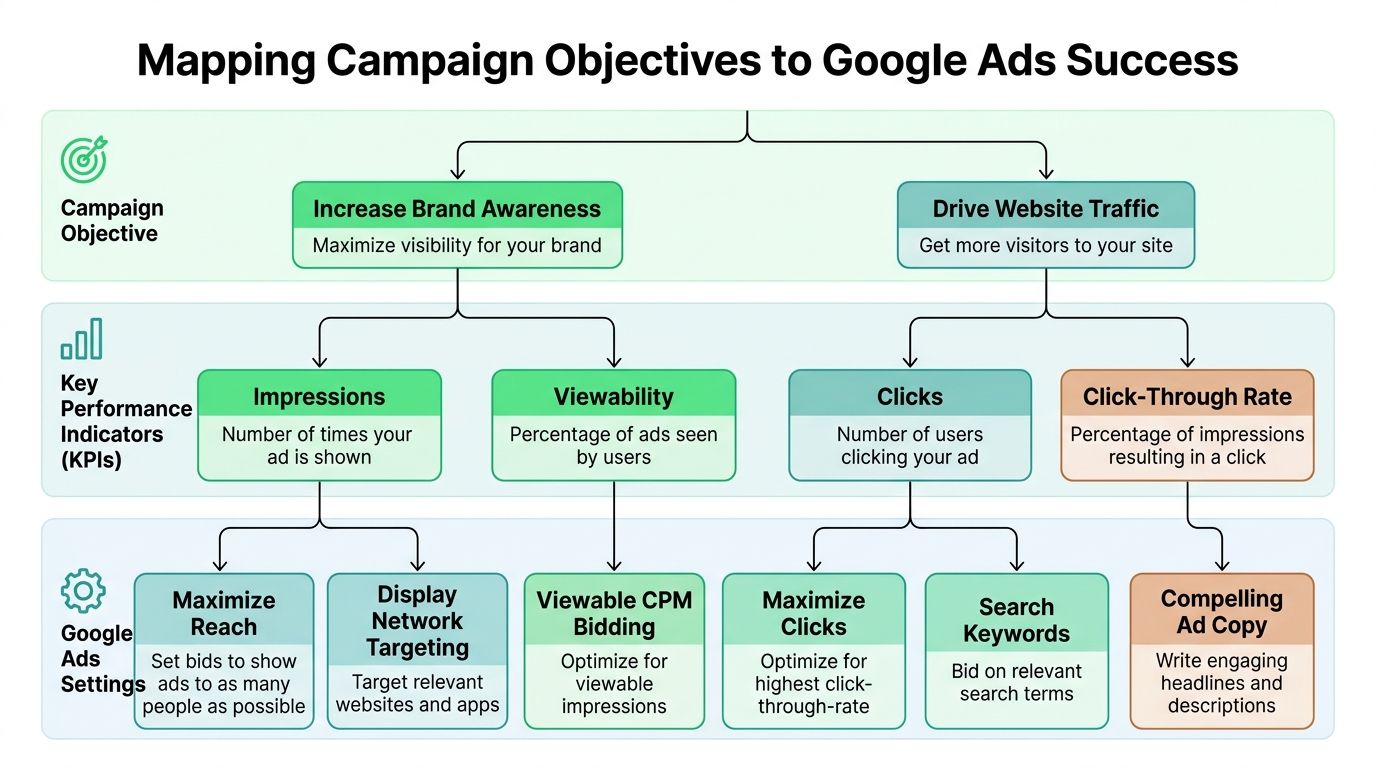
Campaign objectives to Google Ads execution map
| Objective | Primary KPI | Google Ads Campaign Type | Bidding Strategy |
|---|---|---|---|
| Awareness | Impressions or reach | Display or video | Maximize Reach or viewable impression-focused bidding |
| Consideration | Click quality and on-site engagement | Search or demand capture formats | Maximize Clicks when learning, then shift once better signals exist |
| Lead generation | Qualified conversions | Search, Performance Max with tight conversion governance | Maximize Conversions or Target CPA |
| Sales | Revenue or ROAS | Search, Shopping, Performance Max | Target ROAS |
| Retention | Repeat conversion value from existing audiences | Search remarketing, Display remarketing, customer list campaigns | Value-focused bidding tied to return behavior |
This table is not gospel. It is a starting point. But it already puts you ahead of teams that select campaign settings by habit.
Don’t pick the bid strategy first
A lot of practitioners still ask, should I use Target CPA or Target ROAS? Wrong starting point.
Ask what the objective is. Then ask what signal quality you have.
If you sell directly online and can pass back revenue, value-based bidding makes sense. If you generate leads and don’t yet know which ones become revenue, using ROAS too early can become theatre. In that case, start with cleaner lead qualification and better conversion definitions.
The metric has to match the decision
One of the biggest traps in the objectives of a campaign discussion is metric overload. Teams track everything and learn nothing.
Use one primary KPI for decision-making. Secondary metrics help diagnose. They should not run the show.
- Awareness accounts: Watch visibility metrics first. If you optimize awareness with direct-response logic, you’ll strangle reach.
- Lead gen accounts: Prioritize qualified conversion signals. Volume without quality creates fake confidence.
- Sales accounts: Revenue efficiency comes first. Clicks are support metrics.
- Retention accounts: Measure repeat behavior and customer value, not just re-engagement activity.
Settings that usually need more discipline
There are a few settings where strategy often falls apart:
- Conversion selection: Include only conversions that reflect the objective. If every micro action is marked primary, bidding gets confused.
- Audience layering: Separate prospecting from customer retention. Mixing both muddies performance.
- Landing page alignment: Different intent clusters need different pages. Sending all traffic to one generic page is operational negligence.
- Data hygiene: If tags fire inconsistently or values are missing, automation optimizes on broken inputs.
If your tracking is shaky, fix that first. This guide on Google Ads conversion tracking setup is a useful checklist for cleaning up the plumbing before you ask the algorithm to do clever things.
Tip: Google Ads is not bad at optimization. Many teams are bad at giving it clean signals.
A practical way to choose
When in doubt, use this sequence:
- Define the business outcome: Demand, qualified leads, closed revenue, or retained value.
- Choose the primary KPI: One metric that determines success.
- Pick the campaign type: Based on where intent appears and what creative format fits.
- Set the bid strategy: Based on signal maturity, not vibes.
- Audit the feedback loop: Make sure CRM or revenue data can improve bidding over time.
This is the unglamorous work. It’s also where the money is.
The optimization loop from first click to final revenue
A good campaign setup gets you into the game. The optimization loop is what gets you paid.
Too many teams stop at the form fill. They celebrate the lead, export a CSV, and call it performance marketing. That is not performance marketing. That is event collection with better branding.
The primary job is connecting click, landing-page behavior, conversion, qualification, and revenue. If you break that chain anywhere, the account starts learning from noise.
Where campaigns usually break
The first break is often message match.
If the keyword promises one thing and the landing page says something broader, users hesitate. That hesitation is expensive. According to Darkroom’s ROAS guide, poor message match between an ad and landing page can decrease conversion rate by 40-60%. The same source notes that lifting conversion rate from 2% to 3% delivers a 50% revenue increase from the same ad spend.
That is why relevance is not a design issue. It is a finance issue.
The second break is form friction. Long, clunky mobile forms kill intent right at the finish line. The same analysis says mobile-optimized forms with fewer than 5 fields can improve conversion rates by 20-30%.
Build the loop properly
A working loop requires a few key elements:
- Ad to page continuity: The promise in the keyword, ad, and page should feel like one conversation.
- Reliable tracking: Use Google Tag Manager, your CRM, and clear conversion naming so your team knows what fired.
- Lead qualification downstream: A form fill is not the end. Score or classify leads so paid media can learn which ones matter.
- Value pushed back to ad platforms: If some leads become real revenue and others do not, Google needs that distinction.
You do not need a huge martech stack to do this. You do need discipline.
Why most reporting is misleading
A lot of dashboards answer the wrong question.
They show cost per lead, click-through rate, and maybe conversion rate. Fine. But if they cannot show whether those leads turned into sales conversations or revenue, they are incomplete.
Founders and PPC managers need to push back here. Volume metrics are not evil. They are just insufficient. The point of the loop is to stop treating every conversion as equal when the business clearly does not.
Tip: If sales rejects a chunk of your leads, your ad platform should not keep chasing more people who look exactly like them.
For a practical framework on connecting spend to commercial outcome, keep this guide to how to measure marketing ROI in your operating docs.
The compounding effect of post-click quality
Post-click work is where a lot of upside hides.
When the page loads fast, matches intent, keeps mobile friction low, and asks only for what the buyer is ready to give, conversion quality improves. When conversion quality improves, bidding gets smarter. When bidding gets smarter, spend goes further.
That’s the loop. Not magic. Not hacks. Just consistent signal quality from first click to final revenue.
How AI automates objective-driven campaigns at scale
Manual campaign management breaks the moment your objective gets specific.
Saying "we want qualified leads" is easy. Executing that across hundreds of search terms, different intent levels, multiple offers, and constant bid pressure is where teams get exposed. The usual response is to simplify the account until it becomes manageable. Broad ad groups. Reused pages. Generic forms. Then performance drifts, and people blame Google.
The primary problem is production capacity.

What the workflow should look like
Start from the business objective and force the execution to match it. If the goal is lead generation tied to pipeline or revenue, the system needs to carry that objective all the way down into campaign structure, creative, pages, tracking, and bidding.
That means four things need to happen consistently:
- Generate intent-matched assets: Ads, pages, and forms should reflect the actual search context.
- Keep structure consistent: Brand rules, offers, and tracking logic should stay intact across many variants.
- Test continuously: Variants should compete without a human rebuilding the campaign every week.
- Return value data to Google Ads: Closed-loop optimization matters more than surface-level conversion counts.
That is the gap AI should close.
Done well, automation lets you keep relevance as the account expands. It creates more aligned keyword-to-ad-to-page journeys, preserves tracking discipline, and gives bidding better signals to work with. The point is not to produce more assets for the sake of it. The point is to execute the objective with enough precision that the platform can optimize toward it.
The role of AI in the stack
AI should handle the repetitive work that slows good marketers down.
Set the objective, define conversion logic, lock the messaging guardrails, and choose the success criteria. Then let the system generate variants, match layouts to intent, maintain tracking consistency, and push testing live without turning every change into a manual production sprint.
A good example is found in Google Ads automation tools, including platforms that generate coordinated ads and landing pages for keyword clusters, connect with Google Tag Manager and CRM systems, and upload conversion values so bidding can optimize toward revenue instead of raw lead counts.
That changes the economics of account management. You stop asking whether the team has time to build relevant experiences for every high-value segment. You build the workflow so relevance is the default.
What good automation changes
Without automation, PPC teams make compromises that directly weaken performance. They collapse intent into broader groups, send different searches to the same page, delay testing, and accept lower signal quality because the manual workload is too high.
With automation, you can keep the account granular without creating operational chaos. More variants get launched. More intent gets matched. More value data gets fed back into the system. That is the missing link in a lot of campaign advice. Strategic objectives only matter if your execution layer can support them at scale, and that is exactly what tools like dynares make possible.
AI is execution infrastructure. The objective still drives the account. The difference is that now you can carry that objective from keyword to creative to landing page to conversion value without burying the team in grunt work.
Key takeaway: If your team still has to choose between scale and relevance, your workflow is outdated.
The blind spot in most campaign objectives
Most campaign planning still assumes the main barrier is lack of information.
That’s too simplistic. Sometimes people do not convert because the offer is unclear. Sometimes they do not convert because the language, context, or trust signals fail to meet them where they are. And sometimes they do not convert because the barrier is structural, not informational.
That blind spot matters.

Power gaps are not a niche issue
Standard marketing guides on campaign objectives often fail to address power gaps and social conversation gaps that hinder behavior change in underserved audiences. In plain English, some people are not just missing awareness. They are dealing with access barriers, social stigma, institutional friction, or a message that was clearly not built for them.
That is one of the more useful insights in this analysis from the University of Illinois. It challenges the lazy assumption that a better headline fixes everything.
For performance marketers, if your objective is lead generation from underserved segments, the usual playbook may underperform even if the account is technically sound.
Why this matters in paid media
Google Ads people love clean abstractions. Intent, bid, page, conversion. Nice and tidy.
Real markets are messier.
If your ads speak in corporate shorthand, if your page assumes familiarity with systems your audience distrusts, or if your offer ignores how decisions happen in a community, then your campaign objective is incomplete. You may still get clicks. You may still get some conversions. But you are leaving demand on the table because your objective never accounted for social reality.
I think a lot of AI-generated objective setting gets overhyped in this context. It can help draft messaging ideas or segment structures. Fine. But there is still a lack of empirical data on its effectiveness for these nuanced goals, especially when the challenge is genuine connection rather than mechanical optimization.
A better standard for ambitious marketers
If you want to be sharp, stop treating underserved audiences as a targeting checkbox.
Ask harder questions:
- Access: Can this audience realistically act on the offer?
- Language: Does the message sound like it was written for them, or at them?
- Trust: Does the page reduce social and institutional hesitation?
- Context: Are you solving the right problem, or just reciting product features?
These are still objectives of a campaign. They’re just more mature ones.
Tip: A campaign can be technically optimized and still strategically tone-deaf.
The next wave of strong operators will combine the mechanics of PPC with a deeper understanding of audience barriers. Not because it sounds virtuous, but because reality punishes lazy abstraction.
Your playbook for setting smarter objectives today
You do not need another giant framework. You need a working routine.
Use this the next time you launch, audit, or rescue a campaign.
The checklist
- Start with the business constraint: Is the problem visibility, demand capture, sales efficiency, or retention?
- Choose one primary objective: Not three. One. If everything matters equally, nothing gets optimized properly.
- Define the success signal: Pick the KPI that should drive decision-making inside the platform.
- Align the build: Match campaign type, bidding approach, audience logic, ad copy, and landing pages to that objective.
- Close the loop: Make sure conversion tracking, CRM feedback, and revenue signals feed back into the account.
- Use automation where repetition starts winning: Scale relevance without drowning your team in production work.
The gut-check before launch
Ask these questions:
- If I show this objective to a PPC manager, would they know exactly how to structure the account?
- If I show it to sales, would they agree it reflects commercial reality?
- If I show it to finance, could they understand why the spend exists?
If the answer is no to any of those, keep working.
The best objectives of a campaign are brutally clear. They remove ambiguity. They force trade-offs. They give the machine better instructions and give the humans fewer excuses.
Frequently asked questions about campaign objectives
Can one campaign have multiple objectives
Technically, yes. Practically, that usually creates confusion.
Google Ads performs better when the campaign has a clear optimization target. If you try to make one campaign handle awareness, lead quality, and retention at the same time, you usually end up with mixed signals, messy reporting, and arguments in Slack.
Keep one primary objective per campaign. If you need multiple goals, split them by campaign, audience, or stage of funnel.
When should you change a campaign objective
Change it when the business problem changes or when your signal quality improves.
A common example is moving from lead volume to value-based optimization once you have reliable downstream data. Another is shifting from heavy acquisition to retention once customer economics become more important than top-line volume.
Do not change objectives because one bad week made everybody nervous. Change them because the operating reality changed.
How do you set initial targets with no historical data
Start with logic, not fake precision.
Use the economics of the offer, the intent level of the keywords, the quality of your landing pages, and the speed of your sales process to define what “good enough to keep learning” looks like. Then review quickly and tighten once real data arrives.
The mistake is pretending certainty where none exists. Early targets should guide learning, not impress people in meetings.
What is the most common objective-setting mistake
Teams choose the objective they can report on most easily instead of the one that reflects how the business wins.
That is why so many campaigns optimize for clicks, leads, or surface-level conversions long after those metrics stopped being useful.
What should small teams focus on first
Clarity and feedback.
A small team does not need a complex attribution debate on day one. It needs one real objective, clean tracking, strong message match, and a way to learn which traffic turns into value.
If you’re serious about turning campaign objectives into something operational, take a look at dynares. It’s built for teams running Google Ads at scale who need keyword-specific ads, landing pages, forms, testing, and conversion-value feedback without managing the whole thing in spreadsheets.
x4
$0.18
$0.23
dynares let us go from generic pages to keyword-specific experiences without hiring developers or rebuilding our stack. Our search traffic converts at over 79% now, CPC is down, and we can test new ideas in minutes instead of weeks.


x8
-68%
+581%
dynares helped us turn paid traffic into a much more efficient lead generation engine. In just four months, we significantly increased lead volume while bringing down cost per conversion.


Create reusable, modular page layouts that adapt to each keyword. Consistent, branded, scalable.

From ad strategy breakdowns to AI-first marketing playbooks—our blog gives you the frameworks, tactics, and ideas you need to win more with less spend.
Discover Blogour platform to drive data-backed decisions.