
Let's get one thing straight: most advice on how to create leads is garbage. It’s all about volume over value, leaving you with a CRM full of dead ends and a mountain of wasted ad spend.
The game isn't about getting more leads. It’s about getting the right ones. That's the mindset shift you have to make before you spend another euro.
Stop chasing vanity metrics and start creating real leads
As a founder who lives and breathes this stuff, I’ve seen way too many companies burn through cash chasing metrics like cost-per-lead (CPL). They never stop to ask if those leads actually turn into revenue. It’s a dumb way to build a business. We're not here to build a giant contact list; we're here to build a revenue engine.

This whole approach needs a complete teardown, starting with a clear, almost ruthless definition of what a good lead actually is. Forget the fluff. A qualified lead is someone who checks three non-negotiable boxes:
- Genuine intent: They have a real, urgent problem you can solve right now. They aren't just browsing; they're actively hunting for a solution.
- Problem-solution fit: Your product or service is the direct answer to their specific pain point. There's no ambiguity.
- Budget & authority: They have the cash and the authority to make a purchasing decision. Anything less is just a waste of your sales team's time.
Shifting your focus from lead quantity to lead quality is the single most impactful change you can make. It forces discipline into your marketing and aligns every single action with revenue, not just activity.
The new reality of lead generation
This mindset isn't just a preference anymore; it's a necessity. The market has grown up, and lead generation has shifted from a side project to the core commercial engine for high-growth companies.
Budgets are finally reflecting this reality. A solid 53% of marketers now dedicate at least half their budget specifically to generating leads. For those of us deep in the PPC trenches, this means businesses are more willing than ever to invest in platforms that turn ad traffic into a qualified pipeline.
This shift demands a much more sophisticated playbook. You can't just throw money at Google Ads and hope for the best. For a deeper dive into methods that attract real customers, explore these 12 proven lead generation strategies.
Success today means building a precise, scalable system that connects the dots all the way from ad click to closed deal.
Nail your audience and their intent before spending a cent
Jumping into campaigns without deeply understanding your audience is like setting a pile of cash on fire. It’s a rookie mistake, and frankly, a dumb way to burn through your budget.
The first real step in learning how to create leads is to map user intent with surgical precision. Who are you actually trying to reach? What specific problem is keeping them up at night?
Forget those fluffy, outdated personas. We need to get into the weeds of intent mapping. This means figuring out the exact language your prospects use when they're ready to buy versus when they're just window shopping. There's a massive difference, and it’s the key to profitability.
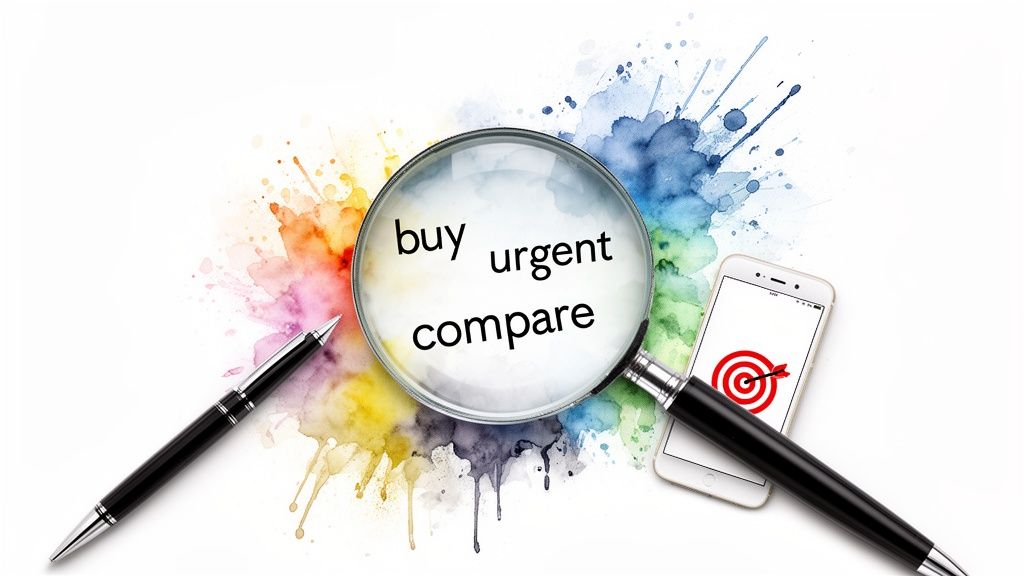
Beyond search volume, commercial intent is king
Too many marketers get obsessed with high search volume keywords. It's a vanity metric that rarely translates to revenue. Who cares if a term gets 10,000 searches a month if none of those people are looking to make a purchase?
Your goal is to cluster keywords based on their commercial intent. Think about the language of urgency and specificity.
Someone searching for "what is HVAC" is worlds away from someone searching for "emergency HVAC repair near me". The second person has a problem right now and a credit card ready. That's the click you want to buy.
Here’s a practical framework for how I think about it:
- High commercial intent: These are your money keywords. They include terms like "buy," "quote," "pricing," "service," or location-specific modifiers like "near me." These people are at the bottom of the funnel and ready to act.
- Mid-commercial intent: This group is in the comparison phase. They use terms like "best," "vs," "review," or "alternative." They know they have a problem and are actively evaluating solutions.
- Low commercial intent (informational): These are top-of-funnel searches. They often start with "how to," "what is," or "why." While not immediate buyers, they are your future customers if you can provide value now.
The magic happens when you connect high-intent search terms to hyper-specific ad copy and landing pages. The user journey should feel like a seamless, logical conversation from their Google search all the way to your form submission.
The power of precise keyword mapping
Building this intent map is foundational. It informs every single decision you make afterward, from the ad you write to the headline on your landing page. When a user sees their exact search query reflected in your ad, their confidence skyrockets, and they are far more likely to click.
This process used to be an insane amount of manual work, especially if you were targeting hundreds or thousands of keywords. Thankfully, technology has made this much more manageable.
Our team has spent countless hours refining our own approach to this, and we've even built tools to speed up the process. You can learn more about our philosophy on dynares’s keyword research features here.
Ultimately, this isn't just about SEO or PPC tactics. It's about empathy. It's about deeply understanding your customer’s mindset at the exact moment they need you. Get this right, and you've built the foundation for a lead generation machine that actually drives revenue.
Mastering the ad and landing page connection
This is where most campaigns completely fall apart.
You spend days crafting a brilliant, high-intent ad that promises a specific solution, only to send the user to a generic, one-size-fits-all homepage. It’s a jarring disconnect that absolutely kills conversions and wastes your ad spend.
Honestly, it’s one of the dumbest and most common mistakes I see. You’ve done all the hard work to get the click, only to drop the ball at the most critical moment.
The secret to generating high-quality leads isn't complicated: it’s message match.
The unbreakable rule of message match
Every single high-intent keyword you target deserves its own dedicated ad and a matching landing page. The page must echo the exact language, value proposition, and solution promised in the ad.
If someone searches for "emergency roof repair quote", your landing page headline better not be "Welcome to Our Construction Company". It sounds obvious, but you'd be amazed how often it happens.
This used to be an insane amount of manual work. Building unique landing pages for hundreds of keywords was a nightmare only massive companies could afford. But technology has completely changed the game. Platforms like ours now automate the creation of thousands of intent-aligned landing pages almost instantly.
This isn’t just about efficiency; it's about respecting the user’s intent. A seamless experience from ad to page builds immediate trust and makes the conversion feel like the next logical step. The effectiveness of your entire funnel relies on strategic web design for converting leads and boosting sales, ensuring every element guides the user toward action.
Stop thinking of your landing page as a digital brochure. It’s a focused, high-stakes conversation with one goal: conversion. Anything that distracts from that goal must be eliminated.
Creating leads efficiently is all about matching this intent, not just buying traffic. Organizations report generating an average of 1,877 leads per month, but a shocking 80% of them never translate into sales without proper nurturing. This gap is exactly why tailored landing pages matter more than sheer volume.
Non-negotiables for a high-converting page
When you get the message match right, the final step is to remove every possible point of friction on the page itself. There’s no room for creativity that hurts clarity. Your page must have these elements, period.
- A crystal-clear headline: It should mirror the user's search query and the ad's promise. No clever wordplay, just a direct answer to their problem.
- A frictionless form: Only ask for what you absolutely need. Name and email are often enough. Every extra field you add causes your conversion rate to drop. Keep it short and simple.
- Powerful social proof: Use real testimonials, client logos, or case study stats. Show visitors that other people like them have trusted you and gotten results.
- A single, obvious call-to-action (CTA): One button. One goal. Don’t confuse users with multiple options. Make the CTA button stand out with a contrasting color and use action-oriented text like "Get My Quote Now".
Getting these details right is crucial. For a deeper dive into crafting pages that convert, check out our guide on landing page design best practices. By combining perfect message match with an optimized page layout, you build a powerful, automated system for turning clicks into valuable leads.
Building your automated lead generation machine
If you're not tracking your campaigns all the way through to revenue, you’re flying blind.
And I don’t just mean counting form submissions—that’s a rookie metric. I’m talking about tracking actual, hard cash in the bank. This is where you separate the serious players from the amateurs who are just burning money on clicks.
Without this feedback loop, you’re just guessing. You might think a campaign is a huge success because it has a low cost-per-lead, but if none of those leads ever close, you're actually losing money. The whole point is to build a system that tells you exactly which ad clicks turned into profitable customers.
This visual shows the simple, direct path we're aiming for: a user clicks an ad, converts on a dedicated page, and becomes a valuable lead in your system.
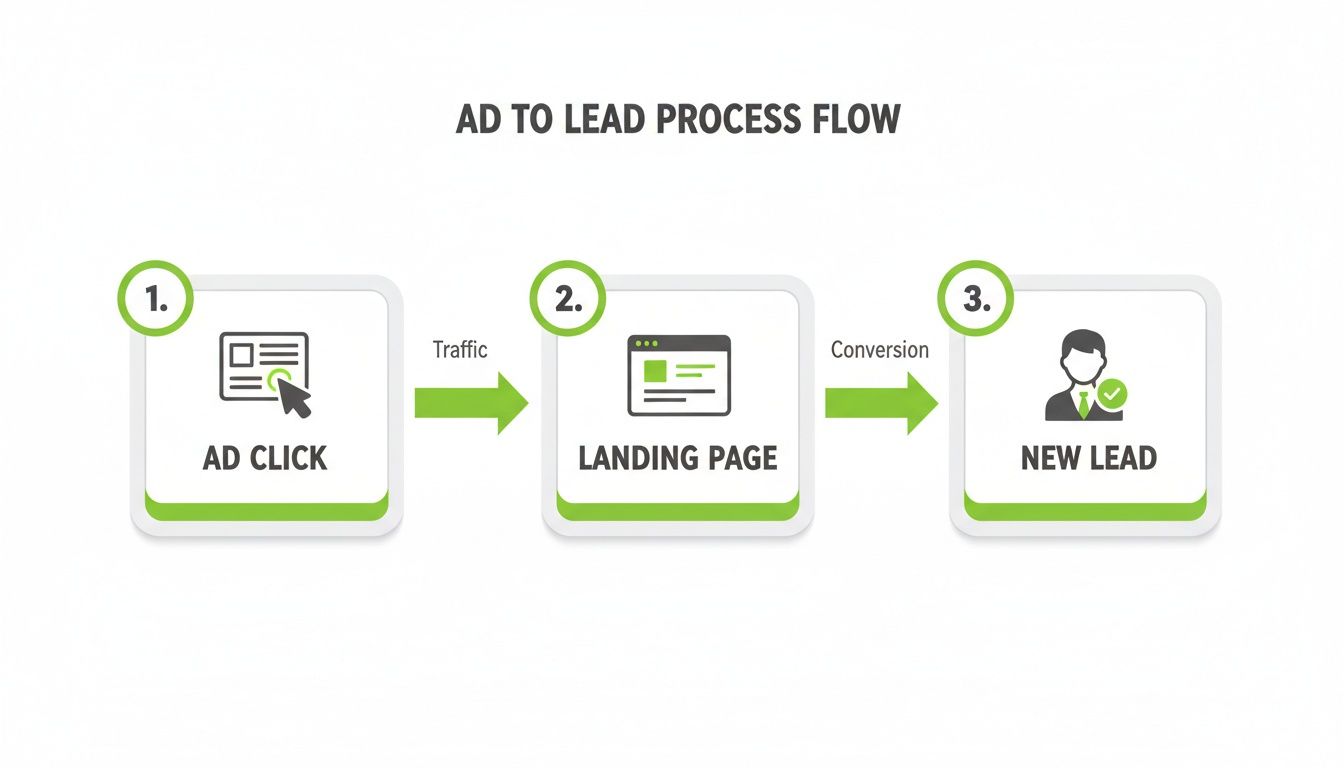
This process seems straightforward on the surface, but the real magic is in the data that flows backward to optimize the very first step.
Closing the loop with real data
The real power move here is setting up a feedback system that connects your sales data directly back to your ad platform. This involves two key steps that most people skip because they think it's too complicated (it's not).
First, you need to pass lead data from your landing page form straight into your Customer Relationship Management (CRM) system. This ensures your sales team gets instant, organized information. No more manual data entry or lost leads.
Second—and this is the part that changes everything—you must upload the conversion values from your CRM back into Google Ads. This tells Google's AI which keywords and ads are generating profit, not just cheap clicks. When Google knows a certain type of lead is worth €5,000, it will actively hunt for more people just like that.
Stop letting your ad platform optimize for vanity metrics like clicks or even form fills. Feed it real revenue data, and it will become a powerful profit-generating machine for your business. That's how you truly learn how to create leads that matter.
Automation that works while you sleep
Once your tracking is solid, the next step is to automate the busywork so you can focus on strategy. The goal is to build a machine that runs 24/7, qualifying and nurturing leads without you lifting a finger.
This isn’t about building some insanely complex, multi-layered system from day one. Start simple.
- Instant lead qualification: Set up a workflow that automatically scores leads based on their form submission data (e.g., company size, job title). High-scoring leads get routed to sales immediately.
- Automated sales alerts: Create a simple notification that pings the right salesperson in Slack or via email the second a high-value lead comes in. Speed is everything here.
- Simple nurture sequences: For leads that aren't quite sales-ready, automatically add them to a simple 3-email sequence that provides value and keeps your brand top-of-mind.
This combination of a powerful channel like Google and smart automation is an absolute game-changer. Among advertisers, 73% say Google outperforms social platforms for high-quality leads, and 74% say it wins on volume. It's the dominant channel, and combining it with smart workflows gives you a massive advantage. You can check out more stats on AI's role in lead generation automation here.
Finally, let technology do the heavy lifting on testing. Platforms that enable Auto A/B testing for ads and landing pages ensure your campaigns are always improving. The system constantly seeks out winning combinations of headlines, copy, and page layouts, meaning your performance gets better over time without endless manual tweaking. This is how you scale.
Measure what matters most: Revenue, not just leads
Alright, let's talk about the final, and most critical, piece of this entire playbook.
The vast majority of marketers stop at Cost Per Lead (CPL). Honestly? That’s a massive, unforgivable mistake.
A low CPL is a feel-good number, a classic vanity metric. Who cares if you’re getting leads for €5 a pop if none of them ever become paying customers? It’s completely useless data that makes you look busy while the business slowly bleeds cash.
The only metric that really counts
The only metric that truly matters is return on ad spend (ROAS). Full stop. You absolutely must connect your ad spend directly to the money it generates. No excuses.
This isn't some dark art. It’s about building a simple, clear feedback loop that shows you exactly which campaigns are profitable and which are just expensive hobbies. Once you have that clarity, your job becomes brutally simple.
- Kill what isn’t working. If a campaign isn't producing a positive ROAS after a fair test, cut it. Don’t get emotionally attached.
- Double down on what is. Find your winners—the campaigns driving real revenue—and pour fuel on that fire. This is how you scale intelligently.
This revenue-first approach elevates you from a "lead generator" to a "growth driver". When you can walk into any meeting and say, "I spent €10k last month, and it directly generated €50k in new business," you’ve won the game. No one can argue with that.
From cost center to profit center
This feedback loop is what separates the pros from the amateurs. It requires discipline and the right technical setup, but it’s non-negotiable for anyone serious about creating leads that actually build a business.
This is exactly why setting up your tracking correctly from the start is so important. When your ad platform gets real revenue data, its algorithms start working for you, optimizing for high-value customers, not just cheap clicks.
If you need a practical guide on the technical side, we’ve broken down the steps in our post on Google Ads conversion tracking setup.
Don't be the marketer who proudly reports a low CPL while the company's bottom line suffers. Be the one who tracks every euro from click to close, making ruthless, data-backed decisions that actually drive growth.
That’s how you become indispensable.
Answering the common questions about creating leads
Let's get into some of the questions that always come up when you're serious about building a lead generation engine. These are the things people wonder about but often don't ask. Think of this as the straight-talk section to clear up any lingering doubts.
How long does it take to see quality leads?
Honestly? It depends.
If you’ve absolutely nailed your audience and are hitting high-intent keywords with a well-built PPC campaign, you could see leads coming in within a couple of days. But let's be real—those are just the first signals, not the finished product.
Optimizing for quality leads, the kind that actually turn into revenue, is a different game entirely. You need to give it at least 30-60 days to collect enough data. That's the minimum runway to see which keywords and ads are driving sales, not just form fills. Patience is everything here; don't kill a promising campaign because of one bad week.
What is a good landing page conversion rate?
Anyone who gives you a single number is guessing. A "good" conversion rate is completely contextual, and chasing some random industry benchmark is a fool's errand.
Your only goal should be to beat your results from last month. Focus on continuous improvement through A/B testing, not on comparing your numbers to some generic average that knows nothing about your traffic source, offer, or audience.
For a super-specific, high-intent keyword, you might see 10-20% or even higher. For broader, top-of-funnel traffic, hitting 2-5% might be a huge win. Stop looking for a magic number and start stacking small, incremental gains.
Should I use SEO or PPC for lead generation?
The real answer is both. Thinking it's an either/or choice is a fundamental mistake. They serve completely different strategic purposes.
- PPC is your speed and precision tool. You can switch it on today and have leads coming in tomorrow. It's perfect for validating offers, testing your funnel, and immediately capturing demand from people who are ready to buy right now.
- SEO is your long-term asset. It’s about building a sustainable, organic engine that generates "free" leads over time. It takes patience and consistent work, but the payoff is a powerful, defensible moat for your business.
My advice is always the same: start with PPC to validate your entire system and generate immediate cash flow. Then, take the profits you make from those campaigns and reinvest them into a rock-solid, long-term SEO strategy. It’s the smartest way to build a growth engine that lasts.
Ready to build a lead generation machine that actually drives revenue? dynares uses AI to instantly create thousands of intent-matched ads and landing pages, closing the gap between ad click and conversion. Stop wasting ad spend and see how you can scale your lead generation at https://dynares.ai.


