
Let's be honest, most keyword strategies are a mess. I see it all the time: massive, unmanageable keyword lists, ad group structures that look like a tangled mess of wires, and budgets just getting torched with nothing to show for it. The old playbook of stuffing every possible keyword variation into a campaign? It's officially dead.
Why most PPC keyword strategies are broken
People don't search in neat, predictable patterns anymore. If your strategy still banks on that, you're just lighting money on fire. The game has shifted entirely. It’s no longer about hoarding thousands of keywords; it’s about surgically targeting the handful that signal real, wallet-out intent.

I've seen startups burn through their entire seed funding chasing high-volume, low-intent terms. It’s a classic trap. You get a ton of clicks, your traffic chart looks amazing, but your sales numbers are completely flat. It’s a vanity metric that does nothing for the bottom line, and frankly, it’s a dumb way to build a business.
This guide cuts through all that noise. We’re moving past the outdated advice.
The real goal isn't just getting clicks—it's attracting customers with high purchase intent. It’s about quality over quantity, every single time. Forget the ego boost of traffic; focus on revenue.
The whole landscape of keyword targeting has changed. High-intent users don't always start their searches with exact-match phrases anymore, forcing us to think about broader audience strategies alongside sharp keyword-level optimization. This is critical, especially when you consider that a shocking 50% of users can't even tell the difference between paid and organic results, blurring the lines for us marketers. If you want to see just how much user behavior has changed, dig into the latest PPC statistics.
This is all about building a smarter, more surgical approach to keywords for PPC that respects your budget and actually drives measurable growth.
We’re going to focus on what's working right now:
- Intent-driven keyword research: How to find the terms that signal someone is ready to pull out their credit card.
- Lean campaign structures: Building setups that are easy to manage and optimize, not impossible to scale.
- Profit-focused optimization: Making decisions based on revenue, not just clicks or impressions.
We're here to build a machine that turns ad spend into customers, not just website visitors. Let's get to it.
Finding keywords that actually make money
Alright, let's get our hands dirty. Forget keyword volume for a second—it’s a vanity metric that will drain your bank account.
We're not looking for just any keywords; we're hunting for clear, undeniable signals of commercial intent. It’s all about getting inside your customer's head.
Think about the language they use right before they need to solve a problem. What questions are they typing into Google moments before they're ready to buy? That’s where the money is. Building a list of 10,000 generic terms is just busy work. The real goal is a tight, focused list of phrases that scream, I'm ready to pull out my wallet.
Uncover your customer’s language
Your best keyword ideas won't come from a tool; they'll come from your customers.
Your sales and support teams are sitting on a goldmine. They hear the exact phrasing, the specific problems, and the feature requests your prospects mention every single day. If you're not talking to them, you're flying blind.
Set up a simple shared document or a Slack channel and ask your teams to drop in verbatim quotes from customer calls and emails. You'll quickly see patterns emerge. These raw, unfiltered phrases are pure gold for creating high-intent keywords.
The most profitable keywords are rarely what you think your customers are searching for. They are what your customers are actually searching for. Stop guessing and start listening.
For example, your marketing team might be targeting "AI content platform," but your sales team keeps hearing prospects ask for a tool that writes Google Ads copy for me. That second phrase is a money-making keyword because it's specific, problem-aware, and signals a clear need.
Categorize keywords by intent
Once you have a list of raw ideas, you need to sort them. Not all keywords are created equal. I like to break them down into a simple framework that maps directly to the buying journey. This isn’t rocket science; it's just about organizing by intent.
- Informational Intent: These are "how-to" or "what is" type queries. Think "how to improve Google Ads ROAS." These are generally terrible for direct conversion campaigns but can be useful for top-of-funnel content. We mostly ignore these for direct response PPC.
- Navigational Intent: Someone is looking for a specific brand or website, like "dynares login." This is important for brand defense campaigns but not for finding new customers.
- Commercial Investigation: Here, people are comparing options. Keywords like "dynares vs competitor" or "best ppc automation software" fit here. This is where things get interesting and profitable.
- Transactional Intent: This is the bottom of the funnel. These searchers are ready to buy. They use terms with high-intent modifiers like "buy," "pricing," "demo," or specific product names like "dynares for agencies." Prioritize these above all else.
To identify the most profitable terms for your campaigns, a deep dive into advanced techniques for effective keyword research strategies is indispensable. Additionally, exploring our own detailed guide on our keyword research features can provide even more context on how to apply these concepts.
The key is to map every keyword to a stage and focus your budget where the intent to purchase is highest.
Structuring campaigns for profit, not chaos
A massive, disorganized keyword list is worthless. Let's be real—it's just a vanity metric that creates chaos. A well-structured campaign is where you turn all that raw keyword potential into actual profit. This is the architecture, the blueprint for a high-performing Google Ads account that doesn’t make you want to pull your hair out.
For a long time, the gold standard was Single Keyword Ad Groups (SKAGs). The idea was simple: one keyword, one ad group. But Google's matching logic has evolved, and frankly, SKAGs can become an unmanageable nightmare at scale. They're not the only answer anymore.
The smarter approach today is building tightly themed ad groups. Think of it like organizing a library. Instead of having a separate shelf for every single book, you group them by topic—fiction, history, tech. This way, everything is hyper-relevant, and it's far easier to find what you need.
Building themed ad groups that work
The goal here is simple: every keyword within an ad group should be so closely related that the exact same ad and landing page can serve all of them perfectly. This isn't just about being organized; it's about boosting your Quality Score.
When your keyword, ad copy, and landing page are all in sync, Google rewards you with lower costs and better ad positions. It’s a win-win.
For instance, if you're a B2B SaaS company selling project management software, you wouldn't lump "kanban board software" in with "gantt chart maker." While related, the user intent is different. Someone looking for a Kanban tool expects to see a Kanban-focused ad and page.
A better structure would be:
kanban board softwarebest kanban tool for teamstrello alternative kanban
online gantt chart makergantt chart project management toolsoftware with gantt charts
This tight grouping ensures the user searching for a kanban tool sees an ad talking about kanban boards and lands on a page showcasing that feature. It seems obvious, but I see accounts every day that get this fundamental principle wrong and bleed cash as a result.
The following diagram breaks down how to think about structuring your keywords, starting from high-level user intent and drilling down to specific, profitable terms.
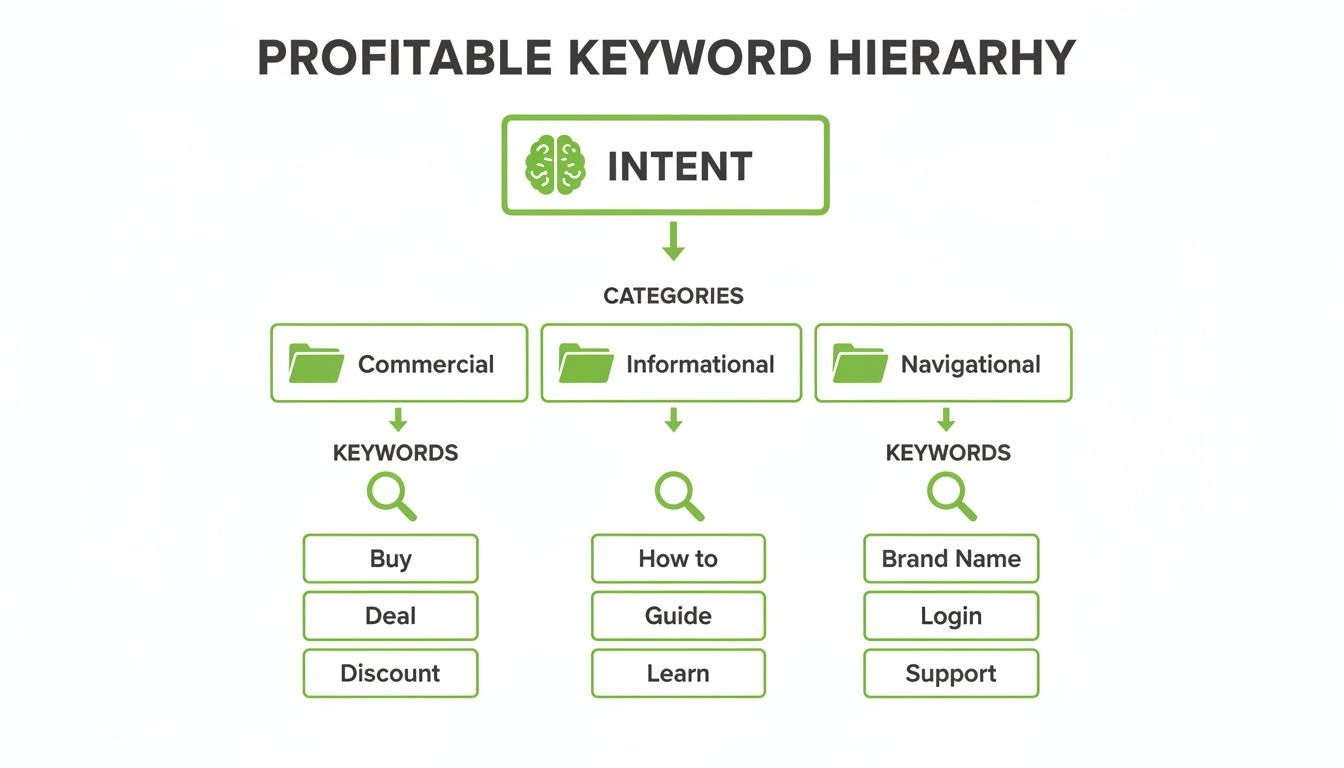
This hierarchy shows that successful campaigns start with understanding user intent, then organizing that intent into logical categories before selecting specific keywords for ppc.
Match types: your traffic control system
Once your groups are structured, you need to control traffic quality with match types. This isn't about rigid rules; it's about building a flexible system. Think of them as different kinds of fishing nets.
You need the right net for the right fish. Broad match is like a giant trawling net—you'll catch everything, including a lot of junk. Exact match is like a spear—precise and targeted.
Here's a practical breakdown of how I use them:
- Broad Match: I use this cautiously, almost exclusively for research. It needs to be paired with a smart bidding strategy like tCPA and a massive negative keyword list. It’s great for discovering new search queries you hadn't thought of, but left unchecked, it will incinerate your budget.
- Phrase Match: This is my workhorse. It offers a great balance between reach and control, capturing relevant variations without going too far off the rails. It's perfect for most of your core, high-intent ad groups.
- Exact Match: This is reserved for your proven winners. When you find a keyword that converts consistently, lock it down with exact match to maximize your impression share and bid aggressively on it.
This isn’t about picking one and sticking with it forever. The best accounts use a mix, graduating keywords from broad to phrase to exact as they prove their worth.
A smart campaign structure isn't set in stone. It's a living system that lets you scale what works and cut what doesn't—fast. Start with tightly themed ad groups, use match types to control traffic flow, and obsess over relevance. That's how you build for profit, not chaos.
The unsung hero: negative keywords
If you're not aggressively managing your negative keyword lists, you are wasting a shocking amount of money. Full stop.
Most people get excited about finding new keywords to bid on, but the fastest way to improve your campaign ROI is by telling Google which searches you don't want. This is the single most underrated and powerful tool in your PPC arsenal.

This isn't just about avoiding a few bad clicks; it's a fundamental strategy for plugging the leaks in your budget. Every euro spent on an irrelevant click is a euro you can't spend on a real potential customer. Think of it as a bouncer for your ad campaigns, turning away traffic that has zero chance of ever converting.
Start with the obvious money-wasters
You don't need a fancy tool to build your initial list. You just need common sense.
Before you even launch a campaign, you should have a foundational list of negative keywords that are almost universally bad for business unless you're in a very specific niche. The goal here is to proactively block the tyre-kickers and job-seekers before they ever see your ad.
- No-Intent Modifiers: Think of all the ways people search for things they will never pay for. Terms like
free,cheap,torrent, anddownloadare classic examples that attract clicks with zero purchase intent. - Informational Queries: Block out research-heavy terms that signal a user is just learning, not buying. This includes words like
tutorial,how to,example,guide, andwhat is. - Employment Searches: Unless you're running HR campaigns, you need to eliminate anyone looking for a job. Add terms like
jobs,careers,hiring, andinternshipto your lists immediately.
Your search query report is the most honest feedback you'll ever get from the market. It tells you exactly where you're wasting money. Ignoring it is like ignoring a fire alarm.
Mine for gold in your search query reports
The proactive list is just the start. The real, ongoing work happens in your search query reports.
This is where Google shows you the exact, verbatim phrases people typed before clicking your ad. Reviewing this report isn't a suggestion; it's a non-negotiable weekly task for anyone serious about performance.
Look for queries that are close but not quite right. For example, if you sell "project management software," you might find you're getting clicks from people searching for "free project management templates." The word "templates" is your enemy here. Add it as a negative.
If you want a more detailed walkthrough, this complete guide to building a negative keywords list is a great resource for protecting your ad spend.
This systematic process is how you refine your targeting over time, ensuring your budget is only spent on high-quality keywords for PPC that attract actual customers. Don't be lazy on this—it’s the single fastest way to make your campaigns more profitable.
Let's get real about the elephant in every PPC manager's room: rising ad costs. It's getting more expensive to show up, let alone compete. If your only move is to keep throwing more money at Google, you're on a fast track to burning through your budget with nothing to show for it.
This isn't just a feeling; the data backs it up. Between 2024 and 2025 alone, Google Search CPCs jumped by a staggering 45%, hitting 87% of industries. The old playbook of "just bid higher" is officially broken.
But here's the good news. Improving your Quality Score from average to great can slash your CPCs by 30-50%. That's not just an edge; it's a complete game-changer. This is where we stop playing Google's game of ever-increasing bids and start playing our own. The key isn't a bigger budget; it's a better, more efficient one.
Quality score is your secret weapon
Quality Score isn't just some vanity metric Google throws on your dashboard. It's a direct rating of how relevant your keywords, ads, and landing pages are, and it has a massive impact on your ad rank and, crucially, what you pay for each click.
Think of it as a discount from Google. They want to show users the most helpful, relevant results possible, even for ads. When your ad and landing page are a perfect match for what someone is searching for, Google rewards you. You get a better ad position for less money than a competitor who's bidding more but has lower relevance. It really is that simple.
So, how do you actually boost it?
- Hyper-Relevant Ad Copy: Your ad copy has to feel like it was written specifically for the search query. If someone searches for "kanban software for remote teams," your headline needs to speak directly to that pain point, not some generic "best project management tool."
- Landing Page Experience: The page you send them to must deliver on the promise made in the ad. It needs to load fast, look great on mobile, and continue the conversation. A disconnect here is a fast way to kill your Quality Score and your budget.
- Expected Click-Through Rate (CTR): This is Google's prediction of how likely people are to click your ad. It’s based on your historical performance. Better, more compelling ads get higher CTRs, which in turn boosts your Quality Score.
Smart bidding vs. manual control
Once you've nailed relevance, you can let Google's bidding strategies do the heavy lifting. But you need to know which tool to use for which job.
Simply cranking up your bids is a lazy, expensive strategy. True growth comes from efficiency—getting more conversions from the same ad spend. This means obsessing over relevance and letting the right bidding strategy execute.
Automated bidding strategies like Target CPA (tCPA) and Target ROAS (tROAS) are incredibly powerful, but only when you're feeding them enough clean conversion data. They use machine learning to adjust bids in real-time, zeroing in on your specific goals. You can learn how to calculate ROAS the right way to make these strategies work even harder for you.
But don't write off manual CPC just yet. It still has a place, especially for brand-new campaigns with no historical data or for those few high-value keywords where you want absolute, granular control. To manage your budget effectively as costs climb, you have to know how to calculate conversion cost to maximize ROI. Don't just set it and forget it. The best PPC managers know when to let the machine drive and when to take the wheel.
How AI is reshaping keyword strategy
The days of wrestling with massive keyword spreadsheets are numbered. Let’s be blunt—that old way of doing things is slow, inefficient, and frankly, a waste of your time. AI isn't just a buzzword for investor meetings anymore; it's fundamentally changing how we approach keywords for PPC. If you're not paying attention, you're already falling behind.
This isn't about AI replacing marketers. It's about giving us tools that let us operate at a scale and speed that were impossible just a few years ago. Think of it as upgrading from hand tools to a fully automated factory floor.
We're talking about platforms that automate keyword research, predict performance with scary accuracy, and spit out thousands of ad copy variations for testing. The human role is shifting from tedious execution to high-level strategy—guiding the machine, not pulling the levers one by one.
The shift from keywords to conversations
The very concept of a "keyword" is evolving. As tools like ChatGPT become the new search engines, we have to start optimizing for natural, conversational questions, not just a clunky string of words.
This means the future of keyword strategy is less about exact-match precision and more about understanding context. The game is changing from matching words to matching problems.
This is a massive opportunity for anyone willing to adapt. While your competitors are stuck optimizing for "best CRM for startups," you'll be capturing users who ask their AI, "What’s the best way to manage my sales pipeline without a huge team?" It's a subtle but critical shift in thinking.
How AI is empowering marketers today
This future isn't far off—the tools are already here and being used. Today, a staggering 75% of PPC practitioners use generative AI for writing ad copy, and a full 60% use it for keyword research. The trend is clear. We’re moving toward an ecosystem where human strategy is amplified by machine execution. You can explore the full breakdown of these PPC adoption stats to see just how fast this is happening.
The real competitive edge comes from embedding these tools into your workflow now.
- Automated Ad & Landing Page Generation: Platforms can instantly create thousands of keyword-specific landing pages and ads, all aligned with your brand guidelines, without bogging down your dev team.
- Predictive Performance Modeling: AI can forecast the potential performance of keyword clusters before you spend a single euro, leading to much smarter budget allocation.
- Intent-Based Optimization: Modern tools can analyze search queries to understand the underlying intent, then automatically adjust bids and copy to match what the user is actually looking for.
This isn't just about efficiency. It's about unlocking a level of personalization and testing at a scale that gives you an almost unfair advantage. If you want to dive deeper into what's available, check out our guide on the best AI tools for digital marketing.
The future of PPC is a partnership between human insight and machine power. The sooner you embrace it, the further ahead you'll be.
A few final thoughts from the trenches
I get asked a lot of the same questions after running campaigns for years, so let's clear up a couple of common ones.
How many keywords is "right"?
People love to ask about the magic number of keywords for an ad group. It’s the wrong question.
There is no magic number. Focus on relevance, not a specific count. If one ad and a single landing page can perfectly serve 15 tightly related keywords, that’s great. If it can only serve one keyword with razor-sharp intent, that's fine too.
The real goal isn't hitting a keyword quota; it's creating a perfect, logical link from the search query to the ad to the page. Group by theme, not by arbitrary numbers.
Isn't broad match just a way to burn money?
Another classic: "Should I avoid broad match?" Not always, but you have to treat it like you're handling explosives. It's a discovery tool, not a set-and-forget strategy.
If you're going to use it, there are two non-negotiables:
- You must use a Smart Bidding strategy (like Maximize Conversions with a target CPA) to give Google guardrails.
- You must have a massive and constantly updated negative keyword list to block irrelevant searches.
Without those two things in place, broad match will absolutely incinerate your budget on garbage traffic. With them, it can be a powerful way to uncover new, profitable search terms you would have missed otherwise. Just don't let it run wild.


