
Let’s cut the hype. Everyone’s talking about AI in marketing, but most of the chatter is noise. As a founder building in this space, I see a lot of shiny objects that don't solve real problems. The truth is, AI isn't a replacement for strategy; it's a force multiplier for smart marketers who know what they're doing. It’s about automating the tedious stuff so you can focus on the big picture. This isn't just another generic list of the best ai tools for digital marketing. It's a founder’s take on the tools that provide real leverage for scaling your business, from automating entire Google Ads funnels to generating content that doesn't sound like a robot wrote it.
We're going to dive into a curated roundup of platforms I've either used, tested, or watched closely. You’ll get an unfiltered look at what each tool actually does, who it’s built for, and where it falls short. I’ll provide direct links and screenshots so you can see for yourself. We'll cover everything from comprehensive platforms like HubSpot and Semrush to specialized automation tools like dynares, which is our solution for scaled Google Ads lead-gen and landing page creation.
The goal is simple: to help you, a fellow PPC manager, agency owner, or founder, cut through the noise and find the right AI-powered leverage for your specific needs. While this list covers a broad marketing spectrum, if you're laser-focused on organic search, it’s worth a look at this list of the 12 best AI SEO tools for 2025 to go deeper on that front. No fluff, just my honest opinion on what works, what doesn't, and who each tool is really for. Ready to get practical? Let's dive in. 👇
1. dynares
Best for: Scaling personalized search campaigns and revenue-driven optimization.
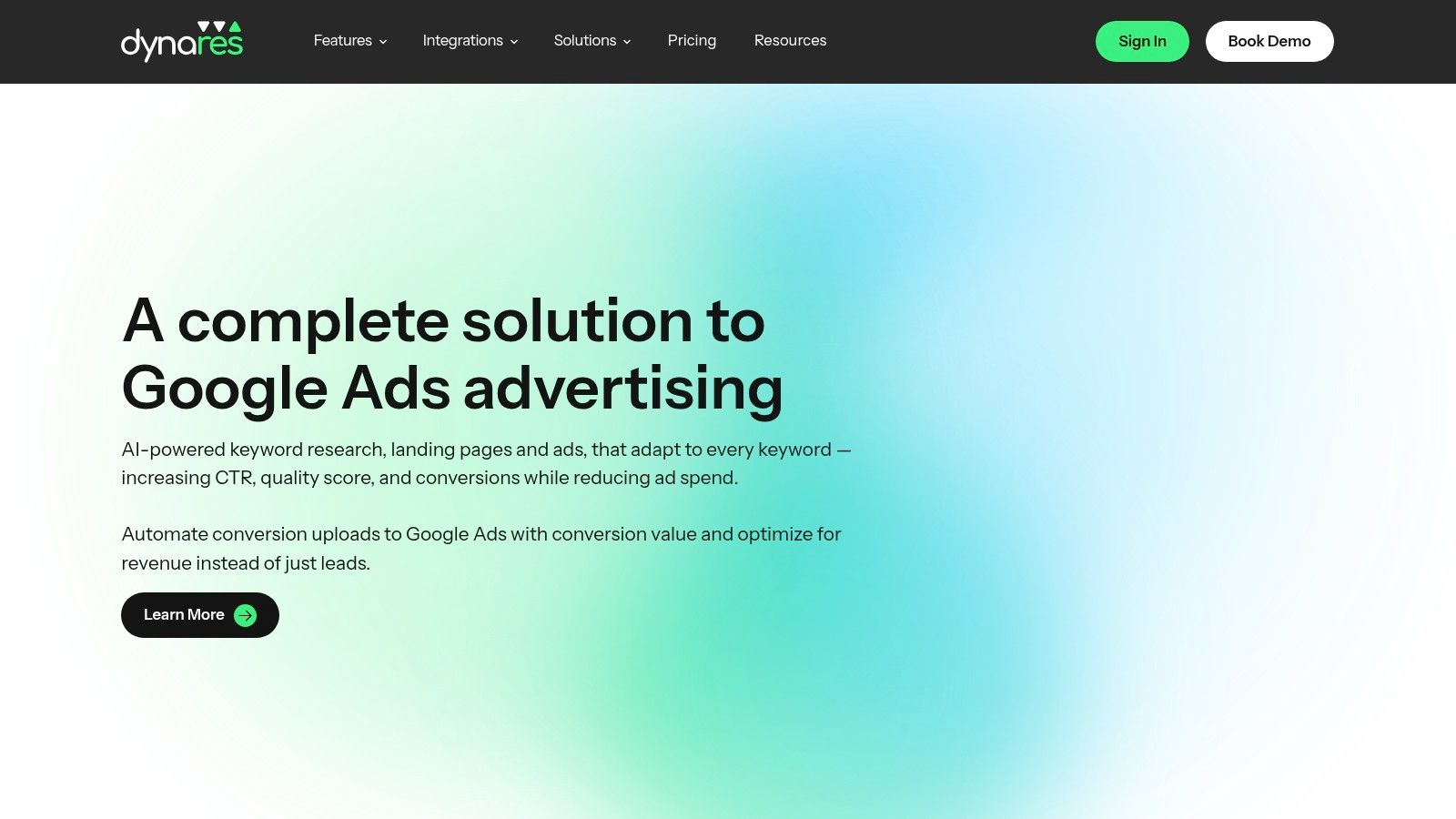
If you’re serious about Google Ads and tired of the manual grind that comes with scaling, dynares is a game-changer. It’s one of the best AI tools for digital marketing because it solves a core problem most platforms ignore: it automates the entire ad-to-conversion funnel, not just the ad copy. The platform intelligently creates thousands of keyword-specific ads, landing pages, and forms at scale. This means every click is met with a hyper-relevant experience, which is exactly how you boost Quality Score, CTR, and ultimately, conversions.
It’s an incredibly practical approach. You feed the system your brand guidelines and some seed keywords, and its AI gets to work, generating a massive volume of coordinated campaign assets that feel hand-crafted. This isn’t just about saving time; it’s about achieving a level of personalization that’s nearly impossible to manage manually, especially for agencies juggling multiple accounts or growth teams targeting niche segments.
Why it's our top pick
What truly sets dynares apart is its focus on revenue, not just lead volume. It’s built for performance marketers who care about ROAS. The platform pushes conversion values back into Google Ads, allowing you to optimize bidding algorithms based on actual business impact. This closes the loop between spend and revenue, which is a massive advantage. Instead of just getting more leads, you get better-quality leads that are more likely to convert.
The workflow is also thoughtfully designed for teams. With a reusable template and form builder, plus integrations with Google Ads, Google Tag Manager, and HubSpot, it fits neatly into existing tech stacks. For agencies, this streamlines campaign launches and reporting across multiple client accounts, making it a powerful force multiplier.
Key features & considerations
- Scales true personalization: Automatically generates keyword-specific ads, landing pages, and forms so every search intent gets a tailored experience.
- Revenue-aware optimization: Uploads conversion values to Google Ads, enabling bid optimization for ROAS and revenue (not just leads).
- End-to-end automation: A comprehensive toolset from keyword research to ad/page generation and A/B testing reduces manual work and speeds up iteration.
- Strong integrations: Connects seamlessly with Google Ads, GTM, and HubSpot, making it agency and team-friendly.
The main drawback is its focus. It’s primarily built for Google Ads and search. It’s not the right tool if you need cross-channel campaign management for social or display. Also, the AI-generated content is strong but still requires a final human review to ensure brand compliance and messaging accuracy.
Pricing: dynares offers a Free plan to get started. Paid plans include Starter (around $29/mo), Pro ($243/mo), and Business ($765/mo), with discounts for annual billing and custom plans available for enterprise needs.
Website: https://dynares.ai
2. G2
Before you commit to any new software, you need to do your homework. G2 is the digital equivalent of a massive, well-organized library for software, but instead of dusty books, you get fresh, verified user reviews. It's a non-negotiable first stop when you’re trying to find the best AI tools for digital marketing because it aggregates real-world feedback, saving you from disastrous procurement decisions.
What makes it essential is its sheer volume of reviews and deep categorization. You can filter for tools specific to AI Writing or AI Sales Assistant, then slice the results by company size (SMB, Mid-Market, Enterprise). This lets you see what platforms your direct competitors or companies of a similar scale are actually using and, more importantly, what they genuinely think of them. It cuts through the marketing fluff and gives you a ground-level view of a tool's performance and support.
How to use G2 effectively
A word of caution: G2’s business model involves sponsored placements, so the default view often pushes vendors who pay for visibility. Always re-sort the results. My go-to is sorting by Highest Rated or Most Reviews to get a more objective picture. Use their side-by-side comparison feature to create a shortlist of 2-3 top contenders, then dive into the negative reviews. That's where you'll find the unvarnished truth about a tool's limitations. The main con is that the default search results are biased by these sponsored placements; you have to actively re-sort to get a clear view.
Website: https://www.g2.com/
3. Capterra
Similar to G2, Capterra is another heavy-hitter when it comes to software reviews, but with a slightly different flavor. Think of it as a comprehensive buyer's guide meets a massive software directory. For anyone trying to navigate the crowded market of best AI tools for digital marketing, Capterra provides a structured, filter-heavy environment to compare options quickly, especially with its clear pricing snapshots and deployment models (cloud, on-premise, etc.).
What sets it apart is its strong editorial bent, featuring buyer guides that outline top tools and cost considerations for specific categories like AI-driven SEO or social media management. This editorial oversight adds a layer of curated expertise on top of user reviews. You can quickly scan over 200 products across various marketing disciplines, from email and content to social media, getting a rapid-fire overview of the landscape before you dive deep into individual reviews.
How to use Capterra effectively
Capterra is fantastic for initial discovery and high-level comparison. Use their filters to sort by Highest Rated or Most Reviews, which gives you a more organic view of the top players. Their comparison tool is also solid for putting a few platforms head-to-head on key features. Pay attention to the editorial guides; they often provide a great shortlist of vetted tools. However, always cross-reference the user reviews, as some newer, more innovative AI tools might not have enough feedback yet to give you a complete picture. Niche or brand-new AI tools often have very few reviews, making it hard to gauge their quality.
Website: https://www.capterra.com/ai-marketing-tools-software/
4. Product Hunt
If you want to stay on the bleeding edge of marketing tech, Product Hunt is your daily intel brief. It’s a discovery hub where new products, including a ton of AI-powered apps, launch every single day. For marketers, it's less about finding a mature, enterprise-ready platform and more about spotting what's next. It’s the best place to find emerging best ai tools for digital marketing before they even hit the mainstream tech blogs.
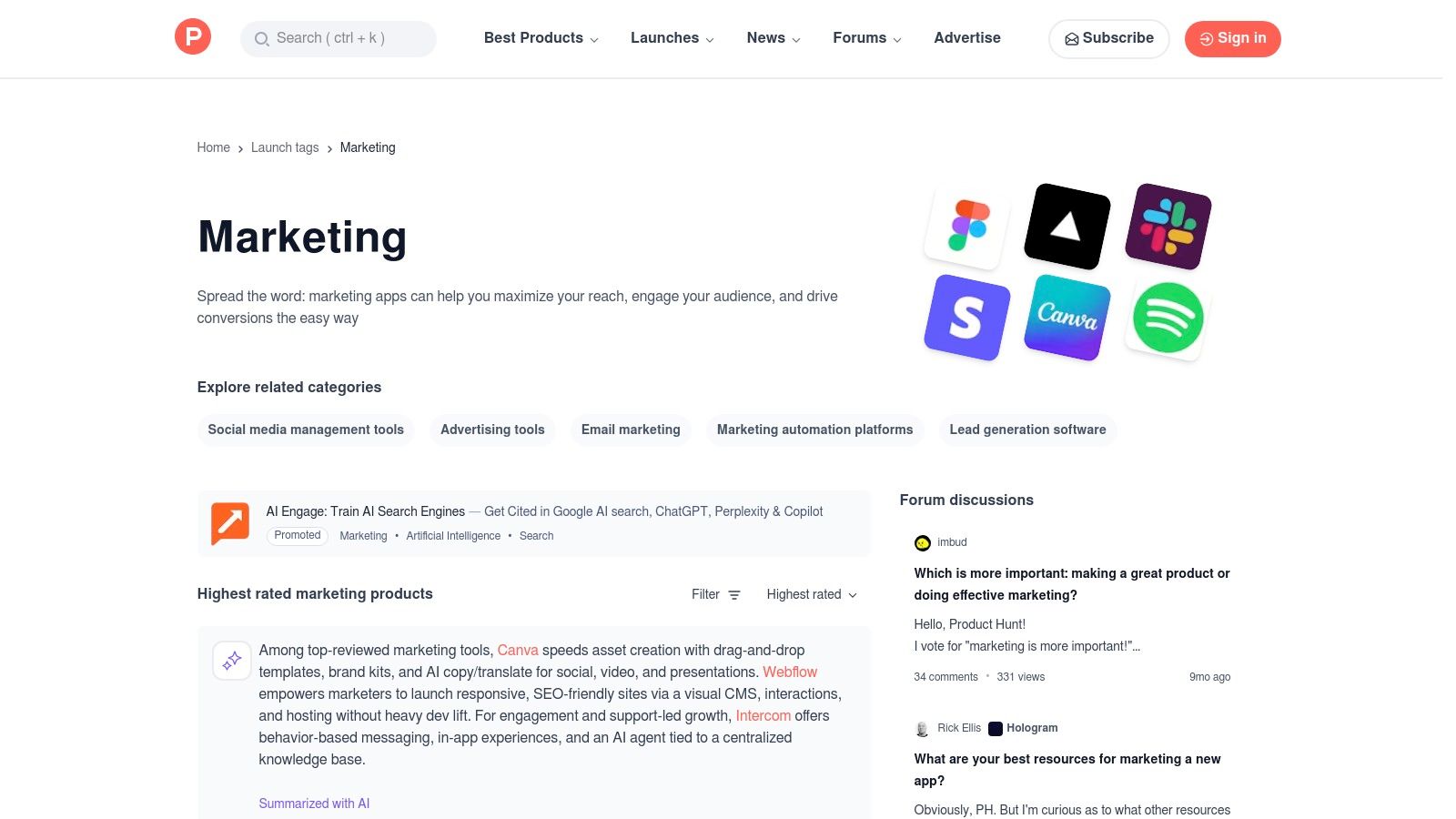
What makes it essential is its community-driven curation. The Marketing and Artificial Intelligence topics are constantly updated with new tools, ranked by user upvotes. This system lets you see what’s generating buzz among early adopters and tech enthusiasts. The comment sections are often goldmines, offering candid first impressions and direct conversations with the founders. You can get a feel for a product's potential and its team's responsiveness in one place.
How to use Product Hunt effectively
Don't just look at the daily top performers. Dive into the specific topic pages like Marketing and sort by Most Upvoted for the week or month to find tools with more staying power. Be skeptical of the initial launch-day hype; a lot of it is driven by pre-existing communities. Instead, look for products that maintain momentum and have an active comments section with genuine questions and feedback. It’s a fantastic resource for inspiration and spotting market trends. The main catch is that upvotes and hype don't always indicate product-market fit.
Website: https://www.producthunt.com/topics/marketing/
5. AppSumo
For startups, solopreneurs, or agencies on a tight budget, funding a full-stack of AI tools can feel impossible. AppSumo is the ultimate playground for cost-effective experimentation. It's a deals marketplace that offers heavily discounted lifetime deals (LTDs) and annual subscriptions on a massive range of software, including a huge selection of emerging AI content, SEO, and automation tools. This makes it a crucial resource when you want to test new, innovative tech without committing to a hefty monthly SaaS bill.
What makes AppSumo a unique stop on your hunt for the best AI tools for digital marketing is the community aspect and the sheer value. Instead of just marketing copy, each product listing has a Q&A section where potential buyers grill the founders on features, roadmaps, and limitations. This, combined with user reviews, gives you a raw, unfiltered look at a tool's potential. It's the perfect place to discover a diamond-in-the-rough AI writer or a niche automation tool that could save your agency hundreds of hours.
How to use AppSumo effectively
A word of warning: the allure of a lifetime deal can be a trap. Not all tools survive, and some founders abandon projects or change terms later. Due diligence is non-negotiable. Always read recent reviews and the community Q&A section to gauge the founder's responsiveness and the tool's development progress. Take full advantage of their 60-day refund policy; if a tool isn't delivering what it promised within a month, get your money back without hesitation. The risk is real, as vendors can change terms or fail, so you need to vet carefully to avoid low-quality or abandoned software.
Website: https://appsumo.com/
6. Google Ads Performance Max & AI asset generation
If you're managing paid search, you're already working inside one of the most powerful AI engines on the planet. Google’s Performance Max (PMax) is the company's aggressive push toward an AI-first advertising ecosystem. It consolidates bidding, targeting, and creative across all of Google's channels, including Search, YouTube, Display, and Gmail, into a single, goal-driven campaign type. For PPC managers, it's a non-negotiable tool.
What makes PMax a standout among the best AI tools for digital marketing is its integration of generative AI for asset creation. Inside the campaign, you can now use Google's AI (powered by models like Imagen) to generate new text headlines, descriptions, and even entirely new images. This allows for rapid creative testing and iteration without leaving the Google Ads interface, turning a once-manual process into a semi-automated workflow. It’s a huge time-saver and lets you focus on strategy instead of tedious asset production.
How to use Performance Max effectively
The biggest complaint about PMax is its black box nature. You hand over control to Google's AI, which can be unnerving. To manage this, start with strict conversion goal settings and provide high-quality audience signals to guide the machine. Use the built-in asset generation to create variations of your best-performing concepts, but always review them for brand alignment. Don't just set it and forget it. Monitor asset group performance closely and replace underperforming creatives. If you're looking to get the most out of your campaigns, you can learn more about how to improve Google Ads performance with a strategic approach.
Website: https://business.google.com/ad-solutions/performance-max/
7. Semrush
While many tools are AI-native newcomers, Semrush is an established giant that has impressively pivoted to embed AI across its entire marketing suite. Think of it as the Swiss Army knife for digital visibility, supercharged with new AI capabilities. For anyone serious about SEO, PPC, and competitive intelligence, Semrush remains a foundational part of the stack, and its recent AI additions make it one of the best AI tools for digital marketing for teams needing an all-in-one solution.
What sets it apart is its integration of AI into a proven, data-rich ecosystem. You're not just getting a standalone AI writer; you're getting AI-powered insights applied to massive datasets for keyword research, competitor ad copy analysis, and content optimization. It moves beyond simple generation to AI-driven strategy, helping you understand why you should target a specific keyword or how your PPC budget stacks up against the competition's. This end-to-end approach prevents the disjointed workflow that comes from using a dozen separate, niche AI tools.
How to use Semrush effectively
Semrush is a beast, and you can easily get lost. Start with a specific goal. If it's improving ad copy, dive into the AdCreative analysis tools. If it's SEO, start with a site audit and the Keyword Magic Tool. Don't try to master everything at once. Use its competitive analysis features to benchmark your domain against two or three direct competitors to find immediate gaps in your PPC and organic strategies. Focus on the actionable reports, not just the vanity metrics. The downside is that it can get expensive at higher tiers, and some toolkit overlap might require careful assessment.
Website: https://www.semrush.com/
8. Jasper
When you move beyond simple AI chatbots and need a tool that actually understands marketing workflows, Jasper is where you land. It’s designed from the ground up for marketing teams, moving past generic prompts into a structured environment for creating entire campaigns. This isn't just about writing a blog post; it's about building a cohesive set of assets, from ad copy and social media posts to landing page text, all while maintaining a consistent brand identity.
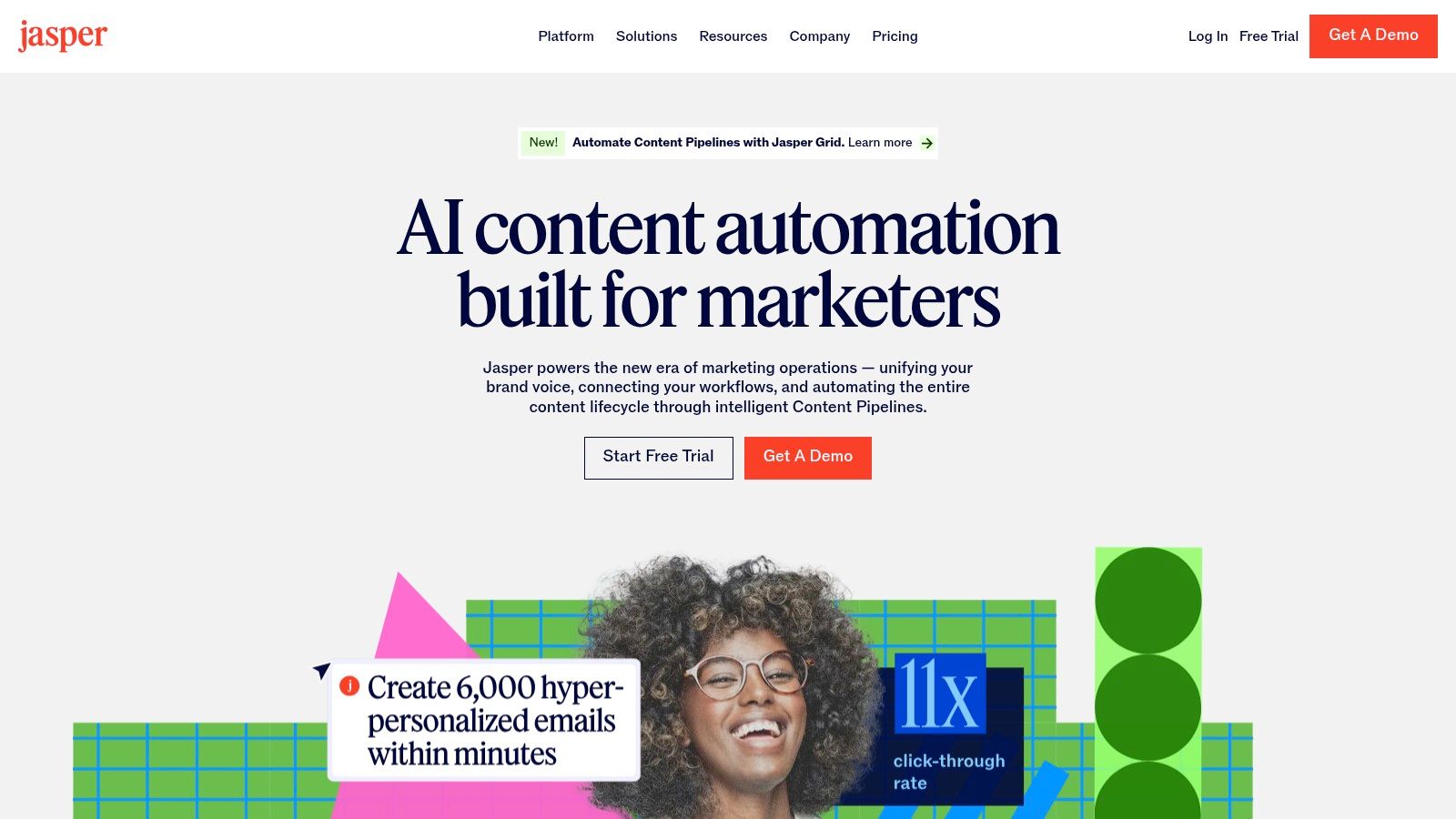
What sets Jasper apart is its emphasis on governance and brand consistency, which is critical for agencies and in-house teams. Features like Brand Voices and Knowledge allow you to upload style guides, product information, and audience personas, ensuring the AI’s output is always on-brand. For teams that need to scale content creation without sacrificing quality control, this makes Jasper one of the best AI tools for digital marketing available. It provides the creative firepower of AI with the guardrails that serious businesses need.
How to use Jasper effectively
To get the most out of Jasper, invest time in setting up your Brand Voice and Knowledge Base. Don't skip this. Feed it your best-performing content, your mission statement, and detailed customer profiles. This initial setup pays dividends by dramatically improving the relevance and tone of every piece of content it generates. For agencies, creating a distinct Brand Voice for each client is a game-changer for maintaining separation and quality. If you upgrade to the Business plan, experiment with the marketing Agents to automate multi-step campaign asset creation.
Website: https://www.jasper.ai/
9. Copy.ai
When you need to move beyond simple prompts and start building repeatable systems for content, Copy.ai is a serious contender. It’s more than just another AI writer; it's a platform built for creating automated workflows and Content Agents that can handle multi-step tasks. For digital marketers, this means you can systematize everything from generating PPC ad copy variations to drafting creative briefs or even creating landing page text variants at scale.
What makes it stand out is its focus on operationalizing AI for marketing and sales teams. Instead of just having a chat interface, you get building blocks to create standardized processes. This is invaluable for agencies managing multiple client accounts or in-house teams aiming for brand consistency. The platform’s ability to access multiple models (like those from OpenAI, Anthropic, and Gemini) also ensures you aren't locked into a single ecosystem, giving you flexibility as the tech evolves. If you're looking to dive deeper into the mechanics, you can learn more about AI copywriting here.
How to use Copy.ai effectively
Start with the Chat feature on the entry-level plan to get a feel for its capabilities, as it offers unlimited words. Once you’re comfortable, move into the Workflows and Content Agent Studio. Begin by mapping out a simple, repetitive task, like generating 10 ad headlines from a product description. Use this as your first automated workflow. This approach lets you learn the system without getting overwhelmed and immediately demonstrates its value in saving time on routine tasks. The catch is that workflow credits and seat limits on mid-tier plans can force an upgrade.
Website: https://www.copy.ai/
10. HubSpot Marketing Hub (with Breeze AI Agents)
HubSpot is the OG of inbound marketing, and their Marketing Hub has evolved into a powerhouse for teams that need everything under one roof. It’s a full-stack platform that combines your CRM, marketing automation, and now, AI-powered tools like Breeze AI Agents. For SMBs and scaling teams, it’s a compelling option because it eliminates the data silos that kill campaign attribution and make reporting a nightmare. This isn't just another tool; it’s an ecosystem designed to give you a single source of truth from first click to closed deal.
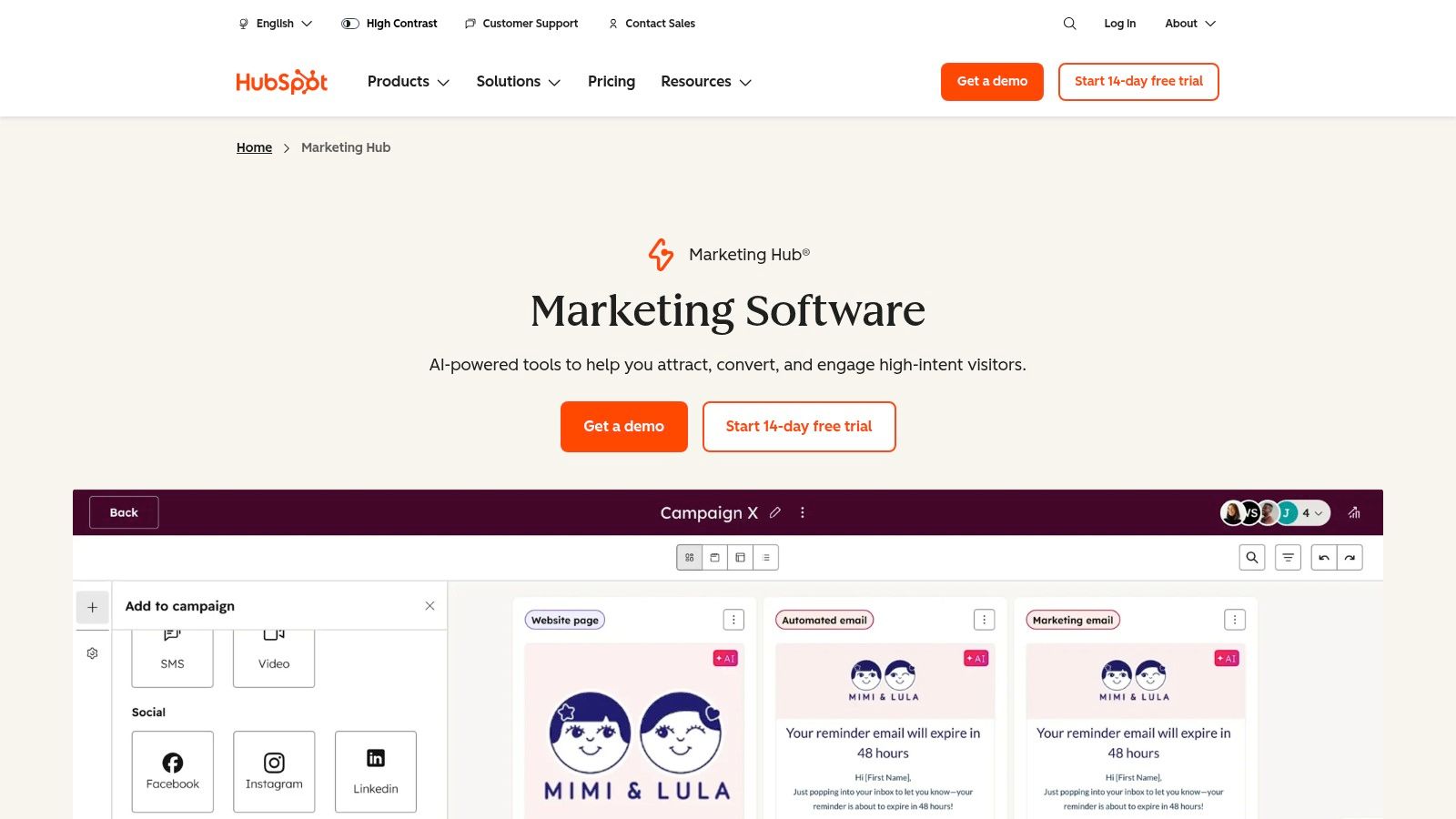
The real power comes from connecting ad spend directly to CRM data, something many point solutions struggle with. With Breeze AI, you can automate content creation, social media management, and even customer prospecting tasks directly within the platform. This makes HubSpot one of the best AI tools for digital marketing for teams who value closed-loop reporting and a unified workflow over stitching together a dozen different apps.
How to use HubSpot Marketing Hub effectively
Don't get paralyzed by the sheer number of features. Start with the core marketing automation and CRM functionalities to get your data flowing correctly. Once your lead lifecycle is mapped out, introduce Breeze AI Agents to streamline content creation for your blog or social channels. A key tip is to leverage its native ad integrations to track campaigns back to actual revenue, not just vanity metrics. For those using external tools for landing pages, you can also explore options for a deeper HubSpot integration to ensure seamless data flow.
Website: https://www.hubspot.com/products/marketing
11. Unbounce
When you're running paid search campaigns, your ad is only half the battle; the landing page is where the conversion actually happens. Unbounce has been a dominant force in the landing page space for years, and for good reason. It lets you rapidly build and deploy campaign-specific pages without ever touching a line of code, making it an indispensable tool for PPC managers who need to move fast.
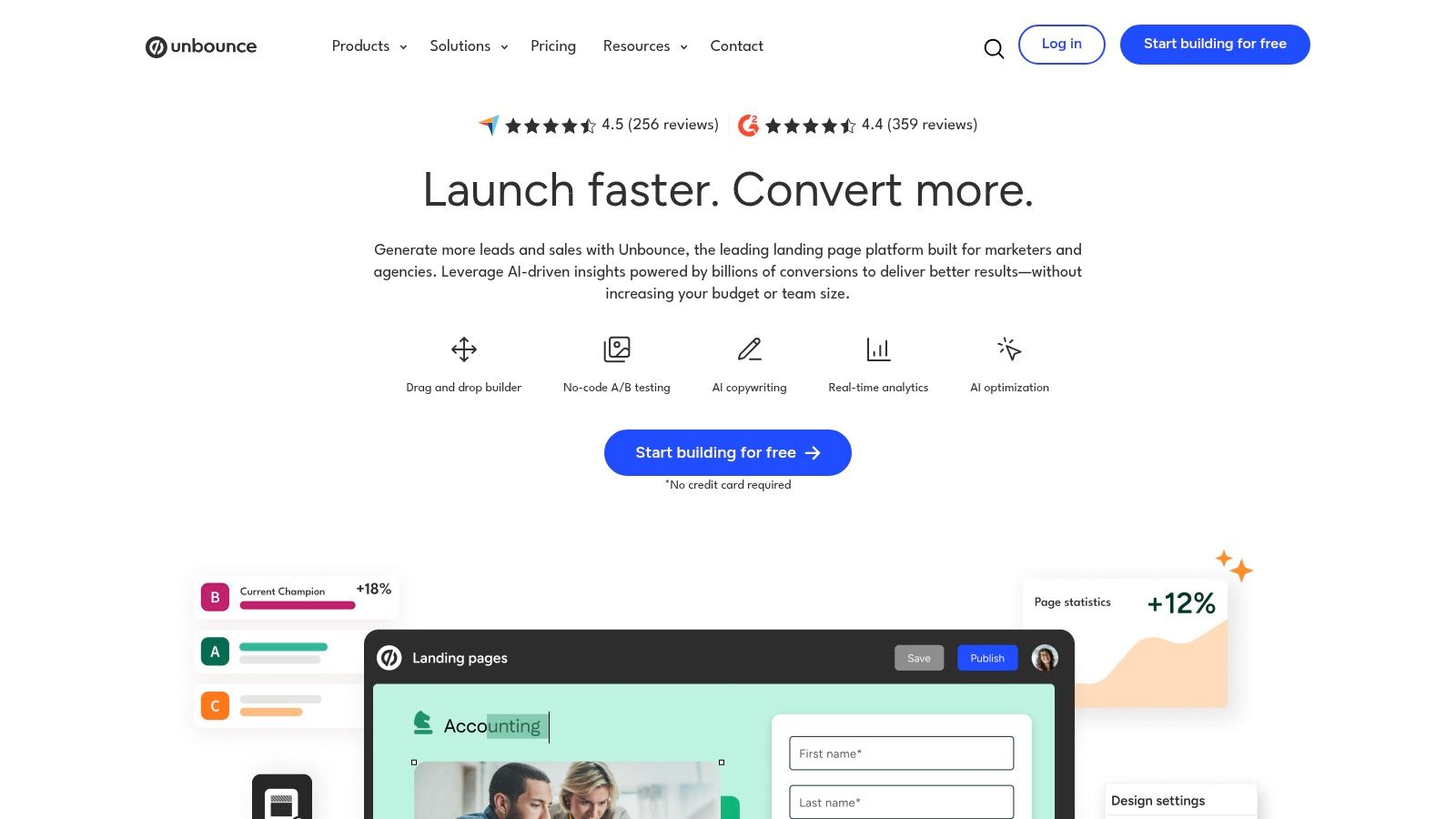
What makes Unbounce one of the best AI tools for digital marketing now is its integration of AI features. Smart Copy helps you instantly generate headlines, ad copy, and body text, beating writer's block. Its most powerful feature, Smart Traffic, is an AI-powered optimization tool that automatically sends visitors to the landing page variant where they are most likely to convert. This moves beyond simple A/B testing and into dynamic, real-time optimization. It’s a game-changer for maximizing ROAS from your paid spend.
How to use Unbounce effectively
Don't just build one page and let it run. The real power of Unbounce comes from continuous iteration. Start with Smart Copy to generate a few headline and call-to-action variants, then launch your page with Smart Traffic enabled. Let the AI do the heavy lifting of figuring out which combinations work best for different audience segments. Make sure you connect your analytics and CRM through its vast library of integrations to close the loop on lead quality. For a deeper dive, learn more about landing page optimization best practices on dynares.ai. The thing to watch is the plan limits on traffic and conversions, which require careful monitoring to avoid overage charges.
Website: https://unbounce.com/
12. OpenAI ChatGPT (Plus, Pro, Business, Enterprise)
Let's be direct: if you're in marketing and not using ChatGPT in some capacity, you're willingly putting yourself at a disadvantage. It’s the foundational, general-purpose AI assistant that has become the Swiss Army knife for everything from brainstorming ad copy variants to debugging tracking scripts. While not a specialized marketing tool out of the box, its versatility is precisely what makes it one of the best AI tools for digital marketing; it’s a blank canvas for nearly any task you can imagine.
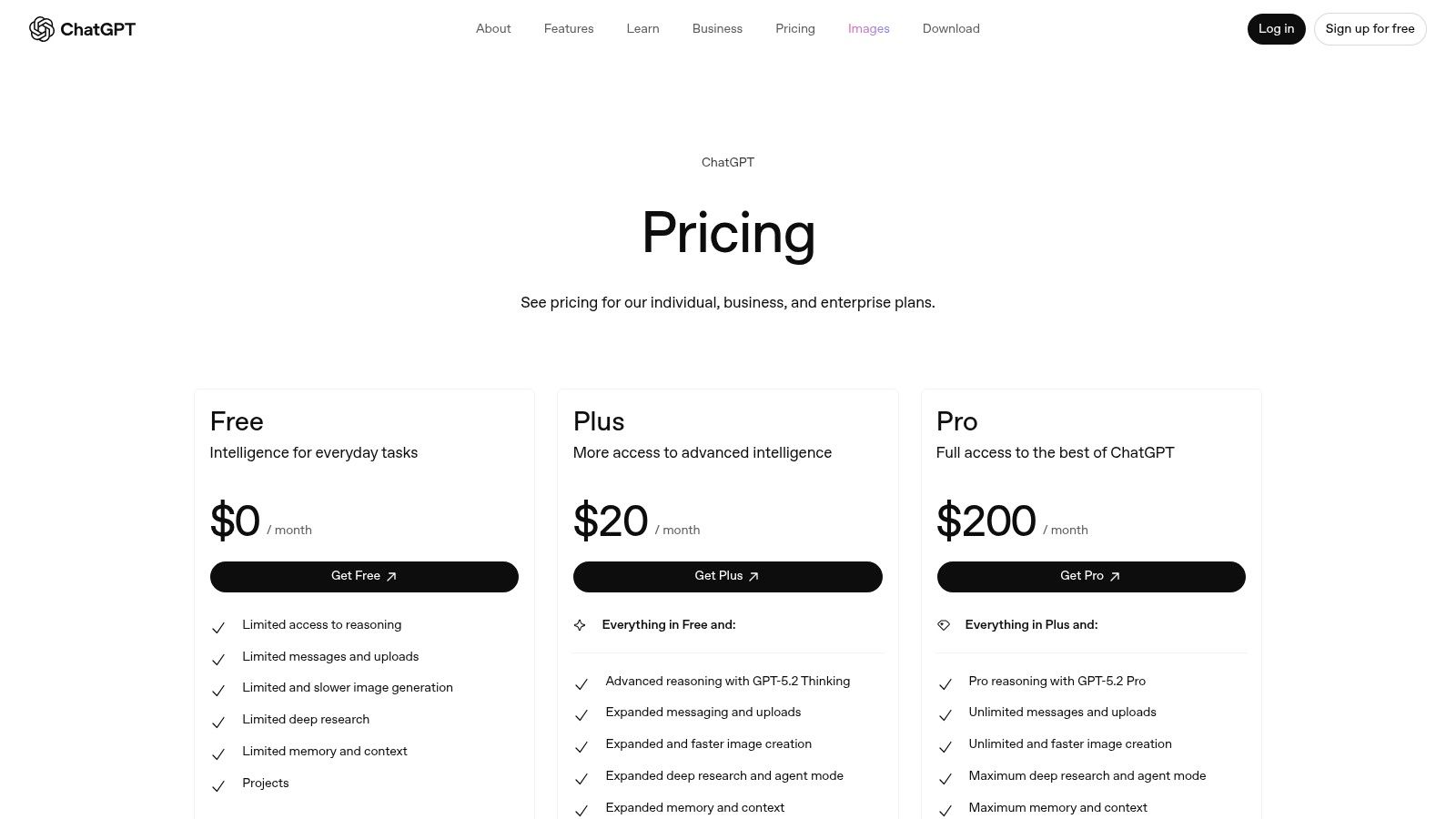
The real power for agencies and teams unlocks with the premium tiers. The Plus and Pro plans grant access to more powerful models and features like custom GPTs, which let you build specialized assistants trained on your own data or processes. For those looking to integrate OpenAI's capabilities into their operations, understanding the specific advantages of ChatGPT for Business is crucial, as it adds the necessary security, admin controls, and workspace collaboration that agencies need to operate safely and efficiently.
How to use ChatGPT effectively
Success with ChatGPT hinges entirely on your ability to give it clear instructions and context. Don't just ask it to write an ad. Instead, feed it your target audience persona, brand voice guidelines, the specific landing page URL, and examples of past winning ad copy. For teams, creating a library of standardized prompts is essential for maintaining brand consistency across all outputs. Use the custom GPT feature to build internal tools for specific workflows, like a PPC Keyword Expander or a Landing Page Headline Generator trained on your top-performing assets.
Website: https://openai.com/chatgpt/pricing/
Top 12 AI marketing tools comparison
| Product | Core features & USP (✨) |
Quality & performance (★) |
Target audience (👥) |
Price & value (💰) |
|---|---|---|---|---|
| dynares 🏆 | AI-generated keyword-specific ads, landing pages & forms; Auto A/B Testing; conversion-value uploads to Google Ads; integrations (GAds, GTM, HubSpot) ✨ | — Revenue-focused lift (↑CTR, ↑CVR, ↑ROAS) | 👥 PPC managers, agencies, lean growth teams | 💰 Transparent tiers: Free → Starter ~$29/mo → Pro ~$243/mo → Business ~$765/mo |
| G2 | Marketplace with vetted user reviews, side-by-side comparisons, category rankings ✨ | — High review volume, trusted signals | 👥 Buyers researching vendors, procurement teams | 💰 Free to use; vendor sponsorships present |
| Capterra | Curated directory + buyer guides, pricing snapshots, category filters ✨ | — Broad coverage, easy shortlist | 👥 SMBs & buyers comparing marketing tools | 💰 Free; quick pricing snapshots |
| Product Hunt | Daily launches, early-adopter feedback, community comments ✨ | — Great for discovery, variable maturity | 👥 Founders, early adopters, product scouts | 💰 Free discovery; links to product sites |
| AppSumo | Deals marketplace for lifetime/discounted SaaS offers ✨ | — High value for deals, risk on longevity | 👥 Solopreneurs, budget-conscious agencies | 💰 Discounted/lifetime deals; 60-day refunds (variable) |
| Google Ads Performance Max | Cross-channel AI campaign type, asset generation, single-campaign access to Google inventory ✨ | — Strong reach & automation; limited transparency | 👥 Advertisers using full Google inventory | 💰 Cost = ad spend; no platform fee (ad budget required) |
| Semrush | All-in-one visibility suite: SEO, PPC, competitive intelligence, AI toolkits ✨ | — Robust data & tooling | 👥 In-house marketing teams, agencies | 💰 Paid plans (Pro→Guru→Business); add-ons increase cost |
| Jasper | AI content platform with Brand Voices, Agents & governance ✨ | — Strong on-brand content workflows | 👥 Marketing teams needing governed content | 💰 Paid tiers; Business features on higher plans |
| Copy.ai | AI writing + Agents for workflows; multiple model access ✨ | — Good entry pricing, unlimited chat on entry plan | 👥 Small teams, copywriters, PPC writers | 💰 Competitive entry price; tiered features/credits |
| HubSpot Marketing Hub | Full-stack marketing automation + CRM, Breeze AI Agents, closed-loop reporting ✨ | — Integrated data & attribution | 👥 SMBs scaling to enterprise | 💰 Free → Starter → Pro → Enterprise; onboarding/seat costs |
| Unbounce | Landing page & form builder, Smart Traffic, AI copy tools & A/B testing ✨ | — Fast deployment & testing | 👥 PMMs, performance marketers, agencies | 💰 Paid plans with traffic/feature limits; free trial |
| OpenAI ChatGPT | General-purpose assistant & customizable GPTs; models, vision, teams & security ✨ | — Fast ideation & copy; requires process to scale | 👥 Creators, agencies, analysts | 💰 Plus/Pro/Business/Enterprise tiers; pay per plan |
Stop chasing tools, start building systems
We’ve just walked through a dozen platforms, from all-in-one giants like HubSpot to specialized content machines like Jasper and, of course, the lead-generation powerhouse that is dynares. The sheer volume of options can be overwhelming, and it's easy to get caught in a cycle of shiny object syndrome, constantly trying the latest thing that pops up on Product Hunt. Let's be candid: that's a recipe for distraction, not growth. The market is saturated, and frankly, many of these tools are just thin wrappers around the same core AI models.
The real game isn't about collecting the most subscriptions. It's about building an integrated, automated system that acts as an extension of your team. The goal is to eliminate manual, repetitive work so you can focus on strategy, client relationships, and the creative thinking that no AI can replicate. Think of it less like finding a single best AI tool for digital marketing and more like assembling a high-performance engine where each component has a specific, critical function. Your tech stack should make your entire operation more efficient, not just add another login to your password manager.
How to choose your AI marketing stack
So, how do you move from chasing tools to building a system? It comes down to asking the right questions before you click buy. Don't start with the tool; start with the problem.
- What is the single biggest bottleneck in your workflow? Is it writing endless ad copy variations? Building and testing landing pages for every single ad group? Analyzing performance data to find actionable insights? Pinpoint the most painful, time-consuming task and find the tool that solves that specific problem best.
- Does it integrate with your core platforms? A brilliant standalone tool that doesn't talk to Google Ads, your CRM, or your analytics suite is a dead end. Look for native integrations or robust API access. A tool that creates data silos is more trouble than it's worth.
- Can it scale with your business? What works for a solo freelancer managing three accounts will break for an agency managing thirty. Consider the pricing models, the capacity for multi-client management, and whether the tool is built for the scale you're aiming for, not just the scale you have today. For instance, manually building landing pages with Unbounce is fine for a few campaigns, but for a Google Ads agency running hundreds, you need an automated system like dynares that connects the ad directly to a dynamically generated page.
Your next move: From reading to doing
The true value of this list isn't just knowing the names of the tools; it's understanding the strategic shift they represent. AI isn't here to replace skilled marketers. It's here to augment them, giving you the leverage to achieve results that were previously impossible or prohibitively expensive. We've covered tools for everything from SEO analysis with Semrush to AI-powered CRM features in HubSpot. Each one solves a piece of the puzzle.
Your job now is to identify the biggest missing piece in your own marketing puzzle. Is it content velocity? Look at Jasper or Copy.ai. Is it turning raw data into strategy? Dive deeper into your analytics tools. Is it scaling lead generation on Google Ads without drowning in manual tasks? That’s where a purpose-built platform shines.
The era of manual, brute-force marketing is over. The future belongs to those who can effectively architect and manage intelligent, automated systems. Don't just adopt technology. Weaponize it. Now, stop reading and go build something remarkable.
Ready to stop manually building landing pages and finally scale your Google Ads lead generation? See how dynares automates the entire ad-to-landing-page workflow, so you can focus on strategy, not tedious production work. Explore dynares and book a demo today.


