
Finding the right a/b testing software feels like a full-time job. You spend hours sifting through marketing fluff, trying to figure out which platform actually works for your specific needs, especially for optimising PPC campaigns and landing pages. Most reviews are either thinly veiled sales pitches or so generic they’re useless. It’s a mess, and it wastes time that should be spent running experiments and growing your business.
This article is the antidote to that chaos. As a European entrepreneur who's been building and scaling tech products for years, I’ve seen firsthand how the right tools can make or break a growth strategy. This isn’t another surface-level list. I’m giving you a direct, no-nonsense breakdown of the best a/b testing software available today, from enterprise giants to smart, focused tools like our own dynares.
Forget the generic feature lists; we’re talking about what actually matters. What can it really do? How well does it play with Google Ads? Is it built for a scrappy startup, an agency, or a massive enterprise? I’ll give you a clear view of the landscape so you can make a decision and get back to work. Let’s cut through the noise and find the tool that will actually help you make more money.
1. dynares
Let’s be direct. For anyone serious about squeezing every drop of performance out of Google Ads, most A/B testing tools are a clunky, manual afterthought. You’re either stuck with basic tests inside the Google Ads UI or you’re duct-taping a landing page tool to your campaigns, creating a disconnected workflow. It's dumb. This is where dynares comes in, and frankly, it's a completely different approach built for a specific, high-value problem.
Instead of sending traffic from dozens of keywords to one or two generic landing pages, dynares automatically creates a unique, coordinated ad and landing page for each keyword. This focus on message matching is fundamental to lifting Quality Scores and conversion rates. Its Auto A/B Testing engine then continuously runs experiments on these pages, keeping winning variations live and reallocating budget to what works. This isn't just a/b testing software; it's an automated optimisation system.
Key strengths and use case
The real differentiator is how it closes the loop. Dynares doesn’t just track leads; it uploads conversion values back into Google Ads. This is huge. It means your smart bidding strategies can optimise for actual revenue, not just cheap leads that don't convert. This shifts your entire paid search operation from a cost centre to a documented revenue driver.
This platform is not for casual users running a few social ads. It’s built for performance marketers, agencies, and businesses who live and die by their Google Ads ROAS. If your day involves spreadsheets, manual page builds, and trying to connect disparate analytics, dynares aims to make that entire process obsolete.
- Pros: End-to-end automation from keyword to revenue tracking, automatic creation of hyper-relevant landing pages, and deep integration with Google Ads for value-based bidding. It's built for scale.
- Cons: It’s unapologetically Google Ads-centric. If you need a tool for Facebook or LinkedIn ads, you'll need something else. Also, while the AI generates content fast, you still need a human to set brand guidelines and do a final quality check.
Pricing and access
Pricing is transparent and scales with usage. There’s a free tier to get started, with paid plans like Starter (around €29/mo) for freelancers, Pro (around €243/mo) for growing businesses, and Business (around €765/mo) for agencies and larger teams, with discounts for annual billing. Custom plans and dedicated onboarding are available for enterprise needs.
For a deeper dive into the mechanics of effective A/B testing, the dynares team has put together a useful guide on their blog about software for A/B testing.
Website: https://dynares.ai
2. Optimizely Web Experimentation
Optimizely is one of the original gangsters of A/B testing, and it shows. This platform is a serious, enterprise-grade tool for companies with mature experimentation programs. If your team is running dozens of tests across web, mobile, and even backend services, Optimizely provides the governance and statistical rigour you need.
It’s built for scale, which is both its biggest strength and its main drawback. You get a powerful visual editor and SDKs for server-side experiments, but the real star is its Stats Engine. It uses sequential testing, which means you can trust your results and even call winners faster without waiting for fixed sample sizes. This is a massive advantage over more basic a/b testing software. For a deeper dive into the statistical side of things, our guide on multivariate versus A/B testing is a good starting point.
Key considerations and use cases
- Ideal User: Large enterprises or mid-market companies with dedicated CRO teams and a high volume of traffic. It’s also a solid choice for agencies managing complex experimentation programs for major clients.
- Pricing: Custom and enterprise-focused. Expect a significant investment; it's not for small teams just dipping their toes in.
- Unique Strength: The platform’s maturity shines through in its collaboration workflows and robust analytics. It’s designed to prevent teams from stepping on each other’s toes, which is a real problem in large organisations.
3. VWO testing (VWO platform)
VWO positions itself as an all-in-one experimentation platform, and for many marketers, that's exactly what it is. It's a popular choice for teams moving on from Google Optimize, mainly because it bundles a solid A/B testing engine with built-in behavioural analytics like heatmaps and session recordings. This means you don't just see what variation won; you get clues as to why it won, all within one interface.
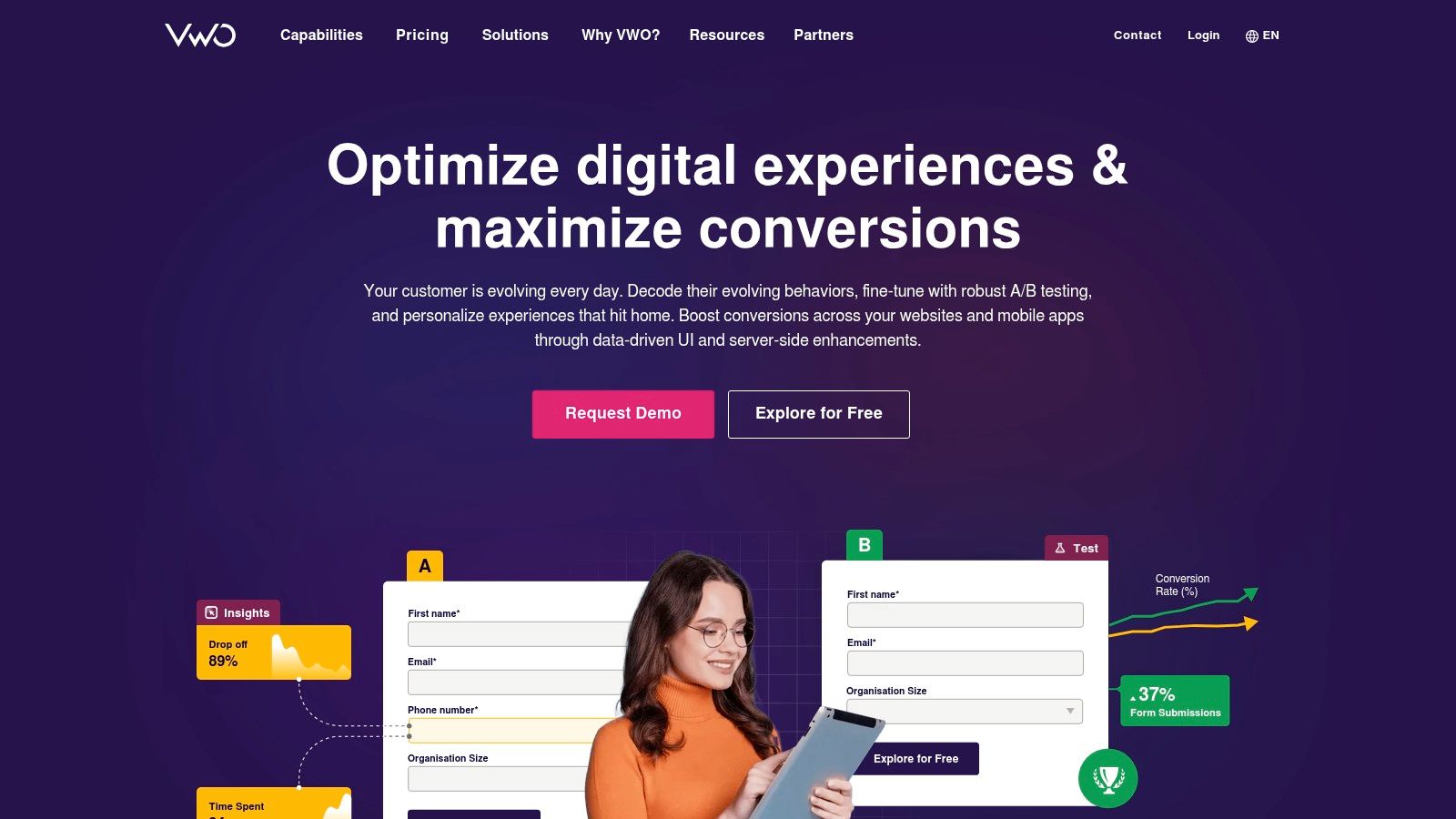
The platform is built for marketers and conversion rate optimisation specialists who need a suite of tools without the enterprise-level complexity of something like Optimizely. You get a good visual editor for building tests quickly, along with split URL, multivariate, and server-side testing capabilities. For teams focused on CRO, having these tools in one place is a major workflow improvement. If you're building out your CRO program, exploring different types of conversion rate optimisation software can give you a better sense of the full landscape.
Key considerations and use cases
- Ideal User: SMB and mid-market marketing teams, CRO specialists, and agencies who need a complete optimisation toolkit without a massive IT overhead. It’s perfect for those who value integrated analytics to guide their testing strategy.
- Pricing: Transparent plans based on traffic, which is a breath of fresh air. However, be aware that advanced features are locked into higher tiers, and costs can escalate as your traffic grows.
- Unique Strength: The integrated suite of CRO tools is its biggest advantage. Having A/B testing, heatmaps, and session recordings in one platform creates a tight feedback loop between identifying a problem and testing a solution.
4. Adobe Target
If your organisation is already deeply invested in the Adobe Experience Cloud, then Adobe Target is less of a choice and more of a natural extension. This is a serious, enterprise-level experimentation engine designed to work seamlessly with Adobe Analytics and Audience Manager. It’s built for large corporations that need to connect their a/b testing software directly into a broader marketing and data ecosystem.
The power here comes from its native integrations. You can build audiences in Adobe Analytics and push them directly into Target for experimentation, creating a closed-loop system for analysis and action. It offers both rules-based and AI-powered personalisation, including an Auto-Allocate feature that dynamically shifts traffic to the winning variation in real-time. This can maximise conversions during a test. Remember to consider how your testing impacts organic traffic; our guide to A/B testing and SEO explains the key principles to follow.
Key considerations and use cases
- Ideal User: Large enterprises standardised on the Adobe Experience Cloud. It’s for marketing departments that need deep data integration and robust security.
- Pricing: Custom enterprise licensing. Getting a quote requires talking to their sales team, and you should budget for implementation and training, as it's not a plug-and-play solution.
- Unique Strength: The tight integration with Adobe Analytics is its killer feature. The ability to use rich, first-party behavioural data from Analytics to define test audiences is something standalone tools struggle to replicate.
5. AB Tasty (one platform)
AB Tasty hits a sweet spot that few other platforms manage. It brings client-side web experimentation for marketers and server-side feature experimentation for developers together under one roof, and it actually works. You get one interface to manage everything from simple button colour tests to complex, phased feature rollouts. This is a big deal for teams that are tired of using separate tools for marketing and product experiments.
The platform feels built for collaboration. The UI is clean enough for a PPC manager to jump in and set up a landing page test without pulling a developer away from their work. At the same time, it provides the SDKs and technical depth needed for proper feature flagging and server-side tests. It’s this unified approach that makes it a strong contender for companies wanting a single source of truth for all their experimentation efforts.
Key considerations and use cases
- Ideal User: Mid-market to enterprise companies that need a single solution for both marketing (CRO) and product (feature flags) teams. It's especially useful for organisations trying to break down silos between those departments.
- Pricing: Custom quote-based. The cost scales with your traffic and the specific modules you need, so expect an enterprise-level investment. It's not really built for small businesses just starting out.
- Unique Strength: The unified platform is its biggest differentiator. Having web and feature experiments in the same UI eliminates the data-stitching headaches that come with using separate, specialised tools for a/b testing software.
6. Convert Experiences
Convert Experiences is the a/b testing software for teams that are serious about performance, privacy, and getting enterprise features without the enterprise price tag. It’s a favourite among savvy CRO agencies and in-house teams who want raw power and control without being locked into a massive, all-in-one marketing cloud. The platform is famously flicker-free, thanks to its smart script loading, meaning your users won't see that annoying flash before a test variant loads.
What really sets Convert apart is its philosophy. They offer a huge number of advanced features, like multipage experiments and deep targeting, even in their lower-priced tiers. You get both Bayesian and Frequentist statistical models, so your stats nerds can get the data they need. It’s an incredibly practical approach that respects the user's intelligence and budget. This focus makes it a standout piece of a/b testing software for teams that know what they're doing.
Key considerations and use cases
- Ideal User: CRO agencies, e-commerce stores, and mid-market companies that need robust testing capabilities without the complexity and cost of an enterprise suite. It's perfect for teams that value speed and data privacy.
- Pricing: Transparent, public pricing with a 15-day free trial. Plans are based on tested traffic volume, making it accessible and predictable. You get almost all features across all plans, which is a massive plus.
- Unique Strength: The combination of flicker-free performance and a privacy-first stance is its killer feature. They don't use your data for anything else, period. For European companies or anyone concerned with GDPR, this is not a small detail; it’s a core reason to choose them.
7. Kameleoon
Kameleoon is an interesting hybrid player trying to bridge the gap between marketing-led and developer-led experimentation. It offers a unified platform for both client-side A/B tests and server-side feature flagging, which means your marketing team can tweak a landing page while your product team rolls out a new feature, all within the same ecosystem. This approach helps unify data and avoid the classic silo problem.
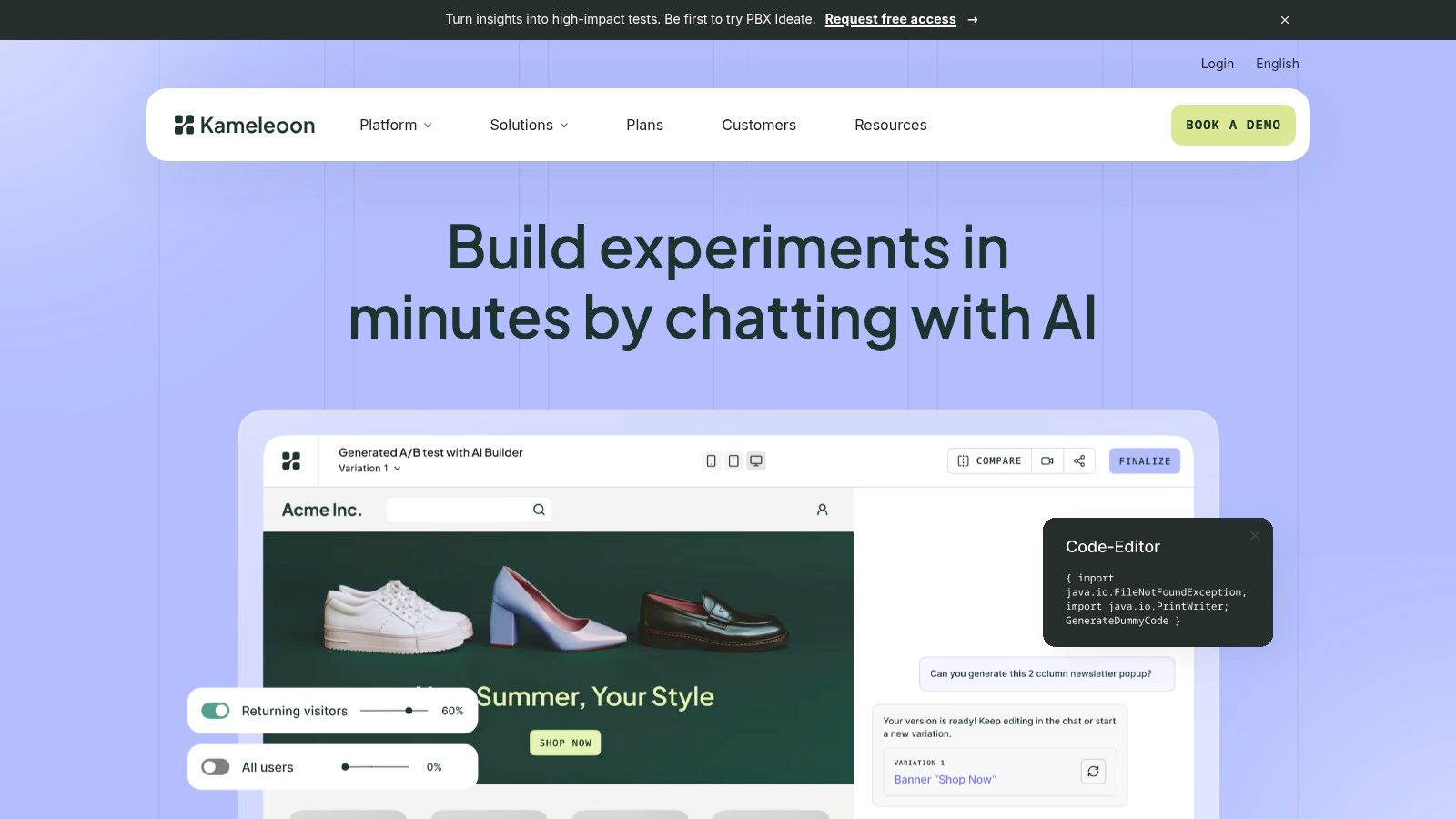
What really caught my eye is their Prompt-Based Experimentation (PBX) flow. You can literally describe the changes you want to test in plain English, and it helps spin up the experiment. It’s a smart way to lower the technical barrier and speed up the process for non-technical users. It’s not perfect, but it's a step in the right direction for making powerful a/b testing software more accessible.
Key considerations and use cases
- Ideal User: Mid-market to enterprise companies that need a single tool for both marketing (CRO) and product (feature management) teams. It’s a good fit if you want to consolidate your tech stack.
- Pricing: Custom, enterprise-focused. You’ll need to talk to their sales team for a quote. The PBX feature runs on a credit system, which is something to keep an eye on so you don’t burn through your allocation too quickly.
- Unique Strength: The unified platform is the main draw. Having web experimentation and feature flagging under one roof simplifies workflows and stops the all-too-common scenario where a marketing test accidentally breaks a new feature.
8. LaunchDarkly (with Experimentation add‑on)
LaunchDarkly is, first and foremost, a feature management platform. That’s its core business, and it’s brilliant at it. Think progressive delivery, targeted rollouts, and kill switches that give engineering teams precise control. Their approach to a/b testing software is an extension of this philosophy, offered as an add-on called Experimentation.
This isn't your typical marketing-focused tool for tweaking landing page headlines. It’s built for engineering-led product experiments conducted directly within your application. The entire system is built around SDKs and feature flags, meaning developers can wrap new features in a flag, roll them out to a small segment of users, and measure the impact with a formal experiment. It’s about testing fundamental product changes, not just cosmetic ones.
Key considerations and use cases
- Ideal User: Engineering and product teams who need to test the impact of new features within a web or mobile app. It's perfect for companies practicing CI/CD who want to de-risk deployments.
- Pricing: Custom. The base platform has its own price, and the Experimentation module is an add-on. This makes it a more significant investment, so you need to be committed to this workflow to justify the cost.
- Unique Strength: Its governance and risk-mitigation capabilities are top-tier. The ability to instantly kill a failing experiment or feature with a single click is a massive safety net for larger organisations.
9. Statsig
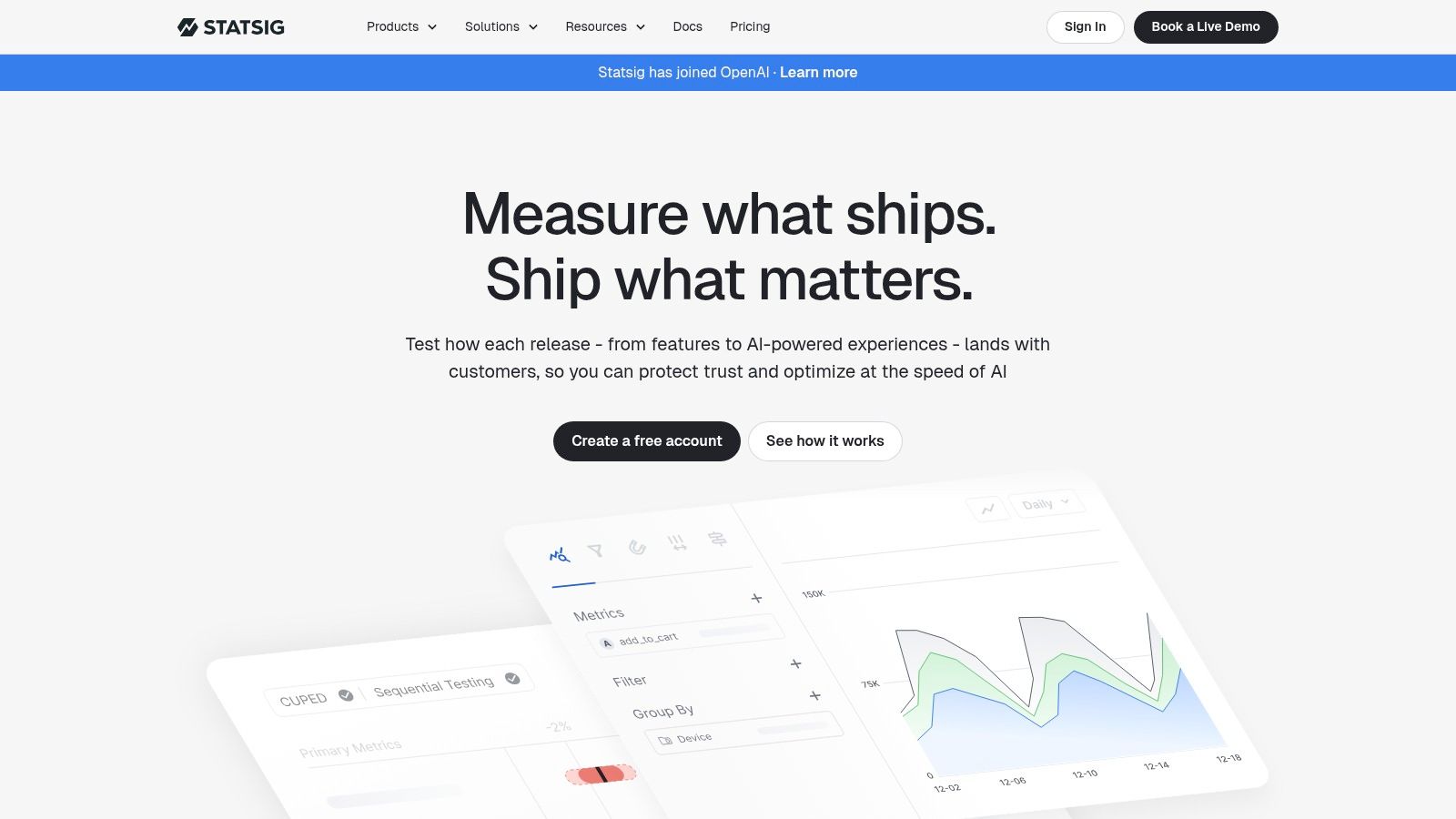
Statsig is a fresh face in the a/b testing software scene, but it comes with serious engineering credibility, having been founded by ex-Meta engineers. It’s a modern experimentation and product analytics platform built for speed and scale. What sets it apart is its developer-first approach combined with clear, usage-based pricing and a generous free tier that makes it accessible for startups.
It isn't just for running simple A/B tests; it’s a full-featured platform that includes feature flags, dynamic configs, and product analytics. This integration means you can ship features behind flags, gradually roll them out, and measure their impact all within one system. The platform also employs advanced statistical methods to reduce variance and get you reliable results faster, which is a big deal for teams with lower traffic volumes.
Key considerations and use cases
- Ideal User: Tech-forward companies, from startups to enterprises, that want to embed experimentation into their development lifecycle. It’s perfect for teams with engineering resources who value feature flagging as much as A/B testing.
- Pricing: Transparent and usage-based, with a very generous free tier. This is a massive plus for smaller teams, as it removes the high entry barrier common with other powerful tools.
- Unique Strength: The combination of powerful feature flagging with robust A/B testing capabilities is its killer feature. This lets you de-risk launches and run experiments on backend logic, not just frontend visuals.
10. GrowthBook
GrowthBook is the dark horse in this race, especially for engineering-led teams who hate vendor lock-in and opaque pricing. It’s an open-source experimentation and feature-flagging platform, which immediately sets it apart. You can use their fully managed cloud version or self-host it on your own infrastructure. This flexibility is a game-changer if you have strict data governance requirements or just want total control.
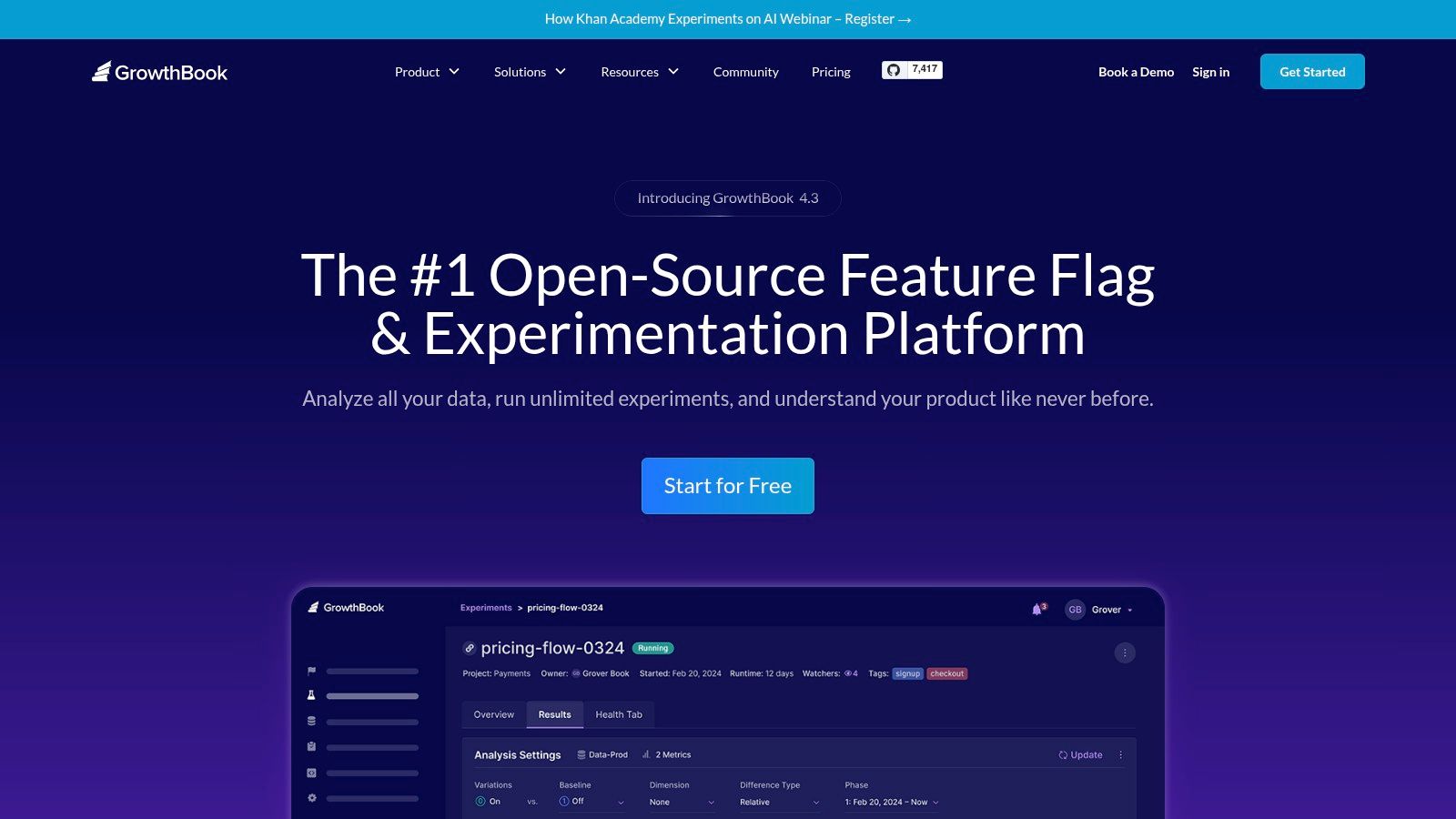
The platform pulls metrics directly from your data warehouse (like Snowflake or BigQuery). This is a massive win for data integrity, as you're using the same source of truth for your tests as you do for your business intelligence. For teams looking for a powerful, developer-friendly piece of a/b testing software without the enterprise price tag, GrowthBook is an excellent choice. Check it out at https://www.growthbook.io.
Key considerations and use cases
- Ideal User: Tech-savvy startups and scale-ups with strong engineering teams. It's perfect for companies that want to build their experimentation culture on an open-source foundation.
- Pricing: The self-hosted version is free and open-source. Cloud plans are tiered, starting with a generous free plan, followed by Pro and Enterprise tiers. It’s much more predictable than metric-based pricing.
- Unique Strength: Its open-source, warehouse-native approach is the core differentiator. This gives you unparalleled flexibility, avoids data silos, and lets your engineers own the full experimentation pipeline without being locked into a proprietary ecosystem.
11. Unbounce
Unbounce isn't a traditional, all-purpose a/b testing software; it's a laser-focused landing page builder designed for marketers who need speed. Its primary purpose is to help you create, publish, and test landing pages for your PPC campaigns without ever needing to ask a developer for help. The entire workflow is built around rapid iteration, which is exactly what you need when managing paid ad spend.
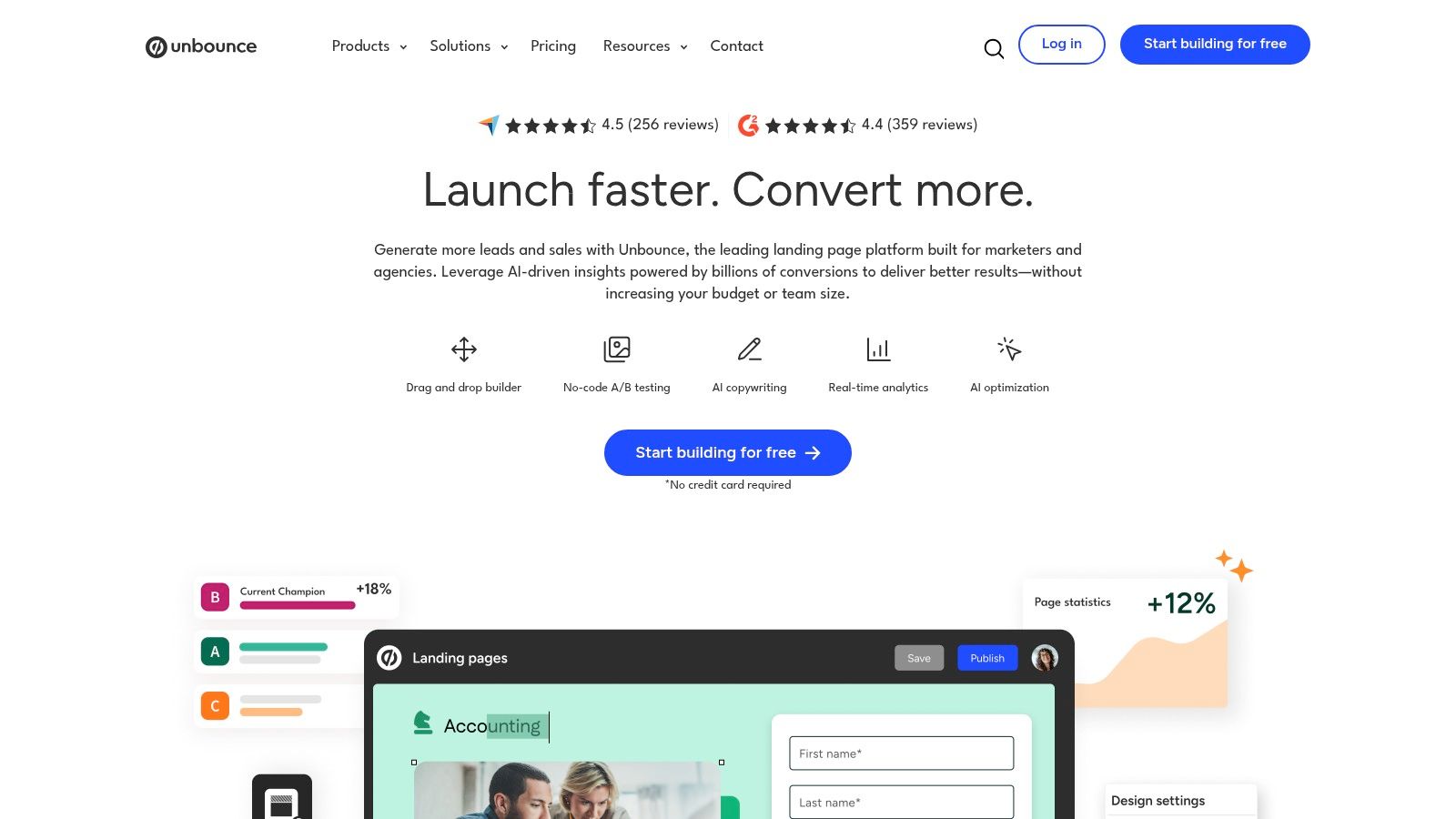
The platform’s real magic lies in its simplicity. You get a no-code drag-and-drop builder, tons of templates, and built-in A/B testing. But its Smart Traffic feature is the interesting part; it's an AI-driven system that starts sending more traffic to the better-performing variant automatically. This moves beyond a classic 50/50 split and starts optimising for conversions from day one, which is a massive win for performance marketers.
Key considerations and use cases
- Ideal User: PPC managers, marketing agencies, and SMBs who live and die by their landing page conversion rates. If you’re spending money on Google or Facebook Ads, Unbounce is purpose-built for you.
- Pricing: Tiered monthly plans, with a 14-day free trial. The core A/B testing is available on most plans, but advanced features like Smart Traffic are reserved for higher tiers.
- Unique Strength: The sheer speed from idea to live test is its biggest asset. A marketer can design a new landing page variant, set up a split test, and have it live in under an hour. This tight feedback loop is where Unbounce outshines more complex tools.
12. PostHog Experiments
PostHog is an interesting beast because it's not just a/b testing software. It's an entire open-source product analytics suite built for engineers, with experimentation as a core feature. This all-in-one approach is its main draw. Instead of duct-taping an analytics tool to a separate testing platform, you get session replay, funnels, analytics, feature flags, and experiments from a single SDK.
This developer-first mentality means experiments are typically implemented in code, not with a visual editor. While that might scare off some marketers, it offers immense power and reliability. You’re testing the actual code path, not just slapping a visual layer on top, which is far more robust. The transparent, usage-based pricing with a massive free tier is also a breath of fresh air; you can get started without talking to a salesperson.
Key considerations and use cases
- Ideal User: Tech-forward startups and scale-ups with in-house engineering resources. It's perfect for product teams who want a single source of truth for user behaviour and experimentation data.
- Pricing: Usage-based with a generous free tier for most products. You pay for what you use beyond the free limits, which makes it accessible but means costs can grow if your event volume explodes.
- Unique Strength: The unified platform is the killer feature. Linking a failed experiment directly to session replays of users in that variant, then digging into their entire user journey within the same tool, is incredibly powerful.
12 A/B testing tools comparison
| Product | Core features | Quality (★) / UX | Value / Price (💰) | Target audience (👥) | Unique selling points (✨) |
|---|---|---|---|---|---|
| 🏆 dynares | AI-driven keyword-level ads & landing pages; Auto A/B; conversion-value uploads; templates & forms | 💰 Free → Starter €29/mo → Pro €243/mo → Business €765/mo (clear tiers) | 👥 PPC managers, agencies, lean growth teams | ✨ Revenue-aware bidding, scalable keyword-specific funnels, fast launch at scale | |
| Optimizely Web Experimentation | Client & server-side A/B/n, MVT, advanced targeting, stats engine | 💰 Enterprise/custom pricing (higher) | 👥 Large enterprises & mature experimentation programs | ✨ Robust statistics, personalization, strong governance | |
| VWO Testing (VWO Platform) | WYSIWYG editor, A/B/split/MVT, heatmaps, session recordings, personalization | 💰 Transparent plans; advanced caps on higher tiers | 👥 Marketers & CRO teams | ✨ All-in-one CRO toolkit with behavior analytics | |
| Adobe Target | A/B & MVT, auto-allocate, rules & AI targeting, deep Adobe integrations | 💰 Custom enterprise pricing | 👥 Adobe Experience Cloud customers, enterprises | ✨ Deep integration with Adobe stack, enterprise-grade security | |
| AB Tasty (One Platform) | A/B, multivariate, personalization, feature experimentation & ROI dashboards | 💰 Custom pricing; scales with traffic | 👥 Marketers + product/feature teams | ✨ Single UI for web & feature experimentation | |
| Convert Experiences | A/B/n, split URL, MVT, advanced targeting, CDN performance focus | 💰 Public pricing + free trial; competitive tiers | 👥 CRO agencies, privacy-conscious teams | ✨ Privacy-minded, flicker-free rendering, strong targeting | |
| Kameleoon | Web & feature experimentation, Prompt-Based Experimentation (PBX), sequential testing | 💰 Pricing private; PBX uses credit model | 👥 Hybrid marketer + developer teams | ✨ PBX to accelerate non-technical test creation | |
| LaunchDarkly (with Experimentation) | Feature flags, targeted rollouts, SDKs, experimentation add-on | 💰 Core platform + experiment add-on (can increase cost) | 👥 Engineering-led product teams | ✨ Best-in-class feature flagging & safe rollouts | |
| Statsig | A/B/n, feature flags, CUPED & sequential methods, warehouse-native analytics | 💰 Usage-based pricing; generous free tier | 👥 Data-mature product teams & startups | ✨ Strong statistical methods and scalable experimentation | |
| GrowthBook | Open-source experiments & flags, visual editor, self-host/cloud, warehouse metrics | 💰 Predictable costs; self-host option reduces vendor spend | 👥 Teams wanting open-source control & self-hosting | ✨ OSS flexibility + warehouse-native metrics | |
| Unbounce | No-code landing page builder, native A/B testing, AI Smart Traffic, templates | 💰 Tiered plans; 14-day free trial | 👥 PPC & marketing teams needing fast LPs | ✨ Rapid no-code page creation with AI traffic optimization | |
| PostHog Experiments | Feature-flag experiments, product analytics, session replay, one SDK | 💰 Usage-based billing with large free quotas | 👥 Developer-centric product teams & analytics-driven teams | ✨ Unified analytics + experiments with self-host option |
Final thoughts
Alright, we’ve covered a lot of ground. From enterprise beasts like Optimizely to nimbler, developer-focused tools like Statsig, it’s clear the world of a/b testing software isn't a one-size-fits-all market. Thinking that a single platform is the best is a rookie mistake; the right tool is the one that fits your team's specific workflow, technical skills, and budget.
If you’re a PPC manager or a small agency, you're not going to pitch Adobe Target to your client. It’s overkill. Your reality is about moving fast, proving ROAS, and not getting bogged down in complex setups. This is where tools like Unbounce or Convert Experiences shine, offering a direct path from hypothesis to test without the enterprise-level drama.
On the other hand, if you're scaling a tech product with an engineering team, platforms like LaunchDarkly or GrowthBook become your playground. They integrate directly into your CI/CD pipeline and give developers the control they need. Trying to shoehorn a visual editor-first tool into a product-led growth motion is just asking for frustration. It's about using the right tool for the job.
Choosing your path forward
So, how do you actually decide? Stop chasing shiny objects and get real about your constraints and goals. Be honest about your team’s capabilities. Do you have a developer who can dedicate time to implementation? If not, cross off the developer-centric tools immediately. Your decision should boil down to who will own this, what your real budget is (including time!), and how much traffic you have.
The biggest mistake I see is teams buying powerful a/b testing software and then… doing nothing with it. They run one half-hearted test, don’t get a clear winner, and the expensive subscription gathers digital dust. This isn't a magic wand. It’s a precision instrument that requires a culture of experimentation to be effective. Start small, build a process, and get wins on the board.
Ultimately, the goal isn't just to run tests; it's to build a system that constantly learns and improves. The software is just the enabler. The real work is in the thinking, the discipline, and the courage to act on the data, even when it tells you your favourite idea was a dud. That's how you build something that lasts.
If you’re running paid campaigns on Google Ads, you know that manually creating and testing landing page variations is a huge time sink. We built dynares to solve this exact problem. It’s an AI platform that automatically generates and A/B tests landing page variants for your ad groups, finding the combinations that convert best without you lifting a finger. Check out dynares to see how you can automate your way to a higher ROAS.


