
Let's get straight to it, because a lot of founders get tangled up in the whole landing page vs. website debate. It’s not just semantics; getting this wrong is one of the fastest ways to burn through your marketing budget.
Think of your website as your digital HQ. It’s your home base, built for exploration, brand building, and telling your story. A landing page is your elite closer—a specialist you bring in for one reason and one reason only: to get a signature on a specific deal.
Sending high-intent ad traffic to a cluttered homepage is a rookie mistake. A really expensive one.
Your HQ vs. your top sales rep
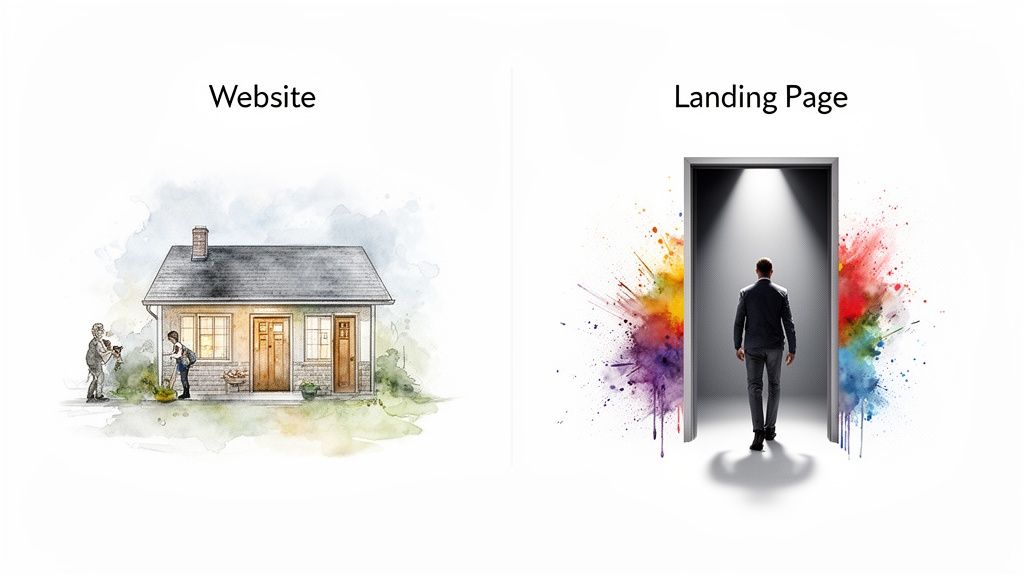
People use these terms interchangeably, and frankly, it kills their ROI. Understanding the difference is foundational to a profitable marketing strategy, especially when you're paying for every single click.
Let's stick with the HQ analogy. Your website has multiple rooms. There’s the "About Us" lobby, a "Products" showroom, and a "Contact Us" office. Visitors are meant to wander around, get a feel for your brand, and see everything you offer. It’s designed for discovery.
A landing page is the opposite. It’s a locked-down negotiation room. One entrance, one topic on the agenda, and one unmissable objective: get the conversion. Every single element on the page—from the headline to the button color—is there to support that one goal, ruthlessly eliminating any distraction that could derail the deal.
The core distinctions
So what are the real, non-negotiable differences? Before you spend a single euro on ads, you need to have this clear in your head.
- Objective: Your website’s goal is broad—to inform, engage, and build credibility. A landing page has one job, like capturing a lead or driving a sale from a specific campaign.
- Navigation: A website uses a big menu to help visitors explore. A landing page removes that navigation on purpose to keep the user focused on the prize. Every link is a potential escape route for a lead you paid for.
- Audience & Traffic: Websites serve everyone—organic search visitors, direct traffic, you name it. Landing pages are engineered for a specific, pre-qualified audience, usually arriving from a paid ad or email campaign.
This focused approach is why digging into landing page design best practices is a non-negotiable for anyone running paid campaigns. It’s a completely different discipline from web design.
To be blunt: sending targeted ad traffic to a generic homepage is like asking your best salesperson to close a deal in the middle of a loud, crowded party. It’s inefficient and disrespectful to the prospect's time.
Core differences between landing pages and websites
To make this crystal clear, here’s a quick-glance table breaking down the fundamental differences between these two essential digital assets.
AttributeLanding PageWebsitePrimary GoalSingle Action (Conversion)Exploration & InformationNavigationMinimal or NoneFull Navigation MenuNumber of PagesOneMultiple Interlinked PagesContent FocusHyper-specific to an offerBroad, covers the entire businessTypical TrafficPaid Ads, Email CampaignsOrganic Search, Direct, Referrals
The takeaway is simple. Websites build relationships and provide comprehensive information. Landing pages drive specific actions, making them the indispensable tool for maximizing the return on your paid advertising spend.
Comparing strategic design and conversion goals
This is where strategy separates the winning campaigns from the ones that just waste your budget. Let’s be real—most websites are built to serve the company’s ego, not the user’s immediate need.
Websites are engineered for discovery. They have complex navigation and multiple paths designed to make people wander around. The goal is broad engagement, which sounds nice but is poison for performance marketing.
A landing page, on the other hand, operates on a philosophy of ruthless minimalism. Its objective is surgically precise: drive one specific action. Every single element must serve that one conversion goal. Anything else is a distraction that actively kills your ROI.
The conversion chokehold of website navigation
A website's navigation menu is a landing page's worst enemy. Think about it. You just paid Google for a click from someone searching for a "B2B SaaS pricing consultant." You promise them an expert guide in your ad, and they click, full of intent.
If you dump them on your homepage, they’re immediately bombarded with links to your blog, your ‘About Us’ page, and your careers section. Each link is a potential exit, a distraction that pulls them away from the one thing you wanted them to do. It’s an insane way to run a paid campaign.
A landing page’s job is to create a frictionless, one-way street to conversion. Removing the main navigation isn't a design choice; it's a strategic necessity to honor the user's intent and protect your ad spend. They didn’t click to explore; they clicked for a solution.
Message match: the unbreakable rule
The most critical concept in the landing page vs. website debate for paid ads is message match. This is the non-negotiable alignment between the promise you make in your ad and the experience you deliver on the page.
When a user clicks an ad that says "Download Your Free E-commerce Growth Checklist," the landing page better have that exact headline, a visual of the checklist, and a clear path to download it. Anything less is a broken promise and a terrible first impression.
Building hundreds of perfectly message-matched pages manually is, of course, a nightmare. That’s where you have to think bigger about your tech stack. Using a dynamic landing page creator can automate this entire process, ensuring every ad click leads to a hyper-relevant experience without draining your team’s resources.
Ultimately, this isn't just about aesthetics. It's about respecting the user. They clicked your ad because you promised a specific solution. A website asks them to go find it themselves. A proper landing page delivers it on a silver platter. One approach builds a profitable business; the other just burns cash.
Why landing pages win the data and CRO battle
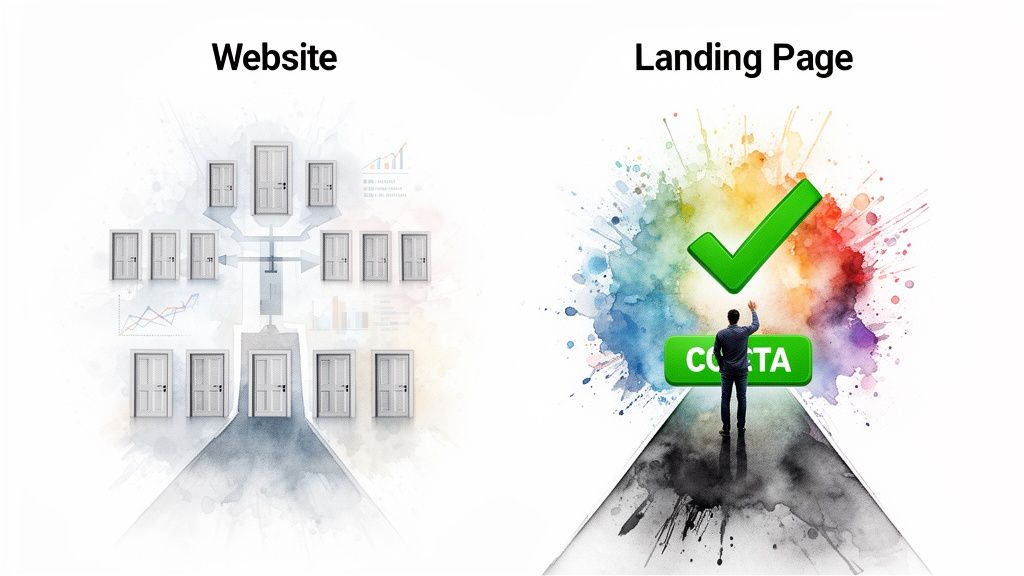
Let's get straight to what actually matters in performance marketing: the numbers. Cold, hard data is the only thing separating a real growth engine from an expensive hobby.
When you try to track conversions on a sprawling website, you drown in vanity metrics. Page views, time on site, bounce rate—they’re interesting, sure, but they don't tell you if you're making money. You’re left with a messy, ambiguous picture that makes optimization a total nightmare.
A landing page, on the other hand, is built for clean, unambiguous measurement. The visitor either converts, or they don’t. That’s it.
The power of binary clarity
This binary clarity—yes or no, convert or leave—is a superpower for conversion rate optimization (CRO). It gives you a clean signal, free from fuzzy interpretations or convoluted user journeys that are impossible to analyze.
Trying to A/B test your entire homepage is, frankly, a fool's errand. You might change a headline, but a visitor could get distracted by your blog and never even see the change. The data you get back is noisy and completely useless.
A landing page provides a controlled environment. It’s a lab for your marketing experiments. You can test one variable at a time, measure a single outcome, and get a clear winner. This rigorous, scientific approach is impossible on a cluttered website. A landing page isolates the variables so you can make data-driven decisions, not just guess.
When your measurement is clean, your optimizations are powerful. Landing pages remove the noise, allowing you to test with precision and get crystal-clear data on what drives results.
Proving the point with data
This isn't just theory; the performance gap is huge. Dedicated landing pages consistently crush general website pages because they are built for one purpose.
For instance, A/B testing has shown that dedicated landing pages can achieve nearly 3x the conversion rate compared to directing the same traffic to a homepage. The result? The cost-per-conversion gets cut by about a third. This isn't a small tweak; it's a fundamental shift in efficiency.
This massive lift happens because the user experience is perfectly aligned with their intent from the ad click. No distractions, no confusion—just a direct path to the solution they were promised. Getting this right is fundamental, and a great place to start is by reviewing some landing page optimization best practices.
Syncing conversions for smarter bidding
Here’s where it gets really interesting for anyone serious about scaling with Google Ads. The ultimate goal isn't just to generate leads; it's to generate revenue. A landing page makes this connection explicit.
When a lead converts on your landing page, modern platforms can sync that conversion data directly back to Google Ads, complete with a value. This is a game-changer.
Instead of telling Google's algorithm to "get me more leads," you can tell it to "get me more high-value leads that turn into revenue." This allows you to optimize for what actually grows your business, not just what fills your CRM. You move from a cost-per-lead (CPL) model to a return on ad spend (ROAS) model—and that’s how you build a truly profitable and scalable acquisition channel. This feedback loop is the difference between simply running campaigns and building a predictable growth machine.
How websites and landing pages work together
Thinking about landing pages versus your website as an either/or choice is a classic rookie mistake. It’s the kind of thinking that keeps your acquisition costs stuck and your growth flat.
Let’s get this straight: they aren't competitors. They are two different tools for two completely different jobs. You need both to build a business that lasts.
Your website is your long-term SEO asset. Think of it as your digital home base, where you build authority and earn the trust of search engines. It's a compounding game—the work you put in today pays off in organic traffic for years. It’s patient and foundational.
Your landing pages, on the other hand, are your PPC strike force. They are built for one thing: immediate ROI. They’re fast, focused, and ruthlessly efficient.
The two-pronged attack for sustainable growth
A smart acquisition strategy never relies on just one channel. It blends powerful short-term tactics with long-term investments. That’s how you win.
- PPC for Immediate Impact: Your landing pages are the tip of the spear for your paid campaigns. They’re built to be hyper-relevant, which Google Ads rewards with a high Quality Score. A higher Quality Score directly lowers your ad costs and improves your ad position. You get leads and sales, right now.
- SEO for Enduring Value: While your PPC campaigns bring in revenue today, your website is quietly working in the background. It’s building your brand, capturing organic search traffic, and educating your market. This is your moat—your long-term defensive position.
- Creating a Symbiotic Relationship: The data from your PPC landing pages is pure gold for your SEO strategy. Which keywords actually convert? What headlines resonate? You can take these insights and apply them directly to your website's content, creating a powerful feedback loop.
This dual approach builds a resilient customer acquisition engine, not just a short-term sugar rush from paid ads that vanishes the moment you turn off the spend.
Why this combination works so well
The real magic happens when you see how these two assets prop each other up. Your website’s authority can lend credibility to your landing pages. The targeted traffic from your ads introduces new people to your brand, who might come back later as organic visitors.
The numbers don't lie. Paid search ads sent to specific landing pages can hit an impressive 10.9% conversion rate. In fact, the top 10% of landing pages convert above 11%. Simplifying your pages also works wonders; shorter pages convert 50% better, and those with fewer than 10 elements can see 2x higher conversion rates.
The pro move is to run targeted PPC campaigns to high-converting landing pages for immediate leads while your website works in the background building brand equity. One fuels today's revenue, the other secures tomorrow's growth.
Beyond just content, knowing how to monitor website performance is critical for maintaining strong SEO and a solid user experience across both your assets. And to get clean data from your paid efforts, a proper Google Ads conversion tracking setup is non-negotiable.
Practical scenarios: when to use which
Theory is great, but execution is what separates the winners from everyone else. So, let’s get straight to it. When do you absolutely need a dedicated landing page versus just sending traffic to a page on your website?
This isn’t about vague concepts. We’re talking about specific, make-or-break scenarios where choosing the right destination directly impacts your bottom line. Making the wrong call here isn't a small mistake; it's actively burning money.
Forget the academic debates. This is a practical, no-BS guide to making smart decisions.
When a landing page is non-negotiable
If you find yourself in any of these situations, building a dedicated landing page isn't just a "best practice"—it's mandatory. Don't even think about sending traffic to your homepage.
- Running Paid Ad Campaigns: This is the big one. If you're spending money on Google Ads, LinkedIn Ads, or any PPC platform, you need a dedicated landing page for each distinct ad group. The goal is perfect message match between your ad and the page. Anything less is a recipe for a low Quality Score and a torched budget.
- Promoting a Gated Resource: Offering an ebook, a webinar, or a checklist? A landing page is the only way to go. Its sole job is to sell the value of that single resource and capture a lead's information through a simple form.
- Launching a New Product or Feature: When you're rolling out something new, you want to capture interest from early adopters without all the noise of your full website. A "coming soon" landing page with a sign-up form is perfect for building a waitlist and gauging market interest.
When a website page is the smarter play
But a landing page isn't always the answer. Sometimes, creating one is just overkill. It’s just as important to know when not to use one.
- Announcing Company News: If you're sharing a press release or publishing a company update, a blog post on your main site is the right home for it. The goal here is broad information, not a single conversion action.
- Providing Detailed Product Information: When a user is deep in the consideration phase—comparing features or looking at pricing tables—a comprehensive product page on your website is far more useful. They need to explore, and a restrictive landing page will only frustrate them.
- Building Your SEO Foundation: For targeting broad, informational keywords like "what is lead generation," a detailed blog post is the right tool. These pages are designed to build authority and attract organic traffic over the long term, which is the primary domain of your website.
This decision tree shows how your core goal—immediate leads or long-term brand building—should dictate your strategy.
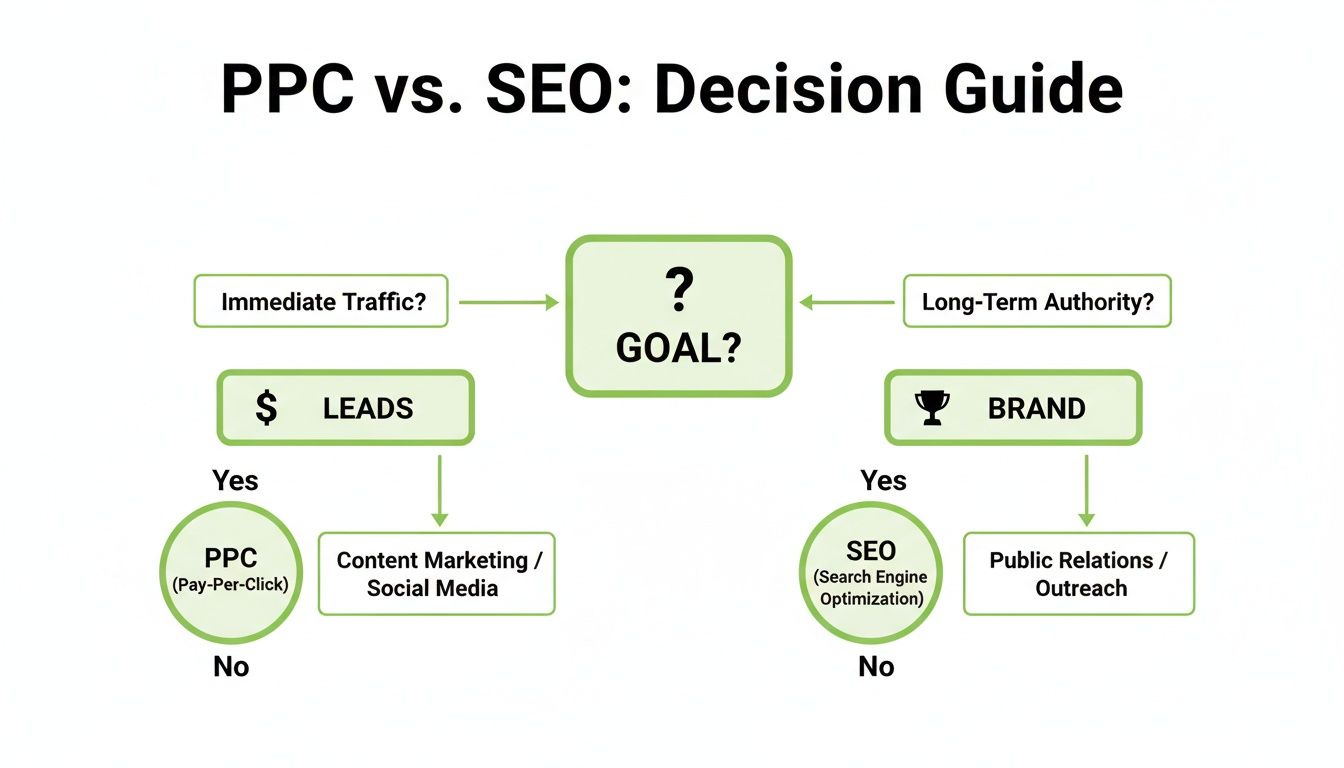
The visualization makes it clear: if your primary goal is immediate lead generation, PPC campaigns directed at landing pages are your vehicle. For building a sustainable brand presence, SEO on your main website is the path.
Decision framework: landing page vs. website page
ScenarioRecommended DestinationKey RationalePPC campaign for "HR onboarding software"Dedicated Landing PageYou need maximum relevance (message match) to the ad for a high Quality Score and conversion rate. No distractions allowed.New blog post on "5 industry trends"Website Page (Blog)The goal is organic reach and thought leadership. A landing page would feel out of place and limit exploration.Early-access sign-up for a new featureDedicated Landing PageFocus is entirely on capturing interest from a targeted group. A simple sign-up form is all you need.Detailed pricing and feature comparisonWebsite Page (Product/Pricing Page)Users are in a deep evaluation stage. They need comprehensive information, not a single, focused CTA.Webinar registration promotionDedicated Landing PageThe page's only job is to sell the value of the webinar and get sign-ups. Anything else is a distraction.Company acquisition announcementWebsite Page (Blog/News Section)This is informational content for a broad audience. The website provides the necessary context and credibility.
Ultimately, the choice comes down to focus. Landing pages are for when you need a user to do one specific thing, right now. Your website is for everything else—exploration, education, and building a long-term relationship.
The future is scaling landing pages with automation
Having one great landing page is a decent start. But if you’re serious about growth in paid search, it’s not nearly enough. A single page can’t possibly serve every keyword, every audience, or every user intent. It’s like trying to win a marathon with a single sprint.
True dominance in paid search comes from scale. Imagine a unique, perfectly message-matched landing page for every single keyword you bid on. The ad for "emergency plumbing services" leads to a page all about emergencies. The ad for "kitchen faucet installation" leads to a page specifically about that.
Manually, this is impossible. Building and managing thousands of custom pages is a logistical nightmare. Don’t even try. This is where automation stops being a nice-to-have and becomes an absolute necessity for anyone serious about winning.
Moving beyond manual limits
The old way of thinking—one campaign, one landing page—is dead. Today, AI-powered platforms can instantly generate thousands of high-intent landing pages tailored to specific search queries, all while staying perfectly on-brand.
This isn't just about making things faster. It’s about unlocking a level of personalization that was previously unimaginable. We’re talking about a future where every single ad click leads to a custom experience that speaks directly to that user’s specific need.
The real game-changer isn't just building one perfect landing page. It's the ability to build a thousand of them, instantly and intelligently, each one a hyper-focused conversion machine. That's how you build a truly defensible paid acquisition channel.
The exponential power of scale
The growth this unlocks is extraordinary. The data is clear: businesses with comprehensive landing page portfolios see conversion increases of up to 1,200%. Companies that maintain 40 or more landing pages generate roughly 12 times more conversions than those with just five or fewer. Even just scaling from 10 to 15 pages can deliver a 55% boost in conversions.
This is the future of paid acquisition. By converting more clicks at a lower cost, your return on ad spend (ROAS) skyrockets. You stop wasting money on mismatched traffic and start investing only in what works.
As we look to the future, solutions like CRM and Automation Development in NZ also play a critical role, helping to optimize processes well beyond just the landing page. It’s all part of building a smarter, more efficient growth engine. This is how we move from simply managing campaigns to building intelligent acquisition systems. It's not about working harder; it's about building smarter. Welcome to the future. 🚀
A few common questions, answered
Alright, let's cut through the noise and tackle some of the questions that always come up. I'll give you the straight, no-fluff answers I've learned from years in the trenches.
Can a landing page live on my main website?
Absolutely, and that's usually the best place for it. Most people host them on a subdomain (like go.yourcompany.com) or in a subfolder (like yourcompany.com/offer).
The real difference isn't the domain; it's the design. Your landing page must be a standalone experience. That means stripping out your website’s navigation, footer links, and anything else that doesn't serve the campaign's single goal. Its only job is to support a specific ad.
Is it bad for SEO if my landing pages aren't indexed?
Not at all. In fact, you should be doing it on purpose. Almost all PPC landing pages should be intentionally set to 'noindex'. Trying to get a short-term campaign page to rank organically is a complete waste of time.
- Your website is for SEO. It's your long-term play for organic traffic.
- Your landing pages are for paid traffic. Their sole purpose is to convert clicks you've already paid for, right now.
Blurring those lines is a rookie mistake. Keep them in their own lanes.
How many landing pages do I actually need?
This is the right question to be asking. The short answer is: more than you think.
Ideally, you need a unique, message-matched landing page for every distinct ad group you're running. If you're targeting "emergency plumbing services" and also "kitchen faucet installation," those are two entirely different user intents. They deserve two different, highly relevant landing pages to get the best conversion rates. One-size-fits-all is just a recipe for burning cash.
Can I just send paid traffic to my homepage?
You can, but you'll be setting your money on fire. Let me be blunt: it’s a terrible move for any targeted campaign.
A homepage is designed to serve everyone. It's cluttered with links and competing messages by design. A proper landing page is engineered for a single audience from a specific ad with one goal. Sending paid traffic to your homepage almost always guarantees a lower conversion rate and a miserable ROAS. Just don't do it.
Ready to stop wasting ad spend on mismatched traffic? With dynares, you can automatically generate thousands of high-intent, message-matched landing pages for every keyword, boosting your Quality Score and conversions. See how it works at https://dynares.ai.


