
Let's be blunt. Most lead gen campaigns are a spectacular way to burn cash.
You spend hours, sometimes days, setting everything up, only to get a flood of low-quality leads from people who were never going to buy in the first place. It's a frustrating cycle that makes you question if digital advertising even works.
Stop burning cash on junk leads

The core problem, the one almost everyone misses, is the massive disconnect between what someone searches for and what they actually see on your landing page. This is where most agencies and in-house teams go completely wrong.
They group a bunch of vaguely related keywords into an ad group, point them all to a single generic landing page, and hope for the best.
That’s just lazy. And it’s fundamentally broken because it ignores user intent.
Someone searching for best CRM for small business has a completely different mindset than someone searching for HubSpot pricing comparison. Yet, they often end up on the same page. It’s a dumb way to spend money, and it’s why your conversion rates are probably terrible.
The precision mindset
I learned this the hard way. My early lead gen campaigns were a mess. I was obsessed with casting a wider net—more keywords, bigger budgets—thinking volume would solve my problems. The reality was a firehose of junk leads and a rapidly shrinking bank account.
The shift happened when I stopped thinking about casting a wider net and started thinking about building thousands of tiny, hyper-specific nets. This is the whole idea behind intent mapping, and it’s about obsessively matching every single keyword to its own unique ad and landing page experience.
It sounds insane, I know. But here’s the thing: scaling lead generation isn’t about more budget; it’s about more precision. When you achieve a perfect message match from keyword to ad to page, a few things happen automatically:
- Quality scores go up because Google sees extreme relevance.
- CPCs go down as a direct result of higher quality scores.
- Conversion rates increase because users see exactly what they searched for.
This isn’t just theory; the data backs it up. Consider that a shocking 73% of B2B leads aren't ready to buy when they first interact with your brand. They're just browsing. Yet, marketers who target leads based on their position in the sales funnel see a 73% higher conversion rate. This shows why precision targeting is everything.
The goal is to make the user feel like you read their mind. The ad and the landing page should feel like a direct, personal answer to the question they just typed into Google.
This playbook is about building a system that automates this level of precision. It's about creating a machine that can generate thousands of perfectly tailored experiences without needing an army of PPC managers to run it.
We’re going to set the stage for a system that scales intelligently, focusing on high-intent prospects and ruthlessly cutting out the noise. You can also improve your targeting by mastering your negative keywords list to filter out irrelevant traffic from the start.
Let's get to it. 🚀
Building a campaign foundation that doesn’t crumble
Before you write a single ad, we need to talk about the foundation. This is the unglamorous prep work everyone loves to skip, and it’s precisely why most lead gen campaigns fail spectacularly. The game is won or lost right here, before you even spend a dollar.
Let’s be blunt: lazy foundational work is the number one killer of lead gen campaigns. Most advertisers grab a handful of obvious keywords, dump them into an ad group, and hope for the best. We won't be doing that. We're going to be methodical, building a structure that’s designed for profitable scaling from day one.
Digging for high-intent keywords
Keyword research isn't about finding terms with the highest search volume. Volume is just a vanity metric if the user has no intention of buying anything. Your real job is to get inside your customer's head and find the exact language they use when they're actually ready to solve a problem.
This means you have to prioritize long-tail keywords. These are the longer, more specific phrases—usually three words or more. Sure, their search volume is lower, but their conversion rates are exponentially higher because they scream intent.
Think about it. Someone searching for CRM is just browsing. But someone searching for best CRM for a 10-person sales team is a red-hot lead. Your mission is to uncover these specific, problem-aware phrases that act as clear buying signals.
Map your keywords to the user's journey. Here are a few intent modifiers I always look for:
- Comparison keywords: Look for terms like vs, alternative, compare, and review. These signal a user is in the final stages of evaluation (e.g., salesforce vs hubspot for startups). They're close to pulling the trigger.
- Solution-focused keywords: These searches include words like software, platform, tool, or agency. The user isn't just researching a problem anymore; they're actively looking for a specific type of solution (e.g., email marketing automation platform).
- Branded + problem keywords: This is a goldmine. When someone searches for a competitor’s name plus a pain point (e.g., mailchimp deliverability issues), they are practically begging for an alternative. You want to be there.
Architecting campaigns around intent
Once you have your treasure trove of high-intent keywords, the next classic mistake is lumping them all into one or two ad groups. This is a cardinal sin in PPC. A tightly organized structure is the blueprint for relevance, and relevance is what Google rewards with high Quality Scores and lower costs.
You need to build hyper-targeted ad groups. Sometimes, this means having only a single keyword in an ad group (Single Keyword Ad Groups, or SKAGs). The guiding principle is simple: every keyword in an ad group must be so similar that the exact same ad and landing page would be a perfect fit for every single query.
If you can't say that with 100% confidence, your ad group is too broad. This granular structure lets you nail the message match from search query to ad headline to landing page copy—the holy grail of paid search. If you want to go deeper on this, you can learn more about selecting the right keywords for PPC in our dedicated guide.
The structure of your campaign is a direct reflection of your understanding of the customer. A messy, broad structure means you have a vague understanding. A clean, granular structure means you know exactly who you're talking to and what they need.
This isn't just about being organized; it's about systematically engineering relevance. Here’s a simple framework to help you connect your keywords to the right assets.
Keyword intent mapping framework
| Intent level | Keyword example | Ad copy angle | Landing page goal | Form CTA |
|---|---|---|---|---|
| High intent | "get a quote for business insurance" | Direct, benefit-driven | Capture qualified lead | Get a Quote |
| Mid intent | "salesforce vs hubspot" | Highlight key differentiators | Provide clear comparison | Watch Demo |
| Low intent | "what is lead generation" | Educational, helpful | Answer the question | Download Guide |
By mapping each keyword to a specific user intent and a corresponding asset, you ensure the entire user experience is cohesive, which is exactly what Google's algorithm is designed to reward.
Tracking what actually matters
Finally, let's get your tracking straight. Most advertisers set up a single conversion action, like a generic form submission, and call it a day. That's a start, but it's nowhere near enough if you want to build truly profitable campaigns.
Not all leads are created equal. A Contact Us lead is likely worth far more than an e-book download. You absolutely must track actions that signal real business value and—this is critical—assign dynamic values to them. This tells Google’s algorithm what you really want more of.
Here’s what your tracking setup should focus on:
- Primary conversions: These are your money-makers, the actions that directly lead to sales conversations. Think Request a Demo, Get a Quote, or Start a Trial.
- Secondary conversions: These are still valuable but indicate less urgency. This includes actions like Download a Whitepaper or Subscribe to Newsletter. They signal interest, not immediate intent to buy.
- Assigning values: This is where the magic happens. If you know a demo request lead closes at 10% and your average customer value is €5,000, then each demo lead is worth €500. You need to pass this value back to Google Ads. This single step shifts the optimization engine from just getting more leads to getting more valuable leads.
This is the non-negotiable work. Get this foundation right, and everything else—the ads, the landing pages, the automation—will be built on solid rock, not sand.
Automating ad and landing page creation at scale
Okay, we've laid the foundation. We’ve done the hard work of digging into keywords and structuring our campaigns around what users actually want. Now we get to the part that genuinely excites me—the part where technology lets us do something that was previously impossible.
Let’s be blunt: manually creating a unique landing page and ad for every single keyword is insane. It's a logistical nightmare, ridiculously slow, and riddled with human error. It simply doesn't scale, and frankly, it's a terrible use of a smart marketer’s time. This is the exact problem that kept me up at night, and it’s the reason I started building my own tools.
The goal isn't just to work faster. It's to build a system that can create thousands of perfectly matched ad-and-page combinations instantly. This is where automation and AI stop being buzzwords and start becoming a serious competitive advantage for your lead gen campaigns.
This visual shows the basic, non-negotiable workflow: meticulous research, precise mapping of keywords to intent, and airtight tracking.
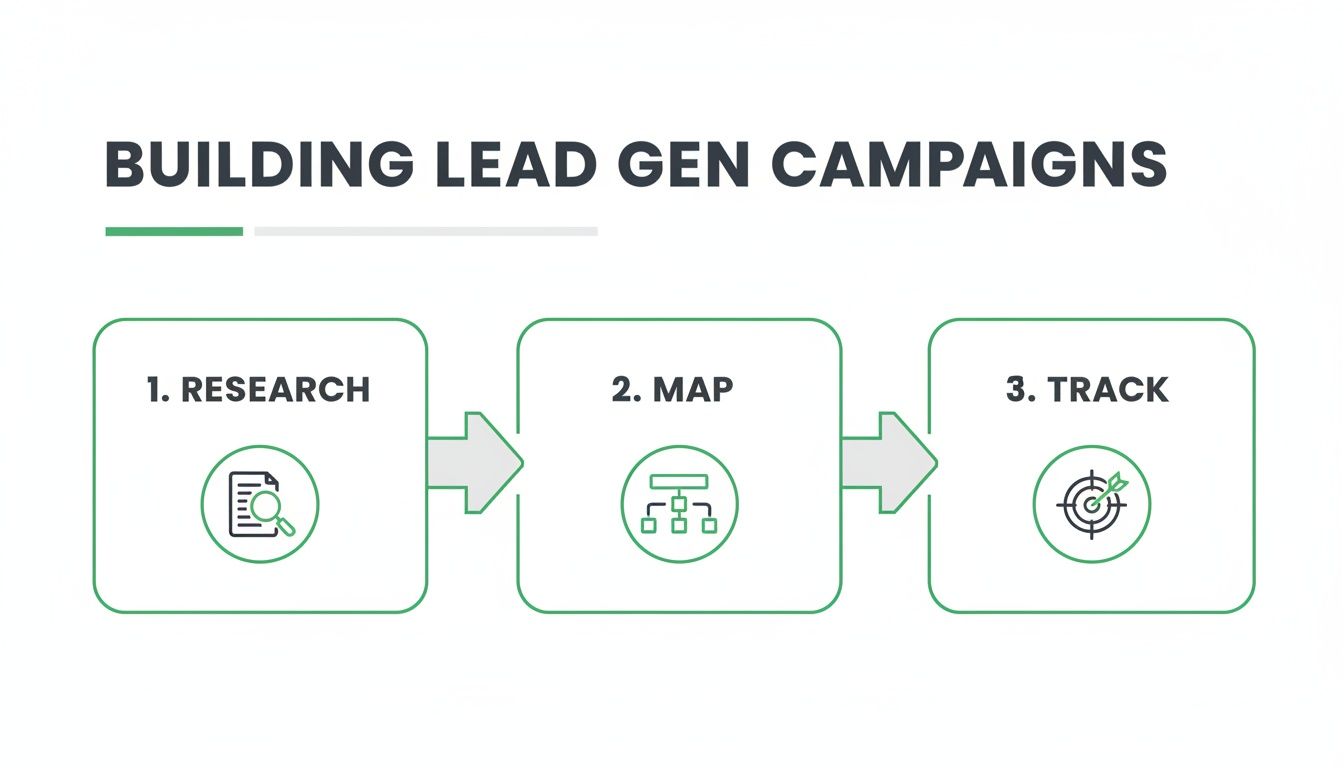
This process is the bedrock of any successful campaign, but automation is what lets you execute it at a scale that leaves competitors in the dust.
The logic of programmatic creation
Think of it like this: your keyword list is a set of instructions. Each keyword contains valuable data about what a user wants. An automated system can read these instructions and dynamically assemble the perfect response—a unique ad and a unique landing page built just for that query, in real-time.
This isn’t about spinning generic content. It’s about creating a true one-to-one marketing experience, at scale. The system just needs a few key inputs from you to make the magic happen.
- Your brand guidelines: This is your brand's DNA—logos, color palettes, fonts, and core value propositions. You set these rules once, and the system follows them across every single asset it creates.
- Your high-intent keyword list: This is the fuel for the engine. The more granular and intent-focused your keyword list, the more precise the output will be.
- Your core offerings: What are you actually selling? The system needs to understand your products or services to craft relevant copy and calls-to-action.
Once the system has this information, it can start to build. It pulls from a component library—pre-approved headline formulas, body copy blocks, testimonials, form designs—and assembles them like building blocks into a cohesive, high-converting page.
The real breakthrough is when the system dynamically injects the user's search term directly into the ad headline, the landing page H1, the body copy, and even the form fields. This creates a seamless, hyper-relevant journey that reassures the user they’re in exactly the right place.
This level of message match is what drives phenomenal results. When a user's specific query is mirrored perfectly on the page they land on, Google’s algorithm rewards you. Quality Scores go through the roof, your cost-per-click (CPC) plummets, and conversion rates soar. It's a powerful feedback loop.
How it works in the real world
Let's get out of theory and into a practical example. Imagine you’re running lead gen campaigns for a SaaS company that offers project management software for different industries.
Your keyword list might include:
- project management software for construction firms
- task tracking tool for marketing agencies
- best agile software for remote dev teams
A traditional approach would lump these into one ad group pointing to a generic page about project management software. It’s lazy and it doesn't work.
An automated system, however, would instantly generate three separate experiences:
- For the construction query: An ad and landing page with a headline like The #1 Project Management Software for Construction Firms. The hero image would show a construction site, the copy would mention features like blueprint management, and the testimonials would be from GCs.
- For the marketing query: An ad and landing page titled Finally, a Task Tracker Built for Marketing Agencies. The page would feature logos of agency clients, talk about campaign calendars and client approvals, and use language that resonates with marketers.
- For the dev team query: An ad and landing page with the headline Agile Software That Keeps Remote Dev Teams in Sync. The copy would highlight integrations with GitHub, talk about sprint planning, and feature testimonials from CTOs.
Each experience feels custom-built because, in a way, it was—all without a human touching a single line of code or a design tool. This isn't just a time-saver; it’s a fundamental performance booster. I’ve seen this approach lift conversion rates by 20-30% or more, simply by eliminating the friction caused by generic messaging. If you're looking to put this into practice, exploring an AI landing page builder is a great way to see this technology in action.
This systematic approach transforms your lead gen campaigns from a collection of static assets into a dynamic, intelligent system that adapts to user intent on the fly. This is how you scale without sacrificing quality.
Designing lead forms that actually convert
Alright, let's talk about the final boss of your lead gen campaign: the form.
You can have the most brilliant ad and a landing page that could sell ice to an Eskimo, but if your form is clunky, confusing, or just plain greedy, you’ve wasted every single click. A bad form will absolutely destroy your conversion rate.
This isn’t a minor detail; it's the final handshake. It's the moment a prospect decides to trust you with their personal information. Messing this up is like fumbling the ball on the one-yard line. It’s painful, and it's entirely avoidable.

The goal here is simple: make filling out your form feel like a natural, effortless next step for someone who’s already sold on your offer. It should be a moment of relief, not a moment of friction.
The art of asking for less
The single biggest mistake I see people make is asking for way too much information. Marketers get greedy. They think, while I have them, I might as well ask for their job title, company size, annual revenue, and blood type. This is a dumb, conversion-killing impulse.
Every single field you add creates friction. Each one is another cognitive load, another reason for a user to hesitate and second-guess their decision. Your job is to be ruthless in cutting fields down to the absolute bare minimum.
I’ve personally seen conversion rates double just by removing a single field like phone number. People guard their phone numbers fiercely. Unless you absolutely need it for an immediate sales call, don't ask for it. Email is almost always enough to start a conversation.
Here's how to think about it practically:
- Bare minimum: What information does your sales team need to have a first, intelligent conversation? Usually, it's just a name, a business email, and maybe a company name. That's it.
- Progressive profiling: If you need more data, collect it later. Use marketing automation tools to ask for more info over time as the lead engages with your content. Don’t demand their life story on the first date.
- Context is king: The number of fields you can ask for is directly related to the value of your offer. For a newsletter, a name and email are plenty. For a high-value demo or a custom quote, you can justify asking for more—but still, be disciplined.
Building forms that guide, not frustrate
Once you've trimmed the fat, the design of the form itself is critical. This isn't about pretty colors; it's about psychology and making the process feel smooth and intuitive. A well-designed form can significantly reduce user anxiety and abandonment.
Think about breaking longer forms into multiple steps. Showing a progress bar (e.g., Step 1 of 3) makes the process feel way less intimidating. It's a small psychological trick that gives users a sense of accomplishment and keeps them engaged. You can learn more about crafting the perfect user experience in our guide to effective lead capture forms.
Your button copy is another massive leverage point. The word Submit is lazy, generic, and uninspiring. It implies the user is giving something up. Instead, use action-oriented language that reinforces the value they are about to receive.
Some examples that work far better:
- Get Your Free Demo
- Download the Guide
- Request My Quote
- Start My Free Trial
This subtle shift changes the entire frame of the interaction from one of submission to one of benefit. Also, make your privacy reassurances simple and clear. A short line like "We respect your privacy and will never share your information" right below the form can do wonders for trust.
Finally, think about the handoff. Your campaign doesn’t end when the form is filled. Use a tool like Zapier or native CRM integrations to pipe that lead data directly into your CRM (like HubSpot or Salesforce) in real-time. This ensures a fast follow-up, which is crucial for turning high-intent leads into sales conversations. The speed of your response is a direct reflection of how much you value their interest.
Closing the loop with smart tracking and optimization
Getting your lead gen campaigns live is just the starting line. The real work—the part that separates the pros from everyone else—begins when you start feeding performance data back into the system. This is how you build a machine that gets smarter, and more profitable, on its own.
Most advertisers stop at the lead. They see a form submission in their inbox, count it as a win, and move on. That’s a huge mistake. The goal isn't just to generate leads; it's to generate revenue. And you can't optimize for revenue if you're blind to what happens after the click.
Moving beyond clicks to actual profit
Let’s be blunt: optimizing for a low Cost Per Lead (CPL) is a rookie move. It pushes you to chase cheap, low-quality leads that waste your sales team's time and never close. The only real win is optimizing for actual profit and high-value customers.
This is where offline conversion tracking becomes your secret weapon. It sounds complicated, but the idea is simple: you have to tell Google Ads which leads actually turned into paying customers and how much they were worth. It's the difference between flying blind and having a crystal-clear map to your ROI.
Once you start uploading that sales data back into Google, everything changes. The algorithm stops trying to find you cheap form fills and starts hunting for users who look just like your best, most profitable customers. You’re no longer just feeding it data on who clicked; you’re feeding it data on who paid. This is the foundation of truly scalable lead gen.
You must connect your ad spend to your CRM revenue. If you don't, you're just guessing. You’re making decisions based on proxy metrics instead of the only metric that actually matters: profit.
This isn’t some nice-to-have feature for enterprise accounts. It's a non-negotiable for anyone serious about scaling paid acquisition.
Creating a self-improving campaign with continuous testing
The second half of the optimization puzzle is A/B testing. I'm not talking about the old-school, manual tests where you set up two landing pages and wait weeks to pick a winner. That’s far too slow. We’re now in an era of continuous, automated optimization.
Think about it. Instead of running one big, slow test, what if your system could automatically test dozens of variations of headlines, copy, images, and forms in real-time? What if it could phase out the losers and push traffic to the winners without you lifting a finger?
This creates a powerful, self-improving system. Here’s what a modern, automated testing process actually looks like:
- Component-based testing: Forget testing Page A vs. Page B. Instead, you test individual components. The system might test five different headlines, three calls-to-action, and two hero images all at once, mixing and matching to find the winning combination.
- Real-time traffic allocation: Using a multi-armed bandit approach, the system intelligently sends more traffic to the variations that are performing well and less to the ones that aren't. This minimizes the time you waste showing underperforming assets to potential customers.
- Automatic winner promotion: Once a variation hits statistical significance, the system automatically declares it the winner and starts phasing out the others. No more checking the data every day and manually making changes.
This approach transforms your campaign from a static asset into a living organism that’s constantly learning and adapting. It's always pushing to find a better way to convert the traffic you’re paying for.
The power of the feedback loop
When you combine offline conversion uploads with continuous A/B testing, you create the ultimate feedback loop. Here’s how it works:
- Launch & test: Your automated system goes live and starts testing hundreds of ad and landing page variations.
- Generate leads: Users convert on the highest-performing variations, becoming leads in your CRM.
- Track to revenue: Your sales team works the leads, and you track which ones close and their actual revenue value.
- Feed data back: You upload this revenue data back to Google Ads, showing the algorithm which campaigns, keywords, and audiences are driving real profit.
- Optimize & repeat: Google uses this revenue data to bid more intelligently, while your A/B testing system continues to refine the on-page experience.
This closed-loop system is the key to scaling lead generation profitably. It ensures every dollar you spend gets smarter, guided by real business outcomes, not just surface-level metrics. It’s how you build a predictable and powerful growth engine for your business.
Your toughest lead gen questions, answered
Alright, let's wrap this up by tackling some of the questions I get asked all the time about running high-performance lead gen campaigns at scale. No fluff, just direct answers based on what I’ve seen work in the trenches. These are the things people wonder about but are often too afraid to ask.
Let's dive in.
"How do I handle broad match without burning cash?"
This is a classic, and for good reason—broad match can feel like setting your wallet on fire. The only way it works is if you're absolutely ruthless with your negative keyword strategy from day one.
I'm not talking about a quick list of 50 keywords. I mean thousands of negatives, updated weekly like a religion.
The other half of the equation is pairing broad match with Smart Bidding. You have to use Target CPA or Target ROAS. This forces you to hand the reins to Google's algorithm, letting it do the heavy lifting to find users who actually convert.
But remember, the algorithm is smart, not psychic. Your job is to give it a crystal-clear do not target list with your negatives. You provide the guardrails; it finds the path to conversions.
"What’s a good starting budget for a campaign like this?"
This question is a trap because the answer is always, it depends. It depends on your industry's CPCs, your stomach for risk, and how fast you need to learn.
So, let’s reframe the question. Forget a specific dollar amount and think in terms of a data threshold instead.
Instead of asking about budget, ask about data. You need enough budget to get at least 50-100 conversions before Google's algorithm exits its learning phase and starts optimizing effectively. If you can't afford to get that much data, you can't afford to play.
Let's make that practical. If a qualified lead costs you €50, you need at least a €2,500-€5,000 budget just to get the initial, meaningful data required. Don’t even bother starting with less. You'll just be donating money to Google without getting any actionable learnings in return, and that’s a dumb way to do business.
"How long does it take to see real results?"
Patience. This is the hardest part. Anyone promising you massive results in the first week is either a liar or a magician, and I haven't met any magicians in this business.
Here’s a realistic timeline based on my experience scaling countless lead gen campaigns:
- Weeks 1-2: the learning phase. This is pure data collection. You're paying for information. Results will be all over the place, and you'll be tempted to panic and change everything. Don't. Let the algorithm learn.
- Weeks 3-4: stabilization. You'll start seeing some consistency in your core metrics like CPA and conversion rate. You'll finally have enough data to make your first small, informed tweaks.
- Month 2+: real optimization. This is where scalable growth begins. You have enough conversion data to make smart decisions, refine your targeting, and start confidently increasing your budget.
This whole process is a marathon, not a sprint. The system we've outlined is about building a predictable, long-term growth engine, not chasing short-term vanity metrics. Stick with it, trust the data, and build something that lasts. 🚀
Ready to stop burning cash and start building a high-precision lead generation machine? At dynares, we've built the platform to automate the entire process, from hyper-specific landing pages to intelligent optimization. See how it works at dynares.ai.


