
Let's be real. Most articles on "lead generation" are a complete waste of your time. They’re filled with the same rehashed, surface-level advice that was maybe relevant five years ago. As someone in the trenches building tech and scaling businesses in Europe, I see what actually moves the needle, and it’s not some mythical marketing "hack." It’s about building smart, repeatable systems.
We’re all drowning in theories, but execution is what separates the campaigns that print money from those that just burn it. The tiny details in the ad copy, the form fields, the bid strategy—that’s where the game is won or lost. This isn't another generic list. This is a practical, no-fluff breakdown of 10 battle-tested paid search lead generation examples you can actually implement.
We'll dissect real-world campaigns, from the ad creative down to the conversion metrics. For each example, we'll cover what worked, why it worked, and how you can replicate it. While paid search is our focus here, a truly effective strategy integrates multiple channels. To maximize your outreach, you should also understand tactics like these top lead generation social media strategies to create a more holistic funnel.
If you’re a PPC manager, agency owner, or founder serious about turning clicks into revenue, you're in the right place. Let's get to it. 🚀
1. High-intent landing pages with keyword-matched copy
Let’s get one thing straight: sending paid traffic from a hyper-specific ad to a generic homepage is marketing malpractice. It’s lazy, and it absolutely kills conversions. The best lead generation examples start with a simple, powerful principle: message matching. This means creating dedicated landing pages that mirror the exact search intent of your target keywords. If someone searches for "marketing automation for startups," they should land on a page that screams "Marketing Automation for Startups," not your general features page.
This alignment is crucial. It directly impacts your Google Ads Quality Score, which lowers your cost-per-click (CPC) and improves ad position. More importantly, it reassures the visitor they’re in the right place, drastically reducing bounce rates. Think of it as a seamless conversation from search query to conversion.

Why it works & how to replicate it
This tactic works because it’s fundamentally user-centric. You’re not just chasing clicks; you’re providing direct answers.
A B2B agency could create separate landing pages for a CMO looking for marketing tools versus a marketing manager needing solutions. The CMO's page would focus on ROI and strategic impact, while the manager's page would highlight efficiency and team collaboration. Same product, totally different messaging.
The real challenge is scaling this. Manually building hundreds of pages is a nightmare. This is where tools like dynares become a game-changer, automatically generating keyword-matched pages. You can set up rules to pull in dynamic copy, ensuring your headline, body text, and CTA all reflect the user's original search. This approach combines precision with scale—something that used to be incredibly difficult. For a deeper dive, review these landing page design best practices on dynares.ai to get the fundamentals right before you automate.
2. Intelligent form design with progressive profiling
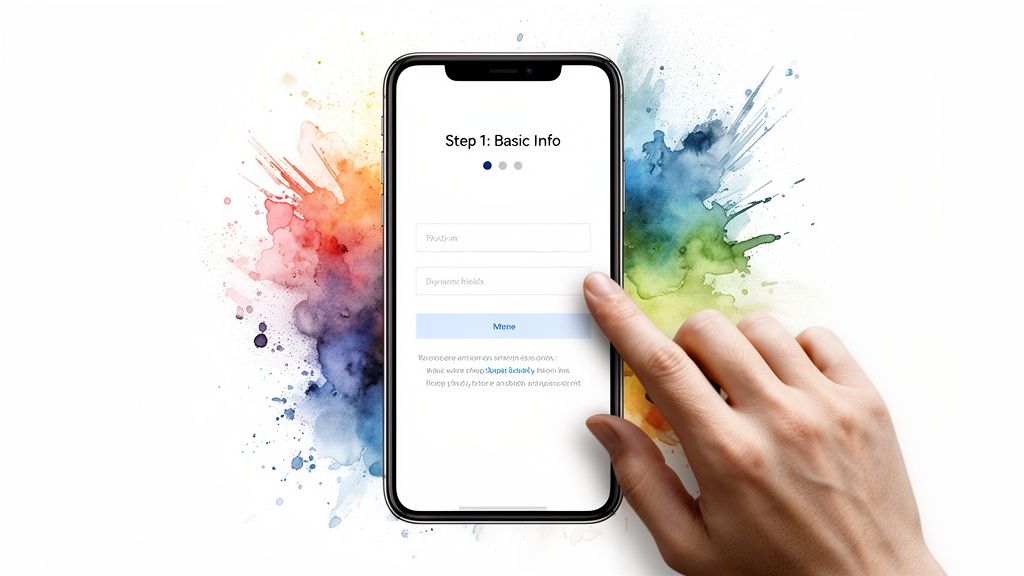
Honestly, asking for a visitor's life story on the first interaction is a terrible strategy. Yet, so many forms do exactly that, demanding everything from their name and email to their budget and company size right away. It’s a huge conversion killer. Intelligent form design, specifically with progressive profiling, is the antidote. It’s about building a relationship, not an interrogation. You start by asking for the bare minimum and gradually collect more information as the prospect engages further down the funnel.
This approach flips the script from a one-time data grab to a multi-step conversation. It drastically lowers the initial barrier to entry, which is critical for maximizing conversions. Instead of scaring away a potential lead with a 10-field monster form, you capture the essential contact info first. Then, you use subsequent interactions, like a second download or a demo request, to ask for more qualifying details. It’s a smarter, more respectful way to generate high-quality leads.
Why it works & how to replicate it
This tactic is brilliant because it aligns with human psychology. It builds trust by reducing initial friction and asking for more only when value has been provided.
A B2B SaaS company might ask only for an email to download a whitepaper. Once the user is cookied, the next time they visit a high-intent page (like pricing), the form pre-fills their email and asks for their company size and role. It’s a seamless way to enrich the lead profile without overwhelming the user.
The key is conditional logic. You need a form builder that can show or hide fields based on what you already know about a visitor. Start with just 2-3 essential fields on your top-of-funnel offers. Use hidden fields to automatically capture UTM parameters so you know exactly which ads are working. As leads progress, use dynamic forms to ask for qualifying information. This is one of the most powerful lead generation examples for turning cold traffic into sales-ready prospects. To implement this, you can learn more about how to set up intelligent forms on dynares.ai.
3. Multi-Variant ad testing with auto A/B testing
Launching a single ad variation and hoping it works is just gambling with your ad spend. It's a rookie mistake, and frankly, it's dumb. Smart lead generation is about rigorous, data-driven optimization. This is where multi-variant ad testing comes in, allowing you to systematically test different headlines, descriptions, and CTAs to find the perfect combination that resonates with your audience. You're not just guessing; you're building a winning formula one element at a time.
This approach moves beyond simple A/B testing by simultaneously evaluating multiple variables. Instead of just testing Headline A vs. Headline B, you're testing multiple headlines against multiple descriptions and CTAs. Modern ad platforms, especially with features like Google's Responsive Search Ads, have made this a core part of paid search strategy. The goal is to let the data tell you what works, not your gut instinct, which is often wrong.
Why it works & how to replicate it
This method works because it uses the scientific method to de-risk your ad spend and continuously improve performance. It’s an iterative process of hypothesis, test, and conclusion that directly boosts your conversion rates.
Imagine a SaaS company testing two different calls-to-action: "Start Free Trial" versus "Book a Demo." They might find that the "Free Trial" CTA converts higher for bottom-of-funnel keywords like "acme software pricing," while "Book a Demo" performs better for top-of-funnel queries like "best crm for small business." This insight allows them to tailor their ads to user intent.
Start small. Isolate one key variable to test, such as your primary headline. Create 3-5 distinct variations focusing on different value propositions: one might highlight cost savings, another urgency, and a third social proof. Use a tool like dynares to automate the A/B testing, which will automatically allocate budget toward the winning ad variations and pause the losers. This ensures you’re not just running tests but actively optimizing for conversions in real-time. For a better understanding, explore the differences in this guide on multivariate testing vs A/B testing on dynares.ai to sharpen your strategy.
4. Keyword-triggered content personalization
Going a step beyond dedicated landing pages, this tactic injects real-time personalization directly into your site content based on the user's search query. It’s the digital equivalent of a salesperson hearing a customer’s specific problem and immediately tailoring their pitch. Instead of a static page, the visitor sees headlines, body copy, and even CTAs that dynamically include their original keyword. This is precision targeting at its most granular.
This level of personalization tells the visitor, "I heard you, and this is exactly for you." It closes the gap between search intent and user experience instantly. This is a powerful lead generation example because it not only improves relevance and Google Ads Quality Score but also builds immediate rapport. You’re no longer just serving a webpage; you're creating a unique, one-to-one conversational experience powered by data.
Why it works & how to replicate it
This method works because it leverages the user’s own language to create a hyper-relevant experience, making them feel understood. It's a direct response to their stated need, which builds trust and accelerates conversions.
A B2B software company can use dynamic keyword insertion to transform a generic headline like "Best CRM for Your Business" into "Best CRM for Real Estate Agents" or "Best CRM for Healthcare Clinics" based on the search query. The entire page can adapt, showing case studies and features relevant to that specific industry, making the value proposition feel custom-built.
The key is automation; you can't manually create thousands of page variations. This is where a tool like dynares is indispensable, as its platform is built to automatically inject keywords into ad copy and landing page elements at scale. You start by mapping keyword themes to user intent (e.g., 'real estate CRM' maps to the "Real Estate Agent" persona). Then, you set up rules in dynares to dynamically insert these keywords and associated content blocks. This ensures your messaging is always perfectly aligned with the search context.
5. Real-time performance analytics and conversion tracking
Running ads without robust conversion tracking is like driving with a blindfold on. You’re spending money, but you have no idea if you’re moving in the right direction or about to hit a wall. The best lead generation examples aren't just about creative ads; they’re built on a foundation of data that connects ad clicks to actual revenue. This means tracking every step of the user journey, from initial engagement to the final sale.
This level of tracking closes the loop between marketing spend and business outcomes. It allows you to see which campaigns are bringing in valuable leads versus those just generating vanity metrics. Without it, you're optimizing for clicks or form fills, not for profit. The goal is to make data-driven decisions that directly impact your bottom line, moving beyond simple lead volume to focus on lead value.
Why it works & how to replicate it
This approach works because it replaces guesswork with certainty. You can confidently allocate your budget to the campaigns, keywords, and ads that are actually making you money.
A SaaS company can track a user from an ad click to a trial signup (a micro-conversion) and then all the way to a paid subscription (the macro-conversion). By assigning a value to the subscription, they can optimize their Google Ads campaigns for maximum return on ad spend (ROAS), not just for the number of free trials.
The first step is to implement comprehensive tracking. Tools like dynares simplify this by integrating directly with Google Analytics and Google Tag Manager, automatically logging form submissions as conversions and pushing that data back to Google Ads. The key is to track both intermediate actions (like demo requests) and final revenue outcomes (like closed deals). Consistently use UTM parameters and set up conversion value tracking. To get started, you can get the full rundown on our guide to a Google Ads conversion tracking setup on dynares.ai and ensure your data foundation is solid.
6. Audience segmentation and intent-based targeting
Lumping your entire audience into one bucket is a fast track to mediocre results. Not everyone searching for your solution is at the same stage or has the same motivation. This is where smart segmentation comes in, treating different search intents as completely separate conversations. It’s the difference between shouting into a crowd and having a direct, meaningful discussion with the right person.
This strategy involves dissecting your audience based on their search queries. Someone searching for "best CRM for small business" is in a different mindset than someone searching for "Salesforce pricing plans." The first is exploring, the second is ready to buy. Tailoring your ads, landing pages, and offers to these distinct intents is a fundamental, yet often overlooked, part of creating high-performing lead generation examples.
Why it works & how to replicate it
This works because it delivers hyper-relevance at scale. You meet the searcher exactly where they are in their journey, building trust and guiding them to the next logical step, instead of forcing a one-size-fits-all sales pitch on them.
A SaaS company could create three distinct campaigns:
- Top of funnel: Keywords like "what is project management software" with an educational eBook.
- Middle of funnel: Keywords like "Asana vs Trello comparison" with a detailed comparison guide.
- Bottom of funnel: Keywords like "Asana pricing" with a free trial or demo offer.
Each segment gets a different ad, page, and CTA. Start by mapping your target keywords to buyer intent stages: awareness, consideration, and decision. Create separate ad groups or campaigns for each stage. Use a platform like dynares to automatically generate unique landing page experiences for each segment, ensuring the messaging from ad to page is perfectly aligned. This avoids the manual hell of building dozens of pages. The key is to make the user feel understood.
7. Landing page conversion rate optimization (CRO)
Driving traffic to a landing page is only half the battle. If that page doesn't convert, you’re just burning cash. Conversion Rate Optimization (CRO) is the systematic process of improving your landing page to increase the percentage of visitors who become leads. This isn’t about guesswork; it's a data-driven discipline of testing headlines, layouts, CTAs, and copy to figure out what truly resonates with your audience. A 10% lift in conversion rate is far more impactful and cost-effective than a 10% increase in ad spend.
This methodical approach is fundamental to scaling paid search profitably. It transforms your landing pages from static brochures into dynamic, lead-generating machines. By continuously testing and iterating, you compound your gains over time, ensuring every click you pay for has the highest possible chance of turning into a valuable lead. It’s the difference between a leaky bucket and a well-oiled funnel.

Why it works & how to replicate it
CRO works because it’s based on user behavior, not assumptions. You’re letting your audience’s actions guide your design and messaging decisions, which is always a winning strategy.
Optimizely famously ran a simple headline test that resulted in a 30% conversion improvement. By changing the headline to better match user intent and clearly state the value proposition, they significantly increased engagement. Similarly, Dropbox simplified its homepage to focus on one core action: signing up. This radical simplicity removed distractions and boosted conversions.
Start with a solid foundation. Platforms like dynares offer conversion-optimized templates that provide a strong baseline, so you're not starting from scratch. From there, form a hypothesis and test one variable at a time. Is your headline clear? Is your form too long? Is your CTA compelling? Use A/B testing to compare your original version (control) against a new version (variant) to see which performs better. Focus on high-impact elements first, like headlines and calls-to-action, before moving to smaller tweaks.
8. Retargeting and sequential messaging campaigns
Let's be real: most of your website visitors won't convert on their first visit. That’s not a failure, it’s a reality. The real marketing blunder is letting them go without a follow-up. This is where strategic retargeting becomes your most powerful ally, moving beyond just showing the same ad over and over again. The smart play is sequential messaging: a choreographed campaign that tells a story and guides prospects back to you.
This isn’t about annoying people with endless ads for a product they glanced at. It’s a sophisticated conversation. The first ad reminds them of the value, the second introduces social proof like a case study, and the third presents a compelling offer. This progression respects the user's journey, building familiarity and trust instead of fatigue. It turns a one-time visit into a relationship.
Why it works & how to replicate it
This method is effective because it mirrors natural human decision-making. We rarely commit to something after the first introduction. We need time, more information, and a nudge.
A B2B SaaS company can retarget a visitor who read their blog. Sequence 1 is a value-prop ad leading to a feature page. If they don't convert, Sequence 2 shows a customer testimonial ad leading to a case study landing page. Still no conversion? Sequence 3 offers an extended free trial with an ad emphasizing "See it for yourself."
The key is segmenting your audience and mapping out the message sequence. You need distinct ads and landing pages for each stage. Manually creating these variants for different audience segments is a massive time sink. This is where a tool like dynares is indispensable. You can generate unique landing pages for each retargeting stage automatically, ensuring your messaging is always coherent. For instance, you can set rules to dynamically display a "Welcome Back!" message on the page for a retargeted user.
9. Competitive bidding intelligence and keyword optimization
Entering a paid search market without knowing what your competitors are doing is like flying blind. You’re just burning cash. Competitive bidding intelligence isn't about copying; it’s about strategically outmaneuvering your rivals by finding the gaps they’ve missed. This means digging into their keywords, ad copy, and landing pages to see where you can deliver a stronger message.
This approach is about calculated precision. You’re not guessing what works; you’re using data to identify high-value opportunities. By analyzing what keywords competitors are bidding on, especially high-intent phrases they're neglecting or low-hanging fruit they deem "too small," you can carve out profitable niches. It’s one of the most effective lead generation examples for gaining an edge in a crowded space.
Why it works & how to replicate it
This tactic works because it leverages your competitors' ad spend as market research. You’re learning from their successes and failures without spending a dime of your own budget on testing.
A B2B software company could use SEMrush to find that its main competitor is bidding heavily on broad terms but ignoring "alternative to [competitor name]" keywords. This is a goldmine. They can immediately create dedicated comparison pages highlighting their superior features, capturing users who are actively looking to switch. This is a direct, high-intent play.
Use tools like Ahrefs, SpyFu, or SEMrush to build a list of competitor keywords. Don't just look at the high-volume terms; hunt for long-tail keywords or industry-specific use cases they are ignoring. Once you identify a promising keyword set, the key is speed. You can use a tool like dynares to instantly generate keyword-matched landing pages for these new opportunities, allowing you to launch highly relevant campaigns in hours, not weeks. This rapid deployment capability turns competitive insights into immediate action.
10. Lead magnet offers with gated content strategy
Look, giving away your best knowledge for free with no strings attached is a noble idea, but it's terrible for business. The best lead generation examples understand the principle of a value exchange. This is where gated content comes in. You create an incredibly valuable resource—a lead magnet—and put it behind a simple form. It’s a direct trade: your expertise for their contact information.
This isn't about tricking people. It’s about offering something so useful, like an ebook, a template, or a webinar, that your target audience is happy to provide their details to get it. It perfectly bridges the gap between a casual visitor and a qualified lead. They raise their hand and say, "Yes, I am interested in this specific topic," giving you a clear signal to start a conversation.
Why it works & how to replicate it
This tactic works because it’s a filter. It separates the window shoppers from the serious buyers and provides immense value upfront, building trust from the very first interaction.
Think of HubSpot. Their entire empire was built on this model. They offer massive libraries of marketing ebooks and templates. To get a social media calendar template, you give them your email. You get a useful tool, and they get a lead who is clearly interested in social media marketing. It's a clean, effective transaction that has generated millions of leads.
Stop guessing what your audience wants and start solving their most immediate problems. The key is to create a lead magnet that directly addresses a specific pain point. Once you have your asset, use a tool like dynares to spin up a dedicated landing page for it. The page should focus entirely on the value of the download, with a clean form that only asks for essential info. Connect this to an automated email to deliver the content and kick off a nurture sequence. Start with one high-value asset, then create variations for different audience segments. You can learn more about crafting the perfect offer by reviewing these content marketing lead generation tips on dynares.ai.
Top 10 Lead Generation Strategy Comparison
| Tactic | Implementation Complexity 🔄 |
Resource Requirements ⚡ |
Expected Outcomes 📊 |
Key Advantages ⭐ |
Ideal Use Cases 💡 |
|---|---|---|---|---|---|
| High-Intent Landing Pages with Keyword-Matched Copy | Medium–High: keyword mapping + templates, automation recommended | Moderate–High: content, keyword data, page builder/automation | Higher Quality Scores, CTR, lower CPC, improved conversions | Scalable relevance; reduces wasted spend; strong ad-page match | PPC managers, agencies, performance marketers |
| Intelligent Form Design with Progressive Profiling | Medium: logic design and sequencing | Low–Moderate: form builder, CRM integration, analytics | Higher form completions (↑20–40%), better lead qualification | Reduces friction; improves lead quality over time | B2B growth teams, agencies, lead-gen focused teams |
| Multi-Variant Ad Testing with Auto A/B Testing | Medium: test design, KPI setup, statistical considerations | Moderate: traffic volume, creative variants, testing platform | Continuous uplift in ad performance; identifies winning messages | Automated optimization; faster discovery of high-performers | Performance marketers, PPC managers, multi-account agencies |
| Keyword-Triggered Content Personalization | High: mapping, dynamic insertion, ongoing maintenance | Moderate–High: keyword intel, templating, QA | Increased ad-page relevance, higher conversions, better QS | Message continuity from query→page; scalable personalization | High-volume PPC, agencies needing scale personalization |
| Real-Time Performance Analytics and Conversion Tracking | Medium–High: tracking architecture, attribution setup, privacy compliance | Moderate: analytics tools, GTM, CRM integration, tagging | True ROAS measurement, better budget allocation, revenue attribution | End-to-end visibility; optimizes for value not just volume | Performance marketers, growth teams, ROI-driven agencies |
| Audience Segmentation and Intent-Based Targeting | High: segmentation strategy, data modeling | Moderate–High: audience data, creative variants, monitoring | Improved conversion rates, efficient budget allocation | Tailored messaging; better customer fit and LTV | B2B with multiple personas, complex account structures, agencies |
| Landing Page Conversion Rate Optimization (CRO) | Medium: experiment design, UX and copy changes | Moderate: traffic for tests, design/dev, experimentation tools | Measurable lift in conversion rate and lower CPL | Improves ROI without extra traffic; reveals user preferences | Performance marketers, SaaS, agencies optimizing funnels |
| Retargeting and Sequential Messaging Campaigns | High: sequence planning, pixel setup, attribution complexity | Moderate: creative sets, audience data, additional ad spend | Higher conversion on follow-up touches; stronger recall | Recaptures non-converters; staged persuasion increases CVR | E-commerce, SaaS with volume, agencies running remarketing |
| Competitive Bidding Intelligence and Keyword Optimization | Medium: ongoing monitoring and analysis | Moderate: tools (SEMrush/Ahrefs), analyst time | Finds whitespace, informs bids, sharper keyword strategy | Identifies competitor gaps; reduces setup guesswork | PPC managers refining strategy, competitive growth teams |
| Lead Magnet Offers with Gated Content Strategy | Medium: content production + gated workflows | High upfront: content creation, landing pages, nurture sequences | Top-of-funnel lead growth; often higher lead quality but lower submit rate | Builds first-party data and trust; effective for nurturing | B2B with long sales cycles, content-first teams, agencies |
It's about systems, not silver bullets
We’ve walked through ten powerful lead generation examples. If you’ve been paying attention, you'll have noticed a clear pattern. It’s not about finding one magic bullet or a single killer ad that will solve all your growth problems. That’s a fantasy.
Sustainable, scalable growth comes from building a system. It's about creating a connected, intelligent engine where each component—from the initial keyword bid to the final form submission—works in concert. The most successful marketers aren't just running campaigns; they are engineering repeatable processes that consistently attract, engage, and convert high-intent prospects.
From manual guesswork to automated precision
Let’s be honest. Many marketers are stuck in a cycle of manual, reactive work. They launch a campaign, check stats, tweak headlines, adjust bids, and repeat. It’s exhausting and, frankly, not a great use of a sharp mind. The real breakthrough happens when you transition from this manual grind to an automated, systematic approach.
This is the shift these examples highlight:
- Keyword-matched copy: It’s not about one good ad. It’s about a system that can generate thousands of variations to match user intent precisely.
- Progressive profiling: It’s not about a shorter form. It’s about an intelligent data collection process that respects the user while systematically enriching your leads.
- Multi-variant testing: It's not about one A/B test. It's about a continuous optimization loop where you are constantly testing, learning, and iterating at scale.
This systematic thinking is what separates campaigns that produce temporary wins from the lead generation machines that build empires. You stop guessing what might work and start building a framework that discovers what does work, automatically and continuously.
The core principles for building your system
Forget the specific tools for a moment and focus on the underlying principles. If you ingrain these into your strategy, you’ll be ahead of 90% of your competition. Your goal is to build a cohesive system that excels in three key areas:
- Intent matching: Your entire funnel, from the ad creative to the landing page headline and the CTA, must be a perfect mirror of what the user searched for. The more friction you remove, the higher your conversion rates will climb. It's that simple.
- Relentless optimization: Your first attempt is never your best. A successful system has feedback loops built in. It uses real-time performance data to inform automated A/B testing, CRO, and bid adjustments. Optimization isn’t a task; it’s a process that runs constantly.
- Scalable technology: You cannot achieve this level of precision manually, not if you want to grow. You need technology that handles the heavy lifting. This is where the right tech stack becomes a massive competitive advantage.
For those managing complex operations or serving multiple clients, the underlying technology is everything. Exploring options like white label marketing automation platforms can provide the foundational infrastructure needed to implement these sophisticated systems without building everything from scratch. It allows you to focus on strategy while the platform handles the execution.
Ultimately, these lead generation examples aren't just a menu of tactics. They are blueprints for constructing a robust, predictable, and scalable growth engine for your business. Stop chasing silver bullets and start architecting your system. Now, go build something.
Tired of manually building and testing countless ads and landing pages? At dynares, we built the platform that automates the very systems we've discussed. Generate thousands of high-intent, keyword-matched campaigns instantly and let our AI handle the relentless optimization for you. See how dynares can build your lead generation engine.


