
Let's be blunt: marketing automation isn't some futuristic, enterprise-level luxury anymore. It's your new best employee—the tireless digital team member who handles the repetitive stuff 24/7, so you don't have to.
This is how you get out of the weeds and back to focusing on strategy and growth.
What marketing automation really means for you

Running a small business feels like you're constantly running on fumes. You’re the CEO, marketer, salesperson, and sometimes even the janitor. The idea of adding another system to your plate sounds exhausting, but that’s the wrong way to look at it.
Think of it this way: you wouldn't manually carry water bucket by bucket if you could just install pipes. Marketing automation is those pipes. It’s a system designed to handle the crucial, yet soul-crushing, tasks of nurturing leads, engaging customers, and driving sales—all while you sleep, strategize, or take a much-needed holiday.
We're talking about smart, personalized communication at scale, not spammy, annoying bots. This is how you compete with the big players without needing their massive budgets.
The shift from manual hustle to smart systems
Most of us start by doing everything by hand because, well, we have to. But that manual hustle has a hard ceiling. You can only send so many follow-up emails, post so many social updates, or track so many new leads before you burn out or things start falling through the cracks.
Automation is the bridge from that frantic activity to scalable, predictable growth.
This isn't just a nice-to-have; it's becoming standard practice for a reason. Globally, 75% of small businesses already use AI for marketing, with many automating email and social media. The data shows companies using these tools see a 34% revenue increase on average.
The goal is to stop being a bottleneck in your own business. It's about building workflows that handle key touchpoints so you can focus on the human side of your company—building relationships and making big decisions.
The daily grind vs the automated flow
Here’s a quick look at how your day changes when you stop doing everything manually.
| Manual Task | Automated Workflow | What You Can Do Instead |
|---|---|---|
| Hand-typing a welcome email for every new sign-up. | A personalized welcome sequence is automatically triggered. | Call your top 3 new customers to say hello. |
| Forgetting to follow up with someone who downloaded a guide. | A timed email sends them a relevant case study 3 days later. | Plan your next big content piece. |
| Copying and pasting lead info into a messy spreadsheet. | A new lead is instantly added, tagged, and segmented in your CRM. | Analyze which lead sources are actually working. |
| Manually posting the same update to three social platforms. | Your content is scheduled and published at the optimal time for each platform. | Engage with comments and build your community. |
See the pattern? Automation frees you up for the high-impact work that only a human can do.
How automation changes the game (in practice)
Let's get practical. What does this actually look like day-to-day? It's about turning those tedious manual tasks into efficient, automated workflows that just... work.
It's about creating a system that works for you, not the other way around. It’s your secret weapon for efficiency, allowing you to punch well above your weight class. For a deeper dive into the strategic implementation, check out this practical guide to implementing marketing automation.
- Lead management: Instead of manually entering every new contact into a spreadsheet (we've all been there), an automation system instantly captures, segments, and begins nurturing them. This is the foundation of effective lead generation marketing.
- Customer onboarding: A new customer signs up. Instead of you remembering to send a welcome email, a pre-built sequence automatically kicks in. It guides them through the first steps and makes them feel valued from day one.
- Personalized follow-ups: A prospect downloads a whitepaper from your site. The system doesn't just thank them; it follows up a few days later with a related case study, moving them further down the funnel without you lifting a finger.
Why most small businesses fail at automation
Here’s a hard truth I’ve learned from years of building tech and scaling businesses: buying a fancy automation tool won't magically solve your problems. In fact, most small businesses that try marketing automation get it spectacularly wrong, and it’s almost always for the same reasons.
The biggest mistake is focusing on the tool instead of the strategy. It’s a classic blunder. You can't automate a broken process; all you’ll get are the same bad results, just delivered faster. It’s like putting a rocket engine on a rusty bicycle—it’s going to be a mess.
This obsession with software leads to a few predictable pitfalls I see over and over again. They’re avoidable, but only if you know what to look for.
The most common automation traps
Founders are ambitious people. That’s our strength, but it can also be our downfall. We see what automation could do and immediately try to build a complex, all-encompassing system that solves every problem at once.
This is a terrible idea. Trying to boil the ocean from day one is a guaranteed path to frustration and burnout. Your team gets overwhelmed, the implementation stalls, and you end up with another expensive subscription gathering digital dust.
Here are the most common traps small businesses fall into:
- Trying to automate everything at once. Instead of building a Rube Goldberg machine, pick one high-pain, high-impact process and automate that first. A simple welcome email sequence is a far better starting point than a 50-step lead scoring model.
- Ignoring data quality. There's a saying in tech: garbage in, garbage out. If your contact list is a mess of outdated emails and incorrect names, your automated outreach will only amplify the problem. Clean your data before you automate anything.
- Writing robotic messages. Automation is not an excuse to sound like a soull-ess machine. The goal is to scale personal communication, not eliminate it. If your automated emails read like corporate jargon, you’ll alienate the very customers you’re trying to connect with.
Automating without a purpose is a waste of money
Another classic error is jumping in without clear goals. What are you actually trying to achieve here? If you can’t answer that question with a specific metric, you’re just automating for the sake of it.
Automation without clear KPIs is just an expensive hobby. You need to define what success looks like before you press start. Are you aiming for more qualified leads, better conversion rates, or a higher customer lifetime value?
Without a number to aim for, you have no way of knowing if your efforts are working. You’re flying blind, spending time and money on a system that might be doing absolutely nothing for your bottom line.
It's the marketing equivalent of pouring cash into paid ads without any tracking—a mistake that turns many promising ventures into cautionary tales. In fact, many founders discover just how powerful combining these two can be when they move from spreadsheet hell to automated PPC funnels with AI.
Finally, let's tackle the fear factor. A lot of founders think marketing automation is too complex or too expensive. This is a myth. The key isn't buying the most powerful tool on the market; it's about starting small, proving the value with a quick win, and then scaling up. This requires a mindset shift—turning automation into a strategic asset, not just another expense on the P&L.
Your first high-impact automation wins
Alright, enough theory. Let's get our hands dirty.
Forget about some 50-step master plan that takes six months to build. The secret to making marketing automation stick is to score a few quick, high-impact wins right out of the gate.
This is all about building momentum. You need to see real results, fast, to prove this isn't just another shiny object. We're going to focus on three powerful but simple workflows you can set up this week.
The non-negotiable welcome series
When someone new signs up for your email list, what happens? If the answer is "nothing, they just sit there," you're burning a massive opportunity. A welcome series is your single best chance to make a killer first impression.
This is non-negotiable. Don't overthink it. Just get something in place. The goal is to introduce your brand, set expectations, and deliver immediate value while their interest is at its absolute peak.
Here’s a simple, effective sequence:
- Email 1 (immediate): Deliver what they signed up for (the e-book, the discount code) and say thank you. Keep it short, sweet, and human.
- Email 2 (2 days later): Share your most popular blog post, a helpful case study, or a short video that tells your brand's story. Show them you’re more than just a product or service.
- Email 3 (4 days later): Gently introduce your core offer. No hard sell here. Just make them aware of the problem you solve and how you solve it.
This simple flow builds a relationship from day one, turning a cold subscriber into a warm lead. It's foundational.
Nurture leads that show intent
So, what happens after someone downloads a resource like a whitepaper or a guide? Don't let that high-intent lead go cold. They've just raised their hand and shown you exactly what they're interested in. Your follow-up should reflect that.
This is where you graduate from generic newsletter blasts. A lead nurturing sequence automatically follows up with tailored content that guides them toward a solution—yours.
Your goal isn't to bombard them with sales pitches. It's to be relentlessly helpful. Provide so much value that when they're finally ready to buy, you're the only logical choice.
For example, if someone downloads your guide on "Improving Google Ads ROAS," your automated sequence could send them a case study on that exact topic a few days later. After that, maybe an invitation to a relevant webinar. You’re continuing the conversation they started, not shouting at them with a new one.
Recapture lost sales and leads
This one is pure gold, especially for e-commerce businesses. Someone adds a product to their cart, gets all the way to the checkout page... and vanishes. Life happens. But that’s a potential sale just sitting there, waiting for a gentle nudge.
An abandoned cart sequence is one of the highest-ROI automations you can build. It’s simple, direct, and shockingly effective.
The biggest mistake is getting bogged down by the tech before you even have a plan. You need a clear strategy first, or you'll just be automating chaos.
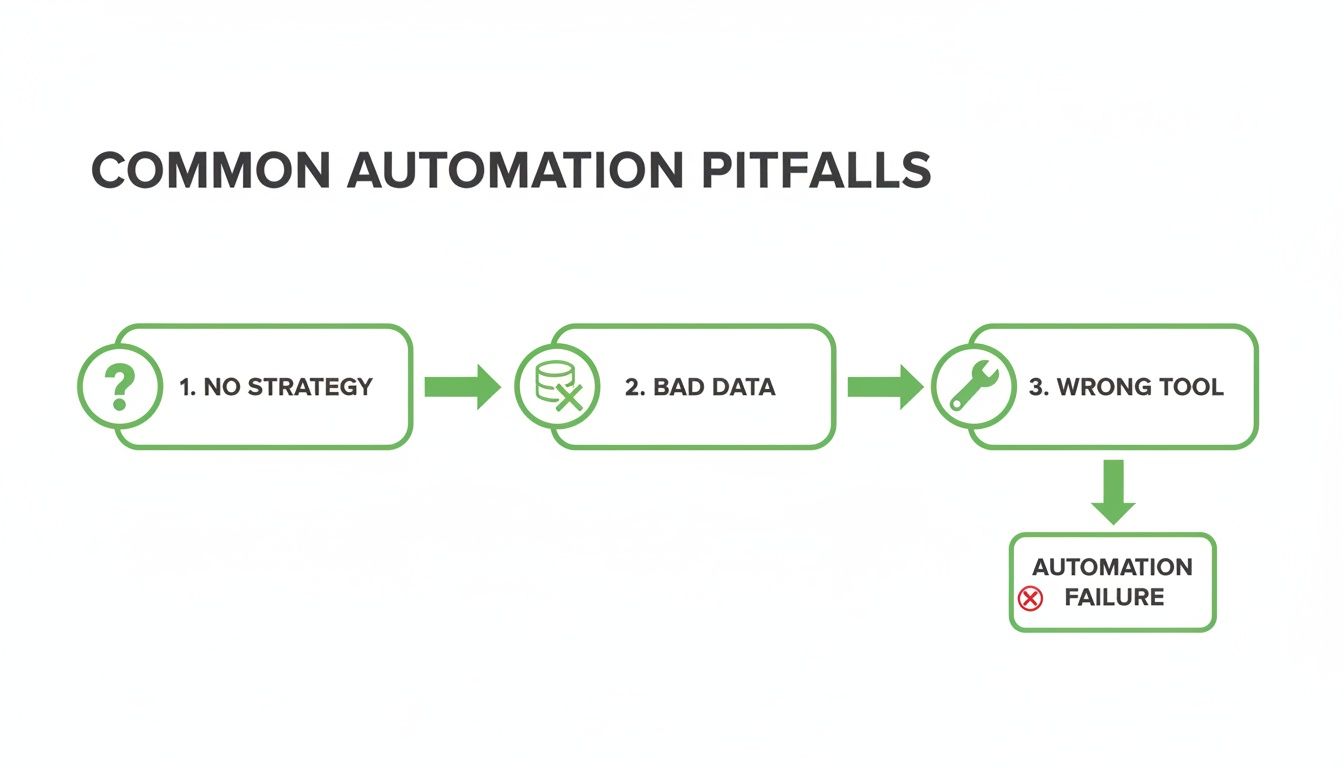
This flowchart nails it. Failure often starts with a lack of clear goals, long before a tool is even chosen.
Even if you don't sell products online, the same logic applies. You can build a workflow to follow up on incomplete contact forms or abandoned sign-up processes. It’s all about re-engaging people who have shown strong intent to buy.
These three wins—a welcome series, a lead nurture sequence, and an abandoned cart reminder—are the bedrock of any smart automation strategy. They're practical, they're easy to implement, and they deliver results you can see almost immediately. For more ideas, check out these 7 automations every African business should set up to keep things running smoothly.
How to choose the right tools without going broke
The market for marketing automation platforms is a noisy, crowded mess. Every provider claims to be the only solution you’ll ever need, promising to solve all your problems with a single click. It’s overwhelming, and frankly, a lot of it is bull.
Let's cut through the noise. I’m not going to list 20 different tools because that’s not helpful. Instead, I’ll give you a simple, pragmatic framework for choosing the right one for your business, right now. Forget the five-year fantasy of a command center that runs your entire company; let's focus on what you actually need to get results this quarter.
It really comes down to just three things. If you nail these, you’ll make a smart investment. If you ignore them, you’ll end up with another expensive subscription you barely use.
Ease of use is non-negotiable
This is the most important factor, and it’s the one most people get wrong. Can you and your team actually use the damn thing without hiring a specialist consultant or spending weeks on training modules? If a tool has a steep learning curve, it’s not built for a small business. You don't have time for that.
Look for platforms with intuitive drag-and-drop builders for emails and workflows. Your goal is to move fast and get campaigns live, not become a certified expert in one specific piece of software. A simple, clean interface will always beat a clunky one bloated with features you'll never touch.
Integrations are your lifeline
No tool is an island. Your business already runs on a stack of software—your CRM, your ad platforms, your e-commerce store. Your automation platform needs to play nicely with them. If it doesn’t, you’re just creating more manual work for yourself, which defeats the entire purpose.
Native integrations are best, but a solid connection through a service like Zapier is the next best thing. This allows data to flow seamlessly between your tools. A new lead from a Google Ad should automatically appear in your CRM and trigger an email sequence without you lifting a finger.
For instance, this screenshot shows a simple Zapier integration connecting Google Ads to HubSpot.
This isn't some complex engineering feat; it’s a straightforward connection that ensures your ad spend is directly tied to your follow-up process. Automating this data flow is a huge win for efficiency and ensures no leads fall through the cracks. It's a prime example of how you can use tools like these to manage and improve your paid campaigns, which is a critical part of scaling. For a deeper look into this area, you might want to check out our guide on Google Ads optimization tools.
Think scalability not complexity
Finally, think about where you’re going, but don’t pay for it today. You need a tool that can grow with you, not one built for a Fortune 500 company you hope to become one day.
Start with a platform that combines the essentials: email marketing, simple landing pages, and a basic CRM. This is the perfect starting point for most small businesses. As you grow, you can upgrade to plans with more advanced features like lead scoring or A/B testing.
Avoid getting locked into expensive annual contracts for bloated enterprise plans. Look for flexible pricing that scales based on your number of contacts or features used. This is about making a smart, pragmatic investment.
The ROI on marketing automation is impressive, making it a highly practical choice for budget-conscious teams. Companies can earn back $5.44 for every dollar spent over three years, often recovering initial costs in under six months. You can discover more insights on Salesgenie.com about these powerful returns.
Connecting your paid ads to automation
This is where the real magic happens, especially if you’re running paid ads on platforms like Google. Pouring money into ads without an automated follow-up system is like trying to fill a leaky bucket—you’re just wasting resources. It’s a dumb way to burn cash, and we can do so much better.
The whole point is to connect your ad campaigns directly to your automation engine. When a new lead comes in from a specific ad, they should immediately get a hyper-relevant, automated follow-up. Anything less is a missed opportunity.
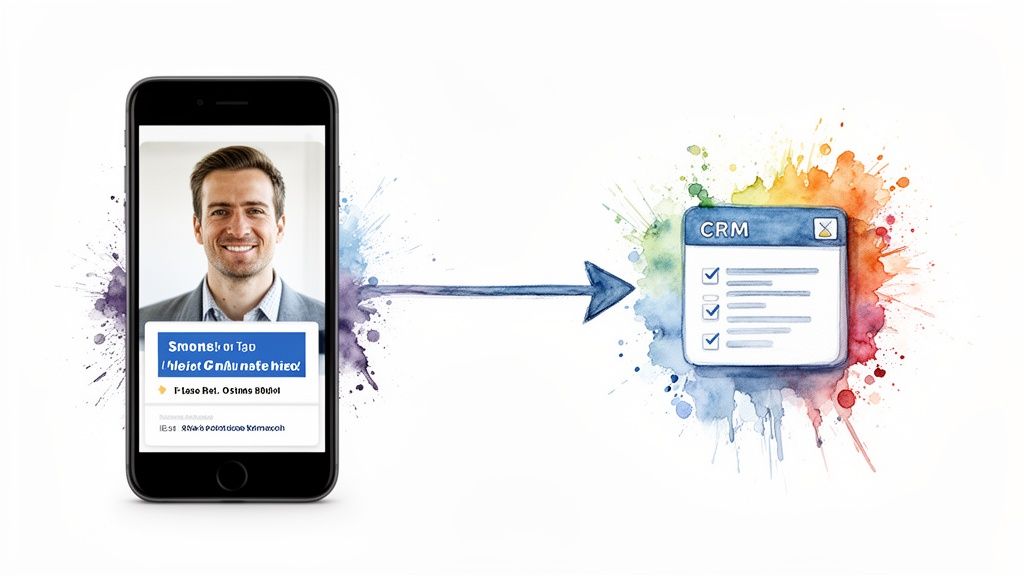
From anonymous click to known lead
This philosophy is exactly what we're building with our own products. Think about it: we're generating tailored landing pages for every single keyword to maximize user intent. But the journey can't just stop at the click. That's only half the battle.
The moment someone fills out a form on that high-intent page, automation needs to take over instantly. This isn't just about sending a generic "thanks for your interest" email. It's about nurturing that lead based on the exact term they searched for.
This tight integration between ad intent and automated follow-up is what dramatically increases conversion rates and your return on ad spend (ROAS). You’re continuing the conversation they started, not forcing a new one on them.
Making the technical connection
So, how do you actually make this happen? It’s not as complicated as it sounds. The key is to pass data from your ads through your forms and into your automation system.
This is often done using hidden fields in your website forms. These fields capture information from the ad URL—like the campaign name, ad group, or the specific keyword—without the user ever seeing it.
When a lead submits the form, this hidden data goes straight into your CRM along with their contact information. Now you don’t just have a name and email; you have the full context of how they found you and what they care about.
This context is everything. It lets you build workflows that are incredibly specific and effective. It's a fundamental part of a robust marketing automation for small business strategy, ensuring your ad spend isn't just generating clicks, but building a pipeline. This whole process hinges on accurate conversion tracking, which is why it's crucial to get your Google Ads conversion tracking setup right from the very beginning.
Here’s a simple breakdown of how this powerful connection works:
- Capture ad data: A user clicks on a Google Ad for the term "office accounting software." Your ad's URL contains parameters that identify the campaign and keyword.
- Pass it through the form: They land on your page and fill out a form. Hidden fields automatically capture "Google Ads" as the source and "office accounting software" as the interest.
- Trigger a specific workflow: This data syncs to your automation tool, which instantly adds the lead to a "Software Trial" email sequence. The first email they get might mention accounting software directly and offer a relevant case study.
This seamless journey from first click to personalized follow-up is what transforms your paid advertising from a simple traffic source into a powerful, automated lead generation machine. It’s smart, it’s scalable, and it’s how you win.
Your action plan and what to actually measure
Enough talk. Theory is great, but execution is what separates the winners from the wannabes. So here is your dead-simple plan to get started with marketing automation. Don't overcomplicate it. Just do this.
Forget about building some massive, all-encompassing system from day one. That’s a dumb way to start and a fast track to getting nothing done. We're aiming for a quick win that proves the value and builds momentum.
Here’s your four-step launch sequence:
- Define one clear goal: What is the single most important thing you want to achieve right now? Is it converting more trial users into paying customers? Is it getting more repeat purchases from existing clients? Pick one specific, measurable goal. Don't be vague.
- Choose one process to automate: Go back to the "high-impact wins" we talked about. Pick one. A welcome series for new subscribers is a fantastic place to start because it's simple and effective. Don’t try to automate three things at once. One.
- Select a tool that fits: Find a platform that matches your current budget and skills. You don't need the most powerful, feature-packed software on the market. You need the one you'll actually use.
- Launch, measure, and Iiterate: Get your first workflow live. It doesn't have to be perfect. Then, watch the numbers and see what happens. The goal is progress, not perfection.
Focus on metrics that matter
Now, let's talk about measurement. Most people get this completely wrong. They fixate on vanity metrics like email open rates or social media likes.
Honestly, who cares? These numbers feel good, but they don’t pay the bills.
Stop tracking feel-good metrics that don't directly correlate to revenue. Your time is too valuable to be wasted on data that doesn't inform a real business decision. We're founders, not analysts in a corporate boardroom trying to justify our existence with pretty charts.
We need to track the Key Performance Indicators (KPIs) that directly impact the bottom line. This isn’t about setting up complex dashboards with a million charts. It’s about tracking a few core numbers that tell you if your strategy is actually working.
Here are the only three you should obsess over at the beginning:
- Lead-to-customer conversion rate: This is the big one. Of all the leads your automation system is nurturing, how many are actually becoming paying customers? If this number isn't going up, something is broken.
- Customer lifetime value (LTV): Are your automated up-sell, cross-sell, and retention campaigns making your customers more valuable over time? A rising LTV is a clear sign your automation is building stronger relationships.
- Cost per acquisition (CPA): How much does it cost you to acquire a new customer? Smart automation should lower this number by improving conversion rates and making your ad spend more efficient.
By focusing relentlessly on these three KPIs, you can prove the financial impact of your marketing automation efforts. You’ll know for sure whether it's an investment driving growth or just another subscription draining your bank account. This is how you run a business with clarity and conviction. 💪
Frequently asked questions
Alright, let's tackle a few of the questions I always get from other founders when we start talking about automation. No fluff, just straight answers.
Is marketing automation just for big companies?
Absolutely not. This is one of the biggest myths out there, and frankly, it holds too many small businesses back. The idea that you need a huge budget or a dedicated tech team is completely outdated.
Modern marketing automation for small business is built for us—the founders and small teams who are scrappy and need to do more with less. It's about using smart tools to punch way above your weight class, not trying to copy what some Fortune 500 company is doing. For us, it’s a survival tool, not a luxury.
Will automation make my marketing feel robotic?
It can, but only if you do it wrong. This is a totally fair question, and the responsibility is on you to keep it human. Automation is a tool to scale personal communication, not to sound like a corporate machine.
The best automation feels human because it’s triggered by something a real customer actually did, delivering something relevant and timely. Here’s how you keep it from feeling cold:
- Write like you talk. Ditch the corporate jargon.
- Segment your audience. Don't blast the same generic message to everyone.
- Use personalization. Little things like using a first name can go a long way.
The whole point is to be relentlessly helpful, not just noisy. Good automation saves you time so you can spend more energy on the high-touch, human stuff that actually builds your brand.
How much does it really cost?
Less than you think. And it's definitely cheaper than hiring another person to do all that manual work. Pricing for these platforms has gotten incredibly competitive, and many offer free or super low-cost plans that are perfect for just getting your feet wet.
You don't need the fanciest tool with a million features you'll never use. You need the right tool for the job you have today. Start small, get a quick win to prove it works, and then scale your investment as your business—and your revenue—grows. The price of the platform isn't the real cost; the real cost is the opportunity you're losing by sticking with manual, unscalable tasks.
Ready to stop wasting ad spend and start turning clicks into customers? At dynares, we built the AI platform to connect your Google Ads directly to high-intent landing pages and automated follow-ups. See how it works at https://dynares.ai.


