What Is Lead Generation Marketing? Forget the Buzzwords, Let's Build a Real Sales Pipeline

Let's get straight to it. If your business isn't generating leads, you're not running a business—you're running a glorified hobby. Lead generation marketing is the entire process of finding people who might need what you sell, grabbing their interest, and turning that initial spark into a real conversation. It's how you stop waiting for customers to magically find you and start building a predictable system that brings them to your door. Simple as that.
So, what is lead generation, really?

Forget the dry, academic definitions. For a founder or marketer, lead generation isn't just another task on the to-do list; it's the engine that powers your entire growth machine. It’s the difference between hoping for revenue and building a pipeline you can actually count on.
I learned this the hard way. In my first startup, we burned through our seed funding on what we called 'brand awareness'—sponsoring podcasts, running vague ads, and chasing social media metrics that made us feel important. It felt productive, but our sales pipeline was a ghost town. We nearly failed because we were making noise instead of starting conversations.
That painful lesson taught me something critical: lead generation is about creating tangible opportunities. It’s a deliberate system for initiating relationships with people who have a problem you can solve. For a solid primer on the basics, this definition of Lead Generation is a great starting point.
Why this matters more than ever
The game has changed. Buyers are firmly in the driver's seat, armed with more information than ever before. They don’t want to be sold to; they want to be helped. This is where modern lead generation shines. It's not about interrupting people with cold calls or spammy emails. It’s about being the most helpful resource they can find.
The numbers don't lie. The market for lead generation solutions is set to explode from US$3.1 billion in 2021 to over US$9.5 billion by 2028. Why? Because it works. Content marketing, for example, delivers three times more leads than old-school outbound tactics, and it costs a lot less.
To give you a clearer picture, here’s a quick breakdown of the core ideas.
Lead generation at a glance
| Concept | What It Really Means | Why You Should Care |
|---|---|---|
| Lead Generation | The process of attracting potential customers and getting their contact info. | It's the first step to building a predictable sales pipeline and not relying on luck. |
| Inbound Marketing | Creating helpful content (blogs, guides, videos) that pulls people in. | You become a trusted resource, not an annoying salesperson. It builds long-term value. |
| Outbound Marketing | Proactively reaching out to potential customers (cold calls, emails). | It can work for specific markets, but it's often more expensive and less targeted. |
| Sales Funnel | The journey a person takes from first hearing about you to becoming a paying customer. | Understanding this journey helps you create the right message at the right time. |
Ultimately, a strong lead gen strategy puts you in control of your own growth. It lets you build a predictable sales pipeline, understand your customers deeply by seeing what they actually care about, and scale your business efficiently by focusing your sales team on prospects who have already raised their hand.
This entire guide is built on this practical, no-fluff approach to lead generation. If you're interested in digging deeper into modern marketing strategies, you can find more articles on our resources blog.
Now, let's build that engine.
Mapping your customer's journey through the funnel
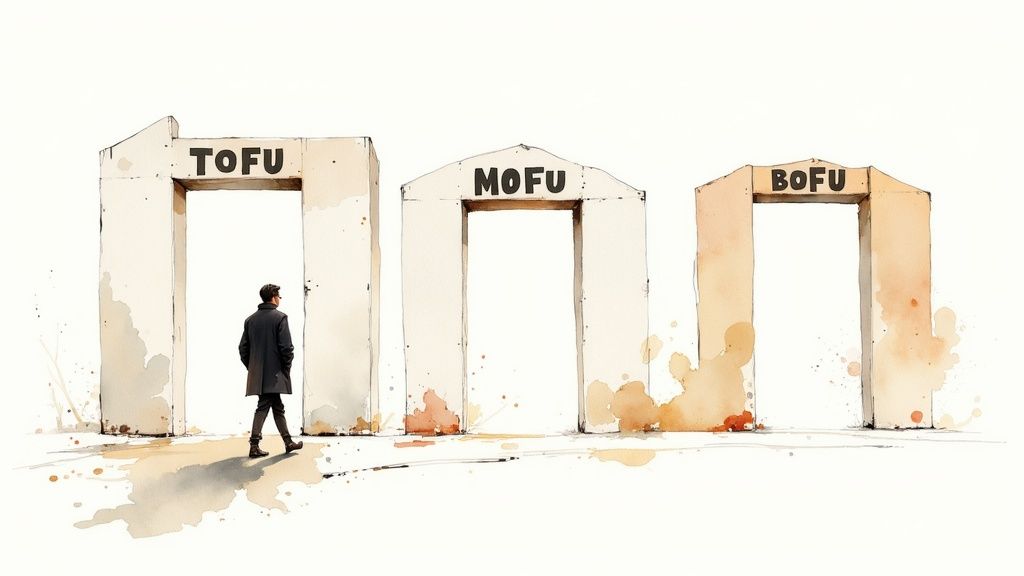
Alright, let's talk about the 'funnel'. It's a term marketers love to throw around, but honestly, it’s just a simple map of your customer’s journey. Forget the abstract diagrams; think of it like finding your way through a new city. First, you spot a landmark (awareness), then you start looking down specific streets (consideration), and finally, you arrive at your destination (decision).
Your job isn't to force people down this path. It's to be the best damn guide they can find at each turn. The whole point of mastering lead generation is to help the right people find their way to you, smoothly and logically.
Top of the funnel (ToFu): Awareness
This is the very beginning. People at this stage don't even know your company exists. They just know they have a problem or a question they're typing into Google.
Your goal here isn't to sell. Trying to sell now is like shouting restaurant recommendations at someone who just asked for directions. It’s annoying, and it flat-out doesn't work.
Instead, your only job is to be helpful. You want to attract a wide audience with valuable, no-strings-attached content that addresses their initial pain points. Think blog posts, social media tips, or educational videos. This stage is all about building trust by offering value first. You're simply putting your brand on their map as a helpful resource.
Middle of the funnel (MoFu): Consideration
Okay, they know who you are. They've found your content helpful. They've moved from 'I have a problem' to 'I need to find a solution'. This is where real lead generation kicks in.
At this stage, you offer more specific, in-depth resources in exchange for their contact information. This is the value exchange. You’re asking for their email, and in return, you’re giving them a clear path to solving their problem. You’re not just collecting a lead; you're earning the permission to continue the conversation. This is the moment a random visitor becomes a genuine prospect.
Think of MoFu content as the next level of guidance. This includes things like detailed guides, webinars, case studies, or checklists. You're helping them evaluate their options while demonstrating your expertise.
Bottom of the funnel (BoFu): Decision
We're at the finish line. Your prospect is ready to make a choice. They’ve done their research, they trust you, and now they're comparing you against competitors. The conversation shifts from 'how do I solve my problem?' to 'is your product the right solution for me?'.
Your offers here need to be highly targeted and action-oriented. You’re making it as easy as possible for them to say yes.
- Free demos or consultations: Show them exactly how your product solves their specific problem.
- Free trials: Let them experience the value for themselves, completely risk-free.
- Detailed pricing pages or custom quotes: Give them the clear, final information they need to pull the trigger.
This is where your sales team steps in to close the deal. By mapping out this journey, you ensure that by the time a lead reaches BoFu, they are qualified, informed, and ready for a serious conversation.
Choosing your channels for maximum impact
Alright, let's get practical. A brilliant lead generation funnel is useless if you're shouting into the void. You have to show up where your potential customers are actually spending their time.
The key isn’t to be everywhere; it’s to be on the right channels. Trying to master every platform is a surefire way to be mediocre at all of them. Instead, let's focus on the few battlegrounds where the game is actually won.
LinkedIn: The B2B powerhouse
If you're in B2B, LinkedIn isn't just another channel—it's the channel. It’s the digital equivalent of the industry’s most important conference, running 24/7. Deals get started here. Reputations are built here. Ignoring it is like showing up to a sales meeting without your phone.
The data is almost comical in its dominance. A staggering 89% of B2B marketers use LinkedIn for lead generation, and the platform is credited with driving 80% of all B2B leads. It's not just about volume, either. LinkedIn is reportedly 277% more effective at generating leads than other major social platforms.
But here’s the catch: you can't just show up and start spamming connection requests. Treat it like a real-world networking event. Share genuine insights, comment thoughtfully on other people's posts, and offer value long before you ever ask for anything. Be a human.
Content marketing & SEO: The long game
Content marketing, powered by SEO, is the ultimate long-term play. It’s the engine of inbound. Instead of constantly hunting for new customers, you create valuable content that helps them find you right when they’re searching for a solution. It's about building an asset that works for you around the clock. Find their pain, be the answer, and build authority.
This isn’t a quick fix. It takes time and consistency. But the leads you get from well-executed SEO are often the highest quality because they've already bought into your expertise. To see how this plays out across different industries, it helps to review diverse content marketing strategy examples.
Paid ads: For immediate & targeted results
Sometimes you just need to light a fire now. That's where paid advertising comes in. While content marketing builds momentum over months, paid ads on platforms like Google can start generating leads within hours.
This is your surgical strike. You can pinpoint your exact audience based on their job title, company size, or—most powerfully—their search intent. It's an incredibly effective lever, but it's also expensive. You have to be smart about it. For a deep dive into making paid search work, check out our guide on effective PPC advertising strategies. The non-negotiable rule is to have a rock-solid offer and a landing page that converts. Otherwise, you're just burning cash for clicks.
Building your automated lead conversion machine
Let's be brutally honest: driving traffic to your website is pointless if nobody converts. It's like hosting a massive party but forgetting to open the door. You're just burning cash for vanity metrics.
The real goal is to build a machine that turns curious visitors into qualified leads, step-by-step. This isn't just theory; it's the blueprint for a system that captures and qualifies leads 24/7, so you can focus on building your product or closing deals.
The process below breaks down the primary channels for driving traffic into your conversion machine.
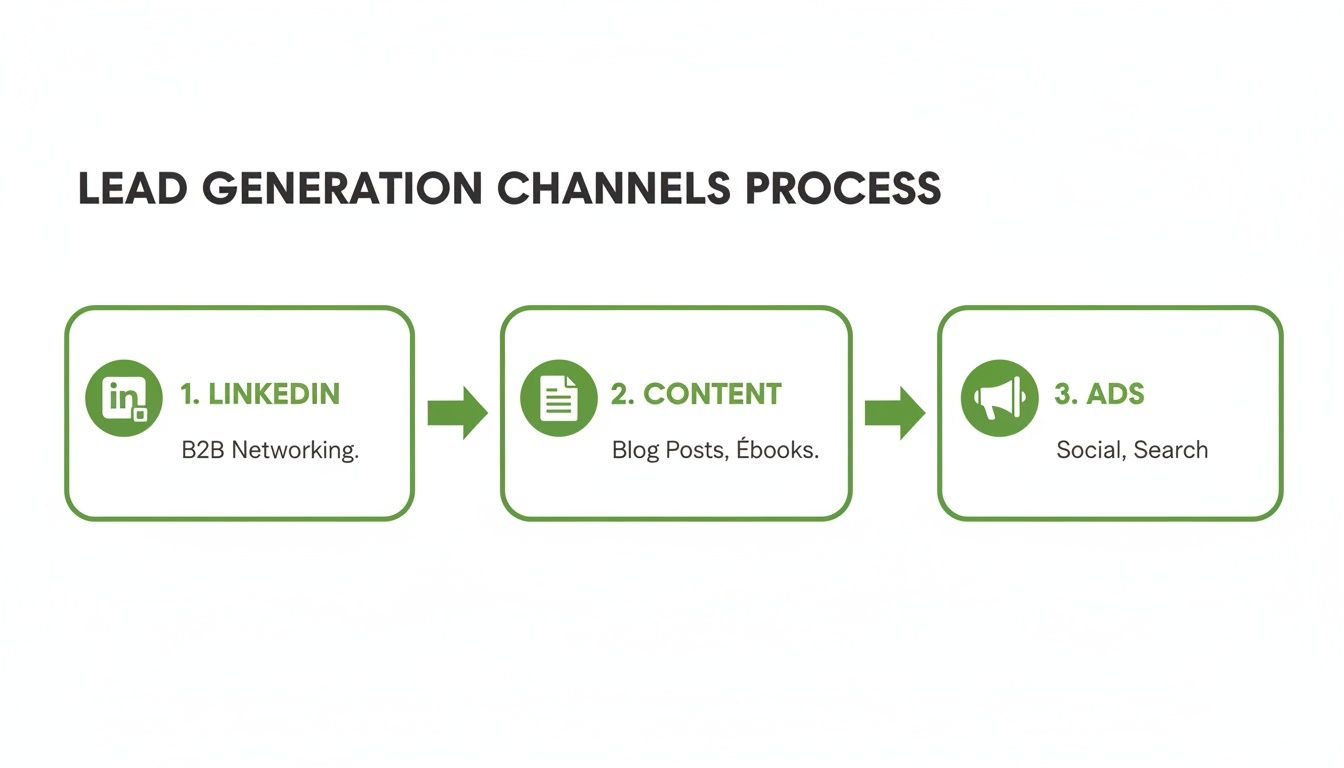
Each channel—whether it's networking on LinkedIn, publishing valuable content, or running targeted ads—acts as an on-ramp. It directs potential customers into your carefully designed system.
The dedicated landing page
This is where most people stumble. They spend a fortune on ads and send all that expensive traffic straight to their homepage. This is a dumb move.
Your homepage is a digital brochure, full of distractions and competing messages. It's designed for browsing, not for taking one specific action.
A dedicated landing page, on the other hand, has one job and one job only: to convert a visitor into a lead for a specific offer. It’s hyper-focused, stripped of all navigation, and its message perfectly matches the ad that brought the person there. The landing page isn't just a webpage; it's the most critical point of persuasion in your entire lead generation workflow. Get this right, and everything else becomes easier.
To build a page that actually converts, you need a few non-negotiable elements. For a practical guide, we've broken down all the essential components in our article on landing page design best practices.
Crafting the perfect capture system
Once your landing page has convinced the visitor, you need a way to actually capture their information. This involves a few key components working together seamlessly:
- The lead capture form: Keep it simple. Seriously. Only ask for the absolute minimum information you need to qualify the lead. Every extra field you add kills your conversion rate. You can always gather more data later.
- The thank you page: Don’t just show a generic "Thanks!" message. Use this page to set expectations. Tell them exactly what happens next—"We'll be in touch within 24 hours" or "Your e-book is on its way to your inbox."
- The initial follow-up: This should be automated and immediate. Deliver the promised asset (the guide, the webinar link) and use it as an opportunity to start the nurturing process.
This entire sequence—from ad to landing page to thank you—is your automated conversion machine. It's the engine that powers predictable growth. And the best part? Once it’s built, it works for you while you sleep.
Focusing on metrics that actually drive revenue
If you can't measure it, you can't improve it. It's a classic business school line, but for a founder trying to scale, it's the absolute truth. A lot of marketers get obsessed with vanity metrics—impressions, likes, clicks. Honestly, who cares? Those numbers don't pay the bills.
Let's cut through the noise and talk about the lead generation metrics that actually connect your marketing spend to real revenue. This is about knowing your numbers so you can make smart decisions, not just feel busy.
The non-negotiable KPIs
Forget overwhelming dashboards. You really only need to obsess over a few key performance indicators (KPIs) to understand if your lead machine is working or just burning cash. These are the numbers I live and die by: Cost Per Lead (CPL), Lead Conversion Rate (LCR), and Lead-to-Customer Rate. CPL tells you if you're overpaying. LCR tells you if your offer sucks. Lead-to-Customer Rate tells you if your leads are actually any good.
Knowing these numbers is the first step, but the real work is taking action on what they tell you. Setting up proper measurement is non-negotiable; our guide on Google Ads conversion tracking setup is a solid place to start if you're not confident in your data.
To really nail this down, it helps to see the key metrics side-by-side to understand what they're telling you about your business.
Key lead generation metrics compared
| Metric | What It Measures | Why It's a Must-Track |
|---|---|---|
| Cost Per Lead (CPL) | The direct cost to acquire a single lead from your marketing efforts. | Measures the efficiency of your ad spend. If it's too high, your growth isn't sustainable. |
| Lead Conversion Rate (LCR) | The percentage of website visitors who turn into a lead (e.g., fill out a form). | Reveals the effectiveness of your landing pages and offers. Low LCR points to messaging or UX issues. |
| Lead-to-Customer Rate | The percentage of leads that ultimately become paying customers. | This is the ultimate health check for your funnel, connecting marketing quality to sales results. |
Each metric tells a different part of the story. CPL tracks your efficiency, LCR diagnoses your offer's appeal, and the Lead-to-Customer rate proves whether your efforts are actually producing revenue. You need all three to get a clear picture.
MQL vs. SQL: The only definition that matters
Finally, let’s clear up the MQL vs. SQL debate once and for all. It’s actually pretty simple.
A Marketing Qualified Lead (MQL) is someone who has engaged with your marketing—like downloading an e-book—but isn't ready for a sales call. They're curious, but not yet committed.
A Sales Qualified Lead (SQL) is someone who has taken an action signaling clear buying intent, like requesting a demo. They have a problem they need to solve now.
Your marketing and sales teams must agree on a crystal-clear, written-down definition for each. Without this alignment, marketing will celebrate useless leads while sales starves. It’s a non-negotiable for scaling.
Using automation to build a scalable growth engine
Let's be real. Running lead generation by hand is a fast track to burnout. It's also a fantastic way to let perfectly good opportunities fall through the cracks. As a founder, this is where things get exciting, because the future isn’t just about working harder—it’s about intelligent automation. This isn’t about firing your team; it’s about giving them superpowers.
The whole point is to build a system that works for you, not the other way around. You’re turning your lead gen process from a repetitive, manual grind into a smart, scalable engine that drives predictable growth. We’re not talking about clunky, old-school software but a modern tech stack that handles the grunt work.
This is how you get an edge. While competitors are stuck manually updating spreadsheets and sending one-off emails, your automated system is qualifying leads, nurturing relationships, and teeing up conversations for your sales team 24/7.
The modern automation stack
Building this engine requires a few key pieces of technology working together. The trick is not to overcomplicate it. Just focus on tools that solve specific problems in your workflow.
- Customer Relationship Management (CRM): This is your single source of truth. A good CRM like HubSpot or Salesforce acts as the central brain, tracking every single interaction a lead has with your company. It’s absolutely non-negotiable for keeping your sales and marketing teams on the same page.
- Marketing Automation Platforms: These tools are the workhorses. They handle everything from sending personalized email nurture sequences to scoring leads based on their behavior, making sure your sales team only talks to the most engaged prospects.
The point of automation isn't to replace human connection. It's to handle the repetitive tasks so your team can focus on what they do best: building genuine relationships and closing deals.
The AI advantage in lead gen
Now, let's talk about the real game-changer: AI. Artificial intelligence is moving way beyond simple automation and into the realm of intelligent optimization. AI-powered tools are fundamentally changing how we approach things like lead scoring and qualification.
Instead of relying on a simple point system, AI can analyze thousands of data points—from website behavior to social media activity—to predict with incredible accuracy which leads are most likely to convert. This means your sales team spends its time on prospects who are genuinely ready to buy, which dramatically boosts their efficiency and close rates.
This isn’t some far-off future; it's happening right now. Embracing this technology is how you build a growth engine that not only scales but actually gets smarter over time.
A few common lead gen questions
Alright, let’s wrap this up with a few questions I hear all the time from founders and marketers. No fluff, just the straight answers to help you get moving.
What is the difference between inbound and outbound lead generation?
Think of it like fishing. Inbound lead generation is like finding the perfect spot on the lake, baiting it with exactly what the fish are looking for (your blog, your SEO), and letting them come to you. You attract customers with valuable stuff they’re already searching for. Outbound lead generation is more like spear fishing. You’re actively going out and hunting for leads with direct outreach, like cold emails or highly targeted ads.
Honestly, any modern strategy needs a bit of both. Inbound builds a sustainable, long-term asset that pays dividends for years. Outbound can give you a quick jolt of activity right when you need it. But over the long haul, inbound almost always delivers higher-quality, more cost-effective leads.
How long does it take to see results from lead generation marketing?
This one depends entirely on your channel. With paid ads (Google, LinkedIn), you can see leads coming in within hours of launching a campaign. It’s immediate, but it's expensive, and the leads stop the second you turn off the spend. With content & SEO, you're building a real asset, but it demands patience. You shouldn't expect significant organic results for at least 6-12 months of consistent work. The smartest play? Use paid ads for immediate feedback and leads while your organic content engine is warming up in the background.
What's a common mistake to avoid in lead generation?
The single biggest mistake I see is a sloppy or non-existent follow-up process. Generating a lead is completely pointless if you don't have a system ready to engage them the moment they raise their hand.
So many businesses let perfectly good leads go cold because they lack an automated nurture sequence or a process for sales to respond instantly. The research is brutal: the odds of qualifying a lead plummet after the first five minutes. You absolutely must have an automated system to engage new leads the second they show interest.
Ready to stop wasting ad spend and start converting high-intent traffic? dynares builds thousands of optimized Google Ads campaigns, ads, and landing pages for you in minutes. Build your automated conversion machine at https://dynares.ai.


