
Alright, let's cut to the chase. You want to know what you should really be paying for someone to manage your PPC campaigns.
The short answer? PPC management pricing usually falls into two buckets: a flat fee starting around $500 a month, or a percentage of your ad spend, typically 12-30%.
But there's no single magic number. Anyone who gives you one without asking about your budget or campaign complexity is just trying to sell you something.
Let's get real about PPC management pricing
You’re trying to budget for PPC management, and every answer you find feels like a carefully crafted sales pitch. It’s a total black box, and honestly, it’s frustrating. As a founder who's been on both sides of this—buying the services and building the tech—I get it. You're seeing quotes from a few hundred bucks to tens of thousands a month, and it's hard to know what's real.

The truth is, the right price depends entirely on your ad spend, how complex your campaigns are, and the actual business results you need to hit. Generally, you can expect the cost of PPC management services to range from $500 to $10,000 per month.
For a lot of small to midsize businesses, a common setup is to budget around $15,000-$20,000 in total monthly spend, which covers both the management fee and the actual ad costs.
A quick look at PPC management pricing models
To make sense of the quotes you'll get, it helps to understand the different ways agencies and freelancers structure their fees. Here’s a quick breakdown of the most common models you'll run into.
| Pricing Model | Typical Cost | Best For | Key Takeaway |
|---|---|---|---|
| Flat Monthly Fee | $500 – $5,000+ | Businesses with predictable budgets and consistent campaign needs. | Simple, predictable billing. Great for straightforward campaigns where the scope is well-defined. |
| Percentage of Ad Spend | 12% – 30% of spend | Companies with larger or fluctuating ad budgets. | Aligns agency incentives with scaling your spend. The more you spend, the more they manage (and earn). |
| Performance-Based | Varies (e.g., cost-per-lead) | Businesses with very clear conversion goals and high risk tolerance. | You only pay for specific results, but it can be complex to track and may lead to a focus on quantity over quality. |
| Hybrid Model | Flat Fee + % of Spend | Businesses looking for a balance of stability and growth incentives. | Combines a predictable base fee with a performance component, offering a middle ground. |
Each of these models has its place. The key is finding the one that aligns with your business goals and budget reality, not just what an agency prefers to sell.
Navigating the pricing maze
This guide is my unfiltered breakdown of the whole pricing landscape. No jargon, no fluff. We'll pull apart the common models, figure out what's a fair deal versus a total ripoff, and give you the tools to make a smart investment in your company's growth.
Here's what we'll cover:
- Understanding the models: We’ll look at flat fees, percentage of spend, and performance-based options—and when to use each.
- Spotting the red flags: Learn what suspiciously cheap or outrageously expensive quotes really mean for your business.
- Focusing on value, not just cost: The goal is a positive return on your investment, not just finding the lowest possible fee.
My only goal here is to give you the clarity to scale your ads without getting burned. Whether you're a startup just getting going or a business ready to scale, understanding these dynamics is non-negotiable.
For many founders, especially in the early stages, just figuring out the economics of paid ads is a huge hurdle. If you're new to this, you might want to check out our guide on how to approach pay-per-click for small businesses.
Now, let’s dive in.
Understanding the four main PPC pricing models
Alright, let's pull back the curtain on how PPC agencies and freelancers actually charge for their work. When you start getting quotes, you'll find they almost always fall into one of four buckets. Some are refreshingly simple, while others can feel deliberately confusing.
My goal here is to break them down so you know exactly what you’re getting into. I’ll give you my honest take on where each model shines and where it can become a total disaster. A model that's perfect for a high-volume e-commerce store might be a terrible fit for a B2B company chasing a few high-value leads a month. Context is everything.
The flat-fee model
This is as straightforward as it gets. You agree on a fixed price every month—say, $1,500—and that’s what you pay, regardless of how much you spend on ads or what the results look like. It’s clean, predictable, and makes budgeting a breeze.
For founders who have a stable, well-defined scope of work, this can be a great option. No surprise invoices. The big catch, though, is the incentive structure. If an agency gets paid the same for simply maintaining the account as they do for doubling your return, which task do you think gets their attention when they're slammed? It’s a solid model, but you need to have crystal-clear performance expectations baked into the contract.
The percentage of ad spend model
This is the industry standard, and for good reason. The agency’s fee is a cut of your monthly ad spend, typically landing somewhere between 12% and 20%. If you spend $10,000 on ads, their fee might be $1,500.
In theory, this model aligns everyone’s interests. As your business grows and you’re able to spend more on ads, their revenue grows too. It motivates them to deliver results that justify scaling your budget. But this model has a dark side. A lazy or unethical agency can just recommend cranking up your ad spend to inflate their fee, even if it tanks your efficiency. Your budget goes up, their invoice gets bigger, but your actual return on ad spend (ROAS) flatlines. You have to watch your core metrics like a hawk with this one.
The performance-based model
On paper, this sounds like a founder’s dream. You only pay for tangible results—a set price per lead, per sale, or per qualified appointment. It feels like you're completely de-risking the investment. But hold on.
The devil is always in the details here. How do you define a 'qualified lead'? Who is responsible for the tracking, and is that tracking foolproof? This model often creates an incentive for quantity over quality, because the agency is trying to hit a volume target. You can end up with a flood of low-quality leads that burn out your sales team, and you're still stuck paying for every single one.
This model can work, but it requires an iron-clad agreement and some seriously sophisticated tracking. For most early-stage companies, it's often more trouble than it's worth.
The hybrid model
Finally, we have the hybrid approach, which cherry-picks elements from the other models. The most common setup is a base flat fee plus a smaller percentage of ad spend or a performance kicker. A hybrid could look like a flat fee plus a percentage of spend, giving the agency a stable retainer while still incentivizing them to scale your ad spend effectively. Or it might be a flat fee plus a performance bonus, where you pay a base of $2,000 plus a bonus for hitting a specific ROAS target.
This is often the best of both worlds. It ensures the agency can keep the lights on but also gives them a clear, tangible reward for driving exceptional results. It takes a bit more effort to set up, but it usually creates the healthiest long-term partnerships.
For a deeper look at how these kinds of decisions fit into the bigger picture, this guide on broader pricing strategies is a great resource. Ultimately, choosing the right model comes down to your business goals and the level of trust you have with your PPC partner.
What actually determines your management cost
Ever wonder why one business pays $500 a month while another pays $5,000 for what looks like the same service? The price tag on pay per click management pricing isn't pulled out of thin air—it’s directly tied to the complexity and volume of the work involved.
Think of it like this: building a simple one-page website isn't the same beast as engineering a complex SaaS platform. One takes a few hours; the other needs a team and months of focused effort.
Your total ad spend is usually the biggest factor. It sets the scale, the stakes, and the amount of data your manager has to wrangle. Managing a $50,000/month budget is a fundamentally different job than managing $1,500/month. More spend means more campaigns, more ad groups, and a lot more on the line if things go sideways.
The complexity multiplier
Beyond just the budget, the real cost drivers are the layers of complexity. It's never just one thing. It’s a combination of factors that determines how much hands-on, strategic time your account will demand from a skilled pro.
These are the core variables that will either inflate or simplify your management fee:
- Number of Networks: Are you just on Google Search? Or are we talking Google Search, Display, YouTube, Performance Max, and a few social platforms like LinkedIn or Meta? Each new network is like adding another engine to a plane—it requires its own monitoring, fuel, and maintenance.
- Campaign & Ad Group Count: A simple campaign with five ad groups is one thing. An account with 15 active campaigns, each with 20 ad groups, is a completely different universe of keyword management, ad copy testing, and bid adjustments.
- Industry Competition: Trying to rank for 'personal injury lawyer' is a knife fight in a phone booth. The CPCs are insane, and you need a top-tier strategist to even stand a chance. Compare that to a niche B2B service, and the competitive landscape is far less brutal, demanding a different, less aggressive approach.
Your business model matters
How your business operates also has a massive impact on the management workload. Managing an e-commerce store with thousands of product SKUs, each needing its own ad, is a logistical marathon. You're dealing with shopping feeds, inventory changes, and constant price updates.
The core truth is that your PPC management fee reflects the amount of brainpower and hours required to drive a meaningful return. It's not a commodity; it's a service tied directly to the scope of the challenge.
On the other hand, a local service business focused on generating five high-quality leads per week has a much simpler objective. The strategy is more focused, the variables are fewer, and the management is less intensive. Understanding where you fall on this spectrum is key to having an intelligent conversation with a potential partner and grasping the value you’re paying for, not just the fee.
This decision tree gives a simplified view of how factors like ad spend and goals influence pricing models.
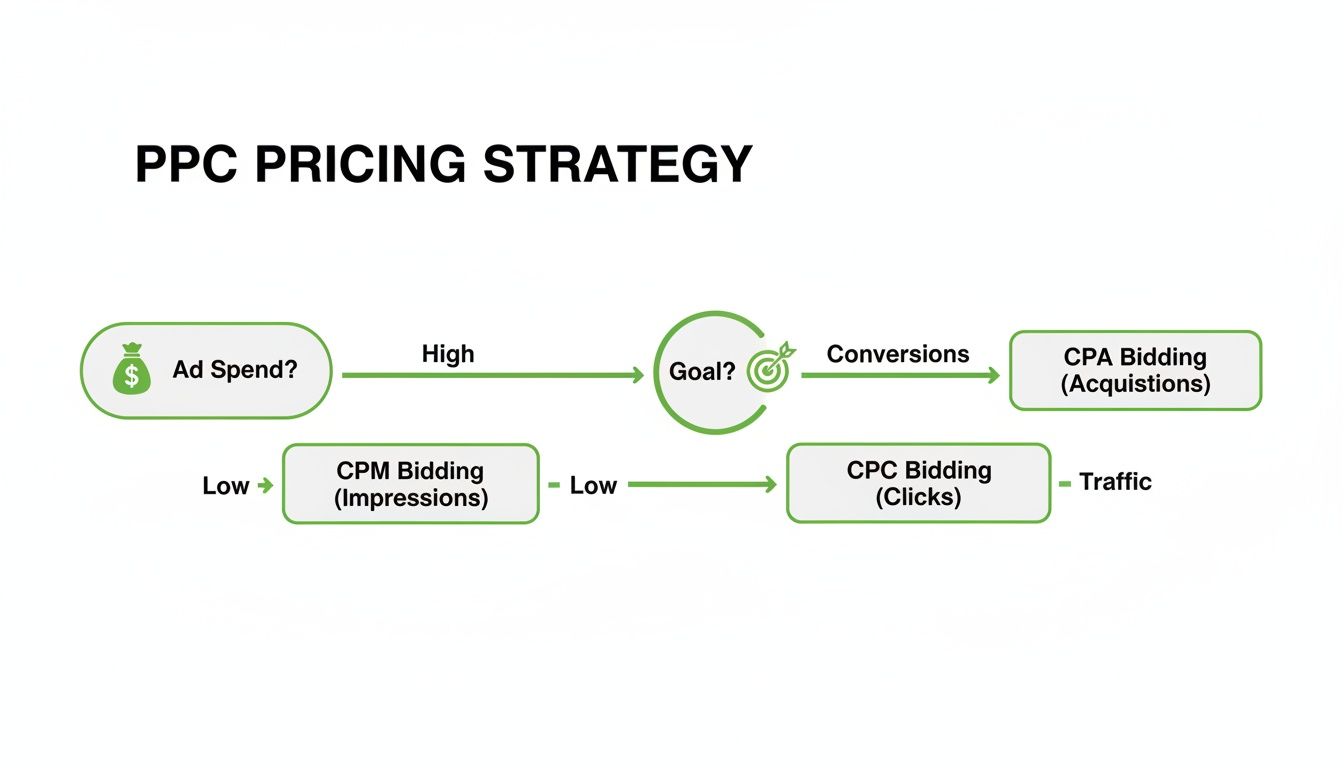
Ultimately, the infographic shows that as your ad spend and complexity increase, pricing models shift from simple flat fees to more aligned, percentage-based structures.
Setting realistic PPC performance benchmarks
Paying someone a hefty management fee is completely pointless if you don't know what 'good' actually looks like. Let's ground ourselves in reality with some hard numbers, because your gut feeling isn’t a KPI.
What’s a decent Cost-Per-Click (CPC) or Return On Ad Spend (ROAS)? Spoiler: it varies wildly by industry.
But that doesn't mean we're flying blind. There are established benchmarks we can use as a North Star. This context is everything—it’s how you set realistic expectations, hold your agency accountable, and ensure your pay per click management pricing is actually tied to tangible returns.
What the data tells us
Let's look at some real-world numbers to get started. Across all industries, Google Ads benchmarks show an average cost-per-click of around $2.69 for search ads and a much lower $0.63 for display ads. This makes sense; search ads capture active, high-intent searches, while display is more about building awareness.
Of course, that average hides a ton of detail. When you drill down, you see the story change. B2B keywords might average $3.33, but some consumer services can jump to $6.40. Paired with an average click-through rate (CTR) of about 3.17%, the average cost-per-acquisition (CPA) on search hovers around $48.96. These figures aren't just trivia; they are your baseline for asking the right questions.
If you want to dig deeper, you can find more PPC industry statistics on SixthCityMarketing.com.
Your industry is your battleground
The single most critical piece of the puzzle is your industry. Your niche dictates the CPCs, the competition, and what a 'win' actually looks like. If your cost-per-click is double the overall average, you need to know why. Is it a flawed strategy, or are you just fighting it out in a brutal space like law or insurance, where single clicks can cost over $100?
A great manager in a hyper-competitive market might deliver a CPA that looks terrible on paper but is actually outperforming the competition by 20%. Conversely, a manager in a niche market with a 'good' CPA might actually be leaving a ton of money on the table.
Here’s a practical way to think about it:
- High-Competition Industries (Law, Finance, Insurance): Expect sky-high CPCs. Success here isn’t about cheap clicks; it’s about ruthlessly optimizing for high-value conversions. A single client can be worth thousands, easily justifying the spend.
- E-commerce & Retail: The game here is all about ROAS. You have to constantly balance your ad spend against your average order value and customer lifetime value. A 4:1 ROAS (meaning $4 in revenue for every $1 spent) is often a solid target to shoot for.
- B2B & SaaS: The sales cycle is long and complicated. Your key metrics might be cost-per-demo or cost-per-qualified-lead. PPC is just the first step in a much longer conversion funnel, not the finish line.
Understanding these nuances is vital. It also throws a spotlight on the importance of precise tracking. If you aren't measuring conversions accurately, you're just guessing.
For a step-by-step walkthrough, check out our guide on the essentials of a proper Google Ads conversion tracking setup. Without it, you can't calculate your true ROI, and you can't hold anyone accountable for performance.
Google Ads performance benchmarks by industry
To give you a clearer picture, here’s a comparative look at key PPC metrics across different industries. Use this data to help you set realistic performance goals for your own campaigns.
| Industry | Average CPC (Search) | Average CTR (Search) | Average Conversion Rate (Search) |
|---|---|---|---|
| Advocacy | $1.43 | 6.64% | 1.96% |
| Auto | $2.46 | 4.00% | 6.03% |
| B2B | $3.33 | 2.41% | 3.04% |
| Consumer Services | $6.40 | 2.69% | 6.64% |
| Dating & Personals | $2.78 | 6.05% | 9.64% |
| E-Commerce | $1.16 | 2.69% | 2.81% |
| Education | $2.40 | 3.78% | 3.39% |
| Employment Services | $2.04 | 2.42% | 5.13% |
| Finance & Insurance | $3.44 | 2.91% | 5.10% |
| Health & Medical | $2.62 | 3.27% | 3.36% |
| Home Goods | $2.94 | 2.44% | 2.70% |
| Industrial Services | $2.56 | 2.61% | 3.37% |
| Legal | $6.75 | 2.93% | 6.98% |
| Real Estate | $2.37 | 3.71% | 2.47% |
| Technology | $3.52 | 2.09% | 2.92% |
| Travel & Hospitality | $1.53 | 4.68% | 3.55% |
(Source: Data compiled from WordStream industry benchmarks)
As you can see, the numbers are all over the map. An e-commerce store aiming for a legal firm's conversion rate is going to be disappointed, just as a lawyer expecting e-commerce CPCs is in for a shock. Context is king.
Why automation is the future, not inflated fees
Here’s my big-picture take, founder to founder: the old-school agency model for PPC management is on its last legs, and that's a huge win for businesses like ours. For years, we've been paying a premium for manual, repetitive work that felt necessary but was wildly inefficient. Think about the countless hours agencies billed for keyword research, painstaking bid adjustments, and writing a handful of ads. That era is over. 💀

AI and automation platforms are rewriting the entire playbook. This shift is completely flipping the conversation around pay per click management pricing. The value is no longer in the manual labor; it's in the strategy that guides the machine.
The shift from labor to strategy
Why would you pay a human thousands of euros to manually create 20 ad variations when an AI can generate and test 2,000 in minutes, each tailored to a specific audience? It’s a trick question. You wouldn't.
The real value now lies in the high-level thinking that machines can't replicate (at least, not yet). Smart platforms handle the grunt work, freeing up marketers—whether they're in-house or at an agency—to focus on what actually moves the needle.
- Creative Direction: A machine can write 1,000 headlines, but it can’t come up with a truly disruptive creative angle that hits on your market’s deepest pain points. That's a human job.
- Customer Psychology: AI analyzes data to see what works, but understanding why a certain message connects with a customer requires genuine empathy and insight.
- High-Level Strategy: Defining your growth plan, spotting new market opportunities, and weaving PPC into your broader business goals is where the best human minds should be spending their time.
This transition means you should be paying for strategic oversight, not for someone to click around in the Google Ads interface. If an agency's pitch still revolves around the hours they spend on manual tasks, they’re already a dinosaur.
Achieving enterprise results without the price tag
This technological leap is the great equalizer. It means lean, ambitious teams can now achieve enterprise-level results without the suffocating enterprise price tag. The old model required an army of analysts to manage complex, large-scale accounts. Today, a single smart marketer armed with the right automation platform can outmaneuver a giant, slow-moving competitor.
We’re moving toward a future where technology empowers small teams to punch far above their weight. The advantage is no longer about who has the biggest budget, but who has the smartest tech stack and the clearest strategy.
This new reality puts growth within reach for everyone. You don't need a $10,000 monthly retainer to access sophisticated campaign structures and optimization anymore. The tools are more accessible than ever, and they’re getting smarter by the day. For a closer look at the platforms making this happen, exploring different Google Ads optimization tools is a great place to start.
What this means for your budget
So, how does this all impact your search for the right management partner or platform? It simplifies things dramatically. Instead of poring over timesheets and labor hours, you should be focused on outcomes and the technology that drives them.
When you're evaluating your options, cut to the chase with these questions:
- How are you using automation to make my budget work smarter?
- What percentage of your team's time is spent on strategy versus manual execution?
- Which specific tasks are automated, and which ones require a human touch?
The answers will tell you if you’re talking to a partner of the future or a relic of the past. Your goal is to invest in a system—a smart blend of human expertise and machine efficiency—that delivers a clear, measurable return. The days of paying inflated fees for busywork are thankfully behind us. Welcome to the future. 🚀
Questions to ask before you sign any contract
So, you've narrowed it down and you're ready to hire someone. Fantastic. But hold on—don't sign a single document until you've done your due diligence. This is the moment you separate the true growth partners from the glorified invoice-senders. Their answers to a few sharp questions will tell you everything you need to know.
Think of this as a pre-flight check for your marketing budget. Skipping it is just asking for a crash landing. I've been there, and the headaches and wasted cash aren't worth it. Here's my personal, non-negotiable checklist to vet any PPC agency or freelancer.
Ownership and strategy
First things first, let’s talk about the fundamentals. The answers here are about control and intellectual property. Get these wrong, and you could be starting from scratch if you ever decide to part ways. It's a dumb position to be in, and it's completely avoidable.
- Who owns the ad account? This is a deal-breaker. The answer must be you. If they build the account under their own MCC (My Client Center), that's fine, but you must have full admin access and ownership. You are paying for the data and the campaign history—don't let anyone hold it hostage.
- What is your process for initial strategy and research? Listen for terms like 'audience analysis,' 'competitor research,' and 'conversion tracking setup.' A good partner will spend significant time understanding your business before a single ad goes live. A bad one will just ask for your credit card and start spraying keywords.
- How do you measure success beyond clicks and impressions? This is where you find out if they're a strategist or just a button-pusher. They should be talking about Cost Per Acquisition (CPA), Return On Ad Spend (ROAS), lead quality, and customer lifetime value. If their answer revolves around vanity metrics, run.
Communication and reporting
Next up is understanding how you’ll work together. A lack of transparency here is a massive red flag. You're not just buying clicks; you're paying for expertise and communication. You need a partner who can articulate what they're doing, why they're doing it, and what the results are in plain language. The quality of their reporting is a direct reflection of the quality of their work. If the reports are vague, automated data dumps, you can bet the work they're doing on your account is just as lazy. Their answers should give you confidence that you'll always know where your money is going and what it's achieving.
Long-term partnership and growth
Finally, you need to understand their vision for the future. Are they thinking about your growth six months or a year from now, or just about hitting next month's numbers? The best partners act like an extension of your own team. They're proactive, they bring new ideas to the table, and they're genuinely invested in your success.
- What does your optimization cadence look like? 'We check it every so often' is not an answer. A pro will talk about weekly bid adjustments, monthly creative testing, and quarterly strategic reviews. They should have a clear, repeatable process for continuous improvement.
- How do you handle underperforming campaigns? Everyone has campaigns that don't work out. The difference is how they react. Do they hide the bad news, or do they proactively bring it to you with a plan to fix it? You want a partner who owns their failures and learns from them, not one who pretends they don't exist.
- What other services do you offer? Do they offer landing page design and optimization? A/B testing? Many specialized PPC managers focus solely on ads, which is fine, but it’s critical to know who is responsible for the post-click experience. Sending great traffic to a terrible landing page is like pouring expensive champagne down the drain.
Asking these questions upfront sets the foundation for a healthy, productive partnership and protects you from signing a contract you'll regret.
Common questions about PPC management
Alright, let's talk about the questions that always come up when founders start looking at pay-per-click management pricing. It’s usually the same handful of concerns, the same gray areas.
Let's cut through the noise with some straight answers so you can make a smarter call. No fluff.
What is a fair percentage for PPC management?
A fair percentage of ad spend for PPC management almost always lands between 12% and 20%.
If you’re working with a newer agency or have a smaller budget, expect it to be closer to 20%. For massive ad spends—think over €50k a month—an established agency might drop their rate to 10-12%.
Be wary of the extremes. Anything over 25% should raise a serious red flag, unless it includes a whole suite of extra services like extensive creative work or landing page development. On the other end, anything below 10% is suspiciously cheap. It probably means your account will be an afterthought, getting zero strategic attention.
The real test is value. Does the fee actually justify the results and brainpower they bring to the table?
Can I just manage my Google Ads myself to save money?
You can, but the real question is should you?
If you have a tiny budget, a very simple product, and an abundance of free time to learn, it can be a decent starting point. Go for it.
But let’s be real. Managing PPC effectively is a full-time discipline, not a side project. The platforms are insanely complex and change constantly. It's incredibly easy to burn through your entire budget on the wrong keywords, sloppy targeting, or a badly structured campaign. Often, the money you 'save' on a management fee is lost many times over in wasted ad spend. A good manager should save you more than their fee costs through sheer efficiency and better results. Your time as a founder also has a cost—is it best spent here?
How long does it take to see results from PPC?
Anyone who promises you immediate, mind-blowing results is selling you a fantasy. 🔮 PPC is not a magic button you press for instant revenue.
It takes time to gather data, test what you think you know, and optimize based on what the market is actually telling you. You should mentally commit to a 90-day ramp-up period.
Here’s what that timeline usually looks like:
- First 30 Days: This is all about setup, deep research, and launching the initial campaigns. You’re just gathering baseline data.
- Days 31-60: Now you have some early data to work with. The focus shifts to analysis and making the first round of meaningful optimizations—killing what isn't working and doubling down on what is.
- By Day 90: You should have a clear, data-backed picture of performance. You should be seeing a stable, positive trend in your key metrics, like cost-per-acquisition or return on ad spend.
Patience is the name of the game. Sustainable growth is built on solid data, not overnight hacks.
Should a management fee include landing page creation?
This is a critical question to ask upfront, and the answer depends entirely on the agreement.
Frankly, sending paid traffic to a generic homepage is one of the dumbest and most common mistakes in PPC. It’s just lazy. The ad and the landing page must be perfectly aligned to have any hope of converting well.
Some agencies include landing page optimization or creation in their standard fee, while others will charge for it as a separate, add-on service. Neither approach is wrong, but you absolutely need to clarify it before signing anything.
A manager who ignores what happens after the click isn't managing the full funnel. And you'll be the one paying the price in the form of terrible conversion rates.
Ready to stop paying for manual work and start investing in strategic automation? At dynares, we built the AI platform that lets you scale your Google Ads with precision, generating thousands of hyper-relevant ads and landing pages automatically. Stop wasting budget and start driving real results. See how dynares works.


