
Let’s get straight to it. Most landing pages are digital dead ends. You pour a fortune into Google Ads, drive all this traffic, and then… crickets.
A truly high-converting landing page isn't about flashy design. It's a precision-engineered tool built for one purpose—turning a click into a customer.
Your landing page is probably a leaky bucket
It’s a brutal truth, but someone has to say it. The reason your paid campaigns feel like you're burning cash isn't because Google Ads doesn't work. It's because your landing page is a leaky bucket. You're paying good money for every single click, only to watch that potential revenue spill out onto the floor.
This happens for a few dumb, but fixable, reasons. Maybe the page fails to match the ad's promise. Or the message is so generic it speaks to no one. Often, the user experience just feels like a complete afterthought. It's a disconnect that absolutely kills conversions and makes your cost per acquisition skyrocket.
We're going to break down how to stop this waste and start building landing pages that actually work. Before diving into the tactical fixes, it helps to get grounded in the fundamentals of What Makes a Good Landing Page. This isn't theoretical marketing fluff; it's a practical playbook for building pages that respect user intent and, more importantly, your budget.
The massive gap between average and awesome
The performance gap between a generic page and an optimized one is staggering. We're not talking about a few percentage points here. Businesses that get strategic about their landing pages can see conversion rates hit anywhere from 21% to 50%, completely blowing the industry average of 2.35% out of the water.
This proves that a well-crafted landing page isn't just an incremental improvement—it's a massive competitive advantage.
The data is clear: more is more. Companies with 21 to 40 dedicated landing pages see nearly a 300% increase in conversions compared to those with just a handful. Each page acts as a targeted entry point for a specific audience and intent.
This playbook is about building the frameworks that separate the pages that convert from the ones that just cost you money. Let's fix that leaky bucket. 🪣
Nail the messaging before you write a single line of code
Most landing pages fail long before a designer ever touches them.
It's not the layout, the button color, or the slick animations that kill conversions. It’s the message. It's the jargon-filled, self-important copy that makes a potential customer’s eyes glaze over.
If someone lands on your page and can't immediately figure out what you do and why they should care, you've already lost. You just paid Google for a bounce.

This is about radical clarity. Your internal corporate-speak is poison here. Nobody cares about your synergistic solutions or paradigm-shifting platforms. They have a problem. They’re looking for a straight answer. A converting landing page gives them that answer without making them work for it.
The goal isn't to be clever; it's to make their decision to convert feel like the most obvious, logical next step in the world. This is commercial engineering, not art class.
Your user's three burning questions
When someone clicks your ad, a stopwatch starts. You have maybe three seconds to answer the silent questions firing off in their brain before they hit the back button.
Your entire above the fold section—everything visible without scrolling—has one job: answer these three things instantly.
- What is this? Can they immediately grasp your offer? A headline like Enterprise-Grade Asset Management is garbage. Try Track Your Company's Laptops and Phones in 5 Minutes. One is corporate fluff; the other is a clear solution.
- How does it solve my problem? They clicked because they have a pain point. Don't just list your features. Show them the after state. Connect your product directly to their relief.
- What do I do next? Is there one, big, unmissable call-to-action? If they have to hunt for the button or wonder what happens when they click it, you've introduced friction. Friction kills conversions.
Anything on your page that doesn't help answer these questions is noise. And on a landing page, noise is the enemy.
People don’t read websites; they scan them. The F-pattern is a well-documented eye-tracking phenomenon where users scan in a pattern resembling the letter F—across the top, then down the left side. Your most critical information absolutely must live in these zones.
This means you put your value proposition, your most compelling benefits, and your primary CTA right where their eyes are already going. Don't try to reinvent the wheel with some avant-garde layout. Just give people what they need, where they expect to find it.
Creating the scent trail
Think of the journey from your ad to your landing page as a scent trail. The ad makes a promise, and the landing page must instantly deliver on it.
If your Google Ad promises a Free SEO Audit Tool, the headline on your landing page better be some variation of Get Your Free SEO Audit in 60 Seconds. Any disconnect, any mismatch, and the trail goes cold.
That tiny moment of cognitive dissonance—wait, is this the right place?—is often all it takes to lose a customer for good.
Here’s how to keep the trail hot:
- Mirror the ad's headline: Your H1 on the landing page should be a direct echo or a logical extension of the ad they just clicked. No surprises.
- Use consistent keywords: The main keywords from your ad group need to be front and center in your headline, subheadings, and body copy. This is as much for the user's confidence as it is for Google's Quality Score.
- Maintain visual consistency: If your ad creative uses a specific color or image, echoing that on the landing page is a subtle but powerful signal of continuity.
This isn’t about tricking anyone. It’s about reassurance. You’re confirming they made a good click and are exactly where they need to be. Building a truly converting landing page is about building trust, one consistent message at a time. Respect their intent, guide them to the solution you promised, and you’ll turn clicks into customers.
Design CTAs and forms that don’t kill conversions
Let's talk about the final moment of truth. You’ve nailed the messaging, the layout is clean, and the user is nodding along, ready to act. Then they see your call-to-action button: a sad, grey rectangle that just says Submit.
That one lazy word can undo all your hard work. It’s the digital equivalent of a limp handshake.
Your CTA button isn't just a button; it's the trigger. It’s the final payoff for the entire page's promise. Using a generic word like Submit is totally uninspiring and focuses on what the user is giving up (their data), not what they’re getting. The copy has to reinforce the value and create momentum, not friction.
Make your CTA a value statement
Think about the psychology here. You want the user to feel like they are gaining something, not just completing a task for you. Your button copy should be the finale of your value proposition.
Instead of a CTA that feels like an obligation, frame it as a clear benefit:
- Instead of Submit, try Get My Free Demo.
- Instead of Download, try Download the Playbook.
- Instead of Sign Up, try Claim My Spot.
See the difference? The first set is passive and weak. The second is active, personal, and puts the focus squarely on the reward. It completes the sentence I want to... for the user, making the click feel like their own idea. Small change, huge impact.
The relationship between page design elements and conversion success is very real. Pages with just one clear link or action convert at 13.5%, while pages cluttered with five or more links see that number drop to 10.5%. Every extra choice you offer is another opportunity for them to leave. You can discover more insights about these landing page stats and see how simplicity wins.
This principle of reducing friction is even more critical when we get to the form itself.
The form is your enemy (so keep it small)
Here's a universal truth: nobody wants to fill out your form. Every single field you add is another reason for a user to abandon the page. It's a direct tax on their time and patience. Your job is to make this process as painless as humanly possible.
Be ruthless about every field you ask for. Does your sales team really need to know their company size and annual revenue right now, or can that wait for a follow-up call? Often, all you truly need is an email address to start the conversation. The rest is just nice-to-have data that kills your conversion rate.
This is where a thoughtful approach to designing better lead capture forms becomes a massive lever for growth. The less you ask for, the more you get.
For more complex offers where you genuinely need more information, multi-step forms are a brilliant solution. They break down a long, intimidating form into smaller, manageable chunks. The user commits to the first step (like entering their email), and thanks to the sunk cost fallacy, they're much more likely to complete the subsequent steps. It feels less like an interrogation and more like a conversation.
Ultimately, great form and CTA design is about empathy. It's about respecting the user's time and making them feel confident in their decision.
Finally, use microcopy and social proof around your form to reduce anxiety. A simple line like We hate spam too under the email field or a small testimonial next to the CTA can provide the final nudge of confidence a user needs to convert. Making this final step on your converting landing page feel effortless and safe isn't just good design; it’s smart business.
If you're not tracking this, you're flying blind
Data is your co-pilot. Without it, you're just guessing. You might as well be throwing money into a bonfire and hoping a customer walks out of the flames. It’s that dumb.
Most people stop after installing a basic Google Analytics tag and call it a day. That’s table stakes. If all you’re tracking is page views, you have absolutely no idea what’s actually working. You're flying completely blind, making decisions based on feelings and vanity metrics.
Real performance marketing starts when you track what actually matters. That means getting your hands dirty with event tracking to understand how people are interacting with your page before they hit submit.
Beyond the basic page view
You need to know more than just someone visited. You need to know if they were engaged. Did they scroll? Did they hesitate over the form? Did they click the button but abandon the next step? This is the data that tells the real story.
Setting up event tracking is non-negotiable. It allows you to see the micro-conversions that lead to the big win. For a deeper dive, our guide on how to use Google Tag Manager can walk you through the practical setup.
Don’t just measure the final conversion; measure the journey. The moments of hesitation, the clicks on the wrong thing, the scroll that stops short—that's where your biggest opportunities for optimization are hiding.
This granular data is your feedback loop. It turns your landing page from a static brochure into a dynamic system you can actively improve.
The real game-changer Google Ads doesn’t talk about
Here’s the part that separates the amateurs from the pros: uploading conversion values back into Google Ads. It’s shocking how few people do this, and it’s a colossal mistake.
When you only track a lead as a binary event—you got one, or you didn't—you're telling Google’s algorithm that every single lead is worth the same. A student downloading a whitepaper is treated the same as a Fortune 500 CEO requesting a demo. That’s just insane.
The process flow below shows the ideal journey for a CTA, moving from a vague ask to a clear value exchange that drives a conversion.
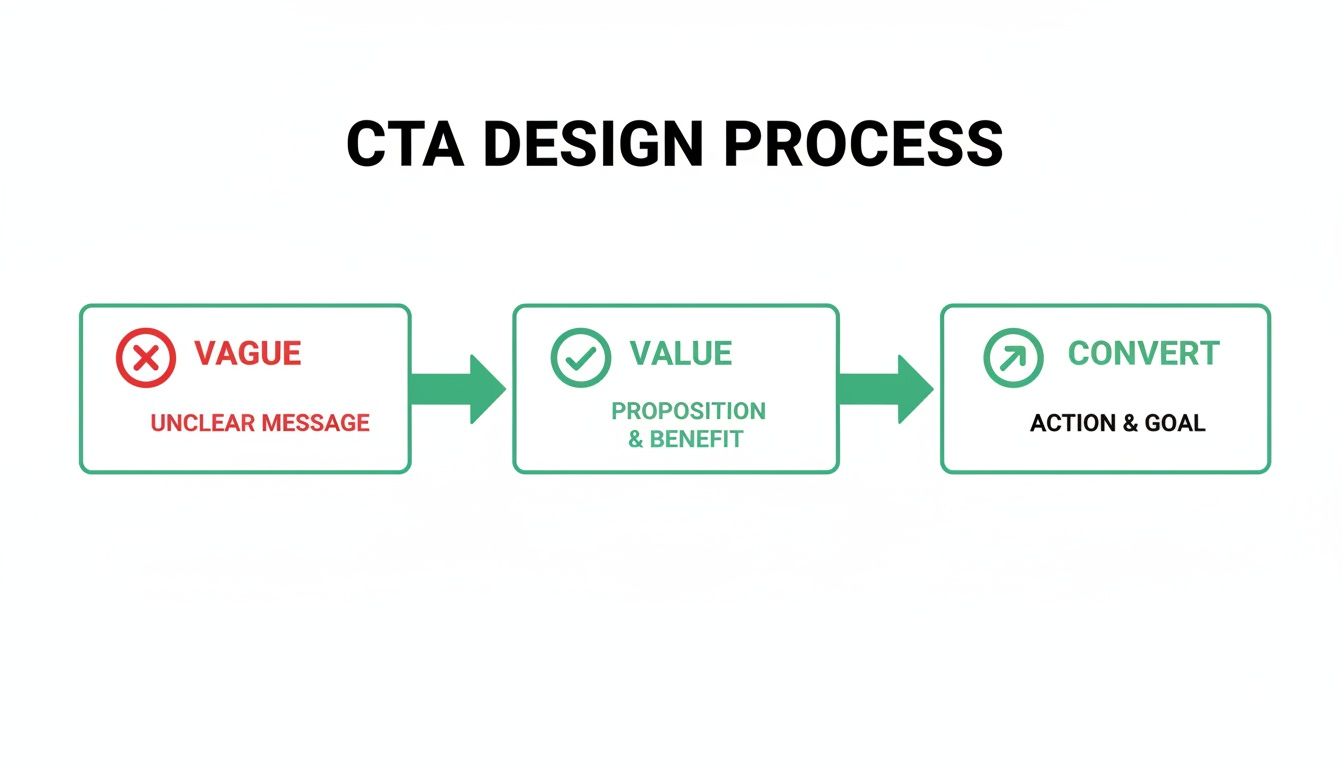
This visualization highlights how clarity directly leads to action, which is precisely what you need to track.
By assigning a monetary value to different types of conversions (e.g., a newsletter signup is worth €5, a demo request is worth €500) and uploading that data back to Google, you give the algorithm something to truly optimize for: revenue.
Suddenly, Google’s machine learning starts working for you. It learns which keywords, ads, and audiences are driving your most valuable customers, not just the cheapest clicks. This shifts your focus from a low Cost Per Lead to a high Return On Ad Spend (ROAS), which is the only metric that actually pays the bills. Understanding traffic sources like Pay Per Click Advertising is crucial for tracking this effectively.
Stop flying blind. Start tracking what moves the needle, feed that intelligence back into your ad platform, and let the algorithm chase profit, not just clicks. That’s how you build a real, scalable growth engine.
A/B testing that actually moves the needle
Let's be real. Most A/B testing is a complete waste of time.
I’ve seen marketing teams burn weeks arguing over changing a button from blue to green, clinging to the hope of some mythical conversion lift. That’s not a strategy; it's a distraction. It's just tinkering at the edges while the real problems go completely ignored.
If you want to build a landing page that actually converts, you have to stop playing so small. Real progress doesn't come from tiny tweaks. It comes from making big, bold swings based on actual hypotheses about what your customer truly wants.
So forget the button color. Start thinking about the entire message.
The goal here isn't to chase a 0.5% lift that might just be statistical noise anyway. The goal is to create a systematic process of learning. Each test should give you a genuine insight into your customer's mindset, helping you build smarter, better pages over the long haul.
Stop testing colors, start testing concepts
Your first few tests should never be about minor design elements. Ever. They should be about the core pillars of your page: the headline, the value proposition, and the offer itself. These are the things that cause massive shifts in performance, not the shade of your CTA button.
A great testing plan starts with a strong hypothesis. Don't just say, let's test a new headline. A proper hypothesis sounds more like this: We believe our current headline is too focused on features. By testing a new headline that focuses on the primary benefit of saving time, we predict we will increase demo requests by 15% because our target audience is time-poor.
See the difference? That structure forces you to justify the test and define what success actually looks like.
These kinds of tests give you clear, actionable learnings about what truly motivates your audience. You can find more ideas in our detailed guide on the fundamentals of split-testing landing pages.
How to prioritize your tests for maximum impact
You can't test everything at once, so you need a framework for deciding what to tackle first. I use a simple matrix based on two factors: potential impact and ease of implementation.
Focus on the high-impact, easy-to-implement ideas first. Changing a headline is easy and can have a massive impact. Redesigning your entire brand's visual identity? That's hard, and the impact is a lot less certain.
Don’t call a test after a handful of visitors. Statistical significance is crucial. If you make a decision based on 100 visitors, you're essentially flipping a coin. You need enough data to be confident that the results aren't just random chance.
The median landing page conversion rate hit 6.6% in late 2024, but that number hides a lot of variation. B2B pages are averaging a strong 13.3%, while top-tier lead generation pages—the kind dynares users aim for—are converting above 11%. These are the benchmarks you're chasing with smart testing. You can discover more insights about these landing page stats to see where you stand.
True optimization is a marathon, not a sprint. Be patient, gather enough data, and focus on tests that teach you something meaningful. That’s how you build a converting landing page that consistently drives real business results.
Scale your wins with templates and automation
So you’ve built one great, high-converting landing page. Fantastic. Now, how do you build a hundred without losing your mind or your budget?
This is the point where manual processes completely fall apart. You simply can't scale excellence by brute force. You need systems. It's all about turning your winning formula into a reusable, scalable playbook.
It starts with creating modular landing page templates. Think of them like Lego bricks for your marketing. You have pre-built, optimized sections—a headline block, a features grid, a testimonial slider—that can be quickly assembled and tweaked for different campaigns and offers. This approach keeps your brand tight while giving you the speed to launch new pages in hours, not weeks.
From templates to true automation
Templates are a solid first step, but the real leap forward is automation. Manually adapting templates for hundreds of different ad groups is still a tedious, soul-crushing job. It’s where human error creeps in and momentum dies.
This is where you need to let the machines do the heavy lifting. Platforms like dynares can take this a massive step further, automatically generating thousands of keyword-matched, high-intent landing pages from a single set of brand guidelines. It’s a totally different way of thinking about scale.
This isn't about replacing marketers with robots. It’s about giving them superpowers to execute at a scale that was previously impossible, ensuring every single ad click lands on a perfectly relevant page.
Imagine running a campaign with 5,000 keywords. Instead of pointing them all to one or two generic pages, an automated system can create 5,000 unique landing pages. Each page’s headline, copy, and imagery is perfectly matched to the user’s search query. This level of relevance is what drives Quality Scores through the roof and conversion rates with them.
Building your automated growth engine
Getting started with this kind of system is more straightforward than it sounds. The core idea is to create a master blueprint that the automation can use to build everything else.
This approach transforms your landing page strategy from a one-off creative exercise into a scalable, data-driven system. If you want to see how this translates into a tangible structure, you can learn more about building a powerful lead generation landing page template that’s built for this kind of scale.
Stop thinking page by page. Start thinking in systems. That’s how you win.
A few final questions we always get
Alright, let’s wrap this up by tackling a few common questions that always seem to pop up. Building a landing page that truly converts is a process, and it's easy to get stuck on the details. Let's clear the air on some of the big ones.
So, how long should my landing page be?
There’s no magic word count. A landing page should be as long as it needs to be to make a convincing argument, and not a single word longer. The real answer comes down to the complexity of your offer and how much you're asking from the user.
For a simple, low-friction ask (like a newsletter signup), keep it brutally short. Give them the value proposition and the form. That's it. For a complex, high-commitment offer (like buying expensive software or booking a paid consult), you're going to need more copy. You have more objections to handle, more trust to build, and more proof to show.
The goal isn't length; it's persuasion. Don't be afraid of a long page if every section serves the core purpose of getting that conversion. If a section doesn't help, kill it.
Should I put a video on my landing page?
Maybe. Look, a video can be an incredible conversion tool, but it can also be a massive distraction. A sharp, well-produced video that nails your value prop in seconds can seriously lift conversions—some studies show by over 80%. It’s a great way to show, not just tell.
But a bad video is worse than no video at all. A long, boring, or low-quality video will just torpedo your page load speed and send people scrambling for the back button.
If you use video, make it the star of the show. Keep it short (under 90 seconds), get to the point immediately, and make sure it auto-plays on mute with clear captions.
Do I really need a unique landing page for every ad group?
Yes. One hundred percent, yes. This isn’t a nice-to-have.
Sending all your traffic—from dozens of different ad groups with wildly different user intents—to one generic landing page is one of the most common and expensive mistakes you can make in PPC.
Message match is everything. When someone clicks an ad for emergency plumbing services, they need to land on a page that screams Emergency Plumbing Services, not your generic homepage. This level of relevance is exactly what boosts your Quality Score, lowers your CPC, and actually converts the click. For serious performance, it's non-negotiable.
At dynares, we believe scaling this level of relevance shouldn't be a manual nightmare. Our platform automatically generates thousands of high-intent, keyword-matched landing pages from a single set of brand guidelines, giving your campaigns the precision they need to win. Stop building pages one by one and start building a scalable growth engine.


